
Minimum wage amendment Act 2025 Sri Lanka: Act No. 11 explained
What Act No. 11 of 2025 changed: two new wage floors, the end of the separate BRA, the no-offset rule and the penalty that still sits in the 2016 Act.
On this page
Last verified against the primary sources on 21 October 2026.
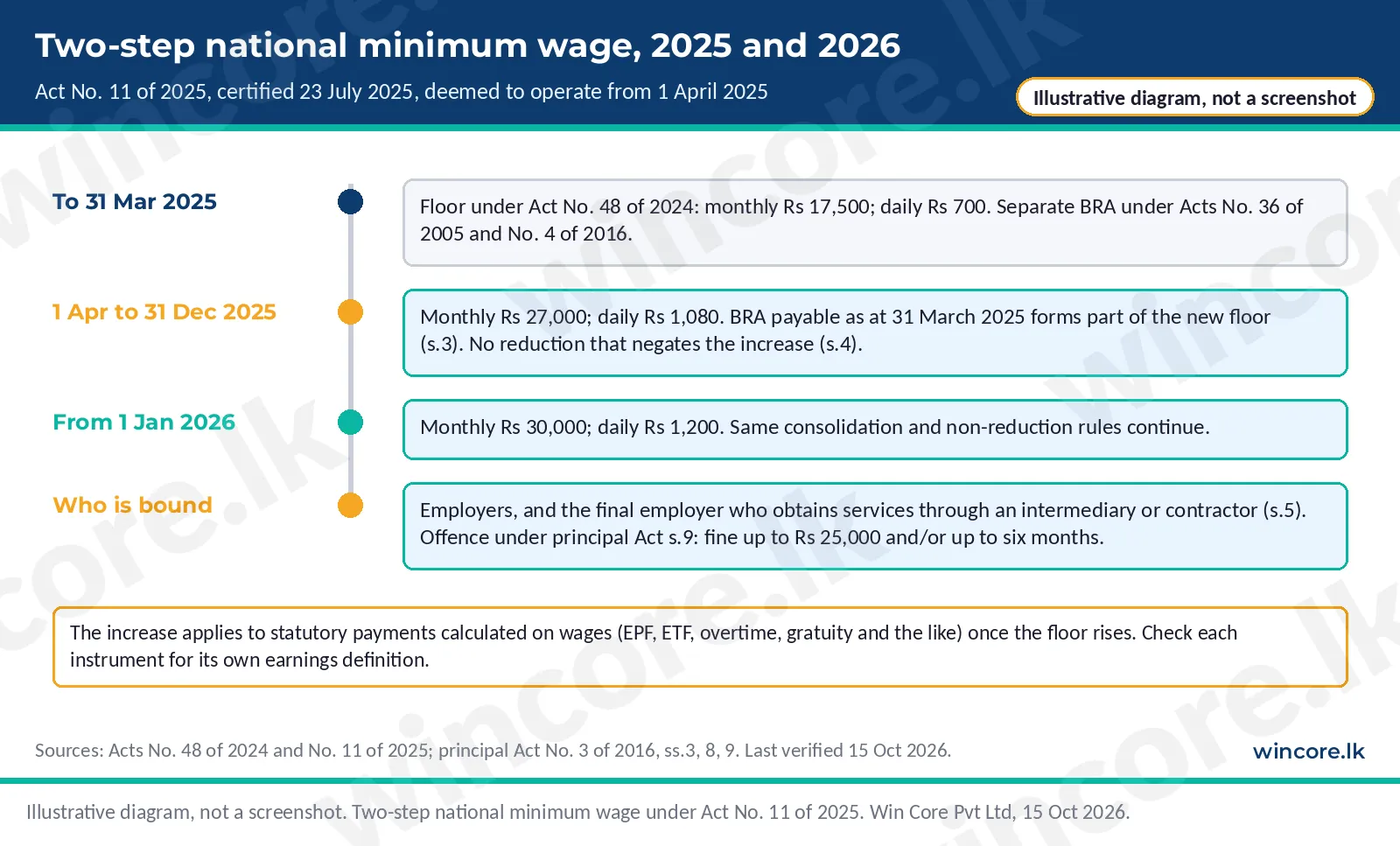
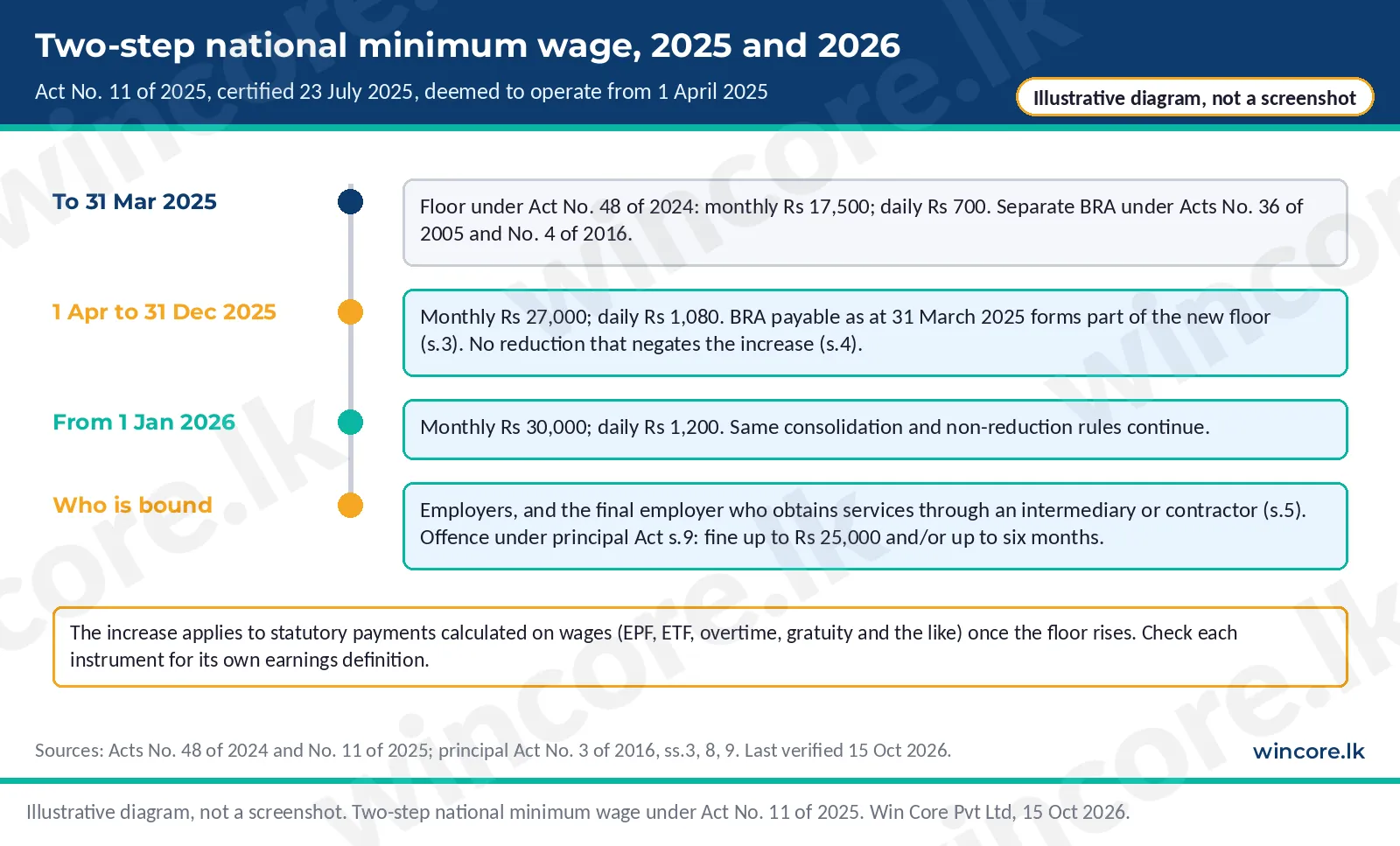
The minimum wage amendment Act 2025 in Sri Lanka is the National Minimum Wage of Workers (Amendment) Act, No. 11 of 2025. Certified on 23 July 2025 but deemed to operate from 1 April 2025, it set the national minimum wage at Rs 27,000 a month (Rs 1,080 a day) from 1 April to 31 December 2025, and Rs 30,000 a month (Rs 1,200 a day) from 1 January 2026 [1]. It also folded the budgetary relief allowances payable on 31 March 2025 into that floor and barred cuts that undo the increase.
This is a Regulation Desk note on the instrument itself: what the Act says, clause by clause, and what changed on which date. For the evergreen guide to paying the minimum wage, Wages Boards and overtime, read our minimum wage guide for 2026. Nothing here changes a figure in that guide.
Think of the floor as the plinth under a building. Raising it does not move the rooms, but anything measured from the plinth has to be measured again.
Act No. 11 of 2025 is six sections, and the penalty is not one of them
Act No. 11 of 2025 amends section 3 of the National Minimum Wage of Workers Act, No. 3 of 2016 (the principal Act) [1]. Its six sections do four things:
| Section | What it does |
|---|---|
| s.1 | Short title; deemed operation from 1 April 2025 |
| s.2 | Replaces s.3(1) of the principal Act with the two new floors |
| s.3 | Declares that budgetary relief allowances payable at 31 March 2025 form part of the floor |
| s.4 | Bars a reduction of wages or allowances that would negate the increase |
| s.5 | Directs the Commissioner-General to issue implementation directives, including to final employers using contractors |
| s.6 | Sinhala text prevails over the Tamil text if they are inconsistent |
There is no new offence section. Offences, penalties and recovery still come from the principal Act [2].
Two companion Acts were certified on the same day. The Budgetary Relief Allowance of Workers (Amendment) Acts, No. 9 and No. 10 of 2025, also deemed to operate from 1 April 2025, close the allowance periods under the 2005 and 2016 BRA Acts on 31 March 2025 [5] [6]. Read together, the three Acts move the allowance inside the wage rather than abolishing the money.
The minimum wage amendment Act 2025 set two floors on two dates
Section 2 repeals section 3(1) of the principal Act and substitutes [1]:
| Period | Monthly floor | Daily floor |
|---|---|---|
| Before 1 April 2025 (Act No. 48 of 2024) | Rs 17,500 | Rs 700 |
| 1 April to 31 December 2025 | Rs 27,000 | Rs 1,080 |
| From 1 January 2026 | Rs 30,000 | Rs 1,200 |
The earlier row comes from the National Minimum Wage of Workers (Amendment) Act, No. 48 of 2024 (certified 11 September 2024), which had replaced the Rs 12,500 and Rs 500 figures inserted by Act No. 16 of 2021 [4].
The daily figure is a figure in its own right. Rs 30,000 divided by 26 working days is Rs 1,153.85, which is below the Rs 1,200 daily floor the Act writes down, so a daily-rated worker is paid at least Rs 1,200 a day.
The printed English text opens the new subsection with "(l)" rather than "(1)". On our reading this is a typesetting slip. Section 6 does not settle it, because it ranks the Sinhala text over the Tamil text only and says nothing about the English print [1].
Who the floor binds, and who the principal Act leaves out
Section 3(2) of the principal Act says that "notwithstanding the provisions of any other written law, no employer in any industry or service shall pay to any worker employed by him a wage which is less than the national minimum monthly or daily wage" [2]. The definitions in section 14 decide the reach:
- "Worker" covers any person under a contract with an employer, expressed or implied, oral or written, including apprentices, but excludes apprenticeships under the Tertiary and Vocational Education Act No. 20 of 1990 and the Employment of Trainees (Private Sector) Act No. 8 of 1978, and excludes domestic servants [2].
- "Industry or service" excludes undertakings of a corporation or board where the Government holds a majority of the share capital, registered co-operative societies, religious institutions, and charitable institutions within the meaning of the Inland Revenue Act No. 10 of 2006 [2].
- "National minimum wage" is defined to include the contractual wage or Wages Board wage, and "wages or basic salary together with the cost of living allowance, special living allowance or any other similar allowance" [2].
So a statement that the floor binds "every employer" needs those exclusions beside it. Where a Wages Board decision for the trade sets a higher wage, the higher figure is the one to pay; our minimum wage guide covers that.
The budgetary relief allowance now sits inside the floor, not on top of it
Section 3 of Act No. 11 is an "avoidance of doubt" declaration [1]:
- (a) the budgetary relief allowances payable as at 31 March 2025 under the BRA Act No. 36 of 2005, the BRA Act No. 4 of 2016, "or both, shall form part of the national minimum monthly or daily wage specified in section 2"; and
- (b) where a worker's wage at 31 March 2025 already included those allowances, the wage shall, from commencement, "consolidate such allowances as part of such wage of such worker".
The Rs 27,000 and Rs 30,000 figures are therefore not meant to sit on top of a still-separate BRA. With Acts No. 9 and No. 10 of 2025 ending the allowance periods on 31 March 2025 [5] [6], a payslip that still shows a separate BRA line below a basic of less than Rs 30,000 is the first thing to fix.
Two anti-avoidance rules: no offsetting cuts, and directives to final employers
Section 4 stops an employer cutting other pay to fund the rise
Section 4: an employer "shall not reduce the monthly wage of any worker in any industry or service, including any allowances payable under" the principal Act or either BRA Act, "in a manner that would negate the increase made to the national minimum wage" by this Act [1].
Renaming a cut does not help. If an attendance allowance is withdrawn in the same month the basic goes up, and the worker ends up no better off, section 4 is engaged. On our reading the test is the effect on the worker's monthly wage, not the label the employer gives the change.
This sits beside section 4 of the principal Act, which is a different rule: a worker employed on 1 January 2016 keeps terms "not less favourable" than those enjoyed the day before the principal Act came into operation [2].
Section 5 reaches the final employer, but only through directives
Section 5 directs the Commissioner-General to issue directives "to any employer, including the final employer who obtains the services of any worker in any industry or service through an intermediary or contractor to take all necessary measures to ensure that the increase ... is duly implemented" [1].
That is a power to direct, not a new definition of "employer". Liability to pay the wage still follows the section 14 definition in the principal Act. In practice a company using a manpower contractor should expect to be asked to show that the contractor pays the floor, and should hold that evidence.
Which section punishes which default
The Amendment adds no penalty. The principal Act supplies it [2].
| Default | Section | Consequence |
|---|---|---|
| Paying less than the national minimum monthly or daily wage | s.3 read with s.9(1) | Fine not exceeding Rs 25,000, or imprisonment of either description up to six months, or both, on conviction by a Magistrate |
| Worsening the protected terms of a worker employed on 1 January 2016 | s.4 read with s.9(1) | Same |
| Failing to deposit the defaulted wage after a Commissioner-General notice | s.8 read with s.9(1) | Same; and the sum can be recovered through a Magistrate as if it were a fine (s.8(3)) |
| Obstructing inspection, refusing a register, false entries or returns, ignoring a s.6 direction | s.9(2) | Same fine or imprisonment, or both |
| Offence by a company, firm or other body | s.10 | Directors, general manager, secretary and similar officers deemed guilty unless they prove no consent or connivance and all due diligence |
| Starting a prosecution | s.11 | Only by or with the prior written sanction of the Commissioner-General |
Under section 8(2), once the notice arrives, paying the worker directly instead of depositing with the Commissioner-General is "not ... a valid payment" of the defaulted amount [2]. The certificate is conclusive as to the calculation (s.8(4)), the burden of proving payment is on the employer (s.8(5)), and the Prescription Ordinance does not apply to recovery (s.8(6)).
A breach of section 4 of the 2025 Amendment is not listed in section 9(1), which names sections 3, 4 and 8 of the principal Act. On our reading, a section 4 cut that takes pay below the floor is still caught by section 3; a cut that leaves pay above the floor may be pursued through the Commissioner-General's directive power rather than a prosecution. We keep that open below.
The floor moves EPF, ETF and other wage-linked payments
Once the floor rises, every payment computed on wages can move. On 13 October 2025 the Cabinet decision on implementing this Act said the increase "should be applicable to all statutory payments such as Employees' Provident Fund, Employers' Trust Fund, overtime, gratuity, maternity benefits and holiday payments" [3]. The Amendment itself does not rewrite the EPF or ETF Acts, which keep their own definitions of earnings.
At Rs 30,000 of earnings, EPF is Rs 2,400 from the employee and Rs 3,600 from the employer, and ETF is Rs 900, all due by the last day of the following month. Our sibling note on EPF and ETF contributions and the surcharge ladder sets out the due dates and the late-payment surcharge, and the EPF calculator and salary calculator run the numbers. Whether a given allowance is in the EPF base is a separate question, covered in our note on which allowances count for EPF and ETF. Gratuity also rides on the last wage; see our note on the Payment of Gratuity Act No. 12 of 1983.
A hypothetical check, worked through
Take an invented garment unit in Kurunegala. On 31 March 2025 a machine operator was paid a basic of Rs 14,000 plus Rs 3,500 of BRA, Rs 17,500 in all, the Act No. 48 floor.
- April 2025. The floor is Rs 27,000 with the BRA inside it. A payslip showing a basic of Rs 23,500 plus a BRA line of Rs 3,500 totals Rs 27,000 and meets the floor, but under section 3(b) the allowance should now be consolidated into the wage, so the payslip should show Rs 27,000 as wage.
- The same month, the unit withdraws a Rs 2,000 attendance bonus "to cover the rise". That is the cut section 4 targets.
- January 2026. The floor is Rs 30,000. EPF rises to Rs 2,400 (employee) and Rs 3,600 (employer); ETF to Rs 900.
- Wages Board check. A garment trade may have a Wages Board decision with a higher rate. If it does, that rate governs.
If the unit had stayed at Rs 27,000 into 2026, each worker would be short Rs 3,000 a month, and the Commissioner-General could issue a section 8 notice for the arrears.
What this means for you
If you employ workers covered by the principal Act, the floor was Rs 27,000 a month for April to December 2025 and is Rs 30,000 from 1 January 2026, with the BRA payable at 31 March 2025 inside that number. Cuts that undo the increase are barred. Check your 2025 payroll as well as your current one, because the Act reached back to 1 April 2025 although it was certified in July. Then re-run EPF, ETF, overtime and gratuity on the new base.
Our payroll services team runs this check monthly, and our HR compliance services cover the wage register and the contractor evidence.
Checklist: documents needed
- Payroll registers for April 2025 onward, showing basic, allowances and total for each worker
- Payslips for March 2025, showing the BRA then paid
- The wage register under s.5 of the principal Act, kept for six years
- Any Wages Board decision for your trade
- Contractor or manpower agency pay records for supplied workers
- EPF and ETF returns and payment receipts from January 2026
FAQ
What is the minimum wage in Sri Lanka from January 2026?
It is Rs 30,000 a month or Rs 1,200 a day under section 2(b) of Act No. 11 of 2025. A Wages Board decision for a particular trade may set a higher rate, and where it does the higher rate applies. The daily figure is fixed by the Act and is not found by dividing the monthly figure by 26.
When did the 2025 minimum wage increase take effect?
It took effect from 1 April 2025, although the Act was certified only on 23 July 2025. Section 1(2) deems it to have come into operation on 1 April 2025, so the Rs 27,000 floor applies to April, May and June 2025 too. Employers who paid below it in those months have arrears.
Is the budgetary relief allowance still paid on top of the minimum wage?
No, the allowances payable on 31 March 2025 now form part of the national minimum wage under section 3. Acts No. 9 and No. 10 of 2025 closed the separate allowance periods on 31 March 2025. A worker on the floor should see Rs 30,000 as wage, not a smaller basic plus a BRA line.
Can an employer cut an allowance to pay for the minimum wage increase?
Not where the cut would negate the increase, which section 4 of Act No. 11 forbids. The rule covers allowances under the principal Act and both BRA Acts. On our reading, renaming or withdrawing another payment in the same move is judged by its effect on the worker's monthly wage, not by its label.
What is the penalty for paying below the minimum wage?
On conviction by a Magistrate, a fine of up to Rs 25,000, imprisonment of up to six months, or both, under section 9(1) of the principal Act. Directors and officers can be deemed guilty under section 10 unless they prove lack of consent and due diligence. Unpaid wages can also be recovered through a section 8 notice.
Open points
- Printed "(l)" in section 2. We read it as "(1)". Section 6 ranks Sinhala over Tamil only, so it does not resolve an English typesetting point.
- Enforcement of section 4 of the Amendment. Section 9(1) of the principal Act names sections 3, 4 and 8 of that Act, not section 4 of the Amendment. Whether a cut that leaves pay above the floor is an offence is open.
- Host of the principal Act text. We read Act No. 3 of 2016 from the official print hosted at srilankalaw.lk, a private site. The text is the Government Printer's, the host is not official.
- Further wage gazettes. We found no 2025 or 2026 instrument other than Act No. 11 of 2025 changing the national floors.
Last verified 21 October 2026. We read Act No. 11 of 2025 on parliament.lk, Act No. 3 of 2016, Acts No. 9 and No. 10 of 2025 on documents.gov.lk and the Cabinet decision on that date.
Talk to us. If you want your 2025 and 2026 payroll checked against Act No. 11 of 2025, including BRA consolidation, contractor workers and the EPF and ETF base, speak to our payroll team at our contact page.
WinCore Pvt Ltd
This article is general information on the law as at 21 October 2026 and is not advice on your specific position.
References
- Parliament of Sri Lanka. National Minimum Wage of Workers (Amendment) Act, No. 11 of 2025 (certified 23 July 2025), ss.1 to 6. https://www.parliament.lk/uploads/acts/gbills/english/6388.pdf . Primary. Accessed 21 October 2026.
- Parliament of Sri Lanka. National Minimum Wage of Workers Act, No. 3 of 2016, ss.3 to 11 and 14 (official print, hosted by srilankalaw.lk). https://www.srilankalaw.lk/gazette/2016_pdf/Act%20No.%2003.pdf . Primary. Accessed 21 October 2026.
- Cabinet Office of Sri Lanka. Implementation of the National Minimum Wage of Workers (Amendment) Act, No. 11 of 2025, Cabinet decision of 13 October 2025 (listed as subject to confirmation). https://www.cabinetoffice.gov.lk/cab/index.php?Itemid=49&dID=13495&id=16&lang=en&option=com_content&view=article . Primary. Accessed 21 October 2026.
- Parliament of Sri Lanka. National Minimum Wage of Workers (Amendment) Act, No. 48 of 2024 (certified 11 September 2024), s.2. https://documents.gov.lk/api/content-file-proxy?file=%2Fact-content%2FNational+Minimum+Wage+of+Workers%28E%29_1786423118.pdf . Primary. Accessed 15 October 2026.
- Parliament of Sri Lanka. Budgetary Relief Allowance of Workers (Amendment) Act, No. 9 of 2025 (certified 23 July 2025), ss.1 and 2. https://www.documents.gov.lk/view/acts/2025/7/09-2025_E.pdf . Primary. Accessed 21 October 2026.
- Parliament of Sri Lanka. Budgetary Relief Allowance of Workers (Amendment) Act, No. 10 of 2025 (certified 23 July 2025), ss.1 and 2. https://www.documents.gov.lk/view/acts/2025/7/10-2025_E.pdf . Primary. Accessed 21 October 2026.
Put these insights to work
WinCore specialists can review your current workflow, document gaps, and build a practical 90-day action plan.
Book a free consultationContinue reading
Explore more WinCore analysis to keep your finance, tax, and compliance roadmap moving.

The national minimum wage is Rs 30,000 a month or Rs 1,200 a day from 1 January 2026. What it covers, Wages Boards, overtime and EPF.
The employer's guide to EPF and ETF in Sri Lanka for 2026: who is covered, 8, 12 and 3 percent, what counts as earnings, the due date, the surcharge ladder and forms.

Employer-focused labour law guide for Sri Lanka covering contracts, hours, wages, leave, records, and inspection-ready controls.