
Which allowances count for EPF and ETF in Sri Lanka
An allowance enters the EPF and ETF base by what it pays for, not its name. The six heads in the Acts, the living allowance test and the exclusions.
On this page
Last verified against the primary sources on 22 October 2026.
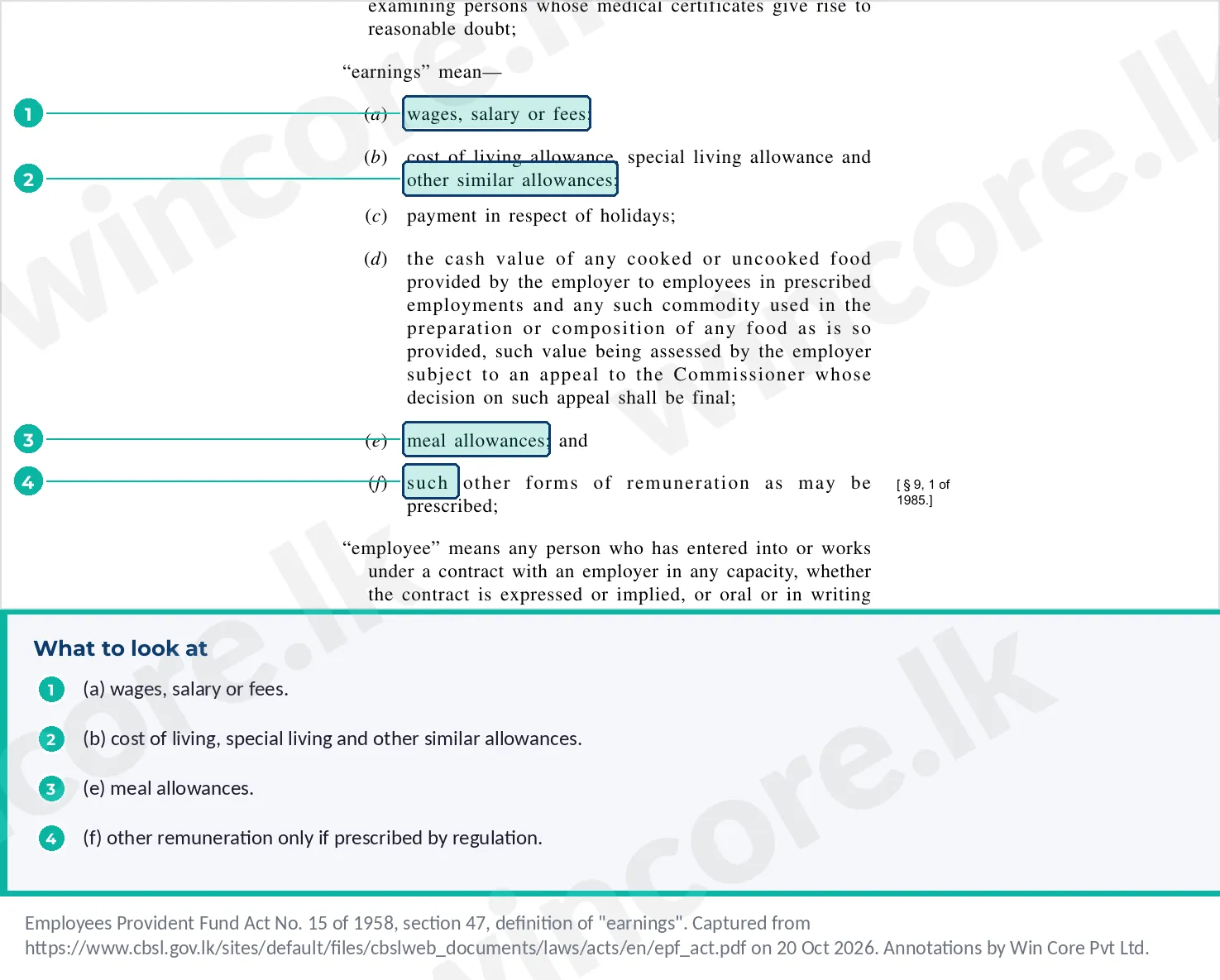
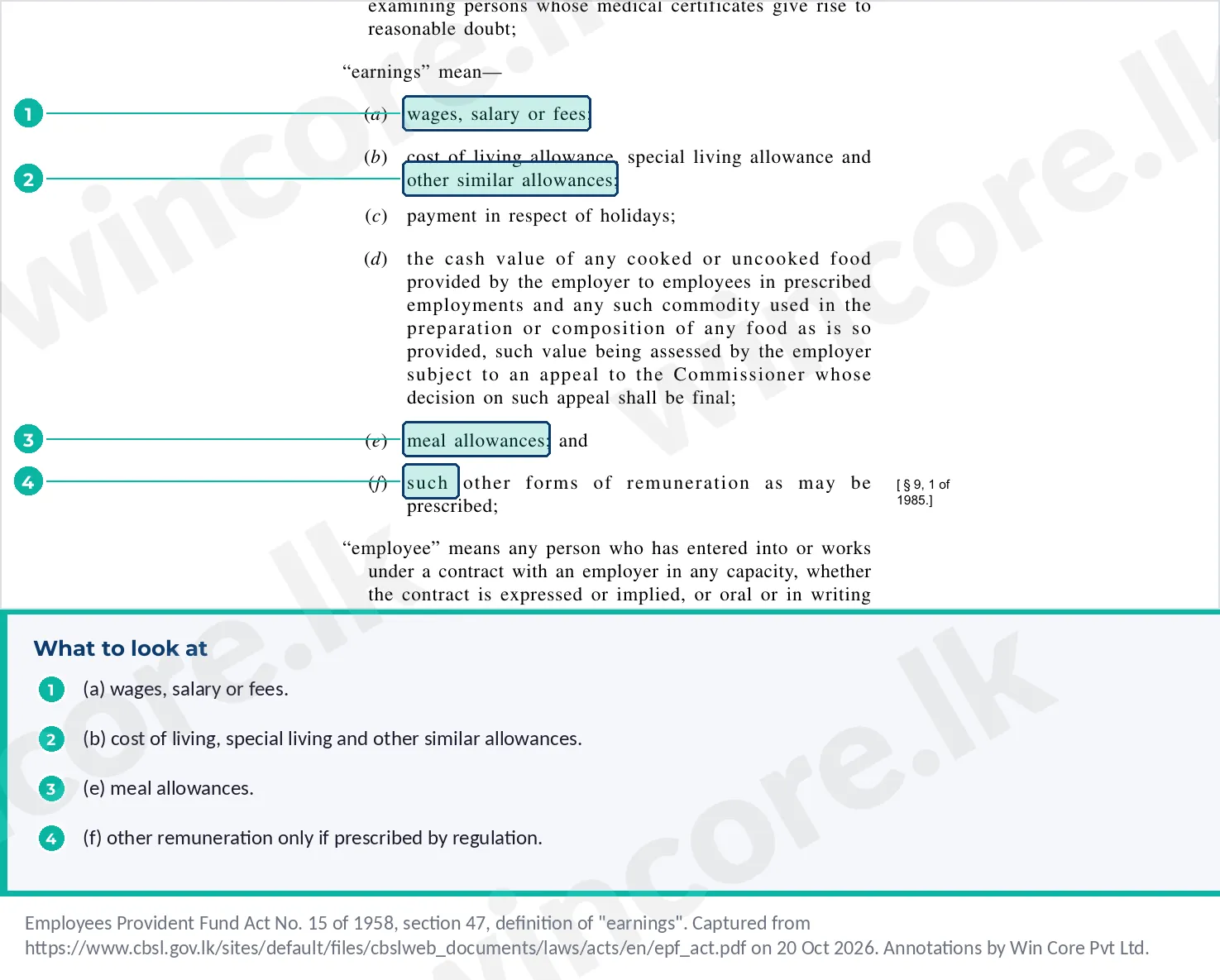
Which allowances count for EPF and ETF is decided by one list. Section 47 of the Employees' Provident Fund Act No. 15 of 1958 defines "earnings" as wages, salary or fees; cost of living, special living and other similar allowances; holiday pay; the cash value of food in prescribed employments; meal allowances; and other remuneration prescribed by regulation. Section 44 of the Employees' Trust Fund Act No. 46 of 1980 repeats the list. The employee pays 8 percent and the employer 12 percent of total earnings to the EPF, and the employer pays 3 percent to the ETF, by the last day of the following month [1] [2]. These rates are unchanged in 2026.
So the question for every allowance is which head of that definition, if any, it falls under, not what it is called.
Take a hypothetical hardware wholesaler in Matara that pays a branch supervisor a basic salary of Rs 90,000 and a "grade allowance" of Rs 35,000 a month. If the allowance is in the base, the employer's EPF share is Rs 15,000 (12 percent of Rs 125,000). If it is out, the share is Rs 10,800 (12 percent of Rs 90,000). Add the employee's 8 percent (Rs 2,800) and ETF at 3 percent (Rs 1,050) on the Rs 35,000, and the gap is Rs 8,050 a month for one person.
Which allowances count for EPF and ETF: a closed list of six heads
Section 47 of the EPF Act says that "earnings" mean [1]:
- "(a) wages, salary or fees;
- (b) cost of living allowance, special living allowance and other similar allowances;
- (c) payment in respect of holidays;
- (d) the cash value of any cooked or uncooked food provided by the employer to employees in prescribed employments ...;
- (e) meal allowances; and
- (f) such other forms of remuneration as may be prescribed".
The same section says "'prescribed' means prescribed by regulation" [1].
A caution on the text. The Central Bank's reprint incorporates amendments only up to 31 December 1998 and is not a statutory reprint. Act No. 23 of 2021 later amended section 47, but only the definition of "employee" (detached workers) and related definitions; "earnings" was not touched, as our note on the EPF and ETF surcharge sections records.
The ETF Act definition in section 44, "As amended by Act No. 18 of 1993", uses the same six heads. Head (d) refers to food in "employments provided by regulations made under the Employees' Provident Fund Act", and head (f) to remuneration "prescribed by regulations made under the Employees' Provident Fund Act" [2]. So for practical purposes the EPF base and the ETF base are the same list.
Both Acts use "means", and the Court of Appeal has read that word as making the list exhaustive (see below). An allowance gets into the base only if it fits one of the six heads. Paying it every month does not put it in, and calling it something other than salary does not keep it out.
Before applying the earnings test, check EPF treatment for working directors and foreign employees.
After classifying the allowances, reconcile gross pay, fund contributions and payments to catch differences between the payroll and the returns.
An allowance that is really pay counts as salary, whatever its name
Head (a), "wages, salary or fees", is the widest, and most allowances are tested against it first. On our reading, a payment that is in substance part of the agreed pay for the work is salary, whatever the payslip calls it. A fixed monthly amount paid to everyone in a grade, with no link to any cost the employee incurs, looks like salary.
The Court of Appeal case discussed in the next section shows the point. There the Commissioner of Labour's first inquiring officer concluded that a so-called "reimbursable allowance" was "in fact part of the wages or salary" of the employee [3]. The court did not decide whether that conclusion was right. It quashed the Commissioner's decision because two inquiring officers had reached two inconsistent conclusions and the Commissioner adopted the result without resolving them, which the court called "arbitrary and ulta vires" [3]. On our reading, an allowance that is really pay remains exposed under head (a).
Back to the wholesaler. Its Rs 35,000 grade allowance is paid to every supervisor at that grade, is not claimed against receipts and does not vary. On our reading it passes head (a) as salary. EPF on the Rs 125,000 base is Rs 10,000 from the supervisor and Rs 15,000 from the employer, and ETF is Rs 3,750. Our EPF calculator works out the three amounts for any base.
"Other similar allowances" means living allowances only, on the 2020 Court of Appeal reading
Head (b) covers "cost of living allowance, special living allowance and other similar allowances" [1]. Employers often treat "other similar allowances" as a home for every allowance. The Court of Appeal read it narrowly.
In CA (Writ) 23/2016, decided on 26 May 2020, the dispute covered both EPF and gratuity dues on an allowance the employer said reimbursed travel and customer entertainment. The court applied the ejusdem generis rule: "The genus is 'living allowance' and accordingly the words 'other similar allowances' must be interpreted to cover only different varieties of living allowances." It added that the definition "uses the word 'means' which is indicative of a definition that is restrictive in nature and exhaustive. Therefore, for any allowance to fall within the phrase 'other similar allowances' it must be a type of a living allowance." [3]
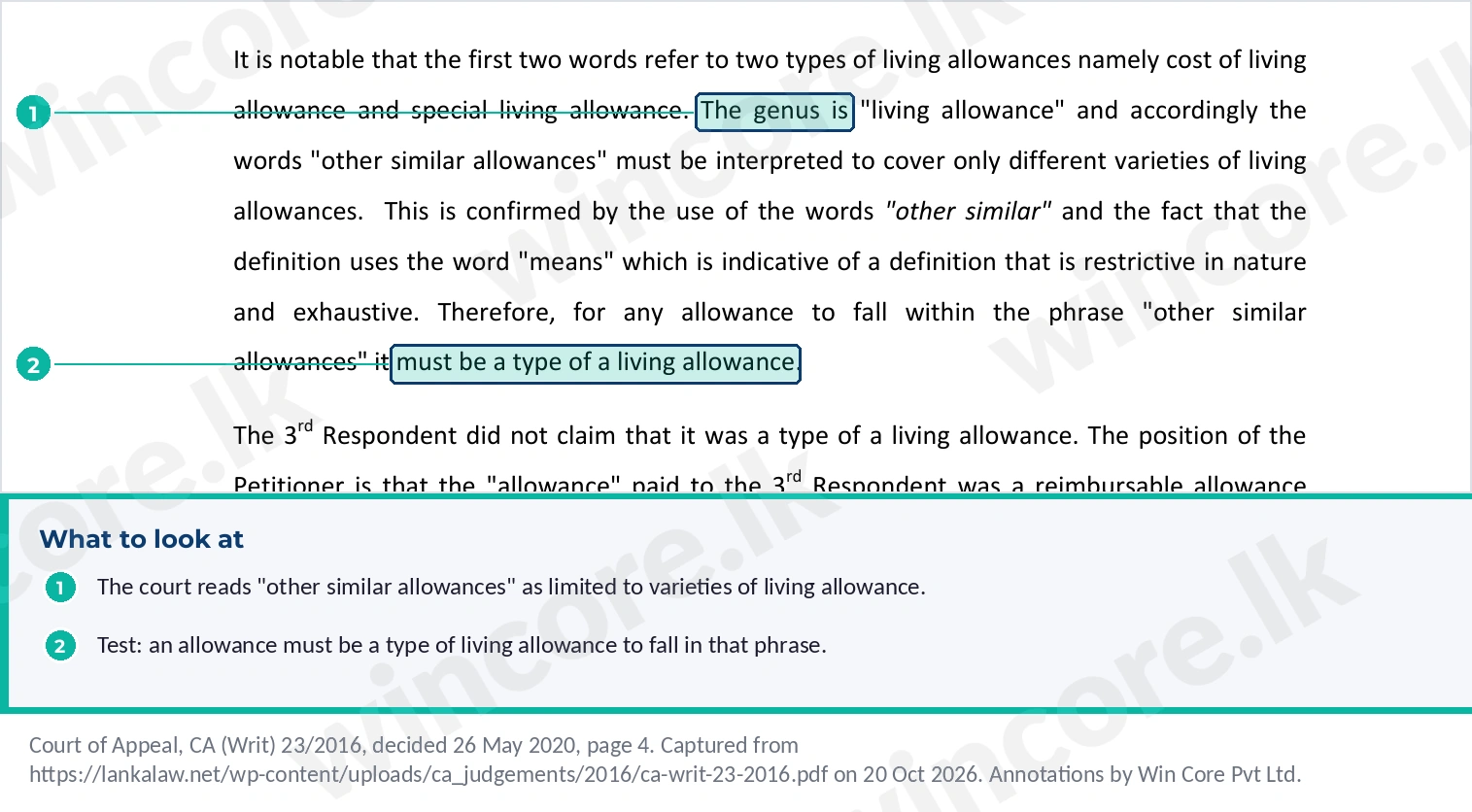
Two cautions. First, the test narrows head (b) only. An allowance that is not a living allowance can still be salary under head (a). Second, this is a Court of Appeal decision on judicial review of one Commissioner's order. We have not found a Supreme Court ruling on the phrase. Treat the test as persuasive, not as the last word.
Holiday pay and meal allowances count; food and commission depend on prescription and guidance
Head (c) is "payment in respect of holidays" [1]. Holiday pay is in the base.
Head (e) is "meal allowances" [1]. A cash meal allowance is in the base, with no condition about the type of employment. The EPF Department lists "Food allowances" among the components of total earnings [4]. For part-time and casual staff, see EPF for part-time and casual employees.
Head (d) is different. It covers the cash value of food the employer actually provides, but only "to employees in prescribed employments", valued by the employer "subject to an appeal to the Commissioner whose decision on such appeal shall be final" [1]. The Department of Labour's FAQ describes this as food supplied to employees "who work in scheduled work places such as hotels and restaurants" [5]. Outside such an employment, head (d) does not apply.
Head (f) does not open on its own. It needs a regulation. The EPF Department's employer FAQ lists, as part of total earnings, "Payments in the form of discounts (Commissions) piece rate payments and contract basis payments" [4], and the Labour Department's FAQ lists "Commission" and payments to employees "who work on piece rate" [5]. We read Parts I to VI of the EPF Regulations, 1958 in the Labour Department's published copy on 22 October 2026 and found no regulation prescribing commission or piece rates as earnings [6]. Until one is found, we treat commission and piece rates as in the base because both Departments say so, and we keep the missing regulation as an open point. The same Regulations do say that employment on work "usually performed by the day or by the job or by the journey" is not a covered employment (regulation 3) [6], which is a coverage question, separate from the earnings question.
Overtime, reimbursed travel and genuine bonuses stay out by Department guidance
The EPF Department's FAQ for employers answers the reverse question. Under "What components to be excluded when calculating Total Earnings?" it lists "Overtime payment", "Reimbursable Traveling expenses" and "Incentive payments/ Bonus Payment" [4].
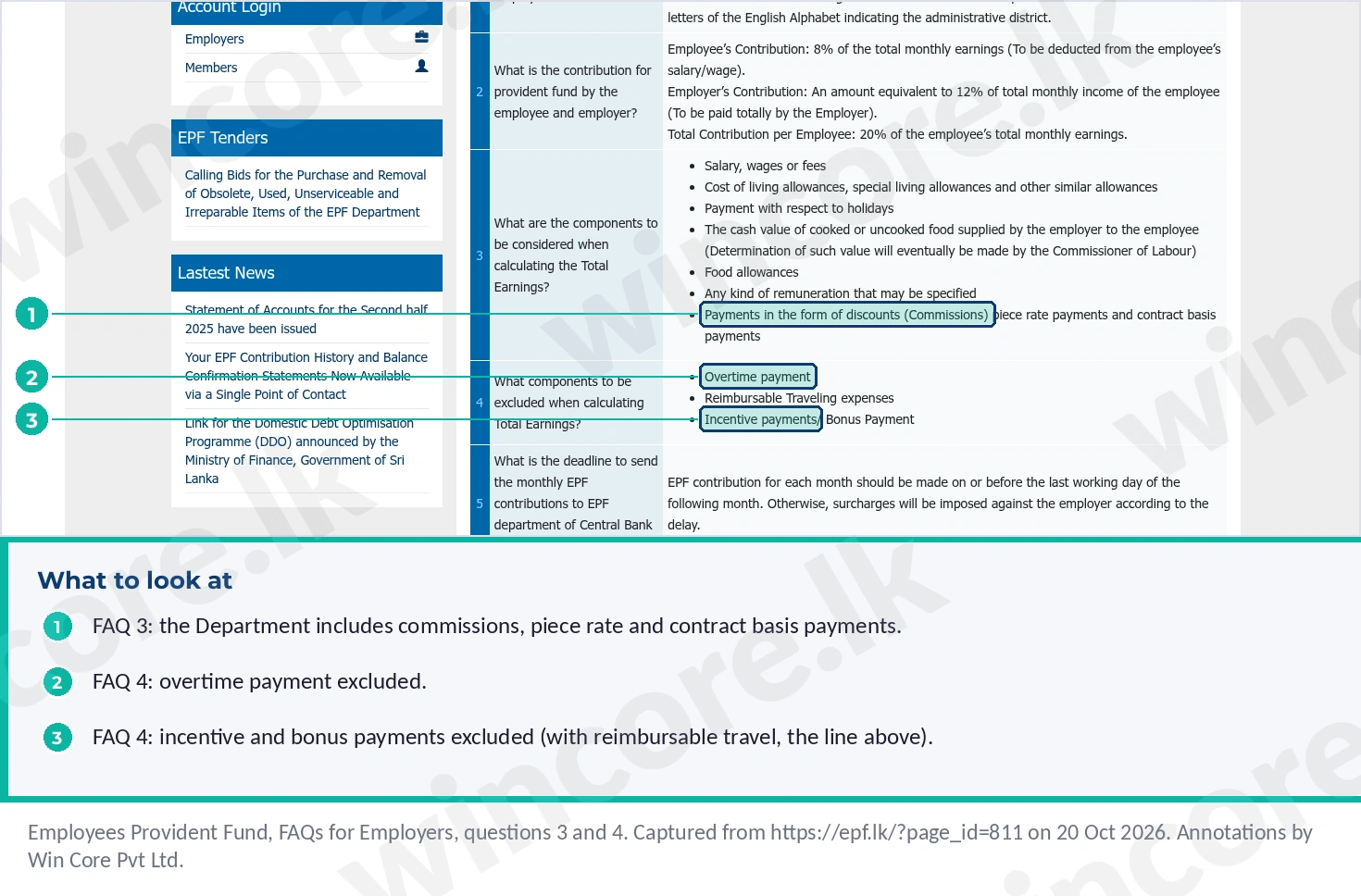
This list is administrative guidance, not a statutory exemption: section 47 does not mention overtime or bonuses. It fits the Act, because none of the three is a wage for normal hours, a living allowance, holiday pay, food or a meal allowance. But labels can mislead. A "bonus" paid every month at a fixed amount, whatever the performance, is hard to tell apart from salary. A "travel allowance" paid at a flat rate with no claim or receipts is not a reimbursement of travel expenses. On our reading, those are the cases where an inspector is most likely to look through the label to head (a).
The test that works in practice is three questions for each allowance:
- Is it really pay for the work? Fixed, paid to everyone in the grade, not tied to a cost or an event. If yes, head (a): in.
- Is it a living allowance, holiday pay, food in a prescribed employment, or a meal allowance? If yes, heads (b) to (e): in.
- Is it on the Department's included list (commission, piece rate) or its excluded list (overtime, reimbursed travel, incentive or bonus)? Follow the list, but check that the label matches the substance.
If the wholesaler's Rs 35,000 were instead a documented reimbursement of fuel actually spent on visits to dealers, claimed monthly against receipts, it would fall on the excluded "Reimbursable Traveling expenses" line. The substance decides, so the paperwork matters.
Gratuity uses a narrower list, so keep a separate base
Do not reuse the EPF base for gratuity. Section 20 of the Payment of Gratuity Act No. 12 of 1983 defines "wage or salary" as "(a) the basic or consolidated wage or salary; (b) cost of living allowance, special living allowance or other similar allowance; and (c) piece rates" [7]. There is no head for holiday pay, food or meal allowances.
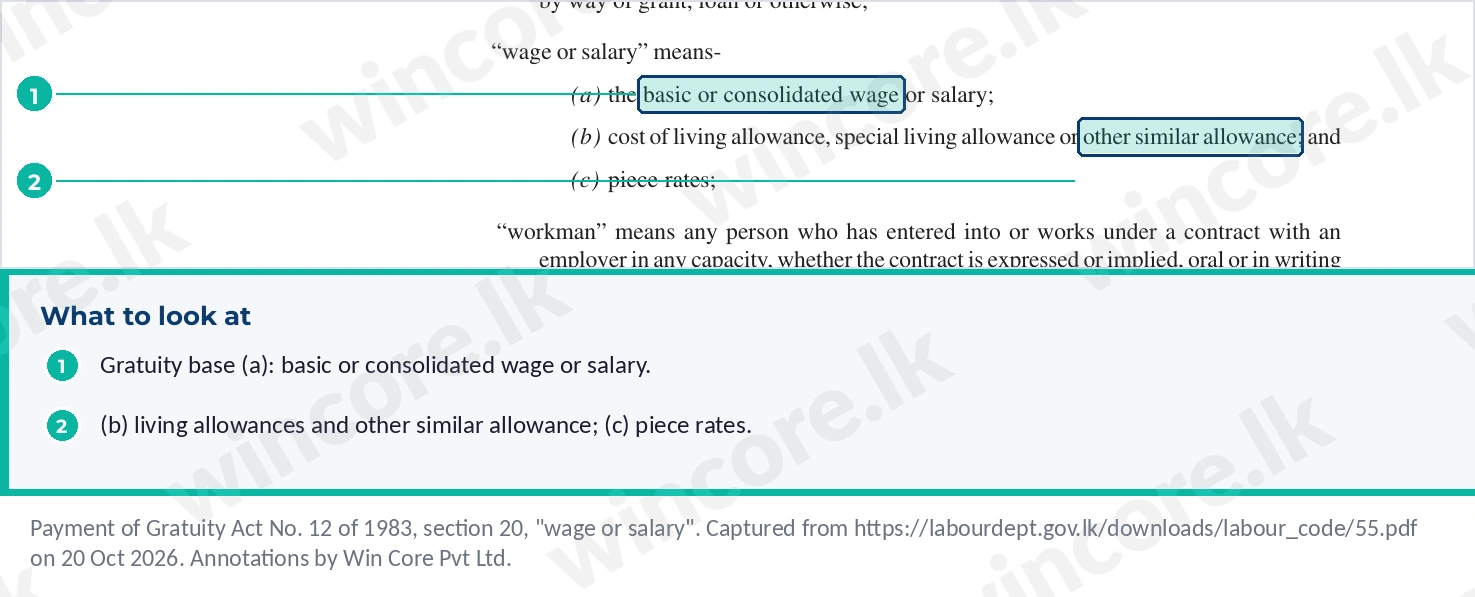
The Court of Appeal in CA (Writ) 23/2016 set out both definitions because the dispute covered EPF and gratuity [3]. On our reading of that judgment, the same living allowance reading of "other similar allowance" applies on the gratuity side. Who must pay gratuity at all, and when, is in our note on the Payment of Gratuity Act. How the headcount tests for gratuity, ETF and EPF compare is covered in our note on the payroll headcount thresholds.
A base that is too small leaves contributions unpaid and the surcharge running
Paying on too small a base means part of each month's contribution was not paid by the due date. On our reading, the late payment surcharge then applies to the unpaid part:
| Default | Section | What the section says |
|---|---|---|
| EPF contributions not paid by the due date | EPF Act s.16 | Where contributions "have not been made to the Fund before the last day of the succeeding month" and the employer cannot explain "to the satisfaction of the Commissioner" that the failure was "due to circumstances beyond his control": 5 percent (up to ten days) rising to 50 percent (over twelve months) of the contributions due [1] |
| ETF contributions not paid by the due date | ETF Act s.27 | Same six steps, 5 to 50 percent, unless the employer explains "to the satisfaction of the Board" [2] |
| Earnings cut to reduce contributions | EPF Act s.12 | The Commissioner directs the employer by written notice to pay the difference [1] |
| Employer's share taken from the employee | EPF Act s.20; ETF Act s.30 | The employer "shall not deduct from the earnings of that employee any sum which that employer is liable to pay as a contribution or surcharge"; under EPF s.20 a contract shifting that liability is void [1] [2] |
On our reading, section 12 targets an actual reduction of earnings made to cut contributions. Relabelling pay without reducing it raises a different question: whether the relabelled amount is still earnings under section 47. It usually is, if it is still pay for the work. The full ladder and who decides "beyond his control" are in our EPF and ETF guide for 2026 and the surcharge note linked above. The APIT side of allowances is a separate set of rules; our income tax advisory services cover it.
What this means for you
- List every allowance and its purpose in writing. The label is not evidence. The written purpose, the eligibility rule and the payment pattern are.
- Test each allowance against the six heads, not against basic salary. Computing EPF on basic only is a shortcut the definition does not allow.
- Keep reimbursements as reimbursements. Claims, receipts and actual amounts. A flat monthly sum with no claim is unlikely to be treated as a reimbursement.
- Treat fixed monthly "bonuses" with care. The Department excludes incentive and bonus payments, but a fixed amount paid every month regardless of performance looks like salary.
- Use a separate base for gratuity. Section 20 of the Gratuity Act is narrower than section 47 of the EPF Act.
- If the base was wrong, correct it from the next month and quantify the past. The surcharge grows with the length of the arrears.
Our payroll services run monthly EPF and ETF on a written allowance policy, and our HR services help put the purpose of each allowance into the employment terms.
Checklist: documents needed
- Payslip template showing every pay component
- Written purpose and eligibility rule for each allowance
- Reimbursement claims and receipts for travel or fuel
- Commission and piece rate schedules
- Bonus or incentive policy showing what triggers payment
- The last twelve months of EPF and ETF returns, with the base used
Open points
- Regulation prescribing commission and piece rates under head (f). Both Departments list them as earnings. We found no such regulation in Parts I to VI of the EPF Regulations, 1958 (Labour Department copy, read 22 October 2026); later regulations were not traced.
- Which employments are "prescribed" for food under head (d). The Labour Department FAQ names hotels and restaurants as examples. We did not locate the prescribing regulation.
- Supreme Court authority on "other similar allowances". We rely on CA (Writ) 23/2016. A higher court ruling could change the reading.
- Surcharge on a partly paid contribution. Sections 16 and 27 speak of contributions not paid by the due date. Applying them to the unpaid part of a contribution paid on a wrong base is our reading, not a quoted ruling.
FAQ
Is EPF calculated on basic salary only in Sri Lanka?
No, EPF is calculated on total earnings as section 47 of the EPF Act defines them. That includes wages, salary or fees, cost of living and other living allowances, holiday pay, meal allowances, food in prescribed employments and prescribed remuneration. An allowance that is really part of the agreed pay also counts, under the "wages, salary or fees" head, whatever it is called.
Is overtime included in EPF and ETF?
No, the EPF Department lists overtime payment among the components excluded from total earnings. That is Department guidance; the Act's definition does not mention overtime either way. It fits the Act because overtime is not a wage for normal hours, a living allowance, holiday pay or a meal allowance. Keep overtime records so the exclusion can be shown.
Is a transport allowance included in EPF?
It depends on what the allowance pays for. A reimbursement of actual travel expenses, claimed against receipts, is on the EPF Department's excluded list. A flat monthly transport allowance paid to everyone in a grade without any claim looks like part of pay, and on our reading falls under the "wages, salary or fees" head and into the base.
Is commission included in EPF?
Yes, according to both the EPF Department and the Department of Labour, which list commission among the components of total earnings. The Act's sixth head covers remuneration "prescribed" by regulation, and we have not found the regulation that prescribes commission. Until that is settled, include commission in the base, as both Departments direct.
Does ETF use the same earnings base as EPF?
Yes, in substance, because section 44 of the ETF Act uses the same six heads as section 47 of the EPF Act. The ETF version ties food and prescribed remuneration to regulations made under the EPF Act. The rate differs: the employer alone pays 3 percent of total earnings to the ETF, against 8 and 12 percent for EPF.
Last verified 22 October 2026 against the EPF Act reprint on cbsl.gov.lk, the ETF Act on etfb.lk, the EPF Regulations 1958 and the Gratuity Act on labourdept.gov.lk, the epf.lk employer FAQ and the Court of Appeal judgment.
Talk to us. If you are not sure which of your allowances belong in the EPF and ETF base, or want last year's base checked, speak to us at our contact page.
WinCore Pvt Ltd
This article is general information on the law as at 22 October 2026 and is not advice on your specific position.
References
- Central Bank of Sri Lanka. Employees' Provident Fund Act, No. 15 of 1958 (reprint incorporating amendments to 31 December 1998, not a statutory reprint), ss.10, 12, 16, 20 and 47. https://www.cbsl.gov.lk/sites/default/files/cbslweb_documents/laws/acts/en/epf_act.pdf . Primary. Accessed 22 October 2026.
- Employees' Trust Fund Board. Employees' Trust Fund Act, No. 46 of 1980 (as amended), ss.16, 27, 30 and 44. https://etfb.lk/wp-content/uploads/2021/03/ETF-Act.pdf . Primary. Accessed 22 October 2026.
- Court of Appeal. CA (Writ) 23/2016, decided 26 May 2020 (Janak De Silva J., N. Bandula Karunarathna J. agreeing). https://lankalaw.net/wp-content/uploads/ca_judgements/2016/ca-writ-23-2016.pdf . Primary (judgment, hosted by a law report site). Accessed 22 October 2026.
- Employees' Provident Fund Department, Central Bank of Sri Lanka. FAQs for Employers, questions 3 and 4. https://epf.lk/?page_id=811 . Primary (administrative). Accessed 22 October 2026.
- Department of Labour. Questions and Answers for GIC Chatbot (FAQ), question 8. https://labourdept.gov.lk/wp-content/uploads/2025/01/faq.pdf . Primary (administrative). Accessed 22 October 2026.
- Department of Labour. Employees' Provident Fund Regulations, 1958 (Labour Code copy), regulations 2 to 17 and Parts I to VI. https://labourdept.gov.lk/downloads/labour_code/48.pdf . Primary. Accessed 22 October 2026.
- Department of Labour. Labour Code of Sri Lanka, reprint of the Payment of Gratuity Act, No. 12 of 1983, s.20. https://labourdept.gov.lk/downloads/labour_code/55.pdf . Primary. Accessed 22 October 2026.
Put these insights to work
WinCore specialists can review your current workflow, document gaps, and build a practical 90-day action plan.
Book a free consultationContinue reading
Explore more WinCore analysis to keep your finance, tax, and compliance roadmap moving.

The employer's guide to EPF and ETF in Sri Lanka for 2026: who is covered, 8, 12 and 3 percent, what counts as earnings, the due date, the surcharge ladder and forms.
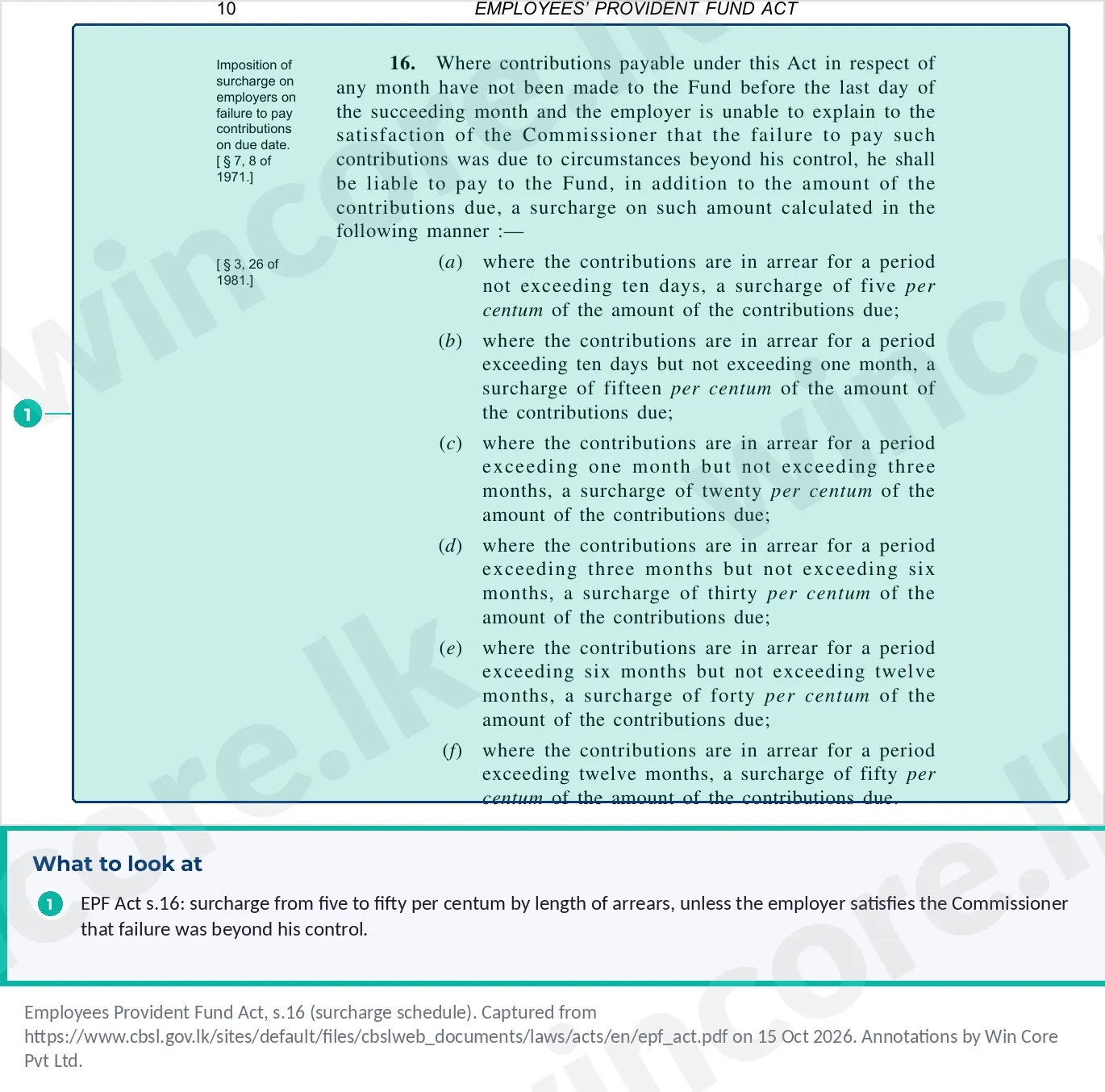
The four sections behind EPF and ETF: rates, the due day, the 5 to 50 percent ladder, who judges 'beyond control', and what Act No. 2 of 2012 changed.
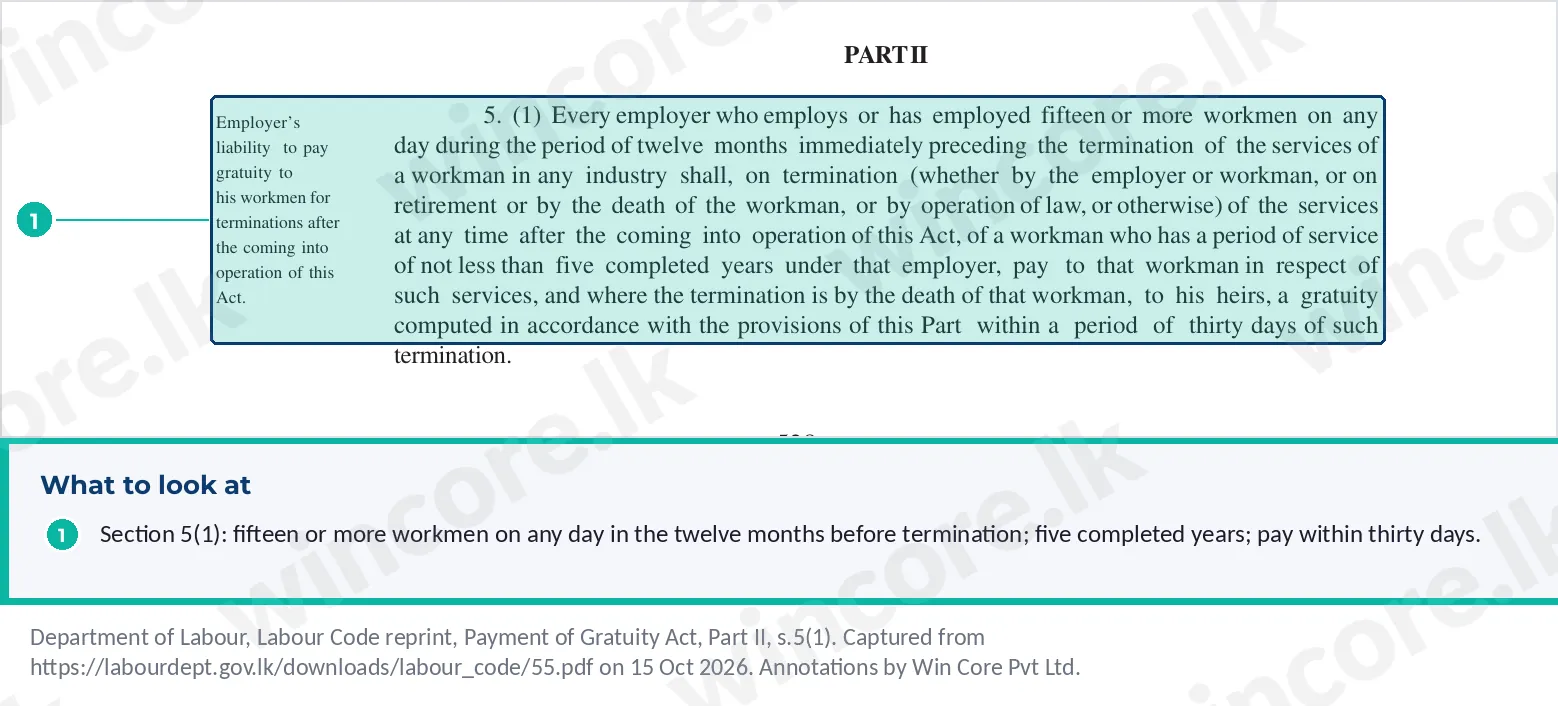
The sections that decide a gratuity claim: who is caught, who is excluded, how much, the day-30 due date and the surcharge Act No. 62 of 1992 added.