
Payroll reconciliation in Sri Lanka: check the transfer before EPF
The salary file and the payroll should agree before EPF and ETF go. Why the Acts make total earnings the base, and a seven-step check that is practice.
On this page
Last verified against the primary sources on 22 October 2026.
Payroll reconciliation in Sri Lanka matters because EPF and ETF are charged on what each employee earned, not on what the bank paid. Section 10 of the Employees' Provident Fund Act sets the employee's 8 percent and the employer's 12 percent on "total earnings" for the month, and section 16(1) of the Employees' Trust Fund Act sets the employer's 3 percent on the same base, all due "on or before the last day of the succeeding month" [1] [2]. Checking the salary transfer against the payroll before you pay is not written into either Act. It is practice, and it is the quickest way to find earnings the payroll missed before the due date passes.
Take a hypothetical engineering contractor in Kurunegala with about forty staff. Its payroll shows net pay of Rs 2,100,000 for October 2026. The bank salary file the finance team uploaded totals Rs 2,115,000. Someone paid Rs 15,000 outside the payroll. Before the October EPF and ETF go, that gap needs an answer. This piece explains why, from the two Acts, and then sets out a routine that we label clearly as practice.
Payroll reconciliation starts from the rule: contributions follow total earnings
Section 10(1) of the EPF Act, "subject to the provisions of subsection (3) of this section and of section 27" (approved provident funds), sets the employee's contribution at "eight per centum of his total earnings from that employment during that month" [1]. Section 10(2) makes the employer "liable to pay to the Fund on or before the last day of the succeeding month, a contribution of an amount equal to twelve per centum of such employee's total earnings from that employment during that month" [1].
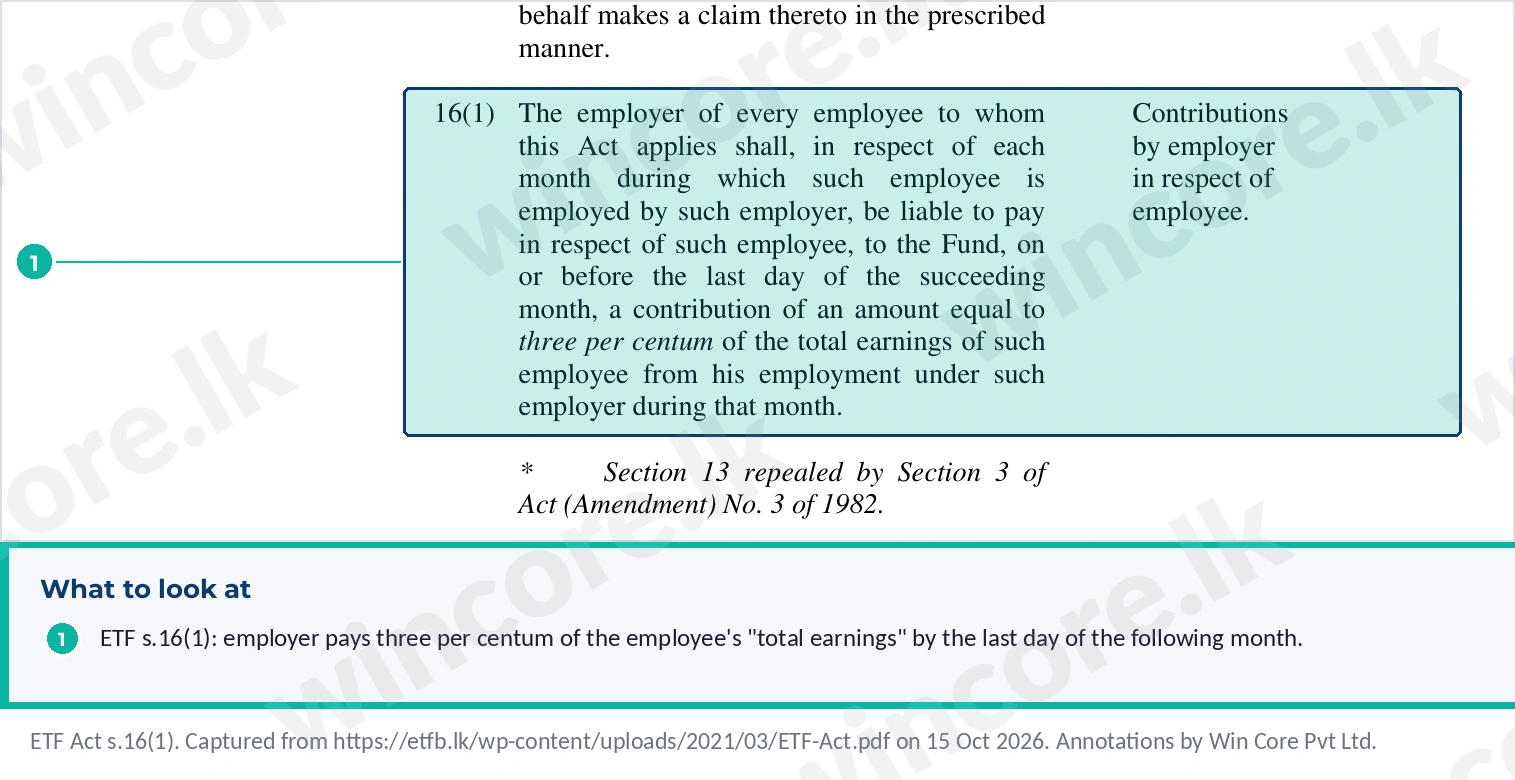
ETF section 16(1) makes the employer liable to pay, "on or before the last day of the succeeding month, a contribution of an amount equal to three per centum of the total earnings of such employee from his employment under such employer during that month" [2].
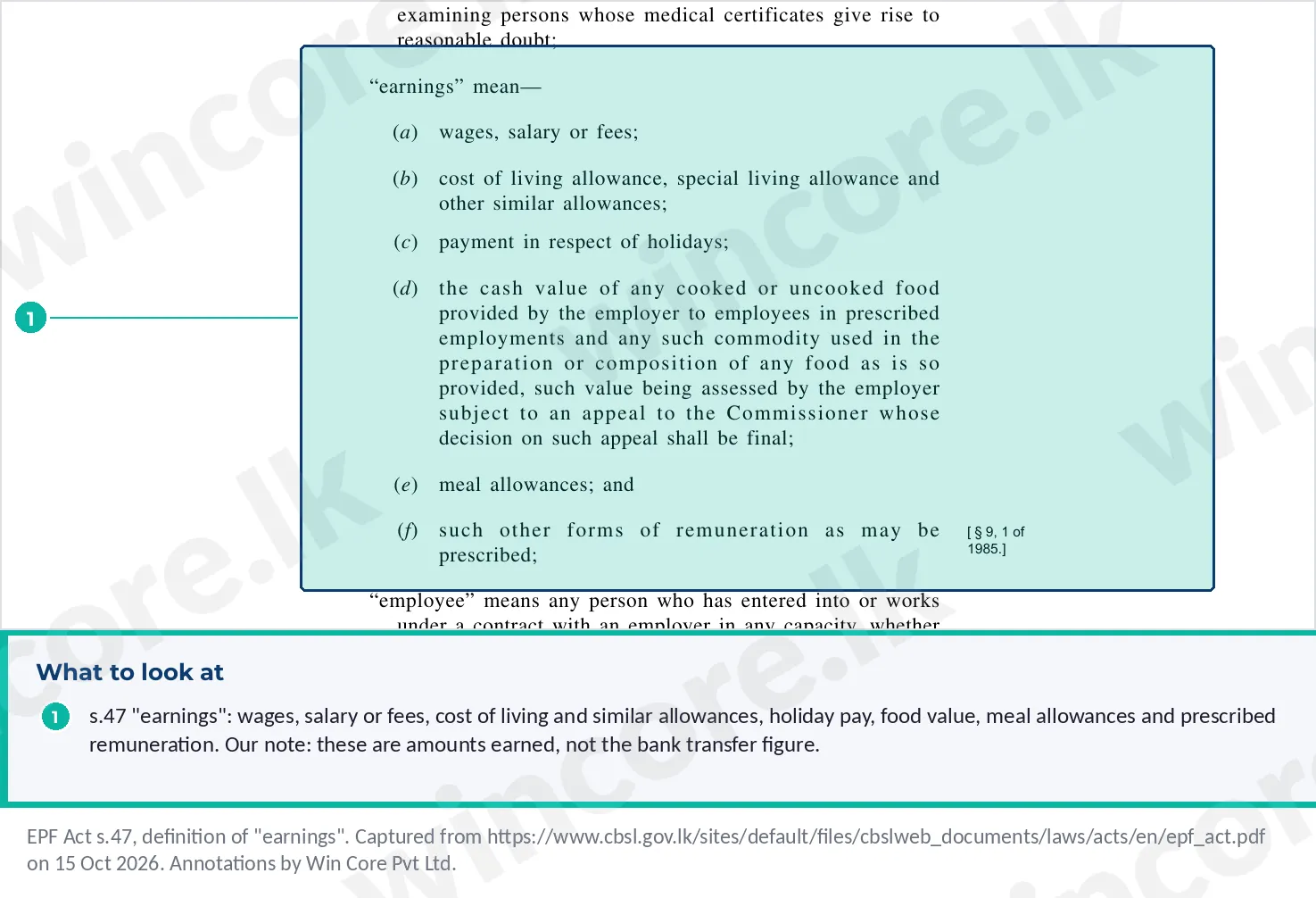
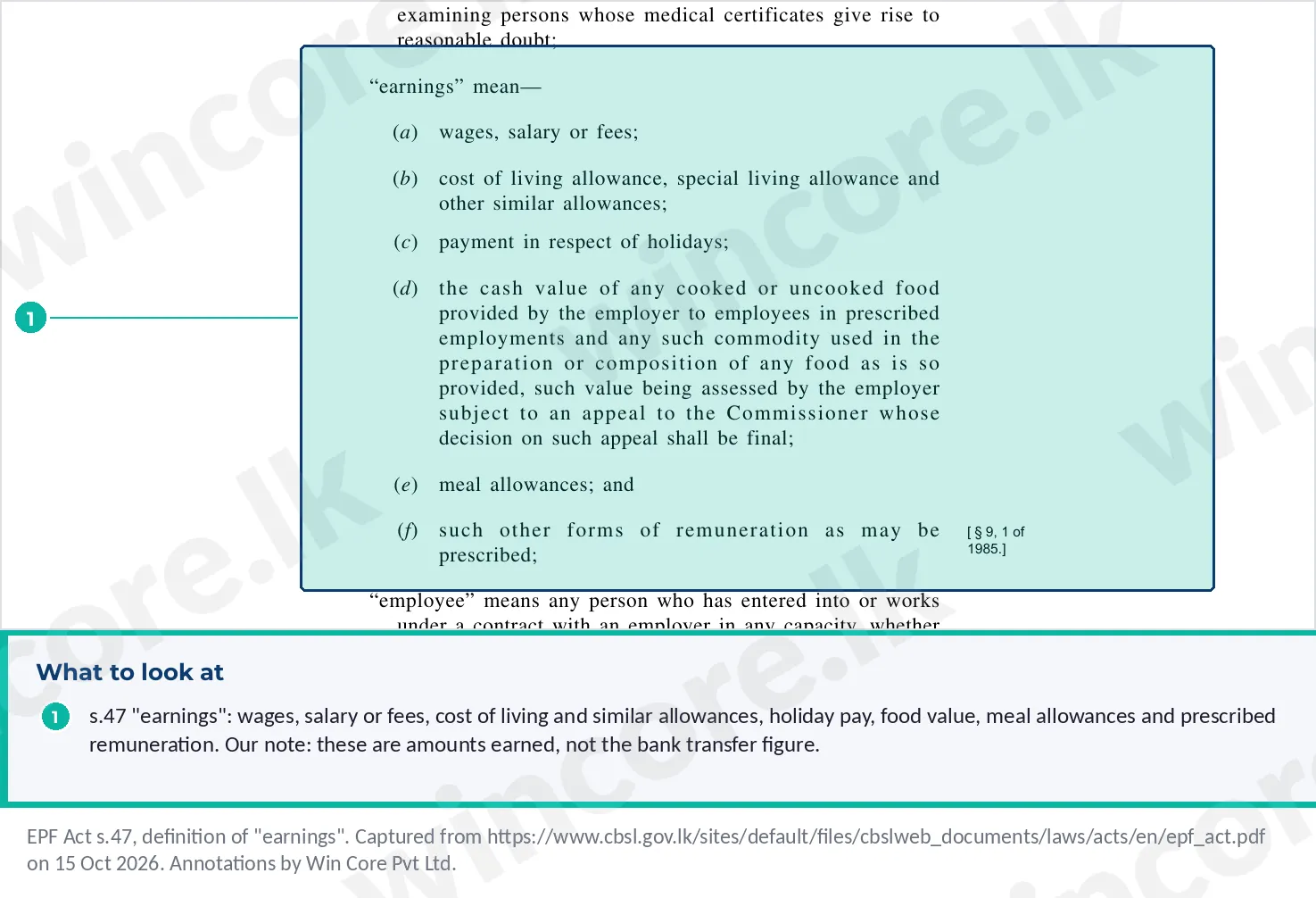
"Earnings" is defined. Section 47 of the EPF Act says "earnings" mean "(a) wages, salary or fees; (b) cost of living allowance, special living allowance and other similar allowances; (c) payment in respect of holidays; (d) the cash value of any cooked or uncooked food provided by the employer to employees in prescribed employments...; (e) meal allowances; and (f) such other forms of remuneration as may be prescribed" [1]. Section 44 of the ETF Act has a parallel list, ending with remuneration prescribed under the EPF Act [2]. "Total earnings" itself is not separately defined in the EPF Act.
A caution on the text. The Central Bank's EPF reprint incorporates amendments only "up to 31st December, 1998" and says it "is, however, not a statutory reprint" [1]. We checked the later amendments for this definition: Act No. 23 of 2021 amended section 47 only to exclude detached workers covered by a social security agreement from "employee" and to add related definitions; it did not touch "earnings" [3]. Act No. 2 of 2012 changed the return surcharge and the general fine, not section 47, as our note on the EPF and ETF surcharge sections sets out.
Carry the monthly reconciliations into the annual payroll close checklist rather than starting the year-end totals again from scratch.
The bank transfer is net pay, so it checks the base but cannot be the base
Nothing in section 10 or section 16 refers to the bank transfer. The transfer is net pay: earnings less the employee's 8 percent EPF, APIT and any other authorised deductions. That makes it a different number from the contribution base, which is why it is useful as a check and useless as a base.
Section 15 of the EPF Act says the employer "shall deduct and pay to the Fund the contribution for each month of such employee ... before the last day of the succeeding month from the earnings of such employee", and a contribution so paid "shall be deemed to have been paid to the Fund by such employee" [1]. Section 10(2) says "on or before" and section 15 says "before"; we quote both as they stand. The EPF Department and the ETF Board ask for payment by the last working day of the following month, an administrative date earlier than the statutory one, as our monthly payment procedures guide explains.
Which allowances belong in "earnings" is its own question. A fixed allowance is tested by what it pays for, not its label; our EPF and ETF guide for 2026 covers it, and our note on which allowances count for EPF and ETF goes further.
A short or late contribution carries its own consequences
| Consequence | Section | What it says |
|---|---|---|
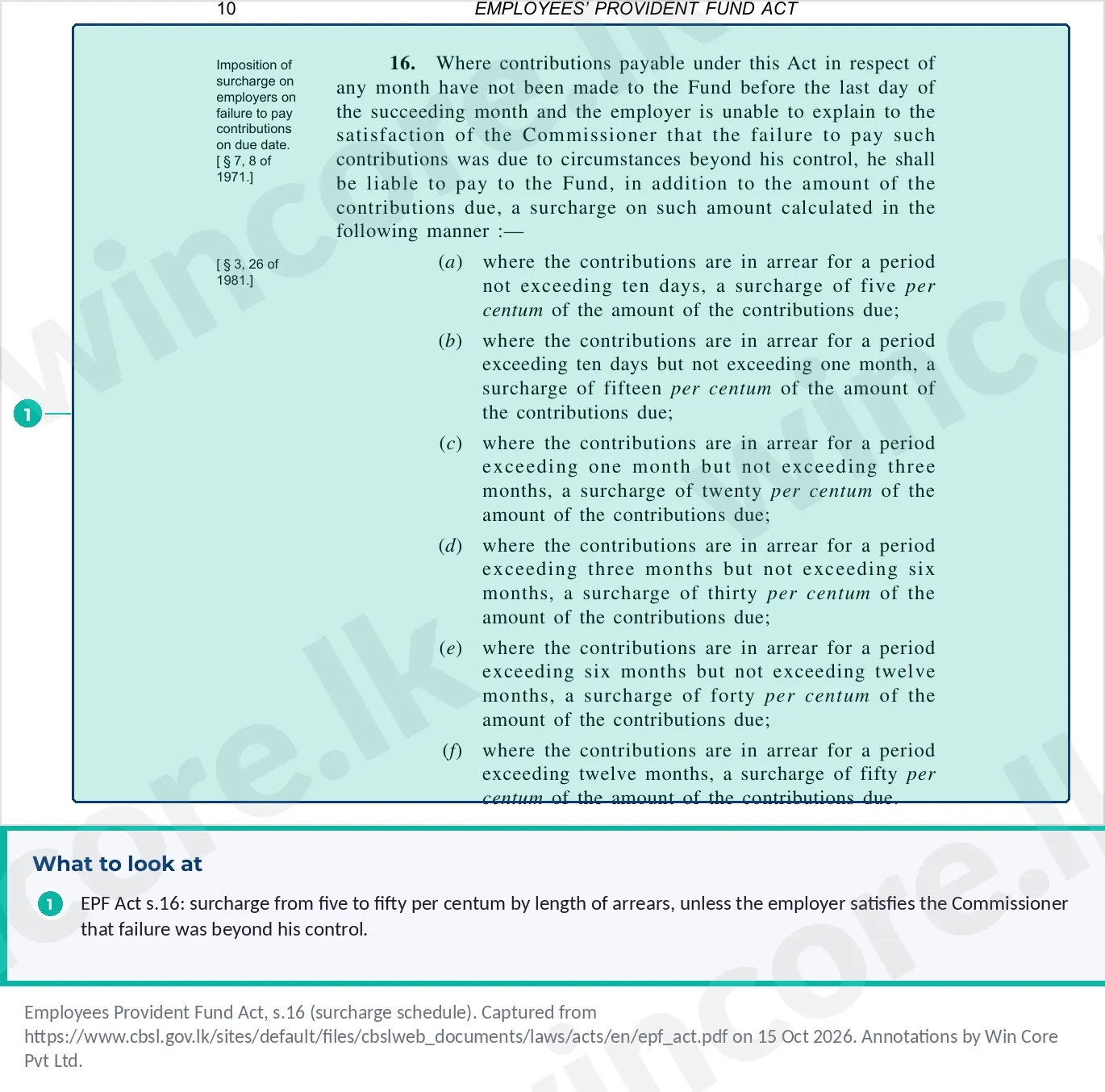
| EPF surcharge | EPF Act s.16 | Contributions not made "before the last day of the succeeding month": 5 percent up to ten days, rising to 15, 20, 30, 40 and 50 percent over twelve months, unless the employer satisfies the Commissioner the failure was "due to circumstances beyond his control" [1] |
| ETF surcharge | ETF Act s.27 | The same 5 to 50 percent ladder for a contribution not paid on the due date, unless the employer satisfies the Board [2] |
| No passing the employer's share to staff | EPF Act s.20; ETF Act s.30 | The employer "shall not deduct from the earnings of that employee any sum which that employer is liable to pay as a contribution or surcharge"; under EPF s.20 a contract shifting it "shall be null and void" [1] [2] |
| Burden of proof | EPF Act s.39 | In proceedings under s.17, "the burden of proving that the sum was paid shall lie on the employer" [1] |
Each row comes from its own section. A short-paid month is, for the difference, a late month: the ladder runs on the unpaid part from the due date. Our payroll services team runs these checks before each remittance.
A seven-step payroll reconciliation before EPF and ETF go
This section is practice, not a legal requirement. The Acts require the right contribution on total earnings by the due date. They do not prescribe how you check it. The routine below is how we would do it.
- Close the payroll first. Fix gross earnings for each employee, split into the section 47 heads: salary, allowances, holiday pay, meal allowances and so on.
- Work out net pay per employee. Gross earnings, less employee EPF at 8 percent, APIT and other authorised deductions.
- Total the bank salary file. Use the file actually uploaded, or the bank's confirmation, not the draft.
- Compare per employee, not only in total. A total can agree while two employees are wrong in opposite directions.
- Explain every difference. A payment in the bank file but not in the payroll is a question: is it earnings under section 47? A payroll amount missing from the bank file is a different question: was the pay held, paid in cash, or wrong?
- Correct the payroll, then calculate. Employee 8 percent, employer 12 percent and ETF 3 percent come from the corrected earnings. Our EPF calculator works out the three amounts.
- Keep the reconciliation. Section 39 puts the burden of proving payment on the employer, and a signed reconciliation sits well in that file.
A Rs 15,000 payment outside payroll changes three contributions
Return to the contractor. Payroll gross earnings for October 2026 are Rs 2,400,000. Employee EPF at 8 percent is Rs 192,000. APIT and a salary advance recovery come to Rs 108,000. Net pay is therefore Rs 2,100,000.
The bank file totals Rs 2,115,000. The per-employee comparison puts the whole Rs 15,000 with one site engineer. Finance confirms it was a meal allowance for a fortnight on an outstation site, approved by the project manager and paid by separate transfer.
Meal allowances are head (e) of the section 47 definition. So the engineer's earnings were understated by Rs 15,000, and the payroll is corrected to Rs 2,415,000 of earnings:
| Contribution | Rate | Increase |
|---|---|---|
| Employee EPF | 8 percent | Rs 1,200 |
| Employer EPF | 12 percent | Rs 1,800 |
| ETF | 3 percent | Rs 450 |
| Total due with October contributions | Rs 3,450 more |
Because the check ran before the October contributions were paid, the whole amount goes by 30 November 2026, the statutory due date, and no surcharge arises. Had nobody checked, the Rs 3,450 would surface only later, and the section 16 and section 27 ladders would apply to it from the due date.
Two loose ends. The Rs 15,000 was paid in full, so the engineer's Rs 1,200 share was never deducted; how the employer settles that with the employee is not something the Acts spell out, and we leave it open. And the same Rs 15,000 is employment income, so check whether it changes the month's APIT, as set out in our APIT deduction guide.
What this means for you
- EPF and ETF are worked out on total earnings as the Acts define them. The bank transfer is not the base.
- Reconcile the uploaded salary file to payroll net pay, employee by employee, before you calculate the contributions. Record it in your manual as internal practice.
- Treat any payment outside payroll as possible earnings and test it against section 47.
- Keep the reconciliation with the month's EPF and ETF records.
- If someone else runs your payroll, agree in writing who runs this check. The liability under the Acts stays with the employer.
Checklist: documents needed
- Closed payroll for the month, with gross earnings per employee by section 47 head
- Net pay per employee and the deductions behind it
- The bank salary file as uploaded, or the bank's confirmation
- Approvals for any payment made outside payroll
- The signed reconciliation and the corrected contribution workings
- EPF and ETF payment confirmations with dates
Open points
- Whether earnings earned in a month but held back and paid later count for that month. Section 10 refers to earnings "during that month"; the Acts do not address held pay directly.
- Whether a particular allowance paid outside payroll is "similar" to cost of living allowances under head (b). That depends on facts.
- How an employer recovers employee EPF on earnings already paid in full. Section 15 speaks of deducting "from the earnings"; it does not deal with a late correction.
- The wording difference between section 10(2) "on or before" and section 15 "before". We have not seen it tested.
FAQ
Is the employer's 12 percent EPF worked out on net pay?
No. Section 10(2) of the EPF Act sets the employer's 12 percent on the employee's "total earnings" for the month, and section 47 defines earnings as wages, salary or fees, cost of living and similar allowances, holiday pay, food value, meal allowances and prescribed remuneration. Net pay after deductions is a smaller, different number [1].
Does ETF use the same base as EPF?
Yes, in substance. ETF section 16(1) charges the employer 3 percent of the employee's "total earnings" for the month, and section 44 of the ETF Act defines earnings with a parallel list that ends by borrowing remuneration prescribed under the EPF Act. There is no employee share of ETF, and the employer may not deduct it from pay [2].
Does the law require a payroll reconciliation in Sri Lanka?
Not in those words. Neither the EPF Act nor the ETF Act prescribes a bank or payroll reconciliation. They require the right contribution on total earnings by the last day of the following month. A reconciliation is the practice that shows you met that duty, and it helps with the burden of proof under EPF section 39 [1] [2].
What happens if EPF is short paid because of a missed payment?
The shortfall is treated as unpaid from the due date. Under EPF section 16 and ETF section 27 a surcharge of 5 to 50 percent of the amount in arrear applies, depending on how long it runs, unless the employer shows the delay was beyond its control. The employer's share and any surcharge cannot be taken from staff pay [1] [2].
Can the employer recover a short-paid employer share from staff?
No. EPF section 20 forbids deducting from an employee's earnings any sum the employer must pay as a contribution or surcharge, and makes a contract shifting that liability null and void. ETF section 30 has the same bar for ETF. Only the employee's own 8 percent EPF share is deducted from pay under section 15 [1] [2].
This article is general information on the law as at 22 October 2026, not advice on your situation.
Talk to us. If your payroll and bank files do not agree, or you want the check built into your month end, contact us at our contact page.
WinCore Pvt Ltd
References
- Central Bank of Sri Lanka (reprint incorporating amendments to 31 December 1998, not a statutory reprint). Employees' Provident Fund Act, No. 15 of 1958, ss.10, 15, 16, 20, 39 and 47. https://www.cbsl.gov.lk/sites/default/files/cbslweb_documents/laws/acts/en/epf_act.pdf . Primary. Accessed 22 October 2026.
- Employees' Trust Fund Board. Employees' Trust Fund Act, No. 46 of 1980 (with amendments), ss.16(1), 27, 30 and 44. https://etfb.lk/wp-content/uploads/2021/03/ETF-Act.pdf . Primary. Accessed 22 October 2026.
- Parliament of Sri Lanka. Employees' Provident Fund (Amendment) Act, No. 23 of 2021 (certified 13 October 2021), s.2 (amending s.47). https://employers.lk/wp-content/uploads/2021/12/4i_Employees_-Provident-Fund-Amendment-Act-No.-23-of-2021.pdf . Primary text, hosted by the Employers' Federation of Ceylon. Accessed 22 October 2026.
Put these insights to work
WinCore specialists can review your current workflow, document gaps, and build a practical 90-day action plan.
Book a free consultationContinue reading
Explore more WinCore analysis to keep your finance, tax, and compliance roadmap moving.
The four sections behind EPF and ETF: rates, the due day, the 5 to 50 percent ladder, who judges 'beyond control', and what Act No. 2 of 2012 changed.

Monthly EPF and ETF payment procedures for Sri Lankan employers: the last working day deadline, Form C and e-returns, ETF electronic payment, surcharges and evidence.

The employer's guide to EPF and ETF in Sri Lanka for 2026: who is covered, 8, 12 and 3 percent, what counts as earnings, the due date, the surcharge ladder and forms.