
EPF for foreign nationals in Sri Lanka, and for company directors
A passport does not take anyone out of EPF. The four exclusions in the 1958 Regulations, the detached worker rule and how directors are treated.
On this page
Last verified against the primary sources on 22 October 2026.
EPF for foreign nationals in Sri Lanka works the same way as for anyone else: nationality is not a test. Section 47 of the Employees' Provident Fund Act, No. 15 of 1958 covers "any person" who works under a contract with an employer "in any capacity", and contributions are 8 percent from the employee and 12 percent from the employer, with 3 percent ETF, due by the last day of the following month. The exclusions are specific. Regulation 2(2) of the EPF Regulations, 1958 leaves out a director for the directorship itself, partners, certain managerial, executive or technical staff with a pension scheme run outside Sri Lanka, and some staff employed abroad. Act No. 23 of 2021 adds the "detached worker" covered by a social security agreement.
Take a hypothetical Sri Lankan garment accessories manufacturer that employs an Indian production manager on a local contract and pays its founder a salary as managing director. Must it pay EPF and ETF for either of them? This piece sets out our current reading of the Acts and Regulations, and what is still open.
EPF for foreign nationals in Sri Lanka turns on the contract, not the passport
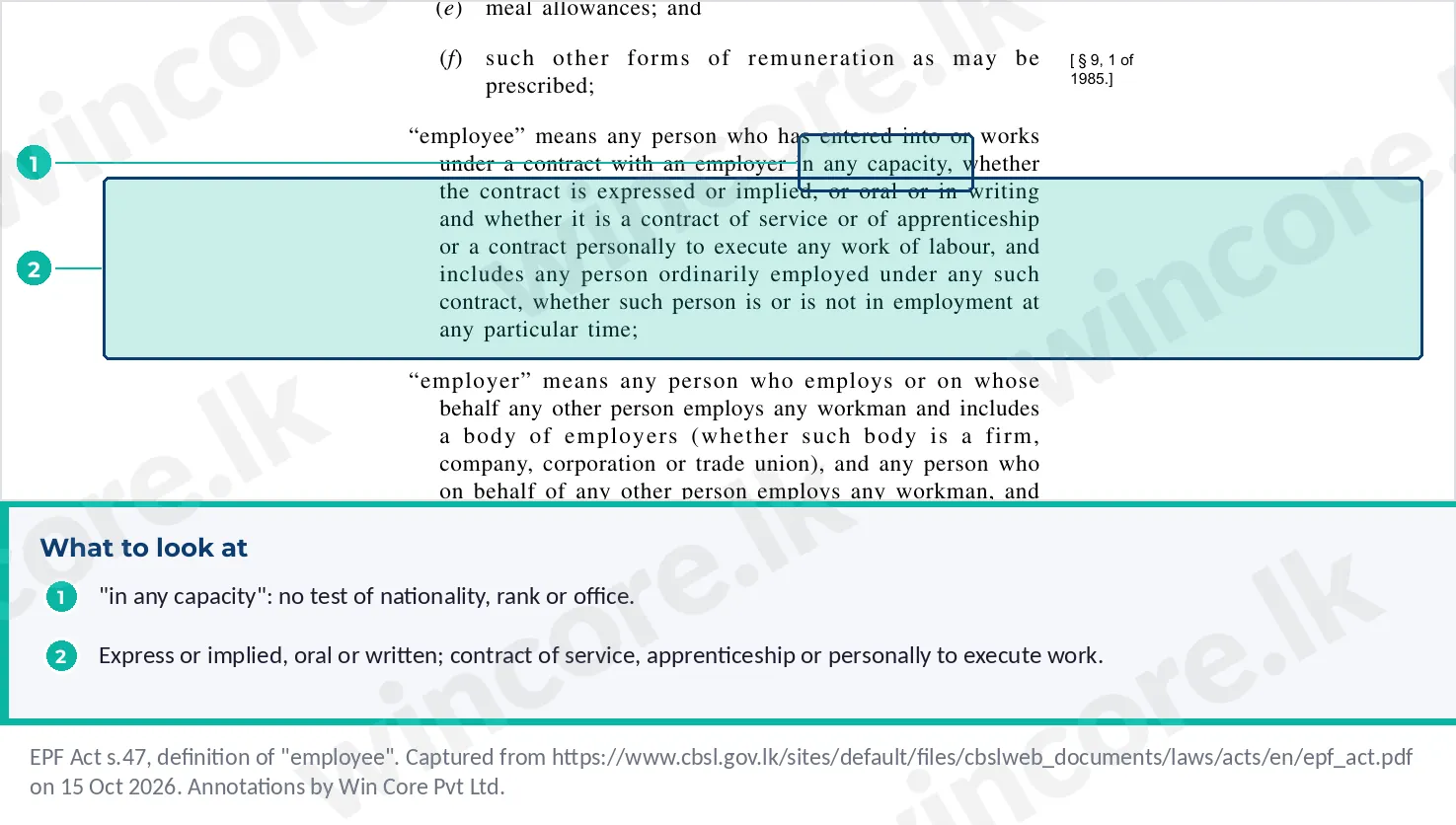
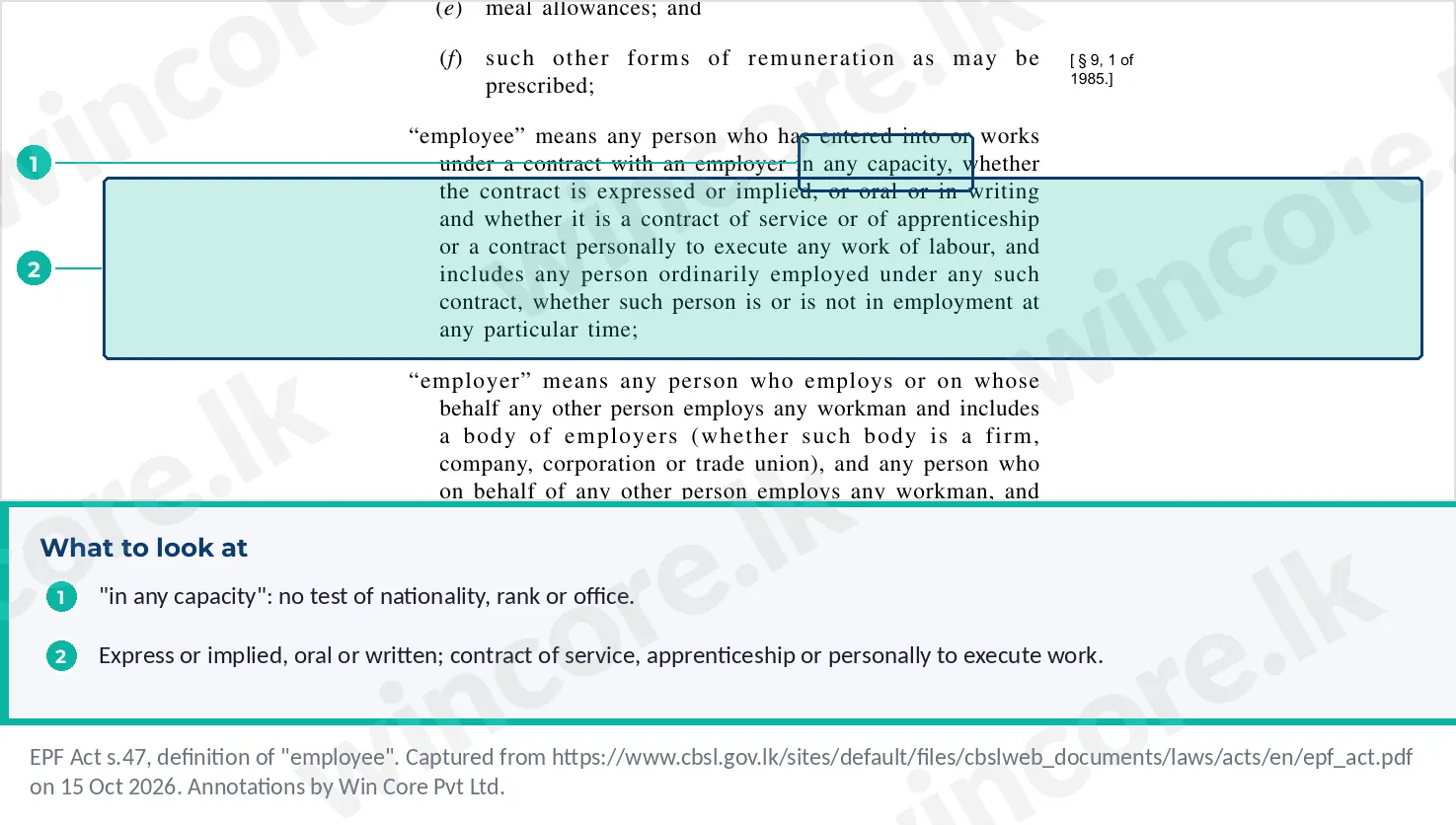
Section 47 defines "employee" as "any person who has entered into or works under a contract with an employer in any capacity, whether the contract is expressed or implied, or oral or in writing and whether it is a contract of service or of apprenticeship or a contract personally to execute any work of labour" [1]. Three features matter here.
- "Any person." No reference to citizenship or residence.
- "In any capacity." No reference to rank or title in the Act's definition.
- The contract can be implied or oral. The label on a document does not settle it.
Section 8(3) then makes "every person over a prescribed age who is employed by any other person in any covered employment" an employee to whom the Act applies, and s.8(4) lets a regulation limit cover to persons of a prescribed class [1]. That is where the exclusions sit. Under s.10, the employee pays 8 percent and the employer 12 percent of "total earnings", the employer paying "on or before the last day of the succeeding month" [1]. Our EPF calculator runs the figures for any salary.
The 1958 Regulations take four groups out, whatever their nationality
Regulation 2(1) of the EPF Regulations, 1958 makes every employment in their First Schedule a covered employment, together with employment outside Sri Lanka connected with the employer's business. Regulation 2(2) then says every person employed in a covered employment is an employee to whom the Act applies, "other than" these [5]:
| Paragraph | Who is left out | Wording |
|---|---|---|
| 2(2)(a) | A director, for the directorship | "a person holding the office of director in respect of his employment as such director" |
| 2(2)(b) | A partner, for the partnership | "a person who is a partner in any partnership in respect of his partnership" |
| 2(2)(c) | Managerial, executive or technical staff with a scheme abroad | employed "in a managerial, executive or technical employment and for whom superannuation benefits or benefits on termination of employment are provided under any provident fund or pension scheme or any other fund or scheme, established or administered outside Ceylon" |
| 2(2)(d) | Staff employed abroad who are not ordinarily resident here | "a person who is employed outside Ceylon, for the purpose of such employment but who is not ordinarily resident in Ceylon" |
Paragraph (bb) covers certain local authority staff and is not relevant to private employers. Regulations 3 and 4 also exclude casual work paid by the day, job or journey, and employment of an employer's spouse [5].
Two points follow. First, none of these exclusions turns on nationality. A Sri Lankan engineer seconded from a foreign group that funds a pension for him abroad can fall within 2(2)(c); a foreign engineer with no such scheme does not. Second, 2(2)(c) needs both limbs: the role must be managerial, executive or technical, and the benefits must actually be provided under a fund or scheme established or administered outside Sri Lanka. On our reading, a state social security scheme abroad that the employer does not provide is not obviously such a scheme, so keep evidence of what the scheme is and who provides it. The text we read is the Labour Department's published Labour Code copy, with Gazette references from 1958 and 1964; we have not traced later amendments to regulation 2.
A detached worker is out only under a social security agreement
The EPF (Amendment) Act, No. 23 of 2021, certified on 13 October 2021, inserted a definition: "'international worker' means, an employee who is a citizen of a country other than Sri Lanka" [2]. Parliament defined a foreign citizen working here as a kind of employee, inside the Act.
It then carved out one group. The definition of "employee" now ends: "and does not include a detached worker for the period of time specified in a social security agreement applicable to such detached worker" [2]. A "detached worker" is "an international worker on a temporary assignment in covered employment in Sri Lanka and contributing to a social security programme in the country in which he is a citizen and who in terms of a social security agreement has been exempted from making any contribution under this Act for the period as set out in such agreement" [2].
| Element | Wording in s.47 |
|---|---|
| Foreign citizen employee | "international worker" |
| Temporary assignment here | "on a temporary assignment in covered employment in Sri Lanka" |
| Paying into the home scheme | "contributing to a social security programme in the country in which he is a citizen" |
| Exempted under an agreement | "in terms of a social security agreement has been exempted" |
| Only for the agreed period | "for the period as set out in such agreement" |
A "Social Security Agreement" is "a bilateral agreement to which Sri Lanka is a party" that exempts citizens of one country on temporary assignment in the other [2]. Without such an agreement for the worker's home country, this exclusion does not exist. We have not identified any agreement in force, and we will not say one exists until we have read it. A Sri Lanka and India agreement was reported in August 2026 as proposed, not signed or in force [6].
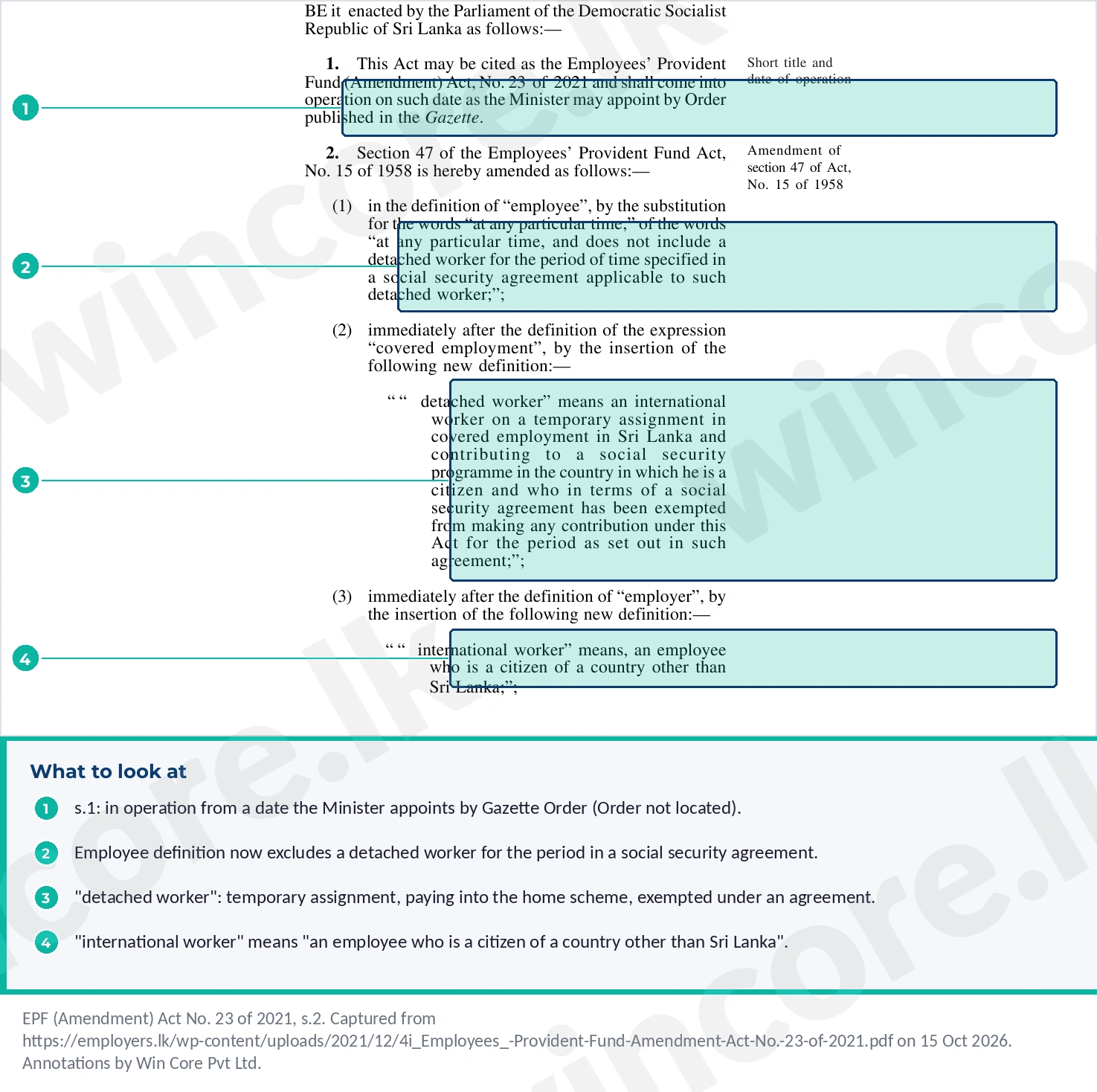
The Act came into operation "on such date as the Minister may appoint by Order published in the Gazette" [2]. We searched for that Order on 22 October 2026 and did not find it, so its commencement date stays open.
A director is out for the directorship, not for a separate job
Regulation 2(2)(a) is the director rule. It excludes "a person holding the office of director in respect of his employment as such director" [5]. The words "in respect of" limit it. On our reading, a director who also works under a separate contract of employment, such as a salaried managing director, is excluded for the board seat but covered for the job.
| Situation | Our reading | Basis |
|---|---|---|
| Director also employed under a contract (managing director, executive director on a salary) | Covered for that employment | Section 47 "in any capacity"; reg 2(2)(a) reaches only "employment as such director"; on our reading |
| Director paid only board fees for holding office | Excluded for those fees | Reg 2(2)(a) |
| Director paid nothing | No earnings, so no contribution base | Section 10 |
Where the boundary falls for a director who does some executive work without a written contract is a question of fact. Put the employment terms in writing, and split board fees from salary on the payroll. What an employer owes for months before it registered is in our guide to late EPF registration.
ETF uses the same employee words but has no detached worker rule
The ETF Act, No. 46 of 1980 defines "employee" in the same "in any capacity" words (s.44) [3]. The Board's published text, with amendments to 1993, has no detached worker exclusion [3]. On that text, a detached worker excluded from EPF is not excluded from ETF. ETF is 3 percent of total earnings, paid by the employer (s.16) [3]. Whether exclusions like those in EPF regulation 2(2) also apply to ETF depends on the ETF Act's own covered employment rules, which we have not read for this piece.
Late or missing contributions carry the ordinary EPF and ETF penalties
| Failure | Consequence | Section |
|---|---|---|
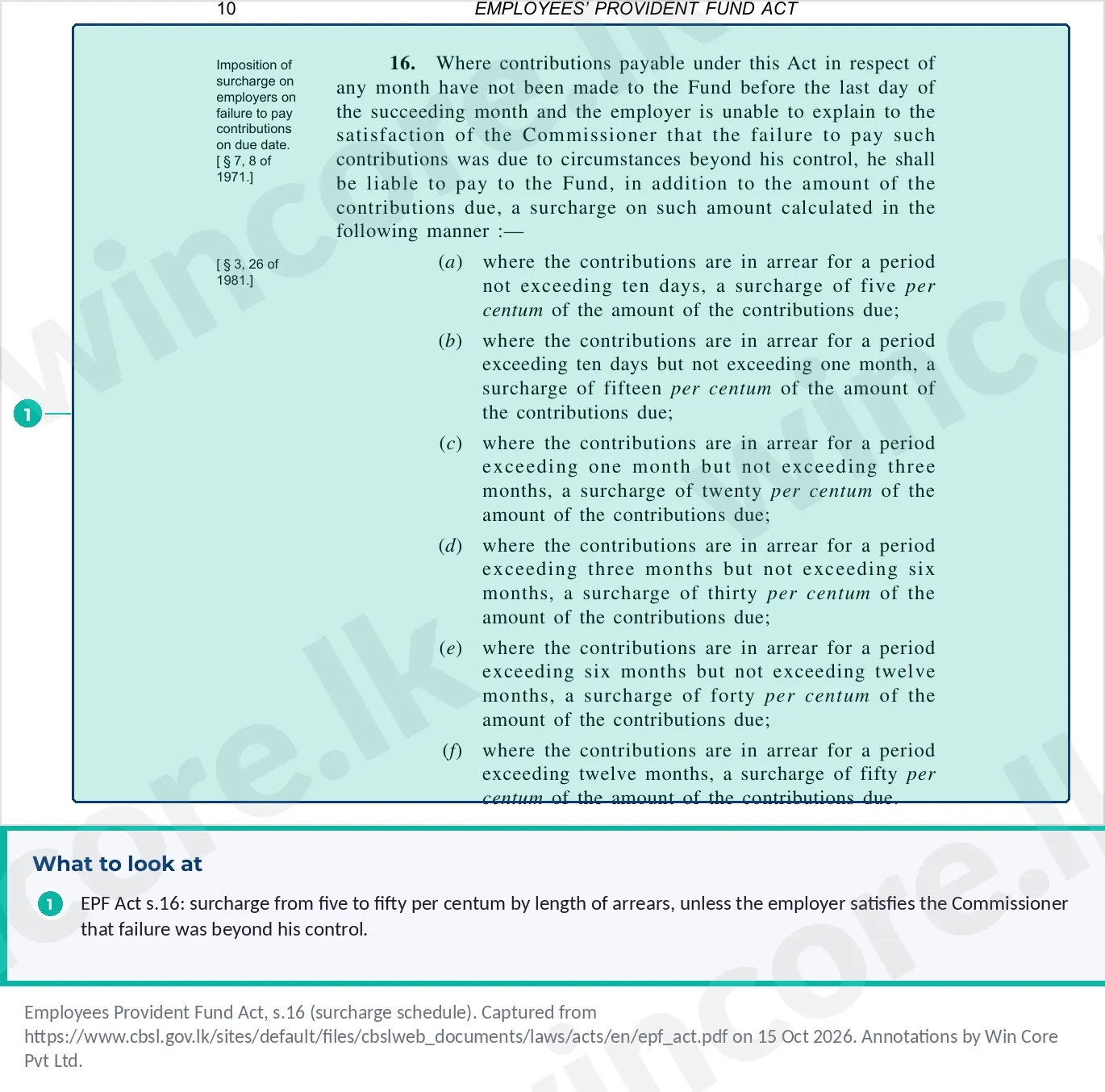
| EPF contribution late | Surcharge of 5 to 50 percent by length of delay | EPF s.16 [1] |
| ETF contribution late | Surcharge of 5 to 50 percent by length of delay | ETF s.27 [3] |
| Offence under the EPF Act | Fine up to Rs 2,500 or up to six months' imprisonment, or both, plus up to Rs 75 a day | EPF s.37, as amended by Act No. 2 of 2012 [4] |
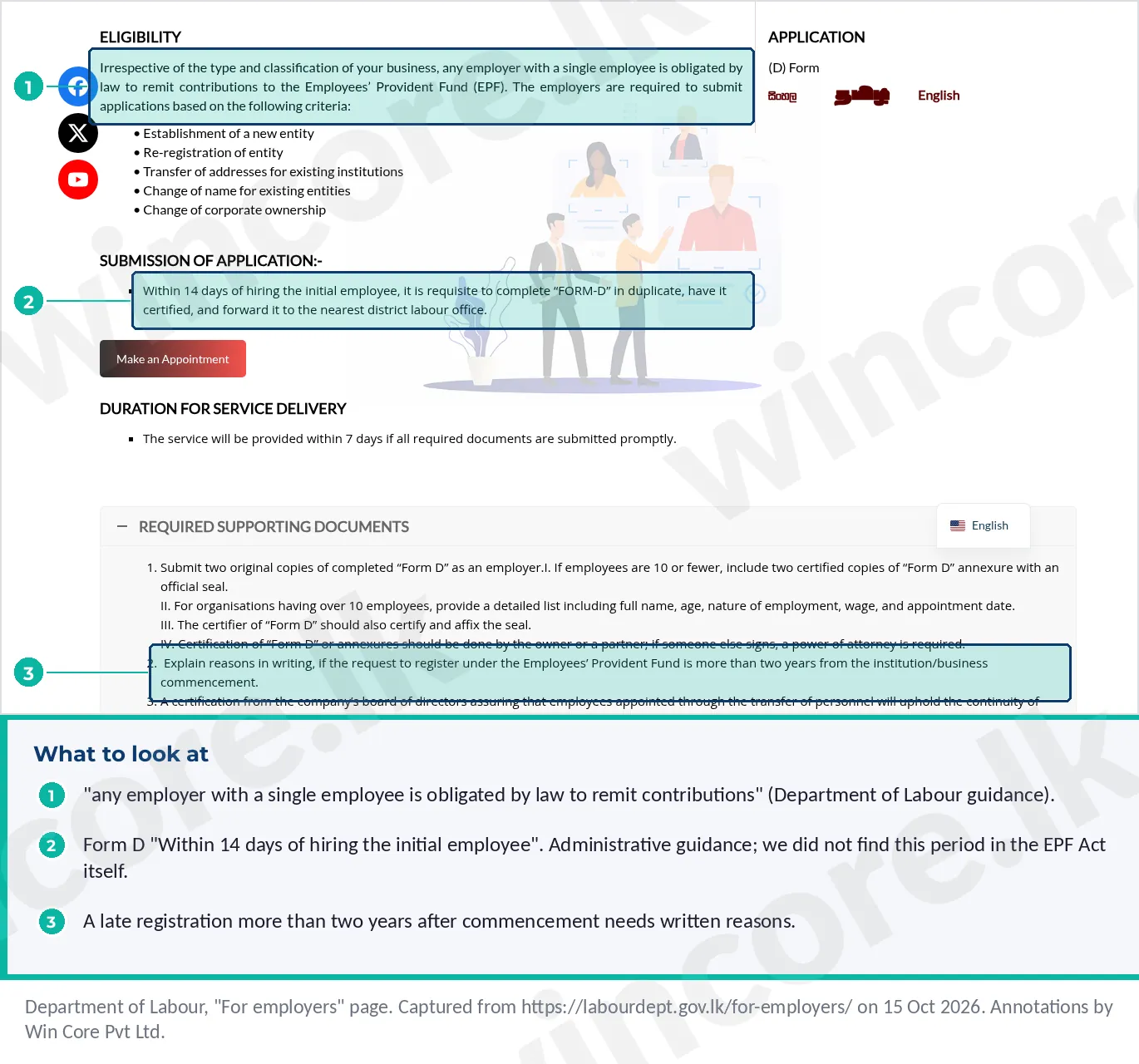
Our note on the EPF Act section 16 surcharge sets out the bands and the "beyond his control" proviso. An employer that has not yet registered sends Form D "within two weeks from the date he becomes so liable" (reg 8) [5]; our EPF employer registration guide covers the form.
What this means for you
Back to the manufacturer. The Indian production manager earns Rs 450,000 a month on a local contract and has no pension or provident scheme run outside Sri Lanka. No exclusion applies, so the employer deducts 8 percent (Rs 36,000), adds 12 percent (Rs 54,000) for EPF, and pays 3 percent (Rs 13,500) for ETF. September contributions are due by 31 October. If a pension for him were provided under a scheme run abroad, regulation 2(2)(c) could take him out of EPF, and the evidence would decide it. If the proposed Sri Lanka and India agreement comes into force, check whether its terms cover him.
The founder holds a contract as managing director at Rs 750,000 a month. On our reading, EPF is Rs 60,000 from her and Rs 90,000 from the company, and ETF is Rs 22,500. Board fees paid to her as a director alone would fall within regulation 2(2)(a).
If you employ foreign staff, assume EPF and ETF apply unless you can document an exclusion. If you pay directors, look at the contract, not the title. Our payroll services run EPF and ETF for foreign staff and directors, including the exclusion file.
Checklist: documents needed
- A list of everyone you pay, with nationality, role, contract type and any board seat
- Written employment contracts for directors who also work in the business
- Board resolutions fixing any directors' fees, kept separate from salary
- For a regulation 2(2)(c) claim: the scheme documents, who provides the benefits and where it is administered
- For a detached worker claim: the agreement reference, the home scheme certificate and the assignment dates
- Form D if the employer is not yet registered, and each month's EPF and ETF payment records
FAQ
Does EPF apply to foreign employees in Sri Lanka?
Yes, unless an exclusion applies. The EPF Act covers "any person" employed "in any capacity", and Act No. 23 of 2021 defines a foreign citizen employee as an "international worker". The exclusions are the detached worker under a social security agreement and the groups in regulation 2(2) of the 1958 Regulations, none of which depends on nationality [1] [2] [5].
What is a detached worker for EPF?
A foreign citizen on a temporary assignment in Sri Lanka who pays into the social security programme of his own country and is exempted under a bilateral social security agreement, for the period that agreement sets. Every element must be present. Without an agreement between Sri Lanka and the worker's country, the exclusion cannot apply [2].
Do company directors pay EPF in Sri Lanka?
Not for the directorship itself. Regulation 2(2)(a) excludes a person holding the office of director "in respect of his employment as such director". On our reading, a director who also works under a contract of employment, such as a salaried managing director, is covered for that employment, so EPF and ETF are paid on the salary but not on board fees [5].
Does ETF follow the same rules as EPF?
Partly. The ETF Act uses the same "in any capacity" definition of employee and charges the employer 3 percent of total earnings. Its published text, with amendments to 1993, has no detached worker exclusion, so a detached worker excluded from EPF may still be within ETF. Whether the EPF regulation 2(2) exclusions carry over to ETF is open [3].
Can a contract say a foreign employee is outside EPF?
No. The definition covers express, implied, oral and written contracts, so a clause saying EPF does not apply carries little weight unless a statutory exclusion actually applies. Our view is that only the documented exclusions in the Act and Regulations take someone out, and the surcharge for getting it wrong runs from the first unpaid month [1].
Open points
- The Gazette Order bringing Act No. 23 of 2021 into operation: not found in our search of 22 October 2026.
- Whether any social security agreement is in force, and with which countries: none identified; a Sri Lanka and India agreement was reported as proposed in August 2026.
- Later amendments to regulation 2 of the 1958 Regulations: not traced beyond the 1958 and 1964 Gazette references.
- Regulation 2(2)(c): whether a state social security scheme abroad counts as a scheme "established or administered outside Ceylon" for this purpose.
- ETF: whether the EPF regulation 2(2) exclusions, or a detached worker rule, apply to ETF.
- Labour Department practice on any of these points: no notice located.
Talk to us. If you employ foreign staff or pay your directors and want EPF and ETF set up correctly from the first month, our contact page.
WinCore Pvt Ltd
References
- Central Bank of Sri Lanka. Employees' Provident Fund Act, No. 15 of 1958 (reprint), ss.8, 10, 16, 37 and 47. https://www.cbsl.gov.lk/sites/default/files/cbslweb_documents/laws/acts/en/epf_act.pdf . Primary. Accessed 15 October 2026.
- Parliament of Sri Lanka. Employees' Provident Fund (Amendment) Act, No. 23 of 2021 (certified 13 October 2021), ss.1 and 2. https://employers.lk/wp-content/uploads/2021/12/4i_Employees_-Provident-Fund-Amendment-Act-No.-23-of-2021.pdf . Primary text, hosted by the Employers' Federation of Ceylon. Accessed 22 October 2026.
- Employees' Trust Fund Board. Employees' Trust Fund Act, No. 46 of 1980 (with amendments to 1993), ss.16, 27 and 44. https://etfb.lk/wp-content/uploads/2021/03/ETF-Act.pdf . Primary. Accessed 15 October 2026.
- Parliament of Sri Lanka. Employees' Provident Fund (Amendment) Act, No. 2 of 2012 (certified 9 February 2012), s.7 (text as reprinted in Central Bank of Sri Lanka, Annual Report 2012, Part IV). https://www.cbsl.gov.lk/sites/default/files/cbslweb_documents/publications/annual_report/2012/en/16_Part_04.pdf . Primary. Accessed 15 October 2026.
- Department of Labour. Employees' Provident Fund Act, No. 15 of 1958, with the Employees' Provident Fund Regulations, 1958, regs 2, 3, 4 and 8 (Labour Code copy). https://labourdept.gov.lk/downloads/labour_code/48.pdf . Primary. Accessed 22 October 2026.
- Daily Mirror. Sri Lankans working in India can continue Sri Lanka EPF contributions (4 August 2026). https://www.dailymirror.lk/breaking-news/Sri-Lankans-working-in-India-can-continue-Sri-Lanka-EPF-contributions/108-347365 . Secondary. Accessed 22 October 2026.
Put these insights to work
WinCore specialists can review your current workflow, document gaps, and build a practical 90-day action plan.
Book a free consultationContinue reading
Explore more WinCore analysis to keep your finance, tax, and compliance roadmap moving.
The four sections behind EPF and ETF: rates, the due day, the 5 to 50 percent ladder, who judges 'beyond control', and what Act No. 2 of 2012 changed.
Registered with the Department of Labour months after the first hire? What is owed for each past month, the surcharge step, and why it never time-bars.

How to register as an EPF employer in Sri Lanka: Form D, the employer number, why ETF needs no registration, Form C each month and what to do when details change.