
Late EPF registration in Sri Lanka: what is owed from the first hire
Registered with the Department of Labour months after the first hire? What is owed for each past month, the surcharge step, and why it never time-bars.
On this page
Last verified against the primary sources on 21 October 2026.
Late EPF registration in Sri Lanka does not move the start date. EPF (8 percent from the employee, 12 percent from the employer) and ETF (3 percent from the employer) are due for every month of covered employment from the first hire, each by the last day of the following month, whatever date Form D was filed (EPF Act s.10, ETF Act s.16). Form D itself is due within two weeks of becoming liable to contribute, which the Department of Labour states as 14 days from hiring the first employee.
Many employers set up payroll before they think about the Department of Labour. Staff are hired, salaries are paid, and only later does someone ask for an EPF employer number. By then the question is no longer how to register. It is what is already owed.
This piece answers two questions. When is registration due? And do contributions run from the start of employment or from registration? It builds on our guides to EPF and ETF contributions and the surcharge ladder and to EPF employer registration, and does not change either.
Instruments: Employees' Provident Fund Act, ss.8, 10, 15, 16, 17, 21 and 47 [1]; Employees' Trust Fund Act, ss.16, 27, 28 and 31 [2]; Shop and Office Employees (Regulation of Employment and Remuneration) Act, ss.17 and 18 [3]; Department of Labour guidance [4] [5].
Form D is due within 14 days of the first hire
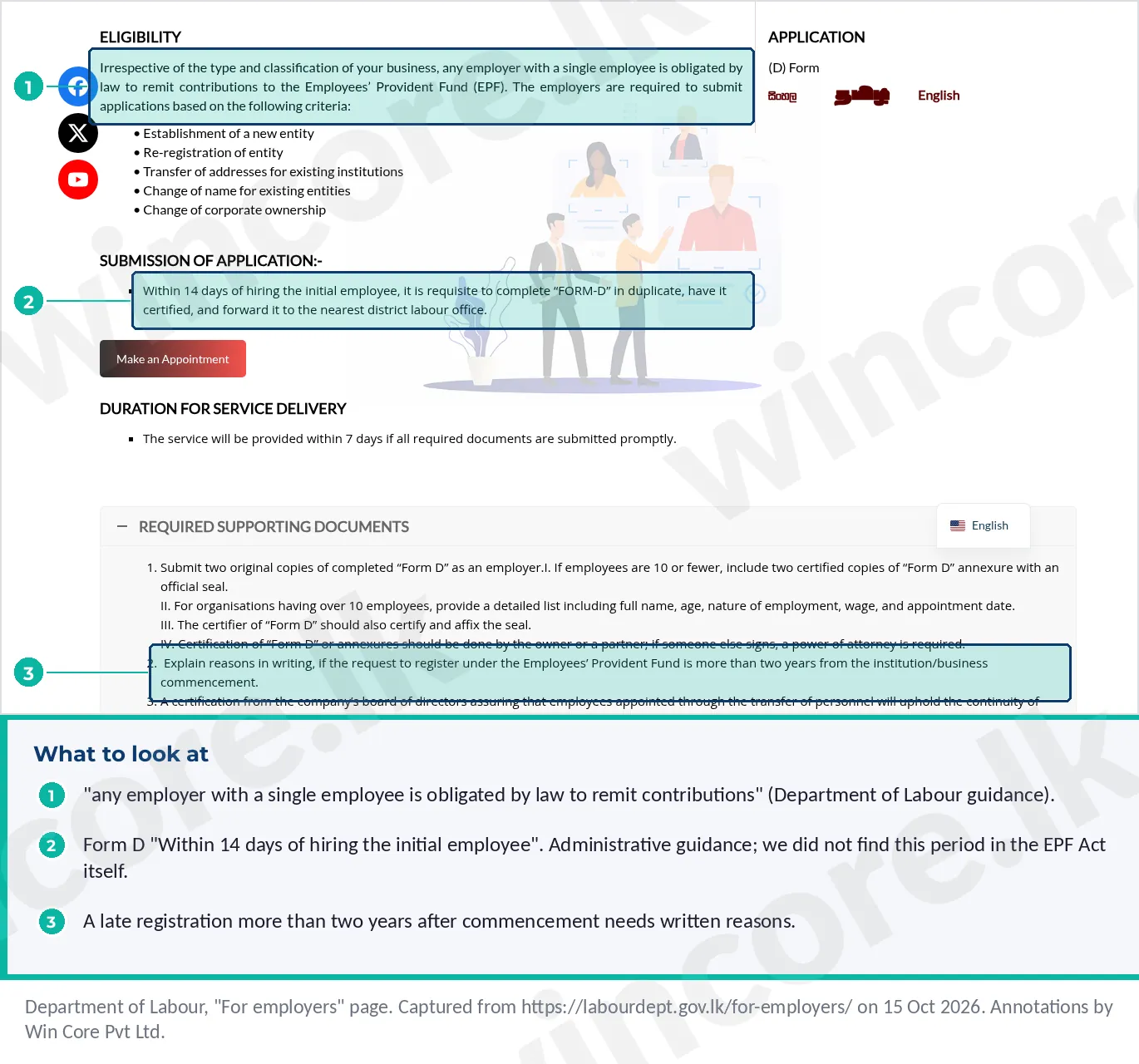
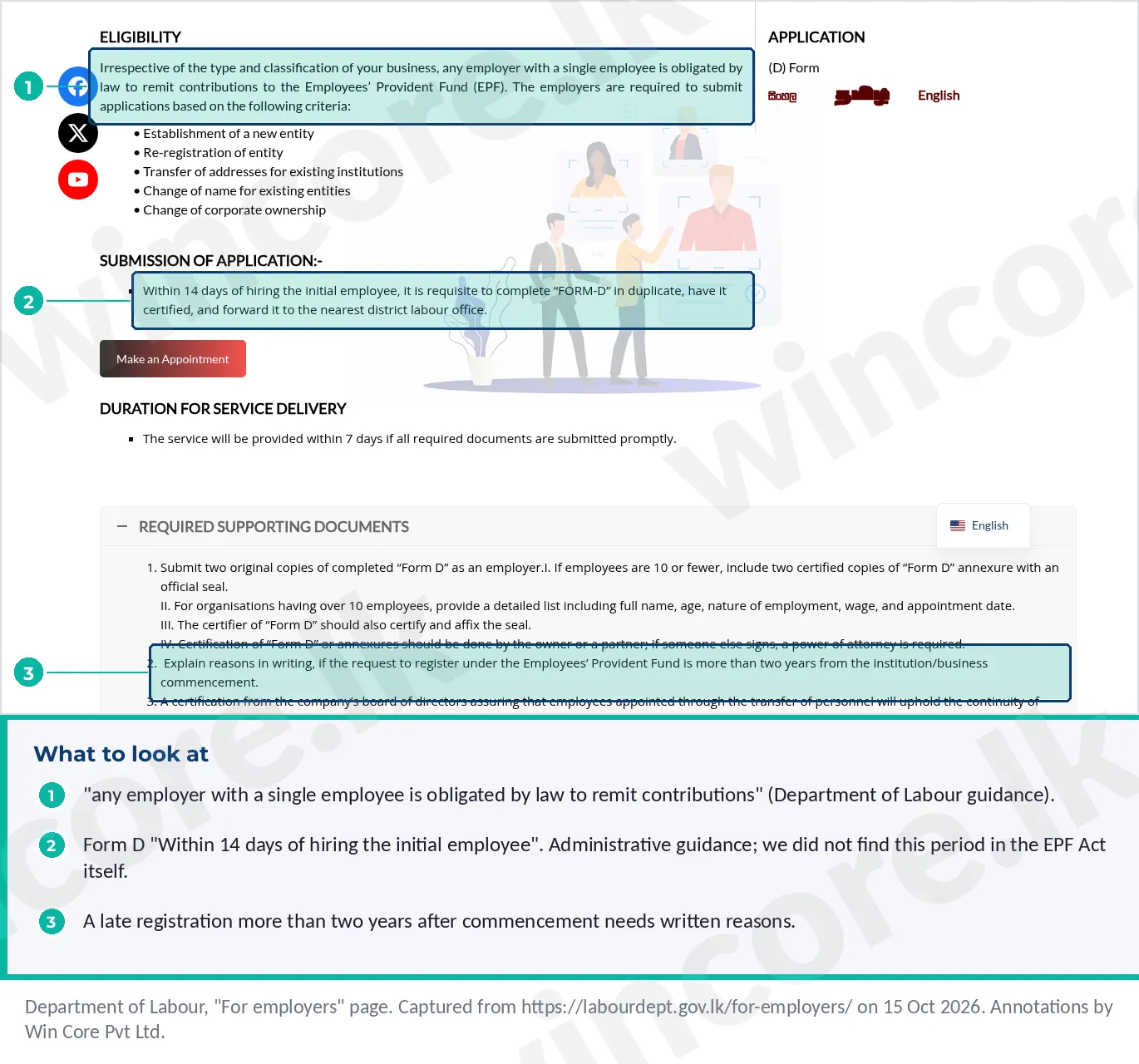
The Department of Labour says: "Within 14 days of hiring the initial employee, it is requisite to complete "FORM-D" in duplicate, have it certified, and forward it to the nearest district labour office" [4]. The registration page lists what goes with it: two originals of Form D, the Form D annexure for ten or fewer employees, or for more than ten a list "including full name of employee, age, nature of employment, wage and date of appointment" [5].
Where does the 14-day period come from? Not from the EPF Act itself. Regulation 8 of the Employees' Provident Fund Regulations 1958, made under section 46, requires the employer to send Form D within two weeks of the date it becomes liable to pay contributions [6]. The Department's "14 days of hiring the initial employee" is the same rule in plain terms.
The same guidance also expects late registrations. It asks for "a written statement containing reasons" if "the gap between the date of commencement or registration of the institution/ business and the date of registration in Employees' Provident Fund is more than 02 years" [5]. That tells you two things. Late registration happens often enough to have its own rule, and the Department will look at the gap.
Contributions run from employment, not registration
This is the point that matters most for money. Section 10(2) of the EPF Act makes the employer of "every employee to whom this Act applies" liable, "in respect of each month during which such employee is in a covered employment", to pay "twelve per centum" of total earnings "on or before the last day of the succeeding month" [1]. Section 10(1) sets the employee's eight percent on the same monthly basis, and section 15 requires the employer to deduct and pay it [1].
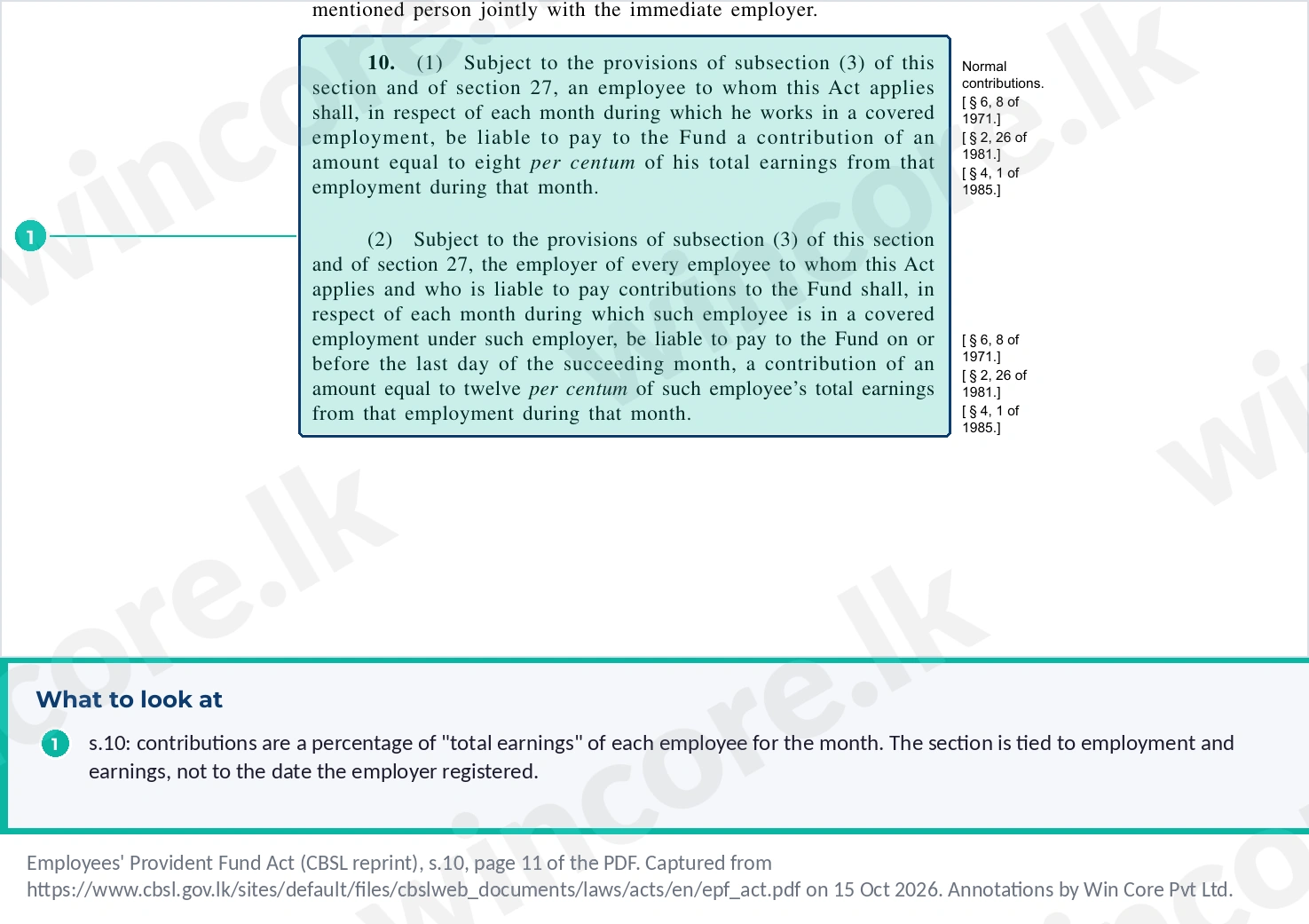
Nothing in that text refers to the employer's registration. The trigger is a month of covered employment and the earnings for it. The ETF Act works the same way: the employer pays "three per centum of the total earnings" of each employee for the month, by the same due day (ETF s.16) [2].
So on our reading, an employer that hired its first employee in January and registered in September owed contributions for each month from January. Each month's contribution fell due on the last day of the following month. Registration gives the employer a number to pay against. It does not start the liability.
Think of registration as the account number on an invoice that was issued months ago. Getting the number late does not change the date on the invoice.
The proviso: "to whom this Act applies"
Should we say contributions are always due for every worker? No. Section 8(3) applies the Act to "every person over a prescribed age who is employed by any other person in any covered employment", and "covered employment" is an employment "declared by regulation" [1]. Regulation 2(2) of the EPF Regulations 1958 then excludes, among others, "a person holding the office of director in respect of his employment as such director", a partner in respect of the partnership, a person in "managerial, executive or technical employment" whose superannuation or termination benefits come from a fund or scheme "established or administered outside Ceylon", and a person employed outside Ceylon who is not ordinarily resident in Ceylon [6]. A detached worker under a social security agreement is outside the definition of employee for the agreed period. On our reading, a director who also holds a salaried post, such as a managing director under an employment contract, is covered for that employment, while fees for the directorship alone are not. Outside those exclusions, foreign nationals and resident staff are covered alike.
What late EPF registration leaves owing for past months
For each past month, three amounts can be due.
| Amount | Section | Note |
|---|---|---|
| EPF contribution, 12 percent employer plus 8 percent employee | EPF s.10, s.15 | Employer pays both; the employee share should have been deducted at the time |
| ETF contribution, 3 percent employer | ETF s.16 | No employee share |
| Surcharge, 5 to 50 percent of the contribution by length of arrears | EPF s.16; ETF s.27 | Not due if the employer explains to the Commissioner (EPF) or Board (ETF) that the failure "was due to circumstances beyond his control" |
Two further rules make the arrears harder to escape:
- No time bar. "The provisions of the Prescription Ordinance shall not apply to the recovery of any sums payable as contributions or surcharges" (EPF s.17(3)); the ETF Act has the same rule in s.28(6) [1] [2].
- First charge. Any sum due from an employer after its due date is "the first charge on his assets" (EPF s.21; ETF s.31) [1] [2].
- Offence penalty, separate from the surcharge. Section 37 of the EPF Act, as amended by section 7 of Act No. 2 of 2012, sets the penalty for offences under the Act on summary conviction: a fine up to Rs 2,500, or imprisonment up to six months, or both, plus up to Rs 75 for each day the offence continues after conviction [1] [7]. Which limb of the offence section a late Form D falls under is an open point; the surcharge is the amount that accrues month by month.
There is also a rule about who bears it. Section 20 of the EPF Act prohibits deducting from an employee's earnings "any sum which that employer is liable to pay as a contribution or surcharge" [1]. Whether an employer can now recover the employee's 8 percent for past months that it failed to deduct is not answered by section 20 in terms. Section 20 is about the employer's share and surcharges. We treat late recovery of the employee share as open, and we would not do it without the employee's written agreement.
Can the surcharge be avoided for the months before registration?
Only through the proviso. "We had not registered yet" is unlikely to be "circumstances beyond his control", since registration is the employer's own step. A real external cause, such as a bank system failure or a court order freezing the account, is a different case. Our piece on the EPF surcharge appeal and evidence file covers how to put the explanation.
Figure 3. Late registration and arrears, step by step. Illustrative diagram, not a screenshot.
Form D is not Shop and Office registration
People often call Form D "Shop and Office registration". It is not. The Shop and Office Employees Act regulates hours, holidays and pay. Its record duties are in sections 17 and 18: the employer must give each person "on the date of his employment" the prescribed particulars of conditions of employment, keep a notice listing persons employed, and keep a record of "the hours actually worked by each such person" [3]. We found no employer registration duty in that Act. Registration with the Department of Labour, in the sense of an employer number, is the EPF process. The Shop and Office records still matter here, because they are the best evidence of when each person started.
Before agreeing an arrears figure, reconcile the payroll to EPF and ETF records for every affected month.
A worked example: six months late costs 40 percent
Take a hypothetical trading company in Kandy, paying staff in rupees. It hired its first employee in May 2025, filed Form D in December 2025 and paid all arrears on 31 December 2025.
May's contributions fell due on 30 June 2025. Paid on 31 December, they were more than six months but not more than twelve months in arrears, so the step is 40 percent of the contribution (EPF s.16(e); ETF s.27(e)) unless the employer shows the delay was beyond its control. If May's EPF was Rs 20,000 (12 percent plus 8 percent on Rs 100,000 of earnings) and ETF Rs 3,000, the surcharges are Rs 8,000 and Rs 1,200. Later months sit on lower steps. The gap is under two years, so no written reasons are needed with Form D. Our EPF calculator gives each month's contribution.
What this means for you
- File Form D within 14 days of the first hire (reg 8 of the EPF Regulations 1958).
- Count from the first month of employment. Contributions and the due dates run from then, whatever the registration date.
- Calculate arrears month by month, with the surcharge step for each month.
- Do not deduct the employer's share or surcharges from staff (EPF s.20; ETF s.30).
- If an external cause delayed you, document it now and put it to the Commissioner and the Board.
Checklist: documents needed
- Two originals of Form D, certified and sealed
- Form D annexure (10 or fewer staff) or a staff list with name, age, job, wage and appointment date
- Appointment letters or Shop and Office records proving each start date
- Monthly earnings for each employee from the first month of employment
- Written reasons, if registration comes more than two years after the business started
- Evidence of any external cause of delay, for the "beyond his control" explanation
Our payroll and EPF/ETF services team can rebuild the contribution schedule from appointment dates.
FAQ
Does late EPF registration reset the start date for contributions?
No. EPF s.10 and ETF s.16 make contributions due for each month of covered employment, by the last day of the following month. The trigger is employment and earnings, not the registration date. Registration gives you an employer number to pay against; it does not start or restart the liability [1] [2].
How many days does an employer have to register for EPF in Sri Lanka?
Two weeks. Regulation 8 of the EPF Regulations 1958 requires Form D within two weeks of becoming liable to contribute, and the Department of Labour states it as 14 days from hiring the first employee. File two certified originals at the nearest district labour office with the staff annexure or list [4] [6].
Can old EPF arrears become time-barred?
No. EPF s.17(3) and ETF s.28(6) say the Prescription Ordinance does not apply to the recovery of contributions or surcharges. Arrears from years ago stay recoverable, with the surcharge step for each month, and any sum due is a first charge on the employer's assets [1] [2]. For who bears the employee share on arrears, see EPF arrears and the employee share.
Is the EPF surcharge automatic for late registration?
It applies unless the employer satisfies the Commissioner (EPF) or the Board (ETF) that the failure was due to circumstances beyond its control. Not having registered yet is the employer's own step, so it is a weak explanation. Put any genuine external cause in writing with the evidence [1] [2].
Two points still open
- Recovering the employee's 8 percent for past months. Section 20 does not answer it in terms.
- Covering regulations. Which employments are "declared by regulation" to be covered employment was not reviewed for this piece.
One limit: beyond regulation 8, we have not reviewed every regulation behind the forms. A regulation could add a rule we have not seen.
Talk to us. If you hired before you registered, contact us at our contact page and we will help you work out the arrears month by month.
WinCore Pvt Ltd
References
- Central Bank of Sri Lanka. Employees' Provident Fund Act, No. 15 of 1958 (reprint), ss.8, 10, 15, 16, 17, 20, 21 and 47. https://www.cbsl.gov.lk/sites/default/files/cbslweb_documents/laws/acts/en/epf_act.pdf . Primary. Accessed 21 October 2026.
- Employees' Trust Fund Board. Employees' Trust Fund Act, No. 46 of 1980 (with amendments to 1993), ss.16, 27, 28, 30 and 31. https://etfb.lk/wp-content/uploads/2021/03/ETF-Act.pdf . Primary. Accessed 21 October 2026.
- Shop and Office Employees (Regulation of Employment and Remuneration) Act (Chapter 129), ss.17 and 18. https://www.lawnet.gov.lk/wp-content/uploads/Legislative_html/1956Y5V129C.html . Primary. Accessed 21 October 2026.
- Department of Labour. For employers (EPF employer registration, Form D). https://labourdept.gov.lk/for-employers/ . Primary. Accessed 21 October 2026.
- Department of Labour. Registration and Re-registration of Employees. https://labourdept.gov.lk/registration-and-re-registration-of-employees/ . Primary. Accessed 21 October 2026.
- Department of Labour. Employees' Provident Fund Regulations 1958, regs 2(2) and 8 (Labour Code). https://labourdept.gov.lk/downloads/labour_code/48.pdf . Primary. Regulation 2(2) read 22 October 2026; regulation 8 verified 15 October 2026.
- Parliament of Sri Lanka. Employees' Provident Fund (Amendment) Act, No. 2 of 2012 (certified 9 February 2012), ss.5 and 7, as reprinted in Central Bank of Sri Lanka, Annual Report 2012, Part IV. https://www.cbsl.gov.lk/sites/default/files/cbslweb_documents/publications/annual_report/2012/en/16_Part_04.pdf . Primary. Accessed 21 October 2026.
Put these insights to work
WinCore specialists can review your current workflow, document gaps, and build a practical 90-day action plan.
Book a free consultationContinue reading
Explore more WinCore analysis to keep your finance, tax, and compliance roadmap moving.

How to register as an EPF employer in Sri Lanka: Form D, the employer number, why ETF needs no registration, Form C each month and what to do when details change.
The employer's guide to EPF and ETF in Sri Lanka for 2026: who is covered, 8, 12 and 3 percent, what counts as earnings, the due date, the surcharge ladder and forms.

Monthly EPF and ETF payment procedures for Sri Lankan employers: the last working day deadline, Form C and e-returns, ETF electronic payment, surcharges and evidence.