
EPF surcharge appeal Sri Lanka: routes, evidence and disclosure
Got an EPF or ETF surcharge notice? Where you can challenge it, the 30-day ETF clock, what to keep on file, and how the disputed amount is shown.
On this page
Last verified against the primary sources on 21 October 2026.
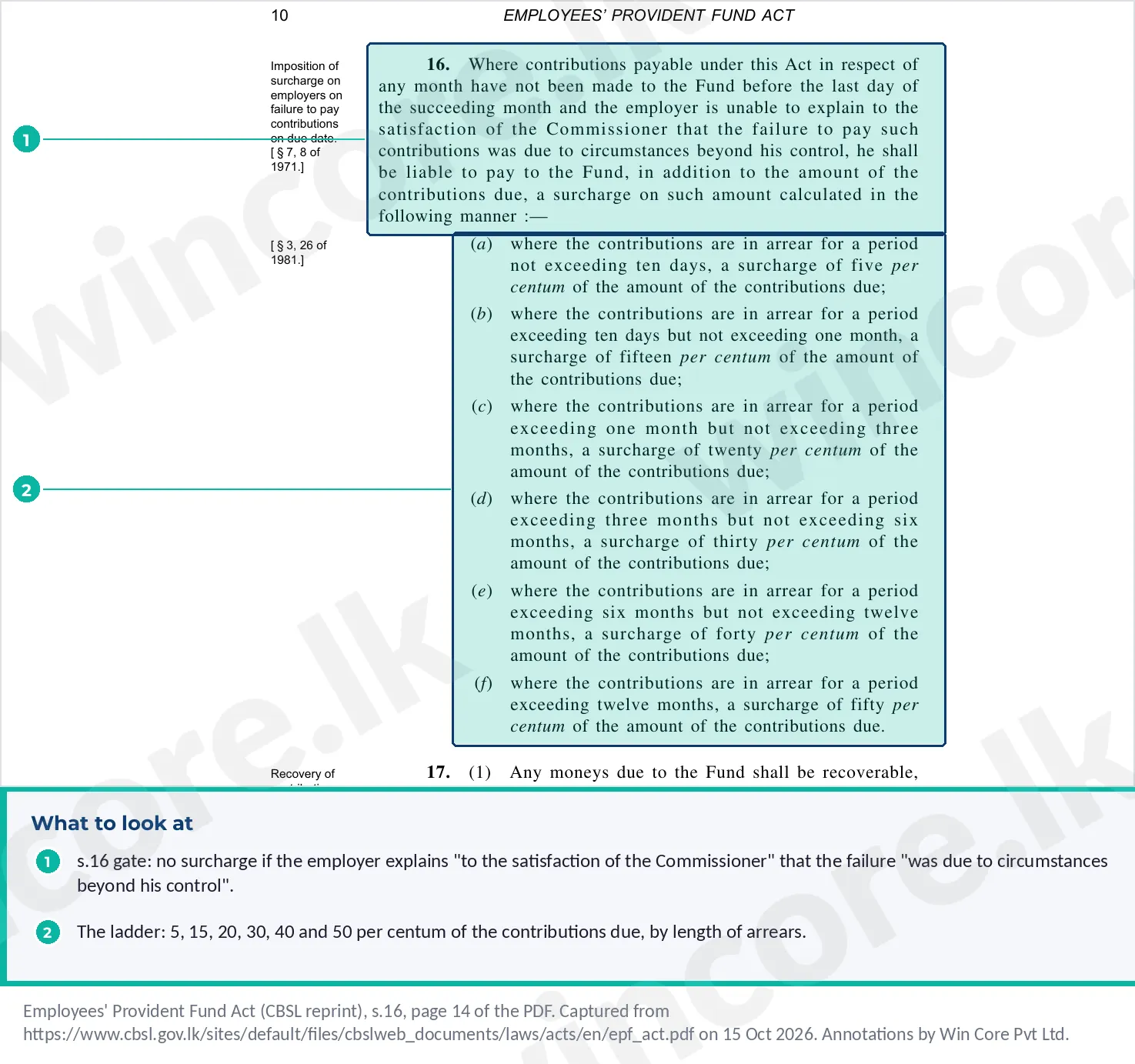
There is no express EPF surcharge appeal in Sri Lanka's EPF Act. The route the Act spells out is the explanation under section 16 that the late payment "was due to circumstances beyond his control", made to the Commissioner. The ETF Act does allow an appeal to the Court of Appeal on a question of law within 30 days of a Board determination (s.34), but whether that reaches a surcharge decision is open. The surcharge itself runs from 5 to 50 percent of the contribution by how late it is (EPF s.16, ETF s.27).
A surcharge notice usually arrives long after the late payment that caused it. By then the finance team wants three answers. Can we challenge it? What do we need to show? And what goes in the accounts while the question is open?
This piece answers each one from the EPF and ETF Acts. It builds on our guide to EPF and ETF contributions and the surcharge ladder and our EPF and ETF guide for 2026, and does not change any figure there. Where the Acts are silent on appeals, we say so.
Instruments: Employees' Provident Fund Act, ss.16, 17, 21, 27(2A), 28, 29, 31A, 37, 38 and 46 [1]; Employees' Provident Fund (Amendment) Act, No. 2 of 2012, ss.5 and 7 [3]; Employees' Trust Fund Act, ss.27, 28, 31, 33, 34 and 37A [2]; Constitution, Article 140 [4].
Each EPF and ETF surcharge has its own section
| Default | Section | Surcharge |
|---|---|---|
| EPF contribution in arrears, not over ten days | EPF s.16(a) | "five per centum" of the contributions due |
| Over ten days, not over one month | EPF s.16(b) | 15 percent |
| Over one month, not over three months | EPF s.16(c) | 20 percent |
| Over three months, not over six months | EPF s.16(d) | 30 percent |
| Over six months, not over twelve months | EPF s.16(e) | 40 percent |
| Over twelve months | EPF s.16(f) | "fifty per centum" |
| Same defaults, approved provident fund or pension scheme | EPF s.27(2A) | Same steps |
| ETF contribution in arrears, same bands | ETF s.27(a) to (f) | Same 5 to 50 percent steps |
| EPF return late, incorrect or deficient | EPF s.31A, rate as amended by Act No. 2 of 2012 s.5 | "two per centum" of the contribution for each completed month or part month |
| ETF return late, incorrect or deficient | ETF s.37A | "one per cent" of the contribution for each completed month or part month |
The contribution surcharge is "in addition to the amount of the contributions due" (EPF s.16) [1]. It does not replace the contribution. Each step is set by how long the contribution was in arrears, measured from the due date at the end of the month after the wage month. The reprint of the EPF Act on the CBSL site runs to 1998 and still shows 1 percent in s.31A; Act No. 2 of 2012 raised it to 2 percent [3].
The surcharge is not the only consequence. Offences under the EPF Act carry, under s.37 as amended by Act No. 2 of 2012, a fine up to Rs 2,500, or imprisonment up to six months, or both, plus up to Rs 75 a day while the offence continues after conviction [1] [3]. That is a criminal penalty on conviction, separate from the surcharge, and the routes below are about the surcharge.
Where an EPF surcharge appeal lies: four routes
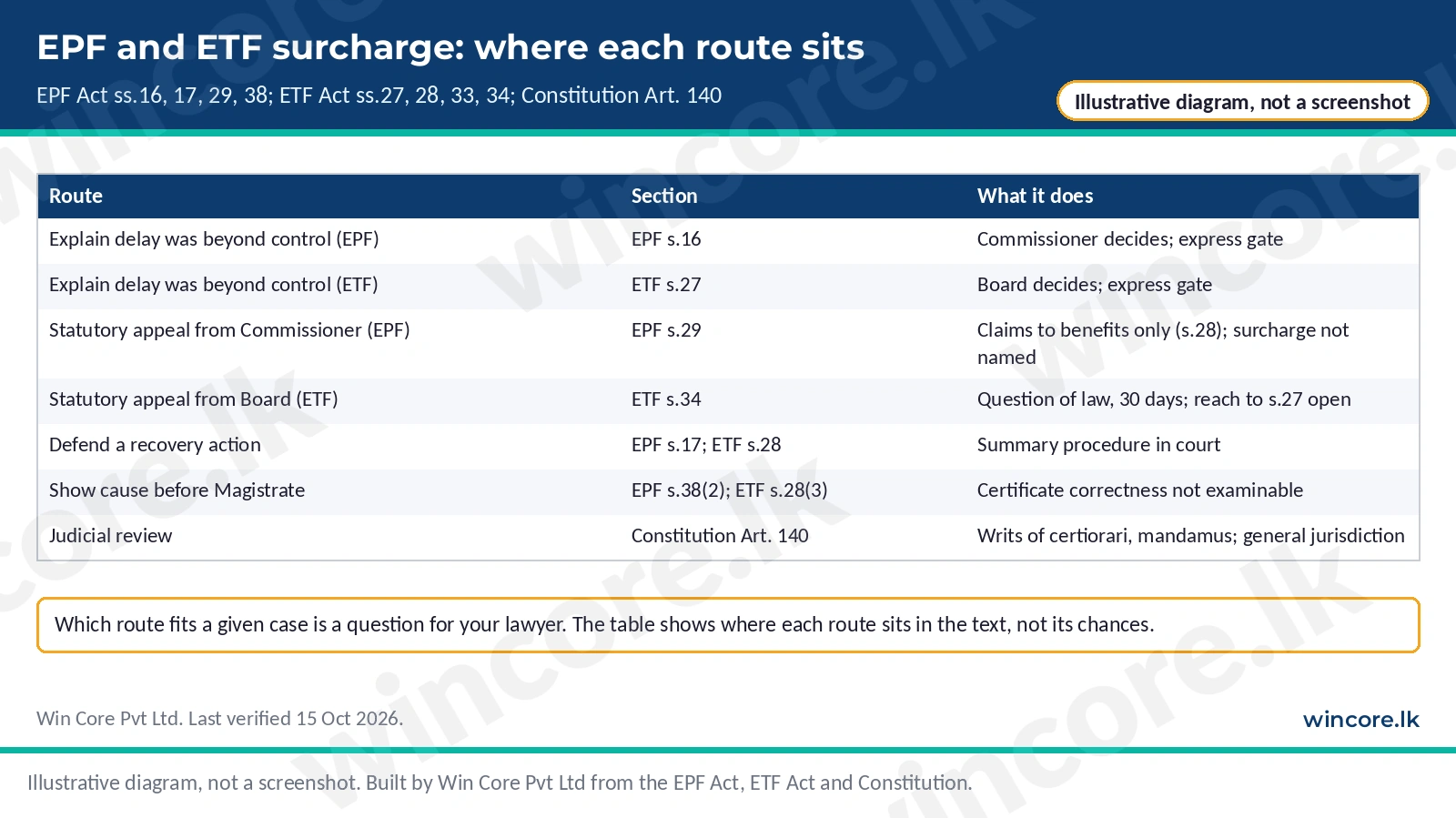
Route one: the explanation, which is the statutory gate
Every surcharge under EPF s.16 has a condition built in. It applies where contributions were not paid on time "and the employer is unable to explain to the satisfaction of the Commissioner that the failure to pay such contributions was due to circumstances beyond his control" [1]. ETF s.27 has the same words, but the explanation must satisfy "the Board" [2]. The return surcharges have similar gates: ETF s.37A asks whether the employer can "explain to the satisfaction of the Board" [2].
So the first route is not an appeal at all. It is the explanation itself. It sits inside the section that creates the liability, and it is the only route the Acts spell out for the surcharge. Put it early, put it in writing, and send it to both the Commissioner and the Board when both funds are affected.
Route two: a statutory appeal, where one exists
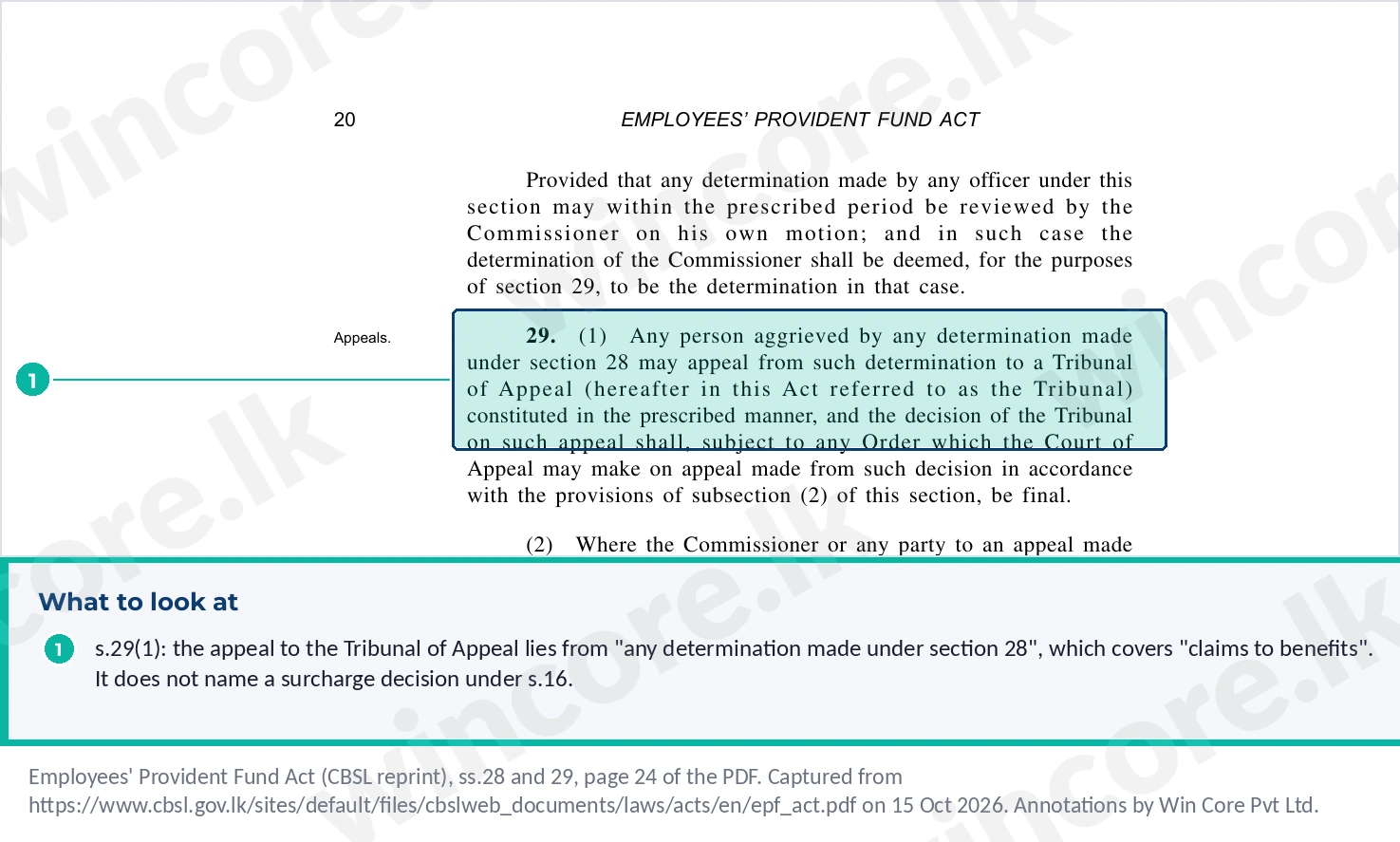
EPF. The EPF Act has an appeal section, but it is narrow. Section 29(1) says "Any person aggrieved by any determination made under section 28 may appeal" to a Tribunal of Appeal [1]. Section 28 covers "All claims to benefits". A surcharge decision under section 16 is not a claim to benefits.
There is one loose thread. Section 46(1)(l) lets the Minister make regulations "to provide for matters arising (i) pending the determination under this Act (whether in the first instance or on appeal) of any claim to a benefit or of any question affecting any person's right to a benefit or any person's liability for contributions to the Fund" [1]. That wording contemplates questions about "liability for contributions" being decided, possibly on appeal. We have not found regulations that set up such an appeal for surcharges. So for EPF, on the Act alone, we found no express statutory appeal from a section 16 decision. That is an open point, not a conclusion that none exists.
ETF. The ETF Act is wider in its words. Section 34(1) says "Any person dissatisfied with the determination of the Board may, by written petition ..., appeal to the Court of Appeal from that determination on a question of law" [2]. The petition must be filed "within thirty days of the communication of the determination", and the communication date is "deemed to be the date on which such determination is posted under registered cover" (s.34(3)) [2].
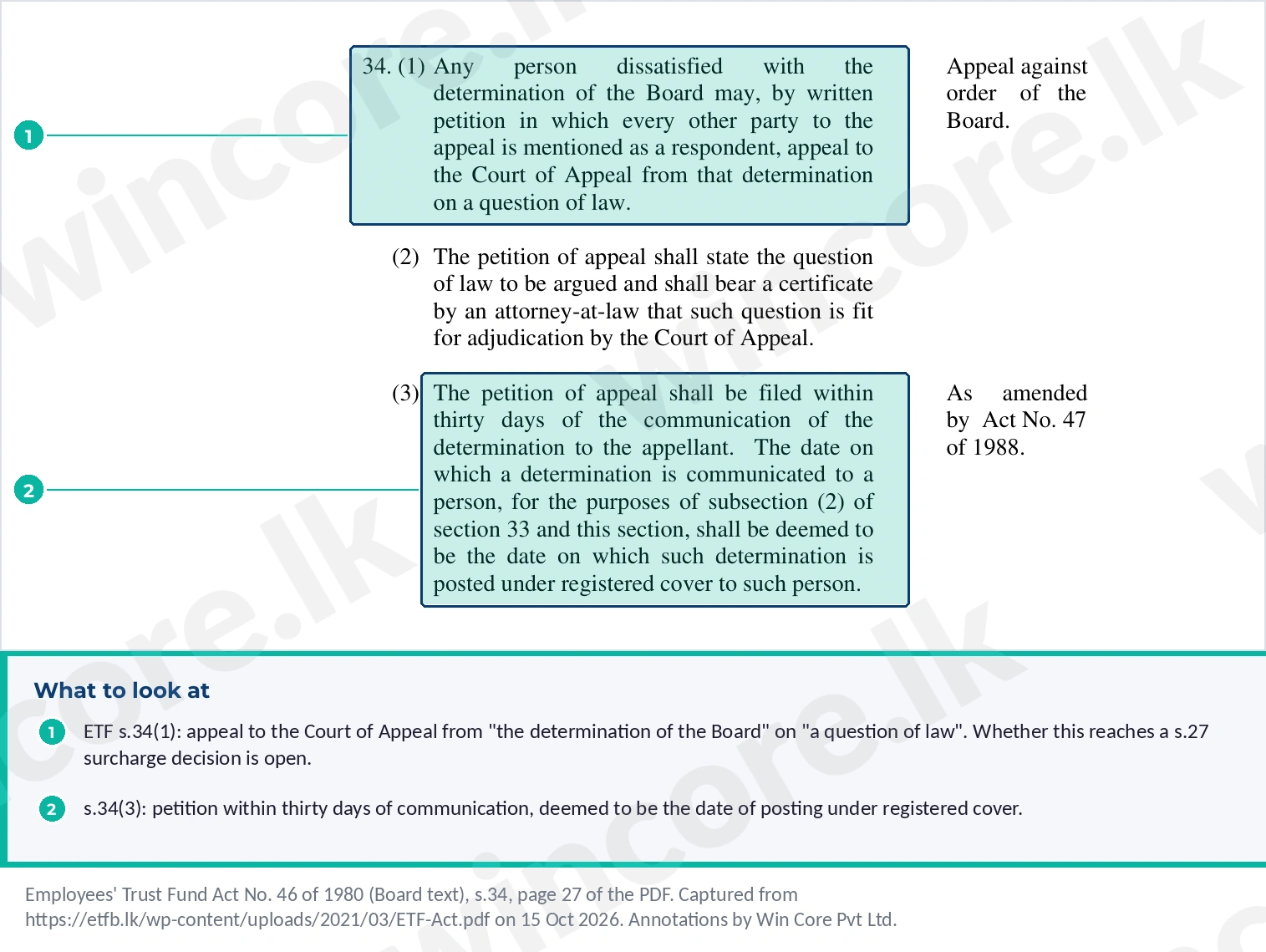
Does section 34 reach a Board decision under section 27 that an explanation was not good enough? The text says "the determination of the Board", without limiting it. But it follows section 33, which is about "claims to any payment from the Fund". Read narrowly, it is a benefits appeal like EPF s.29. Section 33(2) also gives an appeal to the Board, within thirty days, from "a determination made by an officer of the Board", again in the claims context. Read on its words, it covers any Board determination. We treat this as open. If an employer intends to rely on it, the 30-day clock from posting is the date to diary, and the appeal is on a question of law only.
Route three: when the Fund sues or certifies
If the surcharge is not paid, the Commissioner can sue. EPF s.17(1) makes "any moneys due to the Fund" recoverable "as a debt due to the State, by an action in which proceedings may be taken by way of summary procedure" [1]. In that action the employer is a party and can seek to defend, subject to the summary procedure rules of the Civil Procedure Code.
Section 38 is different. Where recovery under section 17 is "impracticable or inexpedient", the Commissioner may issue a certificate to the District Court for seizure and sale, or to a Magistrate, who summons the employer "to show cause" [1]. Section 38(3) then says: "The correctness of any statement in a certificate issued by the Commissioner for the purposes of this section shall not be called in question or examined by the court" [1]. ETF s.28(4) has the same rule for the Board's certificate [2].
The practical lesson is about timing. Once a certificate issues, the amount is largely fixed. The argument about whether the delay was beyond your control belongs before that stage.
Route four: judicial review
Article 140 of the Constitution gives the Court of Appeal power to issue "orders in the nature of writs of certiorari, prohibition, procedendo, mandamus and quo warranto" against "any Court of First Instance or tribunal or other institution or any other person" [4]. That jurisdiction is general. Whether and how it applies to a particular surcharge decision is a matter for a lawyer, and we do not predict outcomes.
Build the evidence file from the day of the late payment
The Acts set the test, "circumstances beyond his control", but do not list the evidence. What follows is general practice, not a statutory list. Think of the file as the minutes of a meeting nobody can reconvene: whatever is not written down at the time is lost.
- The timeline. For each wage month: the due date, the date paid, and the days in arrears. This fixes the ladder step for each month.
- Proof of payment. Bank debit advice, payment references and the remittance file for each month.
- The cause. Documents from the time showing the external event: a bank or system failure notice, a payment system outage notice, a court order freezing accounts. Internal emails showing the team tried to pay.
- The explanation sent. The letter to the Commissioner and to the Board, the date sent, and proof of posting. For ETF, registered post fixes the communication date under s.34(3).
- Their reply. Any decision, with the envelope or posting date.
- Payroll records. Appointment dates and earnings for each employee, which also support the contribution base.
Is "we were short of cash" beyond the employer's control? On the plain words, it is a weak case. The section asks about circumstances beyond the employer's control, and an employer's own cash position is usually within it. A sudden external freeze on accounts is a different case.
Two funds, one letter
EPF and ETF share a ladder but not a decision-maker. A single late month usually creates two surcharges, one decided by the Commissioner and one by the Board. One letter with two addressees is efficient. Two inconsistent letters are worse than none, because each can be read against the other.
Only the disputed surcharge is a contingent liability question
This section describes general practice. It is not advice on Sri Lanka Accounting Standards, and we do not cite or interpret those standards here. Your auditor and the preparers decide recognition and disclosure.
In general practice, finance teams separate three amounts:
- The unpaid contribution itself. It is due under EPF s.10 and ETF s.16 whatever the dispute. It is usually treated as a liability, not a contingency.
- The surcharge already assessed and not disputed. Usually treated the same way.
- The surcharge in dispute. This is where teams consider whether it is a contingent liability, based on how likely the explanation or appeal is to succeed.
Three statutory points usually feed that judgment. There is no time bar: the Prescription Ordinance "shall not apply" to contributions or surcharges (EPF s.17(3); ETF s.28(6)) [1] [2]. The sum due is "the first charge on his assets" (EPF s.21; ETF s.31) [1] [2], which lenders may ask about. And once a section 38 certificate issues, the amount is not examinable in those proceedings.
A worked example
Take a manufacturer whose bank account was frozen by a court order for six weeks. March contributions fell due on 30 April and were paid on 20 May. That is more than ten days and not more than one month in arrears, so the step is EPF s.16(b) and ETF s.27(b), 15 percent of each, unless the explanation is accepted. The evidence file holds the court order, the bank's freeze notice, the payment date and the letters to both funds. The disclosure note, in general practice, separates the paid contributions from the disputed 15 percent.
What this means for you
- Map each month to its step under EPF s.16 and ETF s.27.
- Explain early, in writing, to the Commissioner and the Board, with the evidence attached.
- Diary 30 days from posting of any Board decision, in case s.34 applies.
- Act before a certificate issues. After it, the amount is largely fixed.
- Keep the evidence file from the day of the late payment.
- Ask your auditor about recognition and disclosure.
Checklist: documents needed
- Timeline for each wage month: due date, date paid, days in arrears, ladder step
- Bank debit advice and remittance file for each month
- Documents from the time showing the external cause of the delay
- The explanation letter to the Commissioner and to the Board, with proof of posting
- Each reply or determination, with the envelope or registered post date
- Payroll records: appointment dates and earnings per employee
Our payroll and EPF/ETF services team can rebuild the arrears timeline month by month, and our accounting team can prepare the year-end schedule your auditor will ask for. If the surcharge came from registering late, see late EPF registration and the arrears it leaves. For who bears the employee share on arrears, see EPF arrears and the employee share.
FAQ
Can you appeal an EPF surcharge in Sri Lanka?
Not through an express appeal in the EPF Act. Section 29 appeals lie only from section 28 determinations on claims to benefits. The route the Act spells out is the explanation under section 16 that the delay was beyond your control. Whether regulations under s.46(1)(l) add more is open, and judicial review is a separate matter for counsel [1].
Is there an appeal against an ETF surcharge?
Possibly. ETF s.34 allows an appeal to the Court of Appeal from a Board determination on a question of law, by petition within 30 days of posting under registered cover. Whether s.34 covers a s.27 surcharge decision, rather than only benefit claims, is open, so diary the 30 days anyway [2].
Does an EPF surcharge expire after some years?
No. EPF s.17(3) and ETF s.28(6) disapply the Prescription Ordinance for contributions and surcharges, so old arrears stay recoverable. Any sum due after its due date is also the first charge on the employer's assets under EPF s.21 and ETF s.31, which lenders may ask about [1] [2].
Can a court reopen the Commissioner's surcharge figures?
Not in certificate proceedings. EPF s.38(3) says the correctness of a statement in the Commissioner's certificate "shall not be called in question or examined by the court", and ETF s.28(4) says the same of the Board's certificate. Argue the explanation before a certificate issues [1] [2].
Should a disputed EPF surcharge be a contingent liability?
That is for the preparers and the auditor under the applicable standards. In general practice the unpaid contribution and any undisputed surcharge are treated as liabilities, and only the disputed surcharge is considered for contingent treatment, based on how likely the explanation or appeal is to succeed.
Four points still open
- EPF appeal for surcharges. None in the Act; s.46(1)(l) contemplates questions on "liability for contributions". Regulations not reviewed.
- Reach of ETF s.34. Whether it covers s.27 decisions.
- Writ review. Available in general under Article 140; fit to any case is for counsel.
- Return surcharges. Whether the same routes apply to EPF s.31A and ETF s.37A decisions.
We should be clear about our own limit. We are reading the text, not reported decisions, and a court may already have settled one of these points.
Talk to us. If a surcharge notice has arrived, contact us at our contact page and we will help you build the timeline.
WinCore Pvt Ltd
References
- Central Bank of Sri Lanka. Employees' Provident Fund Act, No. 15 of 1958 (reprint), ss.10, 16, 17, 21, 27(2A), 28, 29, 31A, 37, 38 and 46. https://www.cbsl.gov.lk/sites/default/files/cbslweb_documents/laws/acts/en/epf_act.pdf . Primary. Accessed 21 October 2026.
- Employees' Trust Fund Board. Employees' Trust Fund Act, No. 46 of 1980 (with amendments to 1993), ss.16, 27, 28, 31, 33, 34 and 37A. https://etfb.lk/wp-content/uploads/2021/03/ETF-Act.pdf . Primary. Accessed 21 October 2026.
- Parliament of Sri Lanka. Employees' Provident Fund (Amendment) Act, No. 2 of 2012 (certified 9 February 2012), ss.5 and 7 (text as reprinted in Central Bank of Sri Lanka, Annual Report 2012, Part IV). https://www.cbsl.gov.lk/sites/default/files/cbslweb_documents/publications/annual_report/2012/en/16_Part_04.pdf . Primary. Accessed 21 October 2026.
- Parliament of Sri Lanka. Constitution of the Democratic Socialist Republic of Sri Lanka, Article 140. https://www.parliament.lk/files/pdf/constitution.pdf . Primary. Accessed 21 October 2026.
Put these insights to work
WinCore specialists can review your current workflow, document gaps, and build a practical 90-day action plan.
Book a free consultationContinue reading
Explore more WinCore analysis to keep your finance, tax, and compliance roadmap moving.

The employer's guide to EPF and ETF in Sri Lanka for 2026: who is covered, 8, 12 and 3 percent, what counts as earnings, the due date, the surcharge ladder and forms.

Monthly EPF and ETF payment procedures for Sri Lankan employers: the last working day deadline, Form C and e-returns, ETF electronic payment, surcharges and evidence.
EPF and ETF compliance depends on records that are complete, traceable and ready for inspection. What Sri Lankan employers should keep, and how the PDPA affects it.