
Sri Lanka public holidays 2027: the payroll calendar for employers
All 25 holidays for 2027 are gazetted. Which eight are mercantile, what working each type costs, and where long weekends squeeze payroll.
On this page
Last verified against the primary sources on 23 October 2026.
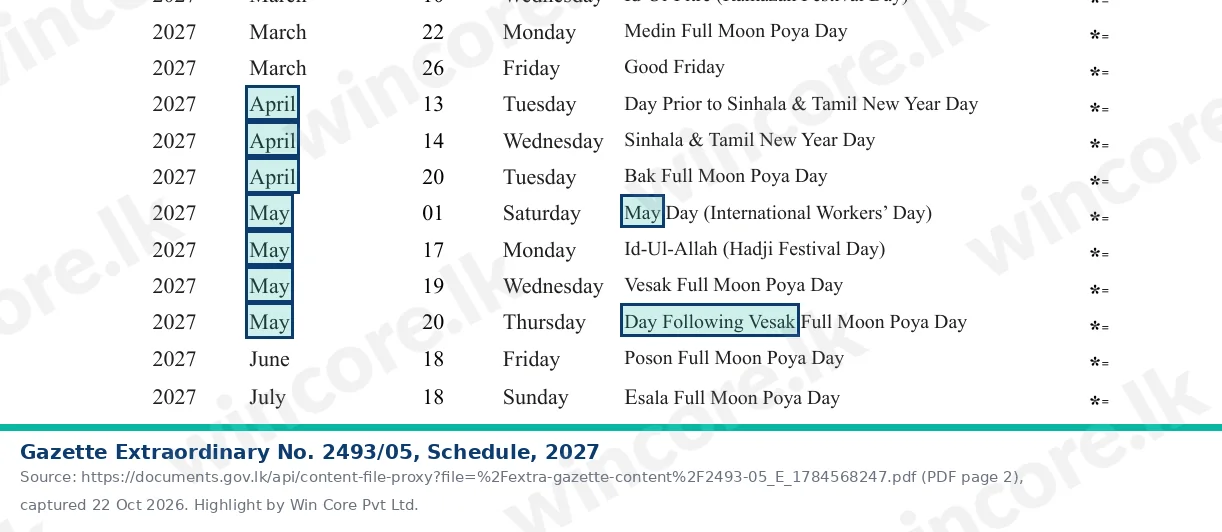
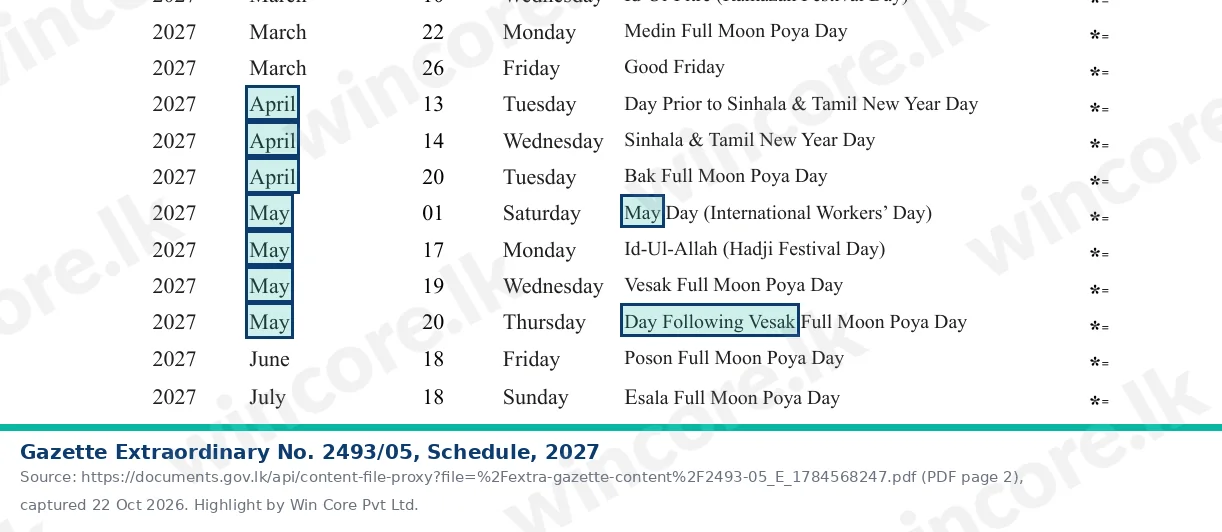
The Sri Lanka public holidays 2027 list is already official. Gazette Extraordinary No. 2493/05 of 16 June 2026 declares 25 public and bank holidays for 2027, and the Central Bank's 2027 list shows the same 25 dates, marking eight of them as mercantile holidays [1] [2]. For shop and office staff, working a mercantile holiday needs the Commissioner's prior sanction and then a substitute paid day by 31 December or double pay, and working a Full Moon Poya Day costs at least one and a half times the daily rate [3]. This guide sets out the dates, the pay rule for each type of day, and where the 2027 long weekends squeeze your cut-offs.
Scope. This piece covers employees under the Shop and Office Employees (Regulation of Employment and Remuneration) Act, which includes the office or clerical side of factories, estates, hotels and transport businesses [4]. Workers in a trade with a Wages Board fall under the Wages Boards Ordinance instead: Part I gives every such worker a holiday on each Full Moon Poya Day and at least one and a half times the normal daily wage for working it (ss.3A and 3B), while weekly holidays and the terms for working them come from the Board's decision for the trade (s.24(1)(c) and (d)) [5]. The Employees' Holidays Act, No. 6 of 1959 lets the Minister extend public holidays to other employees by a Holidays Order, but s.2(3) says such an Order does not apply to shop and office staff or to Wages Board workers [6]. We did not check which Holidays Orders are in force, so check the decision or Order for any staff outside the Shop and Office Act.
Sri Lanka public holidays 2027: 25 dates in Gazette 2493/05
The Minister declared the dates by Order "under Section 04" of the Holidays Act, No. 29 of 1971, signed on 10 June 2026, declaring them "to be Public and Bank Holidays for the Year 2027" [1]. Every date in the Schedule carries both the public holiday and the bank holiday mark. The mercantile column comes from the CBSL list [2].
| Date | Day | Holiday | Mercantile (CBSL) |
|---|---|---|---|
| 15 January | Friday | Tamil Thai Pongal Day | Yes |
| 22 January | Friday | Duruthu Full Moon Poya Day | No |
| 4 February | Thursday | Independence Day | Yes |
| 20 February | Saturday | Navam Full Moon Poya Day | No |
| 6 March | Saturday | Maha Shivarathri Day | No |
| 10 March | Wednesday | Id-Ul-Fitre (Ramazan Festival Day) | No |
| 22 March | Monday | Medin Full Moon Poya Day | No |
| 26 March | Friday | Good Friday | No |
| 13 April | Tuesday | Day Prior to Sinhala and Tamil New Year Day | Yes |
| 14 April | Wednesday | Sinhala and Tamil New Year Day | Yes |
| 20 April | Tuesday | Bak Full Moon Poya Day | No |
| 1 May | Saturday | May Day (International Workers' Day) | Yes |
| 17 May | Monday | Id-Ul-Allah (Hadji Festival Day) | No |
| 19 May | Wednesday | Vesak Full Moon Poya Day | No |
| 20 May | Thursday | Day Following Vesak Full Moon Poya Day | Yes |
| 18 June | Friday | Poson Full Moon Poya Day | No |
| 18 July | Sunday | Esala Full Moon Poya Day | No |
| 15 August | Sunday | Milad-Un-Nabi (Holy Prophet's Birthday) | Yes |
| 16 August | Monday | Nikini Full Moon Poya Day | No |
| 15 September | Wednesday | Binara Full Moon Poya Day | No |
| 15 October | Friday | Vap Full Moon Poya Day | No |
| 28 October | Thursday | Deepawali Festival Day | No |
| 13 November | Saturday | Il Full Moon Poya Day | No |
| 13 December | Monday | Unduvap Full Moon Poya Day | No |
| 25 December | Saturday | Christmas Day | Yes |
Every date above, including all twelve Full Moon Poya Days, is copied from the gazette; none is worked out from a lunar calendar. Some calendars online show a different date for Medin Poya; the gazette says Monday 22 March.
The gazette lists no substitute days. Seven holidays fall on a Saturday or Sunday in 2027: 20 February, 6 March, 1 May, 18 July, 15 August, 13 November and 25 December. Three of them are mercantile (1 May, 15 August, 25 December) and three are Poya Days (20 February, 18 July, 13 November).
Eight of the 25 are mercantile holidays, and that label sets the pay rule
Public holidays are the days the Minister declares under section 4 of the Holidays Act. In 2027 that is all 25 dates [1].
Bank holidays are the same 25 dates plus every weekend. The CBSL list states: "All Saturdays and Sundays are Bank Holidays" [2]. This is the label that moves salary transfers and statutory payments, so plan them as if nothing moves on a bank holiday and check your bank's own cut-off times.
Mercantile holidays are the eight dates the CBSL list marks "M": 15 January, 4 February, 13 and 14 April, 1 May, 20 May, 15 August and 25 December [2]. For shop and office staff these are, on our reading, the paid holidays declared for the purposes of section 7 of the Act, which says the days so declared "shall not exceed nine" [3]. We searched labourdept.gov.lk on 23 October 2026 and found no 2027 notice of the section 7 days, so the mercantile marks in this guide rest on the CBSL list. If the Labour Department publishes a different list, follow it.
Full Moon Poya Days are the twelve days covered by sections 7A and 7B, discussed below. None of them falls on a mercantile holiday in 2027.
Working a mercantile holiday needs the Commissioner's sanction and double pay
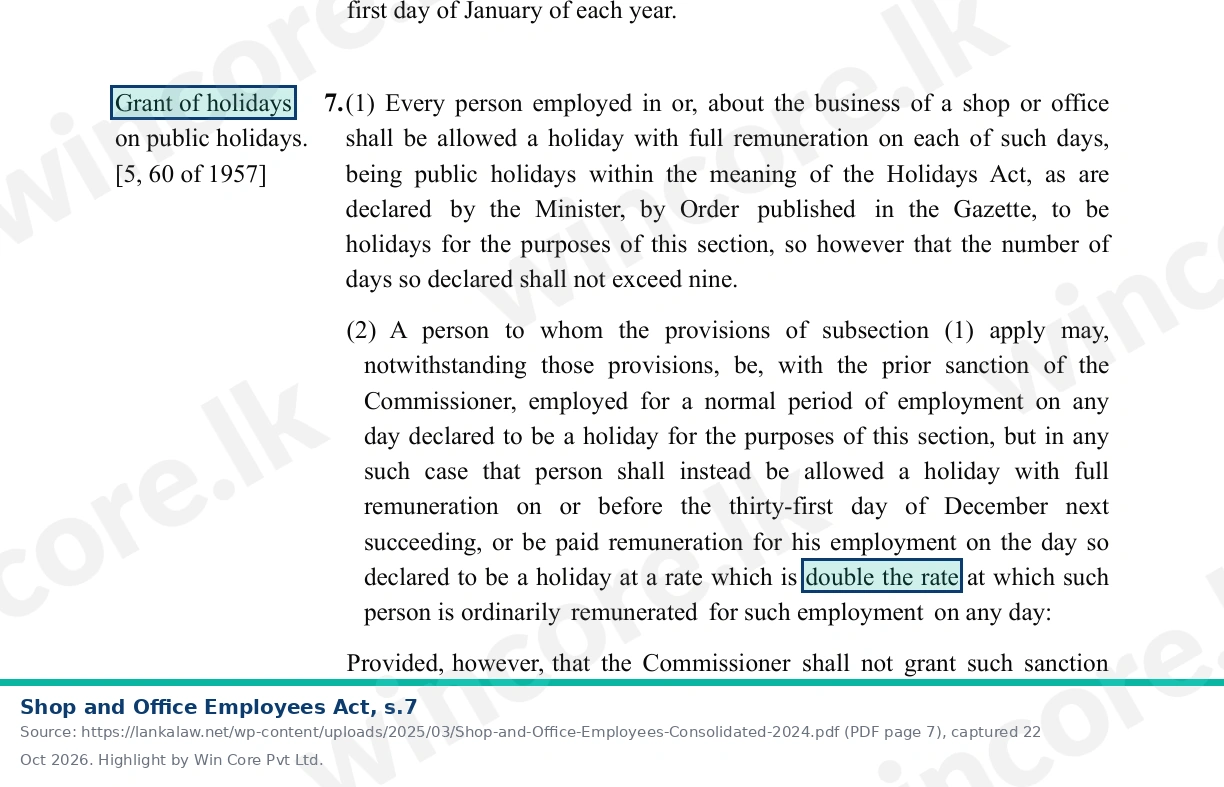
Section 7(1). Every person employed in or about a shop or office "shall be allowed a holiday with full remuneration" on each public holiday declared for the purposes of the section [3].
Section 7(2). An employee may work on such a day only "with the prior sanction of the Commissioner". If they do, the employer must either allow "a holiday with full remuneration on or before the thirty-first day of December next succeeding" or pay "at a rate which is double the rate at which such person is ordinarily remunerated". The proviso adds that the Commissioner will not sanction it unless satisfied that a holiday "cannot, without prejudice to the business" be allowed [3]. The Labour Department's Labour Standards Division handles "Granting Approval for employment on Statutory Holidays" and publishes an application form for it [7]. Apply before the day, not after.
The Act gives no substitute day when a mercantile holiday falls on a weekend, on our reading; the section 7A proviso deals only with Poya Days. A contract or collective agreement may give more.
Working a Poya Day costs at least one and a half times the daily rate
Section 7A. Every shop or office employee "shall be granted a holiday on a Full Moon Poya Day". The proviso matters in 2027: where a Poya Day "falls on a holiday allowed under section 7 of the Act or on a weekly holiday or on a weekly half holiday, no additional holiday shall be allowed" in lieu [3]. Whether 20 February, 13 November (both Saturdays) and 18 July (a Sunday) are weekly holidays or half holidays for your staff depends on your roster under section 5.
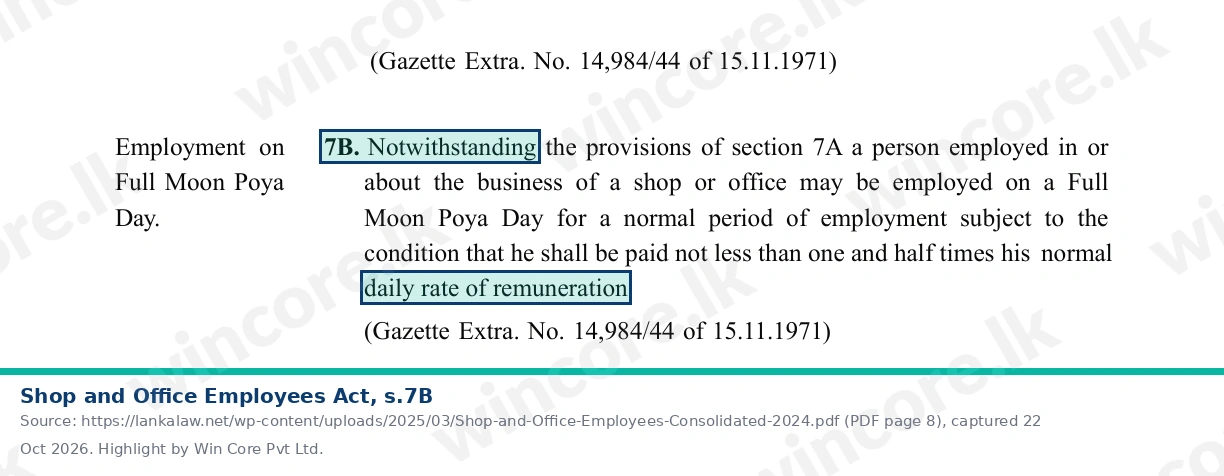
Section 7B. An employee may be employed on a Full Moon Poya Day "for a normal period of employment subject to the condition that he shall be paid not less than one and half times his normal daily rate of remuneration" [3]. Unlike section 7(2), the text of section 7B does not mention the Commissioner's sanction.
If you get it wrong. An employer who fails to pay remuneration in accordance with the Act commits an offence under section 52(1), with fines from Rs 100 to Rs 250 for a first offence rising to Rs 1,000 or six months for later offences, and the court may order the shortfall with a surcharge of 20 to 50 percent depending on how long it is in arrears (s.52(2) and (2A)). Other breaches, such as working staff on a mercantile holiday without sanction, fall under section 51(1): a fine of up to Rs 500, up to six months' imprisonment, or both [3].
For overtime and weekly rest, see our guide to overtime rules, hours and weekly rest. Teams that serve clients abroad and work through Sri Lankan holidays should also read night shift rules for BPO offices.
Worked example: Vesak week costs a dispatch office Rs 140,000
A hypothetical Kandy transport company runs a dispatch office of 10 staff. The office or clerical department of a business that transports goods for reward is an "office" under the Act [4]. Each employee earns Rs 124,000 a month with no cost of living allowance.
The daily rate. Regulation 47 of the Shop and Office Employees Regulations, 1954 sets the rate for the day before a holiday or leave: for a monthly-paid employee, total remuneration (excluding overtime and bonuses, including any cost of living allowance) is "divided by the number of days in the month" [8]. May has 31 days, so Rs 124,000 / 31 = Rs 4,000. The Act does not say in terms that this is also the "normal daily rate" in section 7B or the ordinary rate in section 7(2); on our reading it is the closest rule, and we use it here.
Vesak 2027 is Wednesday 19 May (Poya) and Thursday 20 May (mercantile). Deliveries continue, so all 10 staff work both days.
- 19 May, section 7B. At least 1.5 x Rs 4,000 = Rs 6,000 per person. For 10 staff: Rs 60,000.
- 20 May, section 7(2). Only with the Commissioner's prior sanction. Then either a substitute paid holiday by 31 December 2027, or double rate: 2 x Rs 4,000 = Rs 8,000 per person. For 10 staff: Rs 80,000.
Paying cash for both days gives statutory pay of Rs 140,000 for the two days. Giving substitute days for 20 May instead means Rs 60,000 in Poya pay and 10 paid days off to schedule before 31 December 2027.
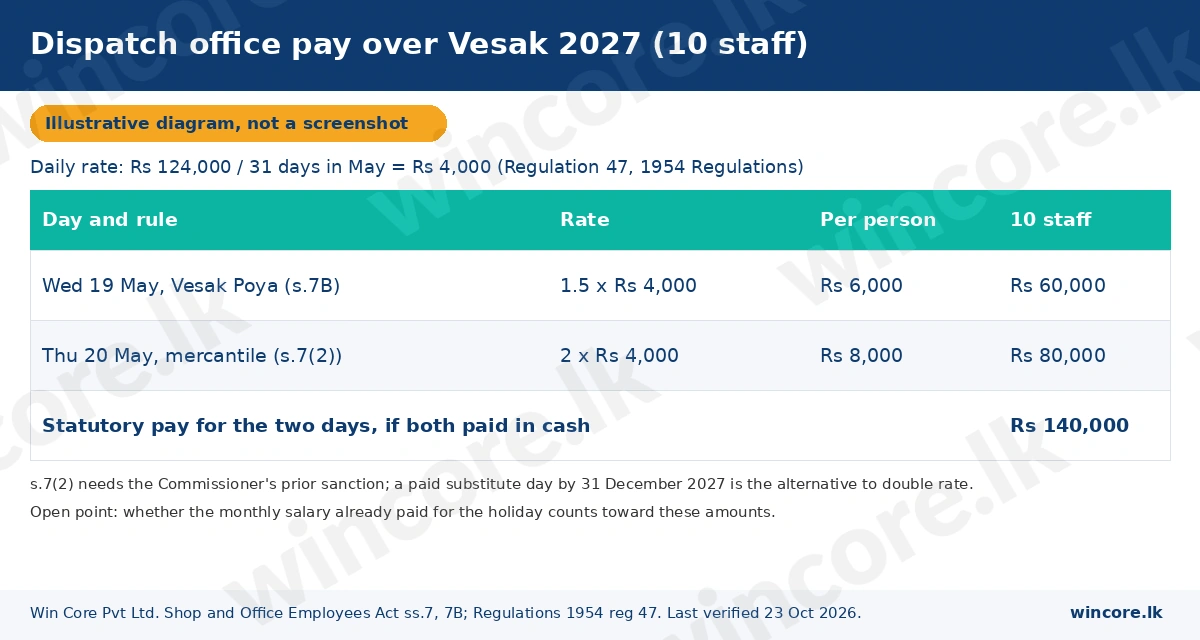
One point stays open. The Act does not say in terms whether the monthly salary already paid for the holiday counts toward these amounts. If it does, the extra cost is the difference (Rs 2,000 for the Poya Day and Rs 4,000 for the mercantile day, a head); if it does not, it is the full amount. Check the employment contract, any collective agreement and any Wages Board decision that applies, set your rule in writing, apply it the same way every time, and take advice before relying on the lower figure. Our salary calculator and leave calculator help with the rest of the arithmetic.
Long weekends in 2027 move your payroll cut-offs
Bank holidays decide when money moves. In 2027 the pinch points are:
- 15 to 17 January (Friday holiday plus weekend) and 22 to 24 January (Poya Friday plus weekend). The last bank working day of January is Friday 29 January, because 31 January is a Sunday.
- 26 to 28 March, the Good Friday weekend, with Medin Poya on Monday 22 March the same month.
- 13 and 14 April, Tuesday and Wednesday. Banks are closed both days, so a New Year advance paid by transfer is safest sent by Monday 12 April.
- 17 to 20 May, three holidays in four days around Vesak. Close timesheets for May overtime early.
- 18 to 20 June, 14 to 16 August and 15 to 17 October, all long weekends built around a Friday or Monday holiday.
- 31 July is a Saturday and 31 October a Sunday, so the last bank working days are Friday 30 July and Friday 29 October.
- 25 December is a Saturday. If you pay salaries on the 25th, December pay must leave by Friday 24 December, or earlier if your bank needs a lead day.
Statutory payments follow the same calendar. The EPF Department and the ETF Board ask for each month's contributions by the last working day of the following month, so December 2026 contributions are due by Friday 29 January 2027 and January 2027 contributions by Friday 26 February 2027, because 27 and 28 February are a weekend. Our guide to EPF and ETF monthly payment procedures covers the payment steps, and our guide to the Shop and Office Employees Act covers leave and weekly holidays.
What this means for you
- Load all 25 dates into your payroll and attendance system now. The gazette has been out since June 2026.
- Tag the eight mercantile days separately from the twelve Poya Days. They carry different pay rules: a substitute day or double rate under section 7(2), and at least one and a half times under section 7B.
- If anyone must work on a mercantile holiday, apply to the Labour Department for the Commissioner's prior sanction first.
- Fix the daily rate you use for holiday pay in writing, and decide whether the monthly salary counts toward it.
- Set salary transfer and EPF and ETF dates against bank holidays, not calendar dates.
- For Wages Board staff, check the Board's decision for your trade. This piece does not cover it.
Checklist: documents needed
- Gazette Extraordinary No. 2493/05 (2027 holidays)
- CBSL 2027 bank holiday list, for the mercantile marks
- Employment contracts showing the salary and any cost of living allowance
- Weekly holiday and half holiday roster under section 5
- Labour Department application and sanction for any work on a mercantile holiday
- Attendance records for holiday and Poya Day work, by employee
- Your written rule on the daily rate for holiday pay
- Bank cut-off times for salary transfers
FAQ
How many public holidays are there in Sri Lanka in 2027?
Gazette Extraordinary No. 2493/05 declares 25 public and bank holidays for 2027, from Tamil Thai Pongal Day on 15 January to Christmas Day on 25 December. Twelve are Full Moon Poya Days. The Central Bank's list shows the same 25 dates and marks eight of them as mercantile holidays. Seven of the 25 fall on a Saturday or Sunday.
Which days are mercantile holidays in 2027?
The Central Bank's 2027 list marks eight mercantile holidays: 15 January, 4 February, 13 and 14 April, 1 May, 20 May, 15 August and 25 December. For shop and office staff these are, on our reading, the paid holidays under section 7 of the Shop and Office Employees Act. Three of them fall on a weekend in 2027.
Do holidays that fall on a weekend move to a weekday in 2027?
No, the 2027 gazette Schedule lists no substitute days, so the seven weekend holidays stay where they fall. For shop and office staff, the section 7A proviso also says no extra holiday is given when a Poya Day falls on a weekly holiday or half holiday. Whether a Saturday is a half holiday depends on your own section 5 roster.
What must I pay a shop or office employee who works on a Poya Day?
At least one and a half times the normal daily rate, under section 7B of the Shop and Office Employees Act, for a normal period of work on a Full Moon Poya Day. On a daily rate of Rs 4,000 that is at least Rs 6,000. Regulation 47 divides a monthly salary by the days in the month to find the daily rate for holidays.
Can staff work on a mercantile holiday?
Yes, but only with the Commissioner's prior sanction under section 7(2). The employer must then either give a paid substitute holiday by the next 31 December or pay double the ordinary rate for the day. The proviso says the Commissioner will not sanction it unless a holiday cannot be allowed without prejudice to the business.
The short version. All 25 dates for 2027 are gazetted. Eight are mercantile and twelve are Poya Days, and the Act prices work on each differently. Book your bank and EPF cut-offs around the long weekends now.
This page reflects the gazette, the Act and the Regulations as read on 23 October 2026. It is general information and not advice on your specific situation.
Talk to us. If you would like your 2027 holiday calendar, holiday pay rules and cut-offs set up in payroll, see our payroll services or speak to us at our contact page.
WinCore Pvt Ltd
References
- Ministry of Public Administration, Provincial Councils and Local Government. Gazette Extraordinary No. 2493/05 (16 June 2026), Holidays Act, No. 29 of 1971, Order under Section 04, and Schedule. https://documents.gov.lk/api/content-file-proxy?file=%2Fextra-gazette-content%2F2493-05_E_1784568247.pdf . Primary. Accessed 23 October 2026.
- Central Bank of Sri Lanka. Bank Holidays for 2027. https://www.cbsl.gov.lk/en/about/about-the-bank/bank-holidays-2027 . Primary (official list). Accessed 23 October 2026.
- Shop and Office Employees (Regulation of Employment and Remuneration) Act, consolidated text to Act No. 28 of 2024, ss.5, 7, 7A, 7B, 51 and 52. https://lankalaw.net/wp-content/uploads/2025/03/Shop-and-Office-Employees-Consolidated-2024.pdf . Secondary (unofficial consolidation, used to read the sections). Accessed 23 October 2026.
- Department of Labour. Salary, Wages and Leave, definitions of shop, office and full remuneration under the Shop and Office Employees Act. https://labourdept.gov.lk/salary-wages-leave/ . Primary. Accessed 23 October 2026.
- Wages Boards Ordinance, No. 27 of 1941, ss.3A, 3B and 24(1)(c) and (d). https://lankalaw.net/wp-content/uploads/2025/02/2001Y5V136C.html . Secondary (unofficial revised edition). Accessed 23 October 2026.
- Employees' Holidays Act, No. 6 of 1959, ss.2 to 4. https://lankalaw.net/wp-content/uploads/2025/02/1981Y7V155C-1.html . Secondary (unofficial revised edition). Accessed 23 October 2026.
- Department of Labour. Labour Standards Division, "Granting Approval for employment on Statutory Holidays" and application form. https://labourdept.gov.lk/labour-standards-division/ . Primary. Accessed 23 October 2026.
- Department of Labour, Labour Code. Shop and Office Employees Regulations, 1954, regulations 8 and 47. https://labourdept.gov.lk/downloads/labour_code/23.pdf . Primary (Labour Department copy). Accessed 23 October 2026.
Put these insights to work
WinCore specialists can review your current workflow, document gaps, and build a practical 90-day action plan.
Book a free consultationContinue reading
Explore more WinCore analysis to keep your finance, tax, and compliance roadmap moving.
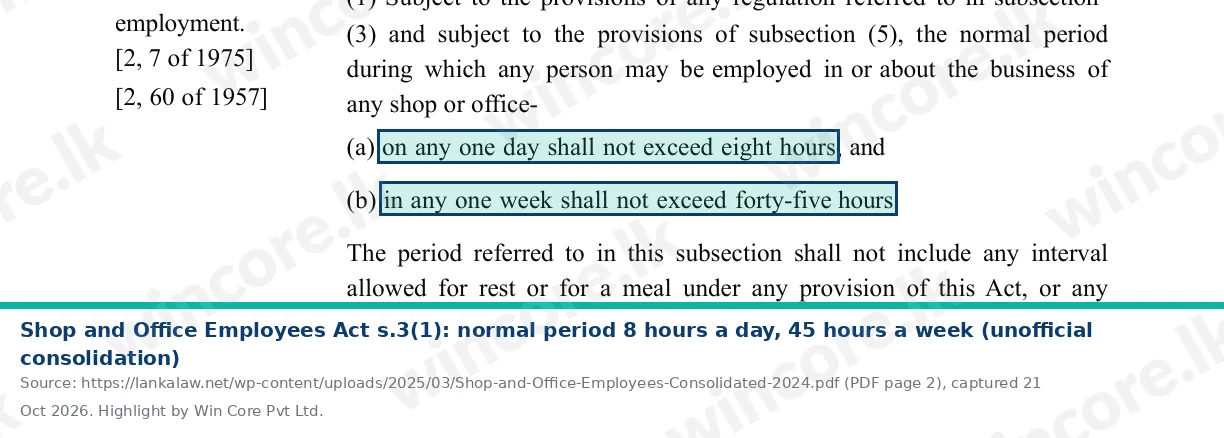
The 8 and 45 hour limits, the 1954 overtime regulations, the 9-hour cap for women, weekly holidays, Poya pay and Wages Board hours, clause by clause.

Employer guide to the Shop and Office Employees framework in Sri Lanka, covering coverage tests, hours, leave, records, and inspection controls.
Monthly EPF and ETF payment procedures for Sri Lankan employers: the last working day deadline, Form C and e-returns, ETF electronic payment, surcharges and evidence.