
Overtime rules Sri Lanka: hours, rates and weekly rest
The 8 and 45 hour limits, the 1954 overtime regulations, the 9-hour cap for women, weekly holidays, Poya pay and Wages Board hours, clause by clause.
On this page
Last verified against the primary sources on 22 October 2026.
The overtime rules in Sri Lanka for shop and office staff come from two places. Section 3(1) of the Shop and Office Employees Act sets the normal period at eight hours a day and 45 hours a week [1]. The Shop and Office Employees Regulations, 1954 then cap overtime at "an aggregate of twelve hours in any one week" and require it to be paid at not less than one and one-half times the hourly rate (regulations 6 and 7) [2]. Every shop or office worker also gets one whole holiday and one half-holiday each week (s.5(1)) [1]. In trades covered by a Wages Board, the Board's decision fixes the hours and the overtime rate within limits set by the Wages Boards Ordinance [3].
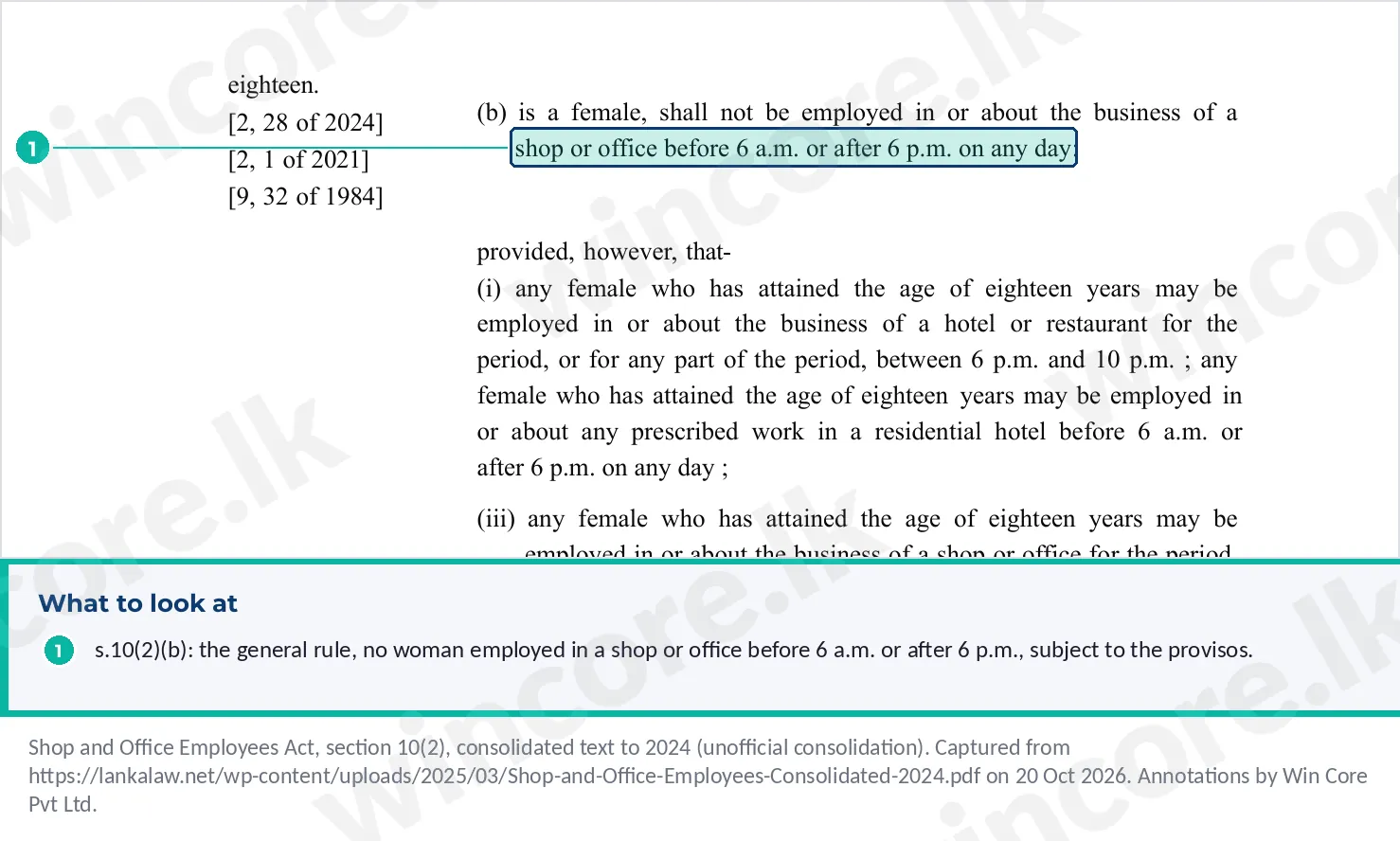
Night work for women is covered in our articles on the Shop and Office Amendment Act 2024 and BPO night shifts.
The overtime rules in Sri Lanka start from an 8-hour day and a 45-hour week
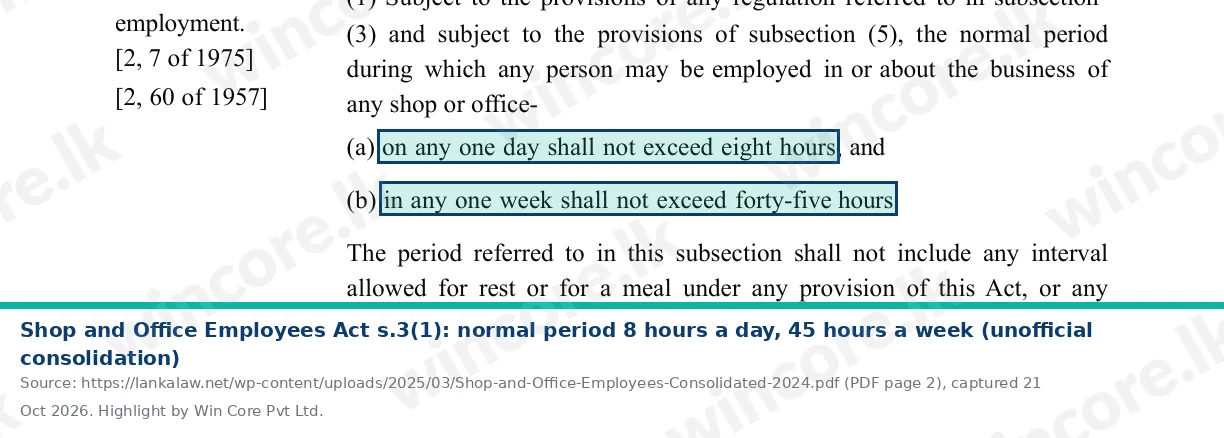
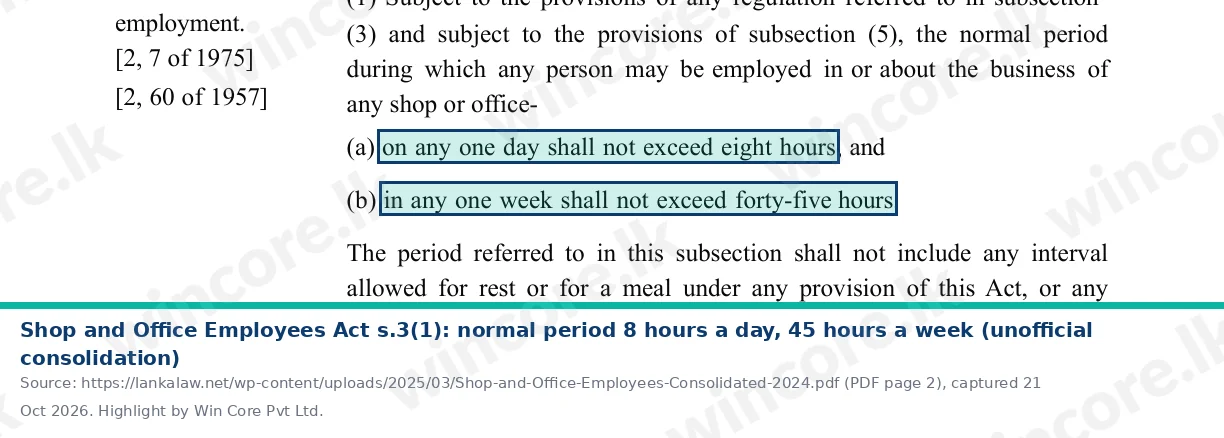
Section 3(1) says the normal period during which a person may be employed in a shop or office "on any one day shall not exceed eight hours" and "in any one week shall not exceed forty-five hours" [1]. That period does not include "any interval allowed for rest or for a meal" [1], which the Schedule to the Act sets (for example, one hour starting between 11 a.m. and 2 p.m.) [1].
The Act defines "overtime" as "employment or work in excess of the normal maximum period provided by or under section 3" (s.68) [1]. On our reading that means both limits count: a ninth hour on any day is overtime even if the week stays under 45 hours, and so is any hour beyond 45 in the week. A "week" runs from midnight on Saturday to midnight on the following Saturday (s.68) [1].
The Act leaves overtime to regulations under s.3(3)(a) and (c) [1]. One limit is in the Act: the proviso to s.3(3) says no regulation may permit "more than twelve hours to elapse between the time at which any person commences work on any day and the time at which he ceases work on that day", but adds that "no account shall be taken of any period of overtime work" [1]. On our reading this caps the spread of the normal day, not the day including overtime.
The 1954 Regulations cap overtime at 12 hours a week and set the 1.5x rate
The Department of Labour publishes the Shop and Office Employees (Regulation of Employment and Remuneration) Regulations, 1954 in its Labour Code [2]. Four of them decide most overtime questions:
| Regulation | What it says |
|---|---|
| 6 | Overtime "shall not exceed an aggregate of twelve hours in any one week" |
| 7 | Overtime must be "paid separately for such overtime work in respect of each hour, at a rate not less than one and one-half times the hourly rate of his ordinary remuneration"; part of an hour is paid pro rata |
| 8 | Hourly rate: one-eighth of the daily rate; for monthly pay, "one-eighth of the monthly rate divided by thirty"; for fortnightly pay, divided by fourteen; for weekly pay, divided by seven |
| 8A | For weekly overtime above 45 hours, a day of leave or holiday in that week is treated as a day worked for the normal daily maximum |
Regulation 9 says which pay goes into the hourly rate. Where a remuneration determination is in force, it is the rate in that determination; otherwise, or where the person's pay is more favourable, it is "the actual rate of remuneration payable to him in terms of his contract of employment" [2]. Regulation 9(2) adds that "no allowance other than a special living allowance determined according to the cost of living shall be included" [2]. On our reading, a fixed transport or attendance allowance is left out of the overtime base unless the contract says otherwise.
Two more limits sit in regulation 2. Regulation 2(1) says no female, and no male under 18, "shall be employed in or about the business of any shop or office for any period (including overtime and an interval for rest or for a meal...) exceeding 9 hours a day" [2]. Regulation 2(2) says a person in a shop to which a closing order under s.40 applies may not be employed beyond 8 hours a day or 45 hours a week "without the prior sanction of the Commissioner" [2].
A contract cannot go below these floors. Section 70(3) makes void any term by which a right under the Act "is in any way affected or modified to his detriment" [1], so on our reading an offer letter promising 1.25 times is void to that extent.
Weekly rest is one whole holiday and one half-holiday, paid after 28 hours
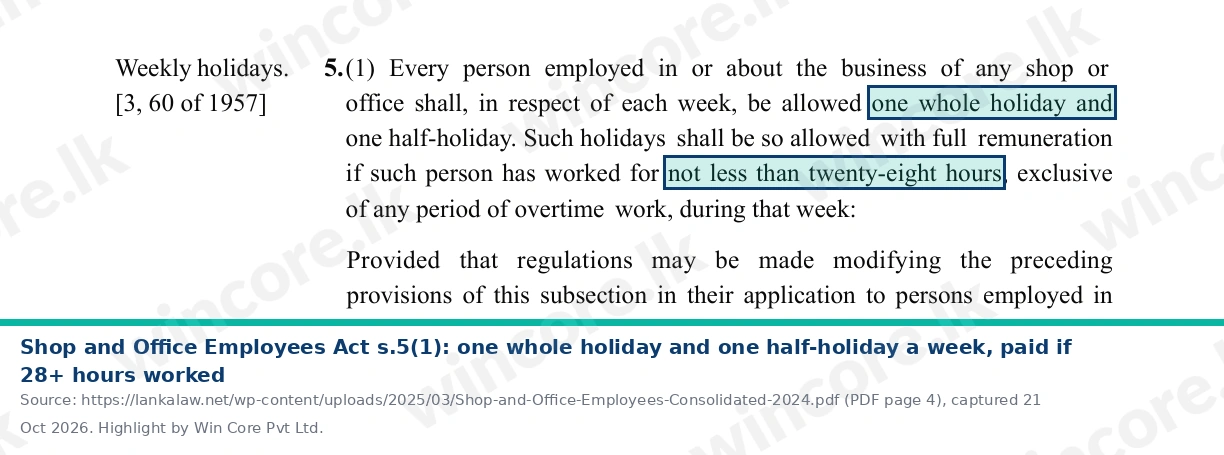
Section 5(1) says every person employed in a shop or office shall, "in respect of each week, be allowed one whole holiday and one half-holiday" [1]. They are paid: "Such holidays shall be so allowed with full remuneration if such person has worked for not less than twenty-eight hours, exclusive of any period of overtime work, during that week" [1]. A proviso lets regulations change the 28 hours for specified classes of work [1].
A "half-holiday" is a day on which the person is not employed "for more than five hours", excluding meal intervals (s.68), and for shifts across midnight s.8 counts the "day" as 24 hours from the usual start [1].
Timing is in s.5(2). The holidays are allowed "either in that week or in the week immediately succeeding" [1]. With the Commissioner's "prior written sanction", the holidays for four consecutive weeks in a month may be given together, one full holiday standing for two half-holidays, but the Commissioner will not sanction it "unless he is satisfied that it is necessary so to do by reason of the nature of the business or of unforeseen circumstances" [1]. Days of paid leave or paid holiday count towards the 28 hours (s.5(3)) [1].
The Act does not set a higher rate for work on the weekly holiday itself, and we found no regulation that does. Hours worked on that day still count towards the daily and weekly limits, so on our reading they are paid as overtime at 1.5 times once they take the person past eight hours that day or 45 in the week.
Poya days and public holidays have their own pay rules
Section 7A grants every shop or office employee "a holiday on a Full Moon Poya Day", with no extra day where the Poya falls on a weekly holiday, half-holiday or a section 7 holiday [1]. Section 7B allows work on the Poya for a normal period "subject to the condition that he shall be paid not less than one and half times his normal daily rate of remuneration" [1].
Public holidays declared under s.7(1), up to nine, are separate. Under s.7(2) a person may work on one only "with the prior sanction of the Commissioner", and then gets a paid substitute holiday by the next 31 December or pay at "double the rate" [1].
Before calculating a holiday shift, check the Gazette-based public-holiday calendar for payroll against the employee's applicable regime.
In Wages Board trades the Board fixes hours inside the Ordinance's limits
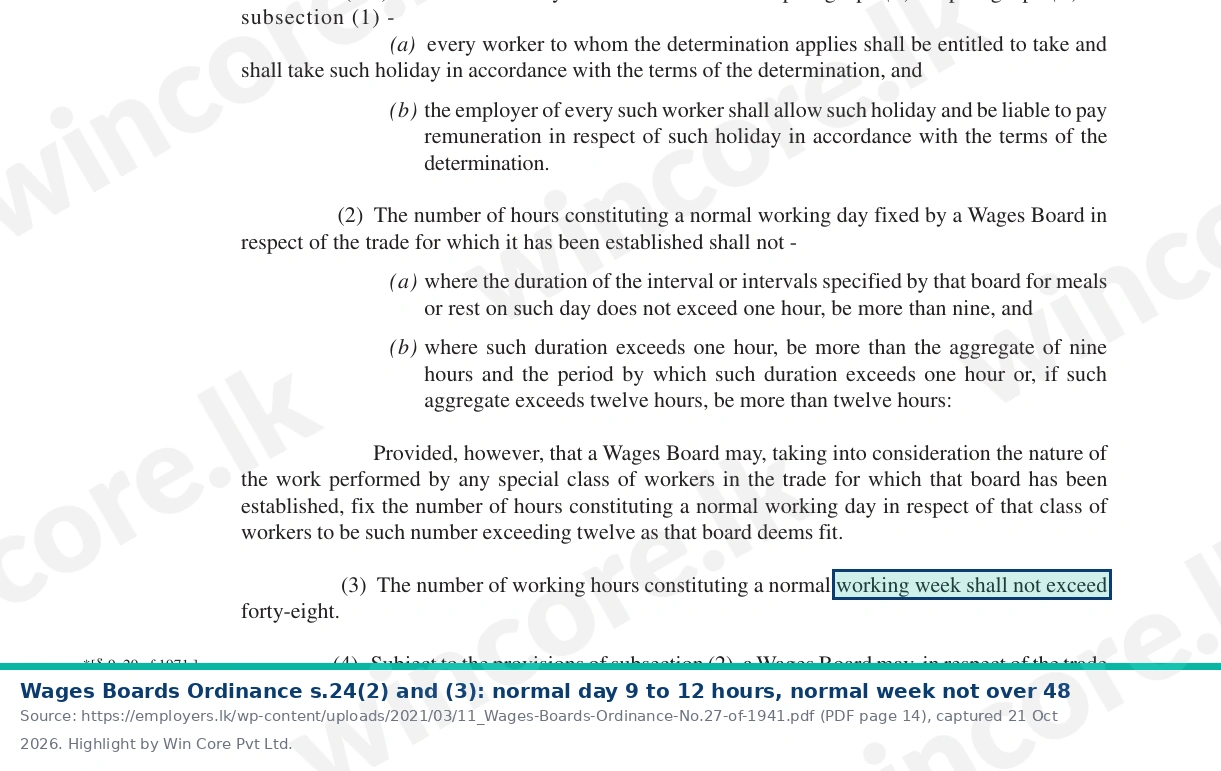
Where a Wages Board has been set up for a trade, s.24(1)(a) of the Wages Boards Ordinance lets the Board fix the normal working day or week, and the day is "inclusive ... of the interval or intervals for meal or rest" [3], unlike the Shop and Office Act. The Board may not fix a day of more than nine hours where intervals do not exceed one hour, or more than twelve where they do (s.24(2)), save for a "special class of workers" under the proviso; a week of more than forty-eight hours (s.24(3)); or a broken day spread over more than twelve hours (s.24(5)) [3].
"Overtime" is time beyond the normal day or week (s.64), and the overtime rate is the minimum the Board determines under s.20(1)(c) [3], so the number for your trade is in the Board's decision. Work on a weekly holiday the Board declares is paid at not less than the overtime rate, or "one-and-a quarter times" if none is set, plus a substitute day (s.24(1)(d)) [3]. Poya days fall under Part I, which applies to every trade: s.3A grants the holiday and s.3B allows work on it for "not less than one and a half times his normal daily rate of wages" [3].
| Rule | Shop and Office Employees Act | Wages Boards Ordinance |
|---|---|---|
| Normal day | 8 hours, meals excluded (s.3(1)(a)) | Set by Board; 9, up to 12 with longer intervals, meals included (s.24(1)(a), (2)) |
| Normal week | 45 hours (s.3(1)(b)) | Set by Board; not over 48 (s.24(3)) |
| Overtime cap | 12 hours a week (reg 6) | Not in the Ordinance; check the decision |
| Overtime rate | At least 1.5x the hourly rate (reg 7) | The Board's overtime rate (s.20(1)(c)) |
| Weekly rest | 1 whole and 1 half-holiday, paid after 28 hours (s.5) | A weekly holiday if the Board declares one (s.24(1)(c)) |
| Work on weekly holiday | No special rate found; overtime rules apply | Overtime rate or 1.25x plus a substitute day, or 1.5x for a special class (s.24(1)(d)) |
| Poya day work | At least 1.5x the daily rate (s.7B) | At least 1.5x the daily rate (s.3B) |
A worked example: a 50-hour week and the 9-hour limit for women
The following is hypothetical. A bookshop in Kurunegala employs a male stores clerk on a monthly salary of Rs 108,000 plus a fixed transport allowance of Rs 8,000. In one week he works 9 hours a day Monday to Friday, each day with a one-hour lunch, and 5 hours on Saturday. Sunday is off.
- Hourly rate (reg 8(b)). Rs 108,000 / 30 / 8 = Rs 450. The transport allowance is left out under reg 9(2). Overtime rate: Rs 450 x 1.5 = Rs 675 (reg 7). Our arithmetic.
- Overtime hours. One hour over eight on each of five days = 5 hours. Normal hours in the week: 5 x 8 + 5 = 45, so nothing more above the weekly limit. Our arithmetic.
- Cap. 5 hours is within the 12-hour weekly cap (reg 6).
- Overtime pay. 5 x Rs 675 = Rs 3,375, paid separately (reg 7). Our arithmetic.
- Spread. Each weekday runs 8 hours of normal work plus a one-hour lunch: 9 hours, inside the 12-hour spread, which ignores overtime (s.3(3) proviso).
- Weekly rest. Saturday, with 5 hours worked, is the half-holiday and Sunday the whole holiday (s.68 definitions). He worked at least 28 hours excluding overtime, so both are paid (s.5(1)).
Now put a woman colleague on the same roster. Regulation 2(1) counts overtime and meal breaks inside her 9-hour daily limit. Nine hours of work plus a one-hour lunch is 10 hours, so on our reading each of those weekdays breaches regulation 2(1), even though the overtime is paid. With a one-hour lunch she can work 8 hours and no more that day. Overtime for her is only possible on a day with a shorter normal period or a shorter interval.
Which section punishes which default
| Default | Section | Penalty |
|---|---|---|
| Hours, overtime cap, 9-hour limit, weekly holidays, Poya or public holiday rules (Shop and Office) | s.51(1) | Fine not exceeding Rs 500, or imprisonment of either description up to six months, or both, on the employer [1] |
| Employee who works a second job the same day beyond the daily maximum | s.51(2) | Same penalties, on the employee [1] |
| Not paying remuneration due, including overtime (Shop and Office) | s.52(1), (2), (2A) | Rs 100 to Rs 250, then Rs 250 to Rs 500, then Rs 500 to Rs 1,000 or up to six months or both, plus up to Rs 50 a day; the court may order the shortfall with a surcharge of 20 to 50 percent by months in arrears [1] |
| Not keeping the hours and overtime record under s.18 (Shop and Office) | s.54A | Rising scale from Rs 100 to Rs 250 for a first offence [1] |
| Not allowing a holiday under a Board decision, or breaching a decision (Wages Board) | s.48(1)(a), (c) | Fine not exceeding Rs 500, or imprisonment up to six months, or both [3] |
| Not making a payment under a decision, such as the overtime rate (Wages Board) | s.44(2), (3) | Rs 100 to Rs 250, then Rs 250 to Rs 500, then Rs 500 to Rs 1,000 or six months, plus up to Rs 50 a day; the court may order the shortfall [3] |
| Poya day holiday or pay (Wages Board, Part I) | s.4(1) | Rising scale of fines, up to Rs 1,000 or six months for a subsequent offence [3] |
Section 51(1) reaches breaches of "any regulation" as well as the Act [1] [4]. Applying s.52 to overtime owed under regulation 7 is our reading, since s.66(3) makes an approved regulation "as valid and effectual as though it were herein enacted" [1].
What this means for you
- Know which law covers each worker. Shop and office staff sit under the Act and the 1954 Regulations; a Wages Board trade sits under the Board's decision. Factories follow other laws not covered here.
- Pay overtime from the right base. Monthly rate divided by 30 and by 8, at not less than 1.5 times. Our payroll services compute this from the attendance record.
- Watch the daily limit as well as the weekly one, and keep overtime within 12 hours a week.
- Roster women and under-18 workers to 9 hours including breaks (regulation 2(1)).
- Write the overtime rate into the particulars of employment, as regulation 15(1)(k) requires [2]. Our HR compliance services review offer letters and rosters against these rules.
Our Shop and Office Employees Act guide covers leave and records, and our minimum wage guide the wage floor under overtime.
Checklist: documents needed
- A list of staff showing which law covers each one (Shop and Office, a named Wages Board, or other)
- The current Wages Board decision for each trade you employ in
- Rosters and daily attendance records with start, finish and meal times
- Overtime approvals and the overtime calculation for each pay period
- Particulars of employment stating normal hours and the overtime rate
- A weekly holiday and half-holiday log
- Any Commissioner's sanction for accumulated holidays or public holiday work
- Poya day and public holiday attendance and pay
FAQ
What is the maximum overtime allowed in Sri Lanka?
For shop and office staff, overtime may not exceed an aggregate of twelve hours in any one week under regulation 6 of the 1954 Regulations. Women and males under 18 are also limited to nine hours a day including overtime and meal breaks by regulation 2(1). In a Wages Board trade, check the Board's decision, since the Ordinance itself sets no weekly overtime cap.
What is the overtime rate in Sri Lanka?
For shop and office staff it is at least one and one-half times the hourly rate, under regulation 7. For a monthly-paid employee the hourly rate is one-eighth of the monthly rate divided by thirty (regulation 8), leaving out allowances other than a cost of living allowance (regulation 9(2)). In a Wages Board trade the rate is the overtime rate in the Board's decision.
How do you calculate overtime for a monthly salary?
Divide the monthly rate by 30 and then by 8 to get the hourly rate, then multiply by at least 1.5. On a Rs 108,000 salary that is Rs 450 an hour and Rs 675 an hour for overtime. Regulation 9(2) keeps allowances other than a special living allowance out of the base, so a fixed transport allowance does not raise the rate.
Are weekly holidays paid for office staff?
Yes, if the person worked at least 28 hours in the week, not counting overtime, under section 5(1). The whole holiday and the half-holiday must be given in that week or the next (section 5(2)). Days of paid leave or paid holiday in the week count towards the 28 hours under section 5(3).
Open points
- 1954 Regulations. We read the Department of Labour's undated reprint and found no amendment to regulations 2 or 6 to 9; we did not search every Gazette since 1954.
- Work on the weekly holiday. No special rate found beyond the overtime rules.
- Wages Board decisions for each trade were not checked, and section 44(1) of the Ordinance was not legible in our copy.
- Sources. The Act is an unofficial consolidation and the Ordinance an Employers' Federation reprint.
Talk to us. If you want your rosters, overtime calculations and offer letters checked against the Act and the 1954 Regulations, speak to us at our contact page.
WinCore Pvt Ltd
This article is general information on the law as at 22 October 2026 and is not advice on your specific situation.
References
- LankaLAW. Shop and Office Employees (Regulation of Employment and Remuneration) Act (Chapter 129), consolidated to 2024, ss.3, 4, 5, 7, 7A, 7B, 8, 18, 51, 52, 54A, 66, 68, 70 and Schedule. https://lankalaw.net/wp-content/uploads/2025/03/Shop-and-Office-Employees-Consolidated-2024.pdf . Primary text, unofficial consolidation. Accessed 22 October 2026.
- Department of Labour. Labour Code, Shop and Office Employees (Regulation of Employment and Remuneration) Regulations, 1954, regs 2, 6, 7, 8, 8A, 9 and 15. https://labourdept.gov.lk/downloads/labour_code/23.pdf . Primary (reprint, undated). Accessed 22 October 2026.
- Employers' Federation of Ceylon. Wages Boards Ordinance, No. 27 of 1941 (as amended), ss.3A, 3B, 4, 20, 24, 44, 48 and 64. https://employers.lk/wp-content/uploads/2021/03/11_Wages-Boards-Ordinance-No.27-of-1941.pdf . Secondary reprint of primary text. Accessed 22 October 2026.
- Department of Labour. Labour Code, Shop and Office Employees Act (English reprint, pre-2024), s.51(1). https://labourdept.gov.lk/downloads/labour_code/20.pdf . Primary. Accessed 20 October 2026 (as cited in our Act No. 28 of 2024 article; not re-fetched today).
Put these insights to work
WinCore specialists can review your current workflow, document gaps, and build a practical 90-day action plan.
Book a free consultationContinue reading
Explore more WinCore analysis to keep your finance, tax, and compliance roadmap moving.

Employer guide to the Shop and Office Employees framework in Sri Lanka, covering coverage tests, hours, leave, records, and inspection controls.
Act No. 28 of 2024 lifted the 6 p.m. bar for women in IT, BPO and overseas back offices. Gazette 2473/25 is a separate hotel and airline rule.

The national minimum wage is Rs 30,000 a month or Rs 1,200 a day from 1 January 2026. What it covers, Wages Boards, overtime and EPF.