
Night shift for women in BPO, Sri Lanka: the operating rules
What a BPO, KPO or overseas back office has to set up before rostering women at night, with the 9-hour limit, rest days and records it must keep.
On this page
Last verified against the primary sources on 22 October 2026.
A night shift for women in BPO in Sri Lanka has been lawful since 13 May 2024 [5], when the Speaker certified the Shop and Office Employees (Amendment) Act No. 28 of 2024 (published 17 May 2024), which added proviso (v) to section 10(2): a woman aged 18 or over may be employed before 6 a.m. or after 6 p.m. in an institution engaged in IT-based knowledge or business process outsourcing, or in back-office administration and accounts work for an institute abroad [1]. The proviso lifts the clock only. Regulation 2(1) of the 1954 Regulations still limits a woman to 9 hours a day including overtime and meal breaks [3], the weekly holidays still apply, and Gazette 2473/25 of 30 January 2026 does not, on our reading, apply to BPO work at all [4].
The legal change itself is analysed in our article on the Shop and Office Amendment Act 2024. This piece is about operations: what an operator should have in place before it rosters women at night, and what it should be able to show an inspector. Where a step is law we cite the clause; where it is practice we say so.
A night shift for women in BPO in Sri Lanka rests on proviso (v), with no permit step
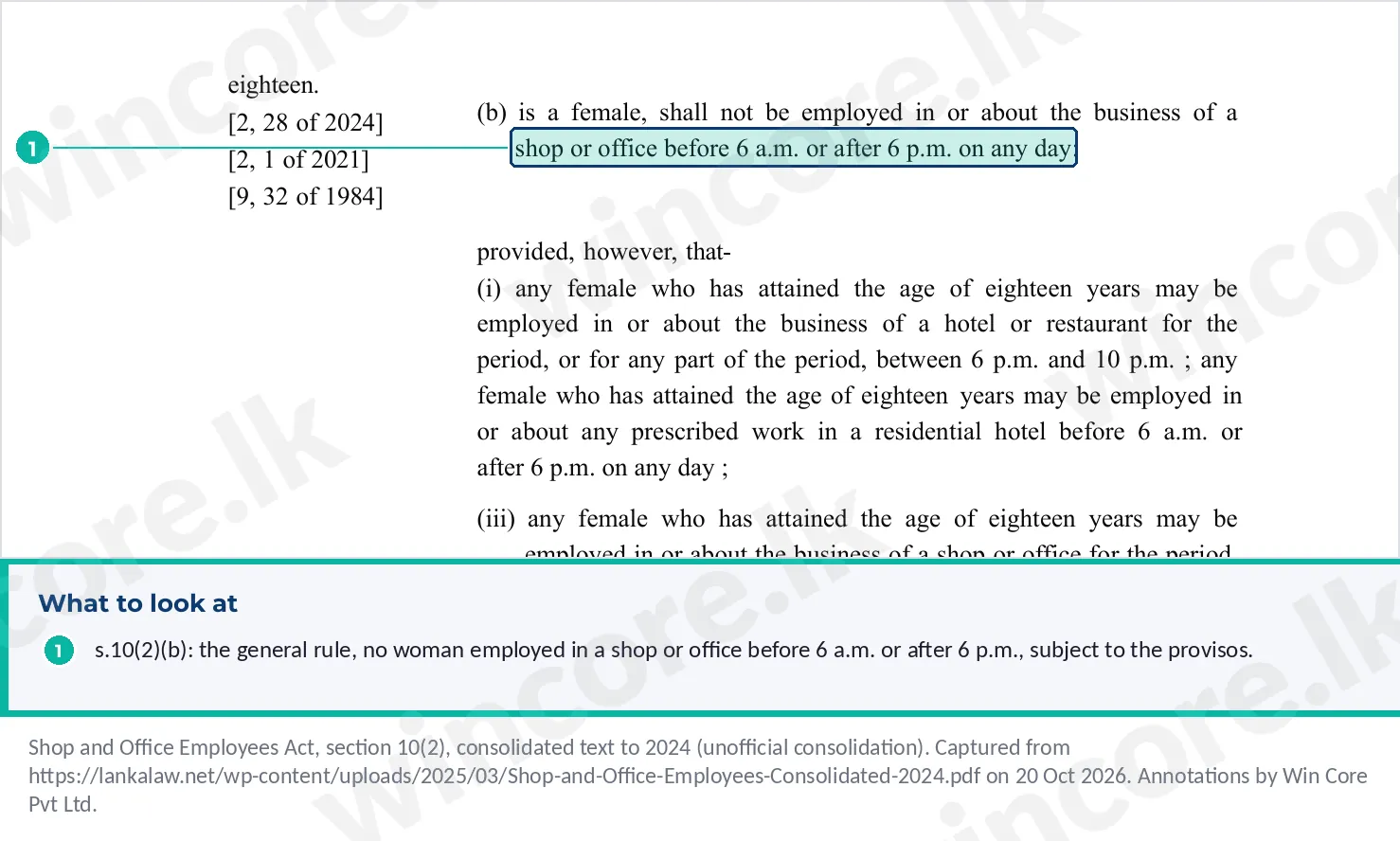
Section 10(2)(b) of the Shop and Office Employees Act is the starting rule: a female "shall not be employed in or about the business of a shop or office before 6 a.m. or after 6 p.m. on any day", followed by a list of provisos [2]. Proviso (v) covers "any female who has attained the age of eighteen years" employed "in any institution which is engaged in business, based on information technology and knowledge process outsourcing or business process outsourcing, or engaged in administration and accounts or related work in a back office for an institute situated abroad" [1].
Section 10 contains no permit or consent step for proviso (v); the permission is in the Act itself [2]. On our reading no prior permission from the Commissioner of Labour is needed. Night work in industrial undertakings is governed by different legislation, outside this article; our Shop and Office Employees Act guide covers who this Act applies to.
The Act does not define the IT, KPO and BPO words, and s.68(c) describes back offices "in connection with" an institution abroad while proviso (v) says "for" one [1]. Our practice suggestion: write one page saying why each night team fits, which services it delivers and to whom, with the client contracts that show it. If part of the operation is a local helpdesk, decide which teams may work at night and record the reason.
Gazette 2473/25 covers hotel and airline roles, not BPO night shifts
Gazette Extraordinary No. 2473/25 of 30 January 2026 publishes a regulation made under section 66 on 12 December 2025 that amends regulation 3 of the 1954 Regulations [4]. Regulation 3 deals with women working at night "in any office maintained by an airline at an airport on the work of a ground hostess, or in any residential hotel" in listed roles [3]. The Gazette adds "ladies janitorial attendant, or a food and beverage stewardess" to the residential hotel list and makes the employer responsible for "the healthcare, safety and welfare of such female employed under this regulation", including accommodation until 6 a.m. or transport home when the shift ends between 6 p.m. and 6 a.m. [4].
A woman on a BPO night shift is employed under proviso (v) of the Act, not under regulation 3. So, on our reading, the accommodation or transport duty in Gazette 2473/25 does not reach IT, KPO, BPO or back-office employers. Its effective date is also open: section 66(3) says no regulation "shall have effect until it has been approved" by Parliament, with notice of approval in the Gazette [2], and we have not confirmed that notice.
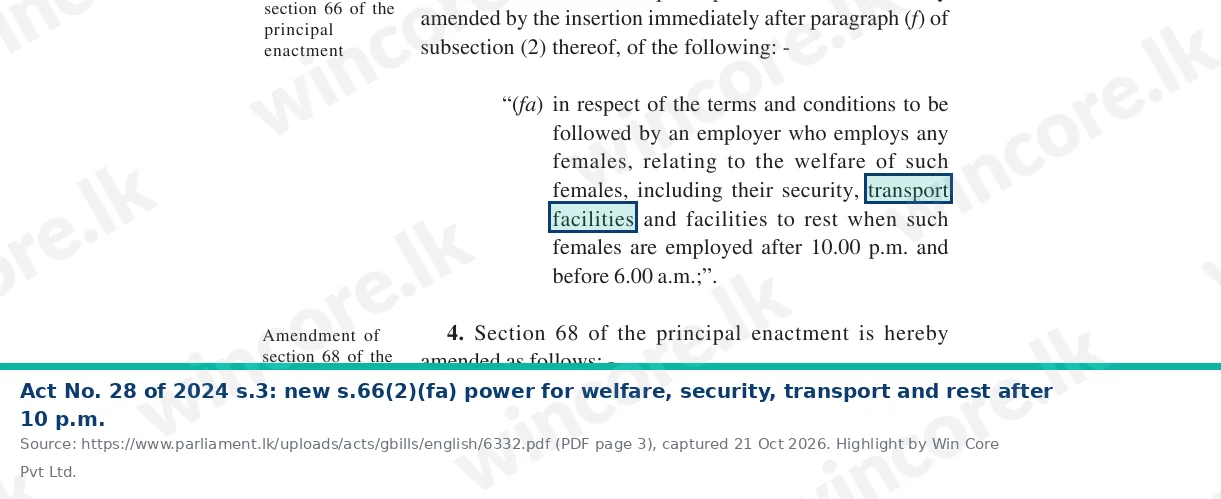
The Act does allow welfare rules for BPO night work. Section 66(2)(fa) lets the Minister make regulations on the welfare of women employed "after 10.00 p.m. and before 6.00 a.m.", "including their security, transport facilities and facilities to rest" [1]. We found no regulation made under that power.
The 9-hour limit for women decides the length of a night shift
Three hours rules shape a night roster:
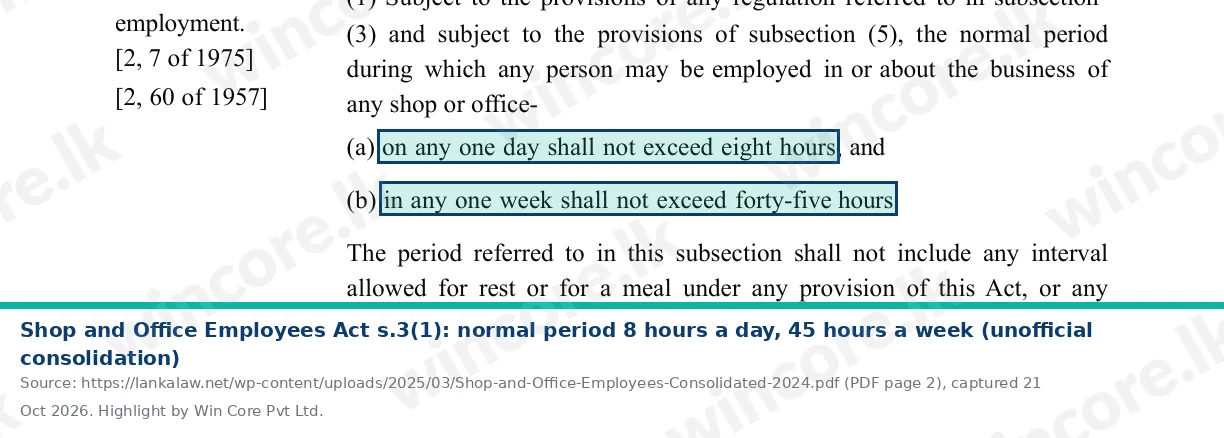
- Section 3(1). The normal period is at most eight hours a day and 45 hours a week, excluding meal and rest intervals [2].
- Regulation 2(1). No female "shall be employed in or about the business of any shop or office for any period (including overtime and an interval for rest or for a meal...) exceeding 9 hours a day" [3].
- Regulations 6 and 7. Overtime may not exceed an aggregate of twelve hours a week and is paid at not less than one and one-half times the hourly rate [3].
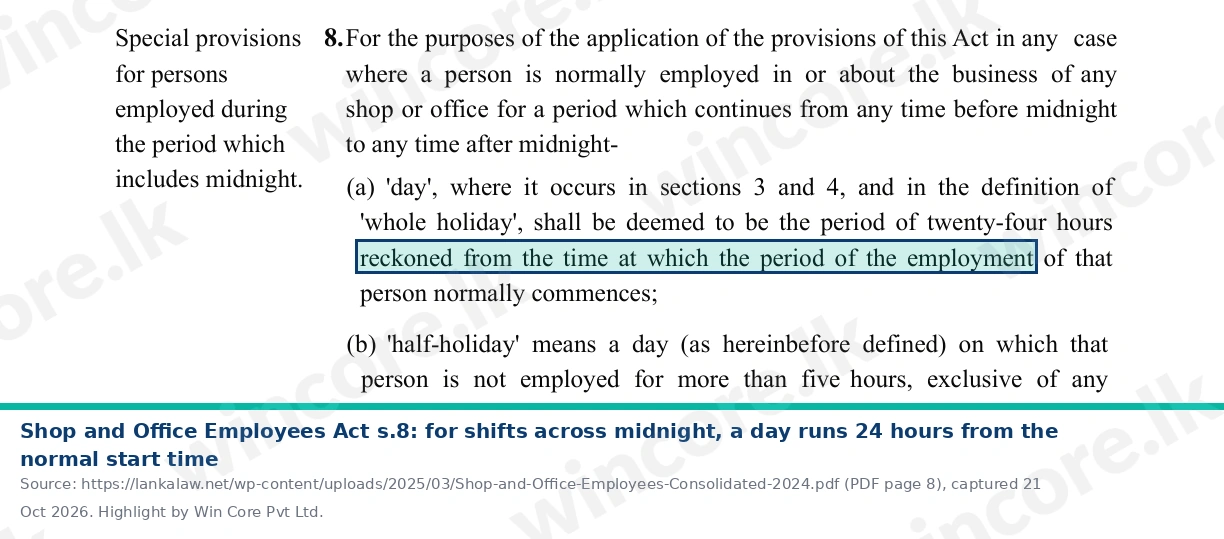
For a shift across midnight, s.8(a) treats "day" in sections 3 and 4 as "the period of twenty-four hours reckoned from the time at which the period of the employment of that person normally commences" [2]. A 9 p.m. to 6 a.m. shift is one day, not two.
Meal intervals follow the Schedule to the Act, which, among other rules, requires half an hour for rest or a meal at the end of each four hours of continuous work (Schedule, rule 2) [2].
The practical result: with a one-hour meal break, a woman's shift is eight hours of work inside a nine-hour span, and there is no room for overtime that day. Asking her to stay an extra hour to clear a queue breaks regulation 2(1) even if the hour is paid at overtime rates. Our overtime rules guide sets out the overtime regulations in full.
Weekly rest, Poya days and public holidays still apply at night
Section 5(1) gives every shop or office employee "one whole holiday and one half-holiday" each week, paid if she worked at least 28 hours excluding overtime [2]. For a shift across midnight, s.8(b) makes a half-holiday a day on which she "is not employed for more than five hours", excluding meal intervals [2]. The holidays are given in that week or the next; accumulating four weeks of them needs the Commissioner's "prior written sanction" (s.5(2)) [2].
Two holiday rules matter for teams serving clients abroad, because foreign clients work through Sri Lankan holidays:
- Poya days. Work on a Full Moon Poya Day is allowed for a normal period if paid "not less than one and half times his normal daily rate of remuneration" (s.7B) [2].
- Public holidays under section 7. Work on a declared public holiday needs "the prior sanction of the Commissioner", and the employee then gets a paid substitute holiday by 31 December or "double the rate" (s.7(2)) [2]. On our reading this applies to BPO offices, which s.68(c) now makes "offices" under the Act [1].
A hypothetical roster, with our arithmetic
The following is hypothetical. A Galle team processes insurance claims overnight for a client in the United Kingdom. The shift is 9 p.m. to 6 a.m. with a one-hour meal break at 1 a.m.
| Pattern | Hours worked | Rules checked | Result on our reading |
|---|---|---|---|
| Five full shifts, two nights off | 5 x 8 = 40 | 8 h a day, 9 h span, whole and half-holiday | Complies |
| Six full shifts, one night off | 6 x 8 = 48 | 3 h over 45 is overtime (within the 12 h cap); no half-holiday that week | Half-holiday must be given the next week (s.5(2)), and the 3 h paid at 1.5x |
| Five full shifts and one 5-hour shift | 40 + 5 = 45 | The short night is the half-holiday (s.8(b)) | Complies, no overtime |
| A full shift extended to 7 a.m. | 9 h work, 10 h span | Over the 9-hour limit for a woman | Breaches regulation 2(1) |
Transport, security and rest: good practice until a regulation says more
Because no s.66(2)(fa) regulation has been made for BPO work and Gazette 2473/25 does not cover it, there is no statutory transport or accommodation duty specific to BPO night work on our reading. The employer's general duty of care still applies, and these are the subjects the Minister has power to regulate. Our practice suggestions:
- Transport. Provide or pay for transport for shifts that start or end between 10 p.m. and 6 a.m., and keep a log of who used it.
- Security. Controlled entry, monitored reception, and a named person responsible for staff safety on each night shift.
- Rest. A rest area for breaks. On our reading a rest room is not residence, but s.12(1) bars an employer from permitting staff "to live or reside in the premises" of an office without a permit [2].
- Policy and consent. A written night-shift policy covering the above and how to ask to move to day shifts. The Act does not require written consent for proviso (v); we suggest it as a record that night work was agreed.
Our HR compliance services review these policies and the proviso (v) note, and our BPO services page describes the back-office work we take on.
Records an inspector would ask for
Section 18(b) requires "a record of the hours actually worked by each such person, including particulars of all overtime work, and of all holidays and leave allowed to or taken by each such person" [2]. Regulation 15(1) lists the particulars of employment, including "Normal hours of work" and the "Overtime rate payable", given in writing on the first day [3]. Failing to keep the s.18 record is an offence under s.54A [2].
For night staff that means, by person and by shift: date of birth evidence, the roster and actual start and finish times, meal breaks, overtime approvals, the weekly holiday log, any Commissioner's sanction, and transport logs. Access-system and transport data are personal data; Parts I and III of the Personal Data Protection Act apply from 1 January 2027, as our PDPA obligations article explains. Night allowances, Poya pay and overtime then run through payroll, which our payroll services handle from the attendance record.
Which section punishes which default
| Default | Section | Penalty |
|---|---|---|
| Employing a woman at night outside section 10, or breaching regulation 2(1), 6 or 7, the weekly holiday or the holiday sanction rules | s.51(1) | Fine not exceeding Rs 500, or imprisonment of either description up to six months, or both, on the employer [2] |
| Not paying overtime, Poya or holiday pay due | s.52(1), (2), (2A) | Rs 100 to Rs 250 first offence, rising to Rs 1,000 or six months for later offences, plus up to Rs 50 a day; the court may order the shortfall with a surcharge [2] |
| Not keeping the hours, overtime and holiday record | s.54A | Rising scale of fines, from Rs 100 to Rs 250 for a first offence [2] |
Applying s.52 to pay owed under the regulations is our reading, based on s.66(3), which makes an approved regulation "as valid and effectual as though it were herein enacted" [2].
What this means for you
- Record why each night team fits proviso (v). Keep the services description and client contracts.
- Check age before the first night shift. The proviso covers women who have "attained the age of eighteen years" [1].
- Roster women to 9 hours including breaks. With a one-hour meal, that is eight hours of work and no same-day overtime.
- Plan the weekly holidays and the holiday sanctions. One whole and one half-holiday each week, and the Commissioner's prior sanction before working a section 7 public holiday.
- Do not copy Gazette 2473/25 into a BPO policy as law. Transport, security and rest are good practice for BPO night work, not a current statutory duty on our reading.
Checklist: documents needed
- One-page proviso (v) note for each night team, with client contracts
- Date of birth evidence for every woman on night shifts
- Night rosters with actual start, finish and meal times
- Overtime approvals and pay at 1.5 times the hourly rate
- Weekly holiday and half-holiday log
- Commissioner's sanction for any public holiday work or accumulated holidays
- Written particulars of employment stating normal hours and overtime rate
- Night-shift policy, employee acknowledgements and transport logs
FAQ
Can a BPO in Sri Lanka employ women on night shifts?
Yes, a woman aged 18 or over may work before 6 a.m. or after 6 p.m. in an IT-based BPO or KPO, or in a back office working for an institution abroad, under proviso (v) to section 10(2). Act No. 28 of 2024 added it from 13 May 2024, its certification date. The 9-hour daily limit, the weekly holidays and the overtime regulations still apply to her shifts.
Does a BPO need the Commissioner's permission for night shifts?
No, not for proviso (v) on our reading, because section 10 itself permits the work and sets no permit step. The Commissioner's prior sanction is still needed for other things, such as working a declared public holiday under section 7(2) or accumulating weekly holidays under section 5(2). Night work in industrial undertakings is governed by a different law.
Must a BPO provide transport for women working at night?
Not as a statutory duty today, on our reading. Gazette 2473/25 places that duty on employers of women in regulation 3 roles in residential hotels and airport airline offices, not on BPOs. The Act allows the Minister to make welfare rules for work between 10 p.m. and 6 a.m., but we found none made. Transport is still sensible practice.
How long can a woman's night shift be?
Nine hours a day in total, counting overtime and meal breaks, under regulation 2(1) of the 1954 Regulations. Within that, normal work is limited to eight hours a day and 45 a week by section 3(1). A 9 p.m. to 6 a.m. shift with a one-hour meal sits exactly at the limit, so any extra hour that night would breach regulation 2(1).
Open points
- Gazette 2473/25 effective date. The Order Paper motion to approve the regulation is on record, but we have not found the Gazette notice of approval that section 66(3) requires.
- Regulations under section 66(2)(fa). None found for IT, KPO, BPO or back-office employers.
- Scope of proviso (v). The IT, KPO and BPO words are undefined, and "for" and "in connection with" an institution abroad differ.
- APIT on employer-provided night transport. Not checked for this article.
- Sources. The Act is an unofficial consolidation and the 1954 Regulations an undated Department of Labour reprint.
Talk to us. If you run night teams and want your rosters, holiday sanctions and particulars of employment checked against the Act, speak to us at our contact page.
WinCore Pvt Ltd
This article is general information on the law as at 22 October 2026 and is not advice on your specific situation.
References
- Parliament of Sri Lanka. Shop and Office Employees (Regulation of Employment and Remuneration) (Amendment) Act, No. 28 of 2024, ss.2, 3 and 4. https://www.parliament.lk/uploads/acts/gbills/english/6332.pdf . Primary. Certified 13 May 2024, published 17 May 2024, no commencement clause. Accessed 21 October 2026; re-checked 22 October 2026.
- Constitution of the Democratic Socialist Republic of Sri Lanka, Article 80(1): a Bill "shall become law when the certificate of the Speaker is endorsed thereon". https://www.constituteproject.org/constitution/Sri_Lanka_2015 . Secondary reproduction. Accessed 22 October 2026.
- LankaLAW. Shop and Office Employees (Regulation of Employment and Remuneration) Act (Chapter 129), consolidated to 2024, ss.3, 5, 7, 7B, 8, 10, 12, 18, 51, 52, 54A, 66, 68 and Schedule. https://lankalaw.net/wp-content/uploads/2025/03/Shop-and-Office-Employees-Consolidated-2024.pdf . Primary text, unofficial consolidation. Accessed 22 October 2026.
- Department of Labour. Labour Code, Shop and Office Employees (Regulation of Employment and Remuneration) Regulations, 1954, regs 2, 3, 6, 7 and 15. https://labourdept.gov.lk/downloads/labour_code/23.pdf . Primary (reprint, undated). Accessed 22 October 2026.
- Department of Government Printing. Gazette Extraordinary No. 2473/25 of 30 January 2026, Regulation under section 66 of the Shop and Office Employees (Regulation of Employment and Remuneration) Act (Chapter 129). https://documents.gov.lk/api/content-file-proxy?file=/extra-gazette-content/2473-25_E_1784567905.pdf . Primary. Accessed 22 October 2026.
Put these insights to work
WinCore specialists can review your current workflow, document gaps, and build a practical 90-day action plan.
Book a free consultationContinue reading
Explore more WinCore analysis to keep your finance, tax, and compliance roadmap moving.
Act No. 28 of 2024 lifted the 6 p.m. bar for women in IT, BPO and overseas back offices. Gazette 2473/25 is a separate hotel and airline rule.
The 8 and 45 hour limits, the 1954 overtime regulations, the 9-hour cap for women, weekly holidays, Poya pay and Wages Board hours, clause by clause.

Employer guide to the Shop and Office Employees framework in Sri Lanka, covering coverage tests, hours, leave, records, and inspection controls.