
Shop and Office Amendment Act 2024: night work and Gazette 2473/25
Act No. 28 of 2024 lifted the 6 p.m. bar for women in IT, BPO and overseas back offices. Gazette 2473/25 is a separate hotel and airline rule.
On this page
Last verified against the primary sources on 21 October 2026.
The Shop and Office Amendment Act 2024 (Act No. 28 of 2024, certified 13 May 2024 and published on 17 May 2024; it has no commencement section, so it applies from 13 May 2024) lets a woman aged 18 or over work before 6 a.m. or after 6 p.m. in an institution engaged in IT-based knowledge process or business process outsourcing, or in back-office administration and accounts work for an institution abroad [1]. It also makes those institutions "offices" under the Act and lets the Minister make welfare rules for women working between 10 p.m. and 6 a.m. [1]. Gazette Extraordinary 2473/25 of 30 January 2026 is a different instrument: it amends regulation 3 of the 1954 Regulations for residential hotel and airport airline roles, and on our reading it does not apply to IT or BPO work [4].
Take a hypothetical Kandy firm that processes payables for a client in Australia, with a team working 2 p.m. to 11 p.m. Act No. 28 of 2024 is what makes the women on that shift lawful. Gazette 2473/25 does not touch them.
The section 10 curfew is still the starting rule
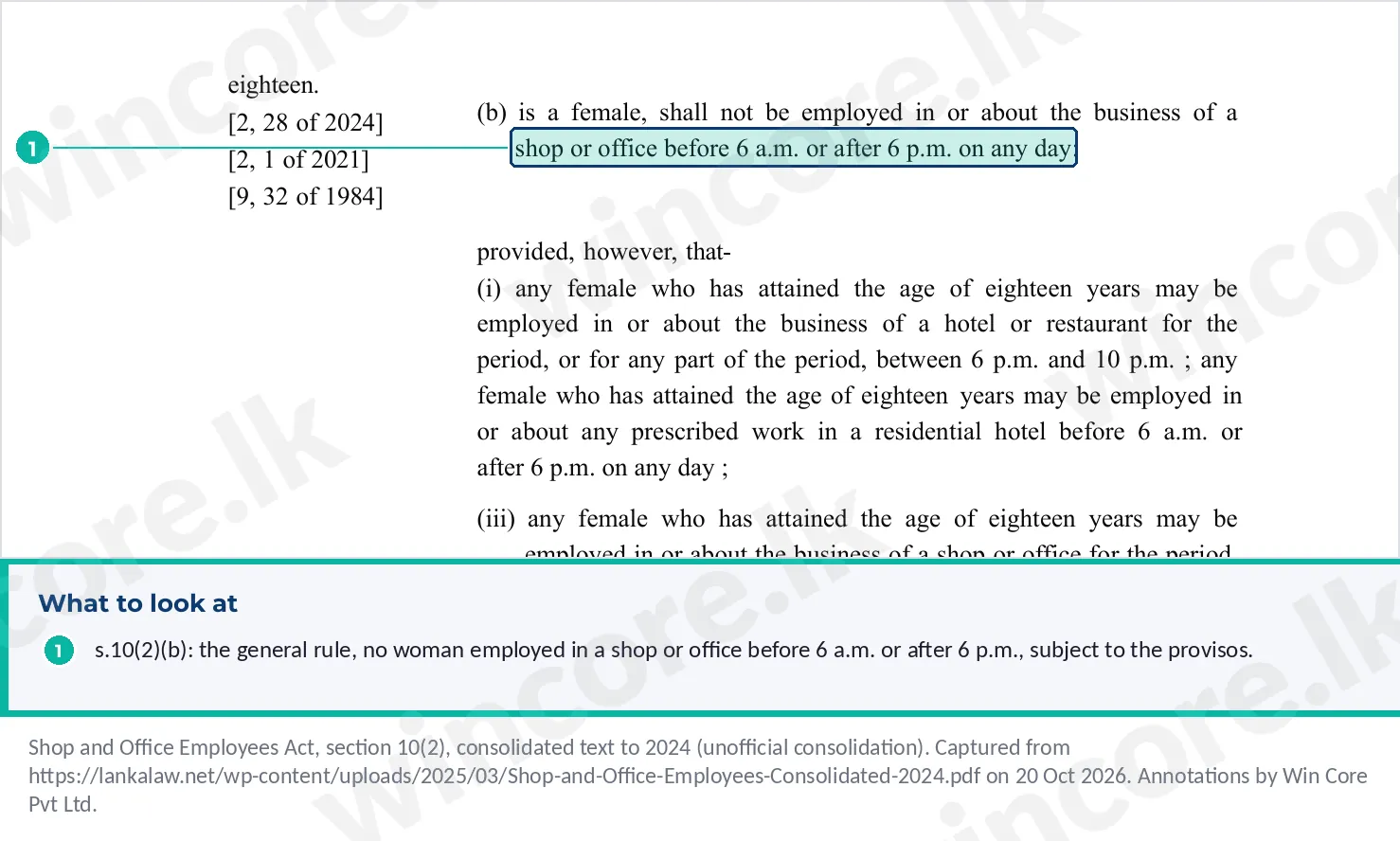
Section 10(2)(b) of the Shop and Office Employees Act (Chapter 129) says that a person aged sixteen or over who "is a female, shall not be employed in or about the business of a shop or office before 6 a.m. or after 6 p.m. on any day", followed by "provided, however, that" and a list of exceptions [2].
Before 2024 the provisos that helped women were three. A woman of eighteen or over could work in a hotel or restaurant between 6 p.m. and 10 p.m.; she could do "prescribed work in a residential hotel" before 6 a.m. or after 6 p.m.; and she could work in a shop or office between 6.00 p.m. and 8.00 p.m. [2]. Proviso (iv), often read as a fourth exception for women, is about males aged sixteen in hotels, restaurants and places of entertainment until 10 p.m. [2].
So the curfew is still the default, and an employer should be able to name the proviso each night shift relies on.
What the Shop and Office Amendment Act 2024 changed in section 10
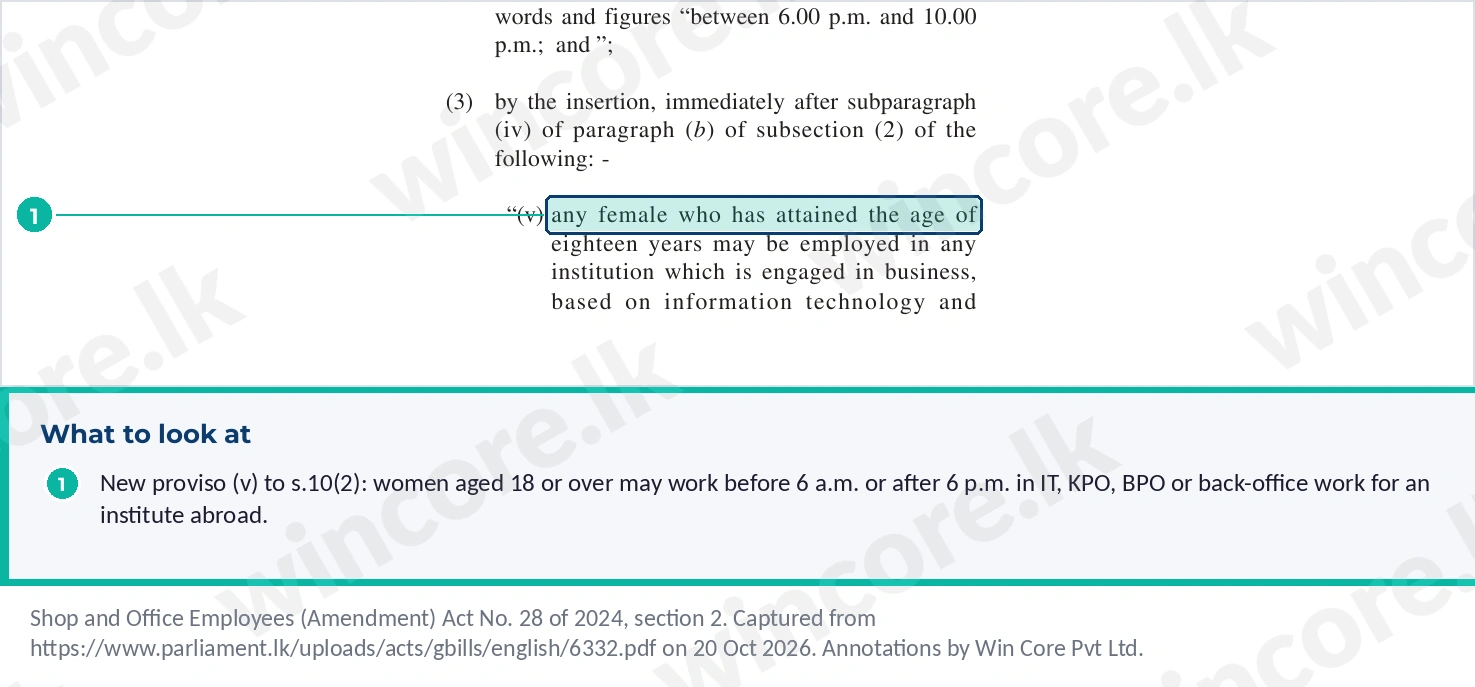
Section 2(3) of the amending Act inserts a new proviso after proviso (iv):
"(v) any female who has attained the age of eighteen years may be employed in any institution which is engaged in business, based on information technology and knowledge process outsourcing or business process outsourcing, or engaged in administration and accounts or related work in a back office for an institute situated abroad before 6.00 a.m. or after 6.00 p.m. on any day." [1]
Four limits are built into the wording of proviso (v):
- Age. The woman must have attained eighteen.
- Type of institution. Either one "engaged in business, based on information technology and knowledge process outsourcing or business process outsourcing", or one engaged in "administration and accounts or related work in a back office for an institute situated abroad" [1].
- No clock limit in the proviso itself. Provisos (i) and (iii) stop at 10 p.m. and 8 p.m. Proviso (v) covers any time "before 6.00 a.m. or after 6.00 p.m. on any day" [1].
- It lifts the time-of-day bar only. On our reading the daily and weekly limits on hours, overtime, rest and holidays still apply in full. We set them out below.
The Act does not define "information technology and knowledge process outsourcing or business process outsourcing". A software company that builds its own product, or a back office serving only Sri Lankan group companies, may sit outside the words. We keep that as an open point.
Section 68 makes these institutions offices for the whole Act
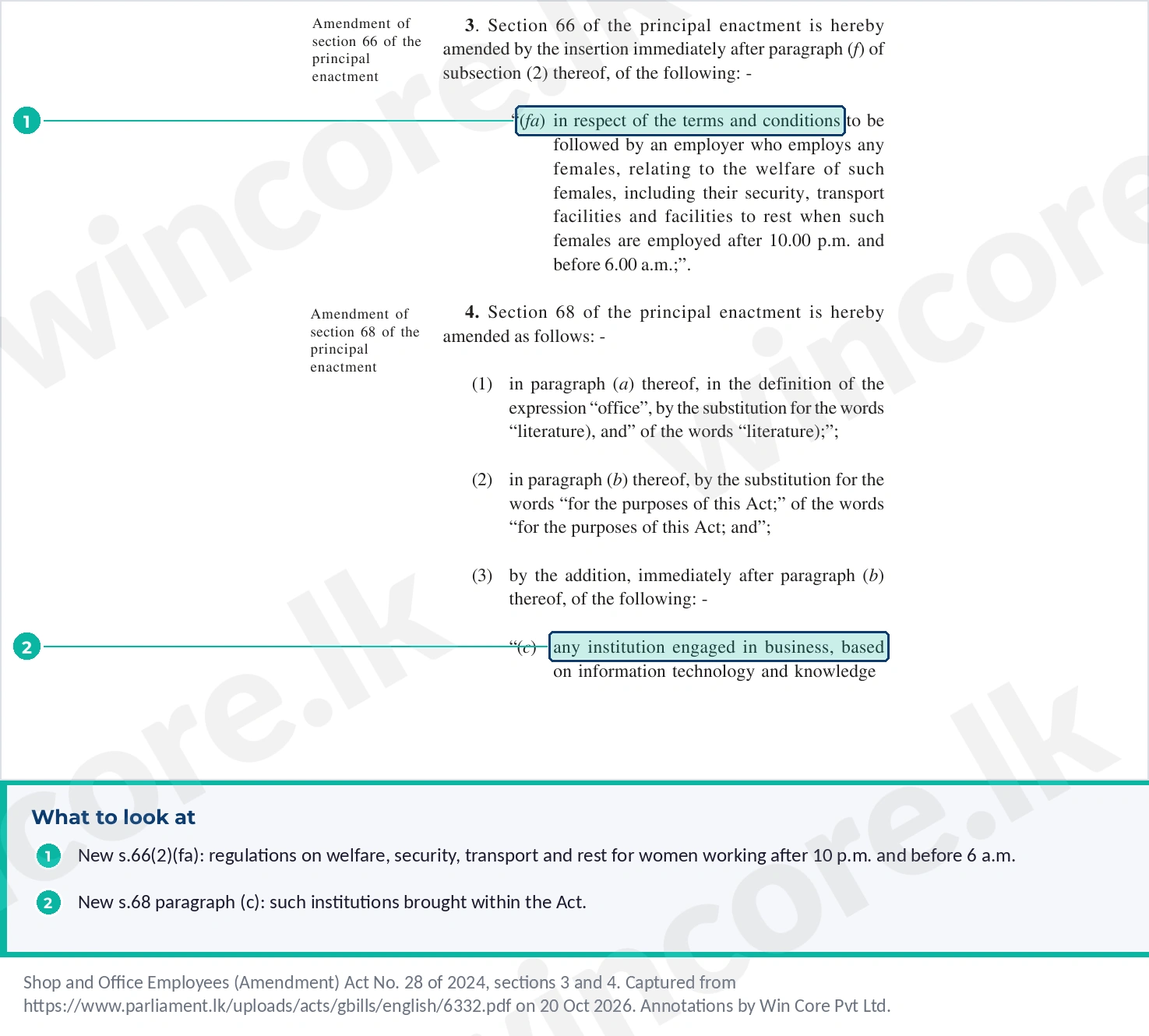
Section 4 of the amending Act adds a paragraph (c) to the definition of "office" in section 68: "any institution engaged in business, based on information technology and knowledge process outsourcing or business process outsourcing or engaged in administration and accounts or related work in a back office in connection with any institution situated abroad" [1].
The general definition already reached the establishments of banks, companies and accountants, and the office or clerical department of other businesses [2]. Paragraph (c) removes any argument for IT, KPO, BPO and overseas back-office institutions. On our reading the whole Act now applies to them expressly: hours, overtime pay, holidays, leave and written particulars of employment.
The two sections use different words. Proviso (v) says back-office work "for an institute situated abroad"; section 68(c) says "in connection with any institution situated abroad" [1]. A back office supporting a foreign group's local sales may be "in connection with" a foreign institution without working "for" it.
Section 66(2)(fa) allows welfare rules for 10 p.m. to 6 a.m., and we found none for IT or BPO
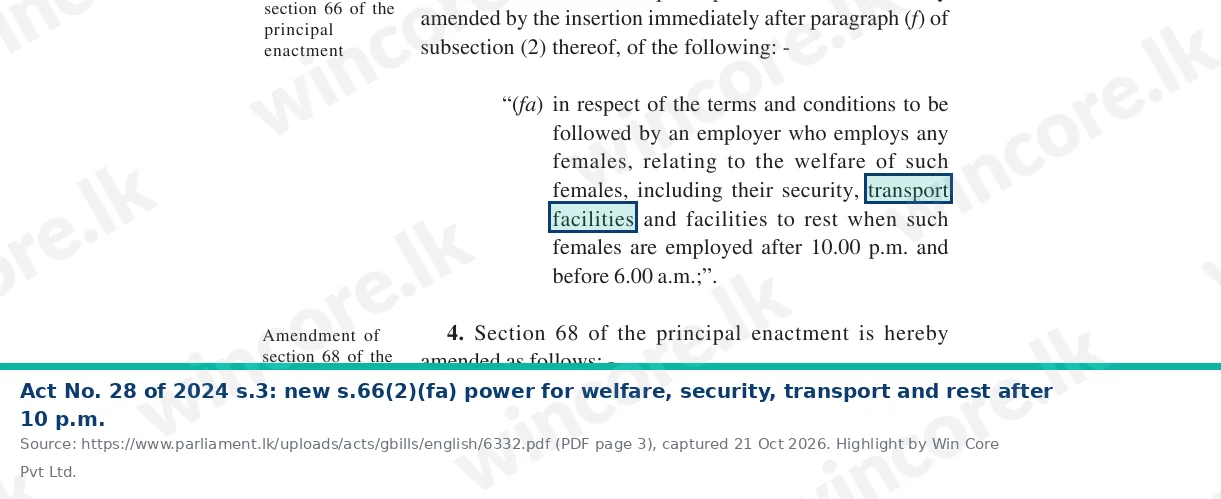
Section 3 of the amending Act inserts paragraph (fa) into section 66(2), so the Minister may make regulations "in respect of the terms and conditions to be followed by an employer who employs any females, relating to the welfare of such females, including their security, transport facilities and facilities to rest when such females are employed after 10.00 p.m. and before 6.00 a.m." [1].
That is a power, not a duty, and section 66(3) adds that "No regulation made by the Minister shall have effect until it has been approved" by Parliament, with notice of the approval published in the Gazette [2]. We found no regulation made under paragraph (fa) for IT, KPO, BPO or back-office institutions on documents.gov.lk or labourdept.gov.lk, and no Order Paper motion for one on parliament.lk. Until one exists, on our reading these firms have no statutory transport or accommodation duty specific to night work.
Gazette 2473/25 covers residential hotel and airline roles, not IT or BPO
Gazette Extraordinary No. 2473/25 of Friday 30 January 2026 publishes a regulation "made by the Minister of Labour under Section 66", dated 12 December 2025 [4]. It amends regulation 3 of the Shop and Office Employees Regulations, 1954 [4].
Regulation 3, as printed in the Department of Labour's reprint, allowed a woman aged 18 or over to work before 6 a.m. or after 6 p.m. "in any office maintained by an airline at an airport on the work of a ground hostess, or in any residential hotel on the work of a receptionist, ladies cloak-room attendant, ladies linen room attendant or ladies lavatory attendant" [5]. Gazette 2473/25 makes two changes [4]:
| What changed | Before | After Gazette 2473/25 |
|---|---|---|
| Hours wording | "before 6. a.m or after 6 p.m" | "after 6 p.m or before 6 a.m of the following day" |
| Residential hotel roles | ...linen room attendant "or ladies lavatory attendant." | ...linen room attendant, "ladies janitorial attendant, or a food and beverage stewardess" |
| Employer duty | None in regulation 3 | Responsible for "the healthcare, safety and welfare of such female employed under this regulation", including accommodation from the end of the shift until 6 a.m., or transport to her usual residence when the shift ends between 6 p.m. and 6 a.m. |
The duty attaches to a woman "employed under this regulation" [4], and regulation 3 is about airport airline offices and residential hotels. A woman on a night shift at a BPO is employed under proviso (v) of the Act, which needs no regulation at all. So, on our reading, the accommodation or transport duty in Gazette 2473/25 does not bind an IT, KPO, BPO or back-office employer. Two more points:
- Restaurants. The Cabinet decision described food and beverage stewardesses "in residential hotels and restaurants" [6]. The Gazette wording adds the role to the residential hotel list in regulation 3 [4]. On our reading a stand-alone restaurant is not covered and stays under proviso (i), which stops at 10 p.m.
- When it took effect. Section 66(3) requires Parliament's approval first [2]. The Order Paper for 8 January 2026 carried the motion that the regulation of 12 December 2025, presented on 18 December 2025, "be approved" [7], and the debate took place in early January (Secondary report) [8]. We did not find the separate Gazette notice of approval, so we give 30 January 2026 as the publication date, not as a confirmed effective date.
The 9-hour limit for women and the overtime cap still apply at night
Proviso (v) removes the clock, not the hours limits. Section 3(1) limits the normal period of work to eight hours a day and 45 hours a week, excluding meal and rest intervals [2]. The 1954 Regulations, as reprinted by the Department of Labour, then add two limits that matter for night rosters [5]:
- Regulation 2(1): no female "shall be employed in or about the business of any shop or office for any period (including overtime and an interval for rest or for a meal...) exceeding 9 hours a day".
- Regulation 6: overtime "shall not exceed an aggregate of twelve hours in any one week", paid under regulation 7 at not less than one and a half times the hourly rate.
Back to the hypothetical Kandy firm. A 2 p.m. to 11 p.m. shift with a one-hour meal break is eight hours of work inside a nine-hour span, so it fits section 3(1) and regulation 2(1) on our reading. If a woman on that shift is asked to stay until midnight to close a month end, her span becomes ten hours and breaches regulation 2(1), even if the extra hour is paid as overtime. Where a normal shift runs past midnight, section 8 reckons the "day" in sections 3 and 4 as 24 hours from the usual start, so the date change does not reset the count [2]. Our sibling piece on overtime ceilings and weekly rest covers the hours rules in full.
Which section punishes which default
| Default | Section | Penalty |
|---|---|---|
| Employing a woman outside the hours section 10 allows, or breaching regulation 2(1), 3 or 6 | s.51(1) | Fine not exceeding Rs 500, imprisonment of either description up to six months, or both, on "the employer" |
| Not paying overtime or other remuneration due under the Act | s.52(1) | First offence Rs 100 to Rs 250; second Rs 250 to Rs 500; later offences Rs 500 to Rs 1,000 or up to six months or both, plus up to Rs 50 a day after conviction |
Section 51(1) covers "any contravention of or failure to comply with any provision of this Act, other than the provisions of section 30, section 43 or section 45, or of any regulation" [3]. We quote the Department of Labour reprint here; the LankaLAW consolidation prints "contravention of failure", a typographical slip [2] [3]. Reading s.52 as the provision for unpaid overtime is our reading, because regulations approved under section 66(3) are "as valid and effectual as though it were herein enacted" [2]. The fines are small; the imprisonment limb is not.
What this means for you
- Name your proviso. If women work after 6 p.m., write down whether you rely on proviso (iii) (to 8 p.m.), proviso (v) (IT, KPO, BPO or overseas back office) or, for a residential hotel, regulation 3.
- Test proviso (v) against your actual business. A product company or a back office serving only local entities should take advice before relying on it. Our HR compliance services cover this review.
- Do not copy hotel rules into a BPO policy as if they were law. Gazette 2473/25 binds hotel and airline employers. For an IT or BPO firm, transport and rest arrangements are good practice and a likely future regulation under section 66(2)(fa), not a current statutory duty on our reading.
- Build rosters around the 9-hour span. Regulation 2(1) counts overtime and meal breaks. Rosters and overtime should run through payroll, which our payroll services handle with the attendance record.
- Read the evergreen rules alongside this. Our Shop and Office Employees Act guide and labour law guide for employers cover leave, holidays and records. See also our sibling guide to night work for women in BPO operations.
Checklist: documents needed
- A short note naming the proviso or regulation relied on for each night role
- Business description and client contracts showing the IT, KPO, BPO or overseas back-office activity
- Night rosters with names, dates of birth, start and finish times and meal breaks
- Overtime approvals and pay records at one and a half times the hourly rate
- Written particulars of employment stating normal hours and the overtime rate
- For residential hotels: accommodation or transport records for each shift ending between 6 p.m. and 6 a.m.
- A copy of Gazette 2473/25 and any later notice of Parliament's approval
FAQ
Can women work night shifts in a BPO in Sri Lanka?
Yes, if she is 18 or over and the business fits proviso (v) to section 10(2). Act No. 28 of 2024 added that proviso for institutions engaged in IT-based knowledge or business process outsourcing, or in back-office administration and accounts work for an institution abroad. The daily and weekly hours limits in the Act and the 1954 Regulations still apply to her shift.
Does Gazette 2473/25 apply to IT and BPO companies?
No, on our reading it applies to residential hotel and airport airline roles under regulation 3 of the 1954 Regulations. Its accommodation or transport duty covers a woman "employed under this regulation". A woman in a BPO works under proviso (v) of the Act instead, and we found no regulation under section 66(2)(fa) that sets a transport duty for BPO employers.
Is there a latest finishing time for women in an IT company?
There is no clock limit in proviso (v), but regulation 2(1) of the 1954 Regulations caps a woman's working span at nine hours a day, counting overtime and meal breaks. Section 3(1) limits normal work to eight hours a day and 45 a week, and regulation 6 caps overtime at twelve hours a week. A late start therefore means a late but limited finish.
Must an employer provide transport for women working late?
Only where a regulation requires it, and today that is the hotel and airline rule in Gazette 2473/25. For IT, KPO, BPO and back-office firms the Act lets the Minister make welfare rules for work between 10 p.m. and 6 a.m., but we found none made. Providing transport or rest facilities is still sensible practice and supports the employer's duty of care.
What is the penalty for breaching the night work rules?
The employer faces a fine not exceeding Rs 500, imprisonment of up to six months, or both, under section 51(1) of the Shop and Office Employees Act. That section covers any contravention of the Act or its regulations except sections 30, 43 and 45. Unpaid overtime falls under the separate section 52 ladder of fines, rising for repeat offences.
Open points
- Parliament's approval of the 12 December 2025 regulation. The motion was on the Order Paper for 8 January 2026 and was debated, but we did not find the Gazette notice of approval that section 66(3) requires. The effective date is open.
- Scope of proviso (v). "Information technology and knowledge process outsourcing or business process outsourcing" is not defined, and sections 10 and 68 say "for" and "in connection with" an institution abroad.
- Regulations under section 66(2)(fa). We found none. Absence is from searches of documents.gov.lk, labourdept.gov.lk and parliament.lk on 21 October 2026.
- Current text of the 1954 Regulations. We read the Department of Labour reprint, which carries regulation 3 in its pre-2026 form. We found no amendment to regulations 2(1) or 6, but the reprint is undated.
- Consolidated Act. The LankaLAW consolidation is unofficial.
Talk to us. If you run evening or night shifts and want your rosters, overtime and written particulars checked against the Act, speak to us at our contact page.
WinCore Pvt Ltd
This article is general information on the law as at 21 October 2026 and is not advice on your specific situation.
References
- Parliament of Sri Lanka. Shop and Office Employees (Regulation of Employment and Remuneration) (Amendment) Act, No. 28 of 2024, ss.1 to 5. https://www.parliament.lk/uploads/acts/gbills/english/6332.pdf . Primary. Accessed 21 October 2026.
- LankaLAW. Shop and Office Employees Act, Consolidated (2024), ss.3, 8, 10, 51, 52, 66, 68. https://lankalaw.net/wp-content/uploads/2025/03/Shop-and-Office-Employees-Consolidated-2024.pdf . Primary text, unofficial consolidation. Accessed 21 October 2026.
- Department of Labour. Labour Code, Shop and Office Employees Act (English reprint, pre-2024), s.51(1). https://labourdept.gov.lk/downloads/labour_code/20.pdf . Primary. Accessed 20 October 2026.
- Department of Government Printing. Gazette Extraordinary No. 2473/25 of 30 January 2026, Regulation under section 66 of the Shop and Office Employees (Regulation of Employment and Remuneration) Act (Chapter 129), L. D. B. 3/2025. https://documents.gov.lk/api/content-file-proxy?file=/extra-gazette-content/2473-25_E_1784567905.pdf . Primary. Accessed 21 October 2026.
- Department of Labour. Labour Code, Shop and Office Employees (Regulation of Employment and Remuneration) Regulations, 1954, regs 2, 3, 6, 7. https://labourdept.gov.lk/downloads/labour_code/23.pdf . Primary (reprint, undated). Accessed 21 October 2026.
- Office of the Cabinet of Ministers. Amending the Regulations of the Shop and Office Employees (Regulation of Employment and Remuneration) Act, No. 19 of 1954, Cabinet decision. https://www.cabinetoffice.gov.lk/cab/index.php?option=com_content&view=article&id=16&Itemid=49&lang=en&dID=13305 . Primary (Cabinet decision, not law). Accessed 21 October 2026.
- Parliament of Sri Lanka. Order Paper of Parliament, 8 January 2026, motion on the Regulation under the Shop and Office Employees Act. https://www.parliament.lk/uploads/businessdocs/english/23011_english_2026-01-08.pdf . Primary. Accessed 21 October 2026.
- The Island. SJB asks govt. to allow female state employees to work from home, January 2026, report of the debate on the Shop and Office regulation. https://island.lk/sjb-asks-govt-to-allow-female-state-employees-to-work-from-home/ . Secondary. Accessed 21 October 2026.
Put these insights to work
WinCore specialists can review your current workflow, document gaps, and build a practical 90-day action plan.
Book a free consultationContinue reading
Explore more WinCore analysis to keep your finance, tax, and compliance roadmap moving.

Employer guide to the Shop and Office Employees framework in Sri Lanka, covering coverage tests, hours, leave, records, and inspection controls.
What a BPO, KPO or overseas back office has to set up before rostering women at night, with the 9-hour limit, rest days and records it must keep.
A late annual return rarely stands alone. Fix the officers, file beneficial ownership at once, then each overdue return with its AGM, then tax.