
Circular SEC/2026/E/06: quarterly income tax instalments for 2026/27
The IRD rewrote its instalment circular twice in nine days. What the 12 August version says on A, C, Method 2, the SET bridge and the November dates.
On this page
Last verified against the primary sources on 21 October 2026.
Circular SEC/2026/E/06 (Re-Revised), issued by the IRD on 12 August 2026, sets how quarterly income tax instalments are worked out for 2026/27. Each instalment is (A minus C) divided by B, where A is last year's tax. A lower estimate may replace it only if you had no taxable income in 2025/26 or reasonably expect lower income in 2026/27, and the supporting Attachments are due on or before 30 November 2026 [1]. The payment dates stay 15 August, 15 November, 15 February and 15 May.
Take a hypothetical freelance software consultant in Colombo. Tax on the 2025/26 taxable income came to Rs 900,000, and clients will withhold about Rs 300,000 during 2026/27. With no further facts, each quarter's instalment is now a matter of arithmetic, not judgement.
Circular SEC/2026/E/06 is the IRD's method under section 90(3)
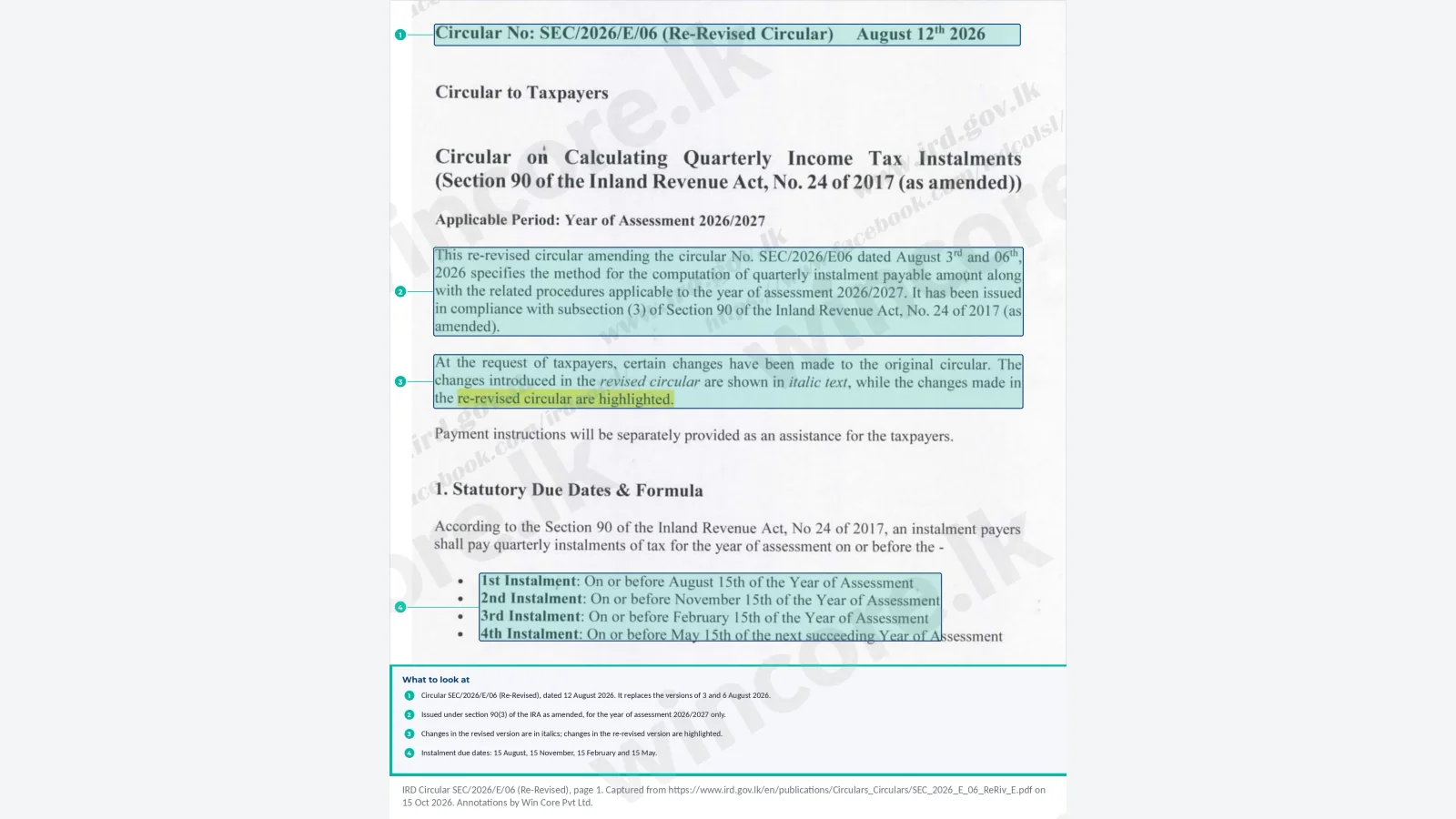
Circular SEC/2026/E/06 (Re-Revised Circular), dated 12 August 2026, is the IRD's "Circular on Calculating Quarterly Income Tax Instalments", with "Applicable Period: Year of Assessment 2026/2027" [1]. It amends the versions of 3 August and 6 August 2026 and says it "has been issued in compliance with subsection (3) of Section 90" [1] [2] [3].
The legal hook is the Inland Revenue (Amendment) Act, No. 11 of 2026. It rewrote item A of the s.90(3) formula. Where last year's figure does not fit, the estimate "shall be calculated as per the procedure, and on the basis, specified by the Commissioner-General" [4]. This circular is that procedure. The IRD's list of circulars shows all three versions [7].
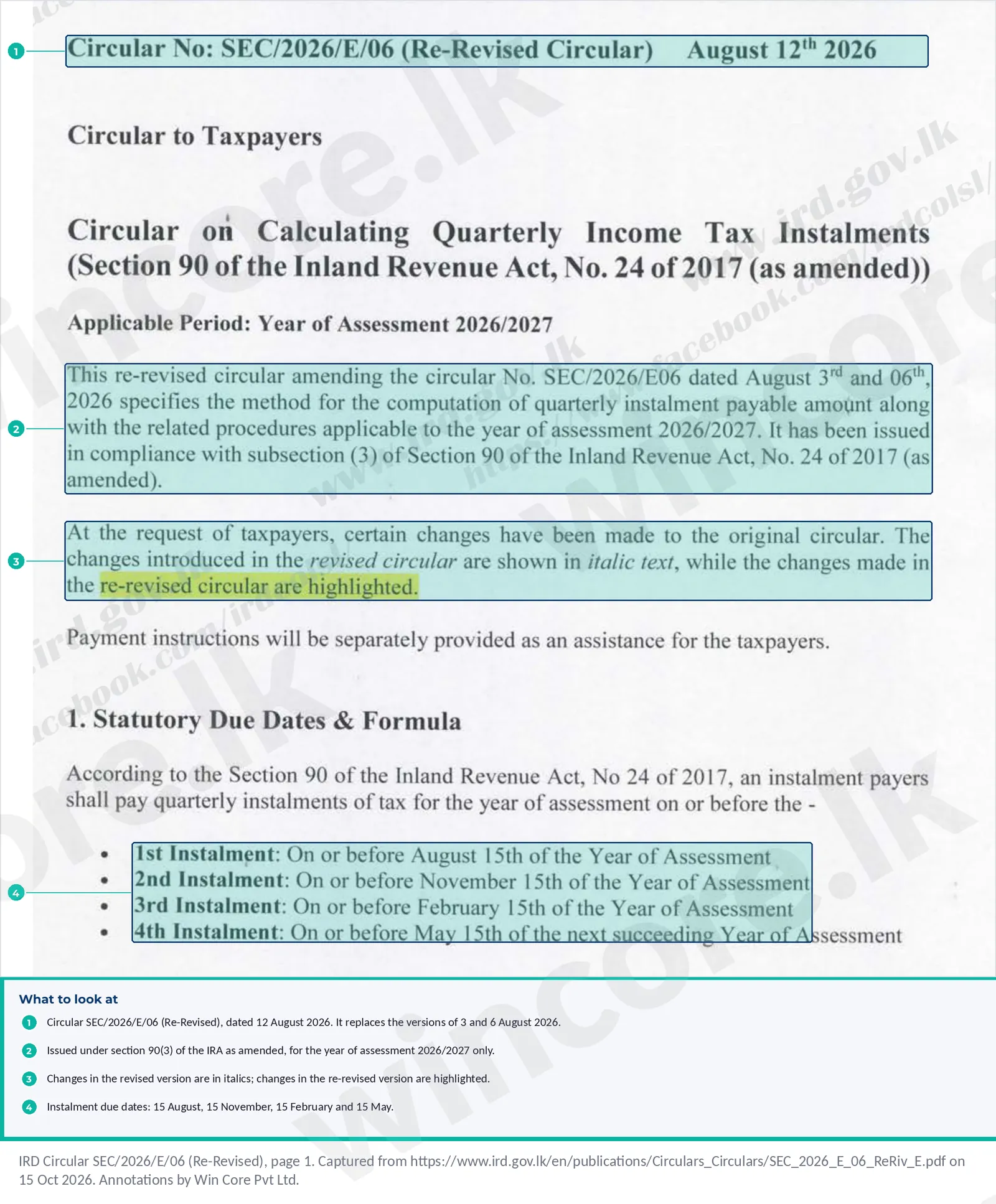
The circular is a scanned document. We read it by OCR and checked every figure quoted here against the page images. It marks changes made in the revised version in italics and those in the re-revised version with highlighting [1].
Who it affects. Every "instalment payer": a person who derives or expects to derive assessable income from a business, investment or other income, or from employment where the employer does not withhold under s.83 or s.83A [5]. That covers companies, firms, trusts and individuals with business or rental income. Gains from realising investment assets "shall not be considered for the purpose of quarterly installments" (s.90(1) proviso) [5].
When it applies. The Act's change to s.90(3) and the limits on ss.91 and 92 operate from 1 April 2026, under the s.1(3) Table [4]. The circular applies to the year of assessment 2026/2027 only [1]. The IRD's June notice put it plainly: the SET requirement "has been discontinued" [6]. The due dates are unchanged: 15 August, 15 November and 15 February in the year, and 15 May after it [1] [5].
Each instalment is last year's tax, less credits, over the quarters left
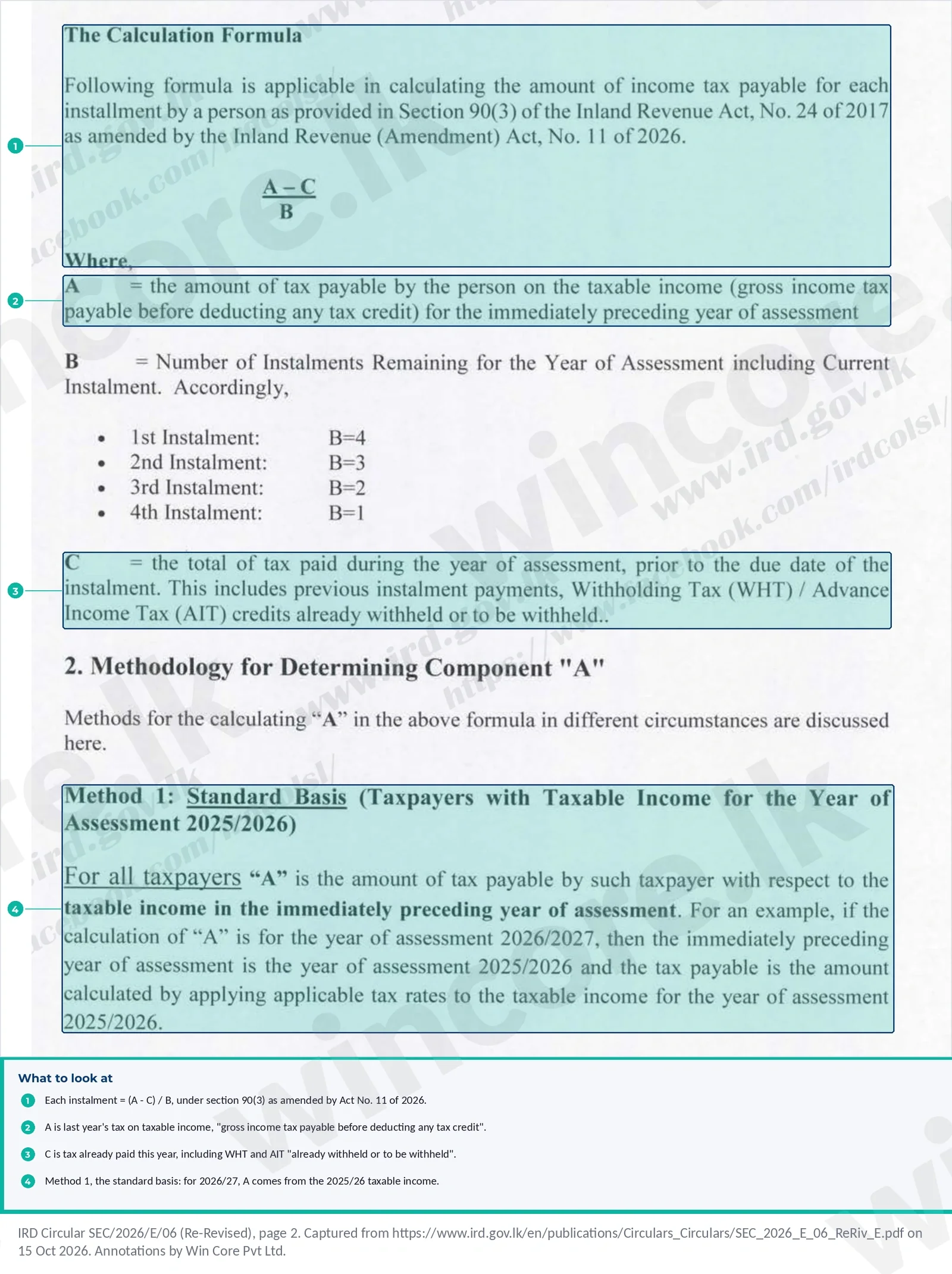
Each instalment is (A minus C) divided by B [1].
- A is, for any year commencing on or after 1 April 2026, "the amount of tax payable by the instalment payer with respect to the taxable income under paragraph (a) of subsection (1) of section 2 in the immediately preceding year of assessment" [4]. The circular describes it as "gross income tax payable before deducting any tax credit" [1].
- B is the number of instalments remaining, including the current one: 4, 3, 2, then 1.
- C is tax already paid in the year before the due date, "previous instalment payments, Withholding Tax (WHT) / Advance Income Tax (AIT) credits already withheld or to be withheld" [1]. The Act's new item C(ba) covers tax "withheld or to be withheld during the relevant year of assessment under Division II" [4].
So can you deduct withholding your clients have not made yet? Yes, if it is expected in the year. The IRD's own Example 2 deducts a full year's expected credits from the first instalment [1].
The standard basis applies unless you meet a Method 2 condition
Method 1, standard basis. A is the 2025/26 tax. The circular's compliance note says "No documentation needs to be filed with the Commissioner-General for payments made under this standard basis". It also says "If you are eligible to use the standard method to calculate your quarterly installments, you cannot use the alternative methods" [1].
Method 2, alternative bases, "strictly reserved" for taxpayers with no taxable income in 2025/26, or who "reasonably expect" lower taxable income in 2026/27 [1]. It has four branches:
- (i) Nothing last year, nothing expected: "A" is considered zero. No instalment is due, but the taxpayer "must submit a statement as specified in Attachment 1 (paragraph 6 and 8.2 of the attachment 1)".
- (ii) Nothing last year, income expected because losses run out or an exemption ends: rework the 2025/26 figures "disregarding any losses deducted or tax exemptions applied in that year, as applicable".
- (iii) Lower income expected: recalculate the 2025/26 tax "by excluding the gains or profits from business or investment activities that are not expected to arise", and submit Attachment 1 "with supporting details (calculations)".
- (iv) Newly registered: estimate the current year using current-year rules, for one year only, and submit Attachment 2 [1].
Method 3. A taxpayer "practically unable" to calculate A under (ii) or (iii) writes to the Commissioner, Tax Policy and Legislation Unit, "seeking for another reasonable alternative method" [1].
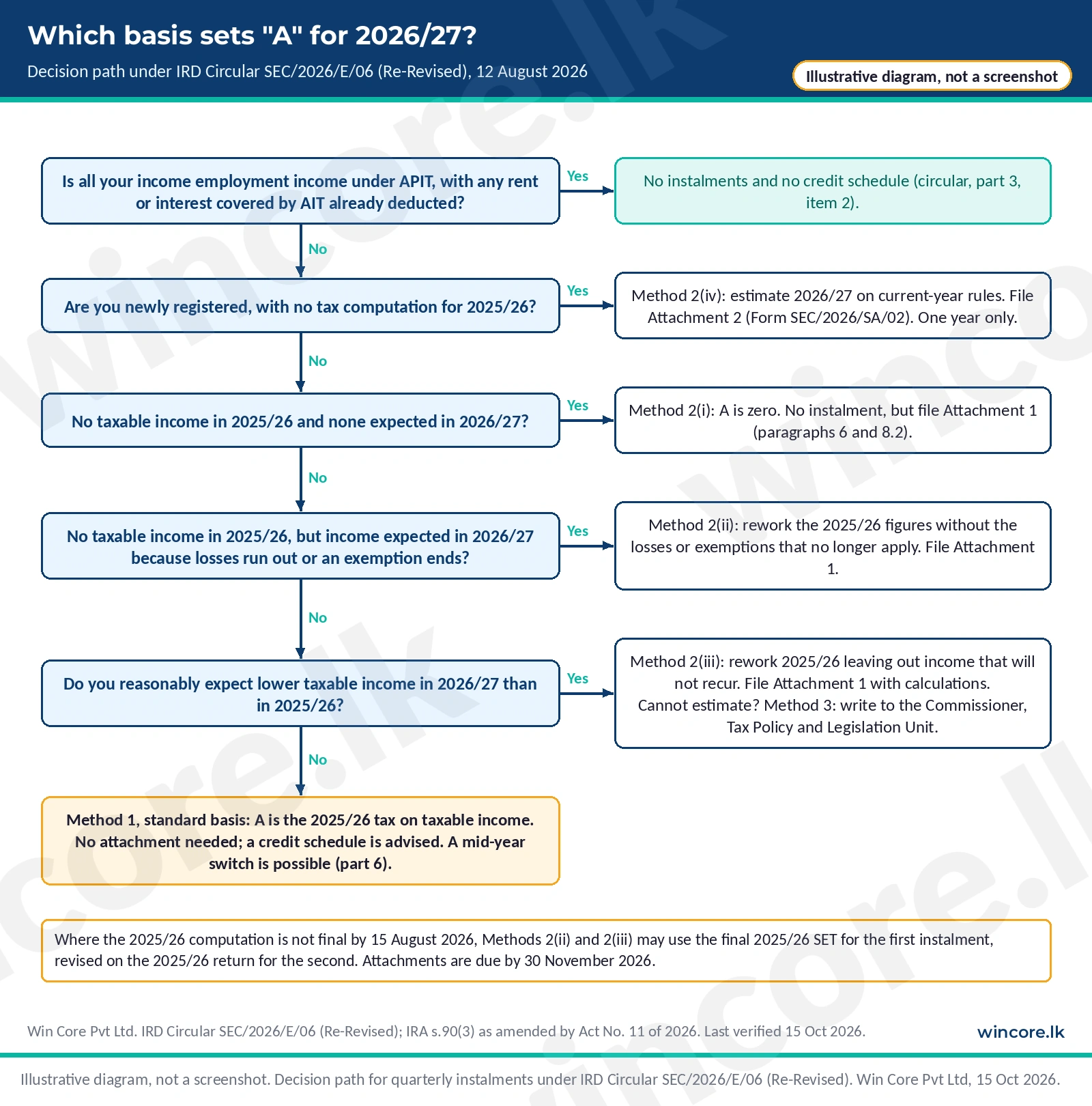
The re-revised version added a bridge for branches (ii) and (iii). Where the 2025/26 computation "has not been finalized by the due date of the first instalment, the taxpayer may use the final SET (Statement of Estimated Tax) for the year of assessment 2025/2026" for the first instalment. "However, for the 2nd quarter installment, this should be revised on the basis of the tax return" for 2025/26. Those taxpayers file Attachment 1 for the first quarter and Attachment 1 (Revised) for later quarters, "with only one revision permitted" [1].
Employees, foreign tax and other special cases
An individual whose only income is employment income under APIT has "no requirement to make quarterly instalment payments", and no credit schedule. The same applies where AIT on rent or interest "is sufficient to cover the remaining income tax liability" [1]. A foreign tax credit under s.80 may be counted only if the foreign tax "has already been paid or is reasonably expected to be paid during the year", which matches new s.90(6) [1] [4]. An approved alternative 12-month accounting period changes nothing [1].
The circular changed three times in nine days
| Point | Original, 3 Aug 2026 | Revised, 6 Aug 2026 | Re-revised, 12 Aug 2026 |
|---|---|---|---|
| Attachment deadline | "before July 31" of the preceding year, but "available until 15 August 2026" for 2026/27 | "on or before 15 August of the year in which the first income tax installment is due" | "on or before November 30, 2026", by RAMIS upload with the 2025/26 return or manually |
| Lower-income statement | Attachment 2 "along with supporting evidence" | Attachment 1 "along with supporting details (calculations)" | As revised, plus the SET bridge and "only one revision permitted" |
| Mid-year switch | "before the end of the relevant year of assessment", "Subject to approval" | By 31 October, 31 January or 30 April, "inform" the CDMU | As revised |
| Credit for employees | APIT only | APIT or AIT | As revised |
Inform, not request. The original circular let a Method 1 payer "request a revised calculation basis", "Subject to approval" [3]. The revised and re-revised versions say the taxpayer may "inform a revision to the basis of calculation" and "may adopt either Method 2 or Method 3" [1]. Read as written, that is a notice, not a request. Whether the IRD can later reject the switch, and charge on the standard basis, is not addressed.
In practice, a switch takes effect only by telling the CDMU before the next instalment month, and only where the projection is lower than last year.
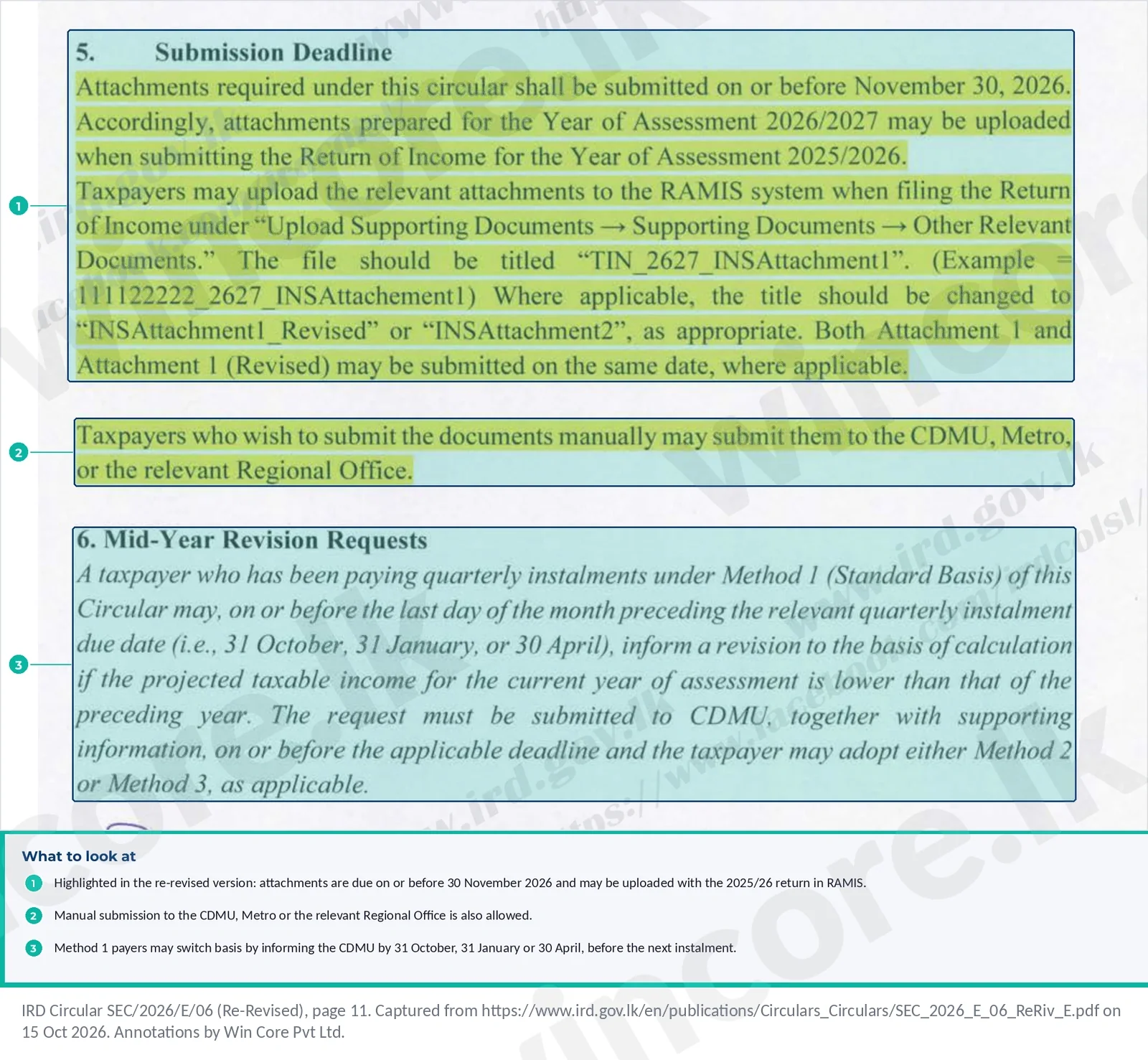
For RAMIS uploads, the file "should be titled 'TIN_2627_INSAttachment1'", changed to "INSAttachment1_Revised" or "INSAttachment2" as needed [1]. The credit schedule goes to the CDMU, Regional or Metro Office by the last day of the month in which each instalment is due: 31 August, 30 November, 28 or 29 February, and 31 May [1].
A late instalment costs 10 percent, plus interest from the due date
| Default | Section | Consequence |
|---|---|---|
| Instalment not paid, in whole or part, "within fourteen days of the due date" | s.179(2) | "a penalty equal to ten per cent of the amount of tax due but not paid" |
| Any tax not paid by the due date | s.157(1), rate in s.159(1) | Interest from the due date to payment, at "one and one-half per cent per month or part month, computed monthly" |
| Balance of the year's tax not paid within fourteen days of its final payment date, or by the due date in a notice of assessment if later | s.179(1) | "a penalty of 20% of the tax due but not paid" (IRD return guide) |
| Unpaid tax, no review or appeal pending | s.163(4A) | Recovery as a deemed fine through the Magistrate's Court (Act No. 11 of 2026) |
Sources: [4] [5] [9]. The circular itself warns that "Any under payment, late payment or no payment will attract an interest and penalty on basis of these standard calculations" [1]. The interest rate is as stated in the 2025 consolidation; s.159(3) lets the Minister vary it by Order [5].
Four misreadings of the circular, and a worked example
- "The statement of estimated tax still applies." Not for 2026/27. Section 91(1) now applies only to "any year of assessment commencing prior to April 1, 2026" [4].
- "I can choose the lower of last year and my estimate." Only if you meet the Method 2 conditions. The circular says the standard method excludes the alternatives [1].
- "The attachment deadline was 15 August." That was the revised version. The re-revised version says 30 November 2026 [1] [2].
- "Withholding credits only count once they are deducted." C includes WHT and AIT "to be withheld" in the year [1] [4].
Worked example: the freelance consultant
All figures are invented.
- First instalment, 15 August 2026: A is Rs 900,000, C is the Rs 300,000 expected WHT, B is 4. (900,000 minus 300,000) divided by 4 is Rs 150,000.
- Second instalment, 15 November 2026: C is now Rs 450,000 (the first instalment plus the expected WHT), B is 3. (900,000 minus 450,000) divided by 3 is Rs 150,000.
- Third and fourth instalments: Rs 150,000 each, so the year's instalments of Rs 600,000 plus Rs 300,000 of WHT equal A.
- If the second is paid on 10 December 2026: that is more than 14 days late, so s.179(2) adds 10 percent, Rs 15,000, and s.157 interest runs at 1.5 percent for one part month, Rs 2,250 [5].
- If a large client leaves in October: the consultant informs the CDMU by 31 October 2026 and recomputes under Method 2(iii) with supporting calculations [1].
What this means for you
For most businesses with a steady year, instalments are now simpler: last year's tax, less credits, spread over the remaining quarters. The work is in the exceptions. If your income is falling, the 31 October date matters more than the 30 November one. Our income tax compliance services can run the Method 2 computation, our quarterly income tax instalment calculator gives a first figure, and our salary calculator helps employees check APIT, which decides whether they pay instalments at all. For the law behind the circular see our pieces on Act No. 11 of 2026 and quarterly instalments after the SET form; for five more worked cases see instalments after SET: worked examples.
What a business must do now
- Find your 2025/26 tax on taxable income, the figure behind the final payment that was due on 30 September 2026 [8]. That is A unless Method 2 applies.
- If your 2026/27 income will be lower, inform the CDMU by 31 October 2026 to change the basis for the 15 November instalment [1].
- File Attachment 1 or 2, if needed, by 30 November 2026, the same day the 2025/26 return is due under s.93(1) ("not later than eight months after the end of each year of assessment") [1] [5].
- File the credit schedule by the end of each instalment month.
- Pay by the 15th. The 14-day margin in s.179(2) is for the penalty only; s.157 interest runs from the due date.
Checklist: documents needed
- The final 2025/26 tax computation or return, which gives A
- The final 2025/26 SET, if you use the first-quarter bridge under Method 2(ii) or 2(iii)
- WHT and AIT certificates received, and a forecast of withholding expected in 2026/27, which give C
- Receipts for instalments already paid for 2026/27
- For Method 2, Attachment 1 or 2 with the supporting calculations
- Any mid-year revision notice sent to the CDMU, with the date it was sent
Open points we are keeping open
- Investment-asset gains in A. Section 90(1) excludes them from instalments, but A is last year's tax on taxable income. The circular does not say whether to strip out 2025/26 gains.
- Gross or net. Section 2(3) computes tax payable after foreign and other credits. The circular says A is "before deducting any tax credit". The circular's reading avoids counting withholding credits twice through C, but the text differs.
- "Reasonably expect". The Act says "expects"; the circular adds "reasonably" and "strictly reserved".
- Whether "inform" needs approval, after the original's "Subject to approval" was dropped.
- Payment instructions. The IRD said they "will be separately provided" [1]; we have not seen them.
FAQ
Do I still file a Statement of Estimated Tax for 2026/27?
No. Act No. 11 of 2026 limits s.91 to years commencing before 1 April 2026, so no SET is filed for 2026/27 [4]. The final 2025/26 SET survives only as a first-quarter bridge under Methods 2(ii) and 2(iii), where the 2025/26 computation was not final by 15 August 2026 [1].
What is A if my business made a loss in 2025/26?
It depends on what you expect for 2026/27. If you expect no income either, A is zero, but you still file Attachment 1. If you expect income because losses are used up or an exemption ends, rework the 2025/26 figures without those losses or exemptions and file Attachment 1 [1].
When are the instalment attachments due for 2026/27?
On or before 30 November 2026, under the re-revised circular [1]. They can be uploaded in RAMIS with the 2025/26 return or handed in at the CDMU, Metro or Regional Office. The date covers attachments only; the 15 November instalment is still due on 15 November.
Can I switch from the standard basis in the middle of the year?
Yes, if your projected 2026/27 taxable income is lower than 2025/26. Inform the CDMU with supporting information by 31 October, 31 January or 30 April, the month before the next instalment, and then use Method 2 or Method 3 [1]. Whether the IRD can refuse a switch is not stated.
Do salaried employees pay quarterly instalments?
Not if all their income is employment income under APIT, or if AIT on their rent or interest covers the rest of the tax. In both cases the circular says no instalments and no credit schedule are needed [1]. Any other income uncovered by withholding brings the instalment rules back.
Last verified: we re-read the re-revised circular and Act No. 11 of 2026 at source on 21 October 2026; the original and revised circulars and the 2025 consolidated IRA were checked on 15 October 2026.
This article is general information on the law as at 21 October 2026 and is not advice on your specific position.
Talk to us. If you would like us to work out your 2026/27 instalments or prepare Attachment 1 before 30 November 2026, book a consultation at our contact page.
WinCore Pvt Ltd
References
- Inland Revenue Department. Circular to Taxpayers: Circular on Calculating Quarterly Income Tax Instalments, SEC/2026/E/06 (Re-Revised Circular) (12 August 2026), pp.1 to 11 and Attachments 1 and 2. https://www.ird.gov.lk/en/publications/Circulars_Circulars/SEC_2026_E_06_ReRiv_E.pdf . Primary. Accessed 21 October 2026.
- Inland Revenue Department. Circular on Calculating Quarterly Income Tax Instalments, SEC/2026/E/06 (Revised) (6 August 2026), parts 2(iii), 3 and 5 to 6. https://www.ird.gov.lk/en/publications/Circulars_Circulars/SEC_2026_E_06_Riv_E.pdf . Primary. Accessed 15 October 2026.
- Inland Revenue Department. Circular on Calculating Quarterly Income Tax Instalments, SEC/2026/E/06 (3 August 2026), parts 2(iii), 3 and 5 to 6. https://www.ird.gov.lk/en/publications/Circulars_Circulars/SEC_2026_E_06_E.pdf . Primary. Accessed 15 October 2026.
- Parliament of Sri Lanka. Inland Revenue (Amendment) Act, No. 11 of 2026 (certified 3 June 2026), ss.1(3), 16, 17, 18 and 28. https://www.ird.gov.lk/en/publications/Acts_Income%20Tax_2017/IR_Act_No_11-2026_E.pdf . Primary. Accessed 21 October 2026.
- Inland Revenue Department. Inland Revenue Act, No. 24 of 2017, consolidated with amendments to 2025, ss.2, 90, 93, 157, 159 and 179. https://www.ird.gov.lk/en/publications/Acts_Income%20Tax_2017/IRA_Cons_Act_-_2025_Changes.pdf . Primary. Accessed 15 October 2026.
- Inland Revenue Department. Notice to the Taxpayers: Amendments to the Inland Revenue Act, No. 24 of 2017, SEC/PN/IT/2026/02 (8 June 2026), item 11. https://www.ird.gov.lk/en/Lists/Latest%20News%20%20Notices/Attachments/794/SEC_PN_IT_2026-02_E.pdf . Primary. Accessed 15 October 2026.
- Inland Revenue Department. List of Circulars (SEC/2026/E/06 original, revised and re-revised). https://www.ird.gov.lk/en/publications/SitePages/Circulars.aspx . Primary. Accessed 15 October 2026.
- Inland Revenue Department. Notice to Taxpayers: Income Tax Final payment for the Year of Assessment 2025/2026 due on or before September 30, 2026. https://www.ird.gov.lk/en/Lists/Latest%20News%20%20Notices/Attachments/813/IT_28092026_E.pdf . Primary. Accessed 15 October 2026.
- Inland Revenue Department. Guide to the Return of Income Tax, Y/A 2025/26, Section 09 (penalty of 20 percent of the tax due but not paid; 10 percent on a late instalment; interest at 1.5 percent a month or part month). https://www.ird.gov.lk/en/Downloads/IT_Individuals_Doc/Asmt_IIT_004_2025_2026_E.pdf . Primary. Accessed 21 October 2026.
Put these insights to work
WinCore specialists can review your current workflow, document gaps, and build a practical 90-day action plan.
Book a free consultationContinue reading
Explore more WinCore analysis to keep your finance, tax, and compliance roadmap moving.

The SET filing requirement is gone from Y/A 2026/27. Quarterly instalments now follow a formula based on the previous year's tax. Here is how it works.
Step-by-step guide to filing income tax returns in Sri Lanka: deadlines, RAMIS process, relief, bands, WHT credits, and common penalty traps.

Sri Lanka income tax bands for 2026 explained with current rates, worked examples, and practical APIT planning for employees and employers.