
How to register a sole proprietorship in Sri Lanka
Registering a sole proprietorship in Sri Lanka: the business name at the Divisional Secretariat, the TIN certificate, income tax, VAT, SSCL and EPF.

On this page
Last verified against the primary sources on 15 October 2026.
Updated 28 October 2026: added the Thimbirigasyaya exception: business names there are registered with the Western Province department, not a Divisional Secretariat.
Updated 23 October 2026: added moving the business into a company (section 46, losses and VAT) and shortened repeated material.
A sole proprietorship is quick to register. A private limited company protects your house, savings and personal assets if the business goes wrong. Those are not the same consideration, and the one most people skip is the second one.
This guide covers the registration steps and the tax obligations for sole proprietors in Sri Lanka. It also tells you when this structure stops making sense and what moving to a private limited company involves.
Sole proprietorship in Sri Lanka: one owner, one tax return, no liability protection
A sole proprietorship, also known as an individual business or sole trader, is a business owned and operated by a single person with no legal distinction between the owner and the business.
In short, the structure trades simplicity for risk. It is quick to set up, you keep control and all the profit, and there is no company annual return or audit. The cost is unlimited personal liability: creditors of the business can claim your personal savings and property. The comparison with a private limited company below sets the two side by side.
When a sole proprietorship is and is not suitable
A sole proprietorship usually works best when the business has one owner-operator, modest operating risk, straightforward billing and collections, and no immediate need for outside investors. It suits a small trader or service business testing an idea. It fits badly where liability exposure is high, two or more people want to share ownership, investors are needed, or customers, banks or tenders expect a company.
Sole proprietorship vs private limited company
Liability
- Sole proprietorship: unlimited personal liability. All business debts are personal debts
- Private limited company: liability is limited; personal assets are generally protected
Legal status
- Sole proprietorship: not a separate legal entity; the owner and business are one person in law
- Private limited company: a separate legal entity that can own assets, enter contracts, and sue and be sued independently of its owners
Tax treatment
- Sole proprietorship: profits taxed as personal income at the individual rates below
- Private limited company: profits taxed at the corporate rates: 30 percent standard, 15 percent on specified concessionary income and 45 percent on liquor, tobacco, betting and similar activities. There is no separate rate for small and medium enterprises [1]
Setup cost
- Sole proprietorship: a registration fee set by the registering office; little documentation
- Private limited company: Registrar of Companies fees are higher, and the company needs Articles, directors and a company secretary. Our guide to ROC government fees has the current figures
Ongoing compliance
- Sole proprietorship: any business name renewal the provincial registrar requires, plus a personal income tax return
- Private limited company: annual returns, audited accounts, company tax returns, board resolutions and statutory registers maintained by a company secretary
Capital access
- Sole proprietorship: limited to the owner's personal capital and standard business loans
- Private limited company: can issue shares to investors and access more formal financing
For the company route, see our guide on how to register a company in Sri Lanka.
Step-by-step registration process
Step 1: Get your TIN certificate
If you do not already have a Taxpayer Identification Number (TIN), get one first. Obtaining a TIN is mandatory for resident individuals aged 18 or over, and from 1 November 2026 the Divisional Secretary must see a valid TIN certificate before registering a business for a resident individual [2]. Our TIN certificate guide explains how to download one from IRD e-services.
Step 2: Choose your business name
Your business name can include your own name (for example, "Silva Trading" or "Perera Consulting") plus a description of activity or location.
Restrictions on name choice:
- Avoid "Limited", "Ltd", "Pvt" or "Corporation". These words signal a company structure
- Should not be identical or deceptively similar to a name already registered for another business
- Expect government-related terms to need prior written approval
Step 3: Go to the right office
A business name is registered with the Divisional Secretariat, not with the Registrar of Companies. In the Western Province you register at the Divisional Secretariat for the area where the business operates, except in the Thimbirigasyaya division, where the Western Province Department of Business Name Registration in Battaramulla registers business names [15]. Municipal, urban and pradeshiya councils deal with trade licences for premises, which is a separate approval from the business name. If you are unsure which office covers your address, ask the Divisional Secretariat before you prepare the documents.
Step 4: Gather the documents
The document list varies between offices, but most require:
- NIC: original for counter verification plus a photocopy
- TIN certificate (from 1 November 2026)
- Proof of business address, if rented: a lease agreement and the landlord's written consent letter
- Proof of business address, if owned: a property deed or municipal assessment notice
- Proof of business address, if home-based: a recent utility bill plus the property owner's written consent
- Passport-size photograph of the owner
- Brief business description: the activities, products or services and nature of trade
- For regulated activities: professional qualification certificates for licensed professions, health certificates for food businesses, and sector approvals where required
Step 5: Complete the application form
At the office you fill in the prescribed form: your details as on your NIC, the proposed business name and address, the nature of the business, and a signed declaration that the details are correct.
Step 6: Submit, pay and receive the certificate
Submit the form and supporting documents at the counter and pay the registration fee. Keep the official receipt. Processing times vary by office, so ask when you submit.
The Business Registration Certificate (called the Deed of Registration by some offices) shows the registration number, the business name, your name and NIC number, the business address and activity, and the date of registration. Verify all details on receipt. Display the original certificate at your principal business premises, and make certified copies for the bank, sector licences and tax registration.
Renewal of business registration
Check with the provincial registrar of business names whether your registration has to be renewed, and if so when and at what fee. Look for any expiry date printed on your certificate. A lapsed certificate can hold up banking, licence renewals and other official transactions.
If renewal applies, the usual steps are:
- Visit the office that issued the original certificate
- Submit a renewal application form
- Provide updated information if your address, activity or any registered detail has changed
- Pay the renewal fee
- Receive the renewed certificate
Tax obligations for sole proprietors
Income tax for sole proprietors
Your business profit is added to any other personal income and taxed at individual income tax rates. The return for a year of assessment (April to March) is due by 30 November after the year ends, and the final payment of the year's tax by 30 September [3].
Allowable business deductions that reduce your taxable income:
- Cost of goods sold
- Rent, utilities and operating expenses
- Employee salaries and related costs
- Professional fees and relevant subscriptions
- Interest on business loans
- Capital allowances on business assets
- Marketing and advertising costs
Personal expenses, capital expenditure (claim capital allowances instead), fines, penalties and personal drawings are not deductible.
Income tax rates for individuals: current bands
From 1 April 2025 (Inland Revenue (Amendment) Act No. 2 of 2025, unchanged for 2026/2027), the first Rs 1,800,000 of annual income is covered by the personal relief, and the rest is taxed at 6 percent on the next Rs 1,000,000, then 18, 24 and 30 percent on each Rs 500,000 after that, and 36 percent above Rs 4,300,000 [1]. Our guide to income tax bands in Sri Lanka for 2026 has the monthly figures and worked examples.
Quarterly instalment payments
Income tax is paid during the year in quarterly instalments. The Statement of Estimated Tax (SET) has been discontinued, and instalments are now worked out from the previous year's tax, with an estimate route where there was no income in the previous year or income is expected to fall [4]. Our guide to quarterly instalments after SET works through the calculation. Factor the instalments into your cash flow planning.
VAT registration
If your taxable supplies exceed Rs 15 million in a quarter or Rs 60 million in twelve months, you must register for VAT with the IRD [5]. The standard rate is 18 percent [6]. Once registered you charge VAT on taxable supplies, file returns and pay on the IRD's schedule. Our guide to the VAT registration thresholds covers the tests and the registration period.
Most early-stage sole proprietors fall well below this threshold. If your business grows quickly, monitor quarterly turnover and register on time, not after.
SSCL (Social Security Contribution Levy)
SSCL has its own registration threshold, separate from VAT. From 1 July 2026 you must register for SSCL once turnover exceeds or is likely to exceed Rs 9 million in a quarter or Rs 36 million over four consecutive quarters [7], so you can need SSCL registration before you need VAT registration. The VAT threshold was not reduced in 2026 [8]. See our guide to the SSCL threshold.
EPF, ETF and APIT obligations when hiring employees
As the owner of a sole proprietorship, you do not contribute to the Employees' Provident Fund (EPF) or the Employees' Trust Fund (ETF) in your own capacity. These obligations arise only when the business employs other people.
Employer obligations when you hire
- EPF: the employer contributes 12 percent and the employee 8 percent of the employee's total earnings, paid to the EPF by the last day of the following month [9]
- ETF: the employer contributes 3 percent of total earnings, paid to the ETF Board by the same date [10]
- Registration: register as an employer with the EPF on Form D through the Labour Office within two weeks of the first employee joining [11] [12]. ETF has no separate registration and uses the EPF number [13]
See our EPF and ETF guide for the surcharge for late payment.
APIT (Advance Personal Income Tax)
If any employee earns more than Rs 150,000 per month (which crosses into the first taxable band), you must deduct APIT from that employee's salary and pay it to the IRD within 15 days after the end of the month [1].
APIT is not an additional tax on top of income tax. It is an advance on the employee's personal income tax for the year. If you fail to deduct it, you must pay the tax yourself [1].
For help setting up payroll deductions, see our payroll services.
Structuring your accounts and bookkeeping
Open a separate business bank account
A dedicated business bank account is strongly recommended from day one. Mixing personal and business funds makes bookkeeping difficult, complicates tax filing and leaves a poor record if the IRD examines your return.
To open a business bank account, you will typically need:
- Business Registration Certificate
- TIN certificate
- NIC
- Proof of business address
- An initial deposit (amount varies by bank)
Minimum bookkeeping records
Anyone engaged in business must keep records and accounts in Sri Lanka sufficient to record all transactions and to work out the profit or loss on them, and must keep the source documents behind them [1]. No specific accounting system is required, but at minimum maintain:
- Sales records: all invoices issued, cash receipts and customer payments received
- Purchase records: all supplier bills and invoices received, and payments made
- Expense records: operating expenses categorised with supporting receipts (rent, utilities, transport, professional fees)
- Bank statements: reconciled monthly against your internal records
- Cash book: a running record of all money received and paid out
Keep records for at least five years from the date of each transaction, and longer where the time limit for assessing the year has not expired or related proceedings are still running [1].
Accounting tools
A spreadsheet is enough for a very small business, cloud accounting software becomes more practical as it grows, and our bookkeeping service is an option if you would rather focus on running the business.
For more on recording and reviewing your finances, see bookkeeping basics for small businesses in Sri Lanka.
Closing a sole proprietorship
Closing is administratively simpler than winding up a company, but outstanding obligations must be cleared before deregistering.
Process for closure:
- Settle all outstanding supplier invoices, loans and creditor balances
- Notify customers and suppliers of the closure
- File a final income tax return covering the period to the date of closure
- Cancel VAT and SSCL registration at the IRD if the business was registered
- Close the EPF employer registration if the business had employees
- Apply to deregister the business name at the Divisional Secretariat
- Close the business bank account
There is no court-supervised winding-up process for a sole proprietorship. Outstanding debts remain the personal liability of the owner even after the business name is deregistered.
Moving to a private limited company
The structure that makes starting simple can begin to limit growth. The usual triggers are a co-owner or investor, customers, banks or tenders that will only deal with a company, and growing personal liability.
A sole proprietorship does not convert. You incorporate a new company and move the business into it:
- Decide on the company type. A private limited company is usually the right choice for most Sri Lankan SMEs
- Register the new company with the Department of the Registrar of Companies, including the beneficial ownership forms
- Register the company for its own TIN within 30 days of incorporation, because your personal TIN does not carry over [4]
- Transfer business assets to the new company (the income tax and VAT points are set out below)
- Novate or assign existing contracts, leases and liabilities where possible
- Update licences and registrations to reflect the new company
- Deregister the business name at the Divisional Secretariat once the business's debts are settled or moved, because the cancellation affidavit says there are none [14]
- Notify banks, customers and suppliers of the change
Run a company name check early. Our guide on how to register a company in Sri Lanka walks through the filing.
Moving the business into the company: income tax, losses and VAT
There is no filing that converts a sole proprietorship into a company. The company is a new person, so moving the business into it is a transfer of assets from you to the company, and the tax law treats that as you realising those assets.
Market value is the starting point. A company is your associate if you control it or "may benefit from fifty percent or more of the rights to income, capital or voting power of the entity" (Inland Revenue Act s.196(2)(a)). On a transfer to an associate, s.46(1) treats you as receiving "the greater of the market value of the asset or the net cost of the asset immediately before the realisation", and the company takes that figure as its cost [1].
Net cost is possible for business assets. Section 46(4) lets "trading stock, a depreciable asset, an investment asset or a capital asset of a business" pass to an associate at net cost, so no gain arises, if every requirement in s.46(5) is met at the time of the transfer (for transfers on or after 1 April 2021):
- you or the company is an entity (the company always is);
- the assets are assets of the company's business immediately after the transfer;
- you and the company are both resident, and the company is not exempt from income tax;
- "the tax rate appliable on the person's gain from the realisation" (as printed) "is equal or less than the tax rate which is applicable on the gain of the associate"; and
- "there is continuity of underlying ownership in the asset of at least fifty per cent" [1].
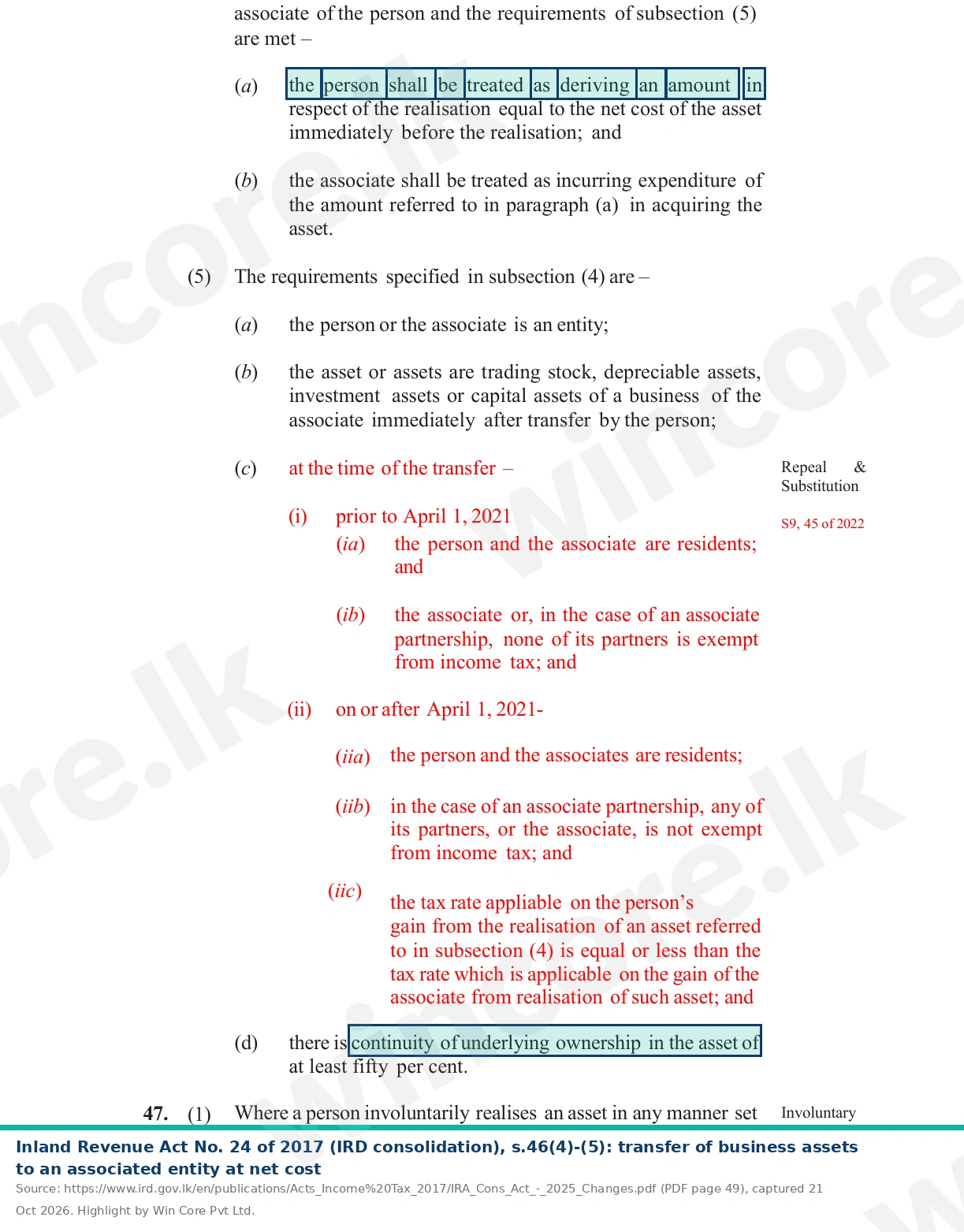
Two of these need testing with your own figures. The rate test compares the rate on your gain with the rate on the company's: individual bands run up to 36 percent and the standard company rate is 30 percent, so on our reading a proprietor whose gain falls in a higher band may fail it. How the test applies to progressive bands is not spelt out, so treat it as open. The ownership test fails if, at the same time, you bring in a co-owner who takes more than half the company. The only 2026 change to s.46 is a new s.46(3A) on gifts to the Government and universities [4].
A hypothetical, with our arithmetic. The owner of a vehicle repair workshop moves lifts and diagnostic equipment with a net cost of Rs 1,800,000 and a market value of Rs 2,600,000 into a company she wholly owns. If s.46(4) applies, she is treated as receiving Rs 1,800,000, her gain is nil and the company's cost is Rs 1,800,000. If only s.46(1) applies, she is treated as receiving Rs 2,600,000, her gain is Rs 800,000 and the company's cost is Rs 2,600,000. The tax on the Rs 800,000 depends on her other income for the year.
Your losses stay with you. Section 19(1) lets a person deduct "an unrelieved loss of the person" [1]. On our reading, losses of the proprietorship remain yours; the company starts with none.
VAT: a recovery rule, not a relief. If you are VAT registered, s.53(2) of the VAT Act says that where a person "transfers the assets of such taxable activity to another person, as a going concern", VAT for periods before the transfer "may, if it cannot be recovered from the transferor, be recovered from the transferee" [5]. We found no provision treating a going-concern transfer as outside VAT. So settle your own VAT position before the company takes the assets, and get the VAT treatment of the transfer itself confirmed before signing; on our reading it is open.
Our tax return filing services can test the s.46(5) conditions on your figures before the transfer price is fixed.
Common mistakes to avoid
Ignoring the tax return
Sole proprietors must file an annual income tax return by 30 November. Late filing carries a penalty under section 178 of the Inland Revenue Act [1], and unpaid tax carries interest.
Not getting required sector licences
Business name registration does not authorise you to operate in a regulated sector. Food businesses, healthcare services, education providers and location-sensitive activities typically need approvals from public health authorities, sector regulators or the relevant ministry.
Delaying the decision to incorporate
The right time to move to a company is before growth forces the change, not after a dispute with a creditor, a failed funding conversation or a contract that demands a company structure.
Talk to us. If you are registering a business name or weighing a move to a company, our sole proprietorship registration and company registration pages explain how we can help; book a consultation at our contact page.
This guide is general information on the law as at 15 October 2026 and is not advice on your specific situation.
References
- Inland Revenue Department. Inland Revenue Act, No. 24 of 2017, consolidated, ss.86(1) and (3), 120(1), (5) and (6), 178 and the First Schedule. https://www.ird.gov.lk/en/publications/Acts_Income%20Tax_2017/IRA_Cons_Act_-_2025_Changes.pdf . Primary. Accessed 15 October 2026.
- Inland Revenue Department. Circular SEC/2026/E/07: Mandatory Submission of TIN Certificate for Specified Transactions (22 September 2026), paras 1 to 4. https://www.ird.gov.lk/en/publications/Circulars_Circulars/SEC_2026_E_07_E.pdf . Primary. Accessed 15 October 2026.
- Inland Revenue Department. Tax Calendar 2026. https://www.ird.gov.lk/en/publications/Tax%20Calendar_Documents/Tax_Calendar_2026_E.pdf . Primary. Accessed 15 October 2026.
- Parliament of Sri Lanka. Inland Revenue (Amendment) Act, No. 11 of 2026, certified 3 June 2026, ss.16 and 23. https://www.ird.gov.lk/en/publications/Acts_Income%20Tax_2017/IR_Act_No_11-2026_E.pdf . Primary. Accessed 15 October 2026.
- Inland Revenue Department. Value Added Tax Act, No. 14 of 2002, consolidated version up to 2025, s.10. https://www.ird.gov.lk/en/publications/Value%20Added%20Tax_Acts/VAT_Act_No_14%5BE%5D_2002_%28Consolidation_2025%29.pdf . Primary. Accessed 15 October 2026.
- Inland Revenue Department. VAT rate order, Gazette Extraordinary No. 2363/22 (19 December 2023). https://www.ird.gov.lk/en/publications/Gazette_Documents/2023_2363-22_E.pdf . Primary. Accessed 15 October 2026.
- Parliament of Sri Lanka. Social Security Contribution Levy (Amendment) Act, No. 10 of 2026, s.2. https://www.ird.gov.lk/en/publications/Acts_SSCL/SSCL_Act_No_10-2026_E.pdf . Primary. Accessed 15 October 2026.
- Inland Revenue Department. Notice to the Taxpayers: Amendments to the Value Added Tax Act, SEC/PN/VAT/2026-03 (3 July 2026), item 3. https://www.ird.gov.lk/en/Lists/Latest%20News%20%20Notices/Attachments/799/PN_VAT_2026-03_New_E.pdf . Primary. Accessed 15 October 2026.
- Central Bank of Sri Lanka. Employees' Provident Fund Act, No. 15 of 1958 (reprint), s.10. https://www.cbsl.gov.lk/sites/default/files/cbslweb_documents/laws/acts/en/epf_act.pdf . Primary. Accessed 15 October 2026.
- Employees' Trust Fund Board. Employees' Trust Fund Act, No. 46 of 1980, s.16. https://etfb.lk/wp-content/uploads/2021/03/ETF-Act.pdf . Primary. Accessed 15 October 2026.
- Department of Labour. Employees' Provident Fund Regulations, 1958, regulation 8 (Form D within two weeks of becoming liable). https://labourdept.gov.lk/downloads/labour_code/48.pdf . Primary. Accessed 15 October 2026.
- Employees' Provident Fund Department. Registration of employers (Form D), web page. https://epf.lk/?p=163 . Primary. Accessed 15 October 2026.
- Employees' Trust Fund Board. Payment of contributions, web page. https://etfb.lk/payment-of-contributions/ . Primary. Accessed 15 October 2026.
- Divisional Secretariat, Sri Jayawardenepura Kotte. Registration of business name (cancellation of business name: affidavit "that the business has been closed, the date of closure, and that there are no debts to pay for the business at the time of closure"). http://kotte.ds.gov.lk/index.php/en/covid-19-info/18-our-services/192-registration-of-business-name.html . Primary (administrative). Accessed 22 October 2026.
- Department of Provincial Business Name Registration, Western Province. Divisional Secretariat divisions and the office that registers business names (Colombo district table lists Thimbirigasyaya under the department). https://bnr.wp.gov.lk/sin/?page_id=787 . Primary (administrative). Accessed 28 October 2026.
Put these insights to work
WinCore specialists can review your current workflow, document gaps, and build a practical 90-day action plan.
Book a free consultationContinue reading
Explore more WinCore analysis to keep your finance, tax, and compliance roadmap moving.
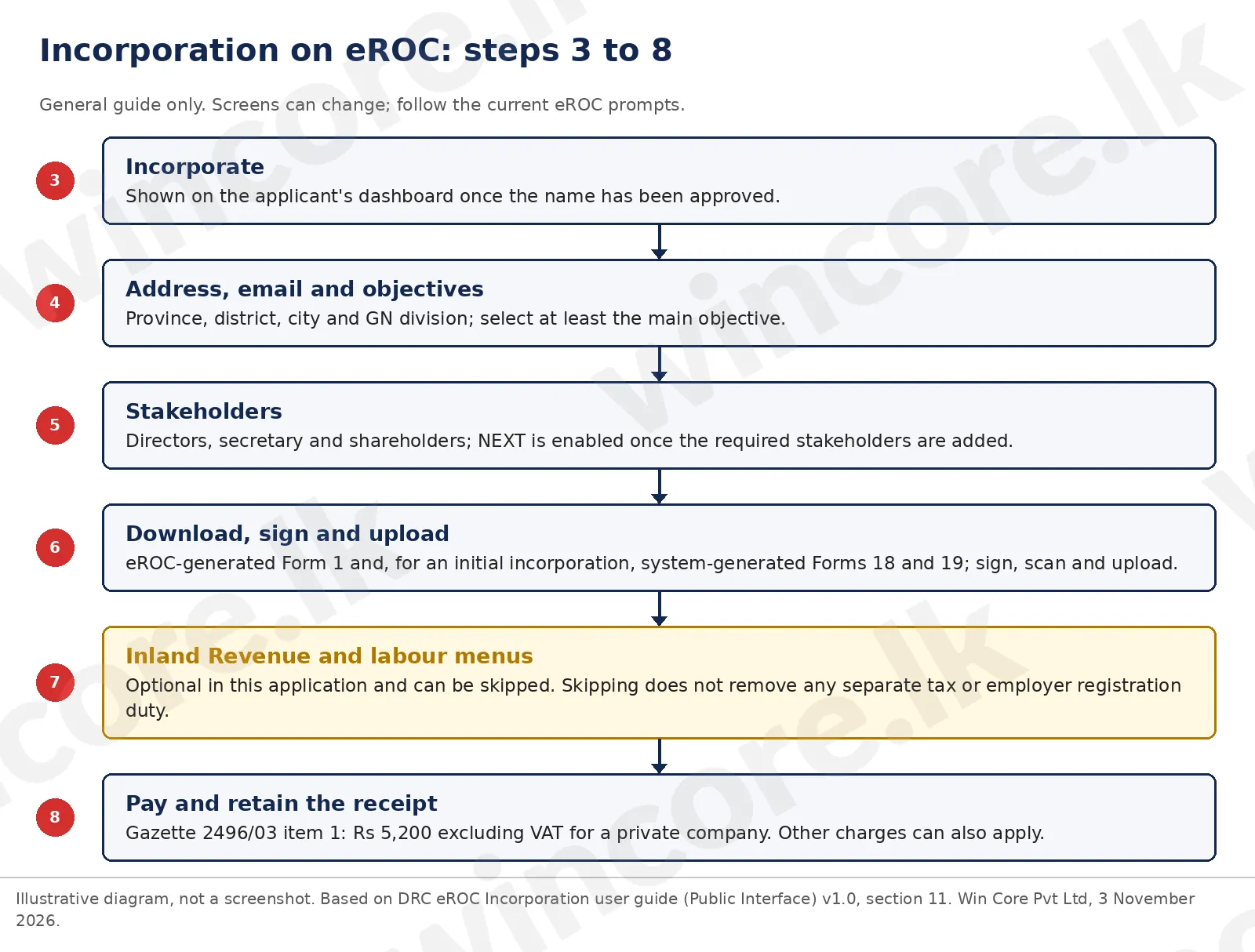
Registering a private limited company in Sri Lanka in 2026: structure, name approval, the eROC filing with BO 1 and BO 5, the TIN and the first year.
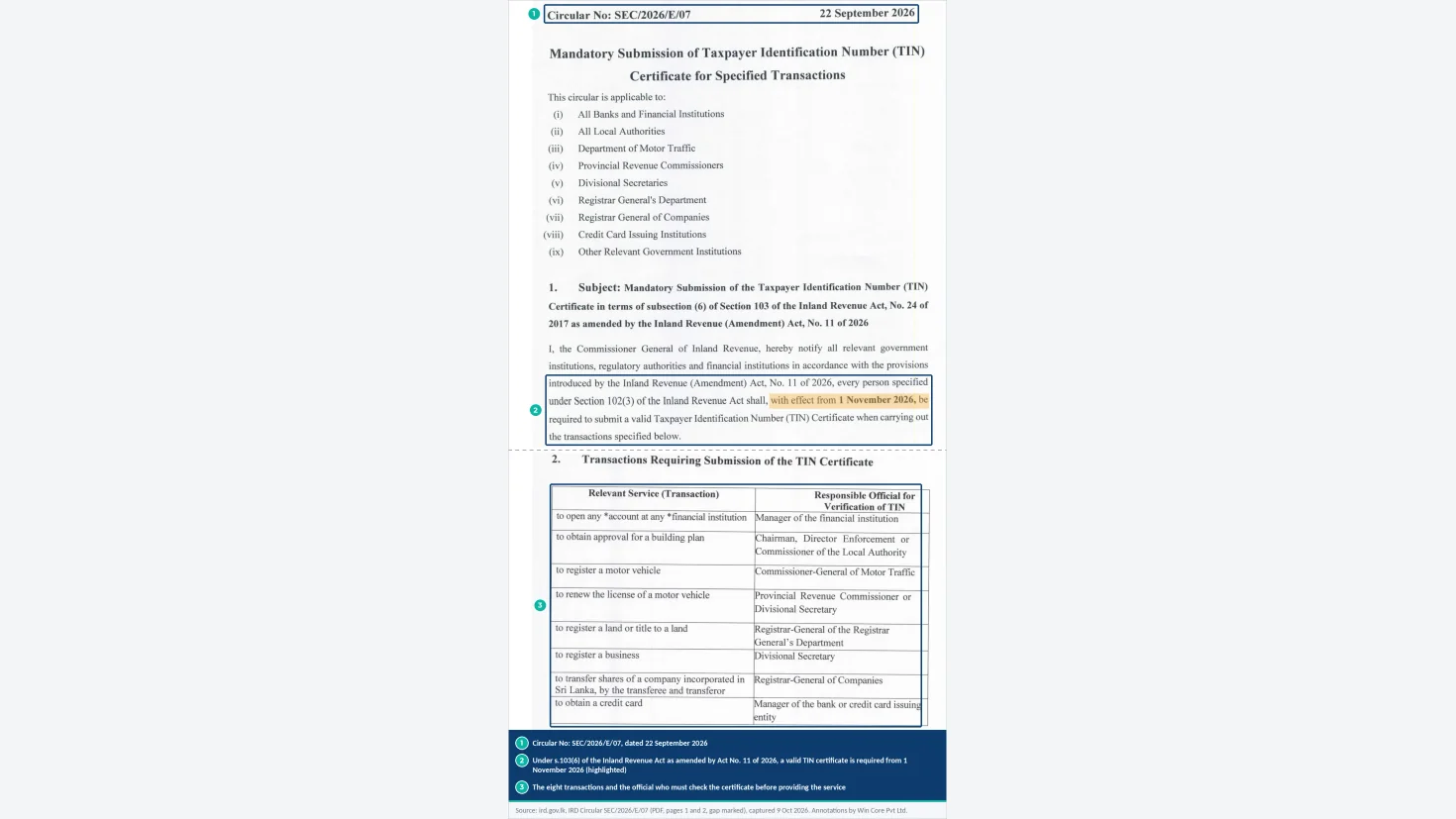
From 1 November 2026 individuals need a TIN certificate for eight transactions. Who needs one, how to get it, and TINs for companies and staff.
Bookkeeping guide for Sri Lankan small businesses: legal requirements, chart of accounts, source documents, 5-year retention rule, and monthly routines.