
Inland Revenue Act consolidated text: what it is and what it misses
Acts, Gazettes, IRD consolidations and circulars do not carry the same weight. How to tell which text is the law, and which dates to check first.
On this page
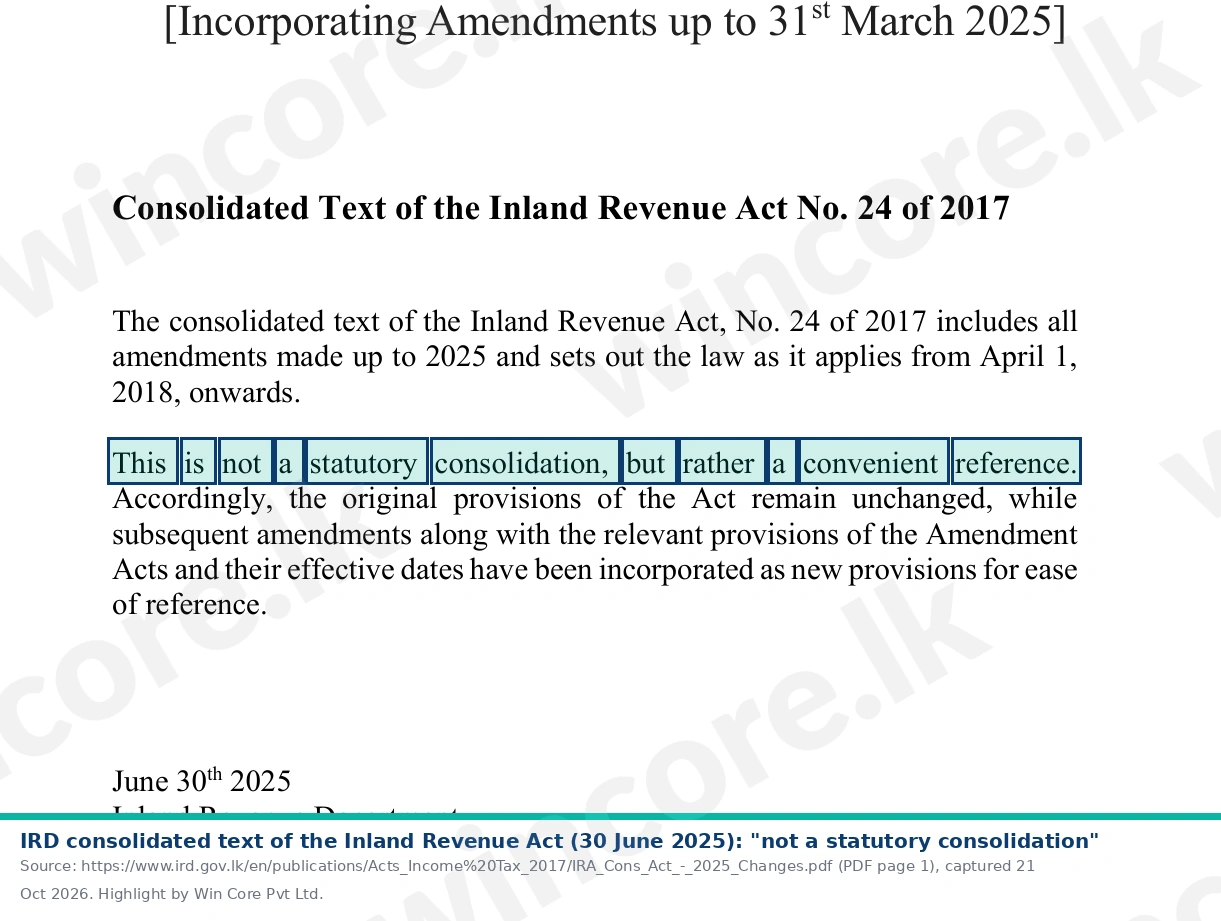
The IRD's Inland Revenue Act consolidated text incorporates amendments "up to 31st March 2025", is dated 30 June 2025, and says on its front page: "This is not a statutory consolidation, but rather a convenient reference." The law is the Inland Revenue Act No. 24 of 2017 and the amending Acts, the latest being Act No. 11 of 2026, certified on 3 June 2026, which the consolidation does not contain. The VAT consolidation, dated 26 December 2025, carries the same warning and also predates its 2026 amending Act [1] [4] [5]. For the method behind these checks, see how we verify Sri Lanka tax rules.
A tax rule repeated in a seminar slide, a newsletter or a blog post is only as good as the text behind it. In Sri Lanka that text sits in a small number of official places, and they do not carry the same weight. This article describes them from the documents we read and captured, and sets out which dates to check in each.
Acts of Parliament are the law, and the Sinhala text prevails
Tax is imposed by Acts: the Inland Revenue Act No. 24 of 2017, the Value Added Tax Act No. 14 of 2002, the Stamp Duty (Special Provisions) Act No. 12 of 2006, and the amending Acts passed since. Each change comes from an amending Act, not from a consolidation.
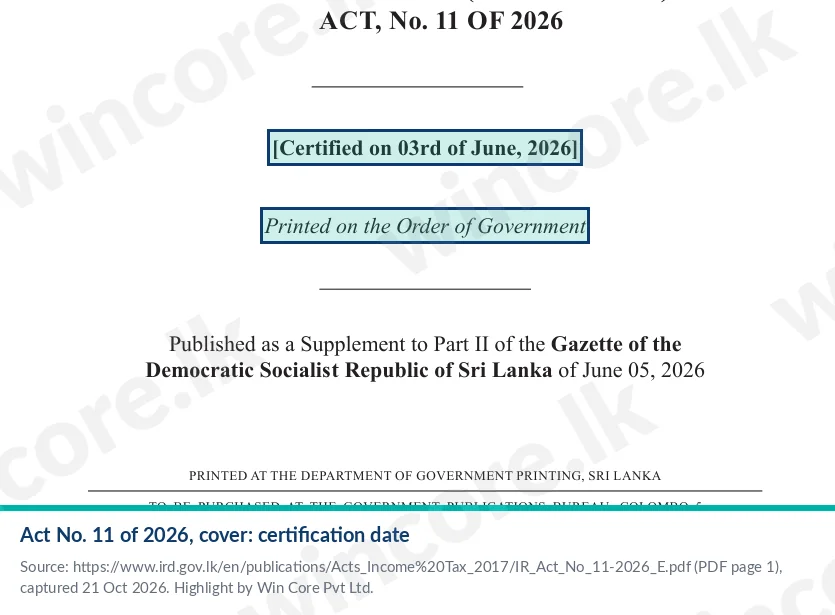
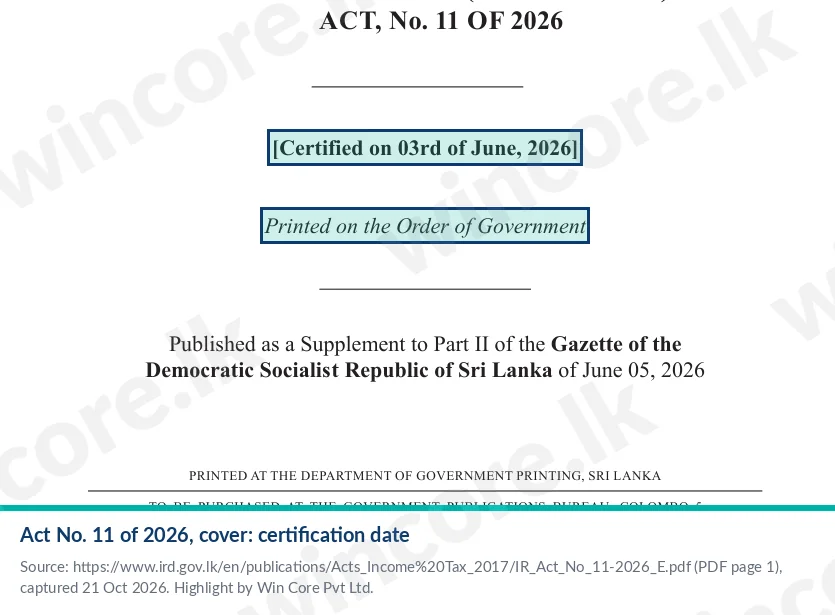
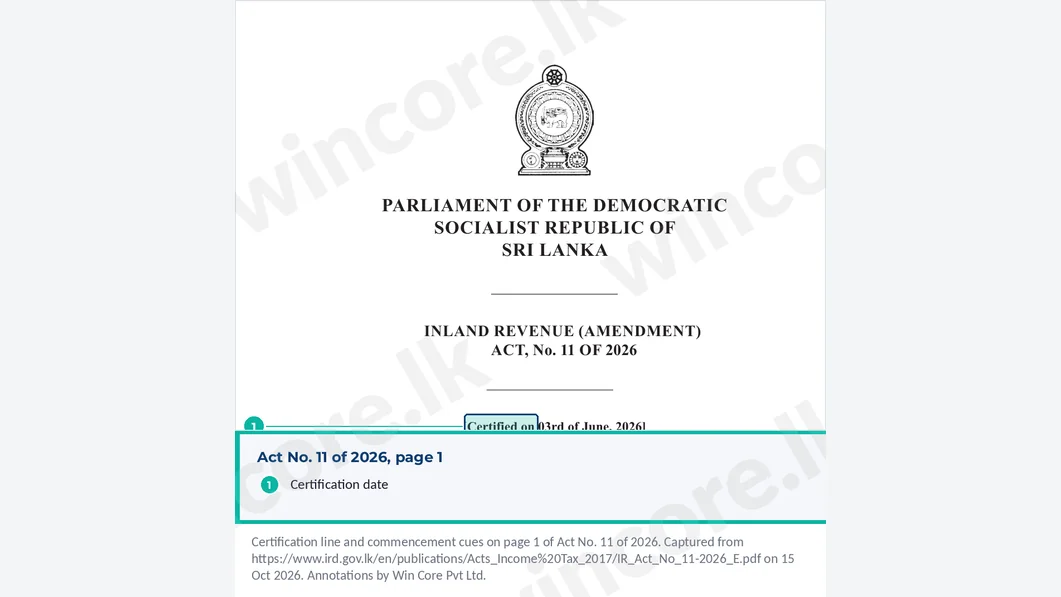
The cover of an Act shows its number, year and certification date. The cover of the Inland Revenue (Amendment) Act No. 11 of 2026 reads "[Certified on 03rd of June, 2026]" and "Printed on the Order of Government", and says it was "Published as a Supplement to Part II of the Gazette" of 5 June 2026 [1].
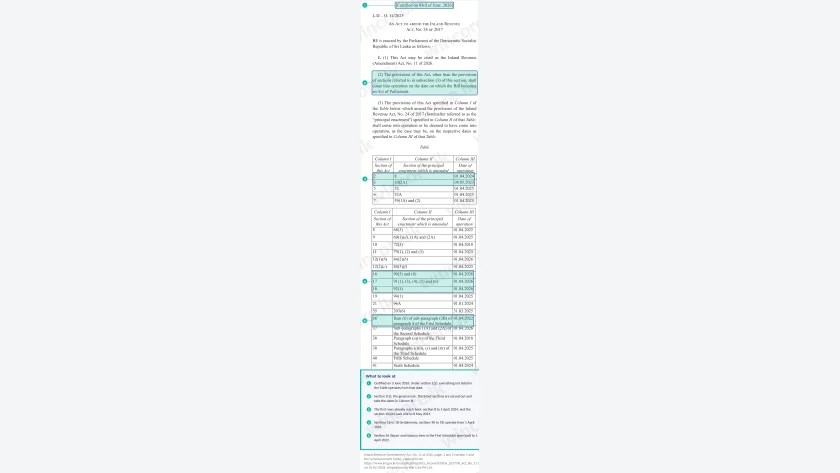
Read the commencement section first. Section 1(2) of Act No. 11 of 2026 brings most of it into operation "on the date on which the Bill becomes an Act of Parliament". Section 1(3) and its table then give other sections their own dates, some of them earlier than the Act itself: the amendment to s.8 operates from 1 April 2024 and the amendment to s.10(2A) from 8 May 2023 [1]. Our article on the Inland Revenue Amendment Act No. 11 of 2026 goes through the table.
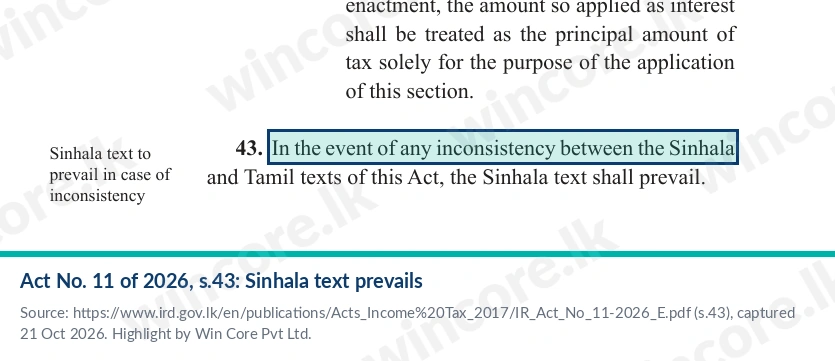
Which language controls. Act No. 11 of 2026, s.43: "In the event of any inconsistency between the Sinhala and Tamil texts of this Act, the Sinhala text shall prevail" [1]. The VAT (Amendment) Act No. 14 of 2026 has the same rule in s.18 [2], and so does s.16 of the Stamp Duty (Special Provisions) Act [6]. We read the English texts for our articles, and say so; where a point turns on fine wording, compare the Sinhala text.
Where to get Acts. Parliament publishes Acts as PDFs (for example the Companies Act at parliament.lk), and the IRD republishes tax Acts on its Acts page. The cover of Act No. 11 of 2026 says it was printed at the Department of Government Printing and "can be downloaded from www.documents.gov.lk" [1].
Gazette Orders set many rates and fees, and carry their own dates
Many figures are not in an Act. They are set by Orders, regulations and notifications in the Gazette, usually the Extraordinary Gazette, under a section of the Act that allows it. Stamp duty rates and exemptions are a standing example: the Stamp Duty Act leaves rates to Orders under s.3 and exemptions to Orders under s.5 [6].
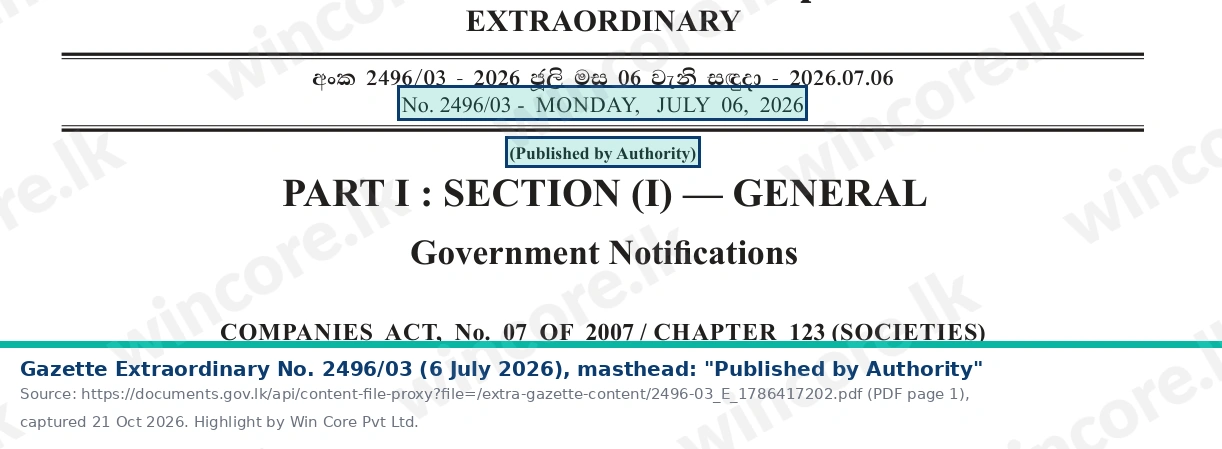
The masthead states the Gazette's status. Gazette No. 2496/03 reads "No. 2496/03 - MONDAY, JULY 06, 2026" and "(Published by Authority)" [3].
Each Gazette names the enabling section (2496/03 is made "under the Section 527 read with Section 477 of the Companies Act"), the date the Minister signed it (23 June 2026) and the date it was published (6 July 2026). Some Orders state a later effective date. On our reading, note all three before relying on a figure. Rate Orders under s.3 of the Stamp Duty Act must also be placed before Parliament for approval within three months, and an Order not approved is deemed rescinded from the date of disapproval (s.3(3), (4)) [6].
The Inland Revenue Act consolidated text is a reference, not the law
The IRD publishes consolidated texts that fold the amendments into the original Act. They are the easiest way to read the Inland Revenue Act and the VAT Act, and they say plainly that they are not the law.
The IRA consolidation's front page: "[Incorporating Amendments up to 31st March 2025]" ... "This is not a statutory consolidation, but rather a convenient reference. Accordingly, the original provisions of the Act remain unchanged, while subsequent amendments along with the relevant provisions of the Amendment Acts and their effective dates have been incorporated as new provisions for ease of reference." It is dated 30 June 2025 [4].
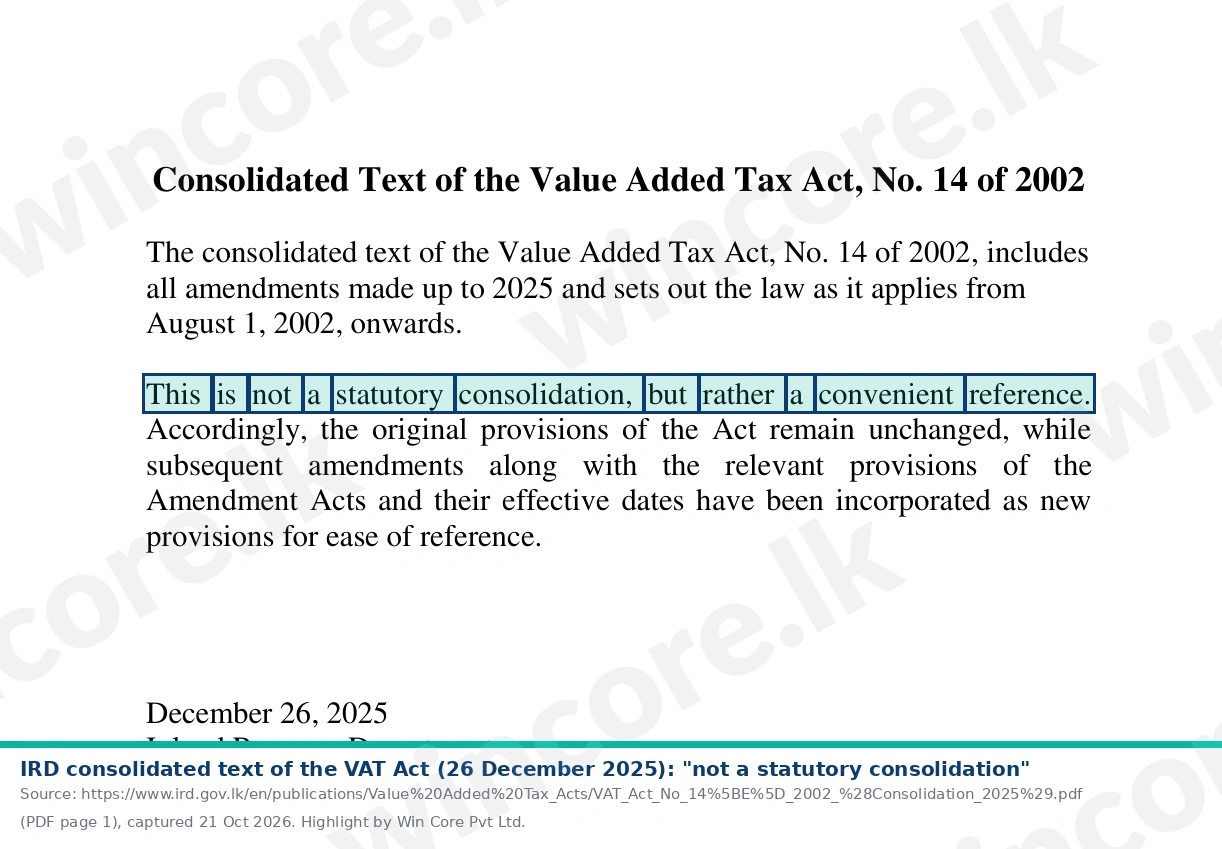
The VAT consolidation uses the same sentence, says it "includes all amendments made up to 2025", and is dated 26 December 2025 by the IRD's Tax Policy and Legislation Unit [5]. The Stamp Duty Act consolidation says it "cannot be regarded as a statutory copy" and is "for the purpose of convenient reference only" [6].
A consolidation stops at a date, so read the later amending Acts with it
Three things follow when you use a consolidation.
- It stops at a cut-off. Neither the IRA consolidation nor the VAT consolidation contains the 2026 amending Acts (Act No. 11 of 2026 for income tax, Act No. 14 of 2026 for VAT). Each has to be read alongside them. Our Sri Lanka tax law changes 2026 list sets out every instrument by date.
- Old and new wording sit side by side. The IRD keeps superseded provisions with margin notes showing which amending Act changed them and from when. Section 126(5) of the IRA consolidation, for example, appears in two versions, one marked "Prior to April 01,2021" [4]. Pick the version for the period you are dealing with.
- Typing slips occur. The consolidation's definition of "person" reads "corporate or unincorporte" [4]. A slip in a consolidation is not the law; where wording matters, read the Act and the amending Act.
The IRD's Acts page itself needs care. On 22 October 2026 it listed Act No. 11 of 2026 and VAT Act No. 14 of 2026, yet its footer read "Last updated: 25-03-2025", and it describes the VAT consolidation as incorporating amendments "up to 31.12.2025" while the PDF is dated 26 December 2025 [7]. The same page lists an SSCL consolidation incorporating amendments up to 30 June 2026, so some consolidations are newer than others. Check the date on the document, not the page.
A hypothetical, with our arithmetic
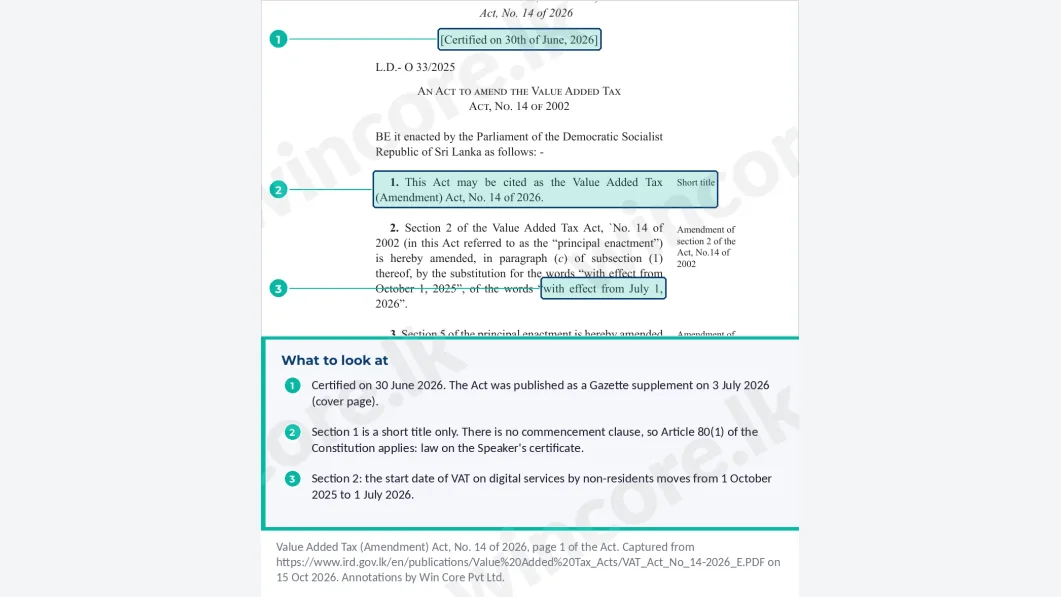
An adviser (hypothetical) in October 2026 checks when VAT on digital services supplied from abroad began, using only the VAT consolidation of 26 December 2025. Section 2(1)(c) there charges VAT on services supplied by a non-resident through an electronic platform "with effect from October 1, 2025" [5]. The VAT (Amendment) Act No. 14 of 2026, certified on 30 June 2026, substituted "with effect from July 1, 2026" (s.2) [2].
| Item | Date |
|---|---|
| VAT consolidation dated | 26 December 2025 |
| Amending Act certified | 30 June 2026 |
| Gap | Our arithmetic: 186 days |
| Start date in the consolidation | 1 October 2025 |
| Start date in the Act as amended | 1 July 2026 |
The consolidation could not include the change, and an adviser relying on it alone would give a start date nine months too early. Our articles on the VAT Amendment Act No. 14 of 2026 and on VAT on digital services from abroad cover the change and the IRD notice that preceded it.
IRD circulars and notices show practice, and can move a date
The IRD also issues circulars, notices and guides. They explain how the IRD administers the law; they are not Acts. A circular can be revised within weeks: the IRD's instalment circular SEC/2026/E/06 was issued, revised and then re-revised for 2026/27.
A circular can also set the working date of a rule the Act dates earlier. Section 103(6)(b) of the Inland Revenue Act, inserted by Act No. 11 of 2026, requires TIN certificates for listed transactions "With effect from April 1, 2026" [1]. The IRD's Circular SEC/2026/E/07 says the requirement applies "with effect from 1 November 2026" [8]. Where the Act sets a date and the IRD sets another, note both; our article on the TIN certificate circular SEC/2026/E/07 explains how the two fit. On our reading, a circular is good evidence of the IRD's practice on its date, read with the Act it applies.
Secondary sources point you to the law but are not the law
Unofficial collections, commentaries, firm newsletters and blogs, including ours, are secondary. They can point you to the right section, but they are not the source. In our articles we label every reference Primary or Secondary, and we name the copy we read.
| Source | Status | What to check |
|---|---|---|
| Act of Parliament (Sinhala text prevails) | The law | Certification date, commencement section, later amending Acts |
| Gazette Order, regulation or notification | Law made under an Act | Enabling section, signing date, publication and effective dates, Parliament approval where required |
| IRD consolidated text | "not a statutory consolidation, but rather a convenient reference" | The date on the document; amending Acts since |
| IRD circular, notice or guide | Administrative statement | Issue date, revisions, the Act it applies |
| Secondary sources | Not the law | The primary source they cite |
What this means for you
- Ask for the section number and the instrument behind any rule you are told about.
- Read the Act or the Gazette, not only a summary of it.
- Check the date on any consolidation, and look for amending Acts since. In October 2026 that means Act No. 11 of 2026 for income tax and Act No. 14 of 2026 for VAT.
- Note certification, commencement, signing, publication and effective dates.
- Treat IRD circulars as the IRD's practice on their date, and look for revisions.
- Where wording is decisive, compare the Sinhala text.
If you want a position checked against the current Acts rather than a consolidation, our income tax services include that review.
Checklist: documents needed
- The Act and every amending Act, with certification dates
- The commencement section of each amending Act, with any table of earlier dates
- Any Gazette Order or regulation on the point, with enabling section and dates
- The current IRD consolidation, with the date on the document
- Any IRD circular or notice on the point, with issue date and revision marks
- The Sinhala text, where a point turns on wording
- A note of the date you checked each source
FAQ
Is the IRD consolidated Inland Revenue Act the law?
No. Its front page says it "is not a statutory consolidation, but rather a convenient reference", and it incorporates amendments only up to 31 March 2025. The law is the Inland Revenue Act No. 24 of 2017 as amended by each amending Act, including Act No. 11 of 2026. Use the consolidation to find a section, then confirm the wording against the Acts.
Where do tax rates set by Order appear?
In the Gazette, usually the Extraordinary Gazette, as an Order or regulation made under a section of the relevant Act. Stamp duty rates, for example, are set by Orders under s.3 of the Stamp Duty Act. Note the enabling section, the signing date, the publication date and any later effective date stated in the Order before you rely on a figure.
Which language governs a Sri Lankan tax Act?
The Sinhala text. Recent tax Acts end with a section saying that in any inconsistency between the Sinhala and Tamil texts, "the Sinhala text shall prevail": s.43 of Inland Revenue Act No. 11 of 2026 and s.18 of VAT Act No. 14 of 2026, for example. Most readers use the English text, so compare the Sinhala version where a point turns on wording.
Can I rely on an IRD circular?
A circular shows the IRD's administrative position on the date it was issued, and it can be revised. It does not override the Act. Where a circular and the Act give different dates, as with the TIN certificate rule (Act 1 April 2026, circular 1 November 2026), note both and read the circular with the section it applies.
Open points
- Whether and when the IRD will issue consolidations that include Acts No. 11 and No. 14 of 2026.
- Whether the Parliament copy and the IRD copy of an Act ever differ; we have not compared them line by line.
- How the 1 April 2026 date in s.103(6)(b) and the 1 November 2026 date in Circular SEC/2026/E/07 interact for a transaction between those dates; see our TIN certificate article.
Last verified: 22 October 2026. We re-read the cover, s.1 and s.43 of Act No. 11 of 2026, ss.2 and 18 of VAT Act No. 14 of 2026, the front pages of the IRA, VAT and Stamp Duty consolidations, s.126(5) and the "person" definition in the IRA consolidation, Gazette 2496/03, Circular SEC/2026/E/07 and the IRD Acts page.
The short version.
- Acts of Parliament are the law, and "the Sinhala text shall prevail" in case of inconsistency.
- Gazette Orders and regulations set many rates and fees, each with its own enabling section and dates.
- The Inland Revenue Act consolidated text is "not a statutory consolidation, but rather a convenient reference" and stops at 31 March 2025.
- Read every amending Act since the consolidation's date; in 2026 that means Acts No. 11 and No. 14.
- IRD circulars are administrative, can be revised, and can set a different working date from the Act.
Talk to us. If you want a tax point checked against the Acts in force rather than a summary, our contact page.
WinCore Pvt Ltd
References
- Parliament of Sri Lanka. Inland Revenue (Amendment) Act, No. 11 of 2026, cover, s.1, s.24 (new s.103(6)) and s.43. https://www.ird.gov.lk/en/publications/Acts_Income%20Tax_2017/IR_Act_No_11-2026_E.pdf . Primary. Accessed 22 October 2026.
- Parliament of Sri Lanka. Value Added Tax (Amendment) Act, No. 14 of 2026, cover, ss.2 and 18. https://www.ird.gov.lk/en/publications/Value%20Added%20Tax_Acts/VAT_Act_No_14-2026_E.PDF . Primary. Accessed 22 October 2026.
- Gazette Extraordinary No. 2496/03 (6 July 2026), masthead and preamble. https://documents.gov.lk/api/content-file-proxy?file=/extra-gazette-content/2496-03_E_1786417202.pdf . Primary. Accessed 22 October 2026.
- Inland Revenue Department. Consolidated Text of the Inland Revenue Act No. 24 of 2017 (30 June 2025), front page, s.126(5) and s.195. https://www.ird.gov.lk/en/publications/Acts_Income%20Tax_2017/IRA_Cons_Act_-_2025_Changes.pdf . Primary (IRD consolidation; non-statutory). Accessed 22 October 2026.
- Inland Revenue Department. Consolidated Text of the Value Added Tax Act, No. 14 of 2002 (26 December 2025), front page and s.2(1)(c). https://www.ird.gov.lk/en/publications/Value%20Added%20Tax_Acts/VAT_Act_No_14%5BE%5D_2002_%28Consolidation_2025%29.pdf . Primary (IRD consolidation; non-statutory). Accessed 22 October 2026.
- Inland Revenue Department. Stamp Duty (Special Provisions) Act, No. 12 of 2006 (consolidation with Act No. 10 of 2008), front note and ss.3, 5 and 16. https://www.ird.gov.lk/en/Type%20of%20Taxes/Stamp%20Duty_Acts/SDActNo.12%5BE%5D2006ConsolFinal.pdf . Primary (IRD consolidation; non-statutory). Accessed 22 October 2026.
- Inland Revenue Department. Acts (web page, Downloads). https://www.ird.gov.lk/en/publications/SitePages/acts.aspx . Primary (official website). Accessed 22 October 2026.
- Inland Revenue Department. Circular SEC/2026/E/07, Mandatory Submission of TIN Certificate for Specified Transactions (22 September 2026), paras 1 and 4. https://www.ird.gov.lk/en/publications/Circulars_Circulars/SEC_2026_E_07_E.pdf . Primary. Accessed 22 October 2026.
Put these insights to work
WinCore specialists can review your current workflow, document gaps, and build a practical 90-day action plan.
Book a free consultationContinue reading
Explore more WinCore analysis to keep your finance, tax, and compliance roadmap moving.
One dated register of the Acts, Gazettes and IRD circulars behind our Regulation Desk pieces, with the day each one actually started to bite.
Certified 3 June 2026, Act No. 11 carries nine start dates. Here is each change, the date it bites, the penalty attached and the 2 December write-off.
Digital services VAT, a 20.5 percent rate for financial services and Rs 1 million fines: each change in the 2026 VAT Act, with its own start date.