
Input VAT before registration in Sri Lanka: the s.22(7) door
Spending before your first sale? Why VAT on early invoices is usually lost, how a section 22(7) approval changes that, and the clocks that still run.
On this page
Last verified against the primary sources on 22 October 2026.
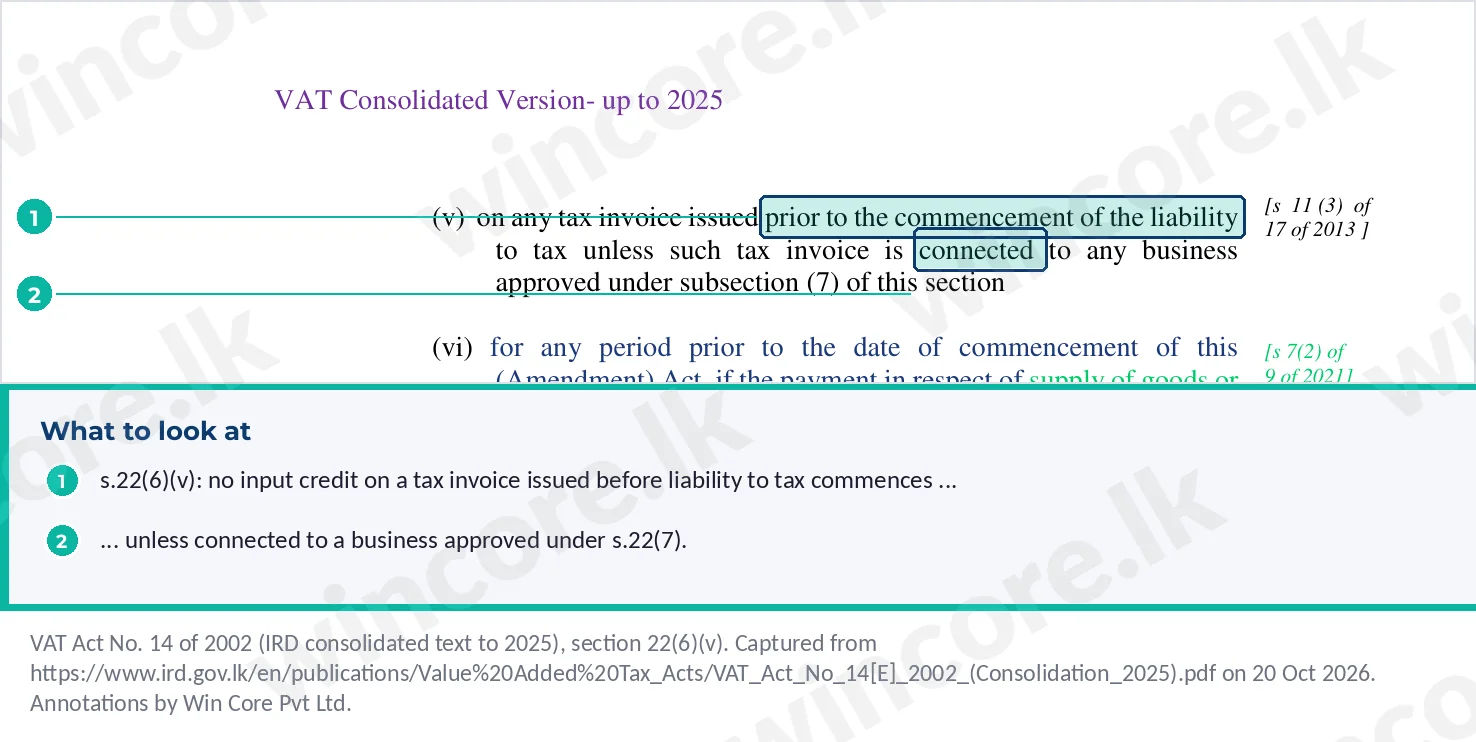
Input VAT before registration in Sri Lanka is, as a rule, not claimable. Section 22(6)(v) of the Value Added Tax Act No. 14 of 2002 denies credit "on any tax invoice issued prior to the commencement of the liability to tax unless such tax invoice is connected to any business approved under subsection (7)" [1]. The one door is a section 22(7) approval from the Commissioner-General for a business that has commenced and undertakes to make taxable supplies within thirty months. The IRD's 2026 registration guide sets out the application (form TPR 007 E or TPR 006 E) [3]. Every claim, approved or not, then runs on a twelve-month clock.
New businesses often spend heavily before a single sale: fit-out, equipment, software, professional fees. Take a hypothetical engineering start-up in Kandy that spends eight months building a test facility before it invoices anyone. By the time it crosses the VAT threshold it has paid a large amount of VAT to its contractors. Whether any of it comes back depends on what it did at the start, not at the end.
Section 22 gives credit only to a registered person
Credit for input tax is in section 22. We read the Inland Revenue Department's consolidated text of the Act, updated to 2025, which the IRD says "is not a statutory consolidation, but rather a convenient reference" [1]. We also read the VAT (Amendment) Act No. 14 of 2026: its section 6 adds a new paragraph (vii) to section 22(6) on deferred tax on project imports and does not change the paragraphs discussed here [2].
Section 22(2) gives the basic entitlement: "Subject to the provisions of this Act, a registered person shall be entitled at end of each such period to credit for so much of his input tax as is allowable under this Act" [1]. Two words do the work: "registered person" and "allowable". The definition of "input tax" in section 83 also speaks of tax charged "in relation to a registered person" [1]. Section 22(6) then lists input tax that "shall not be deducted under subsection (2)". For a worked split, see input VAT apportionment for a hospital and pharmacy.
Invoices dated before your liability to tax starts earn no credit
Paragraph (v) of section 22(6) has three elements:
- The test is the invoice date. It asks when the tax invoice was issued, not when the goods arrived or when you paid.
- The cut-off is the commencement of your liability to tax. Before that date, invoices do not qualify.
- There is one exception. An invoice connected to a business approved under section 22(7).
So for our start-up, on the plain words, VAT on contractor invoices dated before its liability commenced is not deductible unless it holds a section 22(7) approval. The invoices do not become claimable because the company later registers, and the VAT it will charge on its own sales does not net them off.
When does liability commence? The Act does not define the phrase. On our reading it is tied to the effective date of registration, which the certificate shows (s.15(2)) [1]. Where the Commissioner-General registers a late business under s.14(1)(c), he fixes that date himself; our companion piece on late VAT registration in Sri Lanka covers what that means for past sales. Invoices dated from the effective date onwards are in principle claimable, subject to the conditions below.
A section 22(7) approval is the only door, and it is discretionary
Section 22(7) is the route for a business that is spending before it sells. "Where any person has proved to the satisfaction of the Commissioner-General, that such person has commenced any business or any project in Sri Lanka, and undertakes to make taxable supplies in respect of such business or project within a period of thirty months from commencement of such operation", the Commissioner-General "may register such person subject to such conditions as may be specified by him, notwithstanding the provisions of section 14 and allow credit for input tax in respect of such business or project subject to the provisions of sub-paragraph (iii) of subsection (6)" [1].
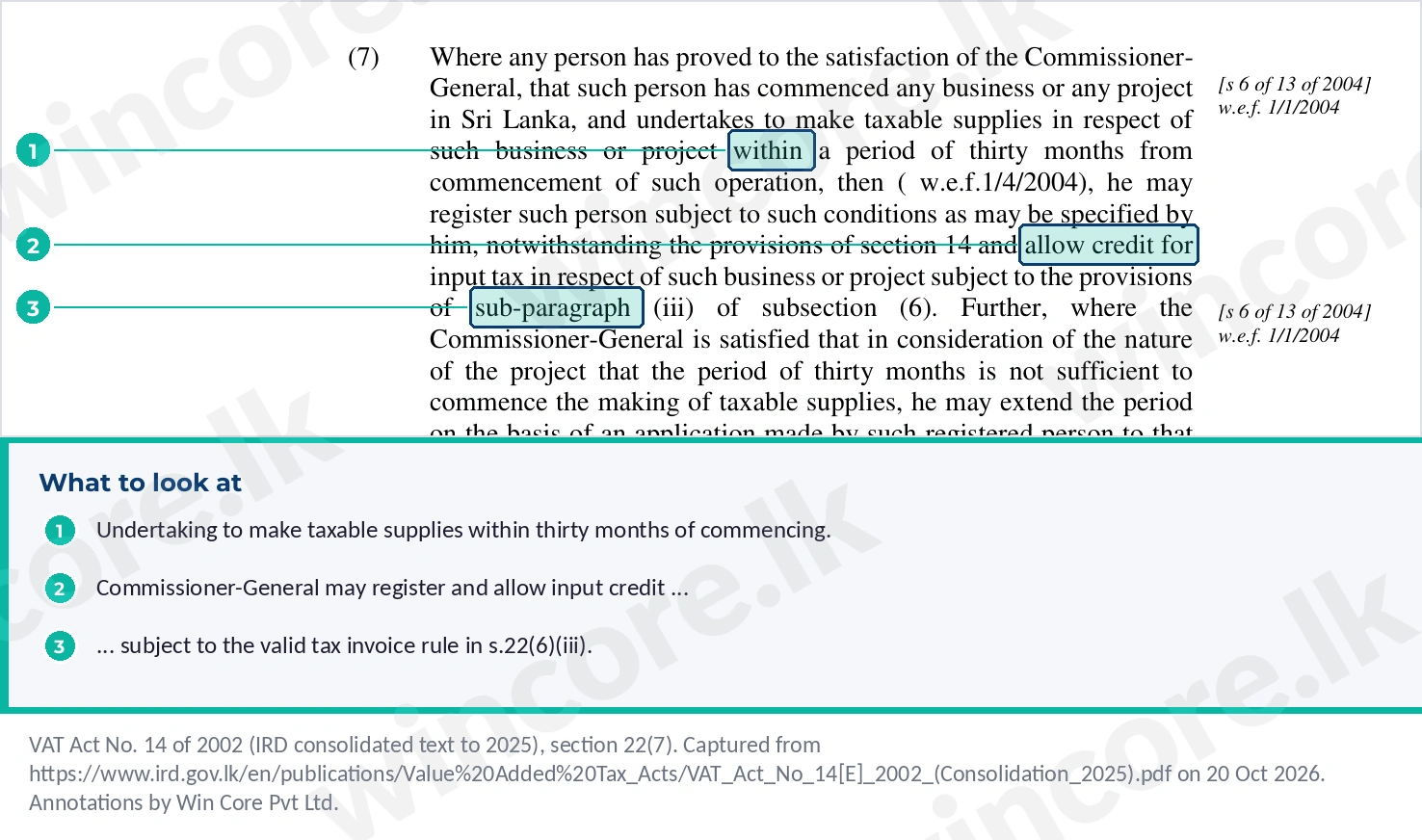
Points to notice in that wording:
- Who decides. The Commissioner-General, on being satisfied. The word is "may": a discretion, not an entitlement, and it can carry "such conditions as may be specified by him".
- What you must prove. That the business or project has commenced in Sri Lanka.
- What you must undertake. Taxable supplies within thirty months from commencement of operation.
- Extension. If the Commissioner-General "is satisfied that in consideration of the nature of the project that the period of thirty months is not sufficient", he may extend it "on the basis of an application made by such registered person".
- Existing registrants. A person already registered for one business must inform the Commissioner-General and "request that such registration be extended to include any new business or project".
- Monthly returns. For periods from 1 October 2025, a person who has commenced a business or project and undertakes to comply with s.22(7) has a one-month taxable period "during the project implementation period" (s.83, "taxable period", as amended by Act No. 14 of 2026) [1] [2].
On our reading this is the only route in the Act for credit on invoices that pre-date commencement of liability. The text does not say in terms that the approval must come before the invoices are issued, but it is framed for a person who "undertakes to make taxable supplies" within thirty months, which presupposes a person who has not yet started selling.
How to apply. The IRD's Taxpayer Guidelines for Registration and Update (2026) list the application as "Approval under Section 22(7) of VAT Act No. 14 of 2002", made on form TPR 007 E or TPR 006 E [3]. The documents include a board resolution approving the project and the application, a project proposal with the "Anticipated date of commencement of business", the "Estimated quarterly value of taxable supplies" and "Details of expenses incurred prior to applying under Section 22(7)", proof of the source of funds, a work-in-progress report, intended import and local purchase lists, the registered deed or lease, approved plans, a bill of quantities approved by a chartered engineer, environmental clearance and the contractor agreement [3]. BOI companies add their BOI certificate and agreement. Extensions are made on the same form with a progress report, bank statements and cost and material reconciliations, and the guide says applications "should be submitted before 14 days from the date of the current extension date" [3].
The list is written for building and project work. A service start-up with modest capital spending may find the cost of the application outweighs the VAT at stake; that is a judgment to make before the spending, not after.
Two twelve-month clocks run on every invoice
Even with an approval, or once you are registered in the ordinary way, input tax must clear section 22(6)(iii) and (iv) [1]:
- (iii) no deduction if the supply is "not supported by (a) a valid tax invoice; or (b) a customs goods declaration or other authenticated document issued by the Director-General of Customs ... and received within twelve months from the end of the relevant taxable period in respect of which such tax invoice was issued or from the date of importation of goods".
- (iv)(a) no deduction if a tax invoice "has not been deducted ... from the output tax for any taxable period ending on or before the expiry of twelve months from the date of such tax invoice, by furnishing within the said period of twelve months the return for that taxable period". For customs declarations the period in (iv)(b) is twenty-four months.
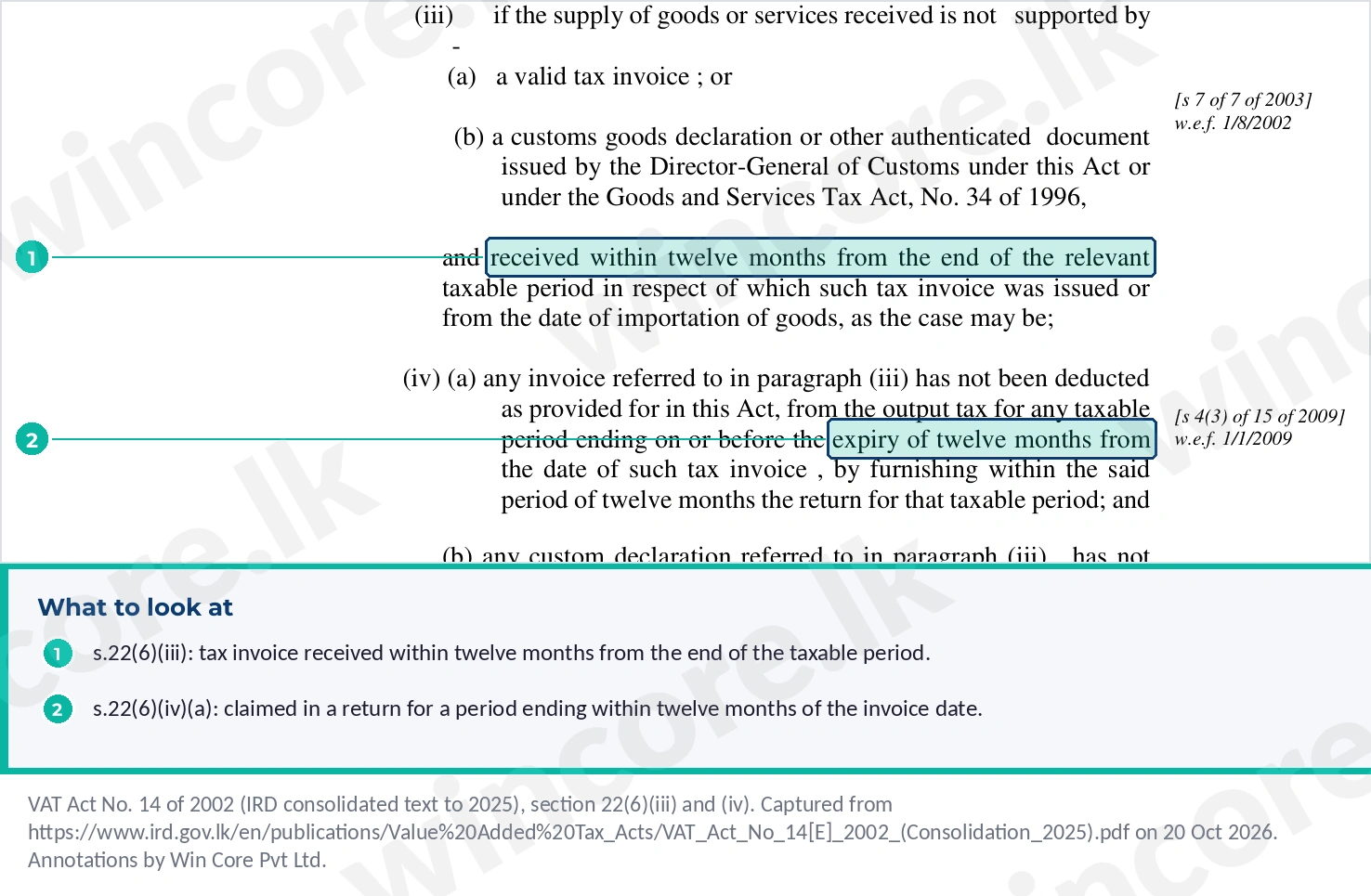
Two practical consequences follow. An approved start-up still needs valid tax invoices, and each invoice's clock runs from its own date: a business that is slow to file returns can lose credit on invoices that were otherwise good. And on our reading, a business registered late from a backdated effective date can find that some invoices dated after that date are already more than twelve months old when it files its first return.
Section 22(6) also blocks some input whatever the timing: under (i), motor vehicles other than the listed classes, and under (ii), supplies "not connected with the taxable activity or not included in the value of taxable supply" [1]. Pre-registration spending gets no relief from those limits.
Claiming credit you are not allowed is assessed as tax in default
Section 22(8) deals with "any excess amount of input tax claimed". It "shall be assessed by an Assessor on the registered person ... making such claim, and such amount shall be deemed to be a tax in default on the first day of the taxable period in which the excess of input tax first arose" [1]. That is the provision for claiming input that is not allowable, such as pre-liability invoices without an approval.
The same subsection catches an approved business that does not deliver. Input tax claimed by a person "who has obtained approval under subsection (7) ... and has not commenced business of making taxable supplies as stated in the undertaking given, by such person prior to the obtaining of such approval, shall be deemed to be an excess amount of input tax claimed" [1]. Miss the undertaking, and the credit already taken can be assessed back as tax in default from the start of the period of the claim. The Act's general provisions on tax in default then apply; we do not quantify them here, because the amount depends on the period and the provisions in force for it.
What a business spending before its first sale should do
- Decide early whether to seek a section 22(7) approval. If you will spend significant VAT-bearing sums for months before you sell, the approval is what makes that VAT claimable. Collect the IRD's document list while the project is being planned.
- Keep every invoice in the company's name and in valid tax invoice form. In our practice, invoices addressed to a founder personally are a weak basis for any claim, because s.22(2) gives credit to the registered person. This is practice, not a statutory rule. The format rules are in our note on the tax invoice format under Gazette 2481/22.
- Track the twelve-month clock per invoice. File returns in time to bring each invoice into a period ending within twelve months of its date.
- Model pre-registration VAT as a cost unless you hold an approval. Do not count on it in the business plan.
- Separate VAT-bearing costs that would be blocked anyway. Vehicles and costs not connected to the taxable activity fall under s.22(6)(i) and (ii) whatever the timing.
- Watch the thresholds while you build. Our guide to VAT registration thresholds that still apply covers the quarterly, twelve-month and forward-looking tests, and our startup accounting guide covers the records to keep from day one.
Our VAT services team can prepare a section 22(7) application, keep the input register and file the monthly returns; bookkeeping that keeps the register clean sits with our accounting services. To check the VAT element on a quote, use our VAT calculator.
Checklist: documents needed
- Evidence that the business or project has commenced in Sri Lanka (incorporation, lease, contracts)
- Board resolution approving the project and the s.22(7) application
- Project proposal with commencement date, estimated quarterly taxable supplies and expenses to date
- Bill of quantities, approved plans and the contractor agreement
- Valid tax invoices in the company's name for each VAT-bearing purchase
- Customs goods declarations for imports
- A register of input invoices with dates and twelve-month deadlines
- Any conditions set in the Commissioner-General's approval letter
What this means for you
VAT on invoices dated before your liability to VAT commences is lost unless the business holds a section 22(7) approval. The approval is discretionary, framed for a business still building towards its first taxable sale, and it carries a thirty-month undertaking that can be assessed back if missed. Once registered or approved, every invoice runs on a twelve-month clock. If you are about to spend heavily before your first sale, decide on the approval now.
Open points we keep open:
- Timing of the s.22(7) approval. The Act does not say whether an approval obtained after invoices were issued covers them. The IRD guide asks for "Details of expenses incurred prior to applying", which suggests earlier spending is looked at, but it does not say that spending earns credit.
- Meaning of "commencement of the liability to tax". The Act does not define it; we read it as the effective date of registration.
- Pre-incorporation spending. Section 22(7) speaks of a person who "has commenced any business or any project". Whether invoices issued before the company existed can be connected to an approved business is not addressed in the text.
- The "before 14 days" wording for extensions. We quote the IRD guide; read it as applying well ahead of the current extension date.
FAQ
Can I claim input VAT on purchases made before VAT registration?
Generally no. Section 22(6)(v) of the VAT Act bars credit on any tax invoice issued before your liability to tax commenced, unless the invoice is connected to a business approved under section 22(7). Registering later does not revive those invoices, and your own output VAT does not net them off. Treat that VAT as a cost unless you hold an approval.
What is a section 22(7) VAT approval?
It is a registration and credit approval by the Commissioner-General for a person who has commenced a business or project in Sri Lanka and undertakes to make taxable supplies within thirty months. It is discretionary and can carry conditions. The IRD guide lists the application on form TPR 007 E or TPR 006 E, with a project proposal and supporting documents.
Can the thirty months under section 22(7) be extended?
Yes. If the Commissioner-General is satisfied that the nature of the project needs more time, he may extend the thirty months on an application by the registered person. The IRD guide asks for a progress report, bank statements, cost and material reconciliations and contractor payment details, submitted before the current extension date runs out.
Is there a time limit to claim input VAT once registered?
Yes. Under section 22(6)(iv)(a), a tax invoice must be claimed in a return for a taxable period ending within twelve months of the invoice date, with that return furnished within the twelve months. Customs declarations have twenty-four months. Section 22(6)(iii) separately requires the invoice to be received within twelve months from the end of its taxable period.
What happens if we claimed pre-registration VAT by mistake?
Under section 22(8), the excess is assessed by an Assessor and treated as tax in default from the first day of the taxable period in which it first arose. On our reading, correcting it early limits the cost, because the default runs from the period of the claim. The same rule applies if an approved business misses its thirty-month undertaking.
We read the IRD consolidation of the VAT Act, the VAT (Amendment) Act No. 14 of 2026 and the IRD's 2026 registration guide on 22 October 2026.
Talk to us. If you are about to spend heavily before your first sale, book a consultation at our contact page.
WinCore Pvt Ltd
This article is general information on the law as at 22 October 2026 and is not advice on your specific situation.
References
- Inland Revenue Department. Consolidated Text of the Value Added Tax Act, No. 14 of 2002 (amendments up to 2025), cover note and ss.2(1), 14(1), 15(2), 22(2), (6)(i) to (v), (7), (8) and 83 ("input tax", "taxable period"). https://www.ird.gov.lk/en/publications/Value%20Added%20Tax_Acts/VAT_Act_No_14%5BE%5D_2002_%28Consolidation_2025%29.pdf . Primary (official, non-statutory consolidation). Accessed 22 October 2026.
- Parliament of Sri Lanka. Value Added Tax (Amendment) Act, No. 14 of 2026 (certified 30 June 2026), ss.6 and 16(5). https://www.ird.gov.lk/en/publications/Value%20Added%20Tax_Acts/VAT_Act_No_14-2026_E.PDF . Primary. Accessed 22 October 2026.
- Inland Revenue Department. Taxpayer Guidelines for Registration and Update (2026), "Approval under Section 22(7) of VAT Act No. 14 of 2002" and "Updating Project Details". https://ird.gov.lk/en/Downloads/SiteAssets/TPR_Guidelines_2026_E.pdf . Primary (administrative). Accessed 22 October 2026.
Put these insights to work
WinCore specialists can review your current workflow, document gaps, and build a practical 90-day action plan.
Book a free consultationContinue reading
Explore more WinCore analysis to keep your finance, tax, and compliance roadmap moving.
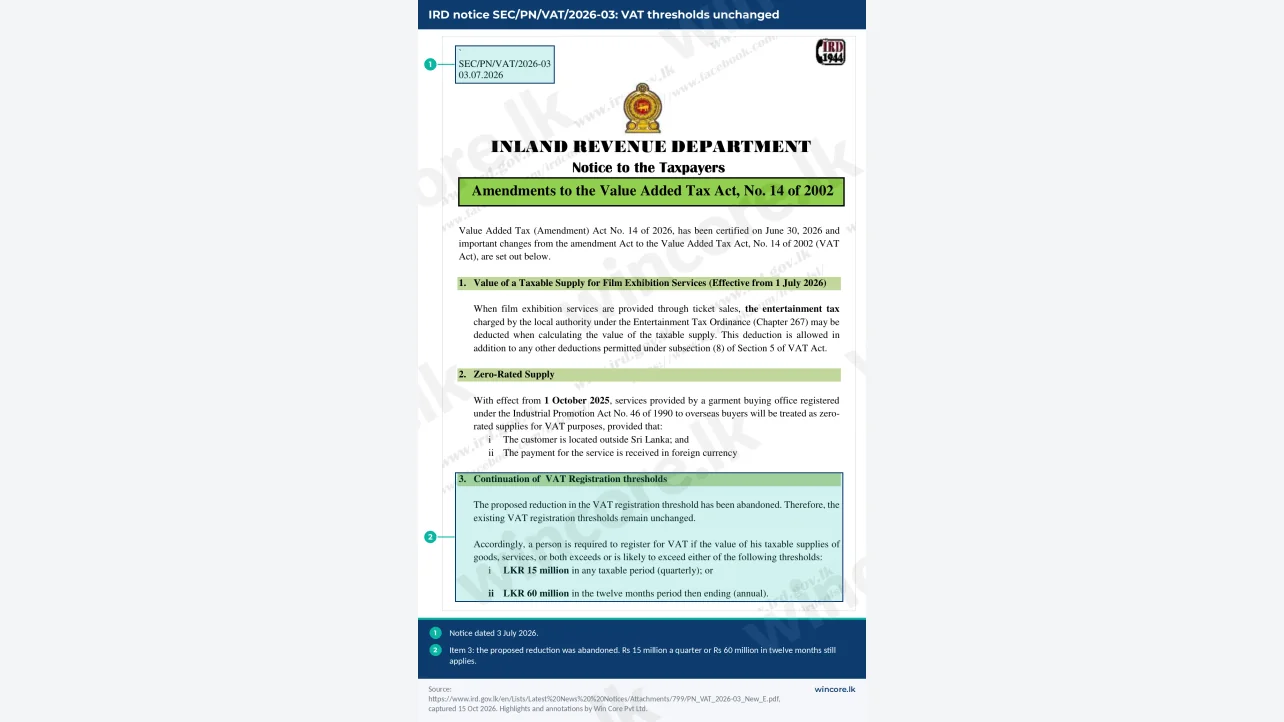
The VAT registration tests are Rs 15 million a quarter or Rs 60 million over 12 months. How the tests run, the 15 day rule and who must register.

VAT guide for Sri Lanka covering who must register, zero rating and exemptions, tax invoices, filing and payment dates, input tax credits, penalties, and deregistration.

New companies in Sri Lanka face eight or more compliance registrations in year one. Here is how to set up your books, register for taxes, and stay clean.