
Tax invoice format Gazette 2481/22: what changed on 1 October 2026
The IRD Order behind the new VAT tax invoice: the 1 October start, the serial number and date rules, and which default carries which penalty.
On this page
Last verified against the primary sources on 21 October 2026.
The tax invoice format in Gazette Extraordinary No. 2481/22 of 27 March 2026 has applied to every VAT registered person since 1 October 2026, the start date set by Gazette Extraordinary No. 2500/106 of 6 August 2026 [1] [2]. Each tax invoice must be titled "TAX INVOICE", show both nine digit TINs, carry a serial number in the form YYMMM_QQQQ_XXXXX with no spaces and at most 40 characters, and give the invoice and supply dates as MM/DD/YYYY [1]. Not issuing a required tax invoice has a named fine in section 20(7) of the VAT Act; getting the format wrong has a less certain consequence, and we set out both readings below.
For the fields, timing and controls as a practical checklist, see our guide to VAT tax invoice requirements in Sri Lanka.
The tax invoice format in Gazette 2481/22 applies from 1 October 2026
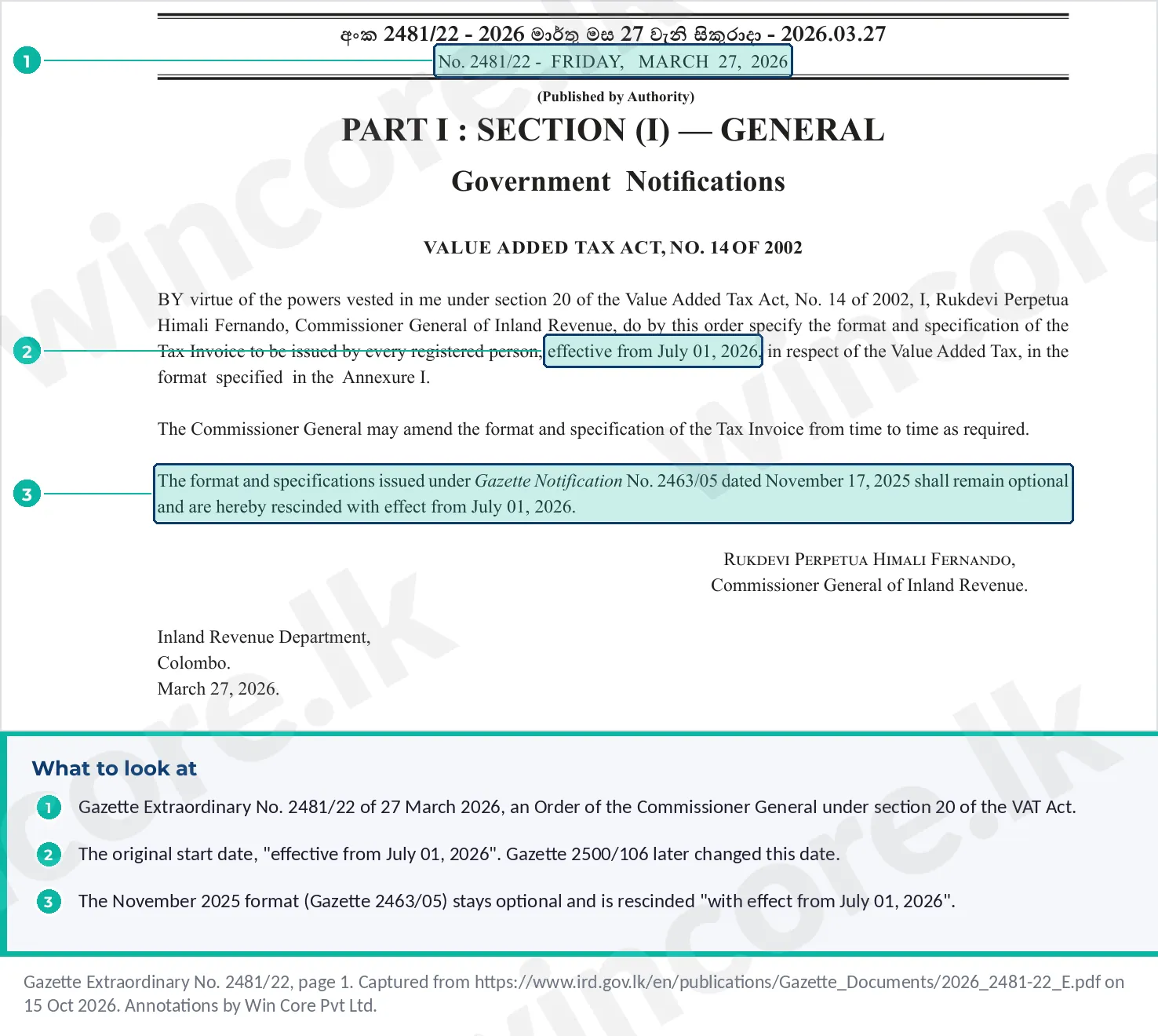
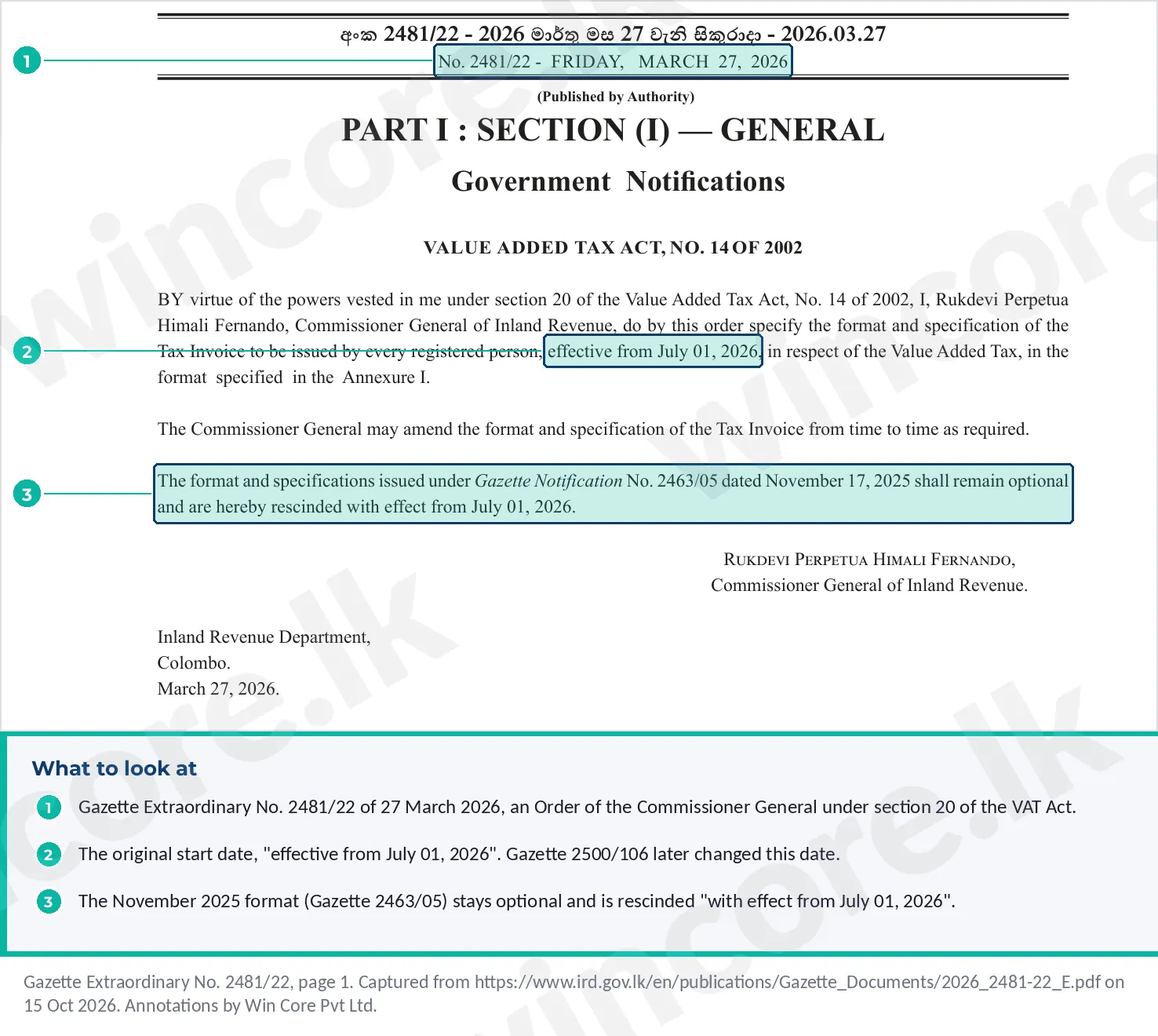
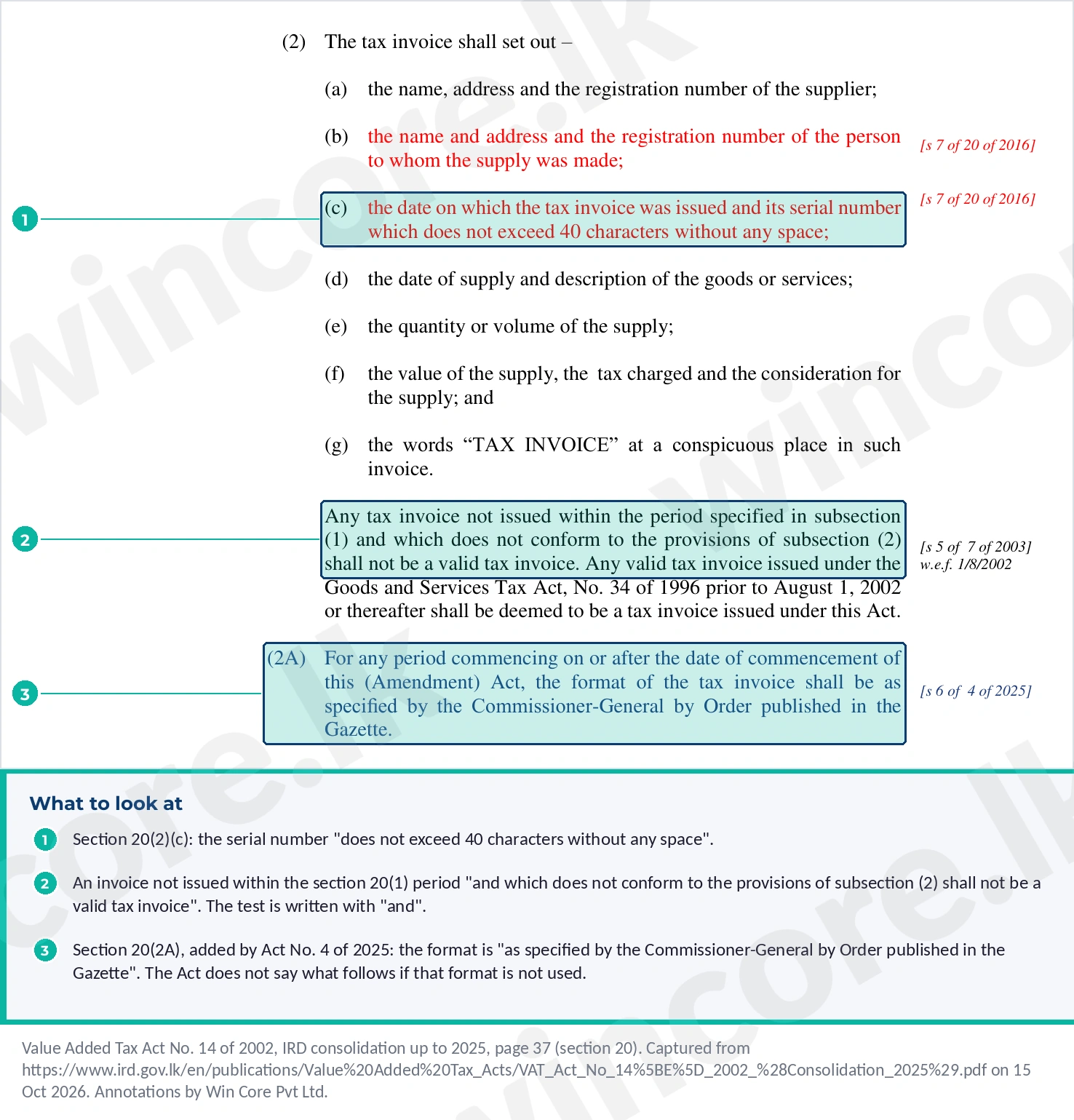
Gazette 2481/22 is an Order of the Commissioner General of Inland Revenue under section 20 of the Value Added Tax Act, No. 14 of 2002. It specifies "the format and specification of the Tax Invoice to be issued by every registered person", set out in Annexure I [1]. The power is in section 20(2A), inserted by Act No. 4 of 2025: "the format of the tax invoice shall be as specified by the Commissioner-General by Order published in the Gazette" [4].
The Order originally took effect "from July 01, 2026". It also dealt with its predecessor: the format under Gazette No. 2463/05 "dated November 17, 2025 shall remain optional and are hereby rescinded with effect from July 01, 2026" [1] [3].
Gazette 2500/106 then amended 2481/22 in two lines: "The effective date of 'July 01, 2026', is hereby amended as 'October 01, 2026'" and "All other matters shall remain unchanged" [2]. On 21 October 2026 the IRD gazette page listed 2500/106 as the latest 2026 entry, with nothing later on tax invoices [7].
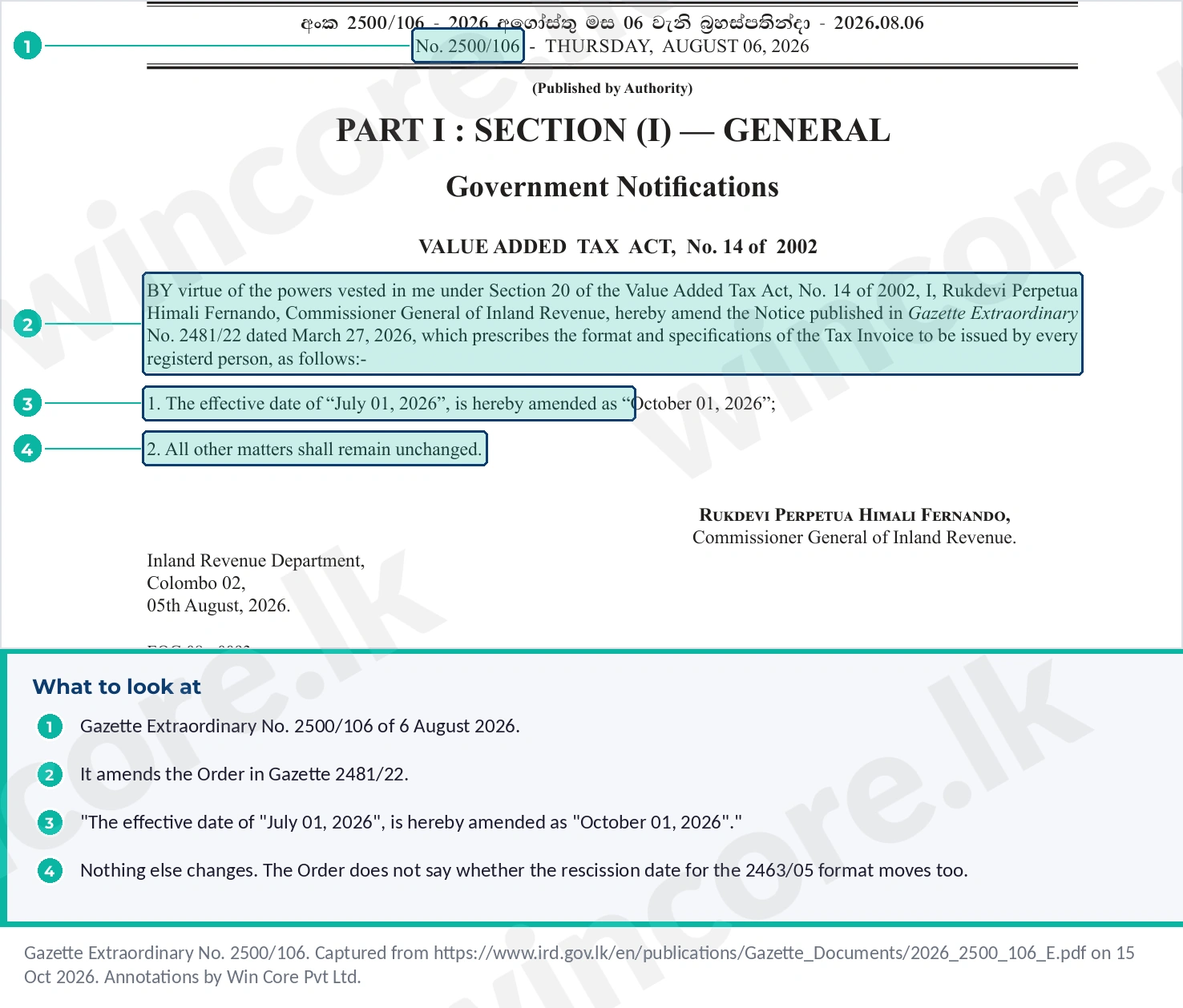
Two timing points stay open. 2500/106 was published five weeks after the original 1 July date had passed, so for those weeks the format was, on paper, in force. And 2500/106 changes "The effective date", in the singular, without saying whether the separate 2463/05 rescission date moved too. On 21 October 2026 we searched ird.gov.lk and found no IRD statement on either point. Either way, use the 2481/22 format for every tax invoice dated on or after 1 October 2026.
Instruments: VAT Act No. 14 of 2002, s.20 as amended by Act No. 4 of 2025; Gazette 2481/22 as amended by 2500/106; VAT (Amendment) Act No. 14 of 2026, ss.11 and 13. Official source: ird.gov.lk. Last verified: 21 October 2026.
The Act still decides who gets a tax invoice and when
Section 20(1) requires a registered person to issue a tax invoice where the buyer "has made a written request within fourteen days from the time of supply or has made a request stating that he is a registered person" and requires a tax invoice. The invoice must be issued "not later than twenty eight days after the time of such supply" [4]. Two provisos matter: once a registered buyer has asked on the first supply, no further request is needed for later supplies, and no tax invoice may be issued on deemed liable supplies under section 8 [4].
Two groups sit outside the format:
- Unregistered buyers. Section 20(6)(a) requires an invoice "giving the total consideration of such supply including the tax charged", and that invoice "shall not be considered as a tax invoice for the purposes of this Act". The proviso: a tax invoice must still be issued to "any Government institution, Provincial Council, Local Government institution, or any public corporation", "whether or not" it is registered [4].
- Imports. Under section 20(3) the customs goods declaration, or another document authenticated by the Director General of Customs, is treated as the tax invoice [4].
Six parts of the specification, and where templates fail
Annexure I has six parts [1].
- Title. "Every invoice ... shall be prominently titled 'TAX INVOICE'", in "bold or highlighted text" in a conspicuous place.
- Supplier details, "as in the VAT Registration Certificate", in "the top left-hand corner": the supplier's TIN "consisting of nine (9) digits", name and address. Telephone is optional.
- Purchaser details at the top right or "below the supplier's particulars": the purchaser's nine digit TIN, name and address.
- Invoice details, set out in the table below.
- Only taxable lines. Paragraph 4.2: "The tax invoice shall exclusively include goods or services only that are subject to VAT."
- Flexibility. The supplier may modify the specimen "subject to the conformity with the specifications set out above", add columns or rows, and display a logo (paragraphs 6.1 to 6.3). Items marked with an asterisk are optional (paragraph 6.4).
| Field | What the Order says | Status |
|---|---|---|
| Serial number | YYMMM_QQQQ_XXXXX, no spaces, 40 characters at most | Required |
| Date of invoice | MM/DD/YYYY | Required |
| Place of supply | Only where it differs from where delivery originates | Optional |
| Date of supply | MM/DD/YYYY | Required |
| Description; quantity or volume | "A clear description"; "The measurable amount" | Required |
| Value | LKR to two decimal places: net value, VAT charged, total including VAT | Required |
| Total in words | Optional | |
| Mode of payment | Cash, bank transfer, cheque, card, mobile or online; the expected mode if not known | Optional |
The serial number, part by part
"YY" is "the last two digits of the calendar year in which the invoice is issued". "MMM" is "the first three characters of the name of the calendar month of issue in uppercase letters". "QQQQ" is "an alphanumeric code used to identify a range of organizational entities", which "may include, branches, sections, units, projects, customers or any classification". "XXXXX" is "the numeric serial number of the invoice, which shall consist solely of numerical characters" [1].
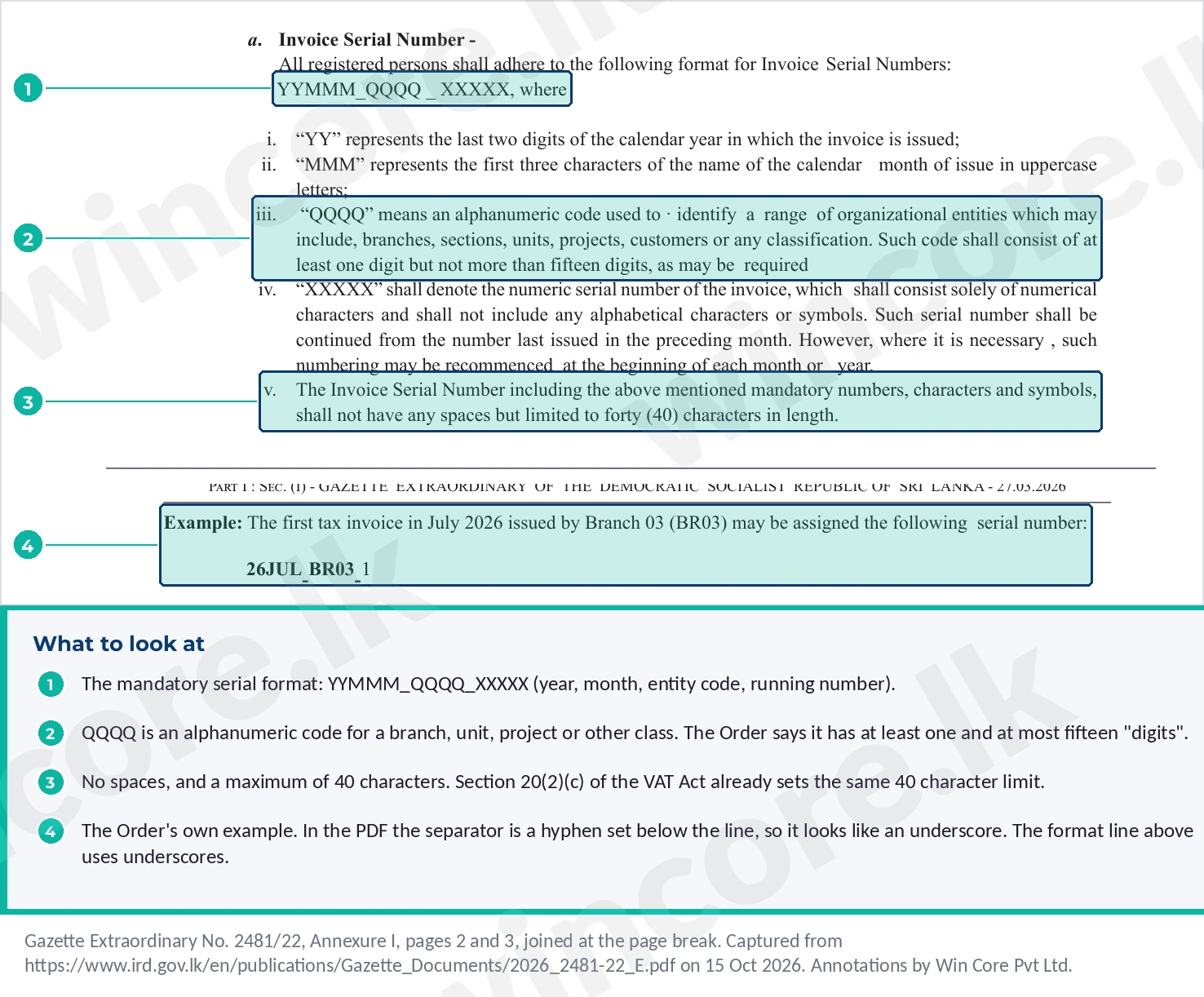
Three details trip people up. The QQQQ code is called "alphanumeric", then said to "consist of at least one digit but not more than fifteen digits"; the Order's own example, "BR03", contains letters, so on our reading "digits" there means "characters". The running number "shall be continued from the number last issued in the preceding month", but "where it is necessary, such numbering may be recommenced at the beginning of each month or year": continuing is the default, restarting is permitted. And the printed example, "26JUL BR03 1", looks as if it has spaces at normal size; on the page the separators are low hyphen marks. We would use underscores, as in the template. The example also shows "1" without leading zeros, so padding to five digits does not appear to be required.
The date format is the easiest field to get wrong
The Order asks for "MM/DD/YYYY" for both dates, while many Sri Lankan documents write the day first [1]. On 3 October 2026 that is 10/03/2026, which most staff would read as 10 March. That matters because section 22(6) refuses input tax unless the purchase is supported by a valid tax invoice received within twelve months from the end of the relevant taxable period [4]. Paragraph 5.1 lets the supplier add information, so a line such as "Dates are MM/DD/YYYY" is allowed.
The penalty depends on which default you commit
| Default | Section | Consequence |
|---|---|---|
| Not issuing a tax invoice when s.20(1) requires one | s.20(7) | Fine of not less than Rs 25,000 and not more than Rs 250,000, then Rs 500 a day if it continues after conviction [4] |
| That offence continuing more than 14 days after conviction | s.20(8) | Court may order closure of the business on the Commissioner-General's application [4] |
| Failing to issue a tax invoice or a s.20(6) invoice; more than one tax invoice for one supply; issuing one without entitlement or while unregistered | s.67(c), (d), (e), (l) | Offence; for periods on or after 1 October 2025, fine up to Rs 1 million or up to six months' imprisonment or both [4] [5] |
| Failing to furnish valid tax invoices "as required under section 21" | s.67(p), from 1 July 2026 | Same s.67 penalty; scope open (below) [5] [6] |
| Invoice not in the 2481/22 format | s.67(m) on one reading only | Otherwise, the buyer's input tax claim is at risk |
Section 13 of Act No. 14 of 2026 set the s.67 penalty: "for any period prior to October 1, 2025", a fine "not exceeding twenty five thousand rupees" or up to six months or both; "for any period on or after October 1, 2025", a fine "not exceeding one million rupees" or up to six months or both [5]. Our piece on the VAT (Amendment) Act No. 14 of 2026 covers the rest of that Act.
Is a wrong format an offence? Two readings
Section 67(m) covers a person who "fails to comply with the requirements specified by order published in the Gazette or the guidelines issued by the Commissioner-General under sections 2 or 25C" [4]. On the narrow reading, "under sections 2 or 25C" governs both the order and the guidelines; the invoice Order is made under section 20, so s.67(m) does not reach it. On the wide reading, "order published in the Gazette" stands on its own, and a wrong format carries the s.67 penalty. The text supports both. We know of no decision on it, so we keep it open and advise treating the format as binding either way.
The new s.67(p) adds an offence of failing "to furnish valid tax invoices or customs good declarations or other authenticated documents as required under section 21" [5]. Section 21 is the section on returns and their schedules [4]. How far it reaches invoices issued to customers, as opposed to documents furnished with a return, is not explained, and we treat its scope as open.
Is a wrongly formatted invoice invalid?
Section 20(2) ends: "Any tax invoice not issued within the period specified in subsection (1) and which does not conform to the provisions of subsection (2) shall not be a valid tax invoice" [4].
The cautious reading, which a buyer's accountant or an assessor is likely to apply, is that an invoice missing the required form cannot be relied on. Part of the format is in subsection (2) itself: section 20(2)(c) already requires a serial number "which does not exceed 40 characters without any space", and (2)(g) requires the words "TAX INVOICE" [4].
The literal reading is narrower in two ways. The sentence refers to subsection (2), the list of contents, not to subsection (2A), which brings in the Order; an invoice could carry every listed item and still miss the Order, for example with a day first date. And the sentence joins its two conditions with "and", so read literally an invoice is invalid only if it is both late and non-conforming. Many practitioners read it as "or". We have no decision on either point.
Either way, a buyer who cannot rely on an invoice will ask for a replacement, and section 20(5) gets in the way: "It shall not be lawful to issue more than one tax invoice for each supply", and the only second document it allows is a copy "clearly marked 'copy only'" where the original is lost [4].
A worked example: one invoice under the new format
Take a hypothetical bicycle retailer with two branches. Its first branch, coded HQ01, delivers a touring bicycle to a VAT registered customer on 14 October 2026 and invoices it on 15 October 2026, within the 28 days in section 20(1). The price is Rs 100,000.00 before VAT.
| Field | Entry |
|---|---|
| Title | TAX INVOICE |
| Supplier, top left | Nine digit TIN, name, address |
| Purchaser, top right | Nine digit TIN, name, address |
| Serial number | 26OCT_HQ01_00001 (16 characters, no spaces) |
| Date of invoice | 10/15/2026 |
| Date of supply | 10/14/2026 |
| Description and quantity | Touring bicycle, 1 |
| Value of supply | Rs 100,000.00 |
| VAT at 18 percent | Rs 18,000.00 |
| Total consideration | Rs 118,000.00 |
The 18 percent is the rate in section 2(1) "for any taxable period commencing on or after January 1, 2024" [4]. You can check the arithmetic with our VAT calculator. The supplier keeps the duplicate "for a period of five years after the expiry of the taxable period in which such invoice was issued" under section 20(4) [4].
What this means for you
- If you are VAT registered: update the template, the numbering logic and the date format in your billing system, then test one invoice against the table above. Our guide to cloud accounting in Sri Lanka covers what to ask a software vendor.
- If you buy from VAT registered suppliers: check incoming invoices dated from 1 October 2026 for the new layout and raise problems early, well inside the twelve month window in section 22(6). Sound bookkeeping basics make that check routine.
- Watch for point of sale rules. New section 64B will require "secured point of sale machines" for transactions and invoices "within three months from the date so prescribed" [5]. The IRD says the specifications will be prescribed "in due course" [6]; none were prescribed on 21 October 2026.
Our VAT and tax services cover VAT registration, returns and tax invoice reviews, and our bookkeeping service can run the monthly invoice check for you.
Checklist: documents needed
- Your VAT Registration Certificate, for the supplier name, address and nine digit TIN as registered
- Each registered customer's nine digit TIN, name and address on the customer master file
- A QQQQ code list for each branch, unit, project or other classification you use
- The last serial number issued before 1 October 2026, and your decision to continue or restart numbering
- A test invoice showing MM/DD/YYYY dates, LKR values to two decimals and only VAT taxable lines
- Duplicates of every tax invoice, kept for five years after the taxable period
Frequently asked questions
From what date must I use the Gazette 2481/22 tax invoice format?
You must use it for tax invoices from 1 October 2026. Gazette 2481/22 first set 1 July 2026, and Gazette 2500/106 of 6 August 2026 amended that effective date to 1 October 2026, leaving everything else unchanged. Whether the July to August gap or the 2463/05 rescission date has any effect is not stated by the IRD, so treat 1 October as the start [1] [2].
Can I keep my own tax invoice design?
Yes, within limits. Paragraph 6.1 of Annexure I lets the supplier modify the specimen "subject to the conformity with the specifications", and paragraphs 6.2 and 6.3 allow extra columns or rows and a logo in the header or footer. The title, the positions of supplier and purchaser details, the serial number and the date format are not optional [1].
What is the penalty for not issuing a VAT tax invoice in Sri Lanka?
Under section 20(7) it is a fine of not less than Rs 25,000 and not more than Rs 250,000, plus Rs 500 a day if the failure continues after conviction. Failing to issue a tax invoice is also an offence under section 67, with a fine of up to Rs 1 million or six months' imprisonment for periods from 1 October 2025 [4] [5].
Can I issue a corrected tax invoice if I used the old format?
The Act does not give a clear route. Section 20(5) makes it unlawful to issue more than one tax invoice for a supply, and the only second document it allows is a copy marked "copy only" for a lost original. Neither the Act nor the Order deals with replacing a non-conforming invoice, so ask the IRD or your adviser before re-issuing [1] [4].
Does a tax invoice need the mode of payment?
No, the mode of payment is optional under Gazette 2481/22. Paragraph 4.1(h) lists cash, bank transfer, cheque, card, mobile or online payment, allows the expected mode where the actual one is not known, and marks the field "(Optional)". The total in words and the place of supply are optional too; the serial number and both dates are not [1].
From 1 October 2026, issue every tax invoice to the specification, not to the printed example. This article is general information on the law as at 21 October 2026 and is not advice on a specific transaction.
Talk to us. If you would like your tax invoice template and numbering checked against Gazette 2481/22, book a consultation at our contact page.
WinCore Pvt Ltd
References
- Commissioner General of Inland Revenue. Order on the format and specification of the Tax Invoice, Gazette Extraordinary No. 2481/22 (27 March 2026), page 1 and Annexure I paras 1 to 6. https://www.ird.gov.lk/en/publications/Gazette_Documents/2026_2481-22_E.pdf . Primary. Accessed 21 October 2026.
- Commissioner General of Inland Revenue. Amendment of Gazette No. 2481/22, Gazette Extraordinary No. 2500/106 (6 August 2026), paras 1 and 2. https://www.ird.gov.lk/en/publications/Gazette_Documents/2026_2500_106_E.pdf . Primary. Accessed 21 October 2026.
- Commissioner General of Inland Revenue. Order on the format and specification of the Tax Invoice, Gazette Extraordinary No. 2463/05 (17 November 2025), page 1. https://documents.gov.lk/api/content-file-proxy?file=/extra-gazette-content/2463-05_E_1784567654.pdf . Primary. Accessed 15 October 2026.
- Inland Revenue Department. Value Added Tax Act, No. 14 of 2002, consolidated up to 2025, ss.2(1)(ix), 20(1) to (8), 21, 22(6) and 67. https://www.ird.gov.lk/en/publications/Value%20Added%20Tax_Acts/VAT_Act_No_14%5BE%5D_2002_%28Consolidation_2025%29.pdf . Primary. Accessed 21 October 2026 (s.20 and s.2(1)); 15 October 2026 (ss.21, 22(6) and 67).
- Parliament of Sri Lanka. Value Added Tax (Amendment) Act, No. 14 of 2026 (certified 30 June 2026), ss.11 (new s.64B) and 13 (s.67). https://www.ird.gov.lk/en/publications/Value%20Added%20Tax_Acts/VAT_Act_No_14-2026_E.PDF . Primary. Accessed 21 October 2026.
- Inland Revenue Department. Notice to the Taxpayers: Amendments to the Value Added Tax Act, No. 14 of 2002, SEC/PN/VAT/2026-03 (3 July 2026), items 9 and 11. https://www.ird.gov.lk/en/Lists/Latest%20News%20%20Notices/Attachments/799/PN_VAT_2026-03_New_E.pdf . Primary. Accessed 21 October 2026.
- Inland Revenue Department. Gazette page, 2026 entries for 2481/22 and 2500/106. https://www.ird.gov.lk/en/publications/sitepages/Gazette.aspx?menuid=1602 . Primary. Accessed 21 October 2026.
Put these insights to work
WinCore specialists can review your current workflow, document gaps, and build a practical 90-day action plan.
Book a free consultationContinue reading
Explore more WinCore analysis to keep your finance, tax, and compliance roadmap moving.

From 1 October 2026 every VAT tax invoice must follow the format in Gazette 2481/22 as amended. The fields, the serial number, the 28-day rule and the controls.
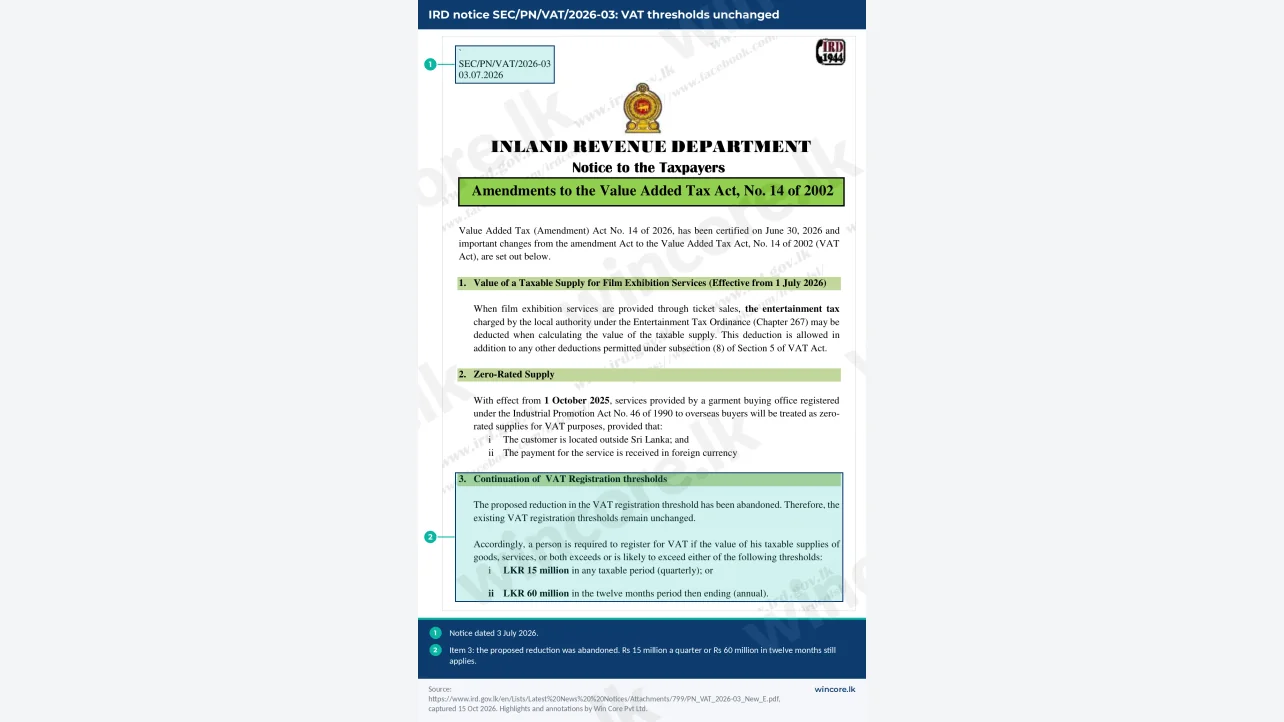
The VAT registration tests are Rs 15 million a quarter or Rs 60 million over 12 months. How the tests run, the 15 day rule and who must register.

Xero, QuickBooks, and Zoho Books are all available to Sri Lankan SMEs in 2026. Which platform fits your business, what does RAMIS integration look like, and should you switch from desktop?