
Companies (Amendment) Act No. 12 of 2025: what else changed
Beyond beneficial ownership, the 2025 amending Act ended bearer shares, moved allotments to working days and added a Rs 1 million general penalty.
On this page
Last verified against the primary sources on 21 October 2026.
The Companies (Amendment) Act No. 12 of 2025, certified on 4 August 2025, came into operation on 30 March 2026 under Gazette 2480/47. Beyond the beneficial ownership regime, it bans bearer shares, makes allotment run on twenty working days from payment, requires the share issue notice to name the allottees, adds special notice for removing a director, and imposes a general penalty of up to Rs 1 million where the Companies Act states none (section 513A).
Most amending Acts either change a policy or tidy a statute. This one does both, and the policy change, beneficial ownership, is the part with its own regulations and forms. This piece is about everything else, which a board is likely to meet more often.
Think of it as a software release: one headline feature (beneficial ownership), a security patch (the end of bearer shares), workflow changes to share issues, director removals and appeals, and 93 bug fixes in the Schedule [1]. A careful board reads the release notes, not only the headline.
Take a hypothetical farm machinery dealer in Kurunegala that is about to issue new shares to a local equipment leasing company. Which deadlines start running, and what must the notice to the Registrar now say? We work through it below.
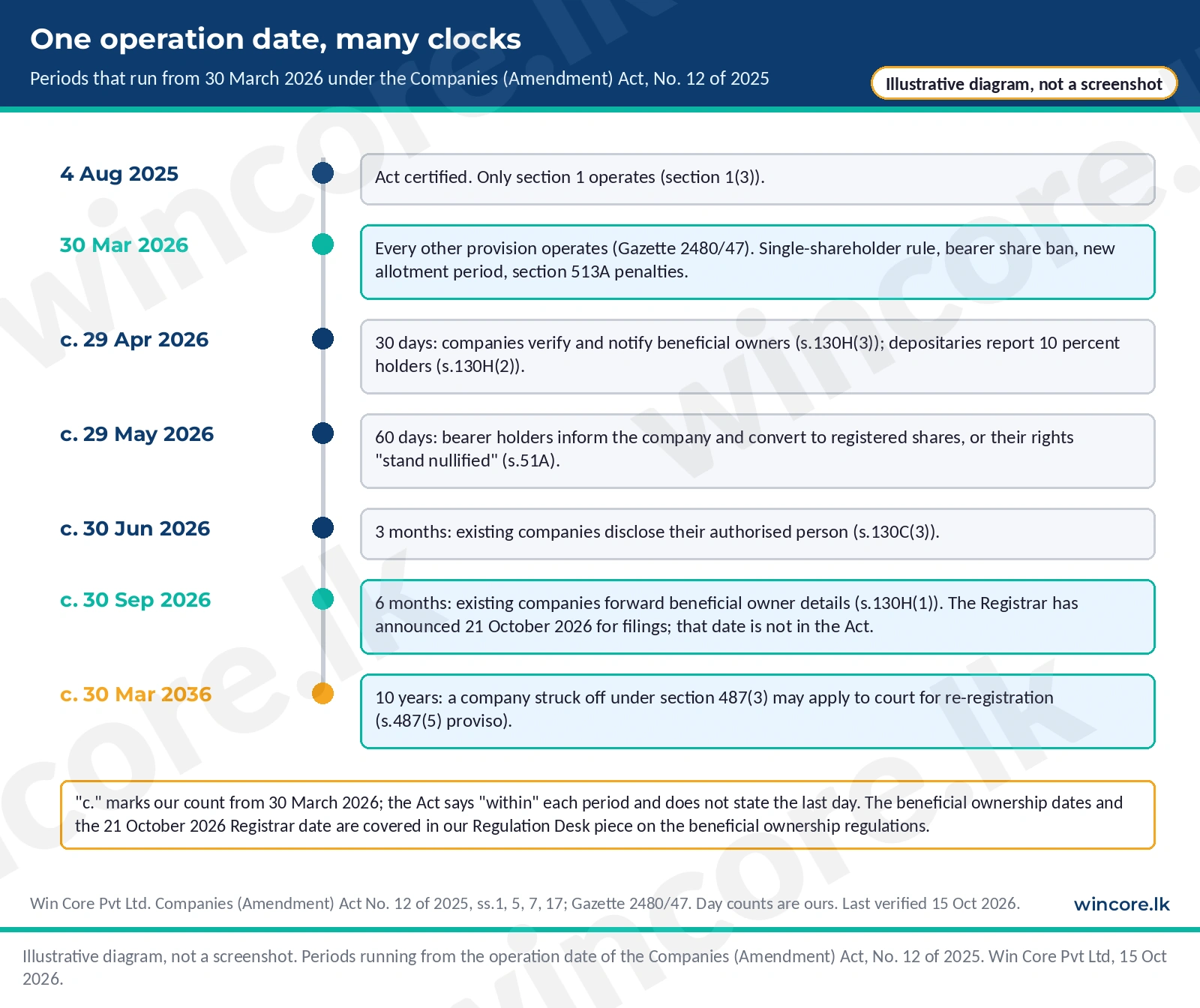
The Companies (Amendment) Act No. 12 of 2025 operates from 30 March 2026
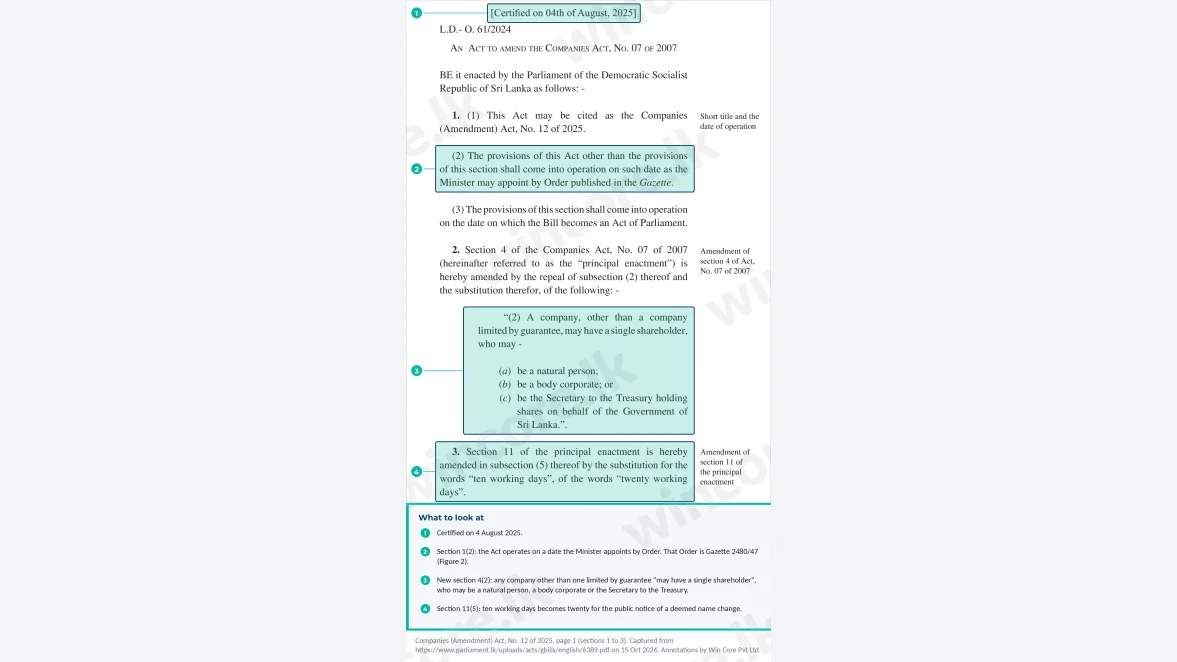
The Companies (Amendment) Act, No. 12 of 2025, "Certified on 04th of August, 2025", amends the Companies Act, No. 07 of 2007 [1]. It has 22 sections and a Schedule. Its centrepiece is a new division on beneficial ownership, sections 130A to 130J.
Who it affects
Every company registered under the 2007 Act or earlier company law, their directors and secretaries, shareholders, liquidators and administrators. Offshore and overseas companies registered under the Act are brought within the beneficial ownership sections by section 130A(10) [1].
When it took effect
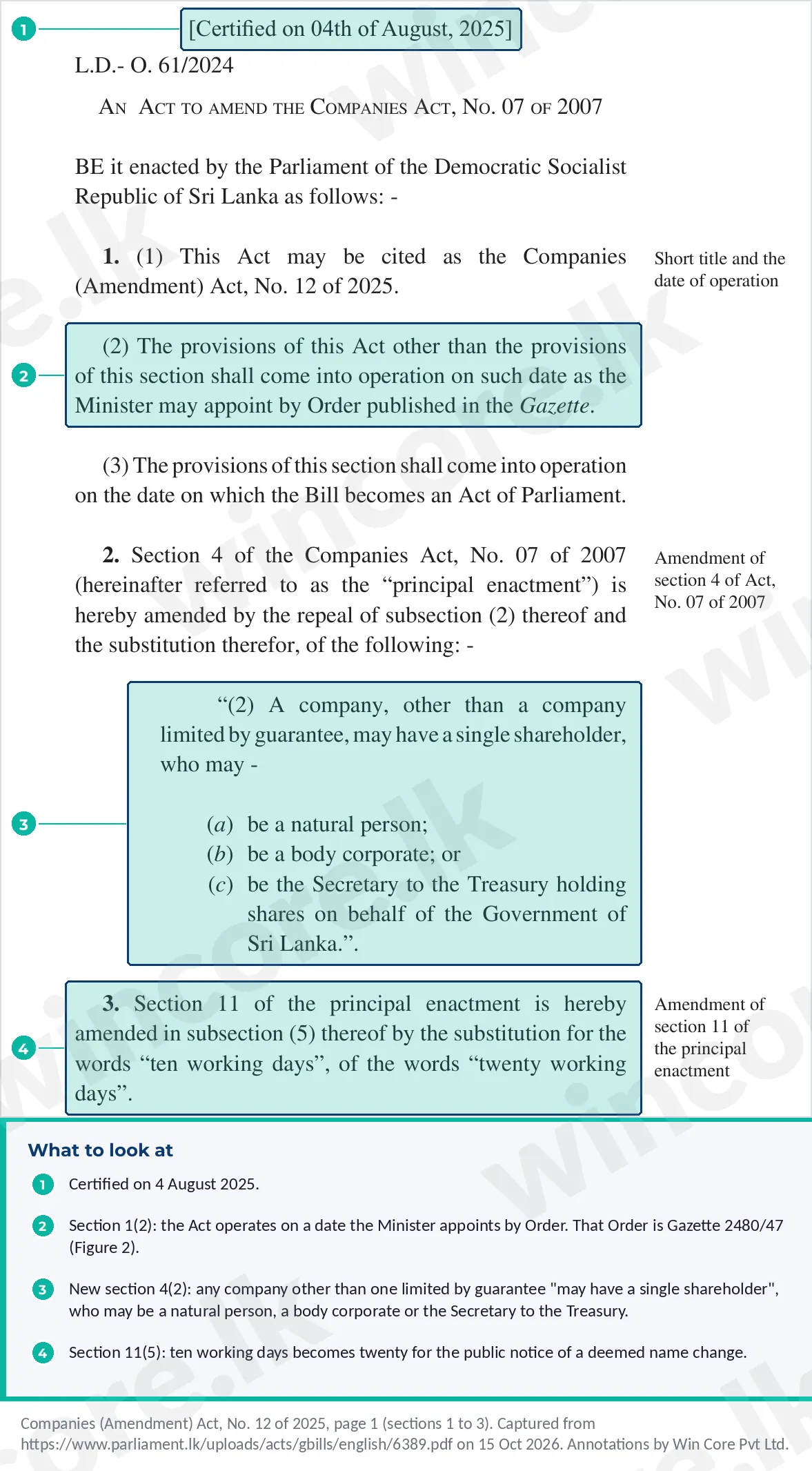
Section 1(2) says the provisions other than section 1 "shall come into operation on such date as the Minister may appoint by Order published in the Gazette" [1]. Extraordinary Gazette No. 2480/47 of 21 March 2026 appoints "March 30, 2026 as the date on which the provisions of the aforesaid Act, shall come into operation" [2]. One date, for the whole Act.
Beneficial ownership, briefly
Companies must record and file the natural persons who "ultimately" own or control "ten per cent or more" of them, or exercise "effective control through other means" (s.130J), keep a register, appoint a resident authorised person, and report changes within fourteen working days (s.130A(7)) [1]. Section 130F says a claim to beneficial ownership may not be recognised "for any lawful purpose" unless disclosed and registered. The forms, the October 2026 regulations that replaced the first set, and the Registrar's 21 October 2026 filing date, now passed, are covered in our piece on the beneficial ownership regulations 2026 and in our evergreen guide to the 10 percent beneficial ownership test. We do not repeat them here.
Bearer shares are banned, and unreported holdings are nullified
New section 51(1A) says a company "shall not issue a share warrant to bearer or bearer share irrespective of whether its articles of association purport to authorise it to do so" [1]. A bearer share is one "whose ownership is determined by the simple possession of a physically issued share certificate". Dematerialised or registered forms whose owners "can be identified" fall outside both definitions, and an instrument that only confers a right to subscribe is not a share warrant to bearer "unless and until the instrument is exercised or redeemed" [1].
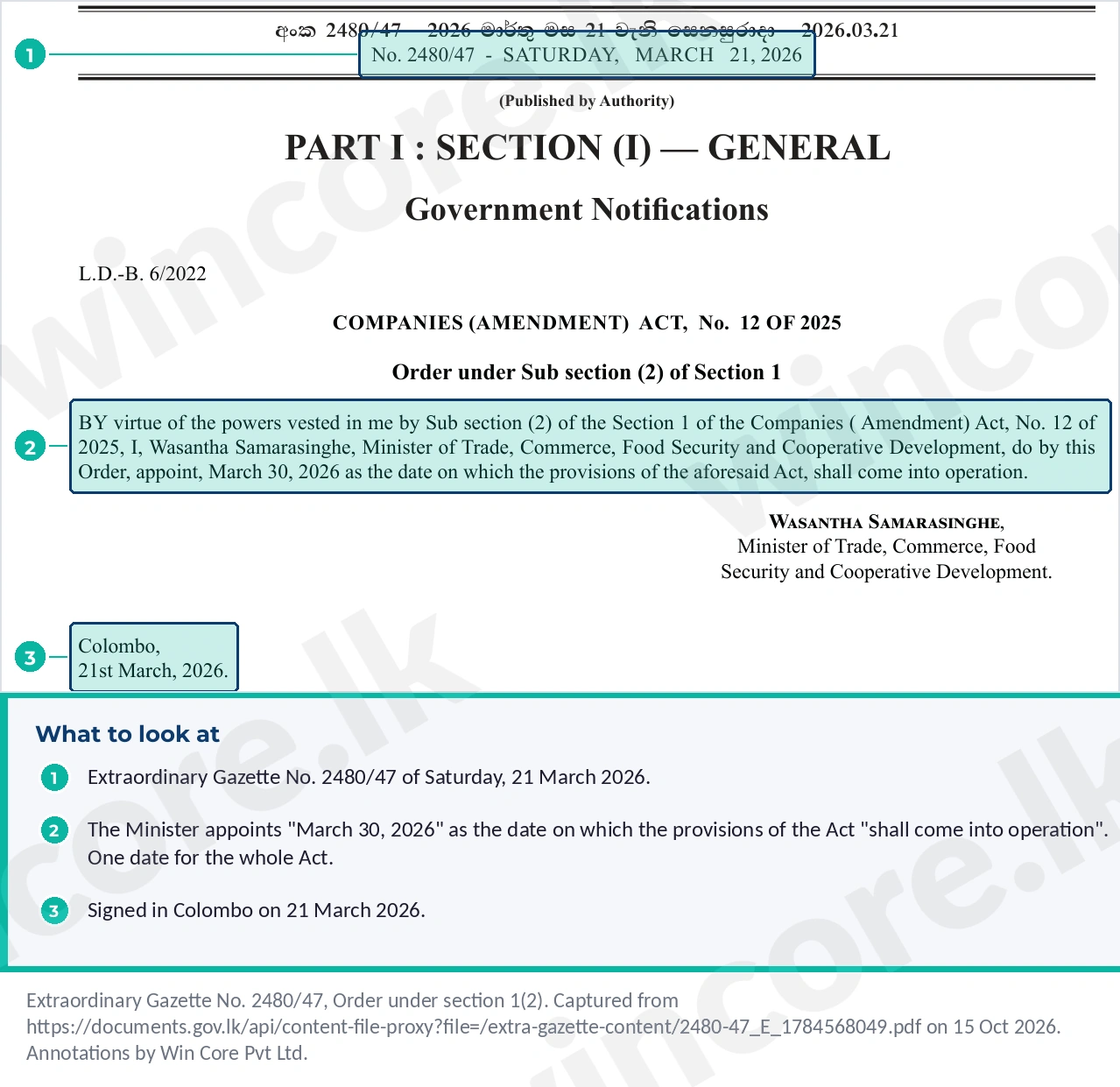
Existing holders had sixty days from 30 March 2026 to inform the company and give the secretary their name, address and contact details (s.51A(1)), and to convert to "shares in registerable form" (s.51A(4)). On our count that ran to about 29 May 2026. A holder who did not inform the company in time loses the rights: they "shall stand nullified at the end of such period" (s.51A(3)). The company must keep a register of the details it receives (s.51A(2)).
Share issues now run on working days and name the allottees
Single shareholder. The 2007 text said a company "shall have not less than two shareholders", then allowed a single shareholder who was an individual, a body corporate or the Secretary to the Treasury [3]. The new section 4(2) drops the two-shareholder sentence and says "A company, other than a company limited by guarantee, may have a single shareholder" [1]. On our reading of the 2007 text, single-shareholder companies were already possible; what is new is the express carve-out for guarantee companies, and the two-shareholder sentence is gone. Sections 270(c) and 272(1)(a)(i), which on our reading tied winding up to falling below that minimum, are repealed (sections 10 and 11 of the amending Act).
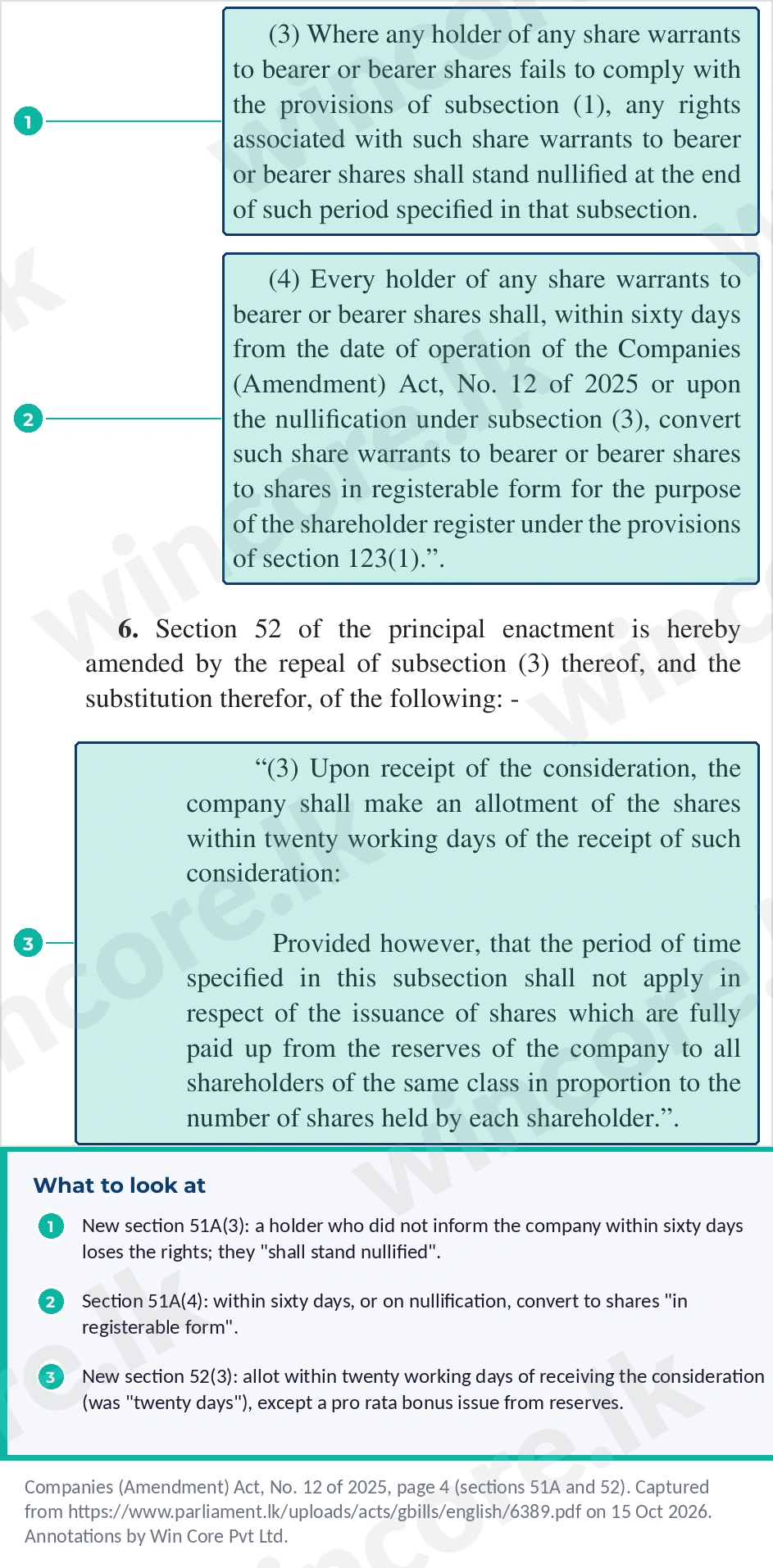
Allotment. The company must now allot "within twenty working days of the receipt of such consideration", not "within a period of twenty days" [1] [3]. The period does not apply to fully paid shares issued from reserves to all shareholders of a class pro rata.
Notice of a share issue. The section 51(4) notice, due within twenty working days of the issue, must now state the "number of shares issued and names of the persons to whom such shares are issued" [1]. For the whole process, see our guide to the issue of shares in Sri Lanka.
Distribution. A "distribution" excluded transfers of "the shares of a company". It now excludes only "the shares of the company" (section 529, as amended by section 20 of the amending Act) [1]. On our reading, handing shareholders the shares of another company, such as a subsidiary, is now a distribution, so section 56 applies to it: board authorisation, the solvency test and the auditors' certificate of solvency [3].
Name change notice. The public notice of a deemed name change moves from ten to twenty working days (s.11(5), section 3 of the amending Act, shown in Figure 1). If a name change is coming, our company name check is a first step.
For a share purchase, connect the statutory changes with the liabilities and records to inspect before an acquisition.
Director removal needs special notice, and Registrar and dispute rules moved
Removing a director. New section 206(2) requires "a special notice" to all shareholders where a company intends to remove a director and appoint a replacement. On our reading section 145 then applies: notice of the intention to move the resolution must reach the company "not less than twenty-eight days before" the meeting [3]. The secretary must send the director a copy. The director is "entitled to be heard at such meeting irrespective of whether or not such director is a shareholder", and may make written representations "within fourteen working days" (was fourteen days) [1].
Directors over seventy. A resolution keeping a director over seventy now stays "valid till the next annual general meeting subject to paragraph (b) of subsection (1) of section 133", not "valid only for one year from his appointment" (s.211(1)) [1].
Registrar. Section 484A lets a company that cannot meet a section 484 notice apply, with reasons, for an extension. Section 472(1) is re-enacted: an appeal from the Registrar lies to court "within fifteen working days" of notice, "or such further time as the court may allow". Section 471 creates Additional Registrars-General.
Struck-off companies. A company struck off under section 487(3) for failing to obtain a new number may, within ten years from 30 March 2026, apply to court, with the Attorney-General as a party, for re-registration and the return of property vested in the State, subject to third parties' rights acquired in good faith (s.17) [1].
Mediation. Under section 508(1), "A party to a dispute" may now request mediation before the Companies Disputes Board; before, the parties referred it "with the approval of the President" [1] [3].
Insolvency. An administrator who cannot meet a creditors' committee notice may apply to the Registrar for more time (s.424(2)). A liquidator must send the accounts and a return to the Registrar within one week of the final meetings, on pain of a fine up to Rs 50,000 (section 341(3), re-enacted).
Section 513A puts a penalty on every duty that lacked one
| Default | Section | Consequence |
|---|---|---|
| Share issue notice (with names) late | 2007 Act s.51(5), on our reading | Company and each officer in default: fine up to Rs 50,000 |
| Bearer holder does not inform the company in time | s.51A(3) | Rights "shall stand nullified" |
| Any breach with no punishment of its own (on our reading, for example issuing bearer shares or late allotment) | s.513A(1) | Fine up to Rs 1 million, up to six months' imprisonment, or both |
| Same, by a company | s.513A(2) | Each director, manager or secretary deemed guilty: fine up to Rs 500,000, up to one year, or both, unless no knowledge or due diligence |
| Company breaches s.130A(1), (3), (4), (7) or (8), or gives false BO details | s.130G(1), (2) | Fine up to Rs 1 million, up to ten years, or both; directors and officers deemed liable |
| Shareholder, secretary or authorised person breaches BO duties | s.130G(3) | Same as above |
| Transitional BO reporting missed | s.130H(4) | Fine up to Rs 50,000, up to six months, or both |
| Information still not given after a Registrar's extension | s.484A(2) | Company: fine up to Rs 500,000; each officer in default: up to Rs 200,000 |
| Liquidator's final return not sent | s.341(3) | Fine up to Rs 50,000 |
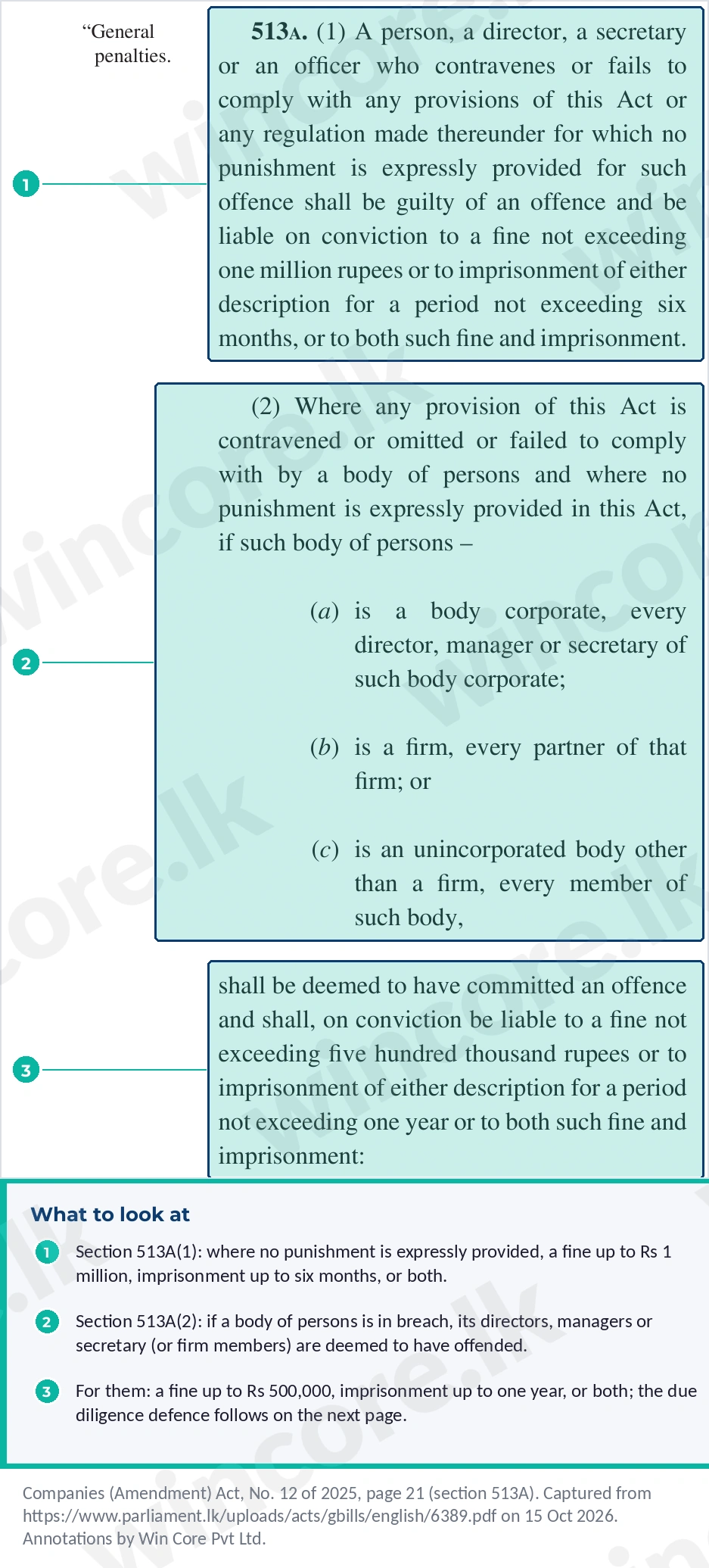
Section 513A matters more than its place in the Act suggests. The 2007 Act had many duties with no stated punishment, and in our reading of it as printed we found no general penalty section. Now every such duty carries one. For what the Companies Act asks of every director, see director duties.
The Schedule corrections change cross-references, not only spelling
The Schedule lists 93 corrections. Most are spelling: "shatres" to "shares", "pruposes" to "purposes", "Notwithstansing" to "Notwithstanding" [1]. A few are not cosmetic. Item 32 changes a cross-reference in section 168(2) from paragraphs "(b) to (j)" to "(d) to (j)". That section lists the subsidiary information a group must put in its annual report, so, on our reading of the 2007 text, paragraphs (b) and (c), the financial statements and audit report items, drop out of it [3]. Item 45 corrects a paragraph reference in section 248(2). Item 30 turns an "annual general meeting report" in section 167(1) into an "annual report". Nobody will be prosecuted over a typo, but a cross-reference decides which rule applies. Which brings us back to the release notes: the small entries are the ones that break a working process.
Common misreadings
- "Single-shareholder companies are new." No. The 2007 Act already allowed them; the change is the guarantee company carve-out [3].
- "Bearer holders still have time." The sixty days ran from 30 March 2026 [1] [2].
- "Twenty days for allotment is unchanged." It is now twenty working days, which is longer.
- "Appeals from the Registrar got a new deadline." Section 472(1), as re-enacted, says fifteen working days.
- "The Act operated when certified." Only section 1 did. The rest waited for 30 March 2026.
- "No penalty is stated, so nothing happens." Section 513A now supplies one.
Worked example: a Kurunegala machinery dealer issuing shares on 2 November 2026
Back to the hypothetical Kurunegala machinery dealer. The investor pays for its shares on Monday 2 November 2026.
- Allotment within twenty working days of that payment (s.52(3)).
- Section 51(4) notice to the Registrar within twenty working days of the issue, now naming the investor.
- Shareholder's duty: the investor gives the company its beneficial owner details within ten working days of subscribing (s.130A(2)).
- Company's duty: notify the Registrar within twenty working days of the issue (s.130A(1)), or fourteen working days after it learns of a change in beneficial ownership (s.130A(7)).
If the investor ends up with 10 percent or more, the natural persons who ultimately own or control that stake are beneficial owners (s.130J). On our reading of section 51(5), missing the section 51(4) notice risks up to Rs 50,000 for the company and each officer in default. For setting up a new company instead, see our guide on how to register a company in Sri Lanka.
What this means for you
If you run a company, the headline is beneficial ownership, but the day-to-day changes are in share issues, director removals and penalties. Allotments now run on working days, share issue notices name names, bearer shares are finished, and almost every duty now carries a fine. If you are planning a share issue or a board change, check the new procedure first, test any distribution of shares in another company against section 56, and put age-seventy resolutions on each AGM agenda. Our company secretarial services team keeps share registers, minutes and filings, and our registration team handles new incorporations. For the step by step on a contested removal, see our guide to removing a director; for a change of secretary, see how to change your company secretary.
Checklist: documents needed
- Share register, including any record of bearer instruments and section 51A conversions
- Board resolution and payment evidence for each share issue, with the allotment date
- Section 51(4) notice naming each allottee
- Shareholders' beneficial owner details received under section 130A(2)
- Special notice, the director's written representation and the meeting minutes for any removal
- AGM resolutions for any director over seventy
- Annual filing diary mapped to the penalty for each filing (our annual filing checklist helps)
Open points we have not settled
- Guarantee companies. The new section 4(2) excludes them from the single-shareholder permission and drops the old minimum of two. Whether a guarantee company now needs two members, and what follows if it falls to one, the Act does not say. Until the Registrar or a court settles it, keep two.
- Removal without a replacement. New section 206(2) speaks of a company that "intends to remove a director and appoint a new director in the place of the director so removed". Whether special notice applies to a removal with no replacement is unclear. We would give it anyway.
- Quorum proviso. The old section 341(3) had a proviso for meetings without a quorum, on our reading. The substituted text omits it. Whether that was intended is not stated.
- Last days. The Act counts "within" sixty days, three months and six months from 30 March 2026; our dates are counts, not official dates.
We read the Act and Gazette 2480/47 again on 21 October 2026. We have not seen the Registrar's updated share issue forms. A company with a live dispute or a guarantee structure will want its own lawyer's view. Read the release notes, then update the routines.
FAQ
When did the Companies (Amendment) Act No. 12 of 2025 come into force?
On 30 March 2026, for everything except section 1. Section 1(2) left the operation date to a Ministerial Order, and Gazette 2480/47 of 21 March 2026 appointed 30 March 2026. Section 1 itself, the short title and operation clause, took effect when the Bill became an Act, certified on 4 August 2025 [1] [2].
Can a company limited by guarantee have a single member now?
The Act does not say so, and we would keep two. The new section 4(2) allows a single shareholder for any company "other than a company limited by guarantee", and the old two-shareholder sentence is gone. Nothing states a new minimum for guarantee companies, so the safe course is two members until the Registrar or a court settles it [1]. For a company limited by guarantee, see guarantee company registration.
What happened to bearer shares that were not reported in time?
The rights attached to them are nullified. Holders had sixty days from 30 March 2026 to inform the company and give the secretary their details, which on our count ran to about 29 May 2026. Section 51A(3) says the rights "shall stand nullified" at the end of that period, and section 51A(4) still requires conversion to registered shares [1].
How long does a company have to allot shares after payment?
Twenty working days from receiving the consideration, under the new section 52(3). The period does not apply to fully paid shares issued from reserves to all shareholders of a class in proportion to their holdings. The section 51(4) notice to the Registrar must now also give the names of the persons to whom the shares are issued [1].
What is the penalty where the Companies Act states none?
Up to Rs 1 million, up to six months' imprisonment, or both, under section 513A(1). Where a company is in breach, section 513A(2) deems each director, manager or secretary guilty, with a fine up to Rs 500,000, up to one year, or both, unless they prove no knowledge or all due diligence [1].
Talk to us. If you would like us to review your share register, board procedures or filings against the amended Act, book a consultation at our contact page.
WinCore Pvt Ltd
This article is general information on the law as at 21 October 2026 and is not advice on your specific position.
References
- Parliament of Sri Lanka. Companies (Amendment) Act, No. 12 of 2025 (certified 4 August 2025), ss.1 to 22 and Schedule items 30, 32 and 45. https://www.parliament.lk/uploads/acts/gbills/english/6389.pdf . Primary. Accessed 21 October 2026.
- Minister of Trade, Commerce, Food Security and Co-operative Development. Order under section 1(2) of the Companies (Amendment) Act, No. 12 of 2025, Gazette Extraordinary No. 2480/47 (21 March 2026). https://documents.gov.lk/api/content-file-proxy?file=/extra-gazette-content/2480-47_E_1784568049.pdf . Primary. Accessed 21 October 2026 (also at documents.gov.lk/view/extra-gazettes/2026/3/2480-47_E.pdf).
- Parliament of Sri Lanka. Companies Act, No. 7 of 2007, ss.4(2), 51(4) and (5), 52(3), 56, 145, 168, 206, 211, 270, 272, 341, 472, 487, 508 and 529. http://www.drc.gov.lk/en/wp-content/uploads/2018/04/Act-7-of-2007-English.pdf . Primary. Accessed 15 October 2026 (not re-read on 21 October 2026).
Put these insights to work
WinCore specialists can review your current workflow, document gaps, and build a practical 90-day action plan.
Book a free consultationContinue reading
Explore more WinCore analysis to keep your finance, tax, and compliance roadmap moving.
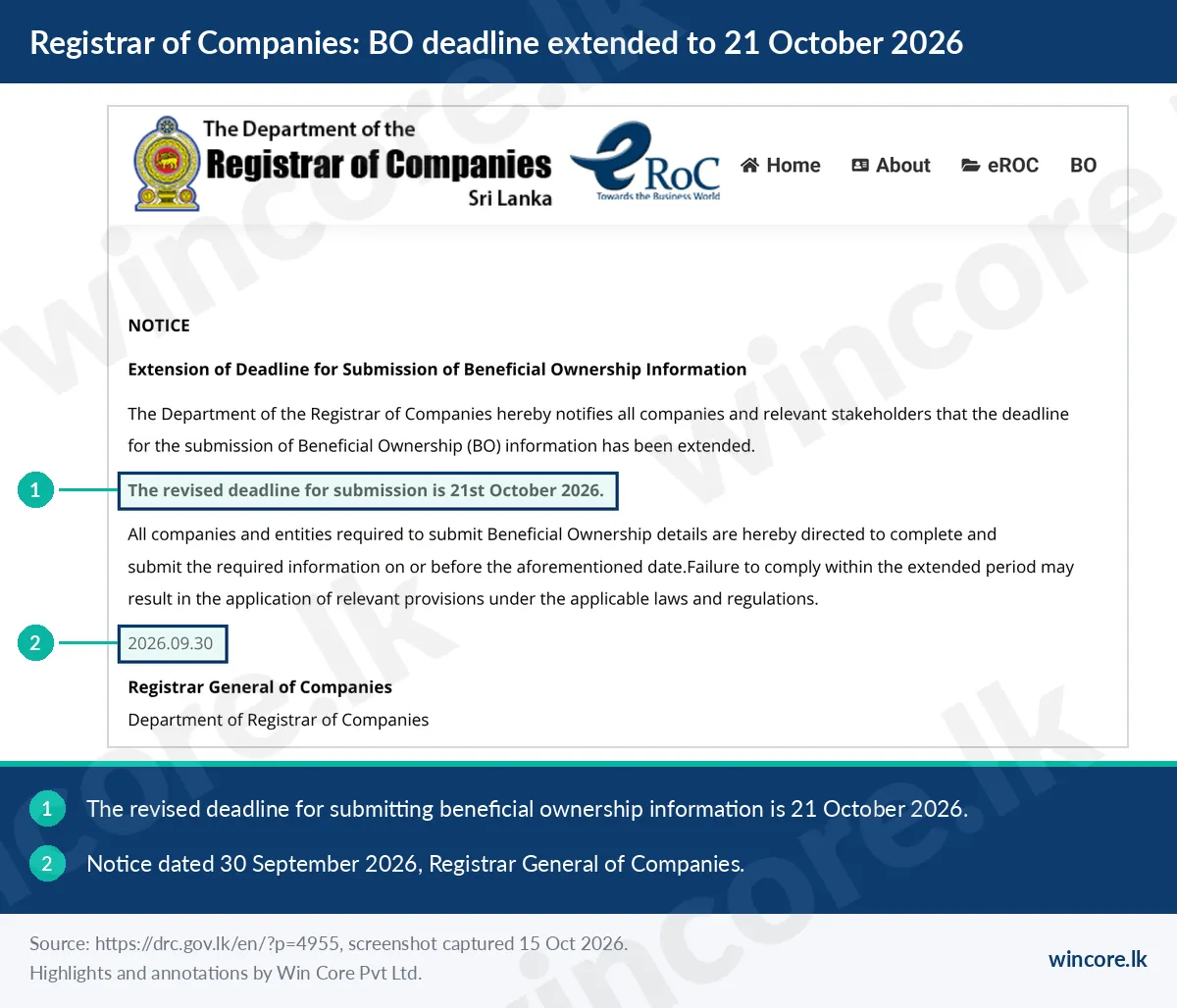
Who counts as a beneficial owner at 10 percent, the forms in the October 2026 regulations, and what existing companies face after the 21 October deadline.
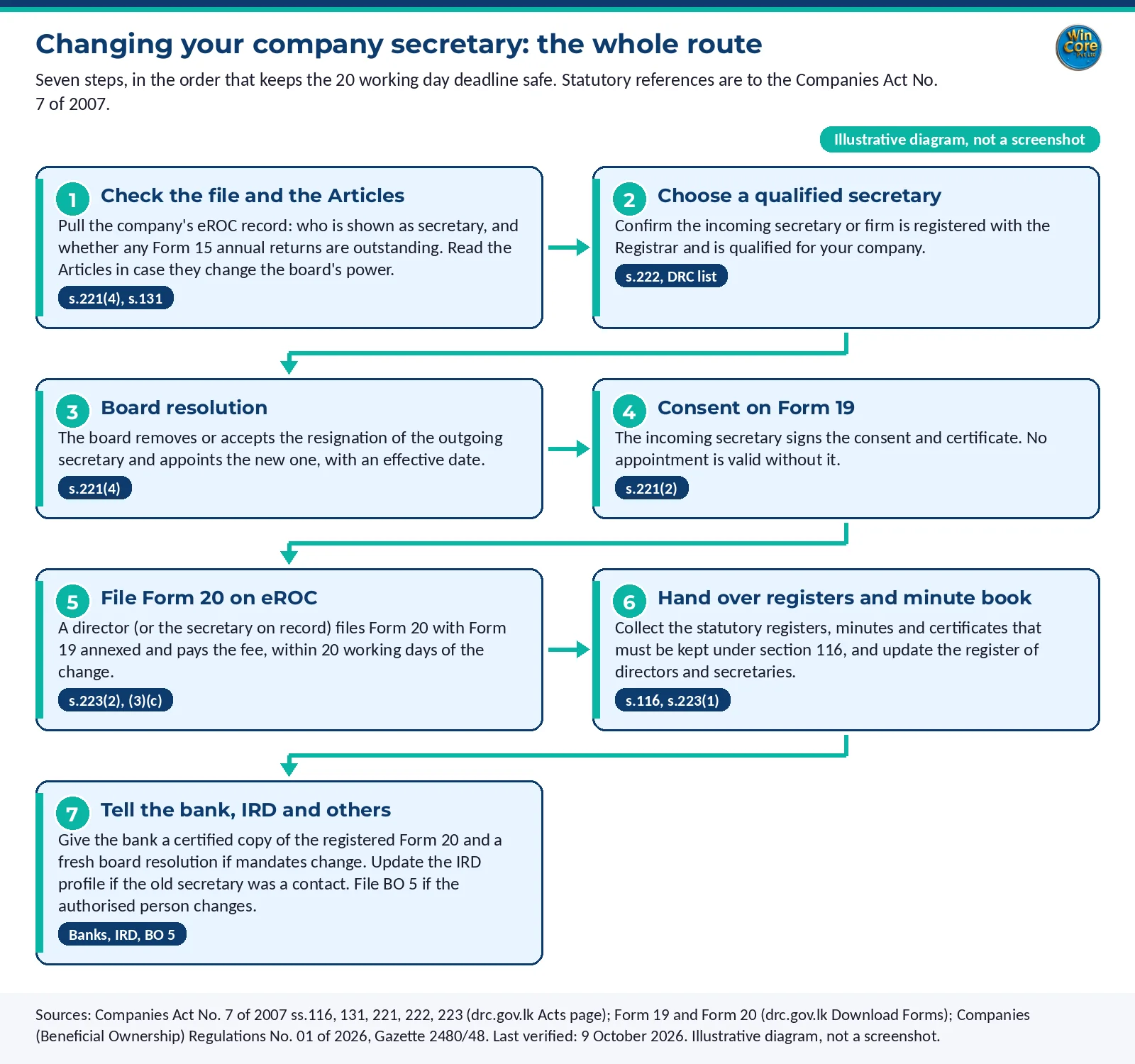
Changing a company secretary step by step: the board resolution, Form 19 consent, Form 20 within 20 working days, the fee and the handover.
Registering a private limited company in Sri Lanka in 2026: structure, name approval, the eROC filing with BO 1 and BO 5, the TIN and the first year.