
Buy an existing company in Sri Lanka or register a new one
Buying a company's shares brings its whole history with it. What the transfer needs, what happens to tax losses, and when a new company is simpler.
On this page
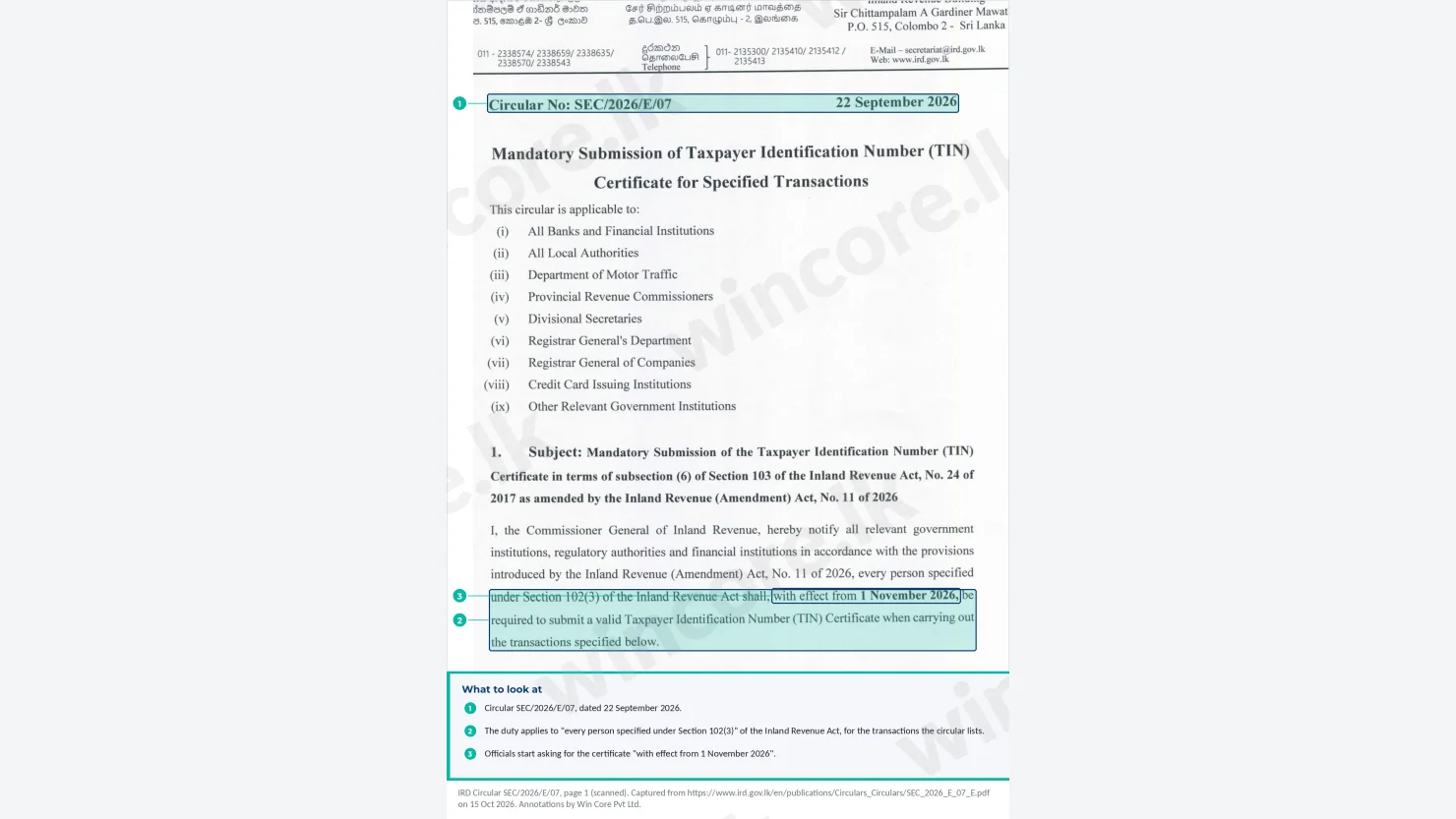
To buy an existing company in Sri Lanka you buy its shares, and the company keeps everything it already has: assets, contracts, debts, tax history and past defaults. The company may register the transfer only when "a proper instrument of transfer has been delivered" (Companies Act No. 7 of 2007, s.73). From 1 November 2026 each individual transferor and transferee must show a TIN certificate (Inland Revenue Act s.103(6)(b); IRD Circular SEC/2026/E/07). And where underlying ownership changes by more than fifty percent, losses from before the change can no longer be deducted unless the company carries on the same business for two years (s.64) [1] [5] [6] [7].
A company offered for sale can look faster than incorporating a new one, and some buyers are drawn by its history: an older incorporation date, a bank relationship, contracts, or tax losses. This article sets out what a takeover involves under the Companies Act and the tax law, what comes with the company, and when a new company is simpler.
When you buy an existing company in Sri Lanka, its history comes with it
When you take over a company, you buy its shares from the shareholders. The company itself does not change. It keeps its assets, contracts, debts, tax history and any past defaults. On our reading, that is the main difference from incorporating a new company, which starts with nothing, good or bad.
The seller, not the buyer, is taxed on any gain on unlisted shares; our capital gains tax guide covers that side.
The share transfer needs a proper instrument and a decision within two months
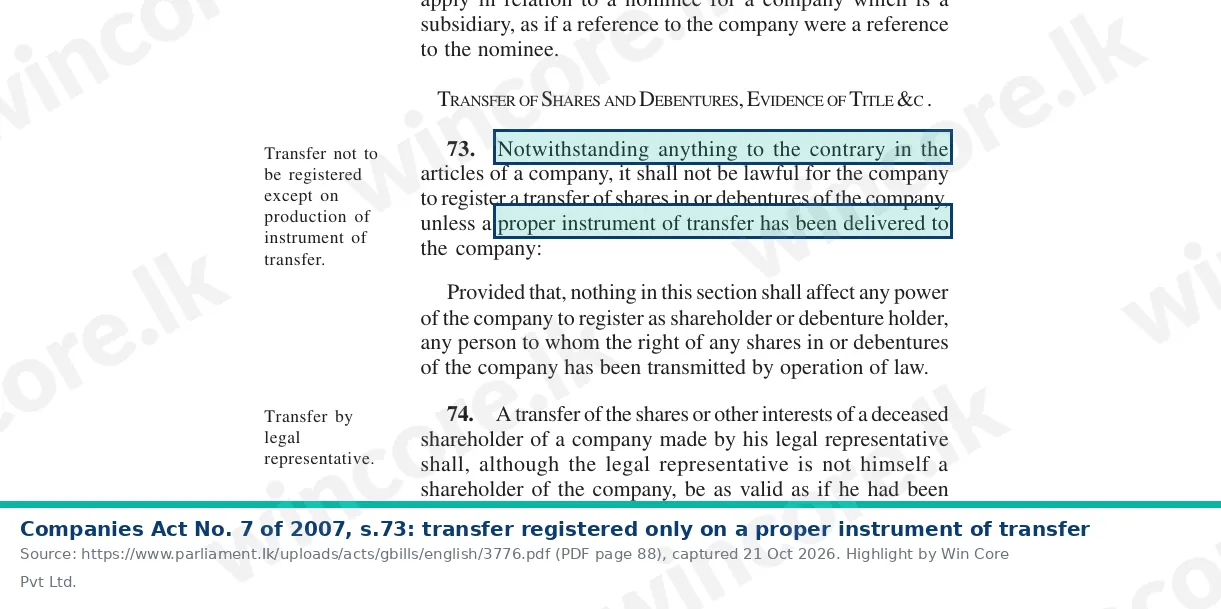
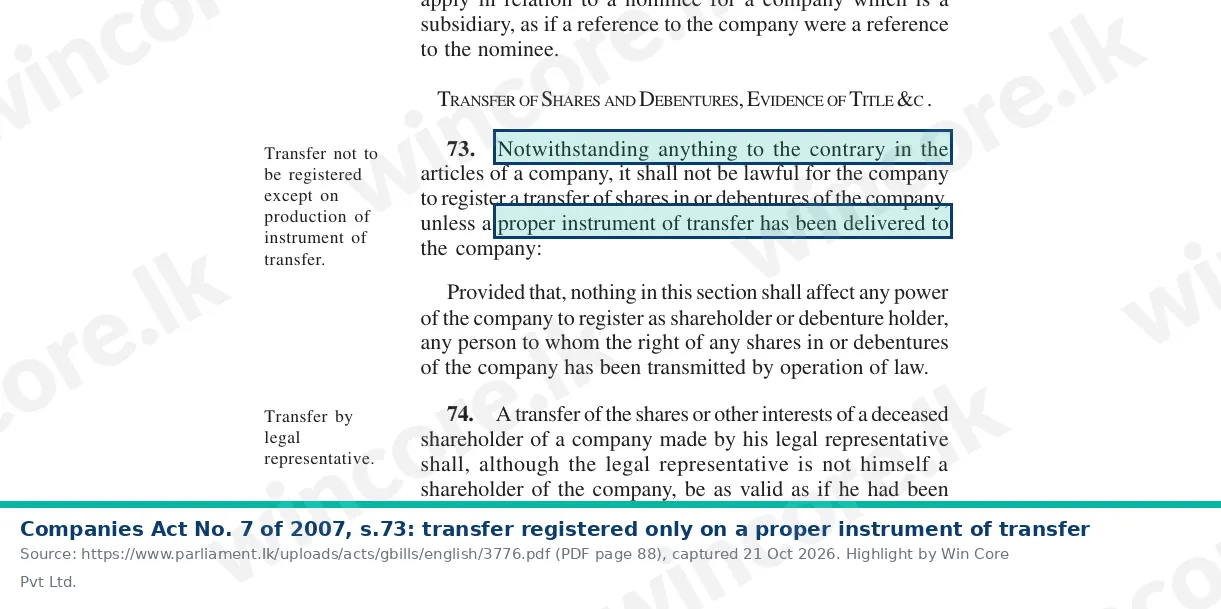
Section 73 of the Companies Act: "Notwithstanding anything to the contrary in the articles of a company, it shall not be lawful for the company to register a transfer of shares in or debentures of the company, unless a proper instrument of transfer has been delivered to the company" [1]. The proviso keeps the company's power to register a person to whom shares have been "transmitted by operation of law", for example on death [1].
Section 75 lets the seller apply for the entry: the company "shall enter in its share register the name of the transferee in the same manner and subject to the same conditions, as if the application for the entry were made by the transferee" [1].
Refusal. Under s.76(1), where a company refuses to register a transfer, it "shall within two months from the date on which the transfer was lodged with the company, send to the transferee a notice of such refusal". Under s.76(2), if it does not, the company and every officer in default are each liable on conviction to a fine not exceeding Rs 50,000 [1].
Private company articles often restrict transfers, for example with pre-emption rights or board approval. That is common practice, not a rule of the Act. Read the articles before agreeing a price.
TIN certificates from 1 November 2026. Section 103(6)(b), inserted by the Inland Revenue (Amendment) Act No. 11 of 2026, lists "to transfer shares of a company incorporated in Sri Lanka, by the transferee and transferor" among the purposes for which a TIN certificate must be submitted, with the Registrar-General of Companies as the official responsible [6]. The IRD's Circular SEC/2026/E/07 applies the requirement from 1 November 2026 and exempts, among others, individuals under eighteen, non-resident individuals and any entity other than an individual [7]. So a company buying shares does not show one, but every individual on either side does. Our article on the TIN certificate circular SEC/2026/E/07 explains the two dates.
A share certificate on transfer has been exempt from stamp duty since 2016
Our article on the Stamp Duty Act No. 12 of 2006 covers the Act generally. For a share transfer, four texts matter:
- Section 4(f) lists as a specified instrument "a share certificate on new or additional issue or on transfer or assignment"; s.6(b) makes duty payable, unless the parties agree otherwise, "in the case of a transfer or assignment of any share, by the transferee or assignee of such share" [2].
- The rate Order in Gazette 1465/19 of 5 October 2006 (item 6) charged duty on "Any share certificate issued consequent to the issue, transfer or assignment of any number of shares of any company", per Rs 1,000 of the aggregate value [2].
- Gazette 1947/46 of 1 January 2016 added item 35 to the exemption Order (Gazette 1465/20): "Any share certificate issued consequent to the issue, transfer or assignment of any number of shares of any company" [3].
- Section 8(1) still carries a proviso that "share transfers executed in Sri Lanka shall be stamped within one month from the execution of the same" [2].
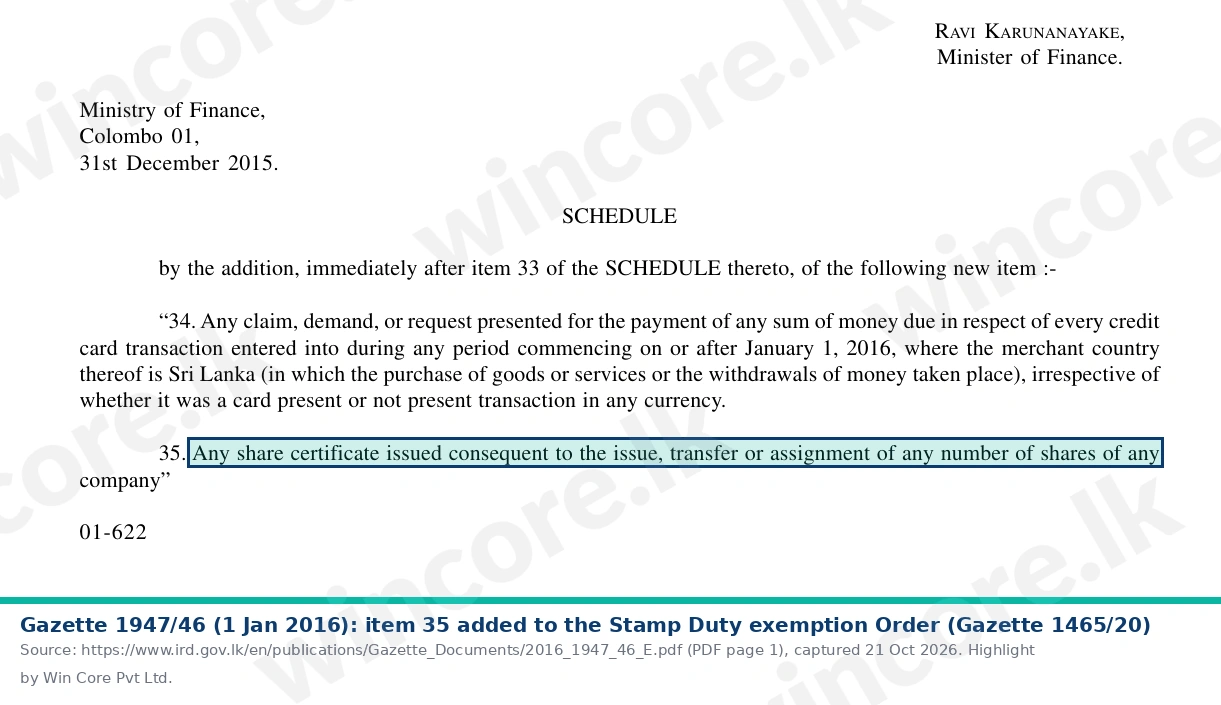
On our reading, item 35 uses the same words as the charging item, so a share certificate issued on a transfer has been exempt since 2016. The later exemption Orders we checked for our Stamp Duty Act article (Gazettes 2149/18, 2312/73 and 2477/22) add items 36 to 38 and do not touch item 35. Two points stay open: how the s.8(1) proviso on share transfers works after the exemption, and whether any other law charges duty on the instrument of transfer itself. We have not found one.
Directors, secretary and beneficial owners must be refiled within set periods
A takeover usually changes the board. Outgoing directors resign by written notice delivered to the registered office (s.207(2)) or are removed; see our guide to removing a director. Under s.223(2) and (3), notice of a change in the directors or the secretary goes to the Registrar "within twenty working days" of the change, with each new director's consent and certificate annexed. Failure is an offence: a fine not exceeding Rs 100,000 for the company and Rs 50,000 for each officer in default (s.223(4)) [1]. A change of secretary follows the same rule; our guide to changing your company secretary covers the forms.
A change of shareholders can change who the company's beneficial owners are. Our article on the beneficial ownership regulations in Gazette 2509/67 covers what must be filed and when, so we do not repeat the deadlines here. Our company secretarial services prepare the transfer, the board papers and these filings.
Tax losses usually stop on a change of more than fifty percent
Losses are often part of the attraction. The rules work against that.
Section 19(1)(b) of the Inland Revenue Act No. 24 of 2017 lets a person deduct "an unrelieved loss of the person for any of the previous six years of assessment from the business or any other business" [5].
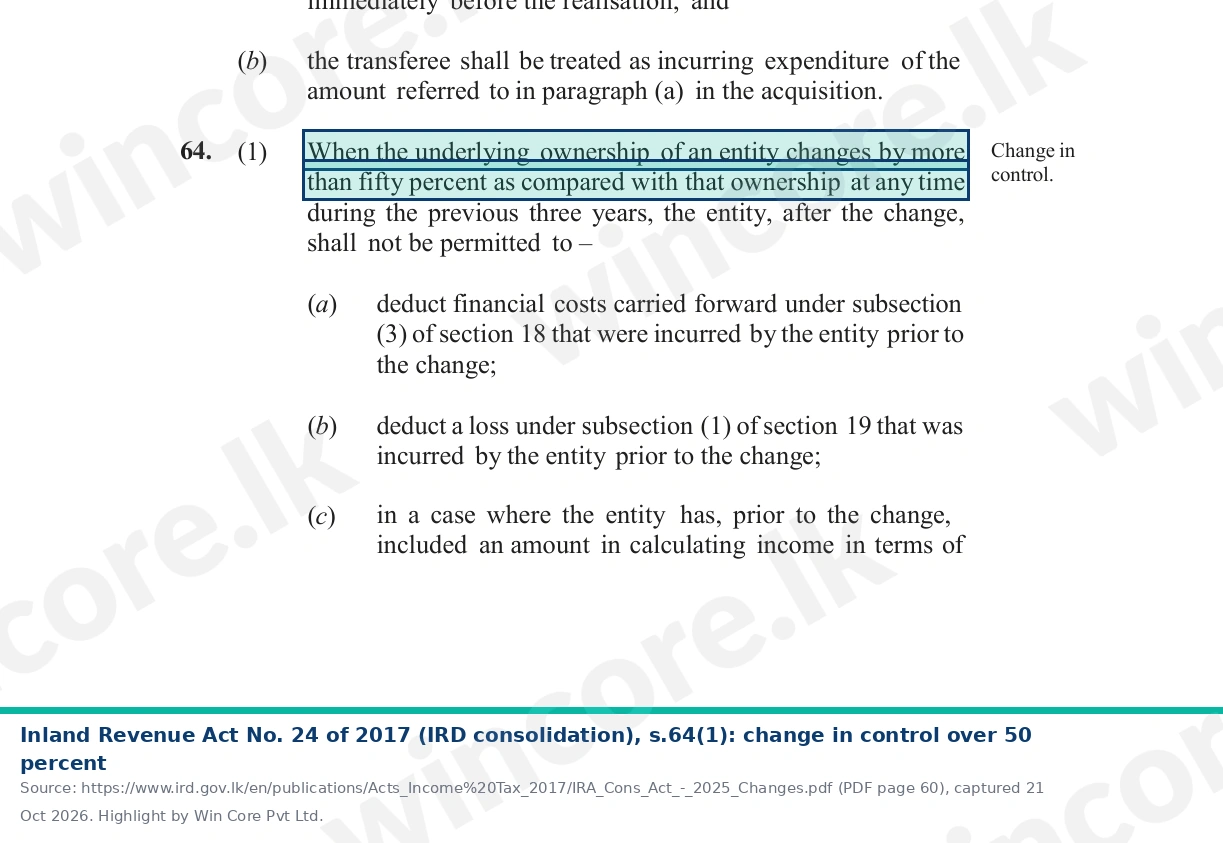
The continuity rule is s.64(1): "When the underlying ownership of an entity changes by more than fifty percent as compared with that ownership at any time during the previous three years, the entity, after the change, shall not be permitted to" (a) deduct financial costs carried forward under s.18(3) that were incurred before the change, or (b) "deduct a loss under subsection (1) of section 19 that was incurred by the entity prior to the change" [5]. Paragraphs (c) and (d) also block certain deductions under s.24 and the carry-back of a later loss under s.25(5) to a year before the change.
Under s.64(2), a year in which the change happens is split, and the parts "before and after the change shall be treated as separate years of assessment". The exception is s.64(3): "This section shall not apply to a partnership or company that conducts the same business after a change as it conducted before the change for a period of two years after the change" [5].
"Underlying ownership" of an entity "means membership interests owned in the entity, directly or indirectly through one or more interposed entities, by individuals or by entities in which no person has a membership interest" (s.195) [5]. On our reading, a change through a holding company counts, and the comparison is with ownership at any time in the previous three years, so a sale in two steps can still cross the line.
Neither s.19 nor s.64 is amended by the Inland Revenue (Amendment) Act No. 11 of 2026; we checked its list of amended sections [6]. "The same business" is not defined in the sections we read. Whether a change of products, customers or scale ends the exception is open; we read no ruling or judgment on it.
A hypothetical, with our arithmetic
This is hypothetical. A company that installs solar panels has Rs 4,200,000 of unrelieved losses from its last two years of assessment.
- A buyer acquires 30 percent of the shares, and nobody else's holding changes. The change is not more than fifty percent, so on our reading s.64 does not apply and the losses stay deductible within the six-year window of s.19(1).
- A buyer acquires 60 percent and keeps installing solar panels for two years. s.64(3) applies, and the losses stay deductible.
- A buyer acquires 60 percent and moves the company into hardware wholesale within a year. On our reading s.64(1)(b) applies, and none of the Rs 4,200,000 can be deducted after the change.
Our arithmetic: in the third case the whole Rs 4,200,000 of deductions is lost. Price any "loss value" on the assumption that it may disappear.
Due diligence decides whether a takeover is worth it
None of this list is set by statute; it is what we check before a takeover.
- Registrar file. Inspect the file (item 9) and the register of charges (item 11); each is Rs 1,300 excluding VAT under Gazette 2496/03 [4].
- Annual returns and AGMs. Check that they are filed. A company that is struck off, or being struck off under s.394, is a separate problem.
- Registers and minute books. Confirm they exist and match the Registrar's file.
- Tax. Returns filed, assessments, unpaid VAT, APIT and WHT, and the losses as actually assessed.
- Liabilities. Loans, guarantees, leases, employee dues (EPF, ETF, gratuity) and litigation.
- Contracts and licences. Change-of-control clauses, and licences that do not survive a change of owner.
- Bank. Expect the bank to treat new directors and owners as a change for its customer checks.
- Warranties and indemnities from the seller in the share purchase agreement.
Our article on the investor due diligence financial packet lists the accounting records a buyer should ask to see. Our income tax compliance services cover the tax review and TIN registration for individuals who need a certificate before the transfer.
Before accepting the asking price, compare earnings, asset and cash-flow valuation approaches with the liabilities found during due diligence.
Buy the company or register a new one: the comparison
| Factor | Buy an existing company | Register a new company |
|---|---|---|
| Past liabilities | Come with the company | None |
| Tax losses | Subject to s.64 | None |
| Filings | Transfer, TIN certificates, board and beneficial ownership changes | Incorporation and beneficial ownership forms |
| Contracts and licences | May continue, subject to their terms | Must be obtained |
| Due diligence | Significant | Minimal |
On our reading, a takeover is worth it where the company holds something you cannot recreate quickly: a licence, a contract, property, or a real trading business. Where the attraction is only an older incorporation date, a new company avoids inherited risk. Our company registration services handle the new-company route; run a company name check first.
What this means for you
- You buy shares; the company keeps all its history.
- Get a proper instrument of transfer, and check the articles for restrictions.
- From 1 November 2026, every individual transferor and transferee needs a TIN certificate.
- On our reading, share certificates on transfer have been exempt from stamp duty since Gazette 1947/46.
- File director, secretary and beneficial ownership changes on time.
- Expect pre-change losses to be lost on a change of more than fifty percent, unless the same business continues for two years.
Checklist: documents needed
- Share purchase agreement and instrument of transfer
- Articles of association, checked for transfer restrictions
- TIN certificate or IRD verification printout for each individual transferor and transferee
- Share register and new share certificates
- Resignations, consents and certificates of directors and secretary, with the Registrar notice within twenty working days
- Beneficial ownership filing
- Registrar file inspection and register of charges search
- Tax returns, assessments and loss schedules
FAQ
Is a company with tax losses worth buying for the losses?
Only if it will carry on the same business for two years after the change. Section 64(1) blocks pre-change losses when underlying ownership changes by more than fifty percent, and s.64(3) lifts that only for a company that "conducts the same business" for two years. A company with little real business may have nothing to continue, so value the losses at nil unless you can show continuity.
Does an older incorporation date matter?
The Companies Act gives an older incorporation date no special status. Some banks and tender documents ask for years of trading, which is practice, not law, and an old date with no trading record rarely satisfies them. Weigh that against the liabilities, filing gaps and defaults an older company may carry, which a new company does not have.
Who pays stamp duty on a share transfer in Sri Lanka?
On our reading, nobody pays on the share certificate, because item 35 of the exemption Order has exempted it since 1 January 2016. Before that, s.6(b) of the Stamp Duty Act made the transferee pay unless the parties agreed otherwise. How the s.8(1) proviso on stamping share transfers within one month works after the exemption is still open.
Do both buyer and seller need a TIN certificate?
Yes, where they are individuals. From 1 November 2026, s.103(6)(b) of the Inland Revenue Act and Circular SEC/2026/E/07 require a TIN certificate "by the transferee and transferor" for a share transfer. Companies and other entities are exempt, as are non-resident individuals and those under eighteen. An IRD e-services verification printout with the NIC number is accepted instead of the certificate.
Can the seller's debts be left behind?
Not in a share purchase. The company is the debtor, and it stays the debtor after its shares change hands. Protect the buyer with warranties and indemnities in the share purchase agreement, a price adjustment or retention for liabilities found later, and a clear list of known debts. If you want only the assets, buying them is a different transaction.
Open points
- How the s.8(1) proviso on stamping share transfers works after the item 35 exemption.
- Whether any other law charges duty on the instrument of transfer itself.
- What counts as "the same business" under s.64(3).
- Whether an exemption Order made after Gazette 2477/22 affects item 35.
Last verified: 22 October 2026. We re-read Companies Act ss.73 to 76, 207 and 223 on the parliament.lk text; Inland Revenue Act ss.19, 64 and 195 in the IRD consolidation (s.64(1) from the page image, as the text layer drops it); the amended-section list, s.103(6) and s.43 of Act No. 11 of 2026; Circular SEC/2026/E/07; the Stamp Duty Act consolidation; Gazette 1947/46; and Gazette 2496/03.
The short version.
- Buying a company means buying its shares and all its history.
- A transfer needs a proper instrument (s.73); a refusal must be notified within two months (s.76).
- From 1 November 2026 individual transferors and transferees need a TIN certificate.
- Share certificates on transfer are exempt from stamp duty under item 35 (Gazette 1947/46), on our reading.
- A change of more than fifty percent in underlying ownership blocks pre-change losses (s.64(1)), unless the same business continues for two years (s.64(3)).
- If you only want a company, a new one is usually simpler.
Talk to us. If you are weighing an existing company against a new one and want the transfer, the filings and the tax position checked first, our contact page.
WinCore Pvt Ltd
References
- Parliament of Sri Lanka. Companies Act, No. 7 of 2007, ss.73, 75, 76, 207 and 223. https://www.parliament.lk/uploads/acts/gbills/english/3776.pdf . Primary. Accessed 22 October 2026.
- Inland Revenue Department. Stamp Duty (Special Provisions) Act, No. 12 of 2006 (consolidation with Act No. 10 of 2008, "for the purpose of convenient reference only"), ss.4, 6 and 8, with Gazettes 1465/19 and 1465/20. https://www.ird.gov.lk/en/Type%20of%20Taxes/Stamp%20Duty_Acts/SDActNo.12%5BE%5D2006ConsolFinal.pdf . Primary (IRD consolidation). Accessed 22 October 2026.
- Gazette Extraordinary No. 1947/46 (1 January 2016), Order under s.5, items 34 and 35. https://www.ird.gov.lk/en/publications/Gazette_Documents/2016_1947_46_E.pdf . Primary. Accessed 22 October 2026.
- Gazette Extraordinary No. 2496/03 (6 July 2026), Companies (Fees) Orders, items 9 and 11. https://documents.gov.lk/api/content-file-proxy?file=/extra-gazette-content/2496-03_E_1786417202.pdf . Primary. Accessed 22 October 2026.
- Inland Revenue Department. Inland Revenue Act, No. 24 of 2017 (consolidation incorporating amendments up to 31 March 2025), ss.19, 64 and 195. https://www.ird.gov.lk/en/publications/Acts_Income%20Tax_2017/IRA_Cons_Act_-_2025_Changes.pdf . Primary (IRD consolidation). Accessed 22 October 2026.
- Parliament of Sri Lanka. Inland Revenue (Amendment) Act, No. 11 of 2026, s.24 (new s.103(6)) and the list of amended sections. https://www.ird.gov.lk/en/publications/Acts_Income%20Tax_2017/IR_Act_No_11-2026_E.pdf . Primary. Accessed 22 October 2026.
- Inland Revenue Department. Circular SEC/2026/E/07, Mandatory Submission of TIN Certificate for Specified Transactions (22 September 2026), paras 1, 2 and 4 and the exemptions. https://www.ird.gov.lk/en/publications/Circulars_Circulars/SEC_2026_E_07_E.pdf . Primary. Accessed 22 October 2026.
Put these insights to work
WinCore specialists can review your current workflow, document gaps, and build a practical 90-day action plan.
Book a free consultationContinue reading
Explore more WinCore analysis to keep your finance, tax, and compliance roadmap moving.
What the IRD circular says, clause by clause: eight transactions, five exemptions, the 1 April and 1 November dates, and why a company still needs a TIN.

Sri Lanka taxes gains on investment assets at a flat rate, separate from your other income: 15% for individuals from 3 June 2026 (10% before). Here is what is exempt and how to file the capital gains tax return.
The law sets the books, the six month accounts and the audit. The investor sets the rest. How to keep the two apart and tie one to the other.