
Stamp Duty Act No. 12 of 2006: exemptions, lease rate and the Orders
Which papers attract stamp duty in Sri Lanka, why most vehicle leases are not exempt, and how the 2025 Order doubled the rate on leases.
On this page
Last verified against the primary sources on 21 October 2026.
The Stamp Duty (Special Provisions) Act No. 12 of 2006, in operation from 1 April 2006, charges stamp duty only on the instruments listed in section 4, at rates the Minister sets by Gazette Order. Two Orders decide most business questions today. Gazette 2429/39 charges a lease of property Rs 20 for every Rs 1,000 of the whole-term aggregate from 1 April 2025. Gazette 2007/24 exempts finance leases and hire purchase from 21 February 2017, except where the asset is a car or a dual purpose motor vehicle of Class B.
Stamp duty under Act No. 12 of 2006 is a short menu, not a tax on every signed paper. The Act names the instruments. The Minister names the rates and the exemptions in Gazette Orders. Mix those three and you get today's charge.
Take a hypothetical logistics firm about to sign a five-year warehouse lease and a finance lease on a delivery van. The lease attracts duty. The van may not, depending on whether it is a car or a dual purpose vehicle of Class B under the Motor Traffic Act. Our stamp duty calculator does the lease arithmetic; this piece is about which Order applies.
Stamp Duty Act No. 12 of 2006 taxes only specified instruments, at Order rates
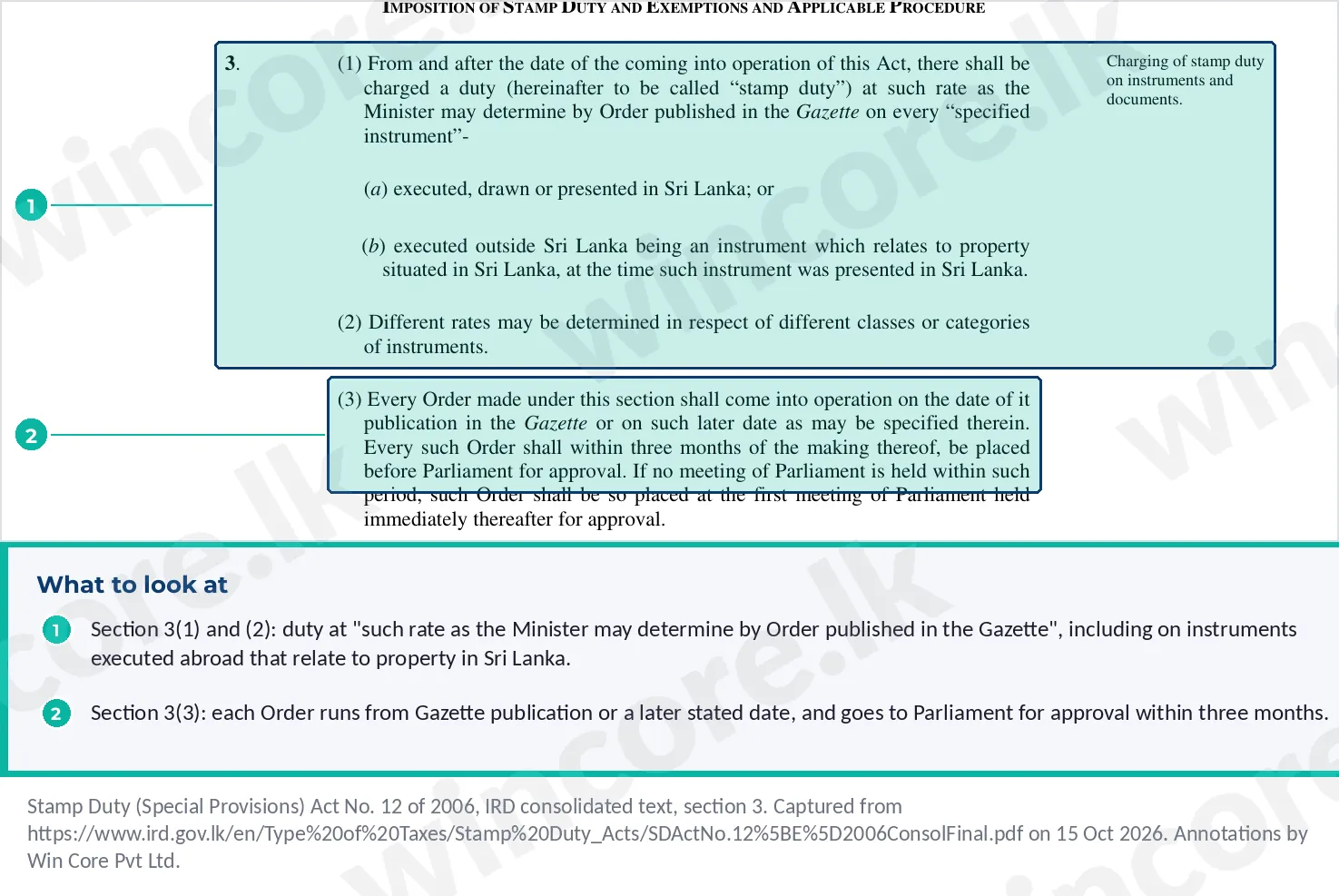
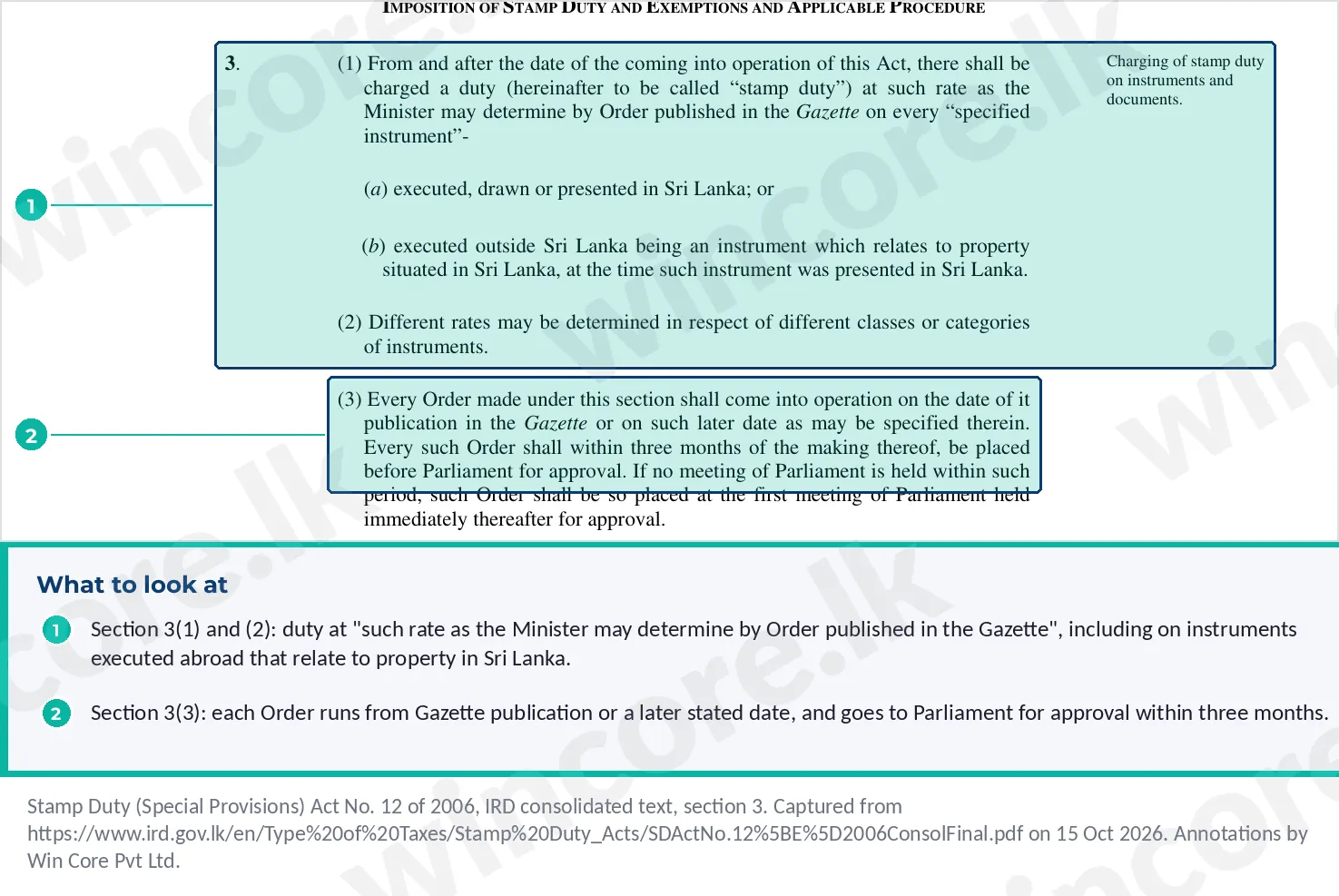
The Stamp Duty (Special Provisions) Act, No. 12 of 2006 was certified on 31 March 2006 and, by section 1(2), came into operation on 1 April 2006 [1] [2]. The IRD publishes a consolidated text incorporating Act No. 10 of 2008, and warns that the consolidation is for reference only [2]. Section 3 charges stamp duty "at such rate as the Minister may determine by Order published in the Gazette" on every "specified instrument" executed or presented in Sri Lanka, or executed abroad if it relates to property in Sri Lanka when presented here [2]. Different rates may apply to different classes of instrument. Each Order runs from Gazette publication or a later date stated in it, and must go to Parliament for approval within three months; an Order Parliament disapproves is deemed rescinded from the date of disapproval (s.3(4)) [2].
Section 4 lists the specified instruments. They include an affidavit, a policy of insurance, a share certificate, a bond or mortgage, a promissory note, "a lease or hire of any property", and a receipt or discharge [2]. The receipt line is why a salary receipt can need a stamp; our payslip format guide covers that case. Stamp duty on transfers of immovable property is a Provincial Council matter under section 9, not a rate under these Orders. Section 5 lets the Minister exempt instruments by Order. Section 6 says that, unless the parties agree otherwise, the lessee pays on a lease [2]. Section 8 sets how to pay: adhesive stamps in the ordinary case; for a mortgage or lease of immovable property, payment to a prescribed bank with a certificate affixed [2].
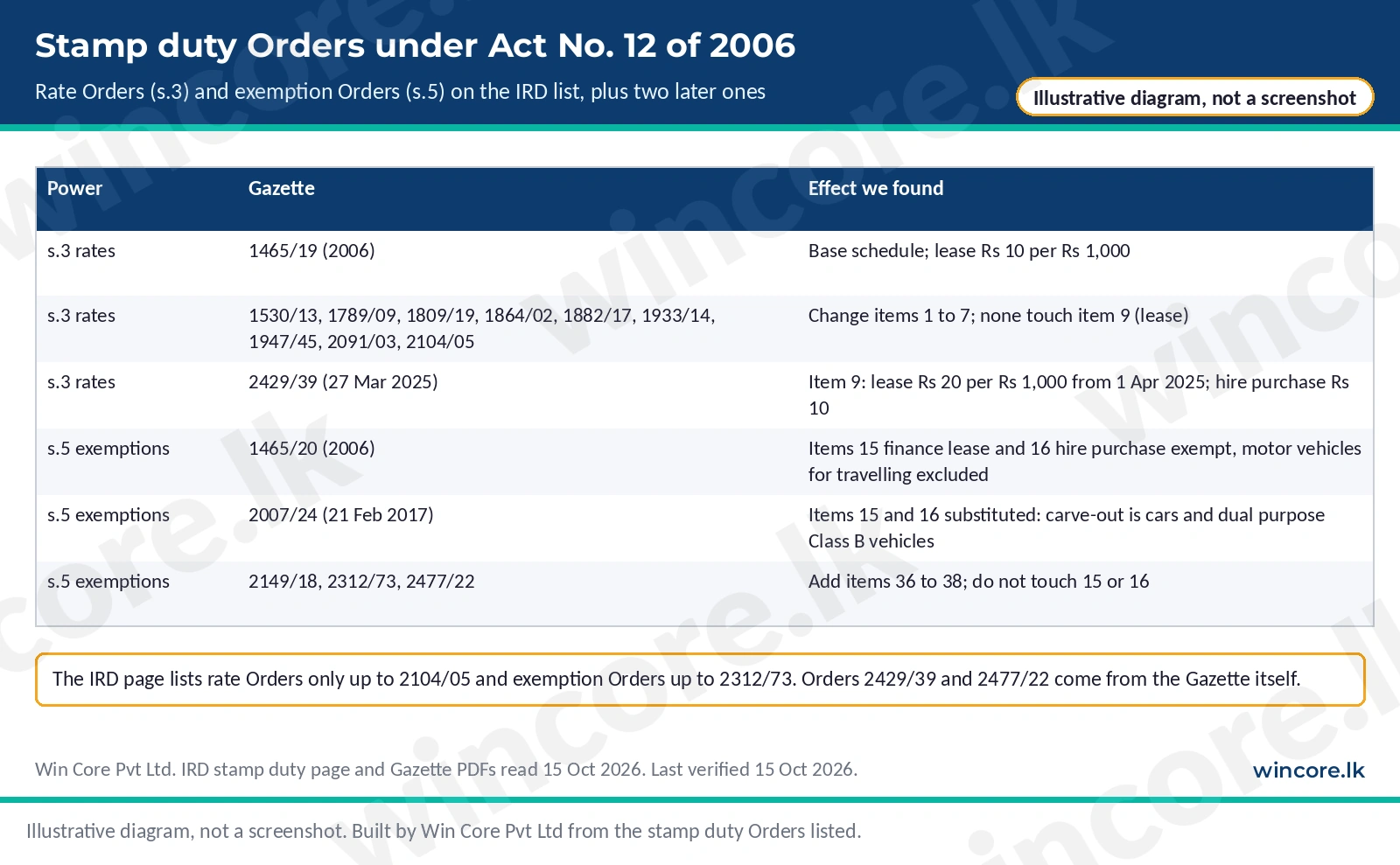
The IRD's stamp duty page is the usual first stop, but it is not complete: on 21 October 2026 (page last updated 15 July 2026) its rate list stopped at Gazette 2104/05 and its exemption list at 2312/73, so the 2025 and 2026 Orders below are not on it [8].
For a foreign buyer, establish whether the land transaction is permitted before working out the instrument and its stamp duty.
Gazette 1465/20 exempts finance leases and hire purchase, with a vehicle carve-out
Gazette Extraordinary No. 1465/20 of 5 October 2006 is the main exemption Order under section 5 [3]. Items 15 and 16 are the ones that matter for asset finance:
- Item 15: "Any instrument relating to any finance lease executed in respect of any property other than any such finance lease in respect of any motor vehicles used for travelling" [3].
- Item 16: "Any hire purchase agreement entered into under the Consumer Credit Act, No. 29 of 1982 in respect of any moveable property other than any motor vehicle used for travelling" [3].
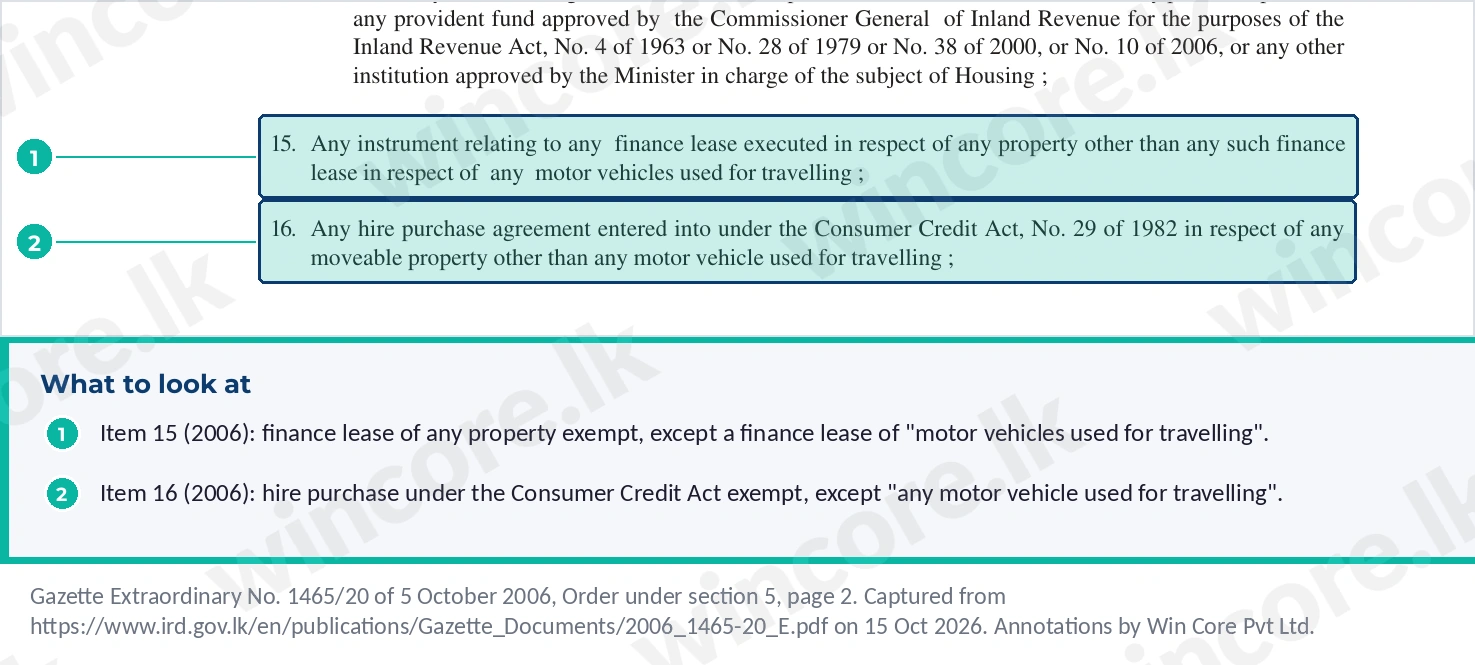
That was the 2006 position: a finance lease of plant was exempt, and a finance lease of a motor vehicle used for travelling was not. The same carve-out sat in item 16 for hire purchase. This wording no longer applies; it was replaced in 2017.
Since 21 February 2017 the carve-out is cars and Class B dual purpose vehicles
Gazette Extraordinary No. 2007/24 of 21 February 2017 amended the 1465/20 Order "as last amended by" Gazette 1947/46 of 1 January 2016, "with effect from 21.02.2017", by deleting items 12, 15 and 16 and substituting new ones [4]. From that date, item 15 exempts a finance lease of any property other than a finance lease of "any car or dual purpose motor vehicle of Class B of classification of driving licences for motor vehicles within the meaning of the Section 122 of the Motor Traffic Act, No. 14 of 1951 as amended by the Motor Traffic (Amendment) Act, No. 8 of 2009" [4]. Item 16 uses the same Class B carve-out for hire purchase [4].
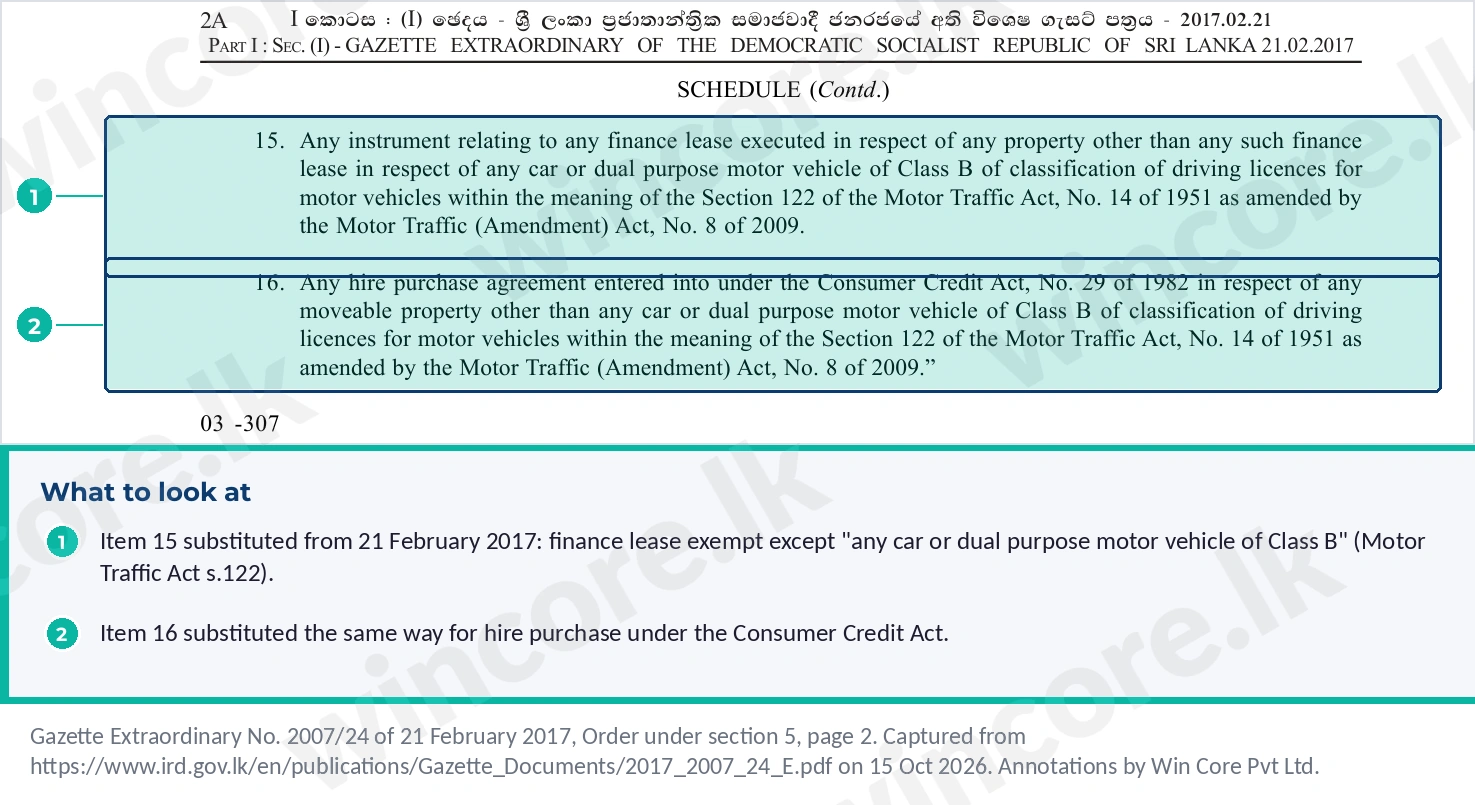
Is a heavy goods vehicle still exempt under item 15? The 2017 text carves out cars and dual purpose Class B vehicles, not every motor vehicle. That is a different test from the 2006 "motor vehicles used for travelling" wording: it turns on the driving licence class, not on use. On our reading the 2017 Order is the current rule. We did not read the exemption Orders made between 2007 and 2016 (1478/07 to 1947/46), so we do not say what items 15 and 16 said immediately before 21 February 2017; it does not matter for a document signed today. Classifying a particular van is a Motor Traffic Act question; we do not decide that here.
The lease rate doubled to Rs 20 per Rs 1,000 on 1 April 2025
Gazette Extraordinary No. 1465/19 of 5 October 2006 set the base rate schedule. Item 09 charged "Rs. 10.00" for every Rs 1,000 or part of the aggregate lease or hire including premium for the whole term, with a twenty-year cap, and Rs 10 for hire purchase under the Consumer Credit Act [5]. Later rate Orders (1530/13 through 2104/05) change other items. None of those Orders we read change item 9 [6].
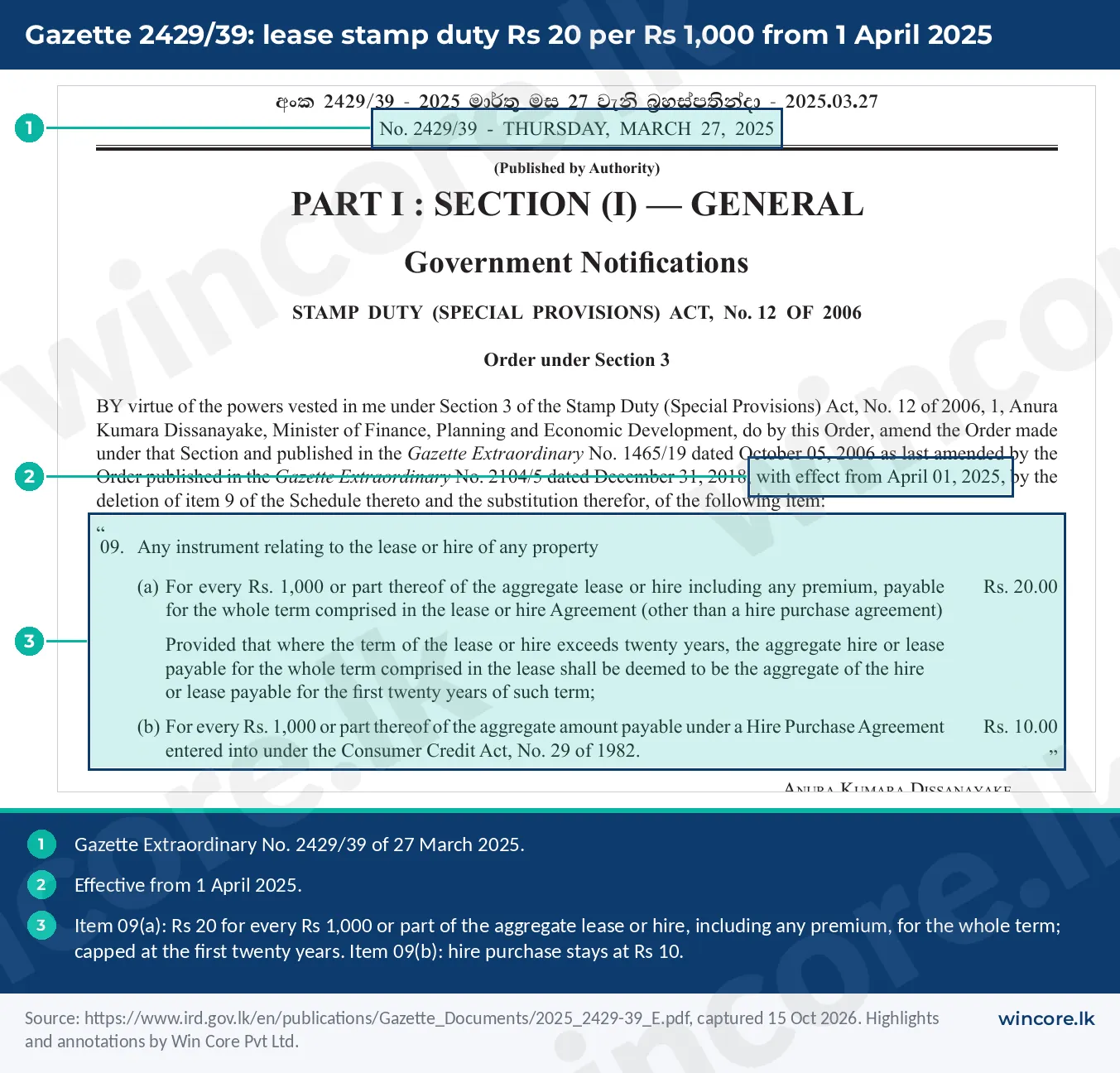
Gazette Extraordinary No. 2429/39 of 27 March 2025 amends 1465/19 as last amended by 2104/05, "with effect from April 01, 2025", by replacing item 9: lease or hire at "Rs. 20.00" per Rs 1,000 of the aggregate for the whole term (twenty-year cap still applies); hire purchase stays at "Rs. 10.00" [7]. That is the same Order our guide to lease stamp duty from 1 April 2025 walks through, with worked examples, for a tenant working out the duty. The IRD tax calendar 2026 changes piece covers the quarterly date for compounded stamp duty under section 7.
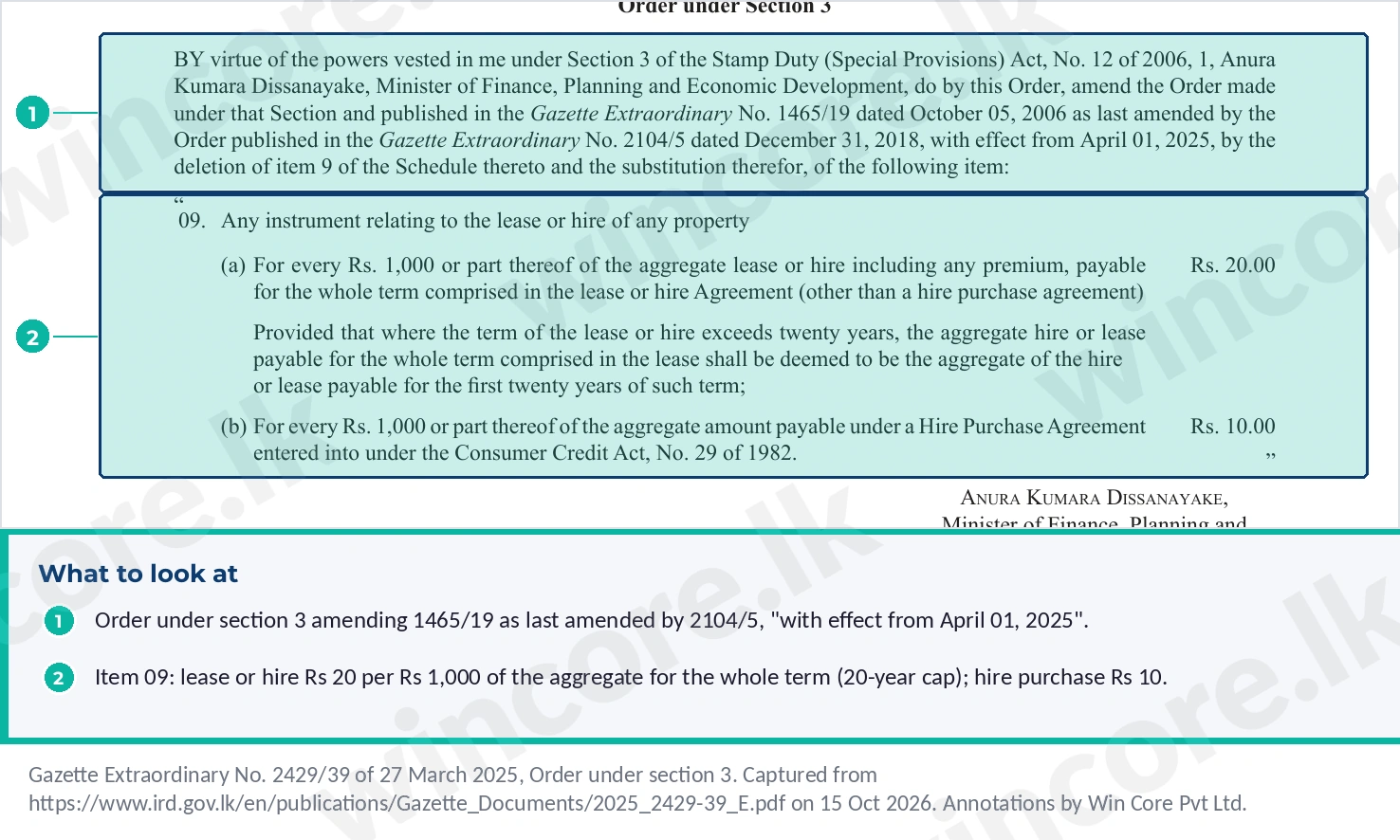
Back to the logistics firm. Say its five-year warehouse lease carries aggregate rent and premium of Rs 12,000,000 (Rs 200,000 a month for 60 months) and is signed on or after 1 April 2025: duty is Rs 20 per Rs 1,000, so Rs 240,000. Before that date it would have been Rs 120,000. That is our arithmetic on item 9 [7]. Round up every incomplete Rs 1,000: Rs 12,000,001 would charge as Rs 12,001,000.
Later exemption Orders add items 36 to 38 and leave 15 and 16 alone
After 2007/24, the IRD list and the Gazettes we fetched add items without rewriting 15 or 16. Gazette 2149/18 adds item 36 (certain Government or UDA land leases where no cash is payable). Gazette 2312/73 adds item 37 (Port City Commission land leases on the same no-cash condition). Gazette 2477/22 of 24 February 2026 adds item 38 (disaster-victim receipts) [8] [6]. A documents.gov.lk Extraordinary Gazette keyword search for "Stamp" for 2025 returned only Gazette 2429/39, and for 2026 returned only Gazette 2477/22. A 2026 Fiscal Policy search likewise listed 2477/22 as the sole Stamp Duty instrument through the search date [9]. On those searches, items 15 and 16 are unchanged after Gazette 2007/24 through 15 October 2026, and none of the later Orders touches finance lease or hire purchase. A search index is not proof that nothing else exists, so treat this as what we found, not a guarantee.
Pay at or before signing, or within seven days through a bank
Section 8 is the practical half of the story. For most instruments you affix adhesive stamps before or at execution and cancel them so they cannot be reused [2]. For a mortgage or lease of immovable property you may pay to a prescribed bank; the bank issues a certificate that is affixed to the deed. Under section 8(2), where the duty "cannot be so paid due to reasons beyond the control of the person by whom the stamp duty is payable", it is paid to the bank "within seven days from the date of such execution" [2]. A stamp of Rs 50 or more must also be cancelled by perforation, and an uncancelled stamp is treated as not there (s.8(3), (4)). Where an Assessor thinks an instrument is under-stamped, section 10 lets him assess the duty and send a notice to pay. The IRD page names a Commissioner-General account at Bank of Ceylon, Taprobane branch, for that payment [8].
We treat that bank detail as administrative guidance on the IRD page, not as a section of the Act. The Act itself says "prescribed bank" [2].
Is every lease in Port City exempt under item 37? Not on our reading. Item 37 covers leases of land granted by the Colombo Port City Economic Commission where the premium or rent is not payable in cash under a Government agreement [6]. An ordinary commercial lease of premises is not that instrument.
What this means for you
- Ask which instrument you have before you ask the rate. A finance lease, a hire purchase and an ordinary property lease sit on different lines [2] [3] [7].
- Check Class B before you treat a vehicle finance lease as exempt under item 15 [4].
- Use Rs 20 per Rs 1,000 of the whole-term aggregate for property leases from 1 April 2025, unless an exemption Order applies [7].
- Say who pays in the contract. Section 6 makes the lessee pay "otherwise than in cases where there is an agreement to the contrary" [2]. Our income tax services team can check the Order that applies to a signing date, and our accounting team can book the duty correctly.
Checklist: documents needed
- The signed or final draft lease, finance lease or hire purchase agreement, with its date of execution
- A schedule of every rent payment for the whole term, plus any premium or key money
- For a vehicle, the registration certificate showing its class and type under the Motor Traffic Act
- The clause saying who bears stamp duty, if the parties have agreed to depart from section 6
- The bank certificate or the cancelled adhesive stamps, kept with the original instrument
Common misreadings
- "Every contract needs stamps." Only specified instruments under section 4, at the rate in the current s.3 Order, unless a s.5 exemption applies [2].
- "Finance leases are always free of stamp duty." Not for cars and dual purpose Class B vehicles under the 2017 item 15 [4].
- "The lease rate is still 1 percent." From 1 April 2025 it is Rs 20 per Rs 1,000 (2 percent of the aggregate) [7].
Open points
- How the IRD treats a dual purpose vehicle that is used only for goods. The Order uses the Motor Traffic Act Class B definition, not the use pattern [4].
- Whether the 1982 Stamp Duty Act penalty provisions still apply to 2006 Act instruments. Section 13 says the 1982 Act's provisions on imposition and exemptions have no operation "in so far as the same are inconsistent" with the 2006 Act. Section 11 applies Chapters XVIII to XXIV of "the Inland Revenue Act", which section 14 defines as Act No. 38 of 2000, since repealed. How those references read today is not settled here [2].
- The wording of items 15 and 16 between 2007 and 21 February 2017, under Orders 1478/07 to 1947/46, which we did not read.
FAQ
What does the Stamp Duty Act No. 12 of 2006 apply to?
It applies only to the specified instruments in section 4. These include affidavits, insurance policies, share certificates, bonds and mortgages, promissory notes, leases or hire of any property and receipts, at the rates set by Orders under section 3 [2]. Anything not on the list, or exempted by a section 5 Order, carries no duty under this Act.
Is a vehicle finance lease exempt from stamp duty in Sri Lanka?
Only if the vehicle is not a car or a dual purpose motor vehicle of Class B. Item 15 of Gazette 1465/20, as substituted by Gazette 2007/24 from 21 February 2017, exempts finance leases of any property except those vehicles [4]. The class comes from the Motor Traffic Act, so check the registration before treating a lease as exempt.
Is hire purchase exempt from stamp duty?
Yes, for moveable property, except a car or dual purpose motor vehicle of Class B. Item 16, as substituted in 2017, exempts hire purchase agreements under the Consumer Credit Act on that basis [4]. Where duty does apply to a hire purchase agreement, Gazette 2429/39 keeps the rate at Rs 10 for every Rs 1,000 or part of the aggregate payable [7].
What is the stamp duty rate on a lease from 1 April 2025?
It is Rs 20 for every Rs 1,000 or part of the aggregate lease or hire, including any premium, for the whole term. Gazette 2429/39 set this from 1 April 2025, doubling the Rs 10 rate in Gazette 1465/19 [7] [5]. Where the term exceeds twenty years, only the first twenty years count. The lessee pays unless the lease says otherwise.
The short version
The Act is the menu. The Orders are the prices and the free items. Act No. 12 of 2006 stamps a short list of instruments. Gazette 1465/20 items 15 and 16, as rewritten from 21 February 2017, exempt finance leases and hire purchase except cars and dual purpose Class B vehicles. Ordinary property leases pay Rs 20 per Rs 1,000 of the whole-term aggregate from 1 April 2025 [2] [4] [7].
Talk to us. If you are about to sign a lease or a finance document and want the right Order applied to the signing date, book a consultation at our contact page.
WinCore Pvt Ltd
This article is general information on the law as at 21 October 2026 and is not advice on your specific transaction.
References
- Parliament of Sri Lanka. Stamp Duty (Special Provisions) Act, No. 12 of 2006 (certified 31 March 2006). https://www.ird.gov.lk/en/Type%20of%20Taxes/Stamp%20Duty_Acts/SDActNo.12%5BE%5D2006.pdf . Primary. Accessed 15 October 2026.
- Inland Revenue Department. Consolidated Text of the Stamp Duty (Special Provisions) Act, No. 12 of 2006 (incorporating Act No. 10 of 2008), ss.1, 3 to 11, 13 and 14. https://www.ird.gov.lk/en/Type%20of%20Taxes/Stamp%20Duty_Acts/SDActNo.12%5BE%5D2006ConsolFinal.pdf . Primary. Accessed 21 October 2026.
- Government of Sri Lanka. Order under Section 5, Gazette Extraordinary No. 1465/20 (5 October 2006), items 15 and 16. https://www.ird.gov.lk/en/publications/Gazette_Documents/2006_1465-20_E.pdf . Primary. Accessed 15 October 2026.
- Government of Sri Lanka. Order under Section 5, Gazette Extraordinary No. 2007/24 (21 February 2017), substituting items 12, 15 and 16. https://www.ird.gov.lk/en/publications/Gazette_Documents/2017_2007_24_E.pdf . Primary. Accessed 21 October 2026.
- Government of Sri Lanka. Order under Section 3, Gazette Extraordinary No. 1465/19 (5 October 2006), item 09. https://www.ird.gov.lk/en/publications/Gazette_Documents/2006_1465-19_E.pdf . Primary. Accessed 15 October 2026.
- Inland Revenue Department. Stamp Duty (SD) web page (rate and exemption Order lists) and Gazette Extraordinary Nos. 2104/05, 2149/18, 2312/73 and 2477/22 (checked; items 15 and 16 unchanged after 2007/24). https://www.ird.gov.lk/en/type%20of%20taxes/sitepages/stampduty.aspx . Primary. Accessed 15 October 2026.
- Government of Sri Lanka. Order under Section 3, Gazette Extraordinary No. 2429/39 (27 March 2025), replacing item 9 with effect from 1 April 2025. https://www.ird.gov.lk/en/publications/Gazette_Documents/2025_2429-39_E.pdf . Primary. Accessed 15 October 2026.
- Inland Revenue Department. Stamp Duty (SD) web page and Act / Gazette links under Type of Taxes (page last updated 15 July 2026; rate list to 2104/05, exemption list to 2312/73). https://www.ird.gov.lk/en/Type%20of%20Taxes/SitePages/StampDuty.aspx . Primary. Accessed 21 October 2026.
- Department of Government Printing. documents.gov.lk Extraordinary Gazettes keyword search ("Stamp", years 2025 and 2026) and Department of Fiscal Policy filter (year 2026). Results: Gazette 2429/39 (27 March 2025) and Gazette 2477/22 (24 February 2026) only; no later Stamp Duty Order. https://documents.gov.lk/view/extra-gazettes/eg.html . Primary (search index). Accessed 15 October 2026.
Put these insights to work
WinCore specialists can review your current workflow, document gaps, and build a practical 90-day action plan.
Book a free consultationContinue reading
Explore more WinCore analysis to keep your finance, tax, and compliance roadmap moving.
Stamp duty on a lease is Rs 20 per Rs 1,000 of the aggregate rent from April 2025. Who pays, how to pay, the exemptions and worked examples.
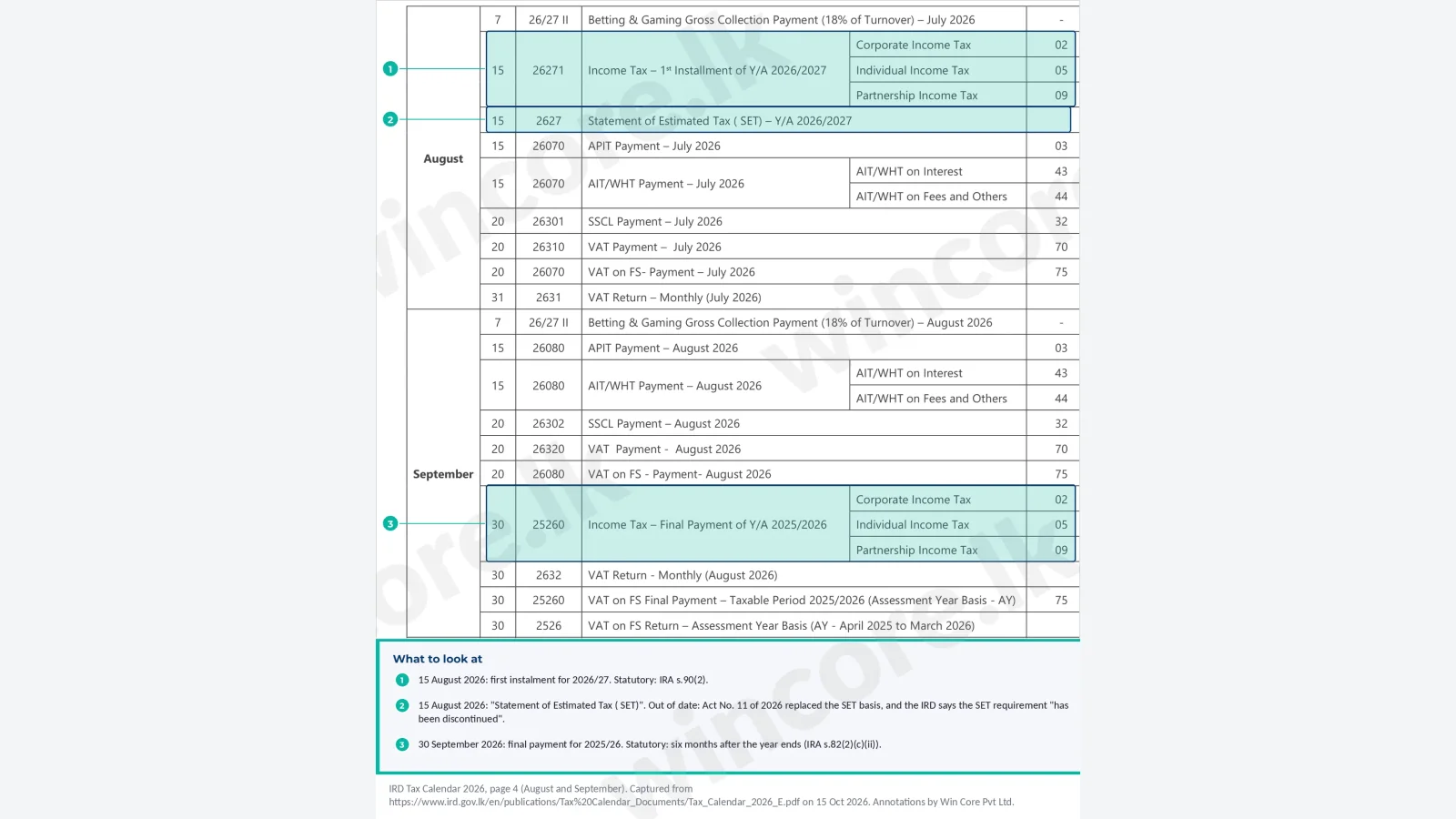
The IRD's printed 2026 calendar predates Act No. 11. One line is obsolete, one statement is missing, and two November dates differ in kind.

Sri Lanka has no single payslip template in law, but EPF, APIT, stamp duty and minimum wage rules decide what a defensible payslip should show. A field-by-field guide.