
Can foreigners buy land in Sri Lanka? The 50 percent rule and leases
A company 50 percent or more foreign-owned cannot take title to land in Sri Lanka without an exemption. What it can lease, and the twenty-year rule.
On this page
Last verified against the primary sources on 21 October 2026.
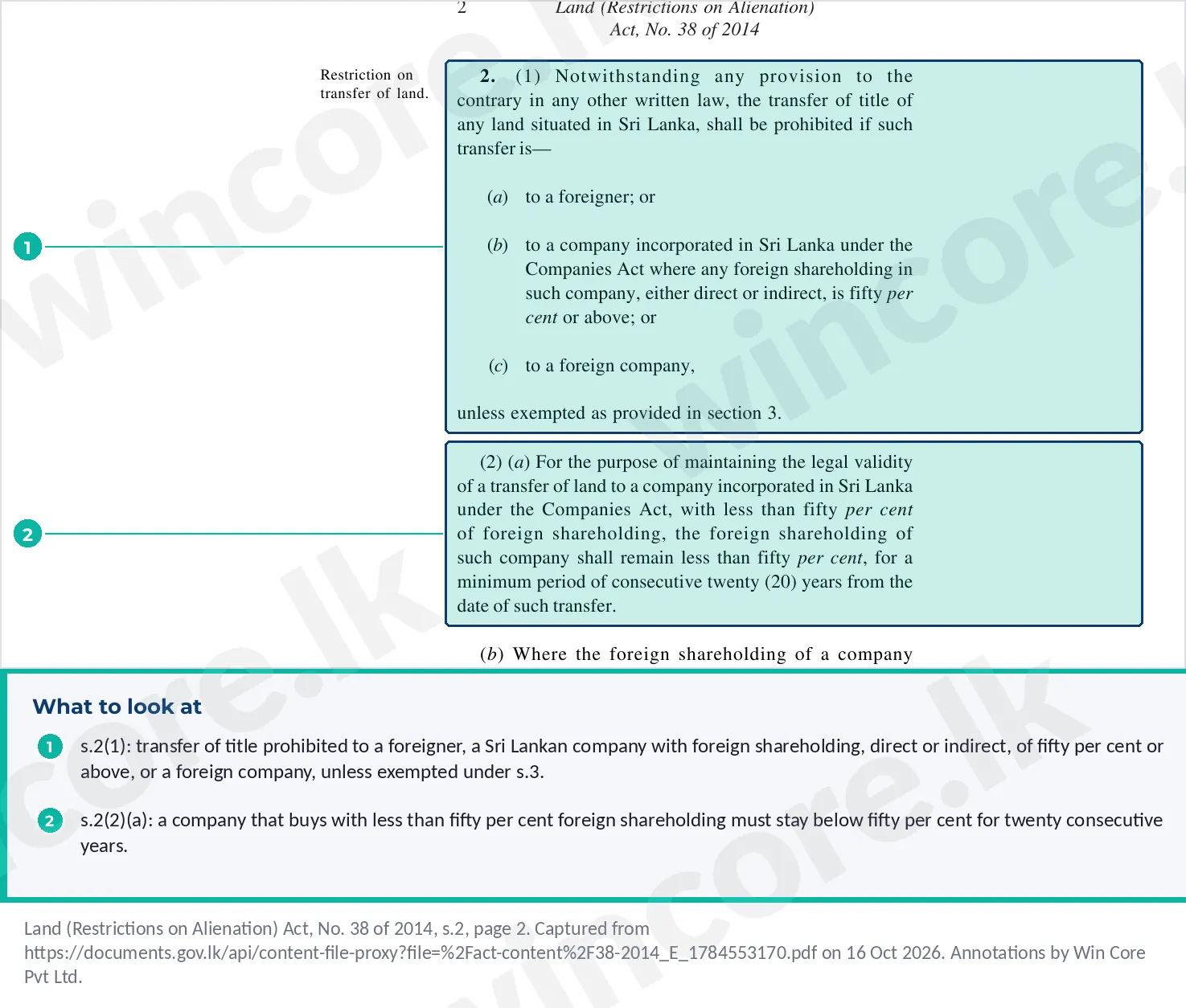
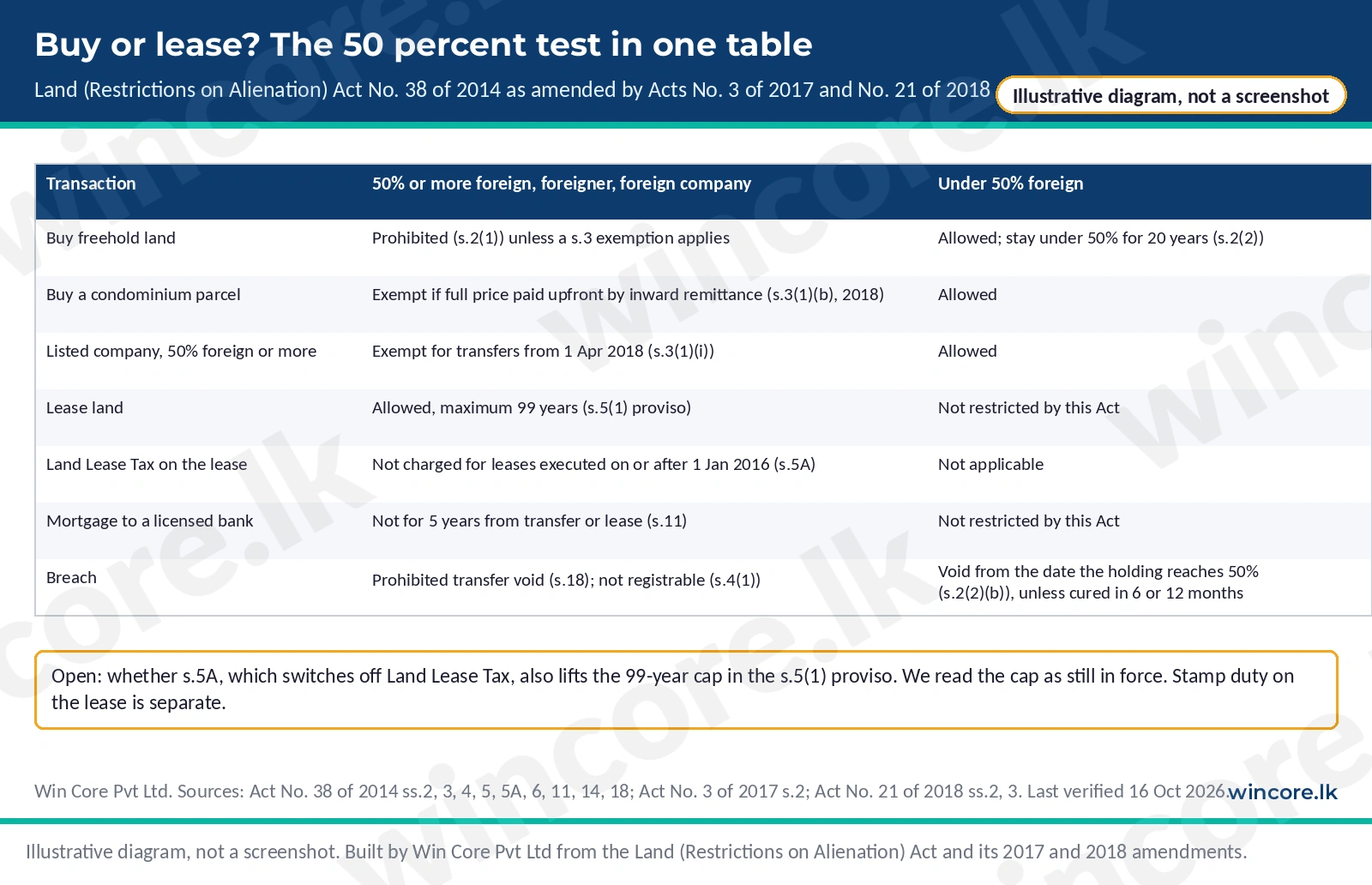
Can foreigners buy land in Sri Lanka? As a rule, no. Under section 2(1) of the Land (Restrictions on Alienation) Act, No. 38 of 2014, the transfer of title to land is prohibited to a foreigner, to a foreign company, and to a Sri Lankan company whose foreign shareholding, direct or indirect, is 50 percent or more, unless a section 3 exemption applies. The Act is deemed to have operated from 1 January 2013 (s.1(2)). The same buyers may lease land for up to 99 years, and for leases executed on or after 1 January 2016 no Land Lease Tax is charged [1] [2] [3].
The Act has been amended twice, by Act No. 3 of 2017 and Act No. 21 of 2018 [2] [3]. We searched documents.gov.lk and parliament.lk on 21 October 2026 and found no later amending Act; Parliament's record shows the 2018 Act endorsed on 30 July 2018 [4], and a secondary consolidation dated 2024 lists the same two amending Acts [5]. A search is not proof that nothing else exists, so treat this as what we found.
Take a hypothetical Sri Lankan subsidiary, 100 percent owned by a Japanese parent, that wants a warehouse site near Colombo. Can it buy the land? No, not without an exemption. Can it lease the land for 50 years? Yes, within the conditions below.
Can foreigners buy land in Sri Lanka? Not at 50 percent foreign shareholding or more
Section 2(1) says "the transfer of title of any land situated in Sri Lanka, shall be prohibited if such transfer is (a) to a foreigner; or (b) to a company incorporated in Sri Lanka under the Companies Act where any foreign shareholding in such company, either direct or indirect, is fifty per cent or above; or (c) to a foreign company, unless exempted as provided in section 3" [1].
Three definitions in section 25 do most of the work. A "foreigner" is "a person who is not a citizen of Sri Lanka". A "foreign company" is "a company or a body of persons incorporated under the laws of any country other than Sri Lanka". And "land" "includes (a) any interest in the land; (b) any land covered with water; and (c) any house or building stands on that land" [1]. So a house is land for this purpose. On our reading, a branch of an overseas company is not a separate legal person, so land bought for a branch is bought by a "foreign company" and s.2(1)(c) applies.
The consequence of breach is in section 18: "Any alienation of land effected in contravention of the provisions of this Act, shall be void and shall have no effect in law" [1]. Section 4(1) adds a gatekeeper: the Registrar of Lands "shall not register" a transfer "unless such registrar of lands is satisfied that such transfer is in compliance with the provisions of this Act" [1].
Under 50 percent you can buy, but must stay under for twenty years
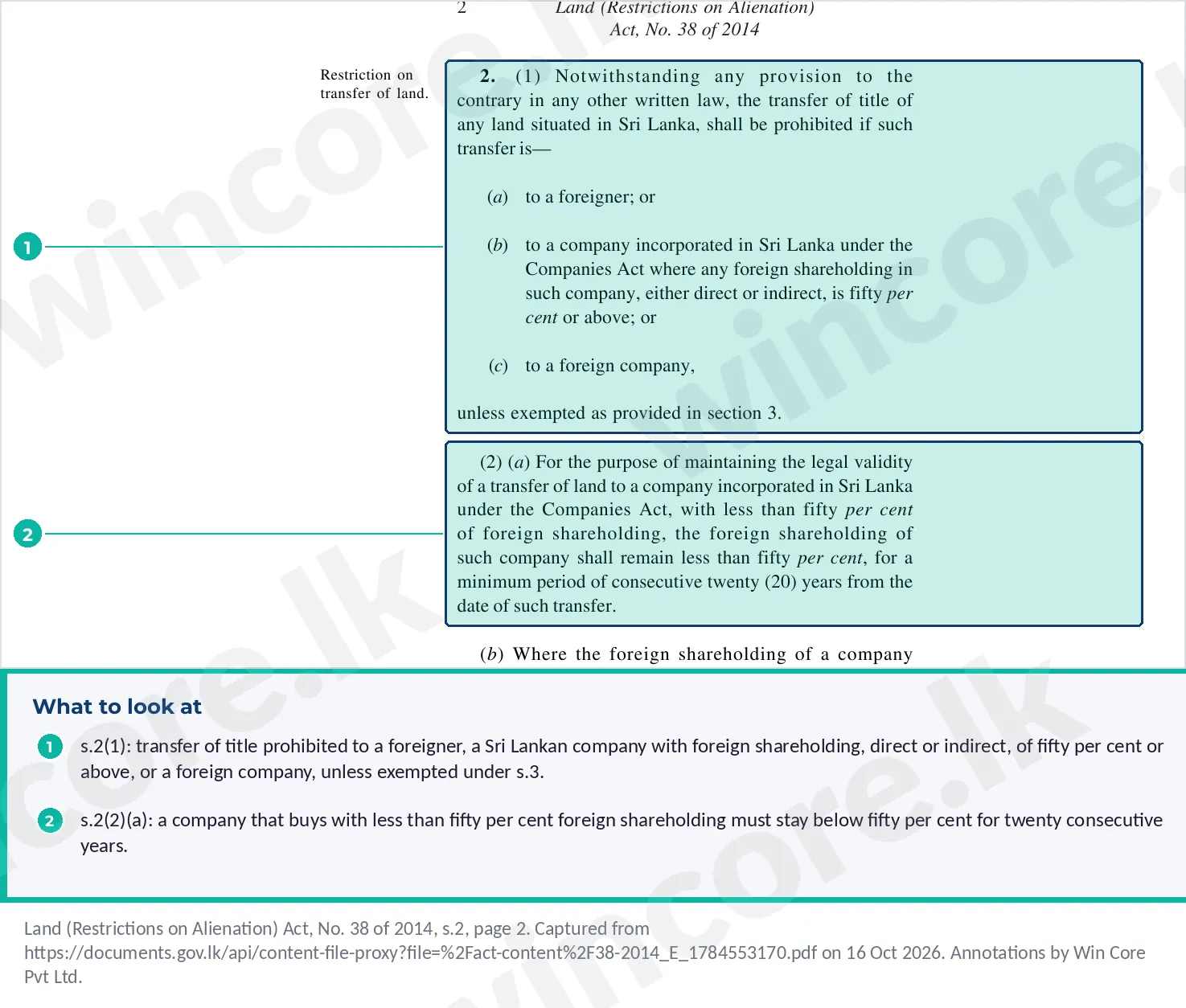
A company with less than 50 percent foreign shareholding can buy. But section 2(2)(a) says its foreign shareholding "shall remain less than fifty per cent, for a minimum period of consecutive twenty (20) years from the date of such transfer" [1]. If it reaches 50 percent through a change of ownership of shares, directly or indirectly, or because a deceased shareholder's shares pass to a foreign next of kin, "the transfer of land referred to therein shall be void and shall have no effect in law, with effect from the date of increase of the foreign shareholding" (s.2(2)(b)) [1].
There is a cure in the proviso. A company listed on the Colombo Stock Exchange (with at least 200 shareholders on the Diri Savi Board or 1,000 on the Main Board) has twelve months to bring the foreign shareholding back below 50 percent; any other company has six months. If it does, the transfer "shall be deemed to be legally valid, with effect from the date of restoring the foreign shareholding" below 50 percent [1].
Section 4 turns the rule into a filing duty. The Registrar of Lands must confirm the shareholding by "requiring the secretary of such company to submit documentary proof" that foreign shareholding is below 50 percent "of the total number of shares issued for the time being" (s.4(3)). The company secretary "shall inform the Registrar of Lands in writing in every six months period commencing from the date of the registration of the relevant deed of transfer" that the foreign shareholding has not exceeded 50 percent (s.4(4)(a)) [1]. For a joint venture with a foreign minority, it is a standing diary item for our company secretarial services.
Exemptions exist, and each carries its own condition
Section 3(1) lists the transfers to which section 2 does not apply [1] [3]. The ones a foreign investor is most likely to meet:
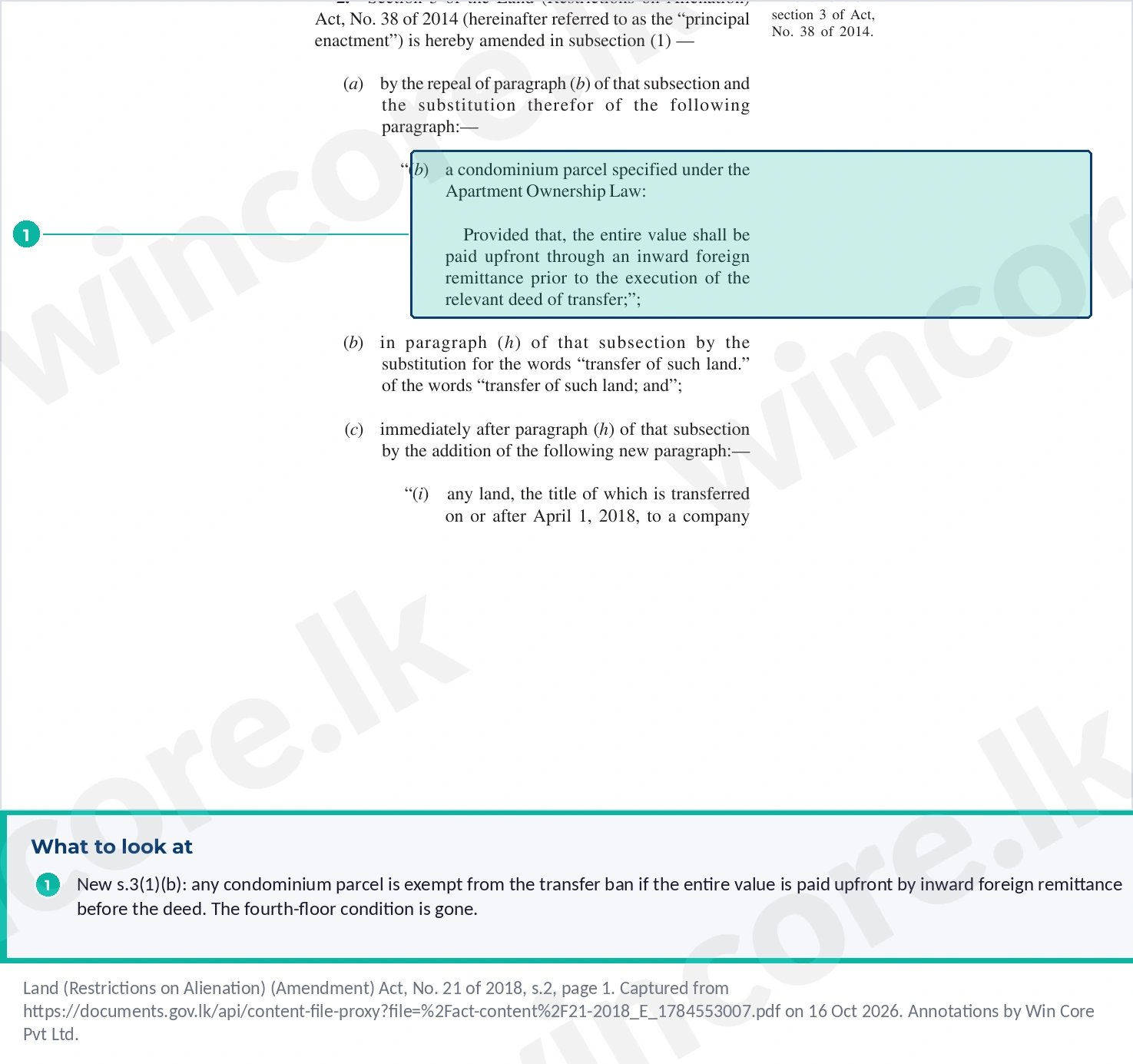
- Condominium parcels. Since Act No. 21 of 2018, deemed in operation from 1 April 2018, the exemption covers "a condominium parcel specified under the Apartment Ownership Law: Provided that, the entire value shall be paid upfront through an inward foreign remittance prior to the execution of the relevant deed of transfer" [3]. The 2014 condition that the parcel be on or above the fourth floor was removed. On our reading, any part of the price paid after the deed, or paid from rupee funds rather than an inward foreign remittance, takes the purchase outside the exemption.
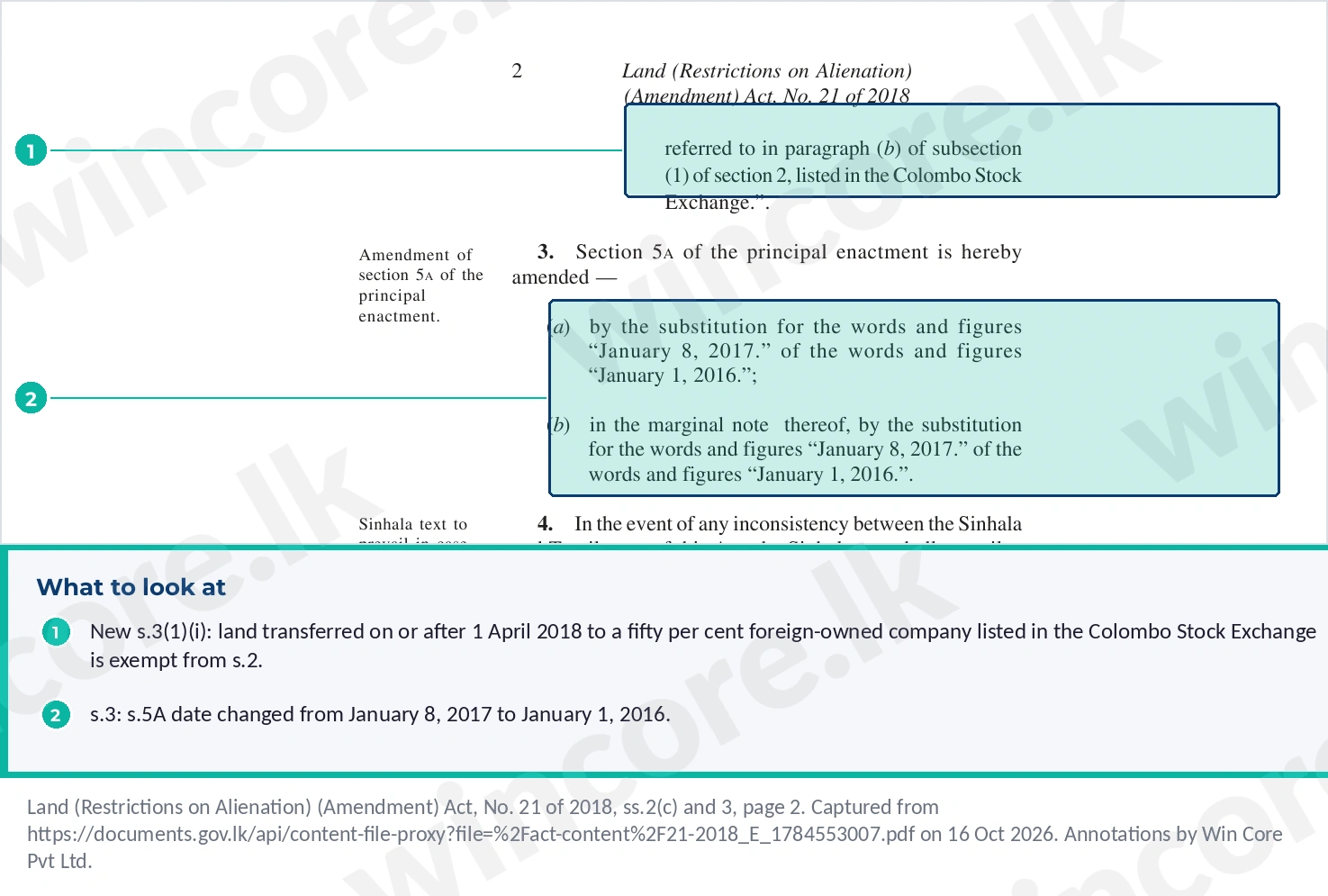
- Listed companies. A new paragraph (i) exempts "any land, the title of which is transferred on or after April 1, 2018, to a company referred to in paragraph (b) of subsection (1) of section 2, listed in the Colombo Stock Exchange" [3].
- Foreign next of kin and dual citizens. Land passing to a foreign next of kin by intestacy, gift or will, and land transferred to a dual citizen within the meaning of the Citizenship Act, are exempt (s.3(1)(d) and (e)) [1].
- Banks and finance leasing institutions that are 50 percent or more foreign-owned, but only in recovery situations such as an auction under the recovery laws or a court decree (s.3(1)(f) and (g)) [1].
- Gazette Orders. The Minister of Finance may, after consulting the Minister in charge of lands and with prior written Cabinet approval, exempt by Gazette Order a foreign entity in banking, finance, insurance, maritime, aviation, advanced technology or infrastructure development identified as a Strategic Development Project (s.3(2)), or a foreign company in international commercial operations buying land "to locate or relocate its global or regional operations or to set up a branch office" (s.3(3)) [1]. These are case-by-case Orders, not a general right.
Two older exemptions, for Cabinet-approved investments decided before 1 January 2013 (s.3(1)(c)) and for certain transfers made between 1 January 2013 and the Act's certification (s.3(1)(h)), matter only for historic deeds. Section 3(4) adds that where a transfer is made under an exemption, "the provisions of this Act shall also apply to every subsequent transfer of title of such land or part thereof" [1]. Section 12 keeps the Land Reform Law ceilings on the maximum extent of land a person may own for exempted transfers and leases [1].
Leases of up to 99 years are allowed, and Land Lease Tax no longer applies
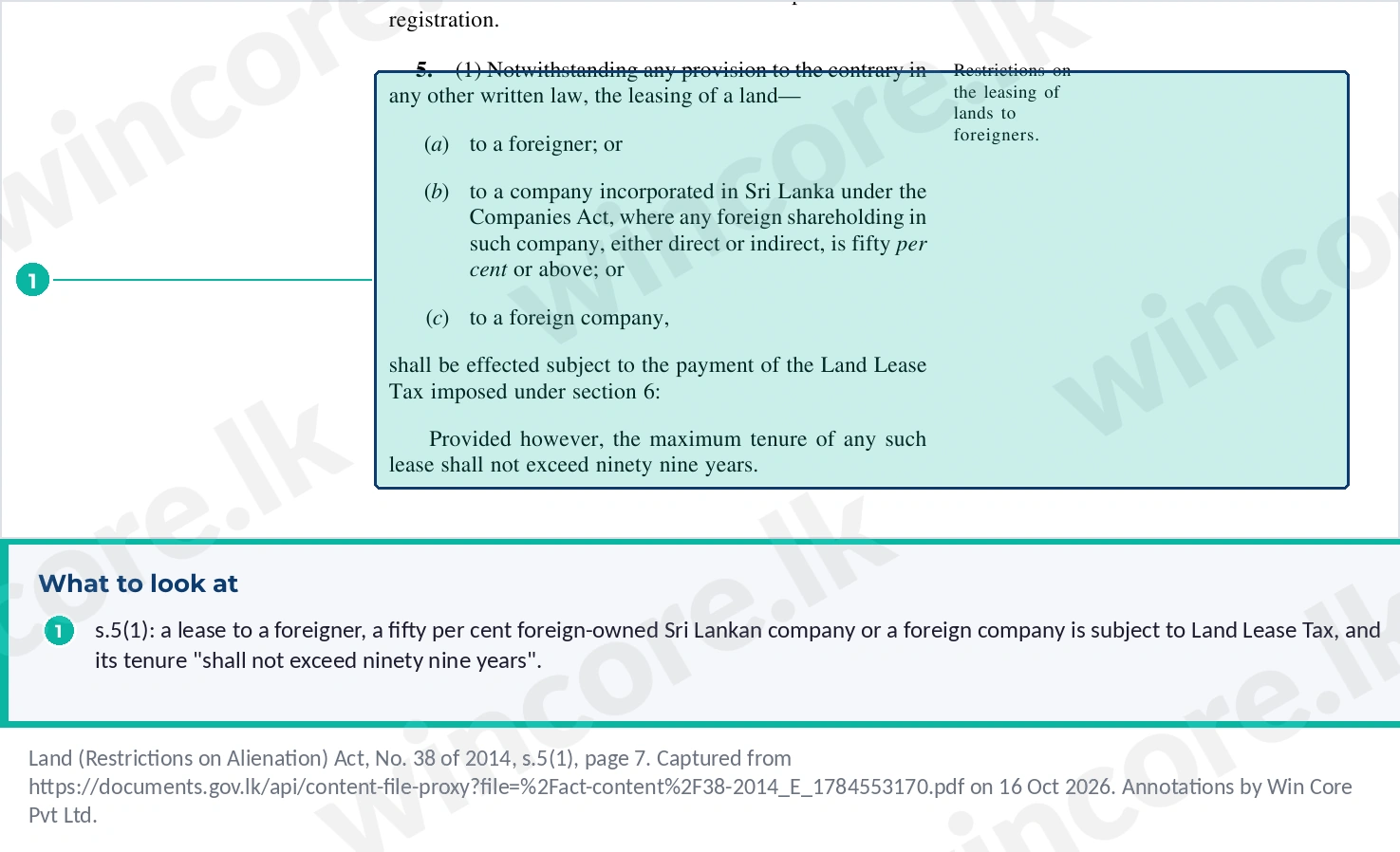
Section 5(1) allows a lease to the same three categories, "subject to the payment of the Land Lease Tax imposed under section 6: Provided however, the maximum tenure of any such lease shall not exceed ninety nine years" [1]. The Land Lease Tax, collected by the Commissioner General of Inland Revenue (s.9) [1] [6], was 15 percent of the total rental for the whole term, or 7.5 percent in specified cases such as land in a BOI licensed zone (s.6(2) and (3)) [1].
That tax was then switched off. Act No. 3 of 2017 inserted section 5A: "the provisions relating to the Land Lease Tax shall not apply to a lease of any land" to those three categories "under and indenture of lease executed on or after January 8, 2017, and accordingly the Land Lease Tax shall not be charged, levied or collected" [2]. Act No. 21 of 2018, s.3, substituted "January 1, 2016" for "January 8, 2017" in section 5A and its marginal note [3]. So, on the Act as amended, no Land Lease Tax is charged on a lease executed on or after 1 January 2016.
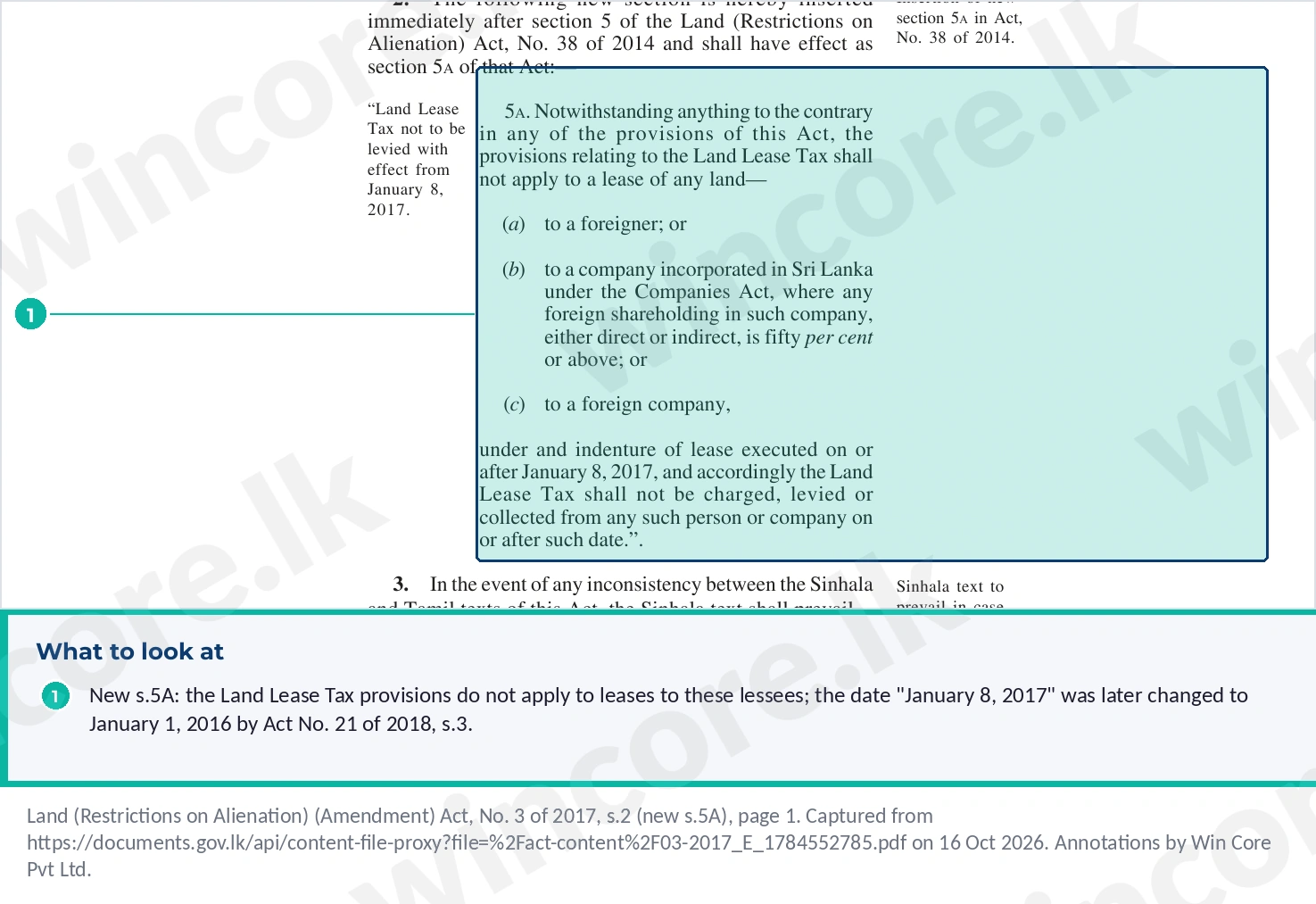
Here is an open point. Section 5A disapplies "the provisions relating to the Land Lease Tax". Does that include the 99-year cap, which sits in the proviso to section 5(1)? The cap is about tenure, not tax, and on our reading it is still in force. We have not found a court decision or official guidance on the question, so we treat it as open and suggest drafting within 99 years.
Two other lease rules survive section 5A, because neither is about the tax. Section 11(1) says land "transferred or leased" to a section 2(1) or 5(1) person "shall not for any purpose be mortgaged or pledged to any bank licensed under the Banking Act, for a period of five years with effect from the execution of the relevant instrument of transfer or lease", and section 11(2) makes such a mortgage void [1]. Section 5(3) bars subletting State land in breach of the lease or without the prior written approval of the Minister in charge of lands [1]. Stamp duty on the lease is a separate charge: our guide to lease stamp duty from 1 April 2025 covers the Rs 20 per Rs 1,000 rate and the twenty-year cap on the aggregate, and the stamp duty calculator runs the arithmetic.
A breach makes the deal void; the only offence is unpaid Land Lease Tax
We read the Act in full and found no criminal penalty for a prohibited purchase. The consequences are civil, section by section:
- Prohibited transfer: void under s.18, and the Registrar of Lands should refuse to register it under s.4(1) [1].
- Breach of the twenty-year rule: the transfer is void from the date of the increase under s.2(2)(b), unless cured within six or twelve months under the proviso [1].
- Mortgage inside five years: void under s.11(2) [1].
- Unpaid Land Lease Tax: the only offence in the Act. Section 14 deems a person who fails to pay the tax "a defaulter of tax", and says the defaulter "commits and offence" (sic), with the Inland Revenue Act applied to prosecution, recovery and punishment. Section 15 extends that offence to every director and officer of a body corporate unless he "proves that such offence was committed without his knowledge and that he exercised all due diligence" [1]. With section 5A in force, this matters only for leases executed before 1 January 2016.
We found no specific penalty for a secretary who misses the six-monthly letter under s.4(4). That is an open point, not a reason to skip it: the letter is how the Registrar of Lands checks that the transfer is still valid.
Indirect foreign shareholding counts, but the Act gives no formula
The 50 percent test counts foreign shareholding "either direct or indirect" (s.2(1)(b)) [1]. The Act does not say how to count it. If a Sri Lankan holding company that is 60 percent foreign-owned holds 70 percent of the land-owning company, is the indirect foreign holding 42 percent (multiplying through) or 70 percent (treating the holding company's whole stake as foreign because it is itself foreign-controlled)? The Act gives no answer. Section 4(3) measures the holding against "the total number of shares issued", which suggests a count of shares rather than votes, but that is our reading.
The Companies Act beneficial ownership rules do multiply down the chain, as our beneficial ownership guide shows, but they are a different statute with a different purpose. Nothing in the Land Act says the same method applies. The safe practice is to model both readings before any share issue or transfer in a land-owning group, and to plan on the higher figure.
How this Act applies to land in the Colombo Port City, which has its own Commission Act, is an open point we have not checked. Our piece comparing a subsidiary, branch, representative office or Port City company covers the vehicle choice, and our guide to foreign ownership of Sri Lankan companies covers the share ownership limits, which are a separate question from land.
Instruments: Land (Restrictions on Alienation) Act No. 38 of 2014 ss.1 to 7, 11, 12, 14, 15, 18 and 25; Amendment Act No. 3 of 2017 s.2 (new s.5A); Amendment Act No. 21 of 2018 ss.1 to 3. Official source: documents.gov.lk. Last verified: 21 October 2026.
What this means for you
- Calculate the foreign shareholding, direct and indirect, of any company that will hold land, before the deed, on both readings of "indirect".
- At 50 percent or more, plan on a lease of no more than 99 years, or check whether a s.3 exemption (condominium, listed company, Gazette Order) fits.
- For a condominium, pay the entire price upfront by inward foreign remittance before the deed is signed, and keep the bank evidence.
- Under 50 percent, put the twenty-year rule into the shareholders' agreement and diary the secretary's six-monthly letter to the Registrar of Lands.
- For a foreigner, a foreign company or a company 50 percent or more foreign, plan no bank mortgage on the land for five years after the transfer or lease (s.11).
- Budget for stamp duty on the lease separately; Land Lease Tax does not apply to leases executed from 1 January 2016.
If the company does not exist yet, our company registration services cover setting it up first.
Checklist: documents needed
- Share register and group chart showing every direct and indirect foreign holding
- Calculation of foreign shareholding on both the multiplied and the control reading
- Draft deed of transfer or indenture of lease, with the term stated
- Bank evidence of the inward foreign remittance (condominium purchase)
- Gazette Order, if relying on a s.3(2) or s.3(3) exemption
- Shareholders' agreement clause holding foreign shareholding below 50 percent for twenty years
- Diary of six-monthly letters from the company secretary to the Registrar of Lands
- Stamp duty calculation for the lease
FAQ
Can a foreigner buy an apartment in Sri Lanka?
Yes, a condominium parcel is exempt from the transfer ban, but only if the full price is paid upfront by inward foreign remittance. Section 3(1)(b), as substituted in 2018, requires that "the entire value shall be paid upfront through an inward foreign remittance prior to the execution of the relevant deed of transfer". The old fourth-floor condition no longer applies [3].
Can a 100 percent foreign-owned company in Sri Lanka buy land?
No, not unless an exemption applies, such as a Colombo Stock Exchange listing or a Gazette Order under s.3(2) or s.3(3). A Sri Lankan company with 50 percent or more foreign shareholding, direct or indirect, falls within s.2(1)(b). It can lease land instead, for a term of no more than 99 years under the proviso to s.5(1) [1] [3].
Is there still a 15 percent Land Lease Tax in Sri Lanka?
No, not for a lease executed on or after 1 January 2016. Section 5A, inserted by Act No. 3 of 2017 and amended by Act No. 21 of 2018, says the Land Lease Tax "shall not be charged, levied or collected" on leases to foreigners, foreign companies or 50 percent foreign-owned companies from that date. Stamp duty on the lease still applies [2] [3].
What happens if foreign shareholding goes over 50 percent after the company buys land?
The transfer becomes void from the date of the increase, unless the company brings foreign shareholding back below 50 percent in time. An unlisted company has six months and a qualifying listed company twelve. If it does, the transfer is deemed valid from the date the holding is restored (s.2(2)(b) and proviso) [1].
How long can a foreigner lease land in Sri Lanka?
Up to 99 years. The proviso to section 5(1) says "the maximum tenure of any such lease shall not exceed ninety nine years". Section 5A removed the Land Lease Tax for leases from 1 January 2016 but, on our reading, not the cap, which is about tenure rather than tax. No court decision on that point was found [1] [2].
This article is general information on the law as at 21 October 2026, not advice on a specific property transaction.
Talk to us. If you want us to model your group's foreign shareholding before a land purchase or lease, or to keep the six-monthly letters on the calendar, book a consultation at our contact page.
WinCore Pvt Ltd
References
- Parliament of Sri Lanka. Land (Restrictions on Alienation) Act, No. 38 of 2014 (certified 29 October 2014, deemed in operation from 1 January 2013), ss.1 to 7, 11, 12, 14, 15, 18 and 25. https://documents.gov.lk/api/content-file-proxy?file=%2Fact-content%2F38-2014_E_1784553170.pdf . Primary. Accessed 21 October 2026.
- Parliament of Sri Lanka. Land (Restrictions on Alienation) (Amendment) Act, No. 3 of 2017 (certified 22 February 2017, deemed in operation from 8 January 2017), s.2 (new s.5A). https://documents.gov.lk/api/content-file-proxy?file=%2Fact-content%2F03-2017_E_1784552785.pdf . Primary. Accessed 21 October 2026.
- Parliament of Sri Lanka. Land (Restrictions on Alienation) (Amendment) Act, No. 21 of 2018 (certified 30 July 2018, deemed in operation from 1 April 2018), ss.1 to 3. https://documents.gov.lk/api/content-file-proxy?file=%2Fact-content%2F21-2018_E_1784553007.pdf . Primary. Accessed 21 October 2026.
- Parliament of Sri Lanka. Act details: 21/2018 Land (Restrictions on Alienation) (Amendment), endorsed 30 July 2018. https://www.parliament.lk/en/business-of-parliament/act-details/G6091 . Primary. Accessed 21 October 2026.
- LankaLaw. Land (Restrictions on Alienation), consolidated to 2024, list of amending Acts. https://lankalaw.net/wp-content/uploads/2025/03/Land-Restrictions-on-Alienation-Consolidated-2024.pdf . Secondary (corroboration only). Accessed 16 October 2026.
- Inland Revenue Department. Land Lease Tax: Act No. 21 of 2018 (copy on the IRD site). https://www.ird.gov.lk/en/publications/Acts_Land%20Tax/Land_Act_No_21-2018_E.pdf . Primary. Accessed 16 October 2026.
Put these insights to work
WinCore specialists can review your current workflow, document gaps, and build a practical 90-day action plan.
Book a free consultationContinue reading
Explore more WinCore analysis to keep your finance, tax, and compliance roadmap moving.
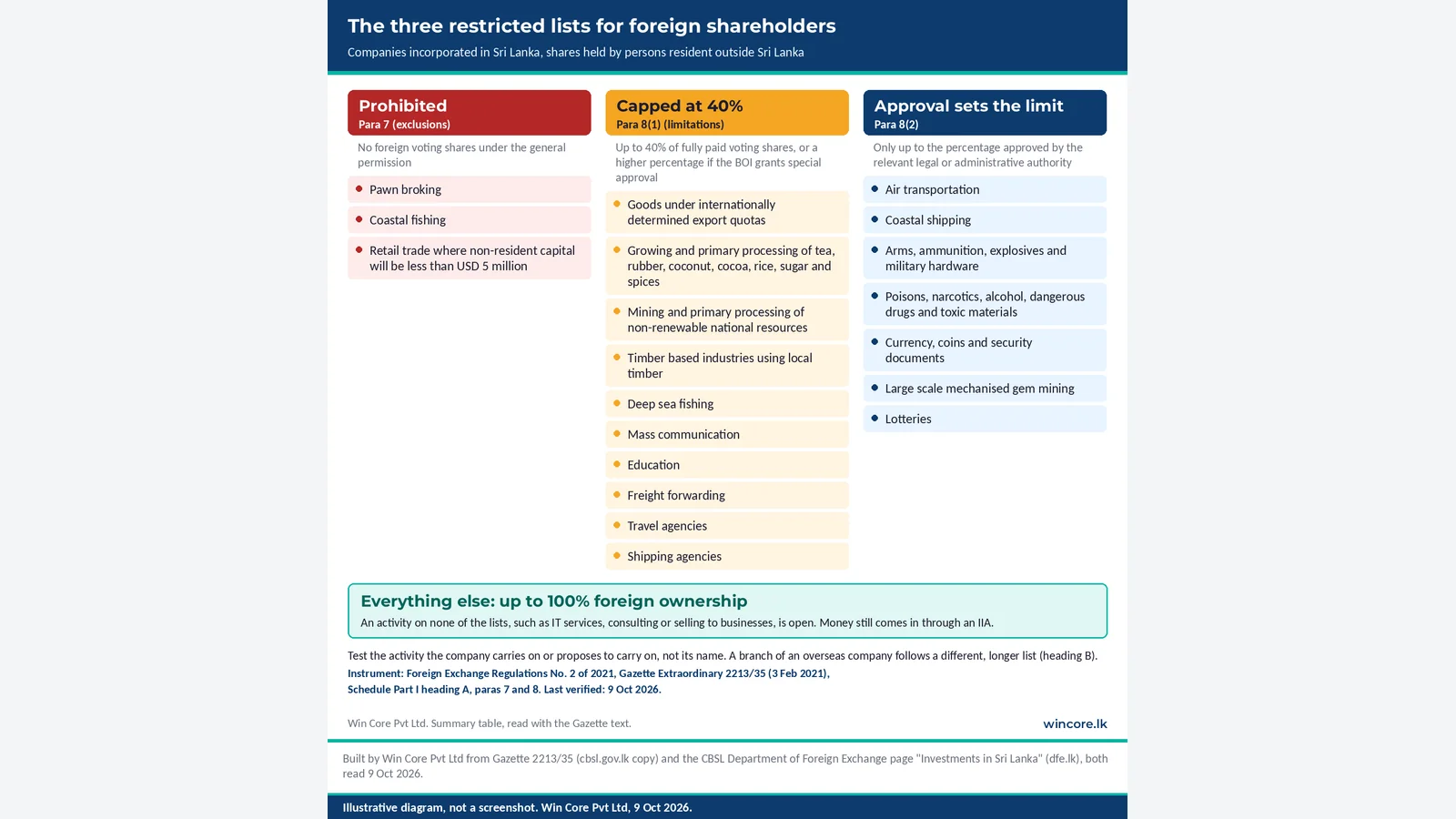
Most Sri Lankan companies can be 100 percent foreign owned. The three restricted lists in Gazette 2213/35, the retail test and the BOI route.
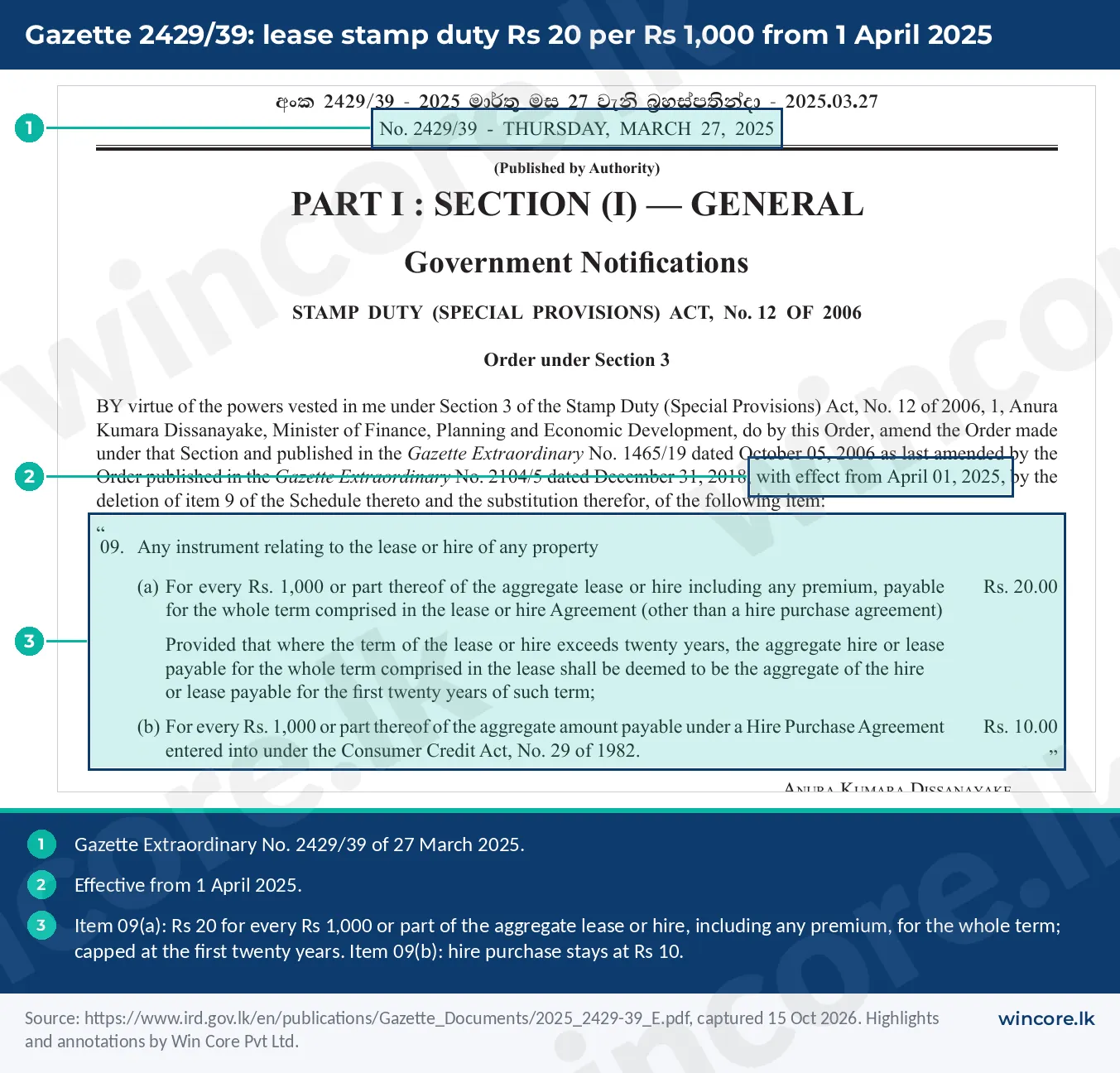
Stamp duty on a lease is Rs 20 per Rs 1,000 of the aggregate rent from April 2025. Who pays, how to pay, the exemptions and worked examples.
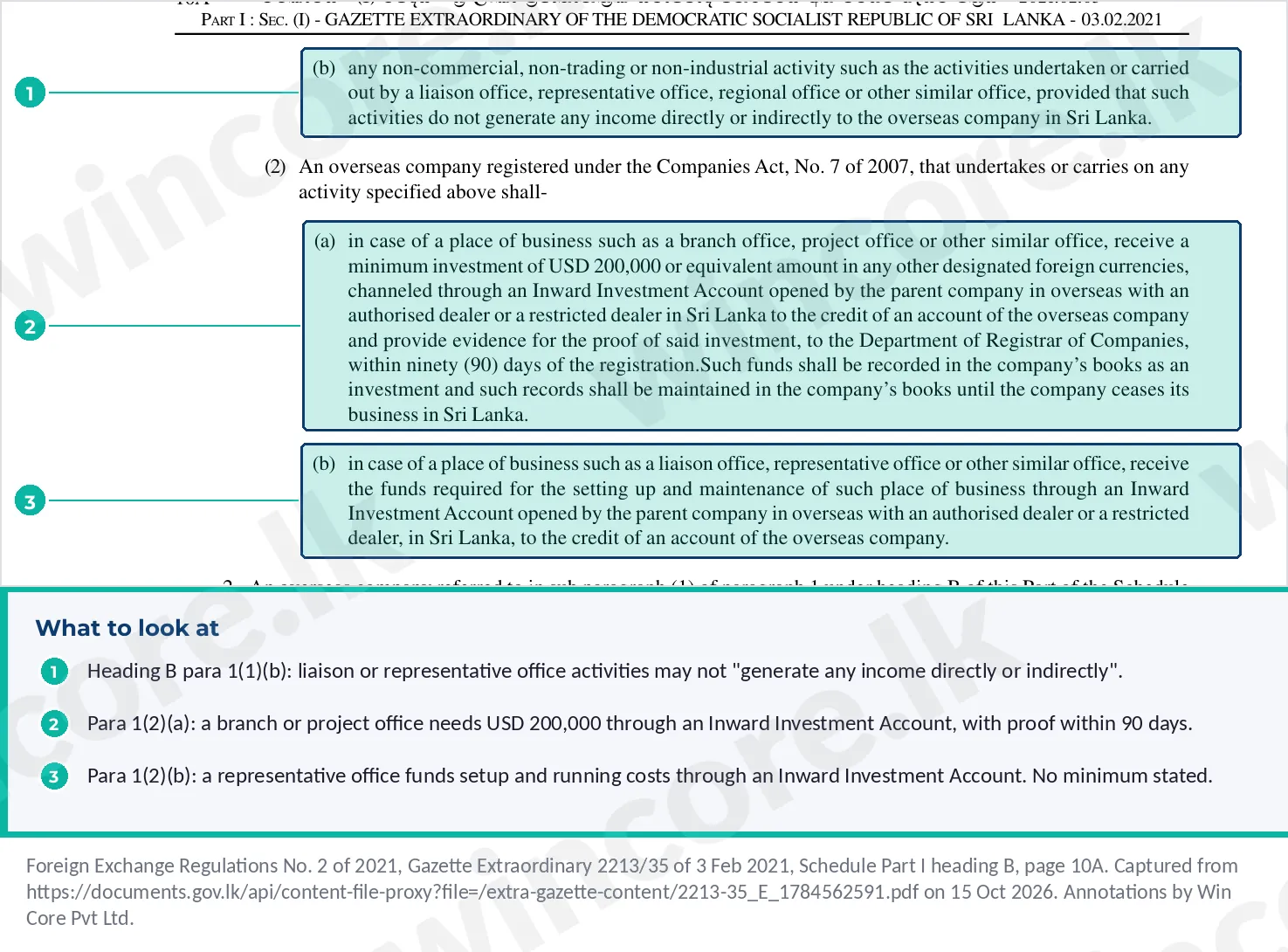
Four ways a foreign company can enter Sri Lanka, set side by side: what each may do, the money each needs, how each is taxed, and what is still open.