
Subsidiary vs branch in Sri Lanka, rep office or Port City
Four ways a foreign company can enter Sri Lanka, set side by side: what each may do, the money each needs, how each is taxed, and what is still open.
On this page
Last verified against the primary sources on 21 October 2026.
Subsidiary vs branch in Sri Lanka comes down to three rules. A branch is the foreign company itself, registered as an overseas company within one month of establishing a place of business (Companies Act s.489), and it must bring in at least USD 200,000 through an Inward Investment Account and prove it to the Registrar within 90 days (Foreign Exchange Regulations No. 2 of 2021, in operation since 22 March 2021). A representative office registers the same way but may not generate any income, directly or indirectly. A subsidiary is a new Sri Lankan company with no minimum investment in an open sector. A Port City company needs a Commission licence and may do business only in and from the Port City. For a foreign company with a place of business here, see overseas company filings on eROC.
Below, each rule is quoted and each open question is marked as open. Take a hypothetical European engineering consultancy that wants to test the Sri Lankan market before it hires anyone. We will come back to it.
Four vehicles carry four different permissions
| Subsidiary | Branch | Representative office | Port City company | |
|---|---|---|---|---|
| Legal person | Separate Sri Lankan company | The foreign company | The foreign company | Licensed authorised person |
| Registered under | Companies Act, incorporation | Companies Act s.489 | Companies Act s.489 | CPCEC Act s.26(3) and Part VII |
| May earn income | Yes | Yes, except para 3 activities | No, directly or indirectly | Yes, in and from the Port City |
| Money rule | Share money through an IIA, no minimum in an open sector | USD 200,000 through an IIA, proof within 90 days | Set-up and running costs through an IIA, no minimum | Investment raised outside Sri Lanka (s.27(4)) |
| Income tax residence | Resident, IRA s.69(4)(a) | Parent non-resident, open point below | As for a branch | Offshore company deemed non-resident, CPCEC s.41(6) |
For overseas incorporation papers, establish the legalisation route for foreign documents before scheduling the local filing.
A branch and a representative office share one register but not one permission
Both start in the Companies Act. Section 489(1) says a company incorporated outside Sri Lanka that "establishes a place of business within Sri Lanka, shall within one month from the date of establishment of its place of business, deliver to the Registrar for purpose of registration" its constitution, a list of directors, "the names and addresses of one or more persons resident in Sri Lanka authorized to accept on behalf of the company, service of documents", and the addresses of its principal office and its "principal place of business of the company within Sri Lanka" [1]. The Registrar may extend the month for sufficient cause (s.489(2)). Section 492(1) then requires every registered overseas company to "in every calendar year prepare financial statements", and section 498 makes a failure to comply with Part XVIII (other than s.493) an offence, with a fine not exceeding Rs 50,000 for the company and for any officer who knowingly and willfully permits the default [1]. The government fee for registering an overseas company is in the Companies (Fees) Order in Gazette 2496/03.
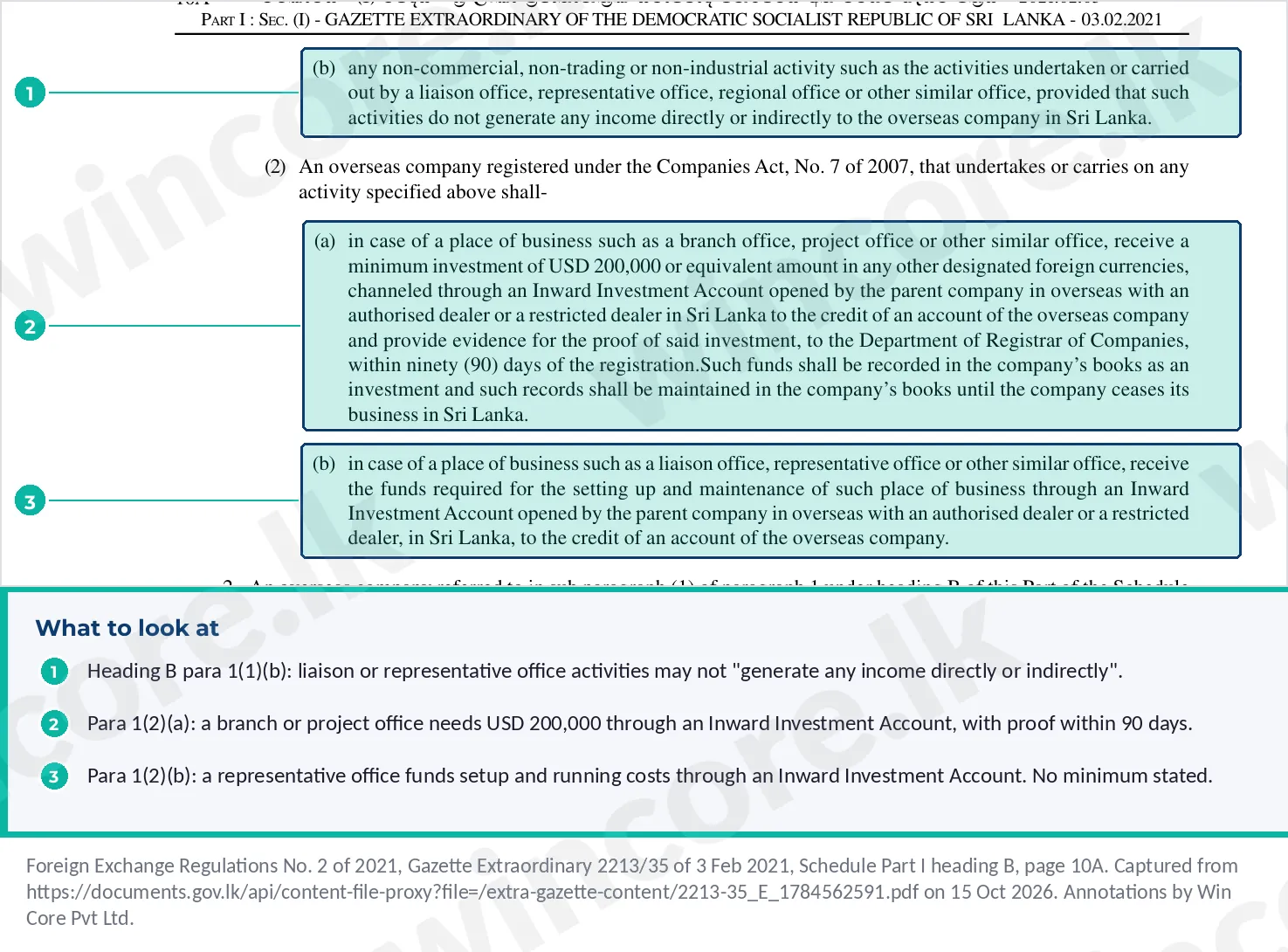
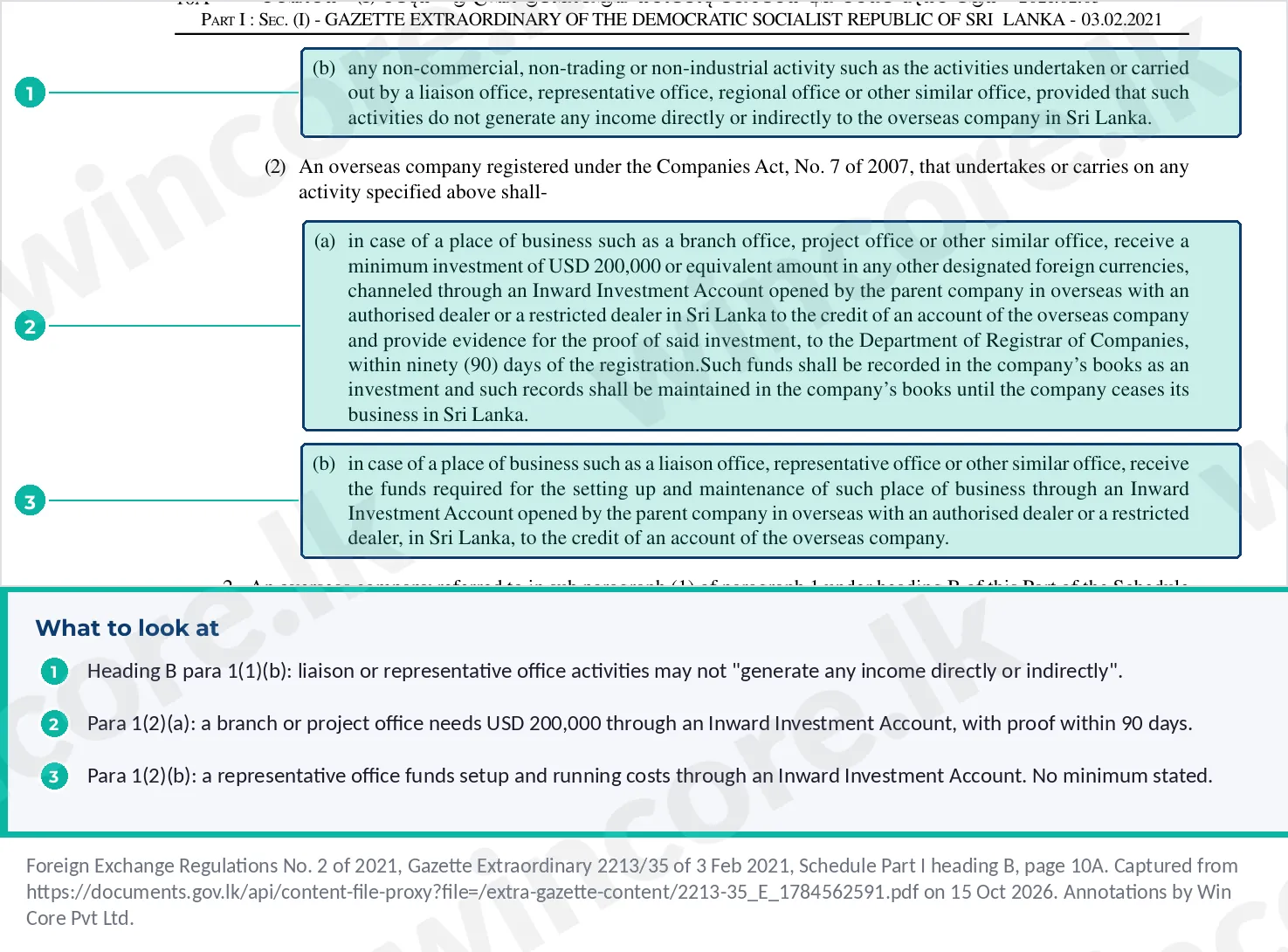
What the overseas company may then do is set by the Foreign Exchange Act. The Foreign Exchange Regulations No. 2 of 2021, made "under section 29 read with section 7" of that Act and published as Gazette Extraordinary 2213/35 on 3 February 2021, deal with overseas companies under heading B of Part I of the Schedule [2] [4].
What a branch may do, and the USD 200,000
Paragraph 1(1)(a) allows "any commercial, trading, or industrial activity" other than the activities in paragraph 3, and only with prior permission from the relevant approving authority for the activities in paragraph 4 [2]. The paragraph 3 list has ten items: money lending (other than branches of foreign banks), pawn broking, retail trade where non-resident capital is less than USD 5 million, coastal fishing, growing and primary processing of tea, rubber, coconut and rice, mining and primary processing of non-renewable resources, freight forwarding, shipping agency business, mechanised gem mining, and lotteries. Paragraph 4 needs prior permission for nine more, including education, mass communication and outbound travel agency business [2].
The money rule is paragraph 1(2)(a). A branch office, project office or similar office must "receive a minimum investment of USD 200,000 or equivalent amount in any other designated foreign currencies, channeled through an Inward Investment Account opened by the parent company in overseas" with a Sri Lankan bank, and "provide evidence for the proof of said investment, to the Department of Registrar of Companies, within ninety (90) days of the registration". The same sentence adds that the funds "shall be recorded in the company's books as an investment" until the company ceases business in Sri Lanka [2]. Paragraph 2 then lets the overseas company remit "profit, royalty, franchise or other similar payments or surplus funds at the time of termination, net of tax" through the parent's Inward Investment Account through which the investment was routed, with a separate route for companies registered before 20 November 2017 [2].
What a representative office may not do
Paragraph 1(1)(b) covers "any non-commercial, non-trading or non-industrial activity such as the activities undertaken or carried out by a liaison office, representative office, regional office or other similar office, provided that such activities do not generate any income directly or indirectly to the overseas company in Sri Lanka" [2]. Paragraph 1(2)(b) requires it to receive "the funds required for the setting up and maintenance of such place of business through an Inward Investment Account" [2]. No minimum sum is stated.
So a representative office cannot invoice Sri Lankan customers, and on our reading "directly or indirectly" also reaches staff who close deals the parent bills from abroad. Is the engineering consultancy's market test a representative office job? If the people in Sri Lanka only meet prospects, gather information and report home, yes. Once they price and close contracts, on our reading it is not, even if the invoice comes from overseas.
A subsidiary separates the liability and has no minimum investment in an open sector
A subsidiary is a company "incorporated or formed under the laws of Sri Lanka", which makes it resident for income tax under section 69(4)(a) of the Inland Revenue Act [5]. Foreign ownership of its shares is allowed by heading A of the same 2021 Regulations, subject to the exclusions and limits in paragraphs 7 and 8 of the Schedule, and the share money is routed through an Inward Investment Account. Our piece on foreign ownership of Sri Lankan companies walks through the three restricted lists. The paragraph 3 list for branches is not the test for a subsidiary; heading A has its own lists, and USD 200,000 is a branch rule, not a subsidiary rule [2].
The incorporation steps are in our step-by-step company registration guide. The Companies Act sets no residence test for directors of a local company, but the Registrar requires at least one resident director in practice, so a foreign parent needs a resident director lined up before filing. WinCore does not supply nominee directors or shareholders; that is our practice, not a rule of law.
The point of a subsidiary is separation: the branch is the parent, the subsidiary is not. On our reading a creditor of the branch is a creditor of the parent. We cannot point to one section that says this, because it follows from what a branch is, not from a rule about branches.
If the proposed activity is selling goods locally, check the retail-trade investment restrictions before choosing the entity structure.
A Port City company works only in and from the Port City unless the Commission authorises more
Section 26(3) of the Colombo Port City Economic Commission Act, No. 11 of 2021 says that a company "intending to engage in business in and from the Area of Authority of the Colombo Port City" needs "(a) a license issued by the Commission ... and (b) a Certificate of Registration issued under Part VII" [3]. The investment must be raised outside Sri Lanka; local foreign currency deposits and loans may not be used (s.27(4)) [3]. A foreign company can also be registered as an offshore company on the Commission's recommendation to the Registrar-General (s.41(2)) [3].
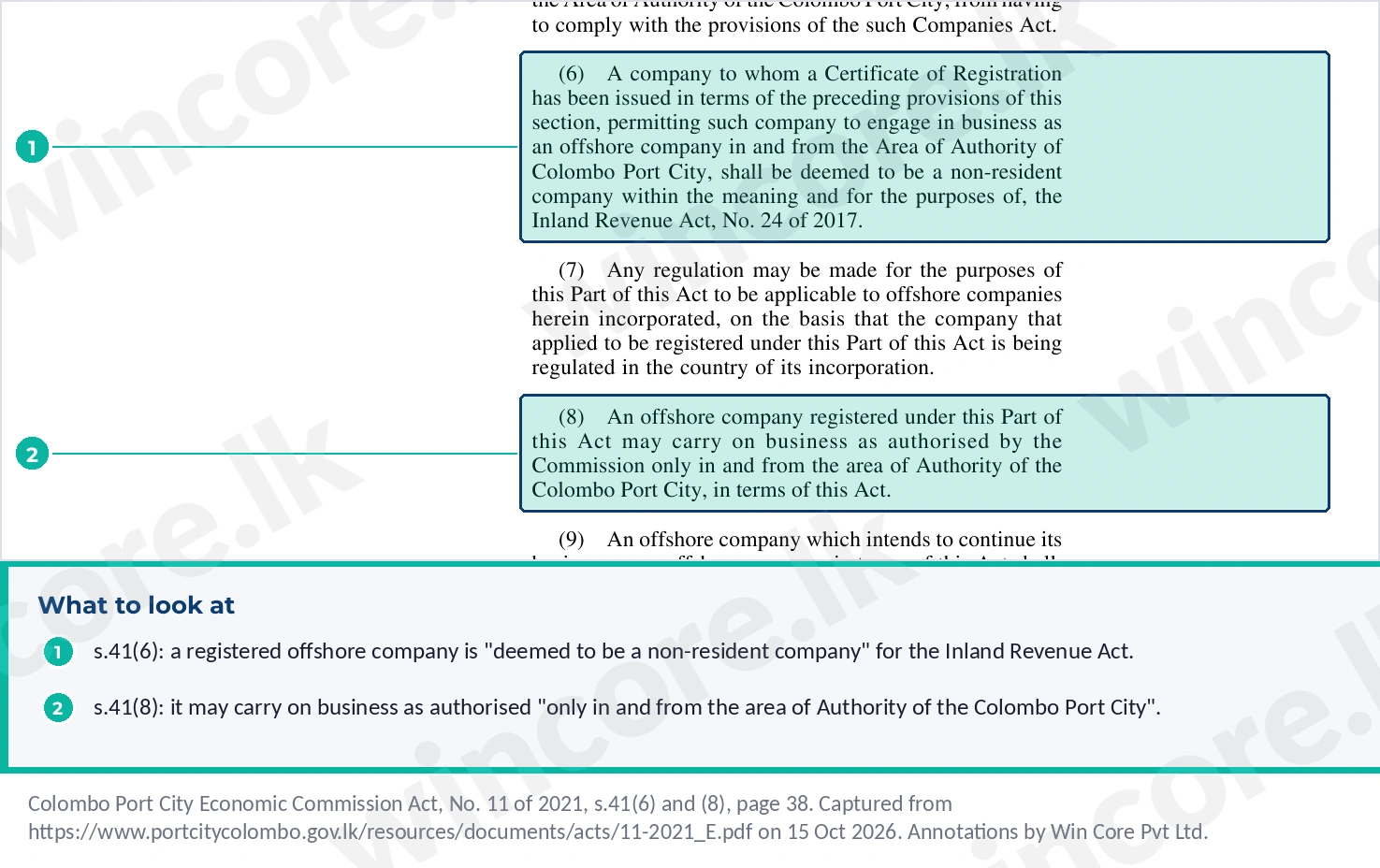
Two consequences follow. A registered offshore company "shall be deemed to be a non-resident company" for the Inland Revenue Act (s.41(6)), and it "may carry on business as authorised by the Commission only in and from the area of Authority of the Colombo Port City" (s.41(8)) [3]. Doing business with a resident engaged in business outside the Port City needs a Commission authorisation under section 37 and Regulations No. 1 of 2023; under those regulations more than half of revenue must come from other customers, and the mainland business gets no Port City exemptions [6]. The licence runs for twelve months and is renewed each year [7]. Port City tax reliefs are not automatic: the 7.5 percent corporate rate, for example, is granted only to a business designated by a Business of Strategic Importance Order in the Gazette.
Subsidiary vs branch in Sri Lanka: tax is where they differ most
| Vehicle | Residence | Profits out of Sri Lanka | Point to watch |
|---|---|---|---|
| Subsidiary | Resident: IRA s.69(4)(a) [5] | Dividends, with 15 percent WHT | Transfer pricing on charges from the parent |
| Branch | Parent non-resident, taxed through its Sri Lankan permanent establishment; see open points | Remittance tax under s.62: 14 percent of gross remitted profits, due within 30 days of each remittance [5] | Head office expenditure capped at the lesser of actual or 10 percent of assessable income, from 2025/26 (s.79(2)) [8] |
| Representative office | As for a branch, if it has any taxable presence | Should have no profits to remit | Income "directly or indirectly" ends the permission [2] |
| Port City offshore company | Deemed non-resident: CPCEC s.41(6) [3] | Per its licence and any BSI Order | Reliefs depend on the Order, its dates and conditions |
Corporate income tax is 30 percent at the standard rate for both a subsidiary and a branch's Sri Lankan profits [5]. The branch pays the second, exit-level tax on top when profits go home. Remittance tax has a zero-rate route for profits reinvested on conditions; our piece on remittance tax on branch profits sets out the conditions. Model both routes with our corporate tax calculator and dividend tax calculator before you choose.
"Established a place of business" is not defined, so register early
Section 488 turns on a company that "established a place of business within Sri Lanka", and the only expansion the Act gives is that a place of business "includes a share transfer or share registration office" [1]. The Act does not say when a hotel room, a co-working desk or a single employee becomes an established place. On our reading the safest course is to register before you sign a lease or hire, not after.
What this means for you
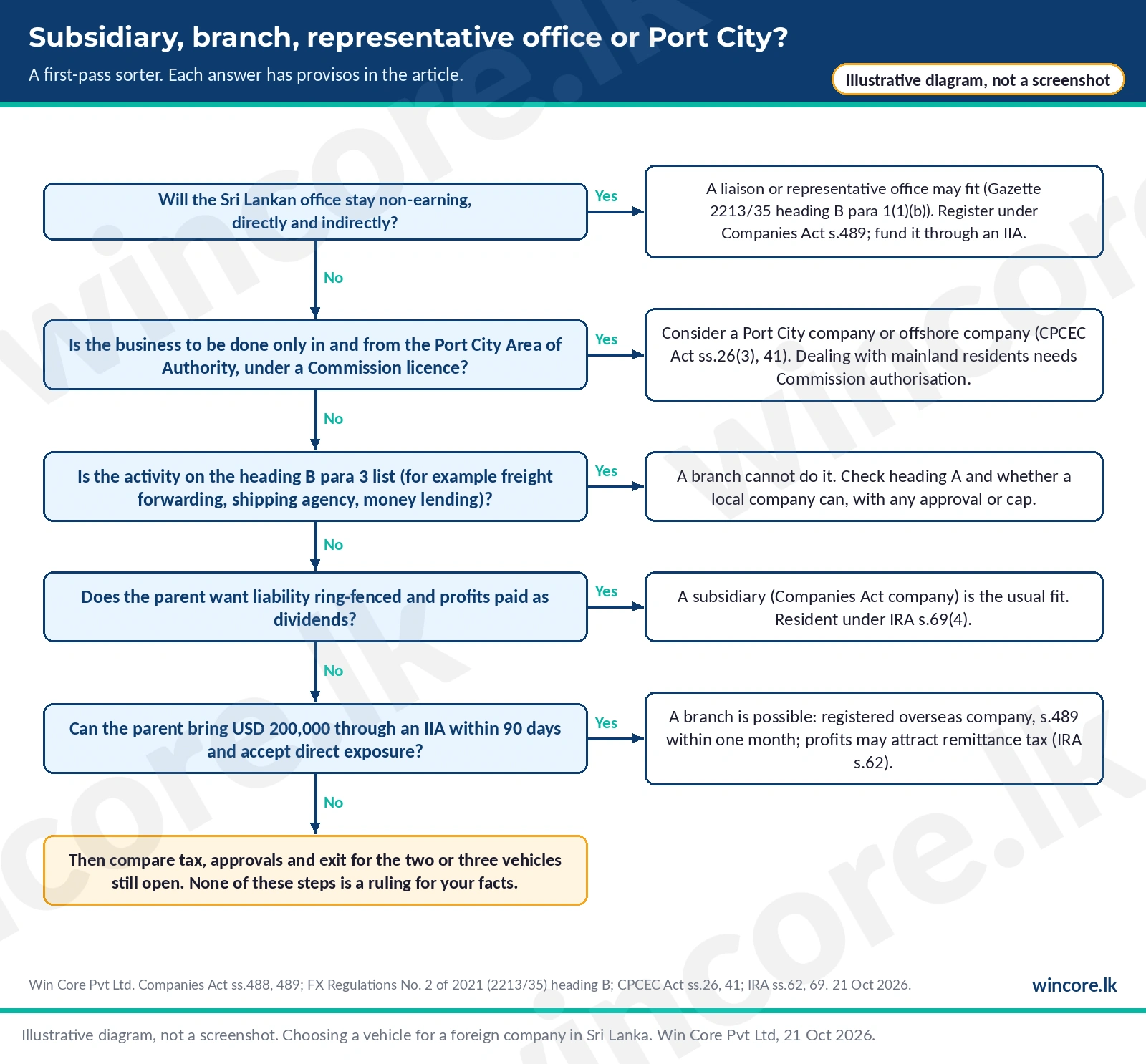
- Decide whether the Sri Lankan office will earn anything, directly or indirectly. If it will, a representative office is out.
- Check the branch lists and the subsidiary lists separately. Heading B paragraphs 3 and 4 apply to a branch; heading A paragraphs 7 and 8 apply to a subsidiary [2].
- Budget the money rule. A branch needs USD 200,000 through an Inward Investment Account, proved to the Registrar within 90 days; a representative office funds its costs the same way with no minimum [2].
- Register within one month of establishing a place of business (s.489) [1], and plan the yearly financial statements under s.492.
- For the Port City, confirm your customers are in and from the Area, or that you can get a section 37 authorisation [3] [6].
- Model tax both ways, including the s.79 cap and remittance tax for a branch against corporate tax and dividend WHT for a subsidiary.
Our foreign branch registration and company registration teams handle either filing, and our tax return filing services team can run the comparison.
Checklist: documents needed
- Parent's certified constitution and certificate of incorporation
- List of the parent's directors
- Name and address of a Sri Lankan resident authorised to accept service of documents (branch or representative office)
- Address of the principal place of business in Sri Lanka
- Bank confirmation of the Inward Investment Account and proof of the USD 200,000 (branch, within 90 days)
- For a subsidiary: name approval, Form 1, director and secretary consents, BO 1 and BO 5, resident director details
- For the Port City: Commission licence application and Certificate of Registration papers
Open points
- Branch residence. Section 69(4)(b) treats a company as resident if "it is registered or the principal office is in Sri Lanka" [5]. Whether registration as an overseas company under s.489 is "registered" for this purpose is not settled in any text we read. Section 62 assumes a branch is a non-resident with a permanent establishment. We treat the point as open.
- Representative office and permanent establishment. The Regulations bar income; they do not decide whether the office creates a taxable presence for the parent. That depends on the facts and on any tax treaty.
- Amendments to heading B. Gazette 2371/50 of 16 February 2024 deals only with investment in International Sovereign Bonds and does not touch heading B. We have not read every other amendment on the Department of Foreign Exchange list, so check for later changes before you rely on the figures.
- "Established a place of business." Undefined beyond the share office inclusion [1].
- Port City business with mainland customers. How the Commission treats a business that needs both depends on the authorisation granted; there is no published standard answer.
FAQ
Can a representative office in Sri Lanka sign contracts?
Not contracts that earn income for the overseas company in Sri Lanka. Paragraph 1(1)(b) of heading B allows only non-commercial activity that does not "generate any income directly or indirectly" to the overseas company in Sri Lanka. On our reading that also rules out staff closing deals that the parent bills from abroad [2].
Is USD 200,000 the minimum capital for a foreign-owned subsidiary?
No. USD 200,000 is the branch, project office or similar office rule in heading B paragraph 1(2)(a). A subsidiary in an open sector has no minimum investment under the Regulations, though its share money still comes in through an Inward Investment Account, and some sectors on the heading A lists carry their own limits [2].
How long does a foreign company have to register a branch in Sri Lanka?
One month from the date it establishes its place of business, under section 489(1) of the Companies Act. Then the USD 200,000 investment must be proved to the Registrar within 90 days of registration. The Act does not define when a desk or one employee becomes an established place, so register early [1] [2].
Is a branch or a subsidiary better for tax in Sri Lanka?
Neither is better in every case. A subsidiary is resident and pays dividend WHT on distributions; a branch pays corporate tax on its Sri Lankan profits, 14 percent remittance tax on profits sent home, and can deduct head office charges only up to 10 percent of assessable income. Model both with your own figures [5] [8].
Is a Port City company resident for tax?
A company registered as an offshore company under Part VII of the CPCEC Act is deemed a non-resident company for the Inland Revenue Act by section 41(6). Other Port City reliefs, such as the 7.5 percent rate, depend on a Business of Strategic Importance Order and its conditions, not on the licence alone [3].
Talk to us. If you are weighing these vehicles and want the registration, the bank account set-up and the tax model done in one sequence, our contact page.
WinCore Pvt Ltd
This article is general information on the law as at 21 October 2026 and is not advice on your specific transaction.
References
- Parliament of Sri Lanka. Companies Act, No. 7 of 2007, ss.488, 489, 492(1), 498. http://www.drc.gov.lk/en/wp-content/uploads/2018/04/Act-7-of-2007-English.pdf . Primary. Accessed 21 October 2026; section text read on the srilaws.com reproduction of the official English text (Secondary) and s.492 on the parliament.lk copy.
- Minister of Finance. Foreign Exchange (Classes of Capital Transactions Undertaken in Sri Lanka by a Person Resident Outside Sri Lanka) Regulations No. 2 of 2021, Gazette Extraordinary 2213/35 (3 February 2021), reg 1 and Schedule Part I headings A and B. https://documents.gov.lk/api/content-file-proxy?file=/extra-gazette-content/2213-35_E_1784562591.pdf . Primary. Accessed 21 October 2026.
- Parliament of Sri Lanka. Colombo Port City Economic Commission Act, No. 11 of 2021, ss.26(3), 27(4), 37, 41(2), (6), (8). https://www.portcitycolombo.gov.lk/resources/documents/acts/11-2021_E.pdf . Primary. Accessed 21 October 2026.
- Parliament of Sri Lanka. Foreign Exchange Act, No. 12 of 2017, ss.7(1), 29. https://www.cbsl.gov.lk/sites/default/files/cbslweb_documents/laws/acts/en/Foreign_Exchange_Act_No_12_of_2017_e.pdf . Primary. Accessed 15 October 2026.
- Inland Revenue Department. Inland Revenue Act, No. 24 of 2017, consolidated to 2025, ss.62, 69(4), First Schedule. https://www.ird.gov.lk/en/publications/Acts_Income%20Tax_2017/IRA_Cons_Act_-_2025_Changes.pdf . Primary. Accessed 15 October 2026.
- Colombo Port City Economic Commission. Colombo Port City (Authorised Persons Engaged in Business) Regulations No. 1 of 2023, Gazette Extraordinary 2339/31 (7 July 2023), regs 5 to 9. https://www.portcitycolombo.gov.lk/resources/documents/extragazettes/2339-31_E.pdf . Primary. Accessed 9 October 2026.
- Colombo Port City Economic Commission. Regulations for Registration, Licensing, Authorisation and other Approvals of Authorised Persons No. 01 of 2022, Gazette Extraordinary 2299/46 (28 September 2022), regs 8 and 21. https://www.portcitycolombo.gov.lk/resources/documents/extragazettes/2299-46_E.pdf . Primary. Accessed 9 October 2026.
- Parliament of Sri Lanka. Inland Revenue (Amendment) Act, No. 11 of 2026, s.11 (new s.79). https://www.ird.gov.lk/en/publications/Acts_Income%20Tax_2017/IR_Act_No_11-2026_E.pdf . Primary. Accessed 15 October 2026.
Put these insights to work
WinCore specialists can review your current workflow, document gaps, and build a practical 90-day action plan.
Book a free consultationContinue reading
Explore more WinCore analysis to keep your finance, tax, and compliance roadmap moving.
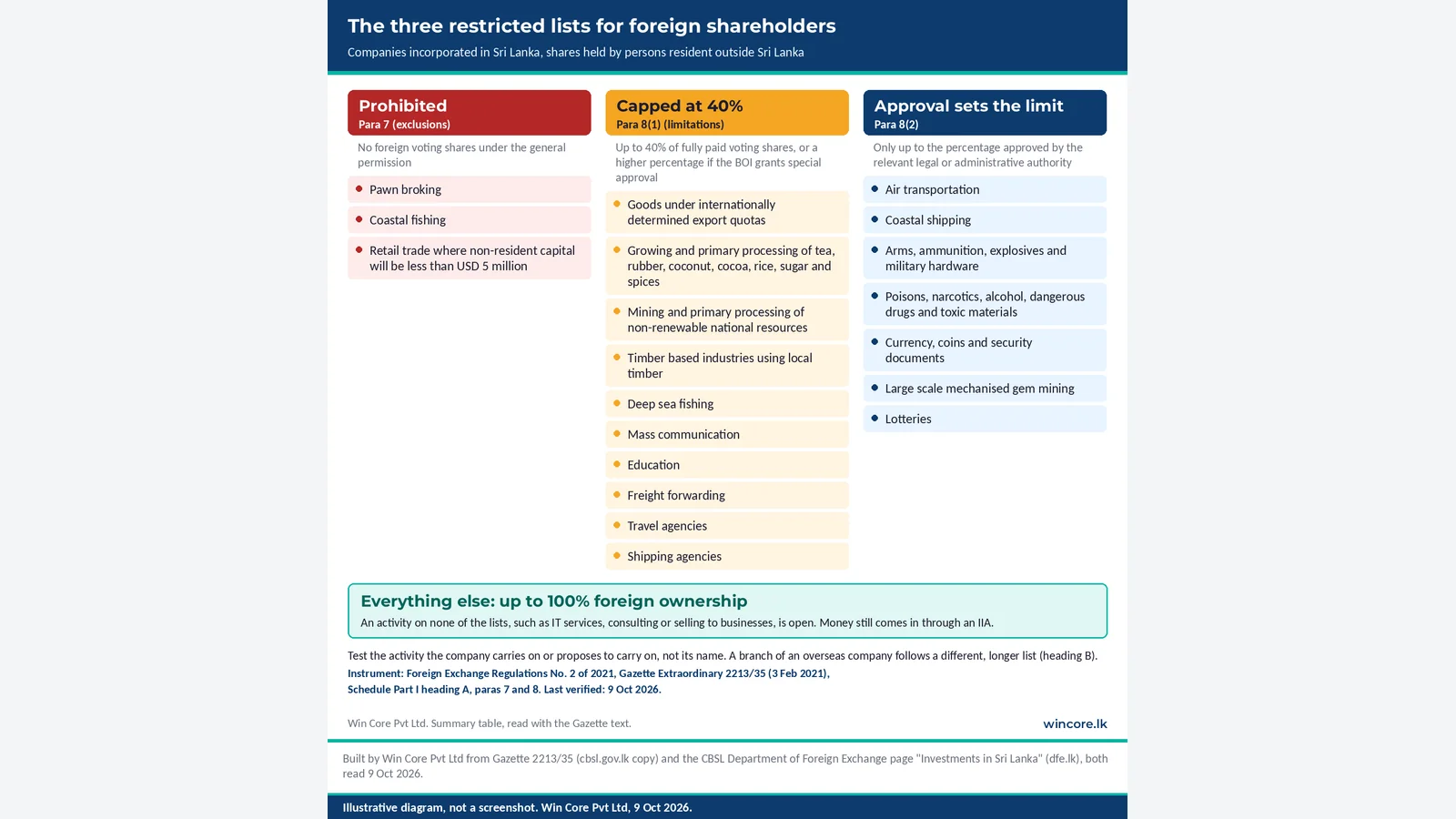
Most Sri Lankan companies can be 100 percent foreign owned. The three restricted lists in Gazette 2213/35, the retail test and the BOI route.
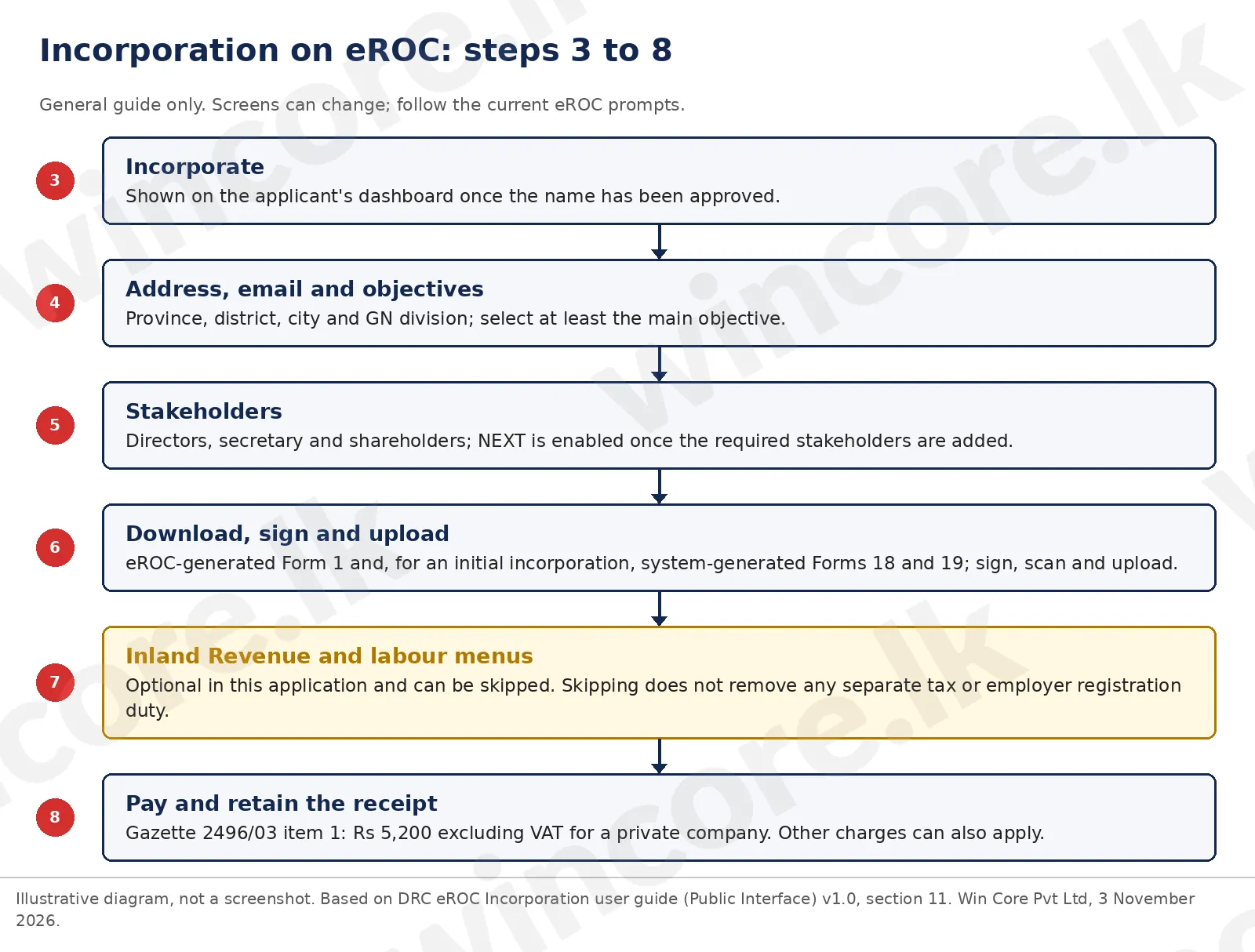
Registering a private limited company in Sri Lanka in 2026: structure, name approval, the eROC filing with BO 1 and BO 5, the TIN and the first year.
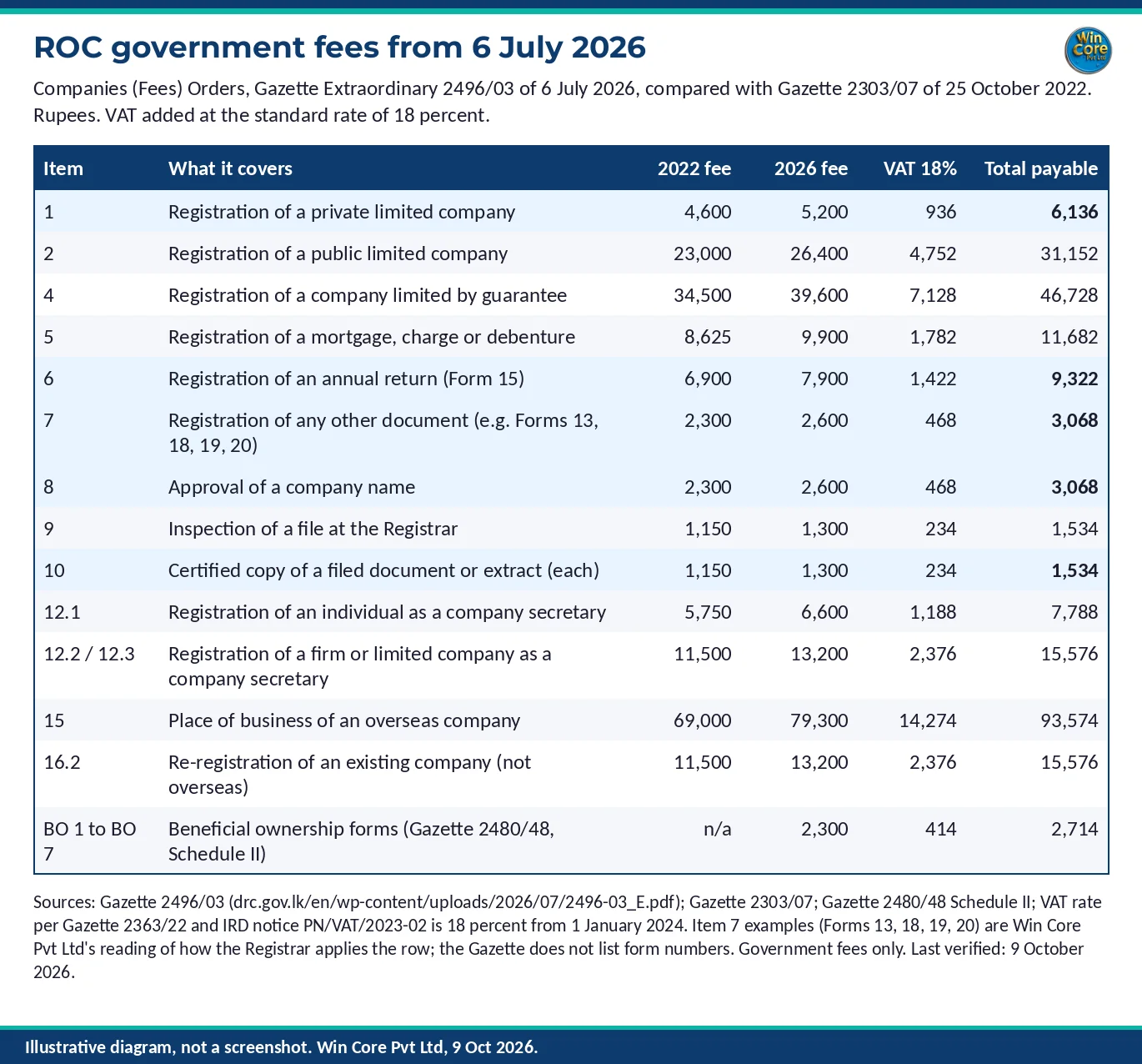
Every Registrar of Companies fee from 6 July 2026 with VAT added, and worked costs for an incorporation, a late Form 15 and a secretary change.