
Remittance tax Sri Lanka: the 14 percent on branch profits sent home
A branch that sends profit to head office pays a second tax at the exit. The rate, what counts as remitted, the 30 day clock and the zero rate route.
On this page
Last verified against the primary sources on 21 October 2026.
Remittance tax in Sri Lanka is a final tax of 14 percent on the gross amount of profits that a non-resident's Sri Lankan branch remits, keeps abroad or receives abroad, payable to the Commissioner-General on or before the thirtieth day after each remittance (Inland Revenue Act, No. 24 of 2017, s.62 and First Schedule paragraph 9) [1]. Neither Act No. 2 of 2025 nor Act No. 11 of 2026 changed it [2] [3]. Since the year of assessment 2021/22, income retained and invested in Sri Lanka for three years can be remitted at zero percent.
A subsidiary's profit leaves as a dividend. A branch has no shares and pays no dividends, so Sri Lanka taxes the exit instead. Corporate income tax is paid at the meter; remittance tax is paid at the gate, on whatever passes through it, with no further deductions.
Take a hypothetical Sri Lankan branch of an overseas engineering contractor. It has paid income tax for 2026/27 and wants to send Rs 10 million to head office in March 2027. How much is due, by when, and is there a lawful way to pay nothing? If you are still choosing a structure, our decision guide on choosing a subsidiary, branch or representative office comes first.
Remittance tax in Sri Lanka is 14 percent of the gross amount, and it is final
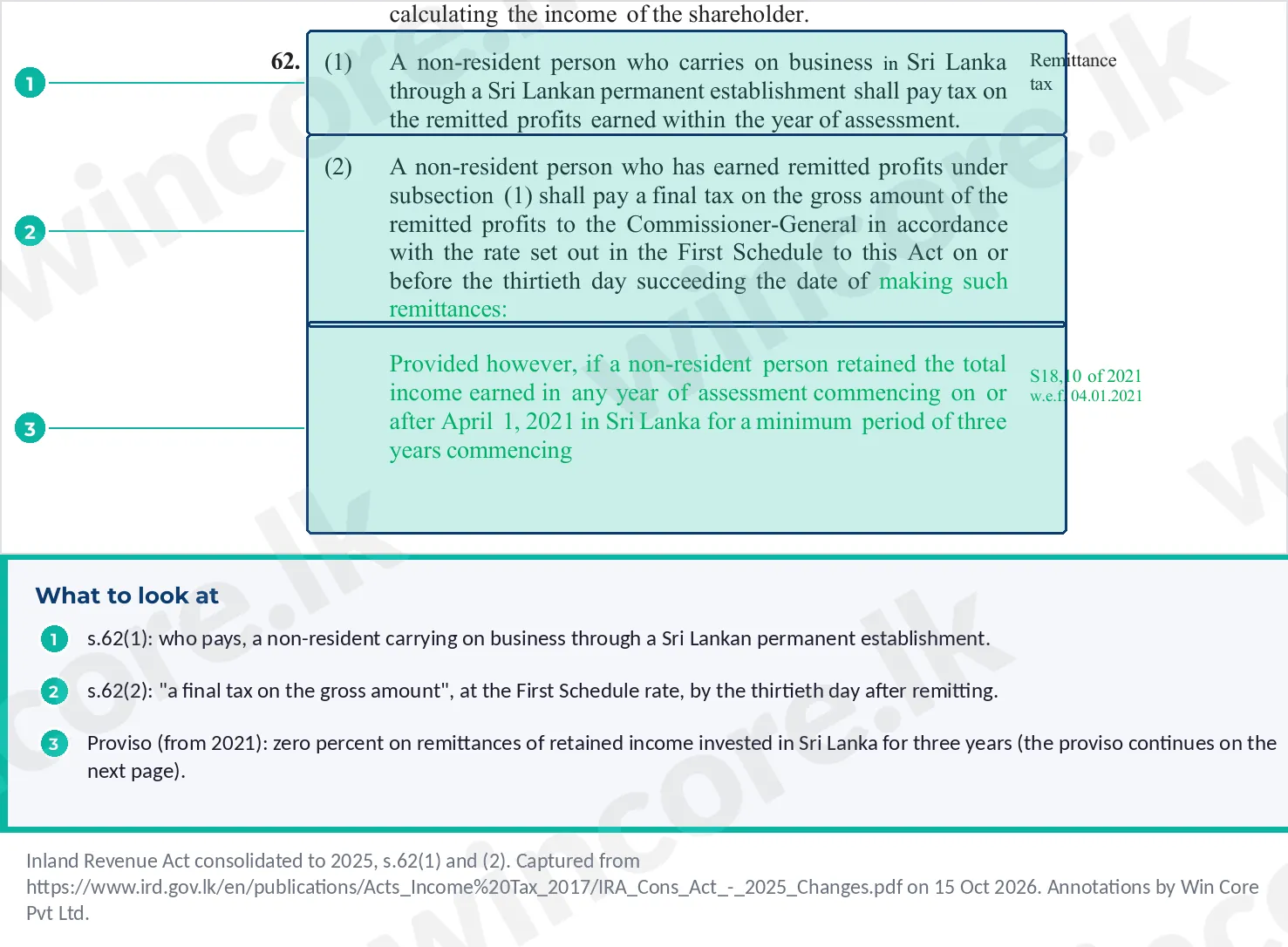
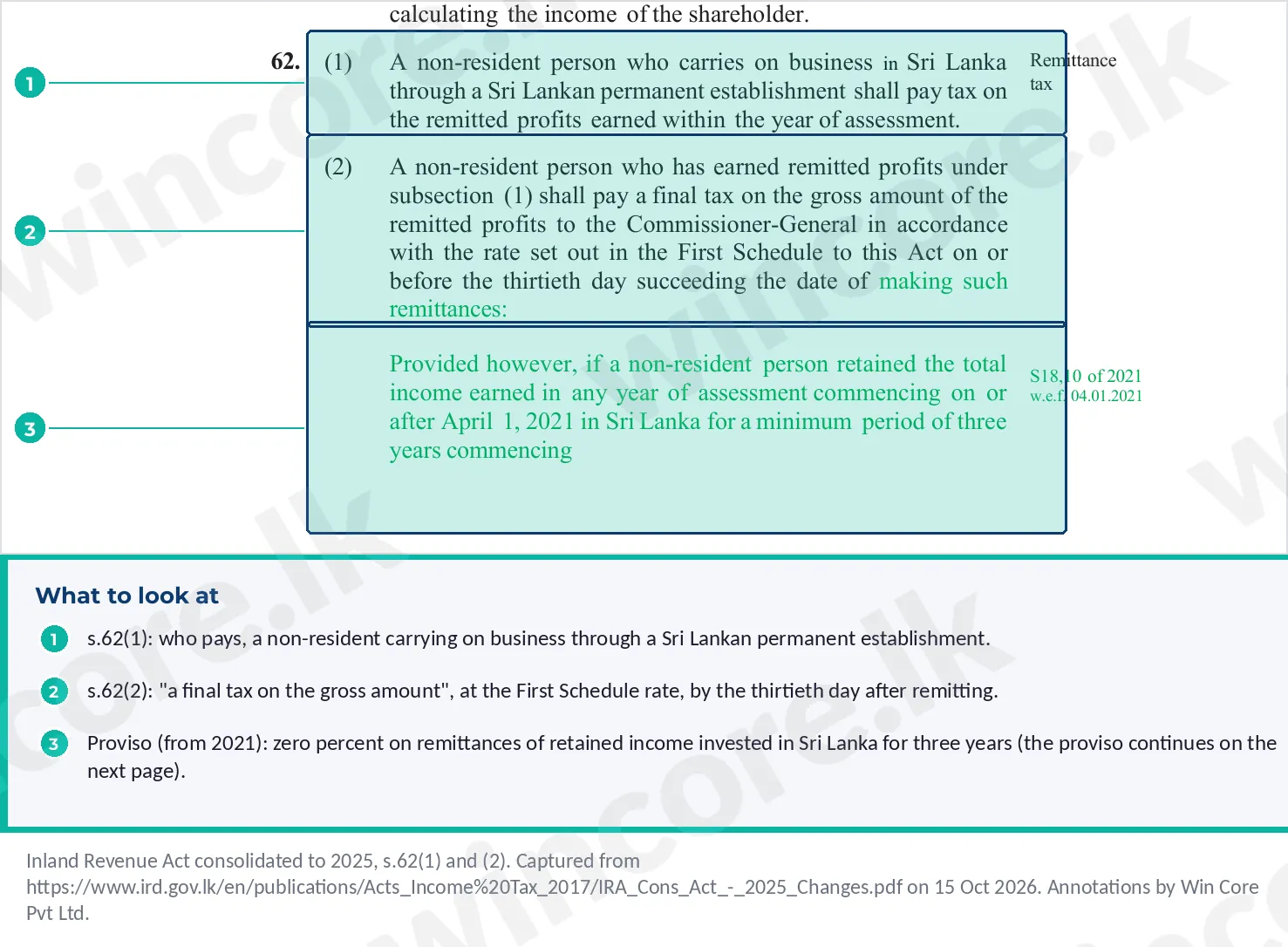
Section 62(1) says who pays: "A non-resident person who carries on business in Sri Lanka through a Sri Lankan permanent establishment shall pay tax on the remitted profits earned within the year of assessment" [1]. In practice that is the registered branch of an overseas company, and the person liable is the non-resident company itself, because a branch is not a separate legal person.
Section 62(2) sets the base and the character of the tax: the non-resident "shall pay a final tax on the gross amount of the remitted profits to the Commissioner-General in accordance with the rate set out in the First Schedule" [1]. Two words carry the weight. "Final" means it is not a credit against income tax and is not refunded when the year's return is filed. "Gross" means no deductions at the gate: the branch's costs were already allowed when its income tax was computed.
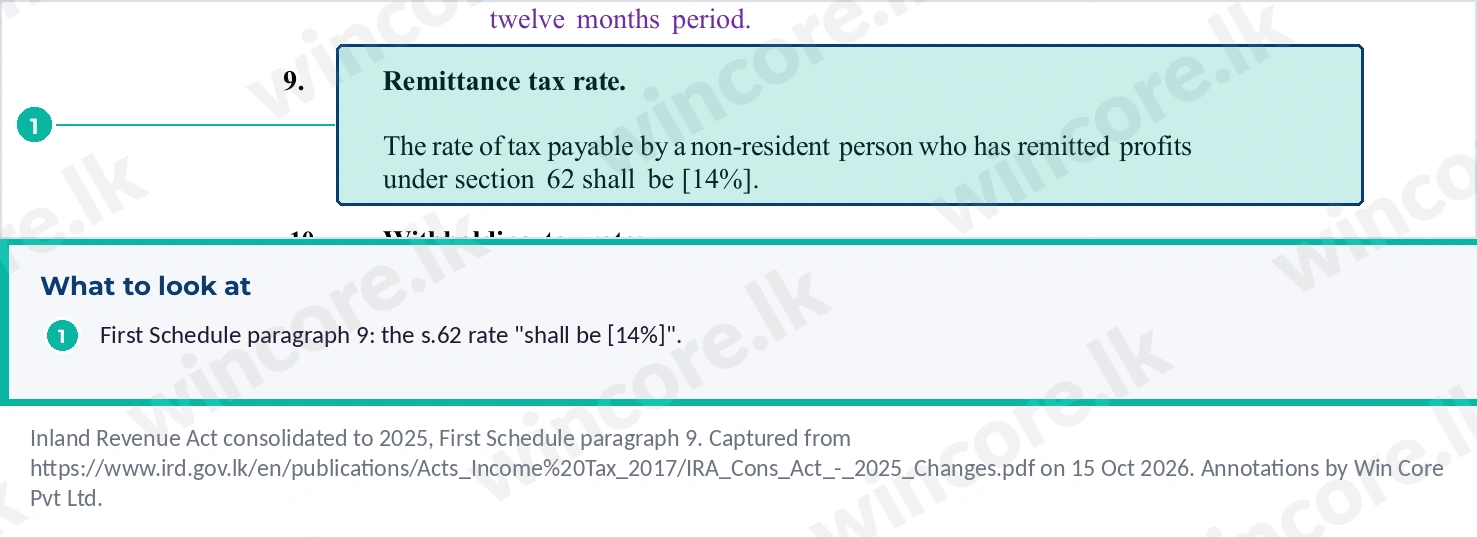
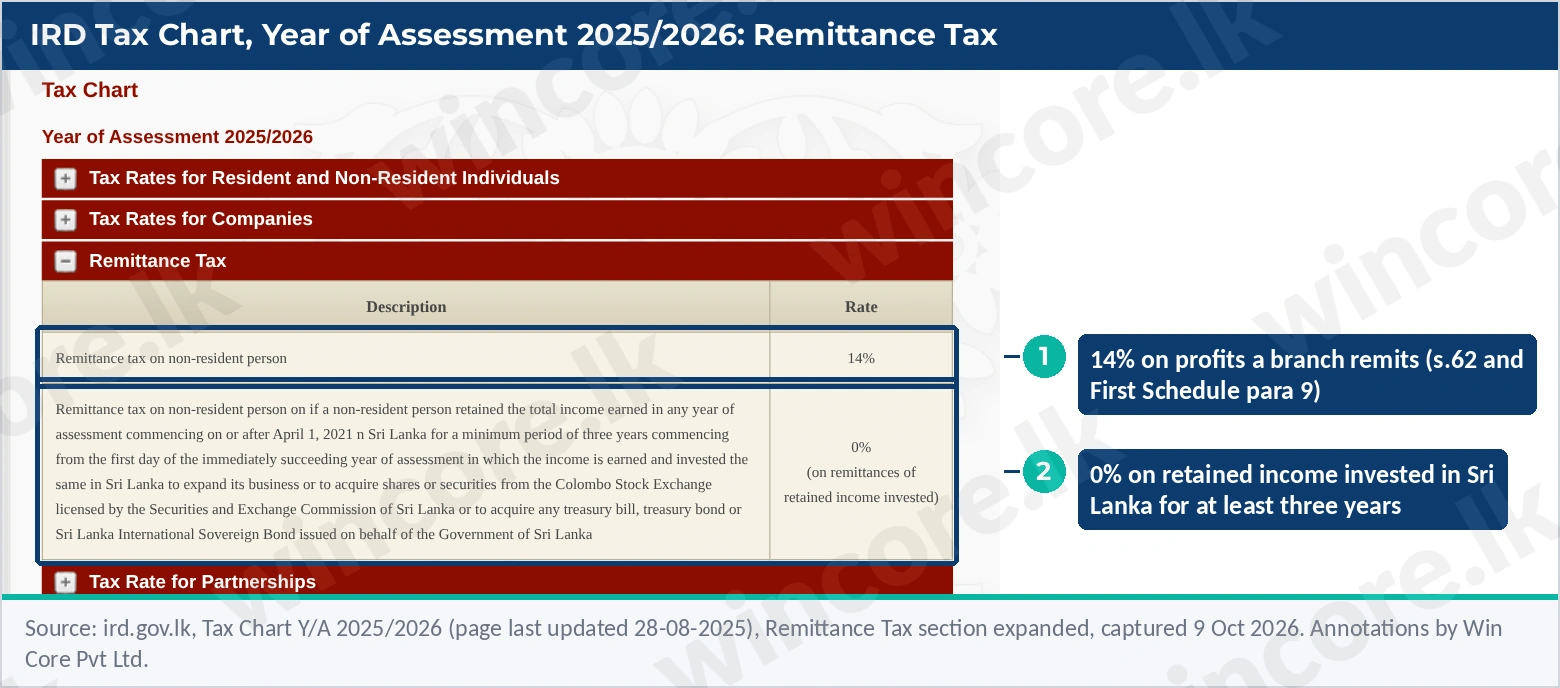
The rate is in paragraph 9 of the First Schedule: "The rate of tax payable by a non-resident person who has remitted profits under section 62 shall be [14%]" [1]. The IRD's Tax Chart for the year of assessment 2025/26 shows the same 14 percent, and the zero rate condition beside it [4].
Remittance tax sits on top of income tax. On Rs 100 of taxable branch profit at the standard 30 percent company rate (First Schedule paragraph 4(1)(d)) [1], income tax takes Rs 30 and leaves Rs 70. Remitting all Rs 70 costs 14 percent of it, Rs 9.80, so the combined charge is Rs 39.80. Where the income qualifies for the 15 percent rate on services used outside Sri Lanka and paid in foreign currency, covered in our guide to foreign service export tax, the same arithmetic gives Rs 15 plus 14 percent of Rs 85, about Rs 26.90. Our corporate income tax guide sets out the rates themselves.
Remitted profits include money kept or received abroad, not only transfers
"Remitted profits" in s.62(3) has more reach than the phrase suggests [1]:
| Limb | Words of s.62(3) | What it catches |
|---|---|---|
| Remitted | "amounts remitted ... out of the profits and income of the non-resident person that are subject to income tax in Sri Lanka" | A transfer to head office out of taxed profits |
| Retained abroad | amounts "retained abroad" out of those profits and income | Taxed profits that never come into Sri Lanka |
| Received abroad | "any amount received outside Sri Lanka by or on behalf of the non-resident person from conducting business in Sri Lanka that is subject to income tax in Sri Lanka" | A customer paying head office directly for the branch's work |
| Excluded | "excluding dividends paid by a resident company to the nonresident person" | Dividends from a Sri Lankan subsidiary, which are not branch remittances |
The first two limbs speak of "profits and income". The third says "any amount received", not "profits". On our reading the words can reach the gross receipt, not only the profit inside it. That reading is ours and is kept as an open point below, together with the harder question of what "the date of making such remittances" is for money that never moved.
The practical message is simpler than the drafting: "no transfer, no tax" is wrong. If head office invoices and collects for work the branch performs, the collection itself can be a remitted profit.
Each remittance starts its own 30 day clock, and paying late costs 20 percent plus interest
Payment is due "on or before the thirtieth day succeeding the date of making such remittances" (s.62(2)) [1]. There is no annual due date for the payment; the return of income reports remittance tax afterwards, and the 2025/26 corporate return schedules carry a "Tax on Remittances" schedule [5]. So the diary works transfer by transfer.
Example 1, one remittance (hypothetical). The branch sends Rs 10,000,000 to head office on 10 March 2027. Tax: 14 percent of Rs 10,000,000 = Rs 1,400,000, due on or before 9 April 2027, the thirtieth day after the transfer.
Example 2, two remittances in one month (hypothetical). Rs 4,000,000 on 5 June 2027 and Rs 6,000,000 on 25 June 2027. Two due dates: Rs 560,000 by 5 July 2027 and Rs 840,000 by 25 July 2027. Batching them into one payment on 25 July makes the first one late.
Example 3, paid late (hypothetical). The Rs 1,400,000 from Example 1 is paid on 30 April 2027, 21 days after the due date.
- Interest runs from the due date under s.157 at "one and one-half per cent per month or part month, computed monthly" (s.159(1)) [1]. Twenty one days is one part month: 1.5 percent of Rs 1,400,000 = Rs 21,000.
- The late payment penalty is 20 percent of the tax due but not paid under s.179(1): Rs 280,000. The IRD's own return guide states the 20 percent [6]. The IRD consolidation prints the fourteen day window in s.179(1) ("within fourteen days of the due date") [1], as does a Secondary reproduction of the Act [7]. Twenty one days is outside it.
- Section 179(1) speaks of "a tax due for a tax period". Remittance tax is due per transfer, not per period. We read s.179(1) as applying, and flag the fit as open.
- From the year of assessment 2026/27, unpaid tax can also be recovered through a Magistrate's Court on the Commissioner-General's certificate, under the new s.163(4A) inserted by s.28(4) of Act No. 11 of 2026 [3].
The instalment penalty in s.179(2), 10 percent, is for income tax instalments and does not apply here. If you want to model the late cost for a different amount, our tax penalty calculator runs the interest and penalty arithmetic.
Retained and invested income can go home at zero percent after three years
The proviso to s.62(2), added by s.18 of Act No. 10 of 2021 [8], reads: "if a non-resident person retained the total income earned in any year of assessment commencing on or after April 1, 2021 in Sri Lanka for a minimum period of three years commencing from the first day of the immediately succeeding year of assessment in which the income is earned and invested the same in Sri Lanka to expand its business or to acquire shares or securities from the Colombo Stock Exchange licensed by the Securities and Exchange Commission of Sri Lanka or to acquire any treasury bill, treasury bond or Sri Lanka International Sovereign Bond issued on behalf of the Government of Sri Lanka, the tax rate on remittances of such retained income invested shall be zero percent" [1].
| Condition | Words of the proviso | For income earned in 2026/27 |
|---|---|---|
| Which income | "the total income earned in any year of assessment commencing on or after April 1, 2021" | 2026/27 qualifies by year |
| Kept where | "in Sri Lanka" | Not held in a head office account abroad |
| How long | "a minimum period of three years commencing from the first day of the immediately succeeding year of assessment" | 1 April 2027 to 31 March 2030 |
| Invested how | Expanding the business; shares or securities from the CSE; treasury bills, treasury bonds or Sri Lanka International Sovereign Bonds | Keep the evidence for each |
| Result | "the tax rate on remittances of such retained income invested shall be zero percent" | Remittances of that income from 1 April 2030 |
Two phrases narrow it. "The total income earned" speaks of the year's whole income; the text does not say whether keeping part of it earns part relief. And "such retained income invested" attaches the zero rate to income that was both kept and invested, so cash left idle in a current account does not qualify on the words.
Example 4, the end to end numbers (hypothetical). The contractor's branch earns Rs 50 million of taxed income in 2026/27.
- If it remits Rs 10 million in March 2027, that remittance pays Rs 1,400,000 by 9 April 2027.
- If it then invests the other Rs 40 million in treasury bonds from April 2027 and holds them to 31 March 2030, the zero rate is available on the remittance of that Rs 40 million from 1 April 2030 only if retaining part of a year's income counts. On a strict reading of "the total income", the March remittance takes 2026/27 out of the proviso altogether and the later Rs 40 million pays Rs 5,600,000.
- If it remits nothing from 2026/27 income and invests all Rs 50 million for the three years, the proviso is met on its plain words, and the Rs 7,000,000 that a 14 percent remittance would cost falls to nil.
That is why the timing of the first remittance matters more than its size.
What this means for you
Plan remittances by date and by the year the profit was earned, before money moves.
- Diarise 30 days from each transfer and pay each one separately.
- Track amounts head office collects abroad for the branch's Sri Lankan work. They can be remitted profits without any transfer.
- Decide the zero rate question before the first remittance of a year, not after, because of the "total income" wording.
- Keep a schedule by year of origin, so any later remittance can be traced to retained and invested income of a given year, with the investment evidence beside it.
- Reconcile the head office account in the branch books to every remittance, so each transfer can be traced to the year of profit it came from.
Our income tax advisory services team prepares remittance tax workings, payments and the return schedule for branches, and our foreign branch registration team handles the set up.
Checklist: documents needed
- Bank advice for every transfer to head office, with its date
- Remittance tax computation for each transfer (14 percent of the gross amount)
- Proof of payment within 30 days of each transfer
- List of amounts head office received abroad for the branch's Sri Lankan work
- Schedule of profits by year of origin: remitted, retained, invested
- Investment evidence for any zero rate claim (expansion spend, CSE contract notes, treasury bill or bond statements)
- Head office account reconciliation in the branch books
- Return of income schedule reporting tax on remittances
Frequently asked questions
What is the remittance tax rate in Sri Lanka?
The remittance tax rate is 14 percent. It is set by paragraph 9 of the First Schedule to the Inland Revenue Act and charged under s.62 on the gross amount of profits a non-resident's Sri Lankan branch remits, keeps abroad or receives abroad. The IRD's Tax Chart for 2025/26 shows the same rate, with a zero rate for qualifying retained and invested income [1] [4].
When must remittance tax be paid?
Remittance tax must be paid on or before the thirtieth day after each remittance. The clock runs separately for every transfer, so two transfers in one month have two due dates. Late payment adds interest at 1.5 percent a month or part month from the due date and, after fourteen days, a 20 percent penalty on the unpaid tax under s.179(1), on our reading of how that section fits [1].
Does a Sri Lankan subsidiary pay remittance tax on dividends?
No, dividends paid by a resident company are expressly excluded from remitted profits in s.62(3). A subsidiary is a separate Sri Lankan company, so its dividends to a foreign parent are dealt with under the dividend rules, not s.62. Remittance tax is a branch tax: it applies to a non-resident carrying on business through a Sri Lankan permanent establishment [1]. For those dividend rules, see dividend tax and the 15% final AIT.
Is remittance tax due if no money is transferred?
It can be, because remitted profits include taxed profits retained abroad and any amount received outside Sri Lanka for the branch's Sri Lankan business. A customer paying head office directly for work the branch performed is the usual case. Track those receipts as carefully as transfers, because the Act does not wait for money to leave a Sri Lankan account [1].
How can a branch pay zero percent remittance tax?
A branch can pay zero percent by keeping a year's total income in Sri Lanka for three years from the start of the next year of assessment and investing it in the business, in CSE shares or securities, or in government treasury bills, bonds or sovereign bonds. Remittances of that retained income invested are then at zero percent. Whether part retention qualifies is not settled [1].
Open points we are keeping open
- Part retention. Whether retaining part of a year's income earns part relief, given "the total income earned".
- Received abroad limb. Whether "any amount received" means the gross receipt, and what the remittance date is for money that never moved.
- Section 179(1) and "tax period". Applied here on our reading.
- Tax treaties. A treaty may limit a branch profits tax; we have not reviewed any treaty for this article.
- Concession instruments. A BOI or Strategic Development Project agreement may carry its own terms; check the instrument itself.
- Margin note. The consolidation's margin note for the proviso reads "w.e.f. 04.01.2021"; the proviso's own words refer to years of assessment from 1 April 2021.
We read s.62, the First Schedule and ss.157 and 159 in the IRD consolidation, checked Acts No. 2 of 2025 and No. 11 of 2026 for amendments, and checked the IRD Tax Chart and the IRD return guide, on 21 October 2026. The consolidation is the IRD's convenience text, not the official one; the Acts are.
Remittance tax is 14 percent of the gross, paid within 30 days of every transfer, and it reaches money kept or collected abroad. Count the days from each transfer, and decide on the zero rate before the year's first remittance.
This article is general information, not advice for your specific situation.
Talk to us. If your branch is planning its first remittance or wants to test the zero rate route, book a consultation at our contact page.
WinCore Pvt Ltd
References
- Inland Revenue Department. Inland Revenue Act, No. 24 of 2017, consolidated text incorporating amendments up to 31 March 2025, ss.62, 157, 159, 179 and First Schedule paragraphs 4(1)(d) and 9. https://www.ird.gov.lk/en/publications/Acts_Income%20Tax_2017/IRA_Cons_Act_-_2025_Changes.pdf . Primary (IRD convenience consolidation). Accessed 21 October 2026.
- Parliament of Sri Lanka. Inland Revenue (Amendment) Act, No. 2 of 2025. https://www.ird.gov.lk/en/publications/Acts_Income%20Tax_2017/IR_Act_No_02-2025_E.pdf . Primary. Accessed 15 October 2026.
- Parliament of Sri Lanka. Inland Revenue (Amendment) Act, No. 11 of 2026 (certified 3 June 2026), s.28(4) (new s.163(4A)); no amendment to s.62 or First Schedule paragraph 9. https://www.ird.gov.lk/en/publications/Acts_Income%20Tax_2017/IR_Act_No_11-2026_E.pdf . Primary. Accessed 21 October 2026.
- Inland Revenue Department. Tax Chart, Year of Assessment 2025/2026, Remittance Tax section (last updated 28 August 2025). https://www.ird.gov.lk/en/publications/SitePages/tax_chart_2526.aspx . Primary. Accessed 21 October 2026.
- Inland Revenue Department. Schedules to Return of Income, Part A, Year of Assessment 2025/2026 (Asmt_CIT_002A_E), Schedule 05, Tax on Remittances. https://www.ird.gov.lk/en/Downloads/IT_Corporate_Doc/Asmt_CIT_002A_2025_2026_E.pdf . Primary. Accessed 9 October 2026.
- Inland Revenue Department. Guide to the Return of Income Tax, Year of Assessment 2025/2026, Section 09 (penalty of 20 percent of the tax due but not paid). https://www.ird.gov.lk/en/Downloads/IT_Individuals_Doc/Asmt_IIT_004_2025_2026_E.pdf . Primary. Accessed 15 October 2026.
- Laws of Sri Lanka (srilankalaw.lk). Inland Revenue Act, revised statutes, s.179(1). https://www.srilankalaw.lk/revised-statutes/volume-iv/1680-inland-revenue-act-1.html . Secondary. Accessed 21 October 2026.
- Parliament of Sri Lanka. Inland Revenue (Amendment) Act, No. 10 of 2021, s.18 (proviso to s.62(2)). https://www.ird.gov.lk/en/publications/Acts_Income%20Tax_2017/IR_Act_No._10_2021_E.pdf . Primary. Accessed 9 October 2026.
Put these insights to work
WinCore specialists can review your current workflow, document gaps, and build a practical 90-day action plan.
Book a free consultationContinue reading
Explore more WinCore analysis to keep your finance, tax, and compliance roadmap moving.

Since 1 April 2025, profits from services used outside Sri Lanka and paid in foreign currency through a bank are taxed at 15%. The conditions and the records to keep.
Four ways a foreign company can enter Sri Lanka, set side by side: what each may do, the money each needs, how each is taxed, and what is still open.
Sri Lanka corporate income tax guide: rates, taxable income, quarterly instalments, deductions, capital allowances, and key compliance penalties.