
Retail trade foreign investment in Sri Lanka: the test is the buyer
Who you sell to decides it: the Gazette 2213/35 retail definition, the USD 5 million line, the branch wording and the cases the text leaves open.
On this page
Last verified against the primary sources on 21 October 2026.
The rule on retail trade foreign investment in Sri Lanka sits in Gazette Extraordinary No. 2213/35, in operation since 22 March 2021: non-residents may not hold voting shares in a company carrying on, or proposing to carry on, retail trade where capital contributed by non-residents "will be less than USD 5 Million" [1]. "Retail trade" means reselling goods, without transformation, to the general public for personal or household use. So the line is drawn at the buyer. The same goods can be open or closed depending on who buys them and for what.
A foreign-owned company can import and sell exactly what a shop sells. If its buyers are other businesses, it is outside the definition. If its buyers are households, it is inside, and below USD 5 million of non-resident capital that is a closed activity. This piece reads the definition word by word, sets the company rule beside the branch rule, and works through the cases the text does not settle. It builds on our guides to 100 percent foreign ownership in Sri Lanka and to the bands in Gazette 2213/35.
Retail trade foreign investment in Sri Lanka turns on the buyer, not the product
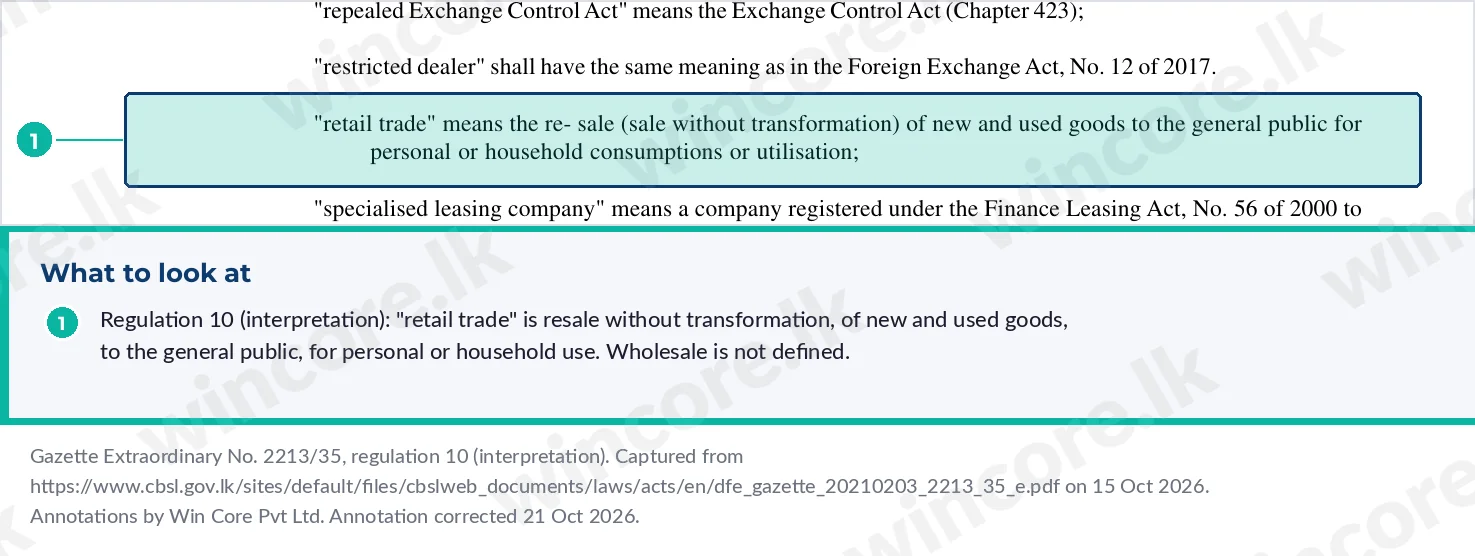
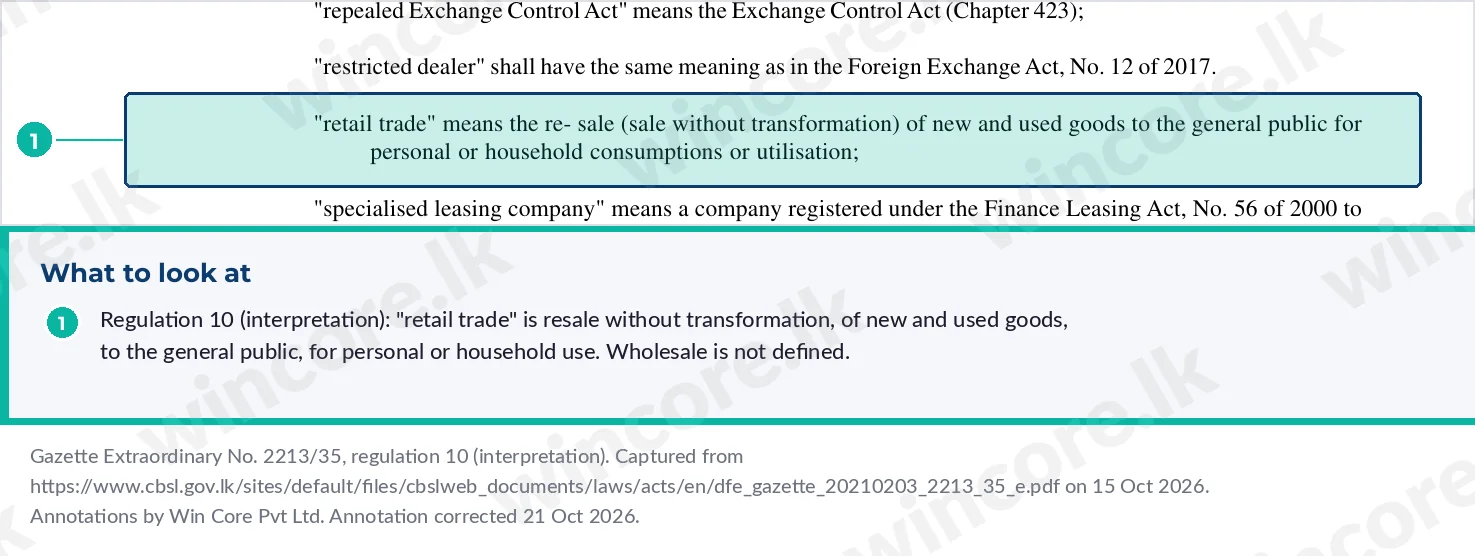
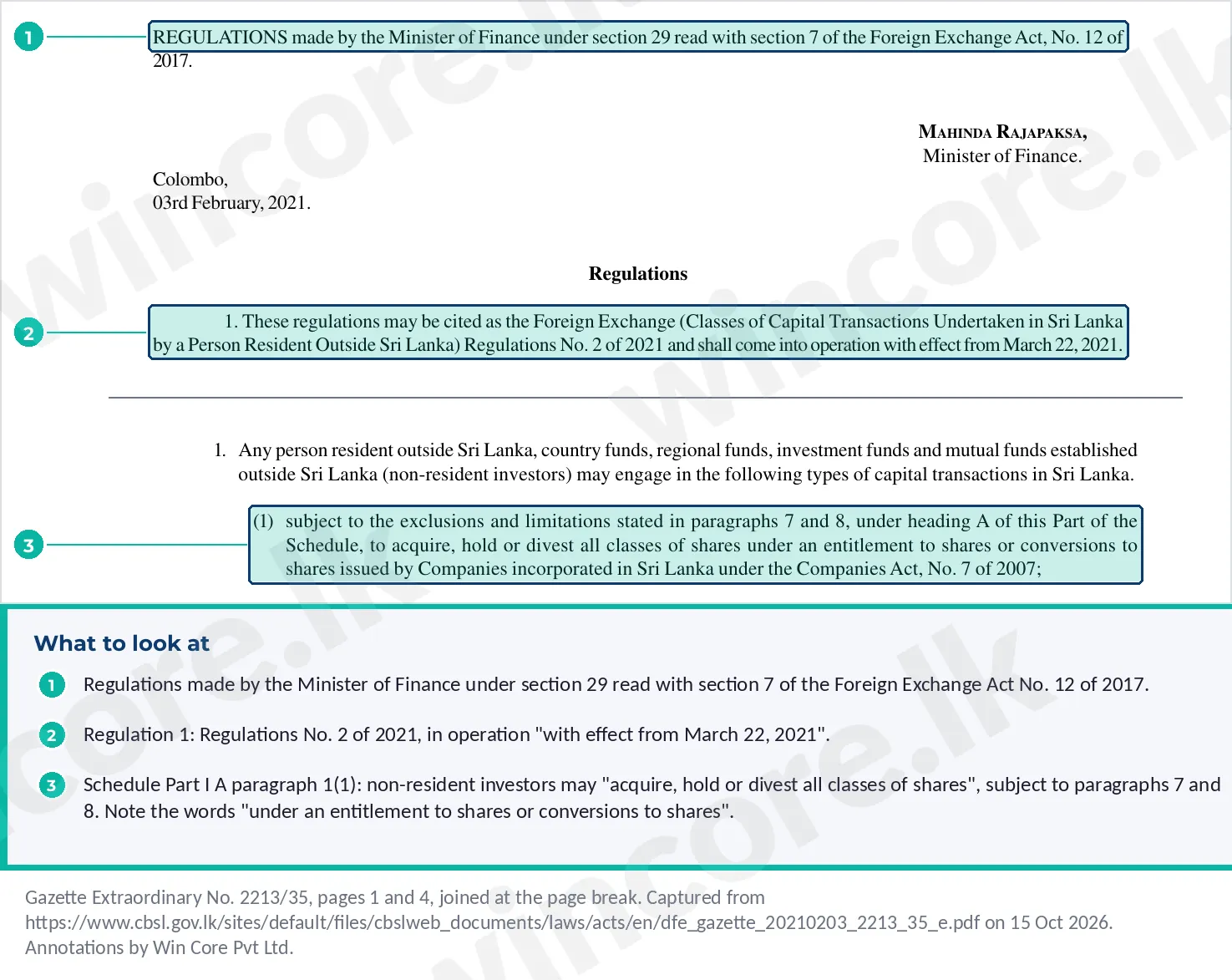
The instrument is the Foreign Exchange (Classes of Capital Transactions Undertaken in Sri Lanka by a Person Resident Outside Sri Lanka) Regulations No. 2 of 2021, made under section 29 read with section 7 of the Foreign Exchange Act, No. 12 of 2017 [1]. Its interpretation clause, regulation 10, says: "'retail trade' means the re- sale (sale without transformation) of new and used goods to the general public for personal or household consumptions or utilisation" [1].
Every element of the definition narrows it.
| Element | What it covers | What it leaves out |
|---|---|---|
| "re- sale (sale without transformation)" | Buying goods and selling them on as they are | A manufacturer selling goods it made |
| "new and used goods" | Physical goods, second-hand included | Services |
| "to the general public" | Consumers | Businesses buying to resell or to use in their business |
| "for personal or household consumptions or utilisation" | Consumer use | Business use |
The Regulations do not define "wholesale" at all. There is no wholesale category to qualify for and no wholesale licence in this instrument. The only question is whether an activity is "retail trade" as defined, and that is why the answer turns on the buyer. Our guide to foreign ownership reads the definition the same way: a company that sells only to shops, hotels, contractors or distributors is outside it.
Once the ownership route is established, check VAT registration for a foreign-owned importer before the first commercial shipment.
Below USD 5 million, non-residents cannot hold voting shares in a retail company
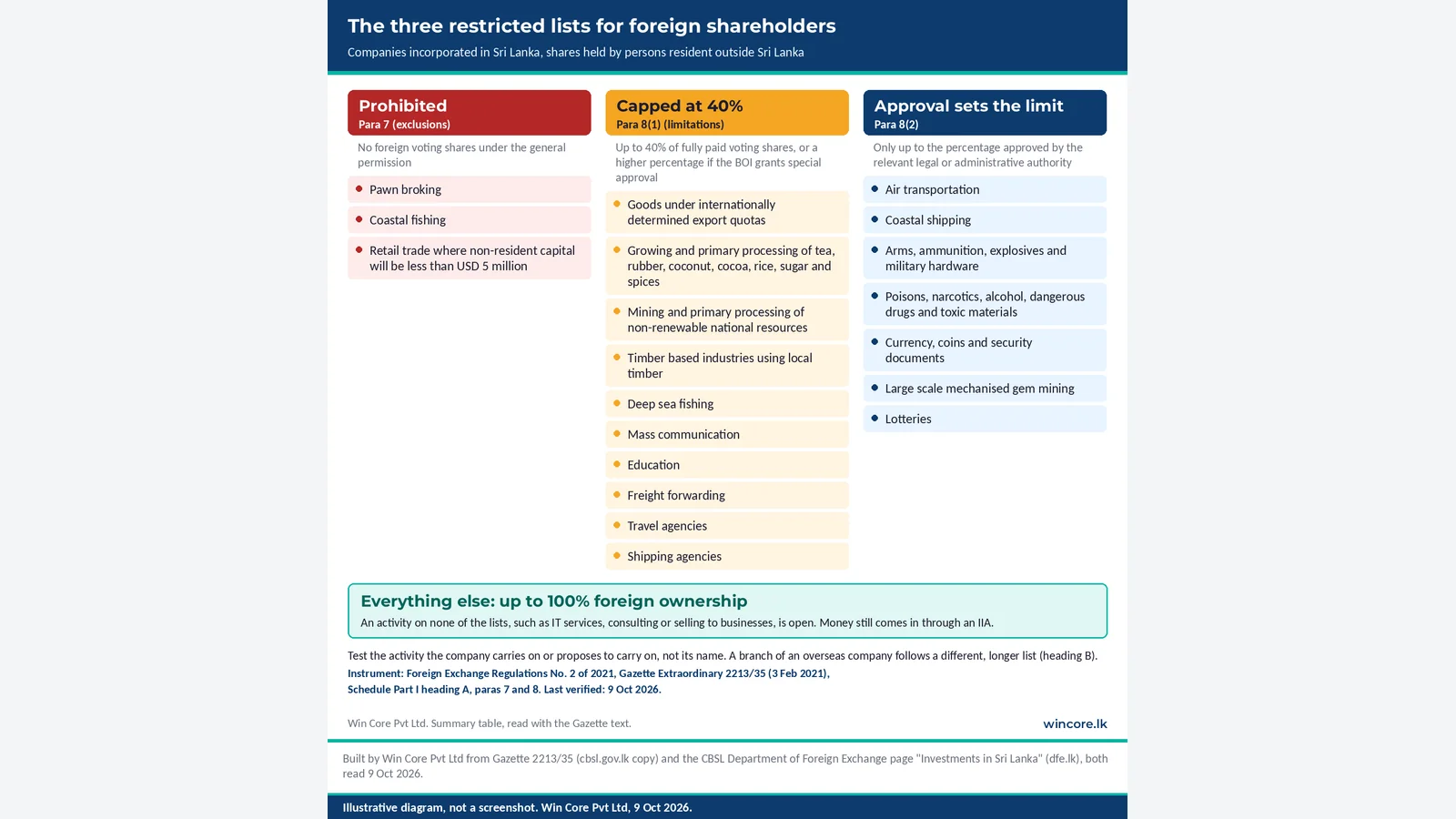
Part I A paragraph 1(1) of the Schedule lets non-resident investors acquire, hold or divest shares in Sri Lankan companies "subject to the exclusions and limitations stated in paragraphs 7 and 8" [1]. Paragraph 7 is the exclusion: "The permission under subparagraph (1) of paragraph 1 under heading A of this Part shall not apply in respect of voting shares of a company proposing to carry on or carrying on any of the following businesses- (1) pawn broking; (2) coastal fishing ...; (3) retail trade where capital contributed by persons resident outside Sri Lanka will be less than USD 5 Million" [1].
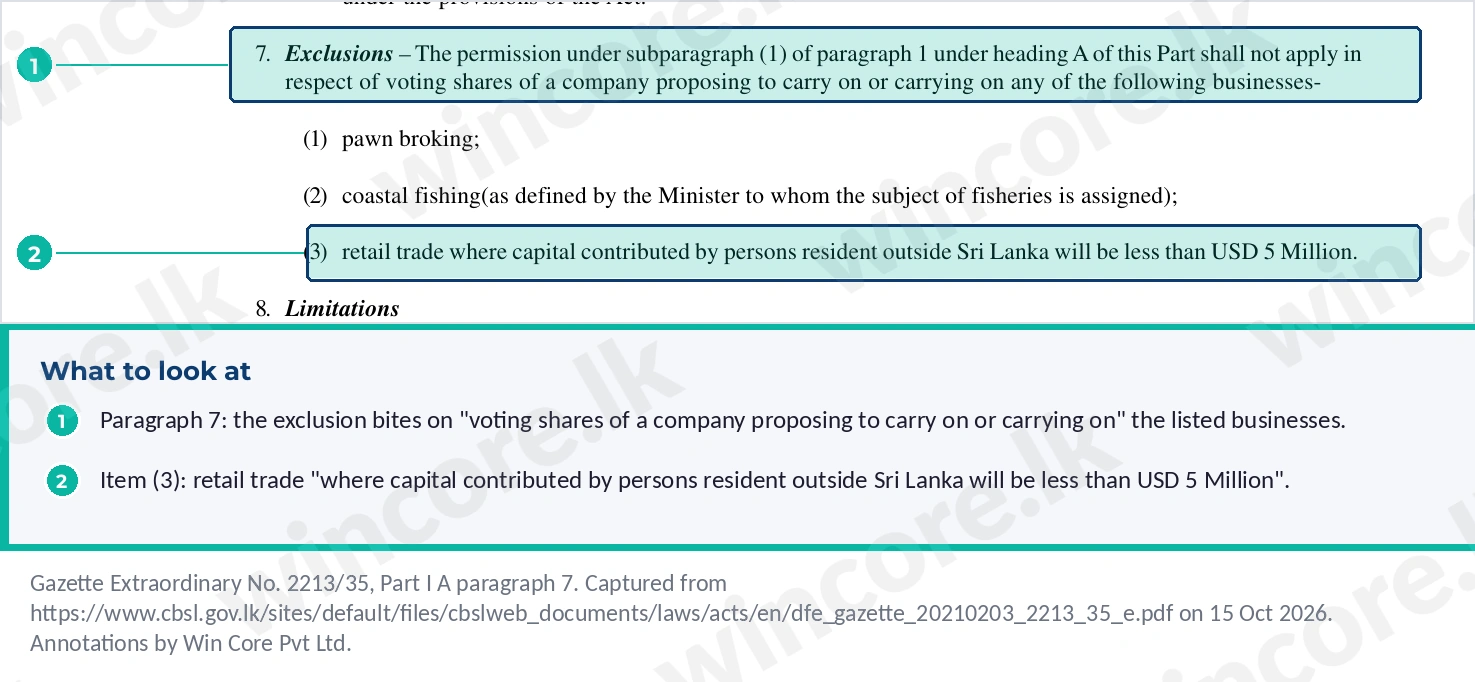
Three limits are built into those words.
- The size proviso. The exclusion applies only where non-resident capital "will be less than USD 5 Million". At or above that figure, retail trade is not excluded by paragraph 7.
- Voting shares. The exclusion is "in respect of voting shares". Our Gazette 2213/35 guide covers what that leaves open; we do not repeat it here.
- "Proposing to carry on or carrying on". The test looks forward as well as at the present. On our reading, a company that plans a consumer channel is caught at the planning stage, not only on the day the channel opens.
The Department of Foreign Exchange restates the rule on its website: non-residents "cannot acquire voting shares in companies engaged in" retail trade "where the capital contributed by non-residents is less than USD 5 million" [3]. That page is guidance; the Gazette governs.
The Regulations have been amended by Gazettes 2235/22 (2021) and 2371/33, 2371/48 and 2371/49 (2024). Those dealt with listed securities, securities lending, short term loans and rupee conversion, and none changed paragraph 7 [4].
A branch faces the same line in different words, and a longer list
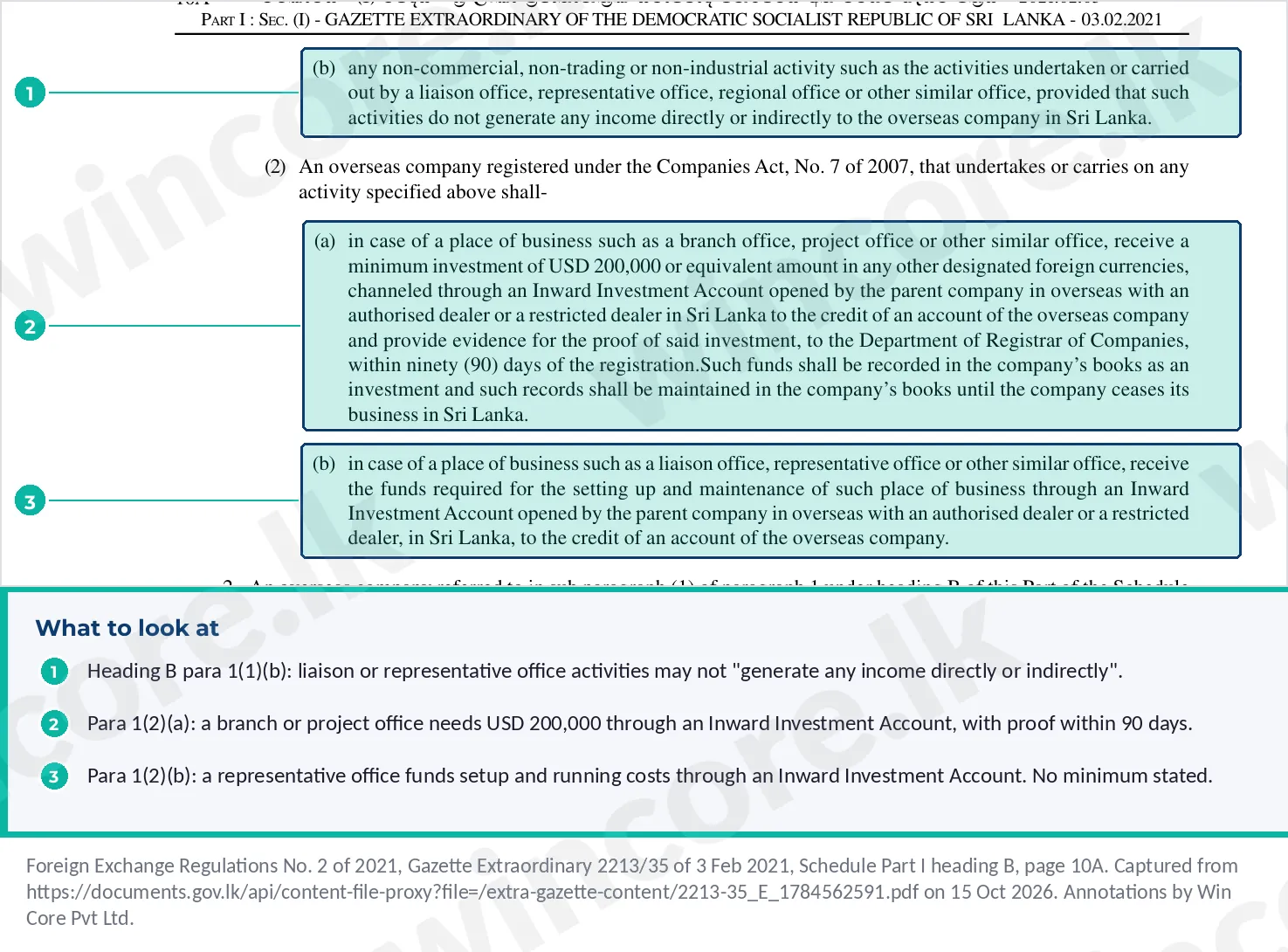
An overseas company opening a branch is not buying shares, so paragraph 7 does not reach it. Part I B paragraph 3 does. It lists activities "not permitted to be carried out by an overseas company", including "(3) retail trade where the capital contributed by persons resident outside Sri Lanka is less than USD 5 million after such investment" [1].
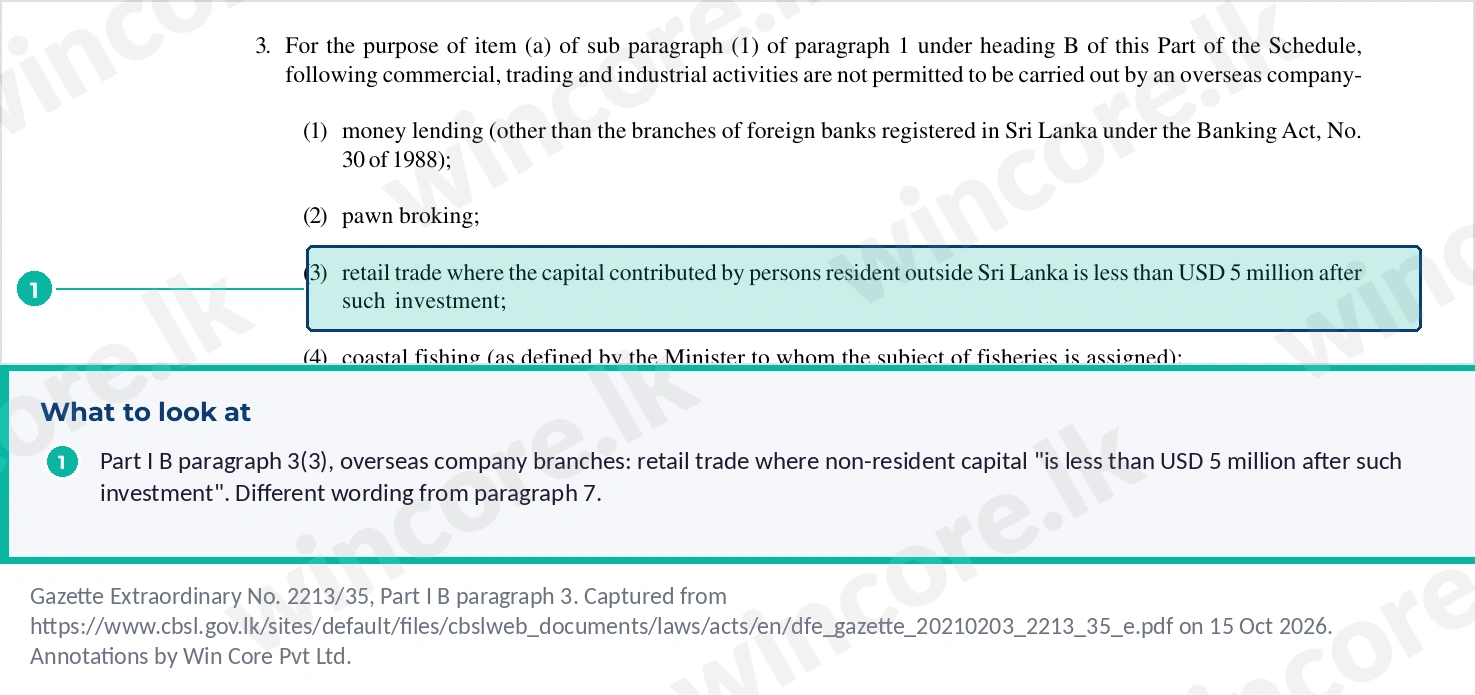
| Point | Company (Part I A para 7) | Branch (Part I B para 3) |
|---|---|---|
| Wording | "will be less than USD 5 Million" | "is less than USD 5 million after such investment" |
| What is restricted | Voting shares of the company | The activity of the overseas company |
| Other items on the same list | Pawn broking, coastal fishing | Money lending (other than foreign bank branches), pawn broking, coastal fishing, growing and primary processing of tea, rubber, coconut and rice, mining of non-renewable resources, freight forwarding, shipping agency business, mechanized gem mining, lotteries |
A branch also needs the separate USD 200,000 minimum investment through an Inward Investment Account under paragraph 1(2)(a) [1]. A trading branch must check the whole of paragraph 3, and paragraph 4 for activities that need prior permission, not only the retail item. Our comparison of a subsidiary, a branch and a representative office sets the structures side by side, and our foreign branch registration team handles the overseas company filing.
Mixed, online and repacked sales are where the test gets hard
Mixed sales. The definition has no percentage or de minimis rule. On our reading, a company that sells goods to consumers at all is carrying on retail trade in part. We found no text in the Regulations saying a small consumer share is ignored. Treat it as a risk, not a safe harbour.
Online sales. The definition does not mention channels. A household buying through a website or a marketplace is still "the general public" buying "for personal or household" use. On our reading, the channel does not change the answer.
Businesses buying for their own use. A hotel buying linen or a contractor buying tools is buying for business use, which is outside "personal or household" use. A sole trader buying for the business is in the same position. Keep evidence of who the buyer is.
Manufacturers. "Sale without transformation" takes a company selling goods it has made outside the definition. A company that imports finished goods and only repacks or labels them is harder. The Regulations do not define transformation, so that point is open.
Services. The definition covers "goods" only. On our reading, a pure service business is not retail trade under this definition, although sector rules may still apply.
The USD 5 million is non-resident capital, and the Regulations leave the method open
The test is "capital contributed by persons resident outside Sri Lanka" [1]. The Regulations do not say whether shareholder loans count, whether retained profits count, or whether the figure is measured at entry or over the life of the company. Share consideration must be routed through an Inward Investment Account under Part I A paragraph 4(1)(a), so the account statements are the natural record of what was contributed [1]. Our guide to the Inward Investment Account explains who opens it and how returns come back to it. The timing question stays open. If you need a rupee view of the threshold for planning, our currency converter gives a quick figure, but the Regulations state the test in US dollars.
The penalty falls under section 11(5) of the Foreign Exchange Act
| Who | Section | What it says |
|---|---|---|
| A person who is not an authorised dealer and acts in violation of s.11(1)(a) to (d) | Foreign Exchange Act s.11(5) | After the Minister is informed and a reasonable opportunity of being heard, the Central Bank may require payment of a penalty "not exceeding rupees one million" or "not exceeding the amount or value of such current transaction or capital transaction", plus its detection and investigation expenses [2] |
| An authorised dealer that deals contrary to the Act or the Regulations | Foreign Exchange Act s.11(1) to (4) | A notice to comply, temporary suspension, revocation after inquiry, payment up to the value of a foreign asset, or a limitation on dealing for up to twelve months [2] |
A penalty under s.11(5) can be appealed to the Board of Inquiry within thirty days under s.11(7)(b) [2]. How s.11(5) applies to an investor in a company that only later starts consumer sales is not spelled out, and we keep it open.
What this means for you
Decide your customers before you decide your structure. If you sell goods and non-resident capital will be under USD 5 million, write the business-to-business limit into the plan and keep to it, because the day the company proposes a consumer channel it is inside the exclusion.
- Write down the customer base in the business plan and the company's records before the investment.
- Check the capital figure against USD 5 million, and keep the Inward Investment Account statements that prove it.
- Keep invoices that show business buyers, with the buyer's business registration details.
- Before adding a consumer channel, reassess the structure. "Proposing to carry on" catches the plan.
- For a branch, check the full Part I B paragraph 3 and paragraph 4 lists.
Checklist: documents needed
- Business plan stating the customer base (businesses or consumers)
- Inward Investment Account statements showing non-resident capital contributed
- Sample sales invoices with business buyers' registration details
- Board minute recording any decision to add or refuse a consumer channel
- For a branch: proof of the USD 200,000 investment filed with the Registrar within 90 days
Our company registration team can check the plan against the Regulations before you incorporate, and our statutory secretarial services keep the share register and board records that show it. For the incorporation steps, see how to register a company in Sri Lanka.
A hypothetical example
A foreign-owned company imports office furniture with USD 750,000 of non-resident capital. It sells only to offices, hotels and furniture resellers, so on our reading it is outside the retail definition. It then plans a website selling desks to home buyers. At that point it is "proposing to carry on" retail trade with non-resident capital below USD 5 million. Its options, on our reading, are to bring non-resident capital to USD 5 million or more, or to keep consumer sales out of the company, for example by selling only through independent resellers.
FAQ
Can a foreign-owned company do wholesale trade in Sri Lanka?
Yes, wholesale is not excluded or capped by Gazette 2213/35. The Regulations do not define or list wholesale, so selling goods to businesses falls under the general permission in Part I A paragraph 1(1). That permission is still subject to paragraphs 7 and 8, so check that the goods or the business are not on those lists, and that sector laws add nothing [1].
Does selling to consumers online count as retail trade?
Yes, on the definition, if the buyers are the general public buying for personal or household use. The definition says nothing about shops or channels, so a website, an app or a marketplace listing reaching households is retail trade on our reading. Below USD 5 million of non-resident capital, that sales channel brings the company inside the paragraph 7 exclusion [1].
Is USD 5 million a minimum investment for every foreign company?
No, USD 5 million is only the line for retail trade. Gazette 2213/35 sets no minimum share capital for a private company in an open activity. The USD 5 million figure decides whether retail trade is excluded, and USD 200,000 is the separate minimum for a branch or project office of an overseas company under Part I B paragraph 1(2)(a) [1].
Is a small amount of consumer sales allowed?
The Regulations do not say so. There is no percentage or de minimis allowance in the definition or in paragraph 7, so on our reading any regular consumer sales of goods are retail trade in part. If a company with less than USD 5 million of non-resident capital must make occasional consumer sales, take advice before it starts rather than after [1].
Have later Gazettes changed the retail rule?
No, not as at 21 October 2026. The four amending Gazettes, 2235/22, 2371/33, 2371/48 and 2371/49, dealt with listed securities, securities lending, short term loans and rupee conversion. Paragraph 7 and Part I B paragraph 3 read as they did in 2021. A new Gazette could change that at any time, so check the Department of Foreign Exchange list [4].
Open points
- Mixed sales. No de minimis rule appears in the text.
- Transformation. Repacking, labelling and light assembly are not addressed.
- Measuring capital. Shareholder loans, retained profits and the measurement date are not addressed.
- Investor penalties. How s.11(5) applies when a company changes its customer base later is not spelled out.
Last verified 21 October 2026. We read Gazette 2213/35 and sections 11 and 31 of the Foreign Exchange Act on 21 October 2026. The amendment list relies on our Gazette 2213/35 guide, which checked the Department of Foreign Exchange list on 21 October 2026. Guidance pages can change without a Gazette.
Retail trade means reselling goods to the general public for personal or household use. Below USD 5 million of non-resident capital, it is closed to non-resident voting shareholders and to overseas company branches. Sell only to businesses and you are outside it. The buyer, not the box, decides.
Talk to us. If you are planning a foreign-owned trading company and want the customer line checked before you invest, our contact page.
WinCore Pvt Ltd
This article is general information, not advice for your specific situation.
References
- Minister of Finance. Foreign Exchange (Classes of Capital Transactions Undertaken in Sri Lanka by a Person Resident Outside Sri Lanka) Regulations No. 2 of 2021, Gazette Extraordinary No. 2213/35 (3 February 2021), regs. 1 and 10; Schedule Part I A paras 1, 4 and 7; Part I B paras 1 to 4. https://www.cbsl.gov.lk/sites/default/files/cbslweb_documents/laws/acts/en/dfe_gazette_20210203_2213_35_e.pdf . Primary. Accessed 21 October 2026.
- Parliament of Sri Lanka. Foreign Exchange Act, No. 12 of 2017, ss.11 and 31. https://www.cbsl.gov.lk/sites/default/files/cbslweb_documents/laws/acts/en/FOREIGN%20EXCHANGE%20ACT%2C%20No.%2012%20OF%202017%20-%20E.pdf . Primary. Accessed 21 October 2026.
- Department of Foreign Exchange, Central Bank of Sri Lanka. Capital transactions: investments by non-residents. https://www.dfe.lk/web/index.php?option=com_content&view=article&id=392&Itemid=730&lang=en . Primary (guidance). Accessed 15 October 2026 by the draft author; not re-opened 21 October 2026.
- Amending Gazettes 2235/22 (6 July 2021), 2371/33 (15 February 2024), 2371/48 and 2371/49 (16 February 2024), as tabulated in WinCore Pvt Ltd, Gazette 2213/35: foreign ownership bands, as amended to 2026, wincore.lk/blog/gazette-2213-35-foreign-ownership-sri-lanka, with links to each Gazette. Checked 21 October 2026.
Put these insights to work
WinCore specialists can review your current workflow, document gaps, and build a practical 90-day action plan.
Book a free consultationContinue reading
Explore more WinCore analysis to keep your finance, tax, and compliance roadmap moving.
Most Sri Lankan companies can be 100 percent foreign owned. The three restricted lists in Gazette 2213/35, the retail test and the BOI route.
What Regulations No. 2 of 2021 actually say about non-resident shares, the four amending gazettes, the IIA and three-month rules, and the penalties.
Four ways a foreign company can enter Sri Lanka, set side by side: what each may do, the money each needs, how each is taxed, and what is still open.