
Inward Investment Account Sri Lanka: whose name, which approval
Who opens the IIA, why returns must go back to it, and the three cases where the Central Bank or the Monetary Board must say yes first.
On this page
Last verified against the primary sources on 21 October 2026.
An Inward Investment Account in Sri Lanka (IIA) is opened in the name of the foreign investor, not the Sri Lankan company that receives the money, under Central Bank Directions No. 15 of 2021, in operation since 22 March 2021 [1]. A routine permitted investment, such as a share subscription in an open sector, needs no prior Central Bank of Sri Lanka (CBSL) approval: the bank checks the documents and deals. Three cases do need a yes from the Central Bank or the Monetary Board first, and we set them out below with the clause for each.
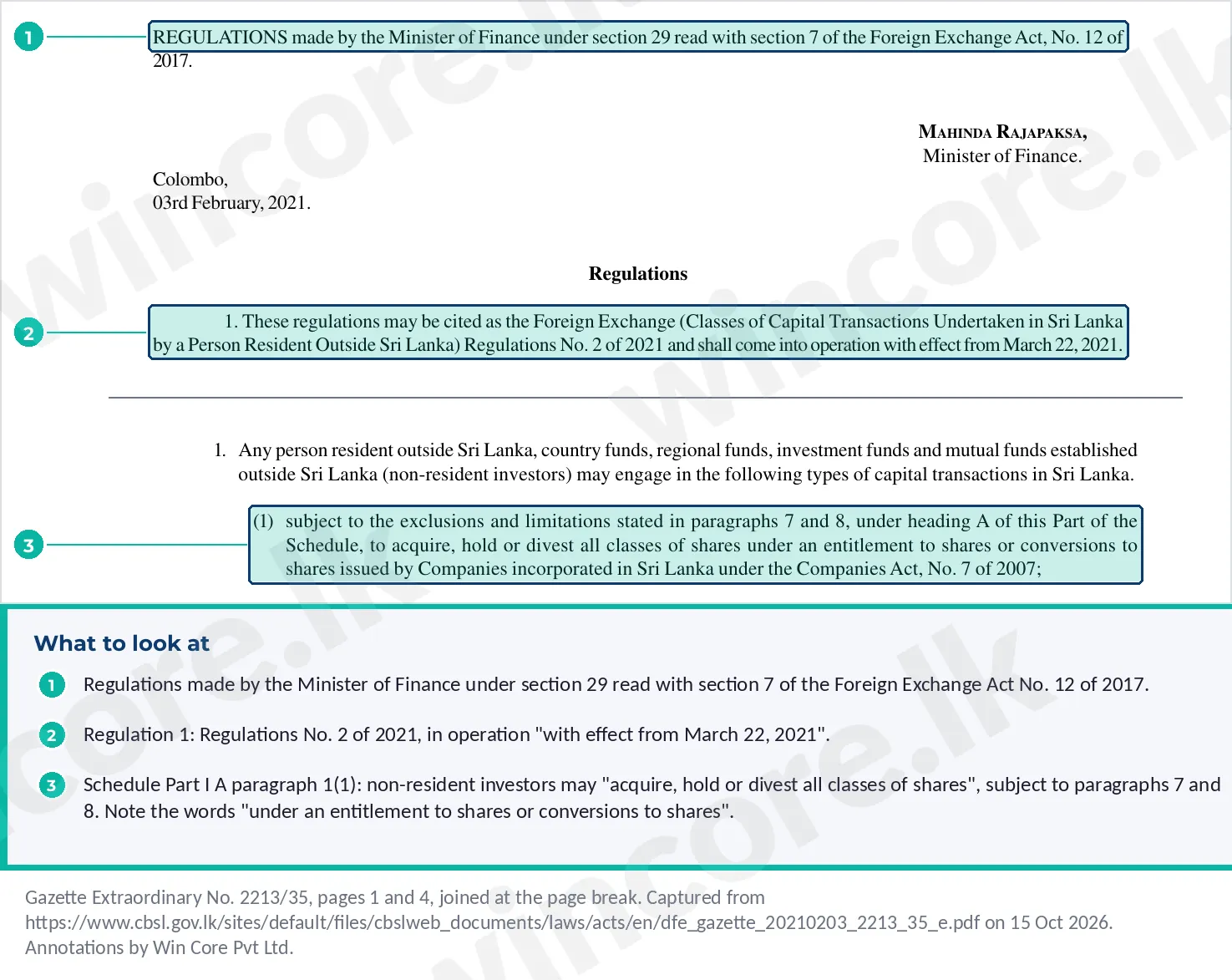
Sri Lanka has worked this way since the Foreign Exchange Act, No. 12 of 2017. The Minister authorises classes of capital transaction by regulation, and a person "shall be entitled to deal in foreign exchange in respect of a capital transaction of such person, through an authorized dealer" when the class is authorised (s.7(4)) [4]. The gatekeeper is the bank at the counter, not an approval desk. Two misreadings follow when people forget that: that the account belongs to the company, and that someone at CBSL must sign off before the money moves.
The Inward Investment Account in Sri Lanka belongs to the investor
The instrument is Directions No. 15 of 2021, "Directions issued to Authorized Dealers on Inward Investment Accounts", signed by the Director, Department of Foreign Exchange, on 18 March 2021 and made under Regulations No. 2 of 2021 (Gazette 2213/35) and "Section 9 read with Section 6 and 7" of the Act [1]. It rescinded the earlier IIA Directions of 2017, 2018 and 2020 (para 12) and was amended by Directions No. 02 of 2024 of 20 March 2024 [2].
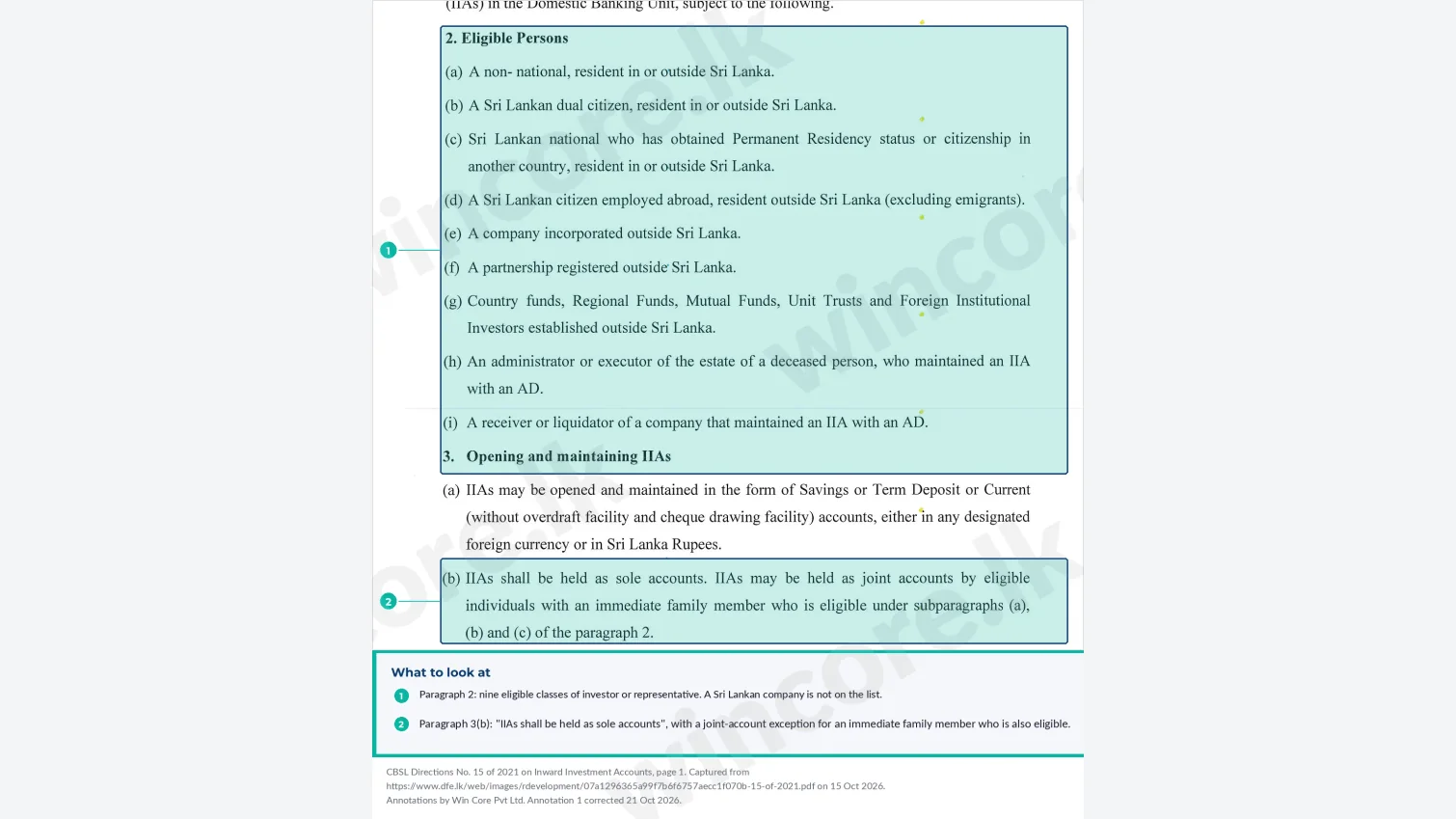
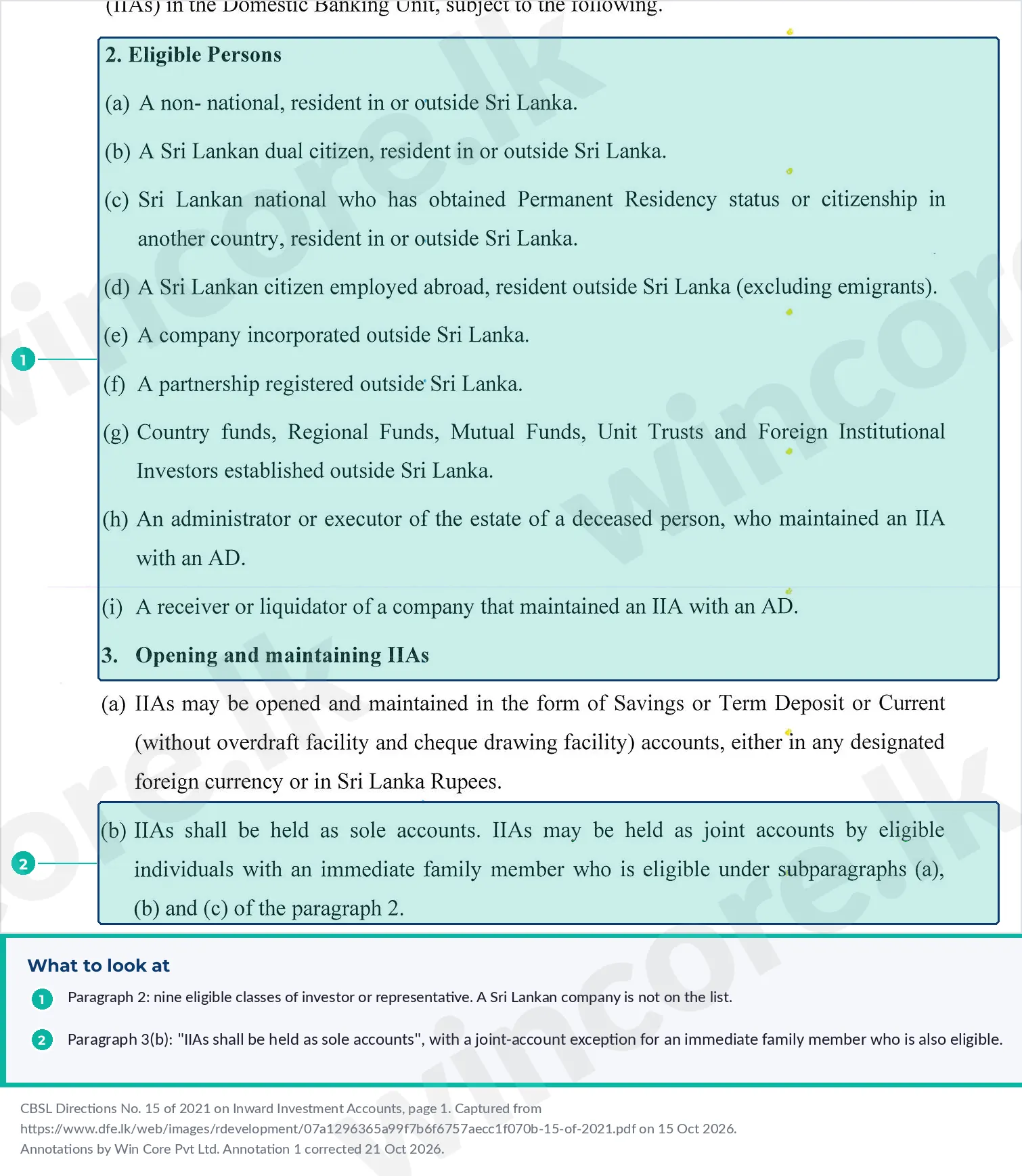
Paragraph 2 lists the eligible persons. They are investors and their legal representatives, not investees [1]:
| Para 2 | Eligible person |
|---|---|
| (a) | A non-national, resident in or outside Sri Lanka |
| (b) | A Sri Lankan dual citizen, resident in or outside Sri Lanka |
| (c) | A Sri Lankan national with permanent residency or citizenship in another country, resident in or outside Sri Lanka |
| (d) | A Sri Lankan citizen employed abroad, resident outside Sri Lanka (excluding emigrants) |
| (e) | A company incorporated outside Sri Lanka |
| (f) | A partnership registered outside Sri Lanka |
| (g) | Country funds, regional funds, mutual funds, unit trusts and foreign institutional investors established outside Sri Lanka |
| (h), (i) | An administrator or executor of a deceased IIA holder; a receiver or liquidator of a company that held an IIA |
A Sri Lankan company is not on the list. Part VI of Gazette 2213/35 gives the same classes and adds a tenth, "Any other person or category of persons who may be authorised by the Central Bank from time to time" [3]. Note item (a): a non-national is eligible whether resident in or outside Sri Lanka, so residence here does not by itself take away the IIA route.
An IIA is a sole account, with a family exception
Paragraph 3(b) says: "IIAs shall be held as sole accounts. IIAs may be held as joint accounts by eligible individuals with an immediate family member who is eligible under subparagraphs (a), (b) and (c) of the paragraph 2" [1]. Paragraph 3(c) lets joint accounts opened before the Directions with someone who is not an immediate family member continue until closure. So "always sole" is wrong as stated, but a new joint holder must be an eligible family member.
Paragraph 3(a) allows savings, term deposit or current accounts, the last "without overdraft facility and cheque drawing facility", in "any designated foreign currency or in Sri Lanka Rupees" [1]. An IIA does not have to be in foreign currency.
Money goes out to the company and comes back to the same IIA
Paragraph 5(d)(i) permits payments for a capital transaction to "A rupee account of the investee/seller (who is a resident) of the investment" [1]. Payment to the company's foreign currency account is allowed only where the company "is permitted to receipt such proceeds in foreign currency in terms of the foreign exchange regulations or special permission granted" (para 5(d)(ii)). Paragraph 6(b) then requires banks to "ensure that all income and capital proceeds of investments are credited to the IIA through which the investment was made" [1]. Gazette 2213/35 Part I A paragraph 4(1)(b) says the same [3].
Is an IIA always required? No. Paragraph 4(1)(c) of the Regulations says IIA routing is "not mandatory" for investments under paragraph 1(4), (5), (6), (7), (8)(a) and (9), and for other paragraph 1(8) investments "if so permitted by the Monetary Board" [3]. For shares under paragraph 1(1), it is required. Our Gazette 2213/35 guide maps those paragraphs, and our piece on the Business Foreign Currency Account covers the company-side account that can pay returns back to an IIA.
A branch follows the same logic in its own words. Part I B paragraph 1(2)(a) requires a branch or project office to receive at least USD 200,000 "channeled through an Inward Investment Account opened by the parent company", with proof to the Registrar of Companies within 90 days of registration [3]. Our foreign branch registration team handles that filing.
No CBSL clearance for a routine investment, except in three cases
For a permitted investment through the IIA, no prior CBSL approval is built into the route. Before dealing, the bank "shall request the person requiring foreign exchange for such transaction, to provide such information or produce such documents or make such declaration as is reasonably necessary" (s.7(6)), and it "shall refuse to deal" where that is not done or the transaction is not authorised (s.7(7)) [4]. A refusal must be given in writing with reasons if requested (s.7(8)), and the investor can appeal to the Central Bank within fourteen days (s.7(9)) [4]. The Directions add that banks "shall obtain proper legally acceptable documentary evidence (as required) to establish the legality and bona-fide of the underlying transaction" (para 6(h)) [1].
The three cases that need a yes first, as we found them in the text:
| Case | Who decides | Clause |
|---|---|---|
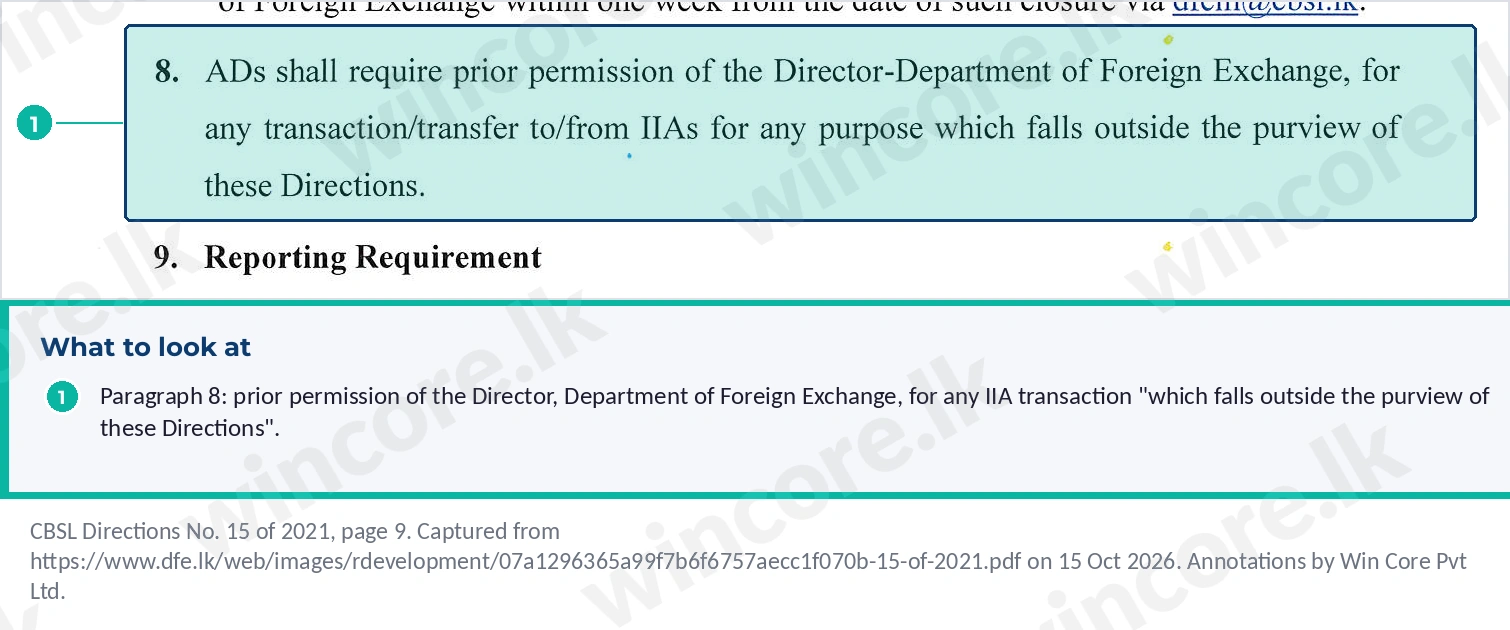
| A transaction or transfer to or from an IIA for a purpose outside the Directions | Director, Department of Foreign Exchange, prior permission | Directions No. 15 of 2021 para 8 [1] |
| Issuing the shares later than three months after the remittance | Central Bank, extension of time | Gazette 2213/35 Part III para 5 [3] |
| Making a paragraph 1(8) investment (other than 1(8)(a)) without an IIA | Monetary Board permission | Gazette 2213/35 Part I A para 4(1)(c) [3] |
Two things sit outside those three. A capital transaction the Regulations do not authorise at all cannot be dealt in unless the Monetary Board "taking into consideration the existence of any exceptional circumstances has granted approval" (s.7(10)) [4]; that is a different route, not a clearance on a permitted investment. And sector approvals still apply: a business on the 40 percent list in paragraph 8(1) needs Board of Investment approval for a higher share, which is not a CBSL clearance [3]. Our guide to 100 percent foreign ownership covers those lists.
Closing or moving the IIA waits until the investments are out
Paragraph 7(a): "IIAs may be closed only after the repatriation/ transfer of proceeds of disposal/liquidation of all investments acquired by the account holder through the said IIA" [1]. Paragraph 7(b) allows a move to an IIA at another bank before disposal, if the first bank forwards a confirmation of the outstanding investments and the supporting documents. Banks report closures to the Department of Foreign Exchange within a week (para 7(e)), and keep IIA records "for a period not less than six years after the closure of such accounts" (para 6(i)) [1]. Keep the IIA open as long as you hold the shares, and keep your own copies.
The penalty for misrouting sits in section 11 of the Foreign Exchange Act
| Who | Section | What it says |
|---|---|---|
| A person who is not an authorised dealer and acts in violation of s.11(1)(a) to (d) | s.11(5) | After the Minister is informed and a reasonable opportunity of being heard, a penalty "not exceeding rupees one million" or "not exceeding the amount or value of such current transaction or capital transaction", plus detection and investigation expenses; appeal to the Board of Inquiry within thirty days (s.11(7)(b)) [4] |
| A bank that fails to comply with a direction under s.9 | s.11(1)(c), (2) to (4) | Notice to comply, temporary suspension, revocation after inquiry, payment up to the value of a foreign asset, or a limitation on dealing for up to twelve months [4] |
Whether an investor who routes money through the wrong account is treated as a violation under s.11(5) is not spelled out, and we keep it open, consistent with our Business Foreign Currency Account guide.
What this means for you
If you are the investor, the IIA is yours: open it in your own name before you remit. If you are the company, your job is the share issue and the record, not the account.
- The foreign investor opens the IIA with a Sri Lankan bank, in its own name, before remitting.
- Pay the subscription from the IIA to the company's rupee account under para 5(d)(i).
- Issue the shares within three months of the remittance, or get a Central Bank extension before the three months run out.
- Pay dividends and sale proceeds back to the same IIA under para 6(b).
- Keep the paper for at least as long as the bank must: six years after closure.
Checklist: documents needed
- IIA opening confirmation in the investor's name
- Inward remittance advice and IIA statement showing the subscription debit
- Company's rupee account credit advice for the share money
- Board resolution and share allotment record dated within three months of the remittance
- Any Central Bank extension letter or Department of Foreign Exchange permission, if one was needed
Our company registration team can set up the company and coordinate the share issue with the investor's bank, and our company secretarial services keep the allotment records and the share register.
A hypothetical example
A Danish individual buys new shares in a Colombo boat-building company for the equivalent of EUR 90,000. He opens an IIA in euros, remits the money, and pays the company's rupee account from the IIA under para 5(d)(i). The company allots the shares within three months. No CBSL application is made. Five years later he sells to another non-resident, who pays from her own IIA into his (para 4(e)), and he remits the proceeds abroad (para 5(a)) [1].
FAQ
Can a Sri Lankan company open an IIA for its foreign shareholder?
No, a Sri Lankan company cannot hold an IIA for its shareholder. Paragraph 2 of Directions No. 15 of 2021 lists the eligible persons, and they are foreign nationals, dual citizens, Sri Lankans with foreign residency or employed abroad, foreign entities and funds, and executors or liquidators. The company receives the money in its own rupee account under paragraph 5(d)(i) and pays returns back to the investor's IIA [1].
Do I need CBSL approval to invest in a Sri Lankan company?
No, not for a permitted investment routed through an IIA. The bank checks the documents under s.7(6) of the Foreign Exchange Act and deals. Approval is needed only for a transaction outside the Directions (para 8), a share issue later than three months, or a paragraph 1(8) investment made without an IIA [1] [4].
Can two unrelated foreign investors share one IIA?
No, not a new one. Paragraph 3(b) says IIAs are sole accounts, and a joint account is allowed only between eligible individuals and an immediate family member who is also eligible. Joint accounts opened before 22 March 2021 with a non-family member may continue until closure under paragraph 3(c) [1].
What happens if the shares are not issued within three months?
The company is outside the Regulations unless the Central Bank extends the time. Part III paragraph 5 of Gazette 2213/35 requires shares to be issued, transferred or registered within three months of receiving the inward remittance, "unless otherwise granted an extension of time by the Central Bank". Ask for the extension before the deadline [3].
Can I close the IIA after the shares are issued?
No, not while you hold the investment. Paragraph 7(a) allows closure only after the proceeds of disposal or liquidation of all investments made through the IIA have been repatriated or transferred. You can move the account to another bank under paragraph 7(b) if the first bank passes on the investment record [1].
Open points
- The 2024 repeal. Directions No. 02 of 2024 repeals "Item (f) of Other Conditions in paragraph 6 of the Direction" as amended [2]. In the 2021 text, 6(f) required returns on investments paid into an investee's foreign currency account to come back from that account with no rupee conversion. The 2024 Direction calls the 2021 text "as amended", and paragraph 6(g)(ii) of the 2021 text refers to a "paragraph 6 (f) (i)" that does not exist; we found no intermediate IIA amendment on a search of dfe.lk on 21 October 2026, but cannot rule one out.
- Investor penalties. How s.11(5) applies to a wrong-account routing by an investor.
- Paragraph 1(8) cases. Which paragraph 1(8) investments the Monetary Board has released from IIA routing.
Last verified 21 October 2026. We read Directions No. 15 of 2021 and No. 02 of 2024 (dfe.lk PDFs), Gazette 2213/35 and sections 7 and 11 of the Foreign Exchange Act on that date. A Direction can be amended by a later Direction posted only on the Department of Foreign Exchange list, so check it before relying on this.
The IIA is the investor's account, sole or family-joint, and returns must go back to it. A routine permitted investment needs no CBSL approval. Open the account in the right name and the rest follows.
Talk to us. If you are investing in a Sri Lankan company and want the IIA, the share issue and the records lined up, our contact page.
WinCore Pvt Ltd
This article is general information, not advice for your specific situation.
References
- Central Bank of Sri Lanka, Department of Foreign Exchange. Directions No. 15 of 2021 under Foreign Exchange Act, No. 12 of 2017: Directions issued to Authorized Dealers on Inward Investment Accounts (18 March 2021), paras 1 to 15. https://www.dfe.lk/web/images/rdevelopment/07a1296365a99f7b6f6757aecc1f070b-15-of-2021.pdf . Primary. Accessed 21 October 2026.
- Central Bank of Sri Lanka, Department of Foreign Exchange. Directions No. 02 of 2024: Directions issued to Authorized Dealers on Inward Investment Accounts (IIAs) (20 March 2024). https://www.dfe.lk/web/images/rdevelopment/32723af2dcc9251b2f8815db33bc1386-Directions-No.%202%20of%202024%20(IIA).pdf . Primary. Accessed 21 October 2026.
- Minister of Finance. Foreign Exchange (Classes of Capital Transactions Undertaken in Sri Lanka by a Person Resident Outside Sri Lanka) Regulations No. 2 of 2021, Gazette Extraordinary No. 2213/35 (3 February 2021), Schedule Part I A paras 1, 4 and 8; Part I B para 1; Part III para 5; Part VI para 1. https://www.cbsl.gov.lk/sites/default/files/cbslweb_documents/laws/acts/en/dfe_gazette_20210203_2213_35_e.pdf . Primary. Accessed 21 October 2026.
- Parliament of Sri Lanka. Foreign Exchange Act, No. 12 of 2017, ss.7 and 11. https://www.cbsl.gov.lk/sites/default/files/cbslweb_documents/laws/acts/en/FOREIGN%20EXCHANGE%20ACT%2C%20No.%2012%20OF%202017%20-%20E.pdf . Primary. Accessed 21 October 2026.
Put these insights to work
WinCore specialists can review your current workflow, document gaps, and build a practical 90-day action plan.
Book a free consultationContinue reading
Explore more WinCore analysis to keep your finance, tax, and compliance roadmap moving.
What Regulations No. 2 of 2021 actually say about non-resident shares, the four amending gazettes, the IIA and three-month rules, and the penalties.
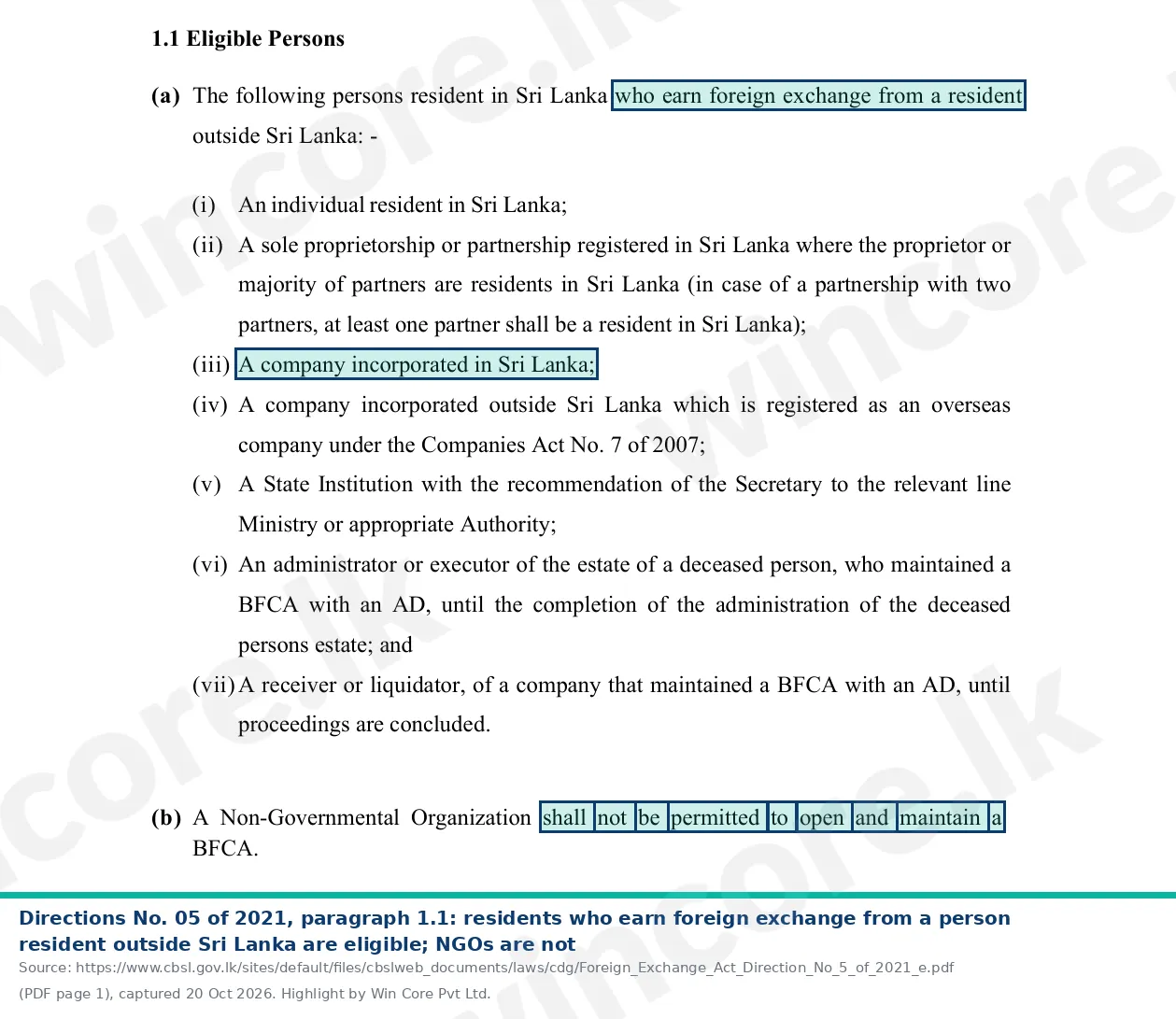
BFCAs are for residents earning foreign exchange from non-residents. The allowed credits and debits, the no-rupee rule and each amending Direction to 2026.
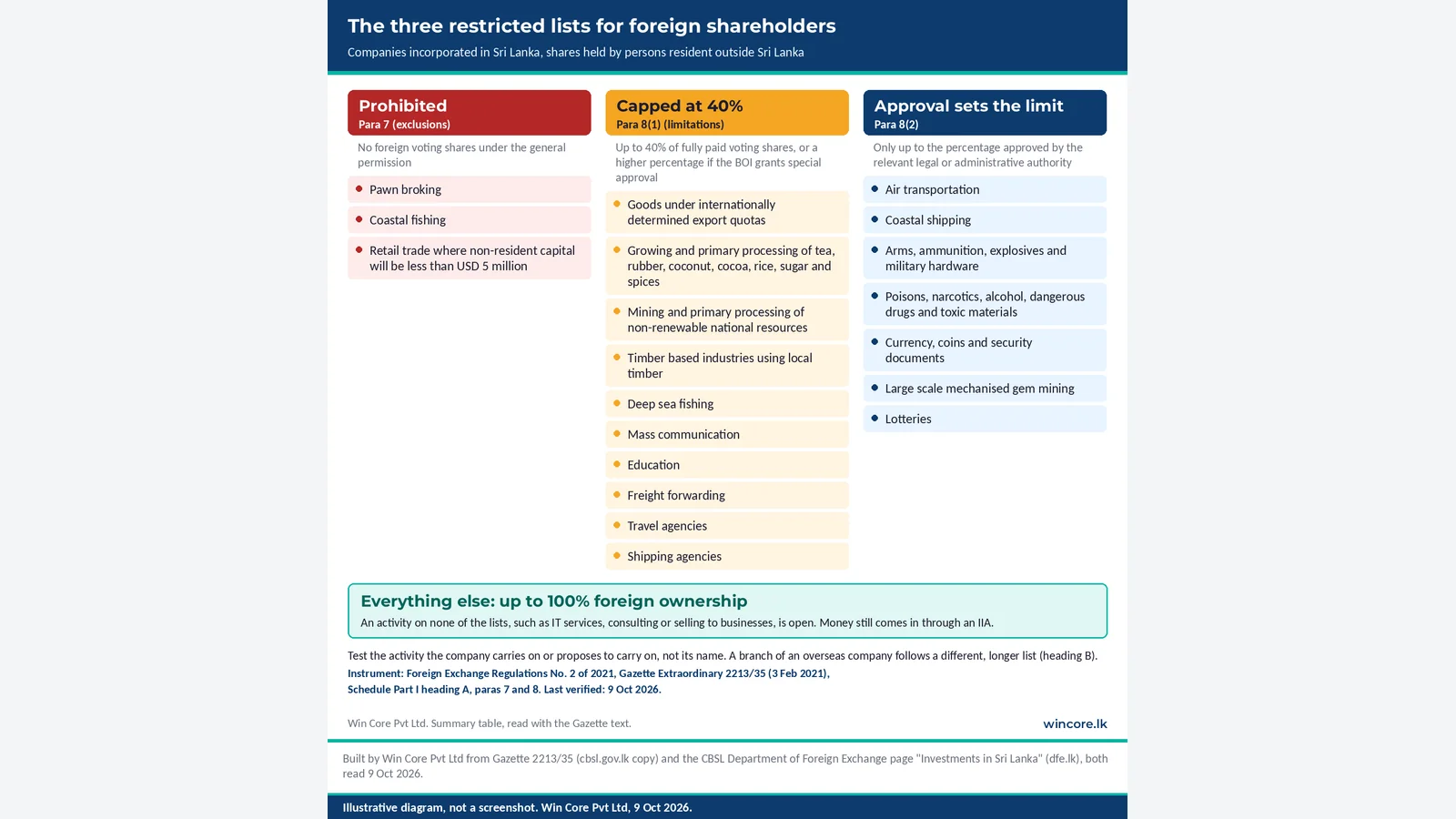
Most Sri Lankan companies can be 100 percent foreign owned. The three restricted lists in Gazette 2213/35, the retail test and the BOI route.