
Business Foreign Currency Account Sri Lanka: rules and amendments
BFCAs are for residents earning foreign exchange from non-residents. The allowed credits and debits, the no-rupee rule and each amending Direction to 2026.
On this page
Last verified against the primary sources on 21 October 2026.
A Business Foreign Currency Account in Sri Lanka (BFCA) may be opened only by a person resident in Sri Lanka "who earn[s] foreign exchange from a resident outside Sri Lanka", under Directions No. 05 of 2021 issued by the Central Bank's Department of Foreign Exchange, in operation since 22 March 2021 [1]. Rupees may never be converted and credited to it. The Directions have been amended six times, most recently by Directions No. 02 of 2026 of 3 March 2026, which widened the Government securities items [7].
A coir products manufacturer in Kurunegala ships coir mats to a buyer in Japan and is paid in yen. Can the money sit in yen, and what can the company do with it later? This article reads Directions No. 05 of 2021 and every amending Direction on the Department's list, from the primary text.
Who can open a Business Foreign Currency Account in Sri Lanka
Directions No. 05 of 2021 are "Directions issued to Authorized Dealers on Business Foreign Currency Accounts (BFCAs)", made under the Foreign Exchange (Opening and Maintenance of Accounts for the purpose of engaging in Foreign Exchange Transactions) Regulations No. 05 of 2021 and section 9 of the Foreign Exchange Act, No. 12 of 2017 [1]. They are addressed to banks (Authorized Dealers, or ADs), not to businesses: they tell a bank what it may credit to and debit from a BFCA. On our reading, a customer meets the rules mainly through the bank applying them, and through the Act itself [1] [8]. Paragraph 5 rescinded the earlier Directions No. 04 of 2017.
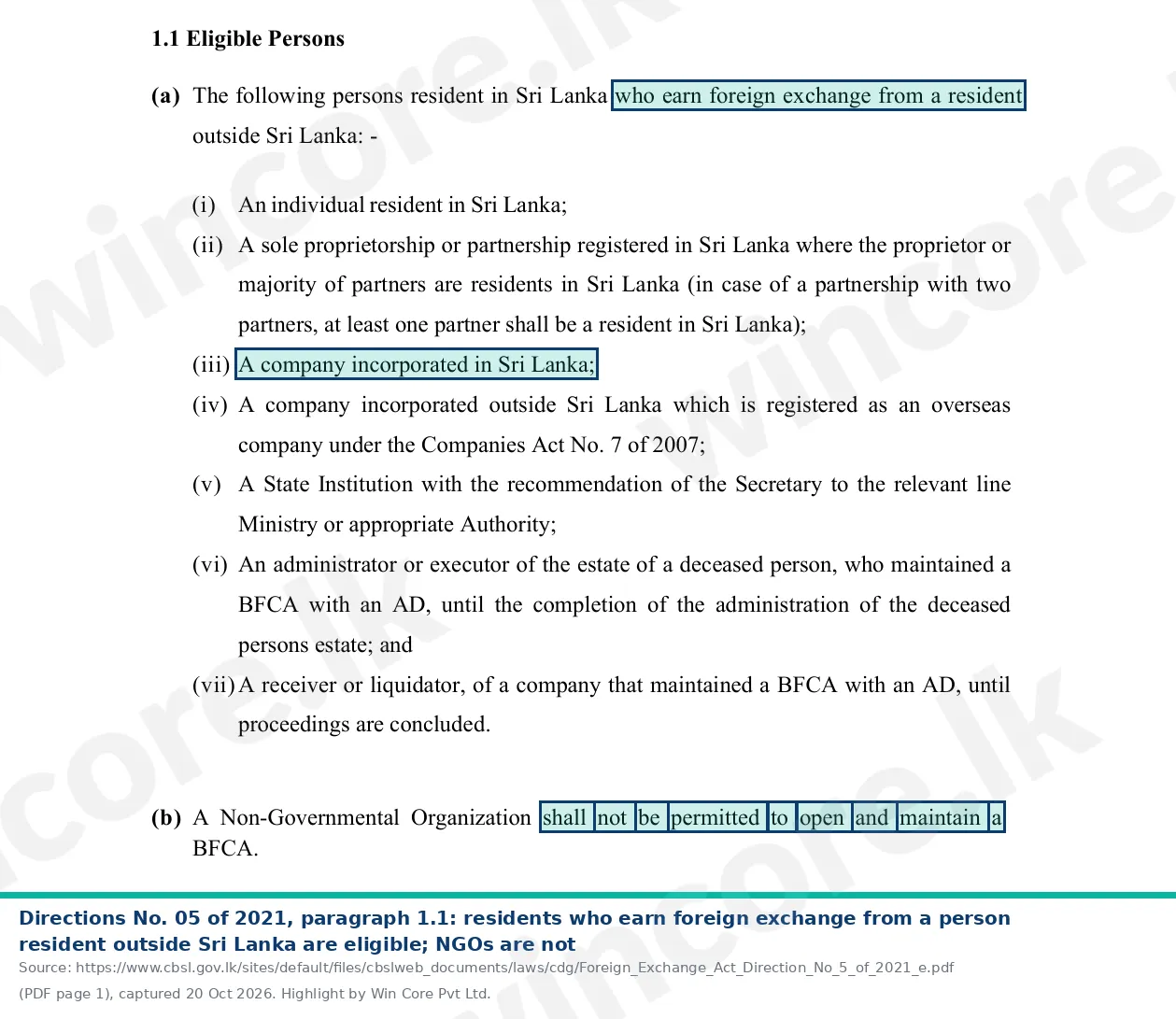
Paragraph 1.1(a) covers "persons resident in Sri Lanka who earn foreign exchange from a resident outside Sri Lanka" [1]:
| Item | Eligible person |
|---|---|
| (i) | An individual resident in Sri Lanka |
| (ii) | A sole proprietorship or partnership registered in Sri Lanka, where the proprietor or majority of partners are resident (for two partners, at least one) |
| (iii) | A company incorporated in Sri Lanka |
| (iv) | A company incorporated outside Sri Lanka and registered as an overseas company under the Companies Act No. 7 of 2007 |
| (v) | A State Institution, with the recommendation of the line Ministry Secretary or appropriate Authority |
| (vi) | An administrator or executor of a deceased BFCA holder's estate, until administration is complete |
| (vii) | A receiver or liquidator of a company that held a BFCA, until proceedings end |
Paragraph 1.1(b) is a flat exclusion: "A Non-Governmental Organization shall not be permitted to open and maintain a BFCA." Paragraph 4(e) defines that term by registration under the Voluntary Social Service Organizations Act, No. 31 of 1980 [1].
The test is earning foreign exchange from a non-resident. Paragraph 1.2(b) requires the bank to "obtain documentary evidence including the authorization by the relevant authority/ies, if any" at opening "to determine the applicant's eligibility" [1]. The Direction does not list the papers, so the checklist below is our practice suggestion, not a rule. One exception runs the other way: paragraph 1.5(e), added by Directions No. 24 of 2021, lets banks keep BFCAs opened under earlier rules for indirect exporters of goods (Annex I item 16), even though they earn from residents [2]. A branch of a foreign company registered here qualifies under item (iv); our foreign branch registration page covers that setup, and our guide to 100 percent foreign ownership covers the share side.
Rupees can never be converted into foreign currency and credited to a BFCA
Paragraph 1.2 sets the shape of the account [1]:
- Savings, current or term deposit, "in any designated foreign currency in the domestic banking unit" (1.2(a)).
- No overdraft, "except by way of an overdraft facility granted under the Directions No. 09 of 2021" on accommodations to BFCA holders (1.2(c)).
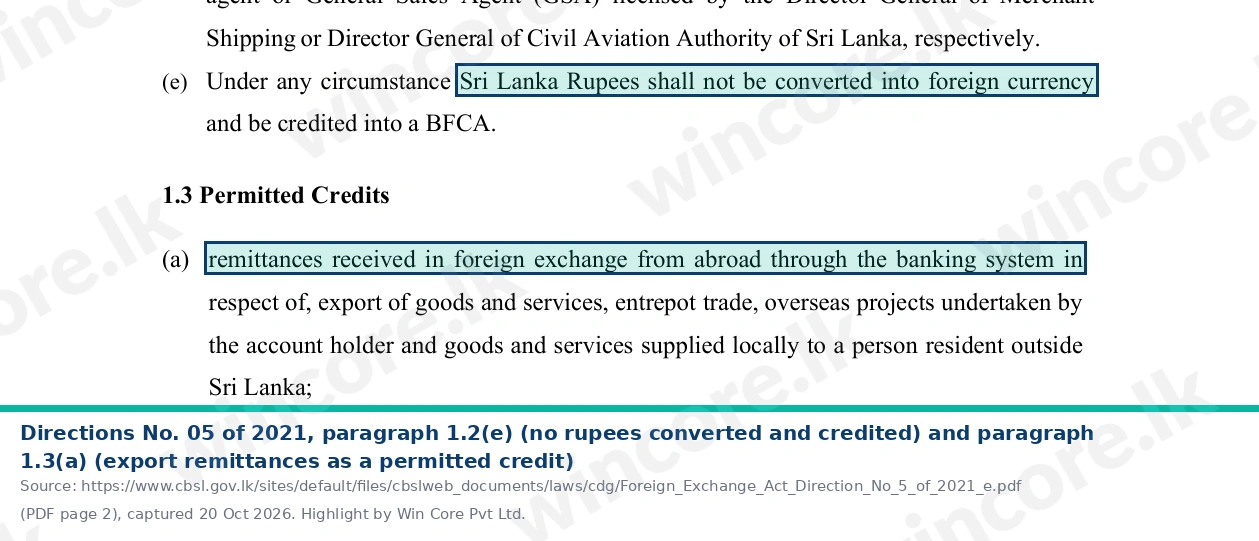
- "Under any circumstance Sri Lanka Rupees shall not be converted into foreign currency and be credited into a BFCA" (1.2(e)).
Paragraph 1.2(e) is the rule people miss. You cannot top up a BFCA by buying dollars with rupees. Money comes in only through the permitted credits.
Export receipts and listed transfers are the only permitted credits
Paragraph 1.3 lists permitted credits as items (a) to (x), later extended to (y) and (z) [1] [4] [5]. The ones most relevant to exporters and IT service companies:
| Item | Permitted credit (short form; see the Direction for full text) |
|---|---|
| (a) | Remittances from abroad through the banking system for export of goods and services, entrepot trade, overseas projects, and goods and services supplied locally to a non-resident |
| (b) | Foreign exchange accepted in Sri Lanka for goods and services supplied to a non-resident |
| (c) | Foreign exchange brought in by the holder, with a Customs declaration above USD 15,000, or a declaration to the bank at or below USD 15,000 |
| (d) | Transfers from the holder's own PFCA, BFCA or Offshore Banking Unit (OBU) account |
| (e) | Transfers from a non-resident's OBU account for a current transaction |
| (o) | Returns on foreign currency debt securities issued by the Government of Sri Lanka, where the investment was made from the BFCA (as replaced in 2026) |
| (w) | Transfers from other BFCAs or OBU accounts for goods and services supplied by a holder in an Annex I category |
| (x) | Interest earned on the account |
Paragraph 1.5(a) adds a condition for card receipts. Where payment came through a card terminal or payment gateway using a card issued outside Sri Lanka, the bank may credit it to the BFCA "only upon written confirmation by the EDC /IPG provider" that it contains such payments [1].
Annex I matters for items (w) and (q). As published in 2021 it listed 15 categories, starting with exporters of goods and "Exporters of professional services". Directions No. 24 of 2021 replaced it with 16 categories, adding indirect exporters of goods [2], and Directions No. 02 of 2023 replaced it again with 17, adding enterprises permitted to sell to the domestic market under the Commercial Hub Regulation [6]. Whether a given software or IT business counts as an "exporter of professional services" is not defined in the Direction; on our reading that is a question for your bank.
Anything outside the listed debits needs the Department's prior permission
Paragraph 1.4 lists debits (a) to (r) [1]. The core ones:
- (a) "any outward remittances made outside Sri Lanka in respect of current transactions and capital transactions of the account holder";
- (b) "disbursements in Sri Lanka in Sri Lanka Rupees";
- (c) transfers to the holder's own PFCA, BFCA or OBU account;
- (e) foreign currency notes up to USD 5,000, or loading a travel card, for the holder's travel, subject to Directions No. 02 of 2021;
- (i) servicing and repayment of foreign currency accommodations from a bank, including transfers to a BFCA Loan Account;
- (k) payments for investing in foreign currency debt securities issued by the Government of Sri Lanka in the holder's name (as replaced in 2026);
- (n) where the holder is an investee, tenant, lessee or buyer, transfers to an Inward Investment Account of income or capital proceeds due to its holder;
- (q) transfers to other BFCAs or OBU accounts to buy goods or services, for Annex I holders.
Paragraph 1.5(c) lets a company holder fund foreign currency notes "up to a maximum of USD 5,000" per individual "being an employee of such company" for that employee's travel abroad [1]. Paragraph 3 closes the list: banks "shall require prior permission of the Director-Department of Foreign Exchange, for any transaction or transfer to/ from BFCAs for any purpose which falls outside the purview of these Directions" [1].
A worked example
The Kurunegala coir manufacturer is paid by bank transfer into its yen BFCA: credit 1.3(a). It pays local wages and husk suppliers by converting yen to rupees: debit 1.4(b). It pays a Japanese machinery maker for spare parts directly from the BFCA: debit 1.4(a), which on our reading is a current transaction. When an employee travels to a trade fair abroad, the bank may issue up to USD 5,000 in notes for that employee against the BFCA: 1.5(c). In a slow month it cannot buy yen with rupees to keep the yen balance up, because of 1.2(e). How the export income is taxed is a separate question; our guide to income tax on service export earnings covers it, and the foreign service export tax calculator runs the numbers.
A permitted outward transfer does not settle the tax position; check remittance tax on branch profits separately from the bank-account rules.
Six Directions have amended No. 05 of 2021, the latest on 3 March 2026
We checked the Department of Foreign Exchange Directions list on 21 October 2026 and read every Direction there titled as a BFCA Direction. Six change the BFCA rules:
| Direction | Date | What it does |
|---|---|---|
| No. 24 of 2021 [2] | 17 June 2021 | Replaces Annex I (16 categories, adding indirect exporters of goods) and adds paragraph 1.5(e) for existing indirect exporter accounts |
| No. 27 of 2021 [3] | 30 July 2021 | Adds debit (s): transfers to the holder's Special Foreign Currency Account under Directions No. 26 of 2021, to pay investors in foreign currency listed shares or debt securities on the Colombo Stock Exchange |
| No. 02 of 2022 [4] | February 2022 (listed 24 February 2022) | Adds credit (y): for a local educational institution, course or tuition fees from the PFCAs of Sri Lankans employed abroad for their immediate family |
| No. 9 of 2022 [5] | 30 June 2022 | Adds credit (z): receipts from a foreign currency account of an authorized person in the Colombo Port City, for a holder eligible under the Schedule to the Regulations |
| No. 02 of 2023 [6] | 4 December 2023 | Amends Directions No. 24 of 2021 by replacing Annex I again (17 categories, adding Commercial Hub enterprises) |
| No. 02 of 2026 [7] | 3 March 2026 | Replaces credit (o) and debit (k): Sri Lanka Development Bonds become "debt securities denominated in foreign currency issued by the Government of Sri Lanka" |
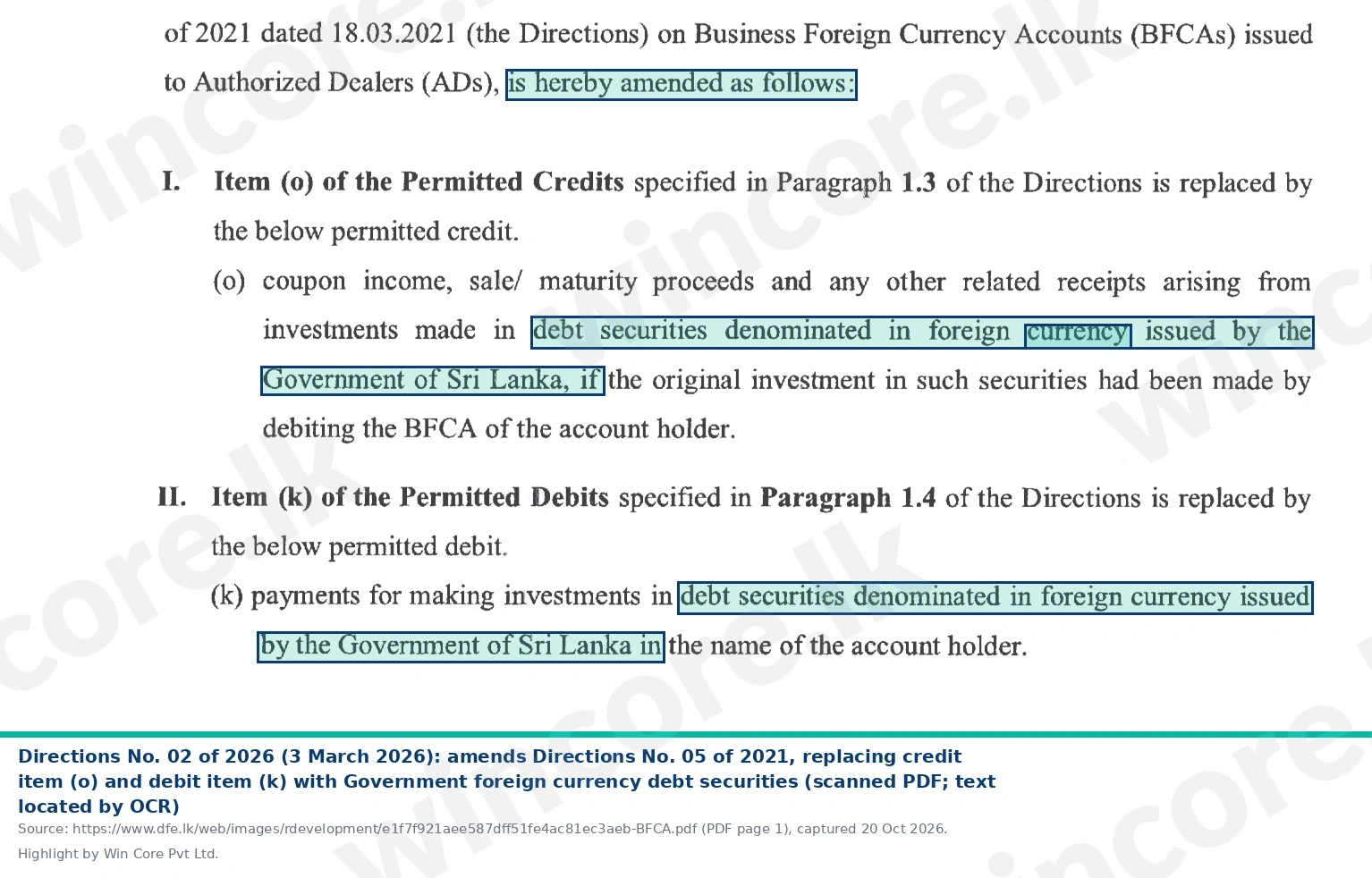
Directions No. 02 of 2026 does not rescind No. 05 of 2021. It says the Directions No. 05 of 2021 "is hereby amended as follows" [7]. So No. 05 of 2021, as amended, is the current text on our reading of the list. Three other Directions on the list mention BFCAs but amend Directions No. 09 of 2021 on accommodations (loans) to BFCA holders: No. 29 of 2021, No. 03 of 2023 and No. 03 of 2024 [9]. Loans are outside this article.
The penalty sits in the Foreign Exchange Act, not in the Direction
| Default | Section | Consequence |
|---|---|---|
| A person other than a bank acts in violation of s.11(1)(a) to (d), which include violating "any provision of this Act or any regulation or Order made thereunder" | Foreign Exchange Act s.11(5) | After the Minister is informed and a hearing, CBSL may require "a penalty a sum not exceeding rupees one million or ... not exceeding the amount or value of such current transaction or capital transaction", plus detection costs; appeal to the Board of Inquiry within thirty days (s.11(7)(b)) [8] |
| A bank fails to comply with a direction issued under s.9 | s.11(1)(c), with s.11(2) to (4) | A notice to comply, then possible suspension, revocation, or a dealing limitation "for a period not exceeding twelve months" [8] |
The Direction itself contains no penalty clause. Whether a customer who, say, routes rupee-funded money into a BFCA falls under s.11(5), as distinct from the bank's breach under s.11(1)(c), is not spelled out. We state it as open, consistent with our reading in the Inward Investment Account article.
Common misreadings
- "Any business can open a BFCA." The test is earning foreign exchange from a non-resident (1.1(a)), and NGOs are excluded (1.1(b)).
- "I can convert rupees to keep a dollar buffer." Paragraph 1.2(e) forbids it "under any circumstance".
- "The Direction was replaced in 2026." Directions No. 02 of 2026 replaces two items only.
- "Annex I still has 15 categories." It was replaced in 2021 and again in 2023, and now has 17 [2] [6].
- "Investors' money goes into the company BFCA." Inward investment by a non-resident runs through an Inward Investment Account in the investor's name, under a separate Direction. Debit (n) covers paying returns from a BFCA to an IIA.
Open points
- Regulations No. 05 of 2021 (Gazette 2213/38). We did not read the Regulations or their 2022 amendment (Gazette 2282/60). The eligibility in credit (z) depends on paragraph 2(3) of their Schedule.
- Customer penalties. How s.11(5) applies to a customer as opposed to the bank is open.
- Completeness. We relied on the Department's online list. A Direction not posted there would not be covered.
What this means for you
If you earn from non-residents, a BFCA lets you hold the earnings in foreign currency and pay foreign costs without converting twice. Before opening one, check that your income fits 1.1(a). Then use only the listed credits and debits. When a payment falls outside the lists, ask your bank to seek the Department's permission under paragraph 3 before you move the money, not after. Keep the BFCA in your books in its own currency and translate it at the rates your accounting policy sets (our piece on functional currency and which CBSL rate explains the choice); our accounting services team handles multi-currency ledgers, our income tax services cover the export income, and the currency converter gives a quick rate check.
Checklist: documents needed
- Certificate of incorporation (or business registration) and constitutional documents
- Contracts or invoices showing earnings from a person resident outside Sri Lanka (practice; the Direction asks for "documentary evidence", 1.2(b))
- Any authorization by a relevant authority, such as a shipping agency licence (1.2(b), 1.2(d))
- Board resolution naming signatories (bank practice)
- For card receipts: the EDC/IPG provider's written confirmation of foreign-issued cards (1.5(a))
- For a State Institution: the line Ministry recommendation (1.1(a)(v))
A BFCA is for residents who earn foreign exchange from non-residents. It can be credited only with the listed receipts, never with converted rupees, and debited only for the listed uses. Six Directions have changed the rules since 2021. Anything else needs the Department's permission through your bank.
FAQ
Who can open a Business Foreign Currency Account in Sri Lanka?
A person resident in Sri Lanka who earns foreign exchange from a non-resident. That covers resident individuals, resident-controlled sole proprietorships and partnerships, companies incorporated here, overseas companies registered under the Companies Act, State Institutions with a Ministry recommendation, and estate administrators or liquidators of earlier holders. NGOs are excluded by paragraph 1.1(b) [1].
Can I transfer rupees into my BFCA?
No. Paragraph 1.2(e) says that "under any circumstance" Sri Lanka rupees shall not be converted into foreign currency and credited to a BFCA. The account can only receive the permitted credits in paragraph 1.3, such as export remittances, foreign exchange from non-resident customers, and transfers from the holder's own foreign currency accounts [1].
Can a company pay staff salaries from a BFCA?
Yes, in rupees. Debit 1.4(b) allows "disbursements in Sri Lanka in Sri Lanka Rupees", so salaries can be paid by converting from the BFCA. The Direction has no general item for paying resident employees in foreign currency; anything outside the lists needs the Department's prior permission through your bank under paragraph 3. Our USD salaries and EPF piece covers the payroll side [1].
What did Directions No. 02 of 2026 change for BFCAs?
It replaced two items only. Credit (o) and debit (k) used to cover Sri Lanka Development Bonds; since 3 March 2026 they cover debt securities denominated in foreign currency issued by the Government of Sri Lanka, bought in the holder's name from the BFCA. It amends Directions No. 05 of 2021 and does not rescind it [7].
Is there a limit on how much a BFCA can hold?
The Direction sets no cap on the balance. The limits are on cash: foreign currency notes of up to USD 5,000 for the holder's or an employee's travel (1.4(e), 1.5(c)), and up to USD 50,000 for gem and jewellery dealers and for shipping agents' Cash-to-Masters (1.4(f), (g)). Anything not on the lists needs prior permission [1].
This article is general information on the Directions as at 21 October 2026 and is not advice on your specific situation.
Talk to us. If you are setting up a BFCA for export earnings and want the accounting and tax side in order from the first receipt, book a consultation at our contact page.
WinCore Pvt Ltd
References
- Central Bank of Sri Lanka, Department of Foreign Exchange. Directions No. 05 of 2021 under Foreign Exchange Act, No. 12 of 2017: Directions issued to Authorized Dealers on Business Foreign Currency Accounts (BFCAs) (18 March 2021), paras 1 to 8, Annex I. https://www.dfe.lk/web/images/rdevelopment/694c068f855db183b932d19b61430cae-Directions-No.%2005%20-%20Business%20Foreign%20Currency%20Accounts.pdf (also at https://www.cbsl.gov.lk/sites/default/files/cbslweb_documents/laws/cdg/Foreign_Exchange_Act_Direction_No_5_of_2021_e.pdf). Primary. Accessed 21 October 2026.
- Central Bank of Sri Lanka, Department of Foreign Exchange. Directions No. 24 of 2021: Business Foreign Currency Accounts (BFCAs) (17 June 2021). https://www.dfe.lk/web/images/rdevelopment/6a2e389458a2f5d515148185eb66999a-Directions-No--24.pdf . Primary. Accessed 21 October 2026.
- Central Bank of Sri Lanka, Department of Foreign Exchange. Directions No. 27 of 2021: Business Foreign Currency Accounts (BFCAs) (30 July 2021). https://www.dfe.lk/web/images/rdevelopment/c343cf36b9dd746fc057feb2058dd5f1-Directions-27-amendment-to-BFCA-CSE.pdf . Primary (scanned). Accessed 21 October 2026.
- Central Bank of Sri Lanka, Department of Foreign Exchange. Directions No. 02 of 2022: Business Foreign Currency Accounts (BFCAs) (February 2022). https://www.dfe.lk/web/images/rdevelopment/2b1cb521dd3dadb87b574b59d6f73e85-Directions-No.%202%20of%202022%20Amendments%20to%20BFCA%20Directions.pdf . Primary (scanned). Accessed 21 October 2026.
- Central Bank of Sri Lanka, Department of Foreign Exchange. Directions No. 9 of 2022: Business Foreign Currency Accounts (BFCAs) (30 June 2022). https://www.dfe.lk/web/images/rdevelopment/c0786d589dfaae081ab964180b02abe8-Directions-9.pdf . Primary (scanned). Accessed 21 October 2026.
- Central Bank of Sri Lanka, Department of Foreign Exchange. Directions No. 02 of 2023: Business Foreign Currency Accounts (BFCAs) (4 December 2023). https://www.dfe.lk/web/images/rdevelopment/ba7ef69afd6fa5e22e36cd61ddb1aa6b-Directions-No.%2002%20of%202023.pdf . Primary (scanned). Accessed 21 October 2026.
- Central Bank of Sri Lanka, Department of Foreign Exchange. Directions No. 02 of 2026: Business Foreign Currency Accounts (3 March 2026). https://www.dfe.lk/web/images/rdevelopment/e1f7f921aee587dff51fe4ac81ec3aeb-BFCA.pdf . Primary (scanned). Accessed 21 October 2026.
- Parliament of Sri Lanka. Foreign Exchange Act, No. 12 of 2017, ss.9 and 11. https://www.cbsl.gov.lk/sites/default/files/cbslweb_documents/laws/acts/en/FOREIGN%20EXCHANGE%20ACT%2C%20No.%2012%20OF%202017%20-%20E.pdf . Primary. Accessed 21 October 2026.
- Central Bank of Sri Lanka, Department of Foreign Exchange. Directions list (Directions No. 29 of 2021, No. 03 of 2023 and No. 03 of 2024 on Accommodations to BFCA holders). https://www.dfe.lk/web/index.php?option=com_rdevelopment&task=alldirection&Itemid=482&lang=en . Primary. Accessed 21 October 2026.
Put these insights to work
WinCore specialists can review your current workflow, document gaps, and build a practical 90-day action plan.
Book a free consultationContinue reading
Explore more WinCore analysis to keep your finance, tax, and compliance roadmap moving.

Since 1 April 2025, profits from services used outside Sri Lanka and paid in foreign currency through a bank are taxed at 15%. The conditions and the records to keep.
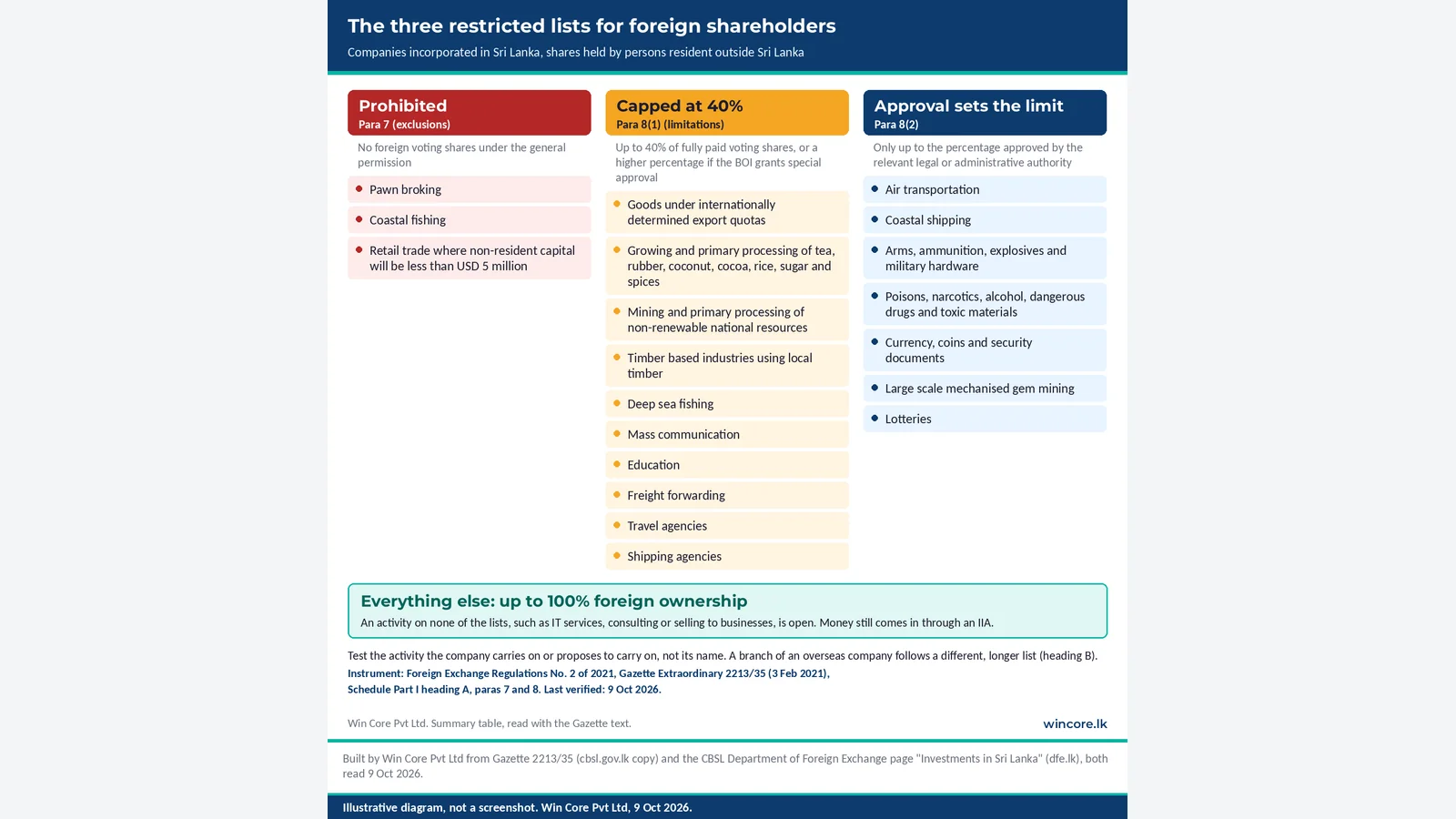
Most Sri Lankan companies can be 100 percent foreign owned. The three restricted lists in Gazette 2213/35, the retail test and the BOI route.
A late annual return rarely stands alone. Fix the officers, file beneficial ownership at once, then each overdue return with its AGM, then tax.