
Can a foreigner own 100 percent of a Sri Lankan company? The three restricted lists
Most Sri Lankan companies can be 100 percent foreign owned. The three restricted lists in Gazette 2213/35, the retail test and the BOI route.
On this page
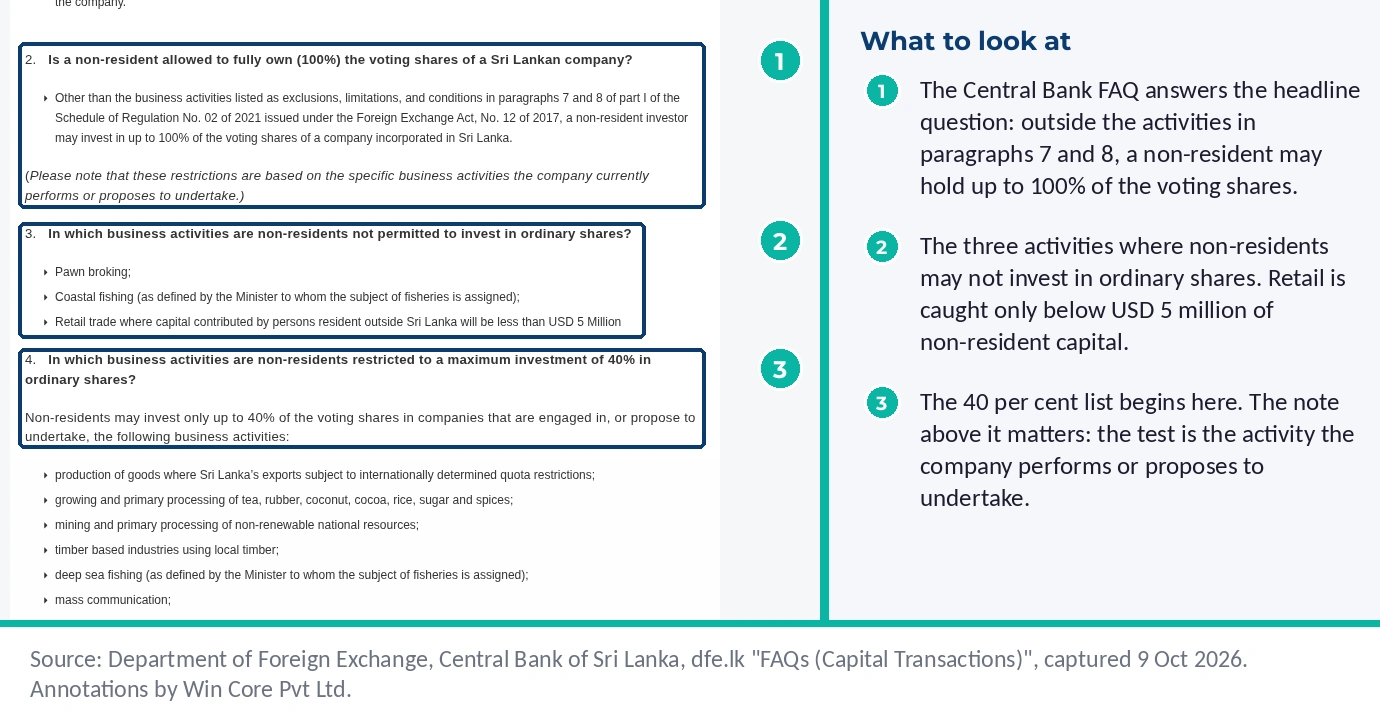
By WinCore Pvt Ltd. Last verified: 9 October 2026.
A country writing foreign ownership rules has two choices. It can list what foreigners may do and forbid everything else, or it can open the whole field and fence off a few plots. Sri Lanka does the second. The rest of this piece walks the fence line.
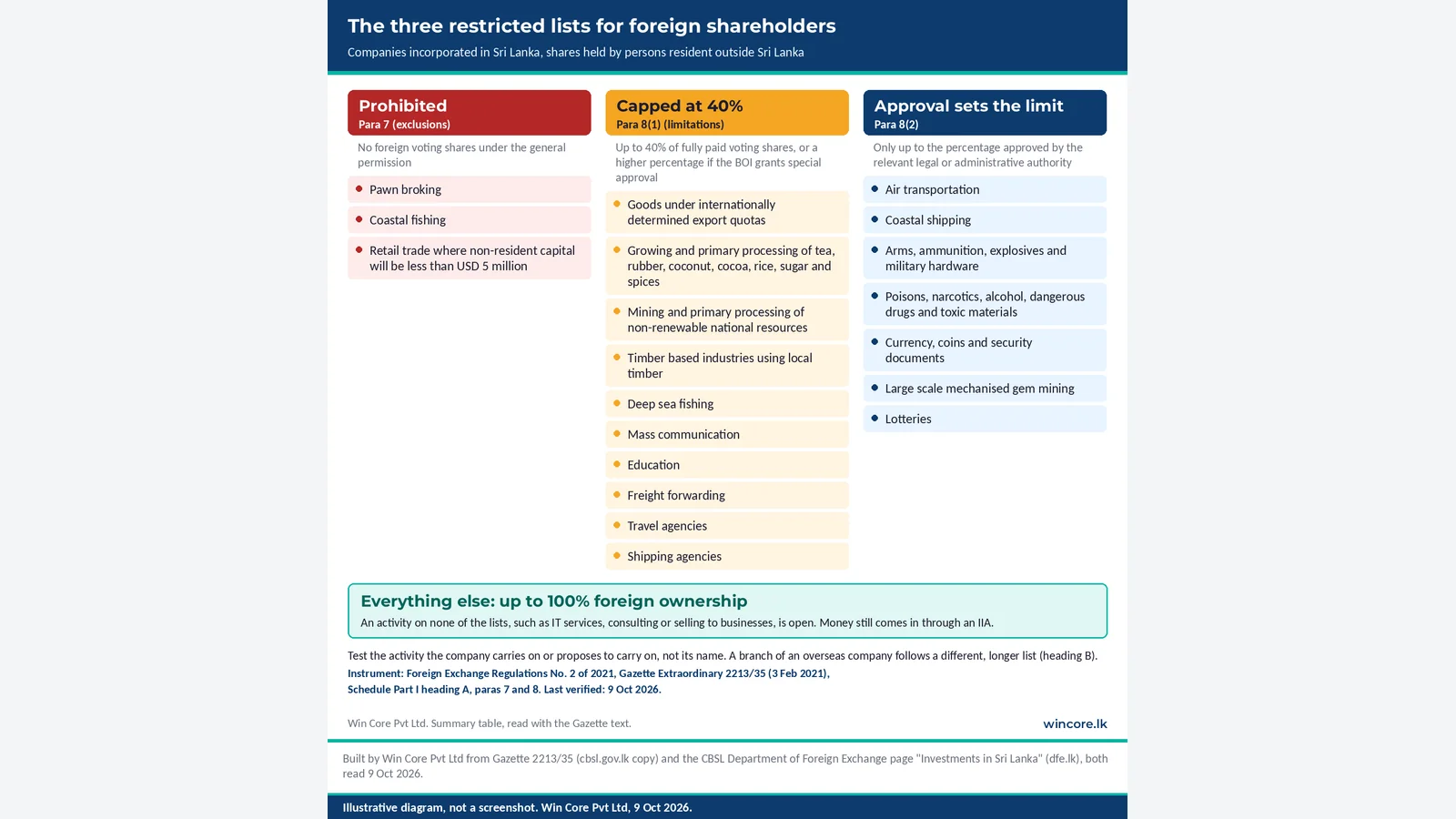
The field is the general permission in the Foreign Exchange (Classes of Capital Transactions Undertaken in Sri Lanka by a Person Resident Outside Sri Lanka) Regulations No. 2 of 2021, published as Gazette Extraordinary No. 2213/35 on 3 February 2021 and in operation from 22 March 2021 [1]. Paragraph 1(1) of Part I of its Schedule lets a person resident outside Sri Lanka acquire, hold or divest shares in a company incorporated under the Companies Act, No. 7 of 2007, "subject to the exclusions and limitations stated in paragraphs 7 and 8" [1]. Those two paragraphs are the fences. There are three of them:
- A locked fence (paragraph 7): three activities where the general permission does not apply at all.
- A fence with a gate (paragraph 8(1)): ten activities capped at 40 per cent, with the Board of Investment holding the key to the gate.
- A fence someone else builds (paragraph 8(2)): seven activities where another authority decides the percentage.
Outside those three fences, the field is open. The Central Bank's Department of Foreign Exchange says so in as many words: other than the activities in paragraphs 7 and 8, "a non-resident investor may invest in up to 100% of the voting shares of a company incorporated in Sri Lanka" [3].
Why the question keeps coming up
A claim that circulates widely online is that foreign ownership in Sri Lanka is capped at 40 per cent across the board, with 100 per cent available only in a few favoured sectors after a board approval. Read in full, the Gazette does not support it. There is no general cap. The 40 per cent figure belongs to one closed list of ten activities, and most business activities, such as a software house or a garment exporter, are not on it.
The confusion is understandable. The 40 per cent number is real, it appears in the Gazette, it appears on the Central Bank's own pages [2], and it is the most quotable figure in the instrument. It is just attached to a fence, not to the field.
Before committing to premises, check how foreign ownership affects land purchases and leases separately from the rules on owning the business.
Fence one: the activities that are closed
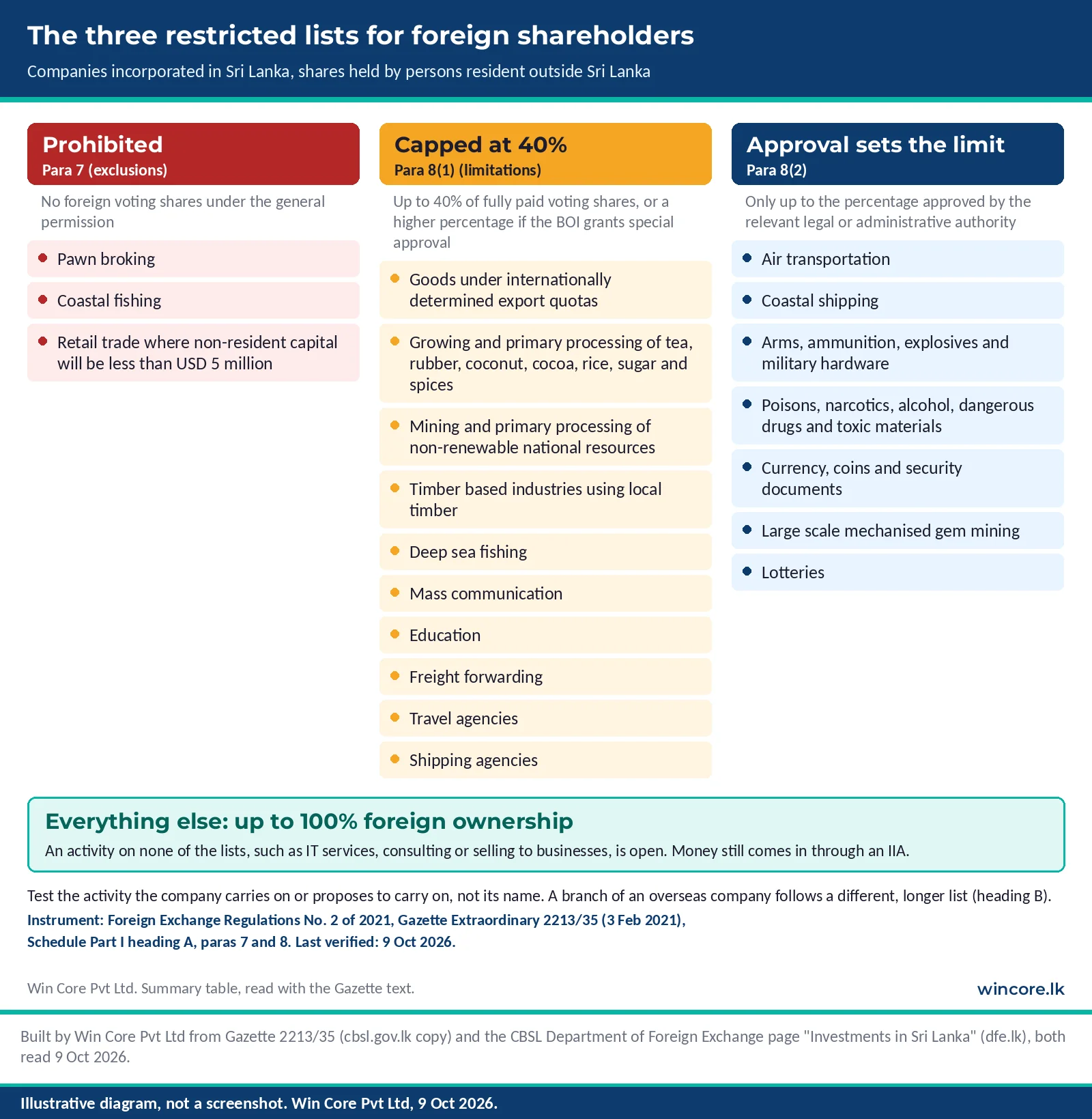
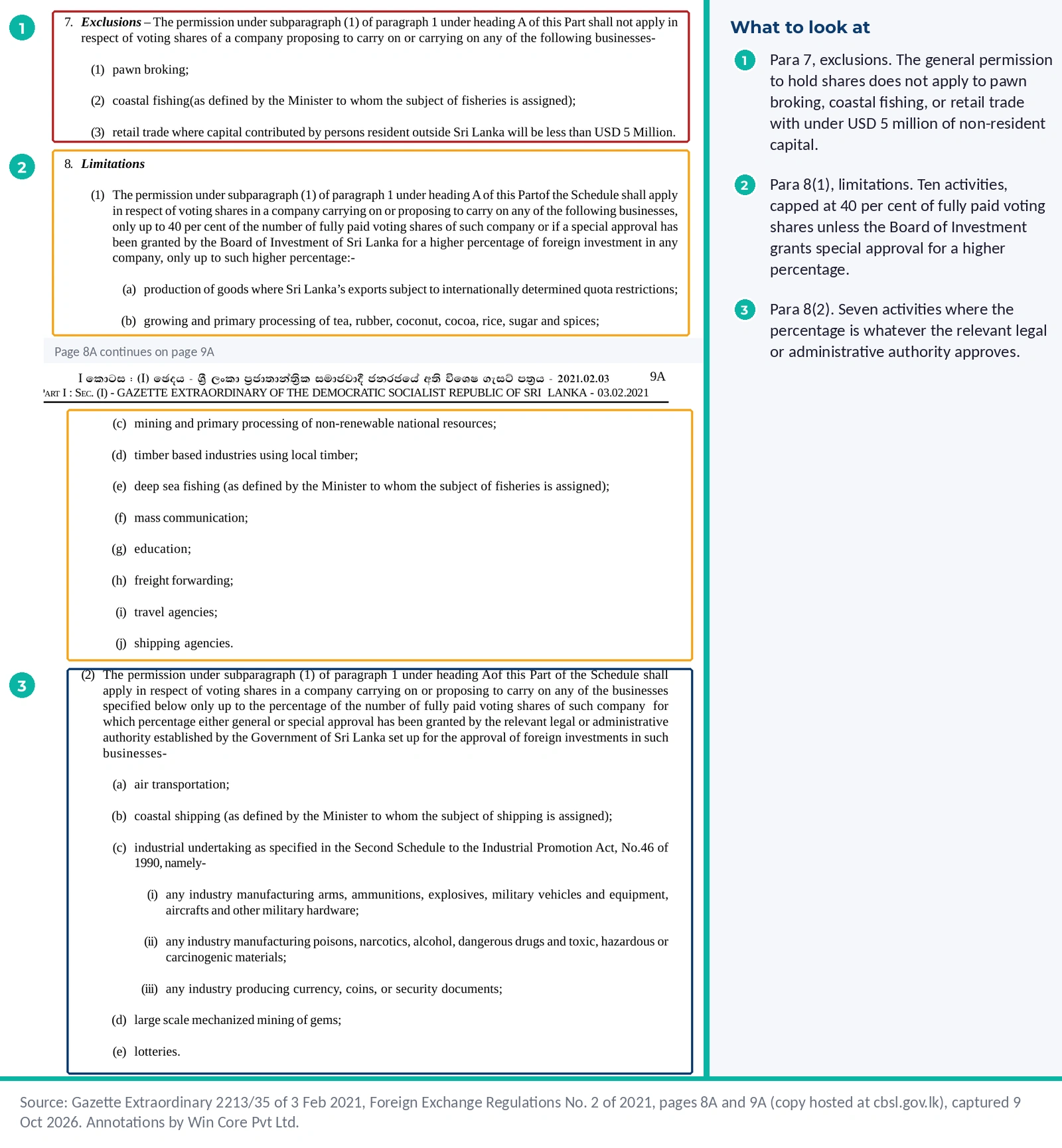
Paragraph 7 says the general permission "shall not apply in respect of voting shares of a company proposing to carry on or carrying on" three businesses [1]:
- pawn broking;
- coastal fishing (as defined by the Minister responsible for fisheries);
- retail trade where capital contributed by persons resident outside Sri Lanka will be less than USD 5 million.
The Department of Foreign Exchange describes these as the activities in which "non-residents cannot acquire voting shares" [2] and, in its FAQ, the activities in which non-residents are "not permitted to invest in ordinary shares" [3]. The wording matters in two places. First, the test covers a company "proposing to carry on" the activity, so a business plan that includes it is caught before the first sale. Second, retail is closed only below USD 5 million of non-resident capital. At or above that figure, retail falls back into the open field. We have seen secondary sources quote a lower figure; the Gazette says USD 5 million, and the Gazette wins.
Instrument: Gazette Extraordinary 2213/35, Schedule Part I heading A, para 7 (documents.gov.lk). Last verified: 9 Oct 2026.
The retail test is about the buyer, not the product
So what counts as retail? The Regulations define "retail trade" as "the re-sale (sale without transformation) of new and used goods to the general public for personal or household consumptions or utilisation" [1]. A law firm note written when the Regulations came out reads the definition the same way [11].
Three things fall out of that definition. The goods are being resold, not made, so a manufacturer selling its own product is outside it. The buyer is "the general public", so a company that sells only to shops, hotels, contractors or distributors is outside it. And the purpose is personal or household use, which is what separates a consumer sale from a business supply. A set of bicycle tyres is the same set whether it goes to a repair workshop or a cyclist's garage. The law looks at whose hands it lands in.
So a foreign-owned trading company that intends to stay outside the retail fence should write the business-to-business limit into its own plan and keep to it. The day it opens a shop or starts selling to consumers online, it is proposing to carry on retail trade, and below USD 5 million of non-resident capital that is a closed activity.
For a shop or distribution model, test the specific foreign-investment rules for retail trade rather than relying on the general ownership position.
Fence two: the 40 per cent list, and the gate
Paragraph 8(1) applies the general permission to ten activities "only up to 40 per cent of the number of fully paid voting shares of such company or if a special approval has been granted by the Board of Investment of Sri Lanka for a higher percentage of foreign investment in any company, only up to such higher percentage" [1]. The ten are:
- production of goods where Sri Lanka's exports are subject to internationally determined quota restrictions;
- growing and primary processing of tea, rubber, coconut, cocoa, rice, sugar and spices;
- mining and primary processing of non-renewable national resources;
- timber based industries using local timber;
- deep sea fishing;
- mass communication;
- education;
- freight forwarding;
- travel agencies;
- shipping agencies.
Is the 40 per cent a ceiling or a starting point? It is a ceiling with a gate in it. The ceiling holds unless the BOI grants a special approval for a higher percentage, and then the higher percentage becomes the ceiling. The Department of Foreign Exchange restates the same rule: up to 40 per cent "unless a higher percentage is approved by the Board of Investment of Sri Lanka" [2], and "if the Board of Investment of Sri Lanka has granted permission for a higher limit, such a limit shall apply" [3].
The trap on this list is travel agencies. People hear "tourism is open to foreigners" and assume a travel business is too. A hotel is not on the list. A travel agency is. A car hire company that starts selling package holidays to the public is taking on a travel agency activity, and from then on it is "carrying on" a capped business.
Instrument: Gazette Extraordinary 2213/35, Schedule Part I heading A, para 8(1) (documents.gov.lk). Last verified: 9 Oct 2026.
Fence three: where another authority sets the number
Paragraph 8(2) lists seven activities where foreign shareholding is allowed "only up to the percentage ... for which percentage either general or special approval has been granted by the relevant legal or administrative authority established by the Government of Sri Lanka set up for the approval of foreign investments in such businesses" [1]:
- air transportation;
- coastal shipping;
- industries manufacturing arms, ammunition, explosives, military vehicles and equipment, aircraft and other military hardware;
- industries manufacturing poisons, narcotics, alcohol, dangerous drugs and toxic, hazardous or carcinogenic materials;
- industries producing currency, coins or security documents;
- large scale mechanised mining of gems;
- lotteries.
The three manufacturing items come from the Second Schedule to the Industrial Promotion Act, No. 46 of 1990, which the Gazette cites by name [1]. Here the Regulations do not give a number at all. The number is whatever the relevant authority approves, so the approval comes first and the share structure follows it.
Instrument: Gazette Extraordinary 2213/35, Schedule Part I heading A, para 8(2) (documents.gov.lk). Last verified: 9 Oct 2026.
A short detour through the history
Sri Lanka has rewritten this fence line more than once in a short time. Gazette 2213/35 itself rescinds an earlier set of regulations under the same Act, published in Gazette Extraordinary No. 2112/25 of 28 February 2019, and it still refers back to arrangements made in November 2017 [1]. Since 2021 the Regulations have been amended at least four times: Gazette 2235/22 of 6 July 2021 [7], Gazette 2371/33 of 15 February 2024 [13], and Gazettes 2371/48 [8] and 2371/49 [9] of 16 February 2024. We read all four on 9 October 2026. They deal with listed debt securities, securities lending, short-term loan repayment and payments where the investee has no foreign exchange. None of them touches paragraph 7 or paragraph 8.
The detour matters for one reason: much of what circulates online about foreign ownership in Sri Lanka was written against an older instrument, and a figure that was true in 2018 can be repeated with confidence in 2026. But back to the fence.
BOI or not BOI?
A common assumption is that a foreign-owned company has to go through the Board of Investment. For a company in the open field, it does not. The shareholding permission comes from the Foreign Exchange Regulations themselves [1], the company is incorporated with the Registrar of Companies in the usual way, and the money comes in through the investor's bank (more on that below). Nothing in paragraphs 1, 7 or 8 asks a company in an open activity to obtain BOI approval before it takes foreign shareholders [1].
The BOI matters in two other situations. First, it is the body named in paragraph 8(1) to grant special approval above 40 per cent [1]. Second, it describes itself as operating "under the BOI Act" and administering "fiscal and non-fiscal incentives granted under the BOI Law" [10], so a company that wants those incentives deals with the BOI for that reason. A US Government investment climate report from 2022 describes the same two tracks, approval with concessions and approval without them [12]. That report is older than the current rules on several points, so we treat it as background only. Our company registration team can tell you whether the incentive route is worth the extra approval for your project.
For a paragraph 8(2) activity, the approval comes from the "relevant legal or administrative authority" for that business, not automatically from the BOI [1]. Check which body that is before you set the share structure.
A branch is a different animal. An overseas company that registers a branch or project office in Sri Lanka is covered by heading B of the same Schedule, not heading A, and heading B has its own, longer list of activities a branch may not carry on (it includes money lending, freight forwarding and shipping agency business) plus a minimum of USD 200,000 brought in through the parent's Inward Investment Account, with proof to the Registrar within 90 days of registration [1]. A third vehicle, the Port City offshore company, is registered through its own route under the Colombo Port City Economic Commission Act.
The money has its own route
Permission to own the shares is half the picture. The other half is how the money arrives. Paragraph 4(1) of the Schedule requires the consideration for a permitted investment to be "routed through an Inward Investment Account", and income and capital proceeds to be credited back to the same account [1]. The Department of Foreign Exchange describes the IIA as an account for "channelling inward remittances in respect of permitted capital transactions in Sri Lanka by non-resident investors" [5], and says the funds are brought in "through an Inward Investment Account (IIA) opened by such non-resident investor with an Authorized Dealer (AD) in Sri Lanka" [2], and the eligible holders listed in Directions No. 15 of 2021 are investors (foreign nationals, foreign companies, funds and similar), not the Sri Lankan company [6]. The company then has to issue the shares "within three (3) months from the date of receipt of inward remittances", unless the Central Bank extends the time [1], [3].
We will cover the account in detail in a separate piece on the Inward Investment Account. For now, the short version: the account is in the investor's name, and the Gazette does not set a minimum share capital for a private company in an open activity. The USD 5 million figure is a retail test, and USD 200,000 is a branch rule.
What this means for you
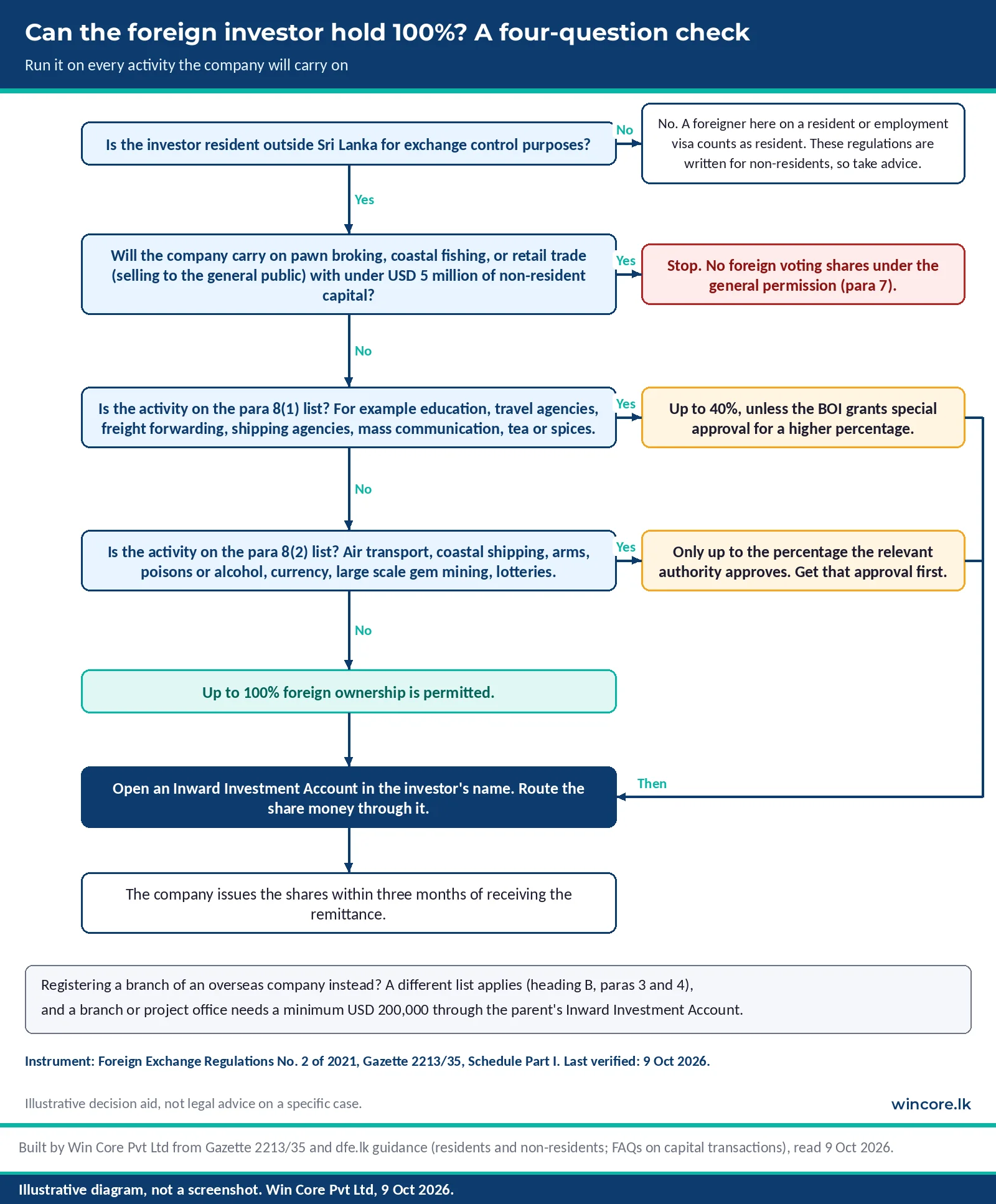
- Test every activity, not the company name. The Central Bank notes that the restrictions "are based on the specific business activities the company currently performs or proposes to undertake" [3]. List each activity in your plan and run it through Figure 3.
- Check residency first. These Regulations apply to persons resident outside Sri Lanka. The Department of Foreign Exchange treats a foreigner living or working in Sri Lanka on a resident or employment visa as a resident [4], which changes the analysis.
- If you sell goods, decide who your buyer is. Business customers only keeps you outside the retail definition. Consumers bring you inside it.
- If you are on the 40 per cent list, plan the approval before the share issue, not after. The same goes for a paragraph 8(2) activity.
- Do not assume a branch follows the same list. Heading B is longer.
- Open the Inward Investment Account in the investor's name and route the share money through it. Keep the bank's remittance records with the share issue papers.
When you are ready to incorporate, our company registration service handles the Registrar's process end to end. Once the company exists, any individual who ultimately owns or controls 10 per cent or more, directly or through a foreign parent, is a beneficial owner to be declared; our guide to beneficial ownership filings for existing companies covers the forms, and the TIN certificate guide covers the 30-day tax registration.
An investment permission does not decide personal tax status; review the individual tax-residency tests separately.
FAQ
Can a foreigner own 100 percent of a Sri Lankan private limited company?
Yes, if none of the company's activities is on the paragraph 7 or paragraph 8 lists of Gazette 2213/35. The Department of Foreign Exchange confirms up to 100 per cent of the voting shares in that case [3].
Is there a general 40 percent cap on foreign ownership?
No. The 40 per cent cap applies only to the ten activities in paragraph 8(1), and the BOI can approve a higher percentage [1].
Can a foreign-owned company sell online to consumers?
Selling goods to the general public for personal or household use is retail trade. Below USD 5 million of non-resident capital, retail is a closed activity [1].
Do I need BOI approval to set up a foreign-owned company?
Not for an activity outside the three lists. BOI approval matters for incentives under the BOI Law and for a special approval above 40 per cent on the paragraph 8(1) list [1], [10].
Is there a minimum investment for a foreign-owned company?
The Regulations do not set one for a private company in an open activity. USD 5 million is the retail threshold and USD 200,000 is the minimum for a branch or project office [1].
References
- Foreign Exchange (Classes of Capital Transactions Undertaken in Sri Lanka by a Person Resident Outside Sri Lanka) Regulations No. 2 of 2021, Gazette Extraordinary No. 2213/35 of 3 February 2021. Department of Government Printing. https://documents.gov.lk/web/extra_gazettes (Feb 2021, No. 2213/35, English; file: https://documents.gov.lk/api/content-file-proxy?file=/extra-gazette-content/2213-35_E_1784562591.pdf). Same text on the Central Bank site: https://www.cbsl.gov.lk/sites/default/files/cbslweb_documents/laws/acts/en/dfe_gazette_20210203_2213_35_e.pdf. Accessed 9 Oct 2026.
- "Investments in Sri Lanka". Department of Foreign Exchange, Central Bank of Sri Lanka. https://www.dfe.lk/web/index.php?option=com_content&view=article&id=392&Itemid=730&lang=en. Accessed 9 Oct 2026.
- "FAQs (Capital Transactions)". Department of Foreign Exchange, Central Bank of Sri Lanka. https://www.dfe.lk/web/index.php?option=com_content&view=article&id=404&Itemid=745&lang=en. Accessed 9 Oct 2026.
- "Residents & Non Residents". Department of Foreign Exchange, Central Bank of Sri Lanka. https://www.dfe.lk/web/index.php?option=com_content&view=article&id=386&Itemid=723&lang=en. Accessed 9 Oct 2026.
- "Bank Accounts: Inward Investment Account (IIA)". Department of Foreign Exchange, Central Bank of Sri Lanka. https://www.dfe.lk/web/index.php?option=com_content&view=article&id=366&catid=79&lang=en. Accessed 9 Oct 2026.
- Directions No. 15 of 2021 under the Foreign Exchange Act, No. 12 of 2017: Directions issued to Authorized Dealers on Inward Investment Accounts. Department of Foreign Exchange, Central Bank of Sri Lanka. https://www.cbsl.gov.lk/sites/default/files/cbslweb_documents/laws/cdg/Foreign_Exchange_Act_Direction_No_15_of_2021_e.pdf. Accessed 9 Oct 2026.
- Amending Regulations, Gazette Extraordinary No. 2235/22 of 6 July 2021. Ministry of Finance, hosted by the Department of Foreign Exchange. https://dfe.lk/web/images/rdevelopment/884d03835d07d7ee86cd7c30e87e222c-2235-22-E.pdf. Accessed 9 Oct 2026.
- Amending Regulations, Gazette Extraordinary No. 2371/48 of 16 February 2024. Ministry of Finance, hosted by the Department of Foreign Exchange. https://dfe.lk/web/images/rdevelopment/1b43dfa6c379e4c69177be57cae3c185-2371-48-E.pdf. Accessed 9 Oct 2026.
- Amending Regulations, Gazette Extraordinary No. 2371/49 of 16 February 2024. Ministry of Finance, hosted by the Department of Foreign Exchange. https://www.dfe.lk/web/images/rdevelopment/f9ffdebeb8ff88c02f22749873d0e4c2-2371-49-E.pdf. Accessed 9 Oct 2026.
- "Who we are". Board of Investment of Sri Lanka. https://investsrilanka.com/who-we-are/. Accessed 9 Oct 2026.
- H. Abayaratne and U. Ratnayake, "The Permitted Investments by Non-resident Investors in Sri Lanka" (7 April 2021). D. L. & F. De Saram (secondary). https://www.desaram.com/the-permitted-investments-by-non-resident-investors-in-sri-lanka/. Accessed 9 Oct 2026.
- "2022 Investment Climate Statements: Sri Lanka". United States Department of State (secondary, archived). https://2021-2025.state.gov/reports/2022-investment-climate-statements/sri-lanka/. Accessed 9 Oct 2026.
- Amending Regulations, Gazette Extraordinary No. 2371/33 of 15 February 2024. Ministry of Finance, hosted by the Department of Foreign Exchange. https://www.dfe.lk/web/images/rdevelopment/dbeb6c2d1b041cdae4e5fd85df11f8fa-2371-33-E.pdf. Accessed 9 Oct 2026.
Instruments: Foreign Exchange Act, No. 12 of 2017; Regulations No. 2 of 2021 (Gazette 2213/35), as amended by Gazettes 2235/22, 2371/33, 2371/48 and 2371/49; Directions No. 15 of 2021. Official links in the References above. Last verified: 9 Oct 2026.
Talk to us
If you are planning a Sri Lankan company with foreign shareholders and want each activity checked against the three lists before you incorporate, book a consultation at our contact page.
The field is open; know where the fences are.
WinCore Pvt Ltd
Put these insights to work
WinCore specialists can review your current workflow, document gaps, and build a practical 90-day action plan.
Book a free consultationContinue reading
Explore more WinCore analysis to keep your finance, tax, and compliance roadmap moving.
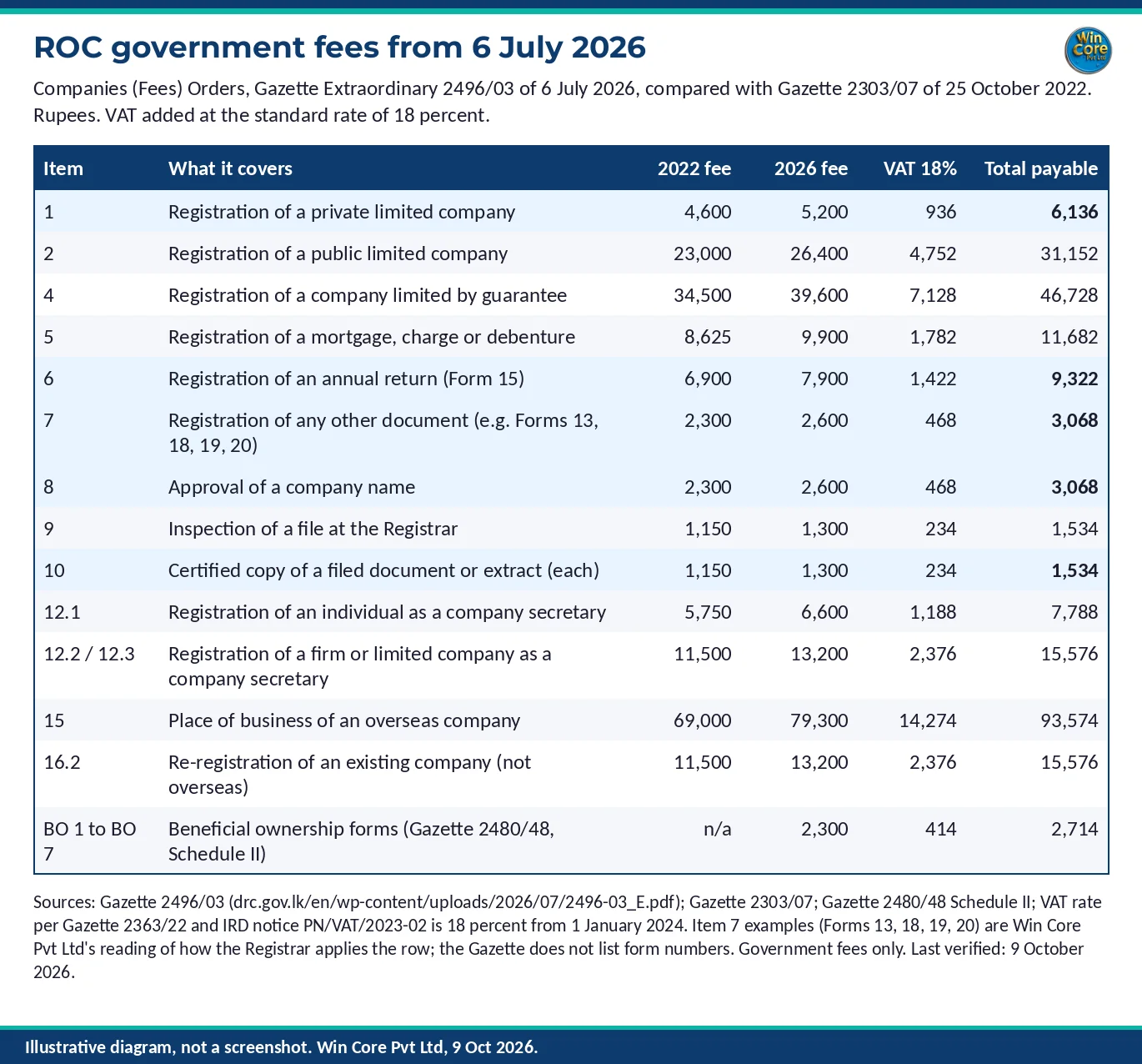
Every Registrar of Companies fee from 6 July 2026 with VAT added, and worked costs for an incorporation, a late Form 15 and a secretary change.
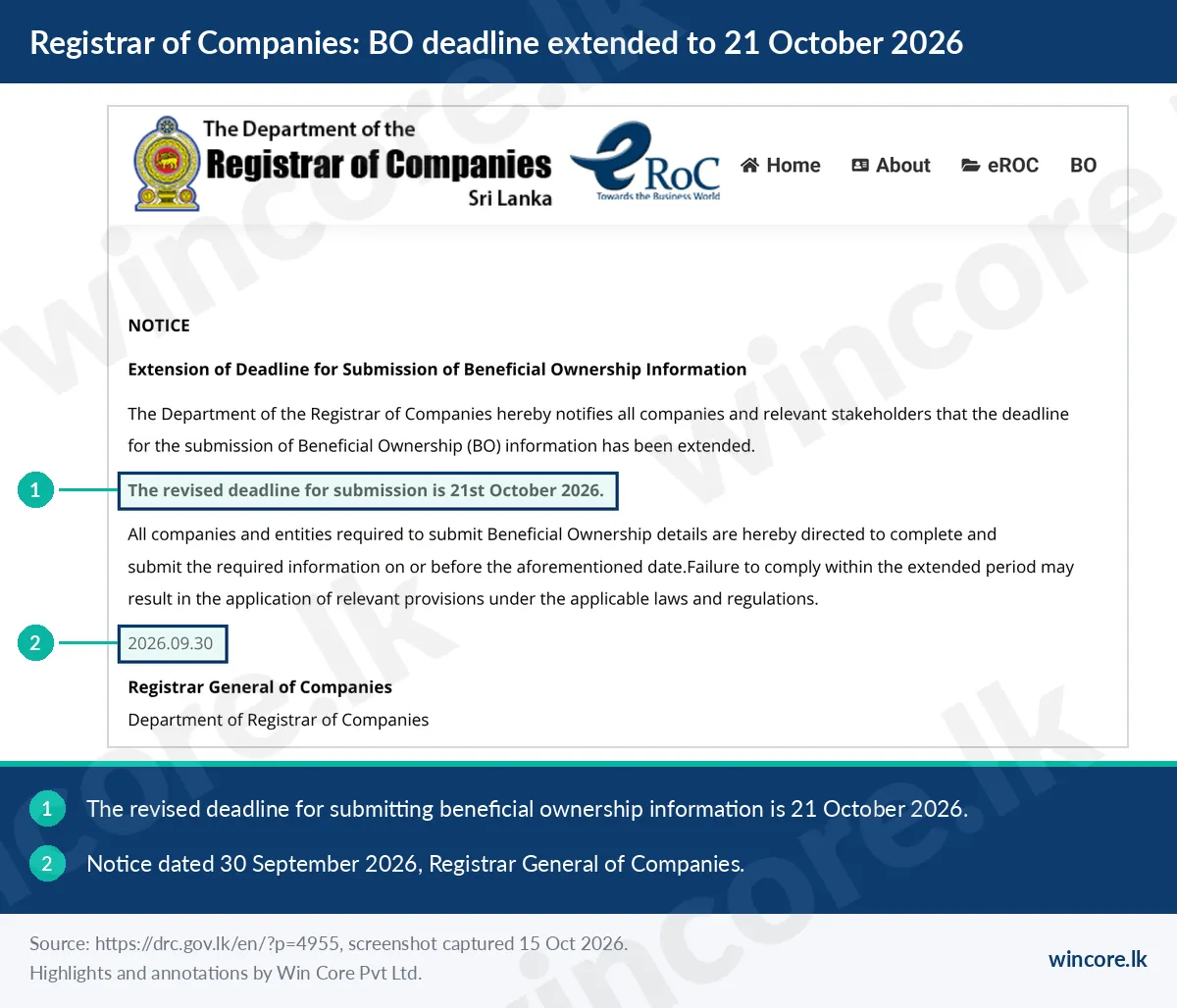
Who counts as a beneficial owner at 10 percent, the forms in the October 2026 regulations, and what existing companies face after the 21 October deadline.
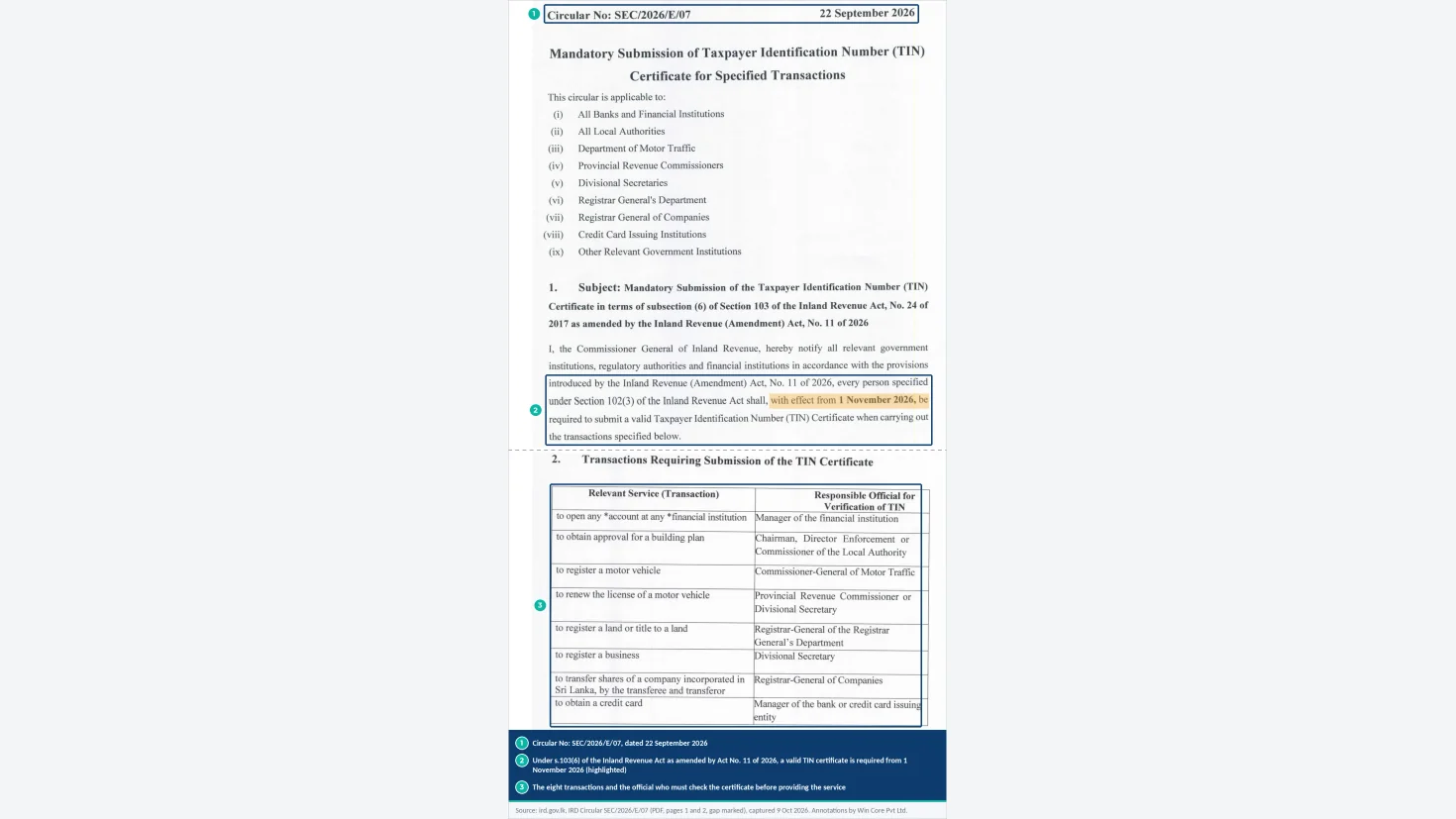
From 1 November 2026 individuals need a TIN certificate for eight transactions. Who needs one, how to get it, and TINs for companies and staff.