
Tax residency in Sri Lanka: the 183 day rule, not your passport
A citizen abroad can be non-resident and a foreigner here resident. The four limbs of s.69, the 2026 changes, and where citizenship still counts.
On this page
Last verified against the primary sources on 21 October 2026.
Tax residency in Sri Lanka is decided by section 69 of the Inland Revenue Act, No. 24 of 2017, not by citizenship: an individual is resident for a year of assessment if he or she "resides in Sri Lanka", or is present for 183 days or more in aggregate in any twelve month period that starts or ends in the year, or falls in two narrow limbs for Government officers abroad and ship crew [1]. From the year of assessment 2025/26, Act No. 11 of 2026 (certified 3 June 2026) added two exclusions: holders of an Investor Category Residence Visa are not resident, and nor is a person who leaves for at least one year's contract employment with an unassociated employer [2] [3].
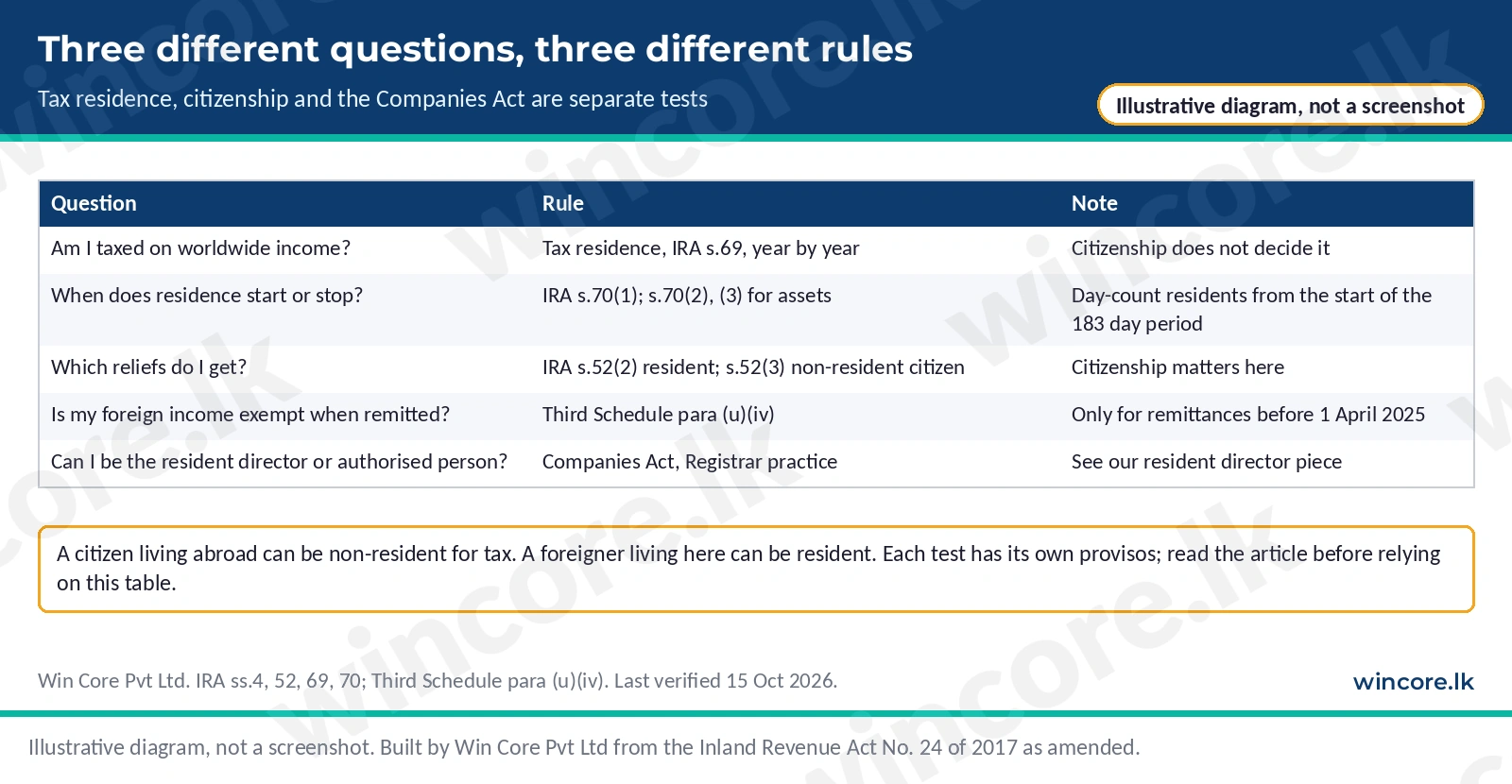
A passport is the question people bring. A calendar, and since 2026 a contract and a visa, are the answers the Act gives. Citizenship still matters, but in a few narrow places, and it is a separate question from whether you can be the resident director of a Sri Lankan company. This guide keeps those questions apart.
Tax residency in Sri Lanka has four limbs, and citizenship is not one of them
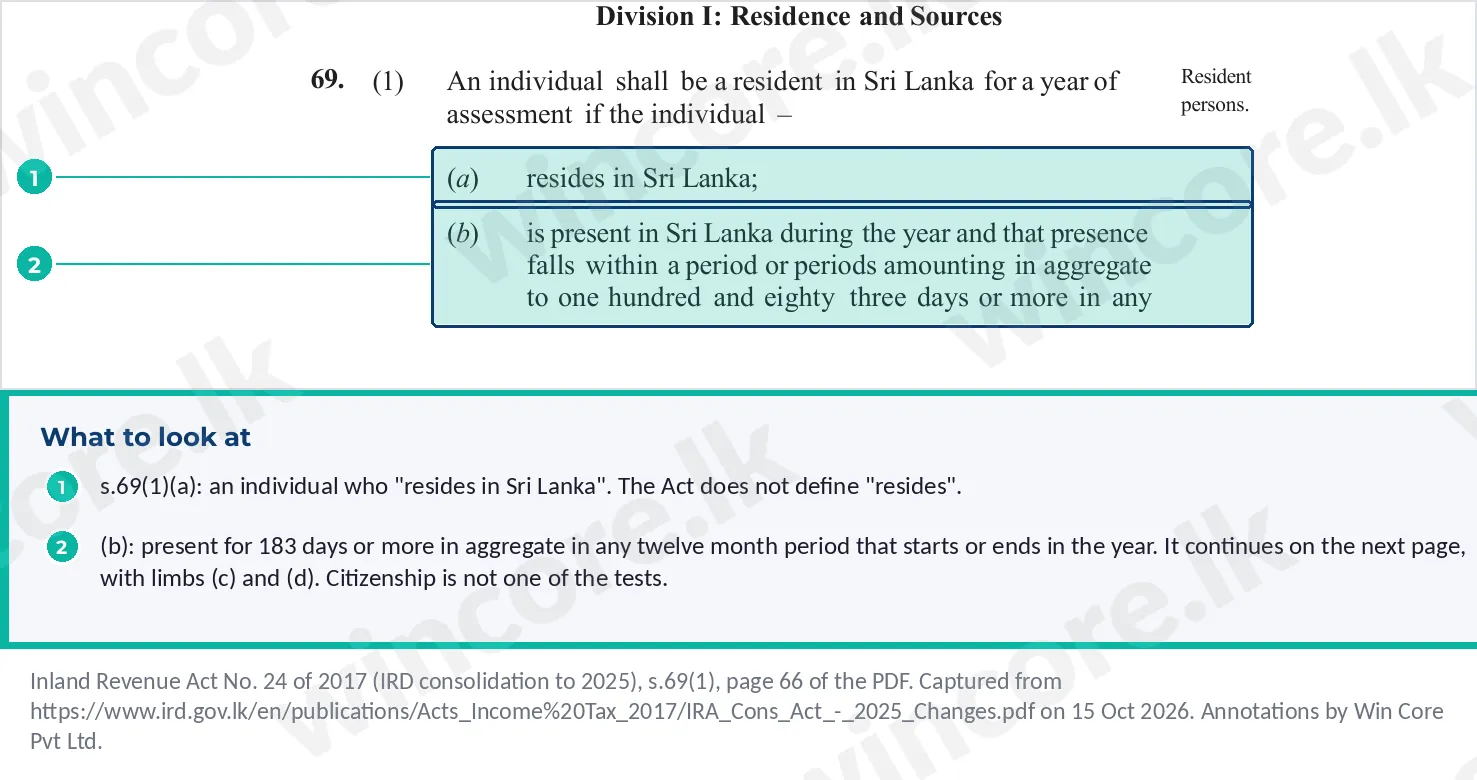
Section 69(1) says "An individual shall be a resident in Sri Lanka for a year of assessment if the individual" [1]:
- (a) "resides in Sri Lanka";
- (b) "is present in Sri Lanka during the year and that presence falls within a period or periods amounting in aggregate to one hundred and eighty three days or more in any twelve month period that commences or ends during the year";
- (c) "is an employee or an official of the Government of Sri Lanka and his spouse is posted abroad during the year"; or
- (d) is employed on a Sri Lanka ship, "during the period the individual is so employed".
Section 195 defines "resident" only by pointing back to section 69 [1].
Two features of the 183 day test catch people. The twelve months float: the window is "any twelve month period that commences or ends during the year", not the April to March year of assessment, so days late in one year and early in the next can combine. And days are aggregated: "a period or periods amounting in aggregate" means several short visits count together. Several summaries online describe the test as 183 days "within a tax year"; that is not what the Act says.
Limb (a) needs no day count at all. The Act does not define "resides". A person who keeps a home and family here should not assume that being away for more than 183 days settles the point, unless one of the 2026 exclusions below applies.
Limb (c) is compressed. On our reading it keeps a Government officer posted overseas resident, and its reach for a spouse is not clear from the text. Limb (d) covers crew of a Sri Lanka ship. Neither limb helps a private sector employee posted abroad by a Sri Lankan company.
Act No. 11 of 2026 took two groups out of residence from 2025/26
Section 69 now has two new subsections [2]:
| Provision | Wording | Who it helps |
|---|---|---|
| s.69(1A) | "Notwithstanding the provisions of subsection (1), an individual shall not be a resident in Sri Lanka for a year of assessment, if the individual holds an Investor Category Residence Visa issued by the Controller of Immigration and Emigration" | A foreign investor living here on that visa, even past 183 days |
| s.69(2A) | "if an individual leaves Sri Lanka for an employment under a contract for a period of not less than one year with an employer who is not associated with the immediate Sri Lankan employer of the individual, such individual shall not be considered as a resident of Sri Lanka for the period commencing on the first day of the year of assessment in which the individual leaves Sri Lanka and ending on the date of expiry of such contract" | A Sri Lankan who leaves for a contract of a year or more with an unassociated employer |
Two details matter. Subsection (2A) is phrased "For the avoidance of doubt", and the employer test is about association with the person's immediate Sri Lankan employer, not about the employer being foreign; the IRD's notice paraphrases it as "an unrelated foreign employer" [3]. And a secondment by a Sri Lankan employer to its own overseas affiliate is, on our reading, outside (2A), because that employer is associated. The IRD notice dates the visa change from 1 April 2025; our guide to Act No. 11 of 2026 reads both changes as applying from 2025/26 [3].
Residence decides whether foreign income is taxed here
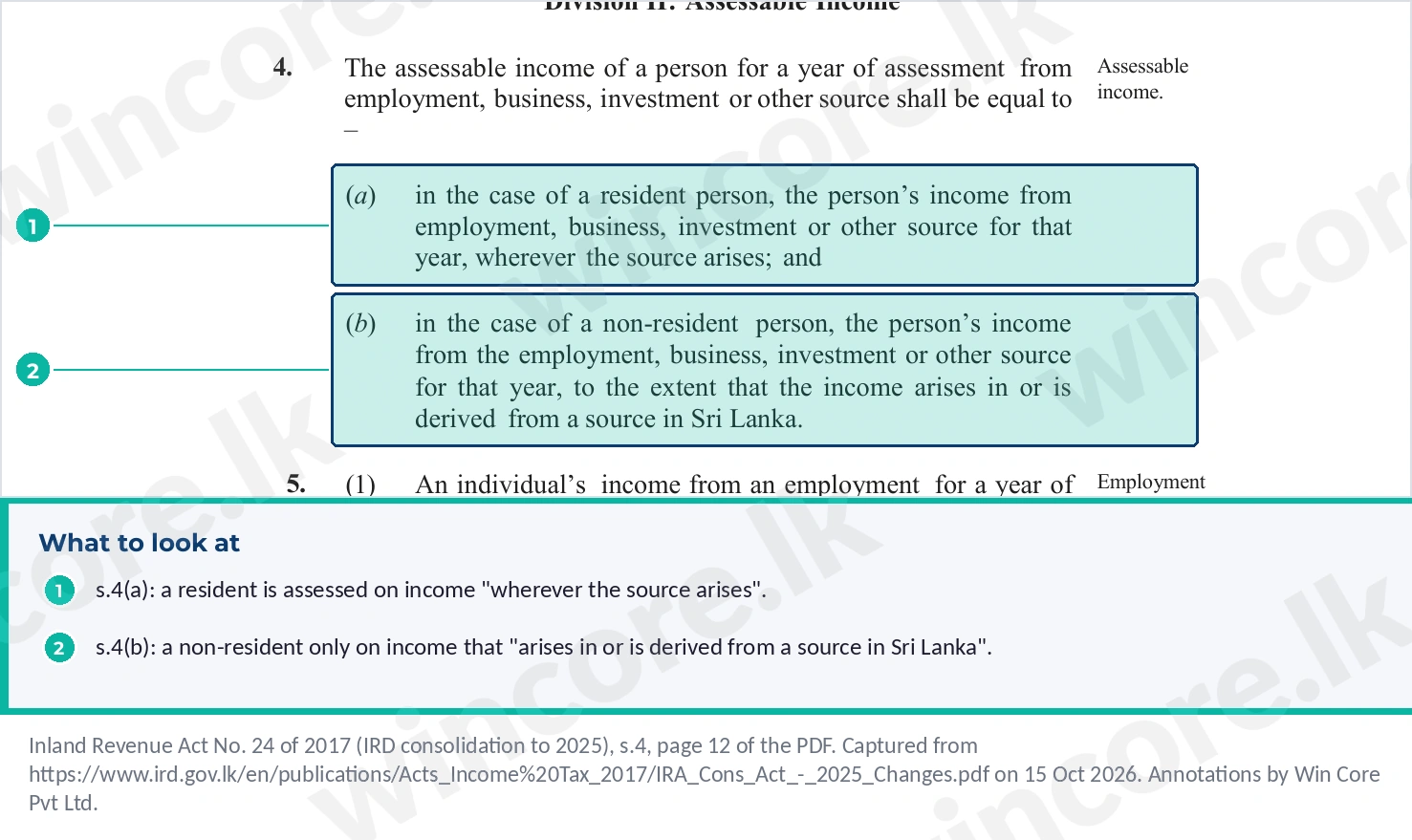
Section 4 sets the reach of the tax [1]. A resident is assessed on income "wherever the source arises". A non-resident is assessed only on income "to the extent that the income arises in or is derived from a source in Sri Lanka".
Foreign income a resident sends home used to be exempt, with conditions. Paragraph (u)(iv) of the Third Schedule exempted foreign source gains earned in foreign currency and remitted through a bank "on or after January 1, 2020, but prior to April 1, 2025" [1]. From 1 April 2025 that income is taxable, at no more than 15 percent for individuals, as our guide to Act No. 2 of 2025 explains. Other income of a resident individual is taxed at the bands in our income tax bands guide.
Residence starts on day one of the 183 days, and leaving can mean a deemed sale
Section 70(1): "An individual who is resident in Sri Lanka only by reason of paragraph (b) of subsection (1) of section 69, shall be so resident from the start of the one hundred and eighty three day period. Otherwise, a person who is resident in Sri Lanka during a year of assessment shall be treated as a resident for the whole of the year" [1]. The original 2017 text referred to paragraph (c); the consolidation reads (b).
So a person who becomes resident only by day count is resident from the first of those days, not from 1 April. A person resident on any other limb, including "resides", is resident for the whole year.
Moving also has an asset rule. When a non-resident becomes resident, the net cost of an asset held is reset to its market value at that time (s.70(2)). When a resident ceases to be resident, the person is treated as having realised all assets immediately before, at market value (s.70(3)) [1]. Section 70(4) excludes a "domestic asset", which includes an interest in land or a building in Sri Lanka and shares in a resident company. Foreign shares or foreign property are the assets exposed to a deemed sale.
Citizenship still matters for reliefs and ship crew
Section 52(2) gives a resident individual "the aggregate reliefs referred to in the Fifth Schedule". Section 52(3) gives an individual "who is not resident in Sri Lanka for a year of assessment but is a citizen of Sri Lanka" only "the relief referred to in paragraph 2(a) of the Fifth Schedule" [1]. A non-resident who is not a citizen gets neither under section 52.
Act No. 11 of 2026 added a second citizenship point, to limb (d): a ship crew member who "is a citizen or subject of any country other than Sri Lanka" is not, by reason of that limb, liable to tax as a resident on any income other than income from the employment on the ship [2]. Citizenship also appears in some withholding rules on interest paid to non-resident citizens; check the specific payment.
The Inland Revenue Act does not say who is a citizen. That is a matter for citizenship law. If your citizenship is in doubt, settle it under that law first, then apply the tax rules.
Company law and exchange control use their own residence tests
Being tax resident does not make you eligible as a resident director, and being a citizen does not either. The Companies Act, No. 7 of 2007 sets no residence test for the directors of a local company; in our filing practice, the Registrar of Companies will not incorporate a private company without at least one resident director. That is practice, not a rule in the Act, and our separate piece on the resident director question, Act versus Registrar, sets out the two side by side. The beneficial ownership authorised person has a third test: a company "shall appoint, in a prescribed manner a natural person residing in Sri Lanka as the authorised person" (Companies Act s.130C(1), inserted by Act No. 12 of 2025) [4].
Exchange control is a fourth test. Under the Foreign Exchange Act, No. 12 of 2017, "a person resident in Sri Lanka" means such person as the Minister determines by Order published in the Gazette (s.31(3)) [5]. Inward Investment Accounts use nationality as well: a non-national may hold one whether "resident in or outside Sri Lanka", as our Inward Investment Account guide explains.
What this means for you
- Count days in rolling twelve month windows, not only in the April to March year.
- Do not rely on days alone if you keep a home or family in Sri Lanka. Limb (a) has no day count.
- Leaving for work abroad? Keep the contract: under s.69(2A) its length and the employer's lack of association with your Sri Lankan employer are what take you out of residence.
- Arriving on an Investor Category Residence Visa? Keep the visa record; s.69(1A) applies while you hold it.
- Leaving for good? List foreign assets before you go; s.70(3) may treat them as sold. Arriving? Record market values on arrival for s.70(2).
- Keep the company questions separate from the tax ones.
Checklist: documents needed
- Passport entry and exit stamps or travel record for each twelve month window
- Overseas employment contract showing its term and the employer's identity
- Investor Category Residence Visa, if held, with its dates
- List of foreign assets with market values on arrival or departure
- Evidence of Sri Lankan citizenship, if claiming the s.52(3) relief as a non-resident
Our income tax compliance services cover residence positions, returns and TIN registration for individuals, and our company registration team handles directors and authorised persons on new companies. See also our income tax return filing guide.
Two hypothetical examples
A Sri Lankan leaving for a contract abroad. A hypothetical Sri Lankan quantity surveyor leaves on 1 August 2026 for a two year contract with a Qatari construction firm that has no link to her Colombo employer. Under s.69(2A) she is not resident from 1 April 2026, the first day of the year of assessment in which she leaves, until the contract expires on 31 July 2028. On our reading that holds even though she keeps a flat in Colombo. Rent from that flat is still Sri Lankan source income, taxable to her as a non-resident under s.4(b), with the s.52(3) relief as a citizen [1] [2].
A foreign engineer moving here. A hypothetical Japanese engineer arrives on 1 October 2026 on an employment visa and stays. His presence reaches 183 days in the twelve months from 1 October 2026, a period that commences in 2026/27, so he is resident for 2026/27 "from the start of the one hundred and eighty three day period", 1 October 2026 (s.70(1)), unless the "resides" limb applies sooner. His foreign assets take a market value cost from that date (s.70(2)). Had he held an Investor Category Residence Visa instead, s.69(1A) would make him non-resident for each year he holds it [1] [2].
FAQ
I am a Sri Lankan citizen living abroad. Am I still tax resident?
Not because of citizenship, which is not a test under section 69. You are resident only if a limb applies, for example "resides" or 183 days in a floating twelve month window. If you left for a contract of at least a year with an employer not associated with your Sri Lankan employer, s.69(2A) treats you as non-resident from the start of that year until the contract ends [1] [2].
Is the 183 days counted in the tax year only?
No, the 183 days are counted in any twelve month period that starts or ends during the year of assessment. The window floats, so days at the end of one year and the start of the next can combine. Days are aggregated across separate visits, and a person who meets the test only by day count is resident from the first day of the 183 day period [1].
Does an Investor Category Residence Visa make me tax resident?
No, it does the opposite from the year of assessment 2025/26. New section 69(1A) says an individual who holds an Investor Category Residence Visa issued by the Controller of Immigration and Emigration "shall not be a resident in Sri Lanka for a year of assessment", notwithstanding the 183 day and "resides" limbs. Other visa types follow the ordinary limbs [2] [3].
As a foreigner, am I ever taxed in Sri Lanka on foreign income?
Yes, once you become resident. Section 4(a) assesses a resident on income "wherever the source arises", and the Third Schedule exemption for foreign income remitted through a bank ended for remittances from 1 April 2025. A non-resident is taxed only on Sri Lankan source income under section 4(b) [1].
Does being tax resident make me eligible as a resident director?
No, tax residence does not decide it. Directors are a Companies Act and Registrar question with their own test: the Act sets no residence rule for local company directors, while in our filing practice the Registrar requires at least one resident director. The beneficial ownership authorised person must be "a natural person residing in Sri Lanka" under s.130C [4].
Open points
- What "resides" means. Undefined in the Act, and how it interacts with s.69(2A) for a person who keeps a home here is, on our reading, settled by the "avoidance of doubt" wording but untested.
- Start date of s.69(2A). The IRD notice dates the visa and ship changes from 1 April 2025 but gives no separate date for (2A).
- Limb (c) and spouses. The text is compressed; its reach for a spouse is not settled.
- Treaty tie-breakers. Where two countries both treat a person as resident, a double tax treaty usually decides. We have not reviewed treaties for this piece.
Last verified 21 October 2026. We read Inland Revenue Act ss.52, 69 and 70 (the 2017 Act and the IRD consolidation to 2025), section 69 as amended by Act No. 11 of 2026, the IRD notice SEC/PN/IT/2026/02, Companies Act s.130C and Foreign Exchange Act s.31 on that date. Section 4 and the Third Schedule were read from the IRD consolidation on 15 October 2026 and checked against our Act No. 2 of 2025 guide.
Tax follows residence under section 69, and since 2026 a contract or an investor visa can take you out of it. Citizenship changes your reliefs, not your residence. Directors and authorised persons are company law questions with their own tests.
Talk to us. If you are moving to or from Sri Lanka and want your residence position worked out before the year closes, our contact page.
WinCore Pvt Ltd
This article is general information, not advice for your specific situation.
References
- Inland Revenue Department. Inland Revenue Act, No. 24 of 2017, ss.4, 52, 69, 70, 195, Third Schedule para (u)(iv), Fifth Schedule para 2(a); consolidated to 2025 and the 2017 Act. https://www.ird.gov.lk/en/publications/Acts_Income%20Tax_2017/IRA_Cons_Act_-_2025_Changes.pdf and https://www.ird.gov.lk/en/publications/Acts_Income%20Tax_2017/IR_Act_No_24_2017_E.pdf . Primary. Accessed 21 October 2026 (ss.52, 69, 70); 15 October 2026 (s.4, Third Schedule).
- Parliament of Sri Lanka. Inland Revenue (Amendment) Act, No. 11 of 2026, amendment of s.69 (new proviso to s.69(1)(d), new s.69(1A) and (2A)). https://www.ird.gov.lk/en/publications/Acts_Income%20Tax_2017/IR_Act_No_11-2026_E.pdf . Primary. Accessed 21 October 2026.
- Inland Revenue Department. Notice to the Taxpayers: Amendments to the Inland Revenue Act, No. 24 of 2017, SEC/PN/IT/2026/02, item 8. https://www.ird.gov.lk/en/Lists/Latest%20News%20%20Notices/Attachments/788/SEC_PN_IT_2026-02.pdf . Primary (guidance). Accessed 21 October 2026.
- Parliament of Sri Lanka. Companies (Amendment) Act, No. 12 of 2025, new s.130C(1). https://www.parliament.lk/uploads/acts/gbills/english/6389.pdf . Primary. Accessed 21 October 2026.
- Parliament of Sri Lanka. Foreign Exchange Act, No. 12 of 2017, s.31(3). https://www.cbsl.gov.lk/sites/default/files/cbslweb_documents/laws/acts/en/FOREIGN%20EXCHANGE%20ACT%2C%20No.%2012%20OF%202017%20-%20E.pdf . Primary. Accessed 21 October 2026.
Put these insights to work
WinCore specialists can review your current workflow, document gaps, and build a practical 90-day action plan.
Book a free consultationContinue reading
Explore more WinCore analysis to keep your finance, tax, and compliance roadmap moving.
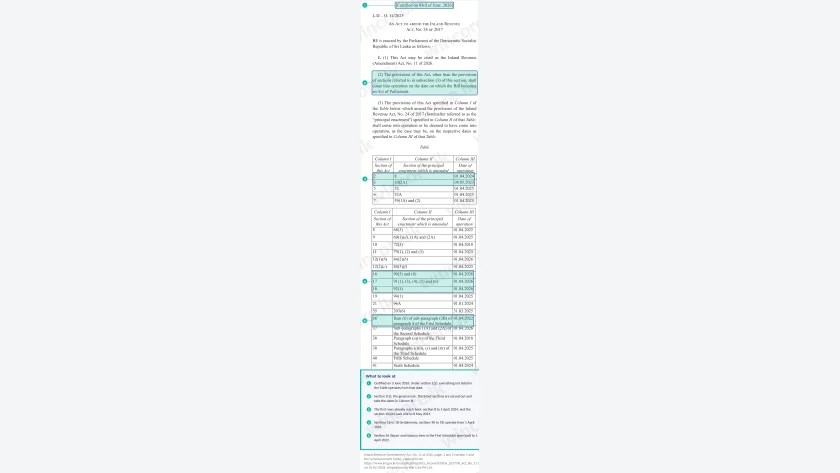
Certified 3 June 2026, Act No. 11 carries nine start dates. Here is each change, the date it bites, the penalty attached and the 2 December write-off.
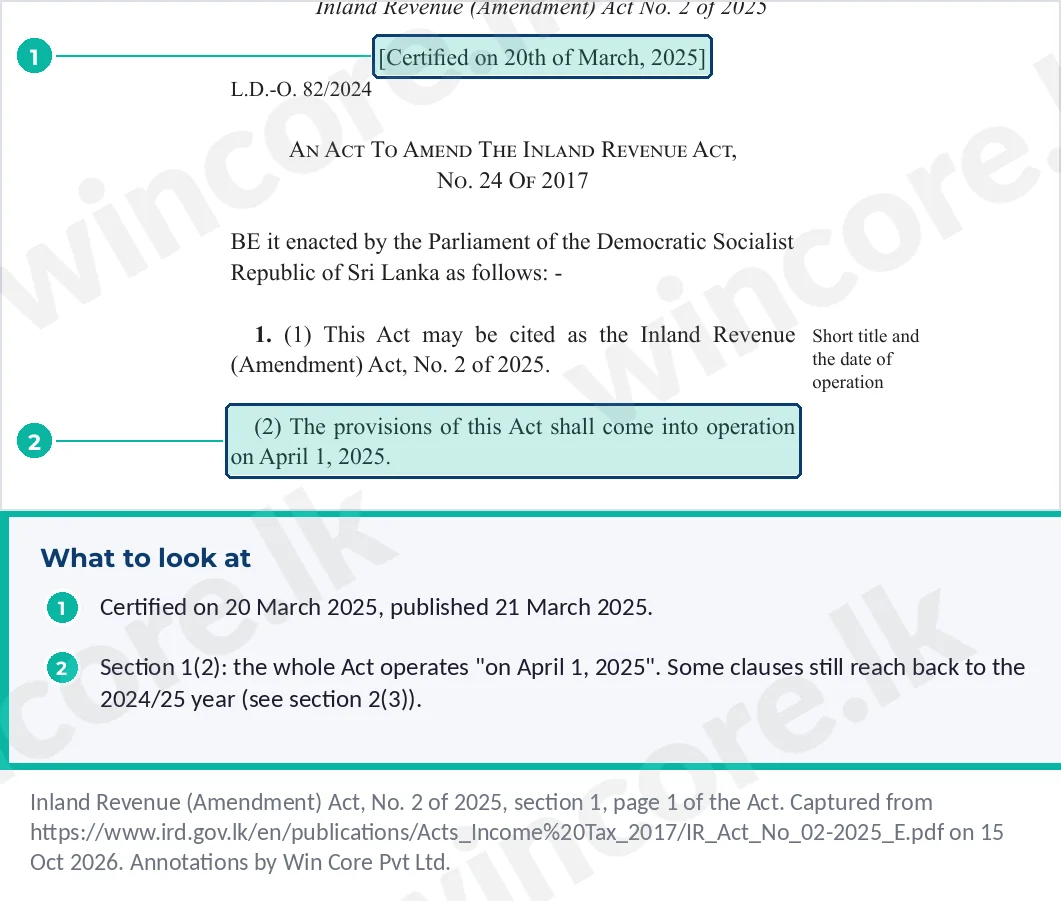
In force from 1 April 2025, Act No. 2 cut tax on most salaries, ended two foreign income exemptions and set a 30-month refund limit reaching 2024/25.

Step-by-step guide to filing income tax returns in Sri Lanka: deadlines, RAMIS process, relief, bands, WHT credits, and common penalty traps.