
Functional currency LKAS 21 Sri Lanka: decide it, then pick the rate
Dollar sales, rupee costs, a dollar loan: which currency are your books really in? The LKAS 21 tests in order, the rates to use, and the tax trail.
On this page
Last verified against the primary sources on 21 October 2026.
Functional currency under LKAS 21 in Sri Lanka is "the currency of the primary economic environment in which the entity operates", and that is "normally the one in which it primarily generates and expends cash" (LKAS 21 paragraphs 8 and 9). It is decided mainly by the currency of your sales prices and your costs. The currency of your loans is only supporting evidence. Once it is fixed, foreign currency transactions are recorded at the spot rate on the transaction date, with an average allowed only while rates are stable, and monetary balances are retranslated at the closing rate. Income tax runs on a separate rule, section 26(6) of the Inland Revenue Act, so most companies with dollar business keep two trails.
For the tax rule in detail, see which exchange rate to use when a tax return needs a USD amount in rupees.
Functional currency under LKAS 21 in Sri Lanka is a finding of fact, not a choice
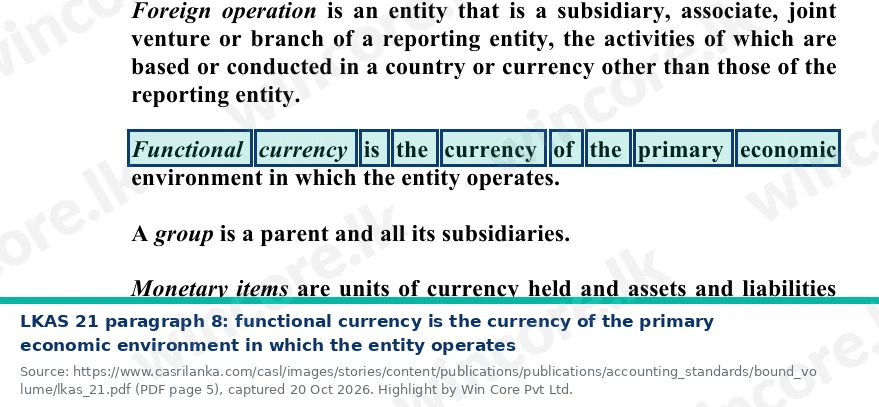
LKAS 21, The Effects of Changes in Foreign Exchange Rates, is issued by CA Sri Lanka and applies to annual periods beginning on or after 1 January 2013 (paragraph 58) [1]. Paragraph 8 defines the two currencies that are easily confused: "Functional currency is the currency of the primary economic environment in which the entity operates", and "Presentation currency is the currency in which the financial statements are presented" [1].
The functional currency is something you find, not something you pick. Paragraph 13: "An entity's functional currency reflects the underlying transactions, events and conditions that are relevant to it. Accordingly, once determined, the functional currency is not changed unless there is a change in those underlying transactions, events and conditions" [1]. Paragraph 17 adds that every entity, "whether a stand-alone entity ... or a foreign operation (such as a subsidiary or branch)", determines its own functional currency under paragraphs 9 to 14.
For the journal entries behind the currency policy, work through booking and settling a dollar-denominated sale.
Sales and costs decide it; loans and other signs only support the answer
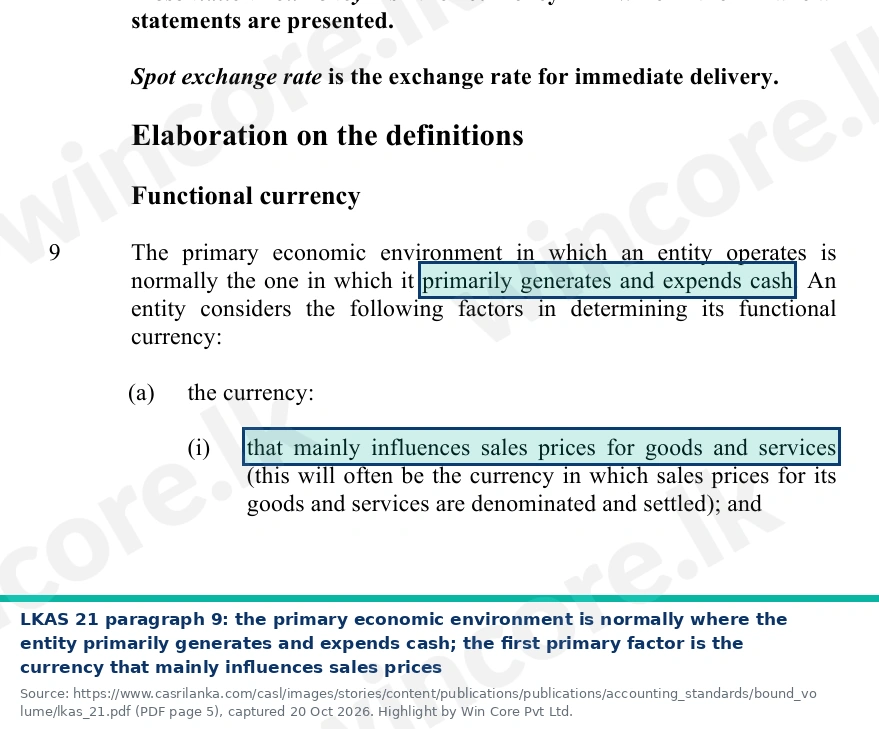
Paragraph 9 opens: "The primary economic environment in which an entity operates is normally the one in which it primarily generates and expends cash." The primary factors are [1]:
- 9(a)(i) the currency "that mainly influences sales prices for goods and services (this will often be the currency in which sales prices for its goods and services are denominated and settled)";
- 9(a)(ii) the currency "of the country whose competitive forces and regulations mainly determine the sales prices of its goods and services";
- 9(b) "the currency that mainly influences labour, material and other costs of providing goods or services (this will often be the currency in which such costs are denominated and settled)".
Paragraph 10 lists factors that "may also provide evidence": "(a) the currency in which funds from financing activities (ie issuing debt and equity instruments) are generated" and "(b) the currency in which receipts from operating activities are usually retained" [1]. For a foreign operation, paragraph 11 adds whether it works "as an extension of the reporting entity, rather than being carried out with a significant degree of autonomy" [1].
Paragraph 12 sets the order when the signs are mixed: "management gives priority to the primary indicators in paragraph 9 before considering the indicators in paragraphs 10 and 11, which are designed to provide additional supporting evidence" [1]. That ordering answers the most common misreading. A dollar loan alone does not make the dollar your functional currency. Financing is a paragraph 10 factor. It supports an answer; it does not override sales and costs.
Two hypothetical companies
| Fact | Company X: steel fabricator exporting structures | Company Y: hardware wholesaler |
|---|---|---|
| Sales prices | Quoted and settled in USD to overseas buyers | Set in LKR for Sri Lankan contractors and shops |
| Main costs | Steel bought and staff paid in LKR | Stock imported and priced in USD; staff in LKR |
| Funding | USD term loan | LKR bank overdraft |
| Receipts kept in | Partly USD, partly converted | LKR |
| Likely answer, on these facts and on our reading | Mixed: USD sales, LKR costs; a para 12 judgement | Probably LKR: the sales market is local (9(a)(ii)), though USD stock costs (9(b)) pull the other way |
Company X is the hard case. Sales point to dollars, costs to rupees, and the dollar loan is only supporting evidence. Paragraph 12 calls for "judgement to determine the functional currency that most faithfully represents the economic effects of the underlying transactions, events and conditions" [1]. The answer turns on facts a table cannot hold, such as how far global prices rather than local conditions set its selling price. Write the reasoning in a board-approved memo and keep it with the year's accounts.
Transactions use the spot rate on the date, and an average only while rates are stable
Once the functional currency is fixed, every other currency is a foreign currency, and LKAS 21 says how to bring it in.
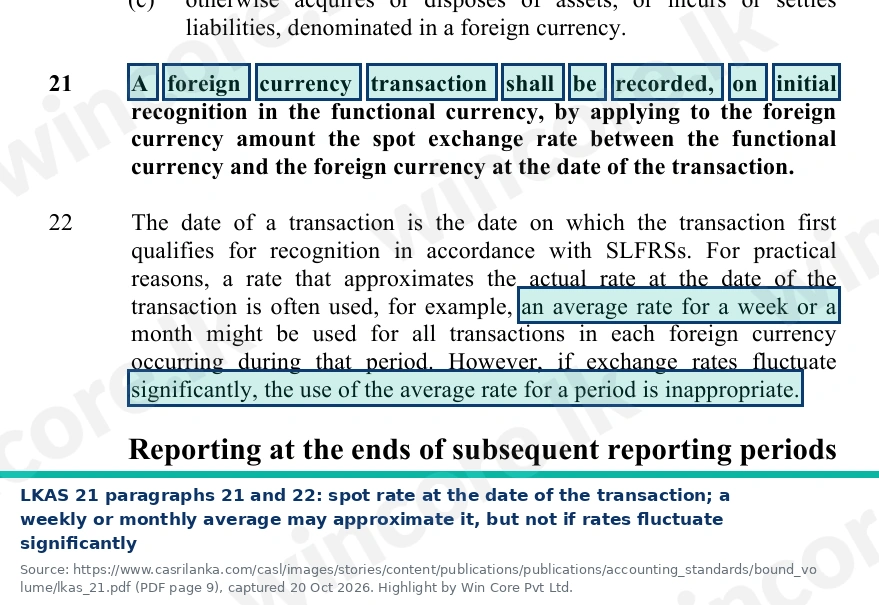
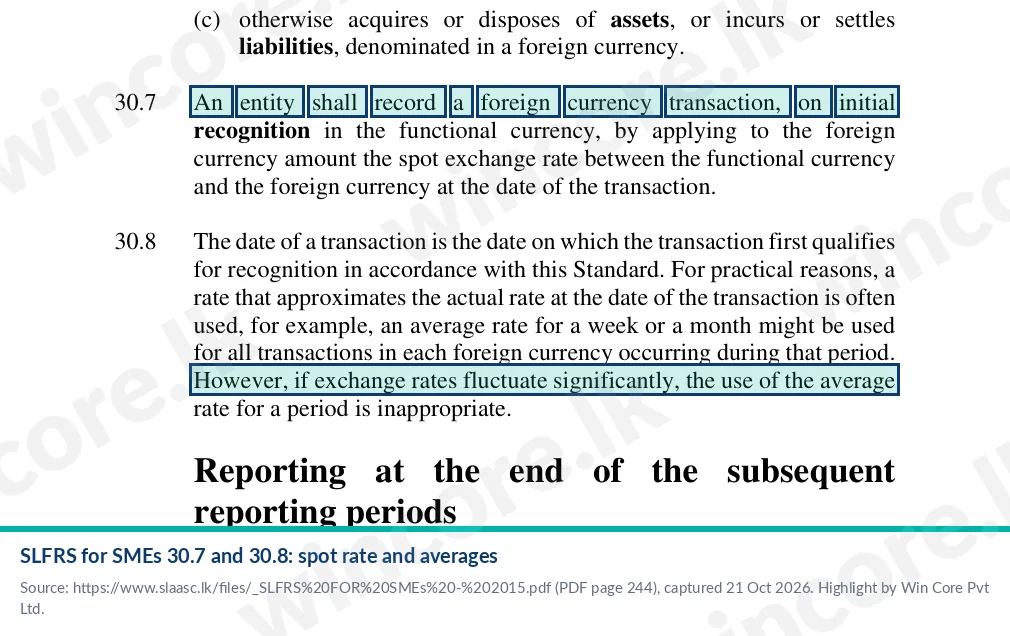
On initial recognition, paragraph 21: "A foreign currency transaction shall be recorded, on initial recognition in the functional currency, by applying to the foreign currency amount the spot exchange rate between the functional currency and the foreign currency at the date of the transaction" [1].
Averages are allowed, with a limit. Paragraph 22: "For practical reasons, a rate that approximates the actual rate at the date of the transaction is often used, for example, an average rate for a week or a month might be used for all transactions in each foreign currency occurring during that period. However, if exchange rates fluctuate significantly, the use of the average rate for a period is inappropriate" [1].
At each reporting date, paragraph 23 [1]:
- (a) "foreign currency monetary items shall be translated using the closing rate" (cash, receivables, payables, loans);
- (b) "non-monetary items that are measured in terms of historical cost in a foreign currency shall be translated using the exchange rate at the date of the transaction";
- (c) non-monetary items at fair value use "the exchange rates at the date when the fair value was determined".
Paragraph 8 defines "Closing rate" as "the spot exchange rate at the end of the reporting period" and "Spot exchange rate" as "the exchange rate for immediate delivery" [1].
Which CBSL series fits each rule
LKAS 21 names no source. In Sri Lanka the obvious public source is the Central Bank of Sri Lanka (CBSL), whose Exchange Rates page publishes the USD/LKR spot indicative rate, indicative rates for other currencies, average TT buying and selling rates, and spreadsheets of monthly average and end-of-month spot rates [2] [3]. Our practice suggestion:
| LKAS 21 rule | CBSL figure we would use |
|---|---|
| Spot rate at the transaction date (para 21) | USD/LKR spot indicative rate for that date; CBSL indicative rate for other currencies |
| Average that approximates it (para 22) | CBSL monthly average spot rate, only while rates are stable |
| Closing rate (paras 8 and 23(a)) | CBSL end-of-month spot rate for the reporting date |
That is practice. The Standard requires a spot rate or a fair approximation of one, nothing more specific. Our currency tool does the arithmetic once you have the rate on file.
Presenting in another currency is translation, not a change of functional currency
A company may report in a currency other than its functional currency. Paragraph 38: "An entity may present its financial statements in any currency (or currencies)." If it does, paragraph 39 requires assets and liabilities at "the closing rate at the date of that statement of financial position", income and expenses "at exchange rates at the dates of the transactions", and the resulting differences "in other comprehensive income". Paragraph 40 again allows "an average rate for the period" unless "exchange rates fluctuate significantly" [1].
Paragraph 53 requires disclosure where the two differ: "that fact shall be stated, together with disclosure of the functional currency and the reason for using a different presentation currency" [1]. That disclosure is what tells a reader the figures have been translated.
A change needs a change in the facts, and it runs forward from that date
Paragraph 36 says the functional currency "can be changed only if there is a change to those underlying transactions, events and conditions", giving the example of "a change in the currency that mainly influences the sales prices of goods and services". Paragraph 35 applies the new procedures "prospectively from the date of the change", and paragraph 37 says the entity "translates all items into the new functional currency using the exchange rate at the date of the change". Paragraph 54 requires disclosure of "that fact and the reason for the change in functional currency" [1]. A wish to reduce exchange differences is not a change in the facts.
Income tax runs on its own rule, so keep a rupee trail
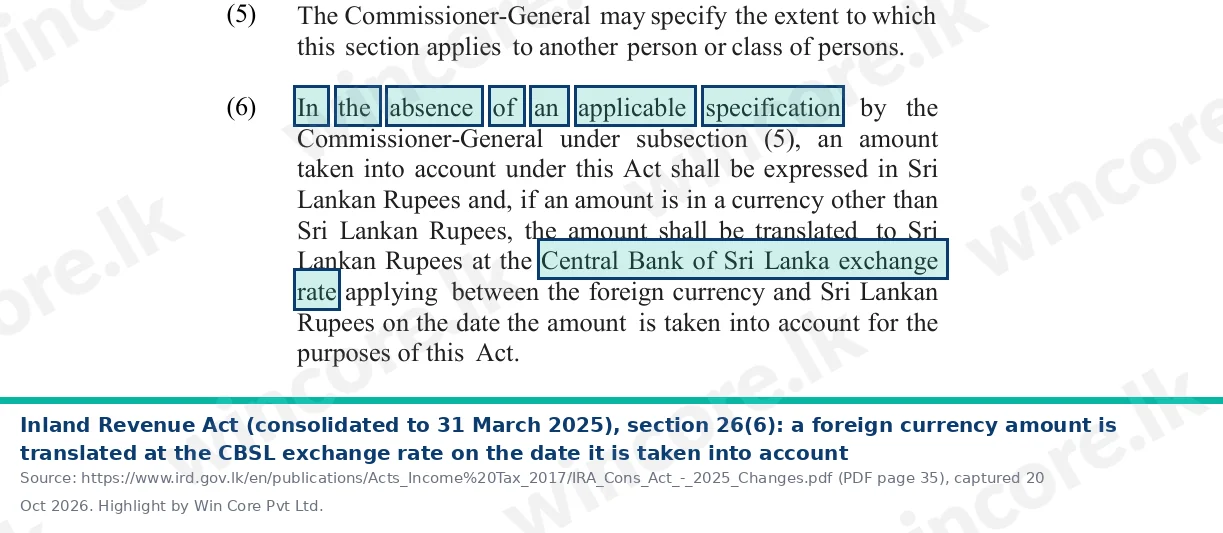
Whatever the books use, income tax is computed in rupees. Section 26(6) of the Inland Revenue Act requires an amount "in a currency other than Sri Lankan Rupees" to be translated "at the Central Bank of Sri Lanka exchange rate ... on the date the amount is taken into account for the purposes of this Act", unless the Commissioner-General specifies otherwise under s.26(5) [4]. The IRD's Public Ruling PR/IT/2023/01 confirms that s.26(6) applies to persons other than financial institutions (section 5.2). For financial accounts prepared in a foreign currency, it says s.26(6) governs the translation into rupees, but where the spot rate of each transaction is difficult to trace "it is recommended to apply average exchange rate declared by Central Bank of Sri Lanka (CBSL) for the year" (section 5.4) [6].
| Purpose | Rule | Average allowed? |
|---|---|---|
| Accounts (LKAS 21) | Spot at transaction date; closing rate for monetary items | Yes, para 22, unless rates fluctuate significantly |
| Income tax (IRA s.26(6)) | CBSL rate on the date the amount is taken into account | Not in the default rule; the IRD's ruling PR/IT/2023/01 recommends the CBSL annual average where foreign-currency accounts cannot trace each spot rate |
So books on a monthly average leave a translation difference in the tax computation, and a dollar functional currency needs a rupee figure for every taxable amount. On our reading, keeping one daily CBSL rate table, and using the daily rate in the books wherever paragraph 22 is not needed, removes most of that reconciliation. Our tax services team prepares the rupee computation from either set of books, and the corporate tax calculator gives a first estimate.
LKAS 21 has no penalty, but the Companies Act and the tax law do
The Standard itself carries no sanction. The consequences come through company and tax law:
| Default | Section | Consequence |
|---|---|---|
| Accounting records do not "correctly record and explain the company's transactions" | Companies Act s.148(1), (3) | The company, and every officer in default: fine "not exceeding two hundred thousand rupees" each [5] |
| Board fails to ensure financial statements complying with s.151 are completed, certified, dated and signed within six months of the balance sheet date (or the Registrar's extended period) | Companies Act s.150(1), (2) | Every director in default: fine "not exceeding one hundred thousand rupees" [5] |
| Tax underpaid through an incorrect statement in a return from intentional conduct or negligence, for example a wrong rate | IRA s.180 | 25% of the underpayment, or 75% where it is higher than Rs 10 million or higher than 25% of the tax liability for the period [4] |
Section 151(1) requires the financial statements to "give a true and fair view" [5]. Whether a wrong functional currency, by itself, breaches s.151 or s.150 is a question for the auditor and, if it came to it, a court. We do not state that it does.
What this means for you
Decide the functional currency on the paragraph 9 facts, write the reasoning down, and have the board approve it. Treat the currency of your loans and where you keep receipts as supporting evidence only. Use a CBSL spot rate for each transaction, the end-of-period spot rate for monetary balances, and averages only while rates are stable. Keep a separate rupee trail for tax under s.26(6). Revisit the decision only when the currency of your sales or costs actually changes. For the year-end routine see our year-end financial close guide. Our accounting services and virtual CFO services teams can draft the functional currency memo and the rate policy with you.
Checklist: documents needed
- Board memo on functional currency applying LKAS 21 paragraphs 9 to 12
- Sales contracts and price lists showing the pricing currency
- Payroll and supplier cost analysis by currency
- Funding agreements (equity and loans) and their currency
- CBSL rate table: daily spot indicative, end-of-month, monthly averages
- Tax computation workings in rupees at s.26(6) dates
Frequently asked questions
Our main supplier invoices in euros. Does that make the euro our functional currency?
Not by itself. Paragraph 9(b) looks at the currency that mainly influences labour, material and other costs, and one supplier is only part of that. Weigh it with the currency of your sales prices under paragraph 9(a) and with your staff and local costs. Where they point different ways, paragraph 12 calls for a judgement, written down and approved by the board [1].
Can a Sri Lankan company keep its books in US dollars?
If USD is genuinely its functional currency, paragraph 21 requires transactions to be recorded "in the functional currency", so on our reading the books are measured in dollars. We did not find a Companies Act or Inland Revenue Act rule on the currency of accounting records, so treat that as an open point. Tax figures must still be in rupees under s.26(6).
Can we use a monthly average exchange rate in the accounts?
Yes, under paragraph 22, as a practical approximation of the rate at each transaction date, but not if exchange rates fluctuate significantly in the period. Monetary balances at the reporting date still use the closing rate. For income tax the default in s.26(6) of the Inland Revenue Act is the CBSL rate on each date, although IRD Public Ruling PR/IT/2023/01 recommends the CBSL average for the year where accounts kept in a foreign currency cannot trace each spot rate.
Which rate is the closing rate under LKAS 21?
Paragraph 8 defines it as "the spot exchange rate at the end of the reporting period". In practice we use the CBSL spot rate for the reporting date, which CBSL also publishes as an end-of-month spot rate spreadsheet. It applies to monetary items such as cash, receivables, payables and loans, which are retranslated at each reporting date under paragraph 23(a).
Can we switch our functional currency to USD to reduce exchange differences?
No. Paragraph 13 says the functional currency "is not changed unless there is a change in those underlying transactions, events and conditions", and paragraph 36 gives a change in the currency of sales prices as the example. A preference for fewer exchange differences is not such a change. If the facts do change, the switch applies prospectively and must be disclosed.
Open points we are keeping open
- Version of LKAS 21. We read the CA Sri Lanka bound volume text, effective for periods from 1 January 2013, which still refers to LKAS 39. The IASB's 2023 amendment to IAS 21 on lack of exchangeability applies internationally from 1 January 2025 (Secondary: KPMG and EY summaries); whether and from when CA Sri Lanka adopted it in LKAS 21 we did not verify.
- SLFRS for SMEs Section 30. Not read for this article; smaller entities on that framework should check its equivalent rules.
- Books in a foreign currency. No Companies Act or Inland Revenue Act rule on the currency of accounting records found; open, not permission.
- Which CBSL series. LKAS 21 names none; our table is practice.
- IRA s.26(6) and the IRD ruling. PR/IT/2023/01 applies s.26(6) to persons other than financial institutions and recommends the CBSL annual average for foreign-currency accounts; it is guidance under s.104 and can be withdrawn.
This article is general information, not advice for your specific situation.
Talk to us. If you need a functional currency memo, a rate policy or a rupee tax trail for dollar business, reach us at our contact page.
WinCore Pvt Ltd
References
- Institute of Chartered Accountants of Sri Lanka. Sri Lanka Accounting Standard LKAS 21: The Effects of Changes in Foreign Exchange Rates (bound volume), paras 8 to 13, 17, 21 to 23, 35 to 40, 53, 54 and 58. https://www.casrilanka.com/casl/images/stories/content/publications/publications/accounting_standards/bound_volume/lkas_21.pdf . Primary (standard). Accessed 21 October 2026.
- Central Bank of Sri Lanka. Exchange Rates (web page). https://www.cbsl.gov.lk/en/rates-and-indicators/exchange-rates . Primary. Accessed 21 October 2026.
- Central Bank of Sri Lanka. Monthly Average Exchange Rates (spreadsheet, to September 2026). https://www.cbsl.gov.lk/sites/default/files/cbslweb_documents/statistics/sheets/IF_Monthly_Average_Exchange_Rates_September%202026.xlsx . Primary. Accessed 21 October 2026.
- Inland Revenue Department. Consolidated Text of the Inland Revenue Act No. 24 of 2017 (amendments up to 31 March 2025), ss.26 and 180. https://www.ird.gov.lk/en/publications/Acts_Income%20Tax_2017/IRA_Cons_Act_-_2025_Changes.pdf . Primary (IRD consolidation, not a statutory text). Accessed 21 October 2026.
- Parliament of Sri Lanka. Companies Act, No. 07 of 2007, ss.148, 150 and 151, as reproduced by CA Sri Lanka. https://www.casrilanka.com/casl/images/stories/EDBA/regulatory%20framework%20-%20companies%20act%202019.pdf . Secondary (CA Sri Lanka extract of the Act). Accessed 21 October 2026.
- Inland Revenue Department. Public Ruling No. PR/IT/2023/01: tax treatment of foreign exchange gains and losses (6 July 2023), sections 5.2 and 5.4. https://www.ird.gov.lk/en/publications/Public_Rulings_IT/PR_IT_2023_01_E.pdf . Administrative guidance (Commissioner-General's public ruling under s.104). Accessed 22 October 2026.
Put these insights to work
WinCore specialists can review your current workflow, document gaps, and build a practical 90-day action plan.
Book a free consultationContinue reading
Explore more WinCore analysis to keep your finance, tax, and compliance roadmap moving.

Close your books before the March 31 deadline to reduce audit risk and start with clean numbers. A practical 10-step year-end guide for SMEs.
Dollar invoice, dollar dividend, rupee return. The Inland Revenue Act picks the Central Bank rate and the date; you still have to pick the series.
A flat rupee rate makes dollar sales look better than they are. Which rate to book, what to revalue at year end, platform fees, and what the IRD taxes.