
Exchange gain or loss Sri Lanka: booking dollar sales right
A flat rupee rate makes dollar sales look better than they are. Which rate to book, what to revalue at year end, platform fees, and what the IRD taxes.
On this page
Last verified against the primary sources on 22 October 2026.
An exchange gain or loss in Sri Lanka arises when a foreign currency sale is booked at one rupee rate and then settled, or revalued at the year end, at another. For a company whose functional currency is the rupee and which reports under SLFRS for SMEs (2015), the sale is recorded at the spot rate on the transaction date (paragraph 30.7), unsettled dollar balances are retranslated at the closing rate (30.9(a)), and every difference goes to profit or loss (30.10). For income tax, the IRD's Public Ruling PR/IT/2023/01 of 6 July 2023 says that for businesses other than financial institutions only realised differences on trade receivables are taxed or deducted; unrealised year-end differences are not.
Sri Lankan freelancers, tour operators and translation and design studios that invoice in US dollars, euros or pounds can get the books wrong in three ways. Sales are booked at a convenient flat rate. Dollar receivables are never revalued. And the amount that lands from a bank or an online payment platform is posted as revenue, with fees and exchange differences mixed in. This article covers those three problems.
It does not repeat two related pieces. For how functional currency is decided and which Central Bank of Sri Lanka (CBSL) series to use, see functional currency and which CBSL rate the books use. For the date and rate a tax return uses, see the exchange rate for income tax in Sri Lanka.
Exchange gain or loss in Sri Lanka starts with the rate on the transaction date
We read Section 30 of the Sri Lanka Accounting Standard for Small and Medium-sized Entities (SLFRS for SMEs), 2015 edition [1]. Companies on full SLFRS apply LKAS 21, whose paragraphs 21 to 23 carry the same rules; our functional currency article quotes them.
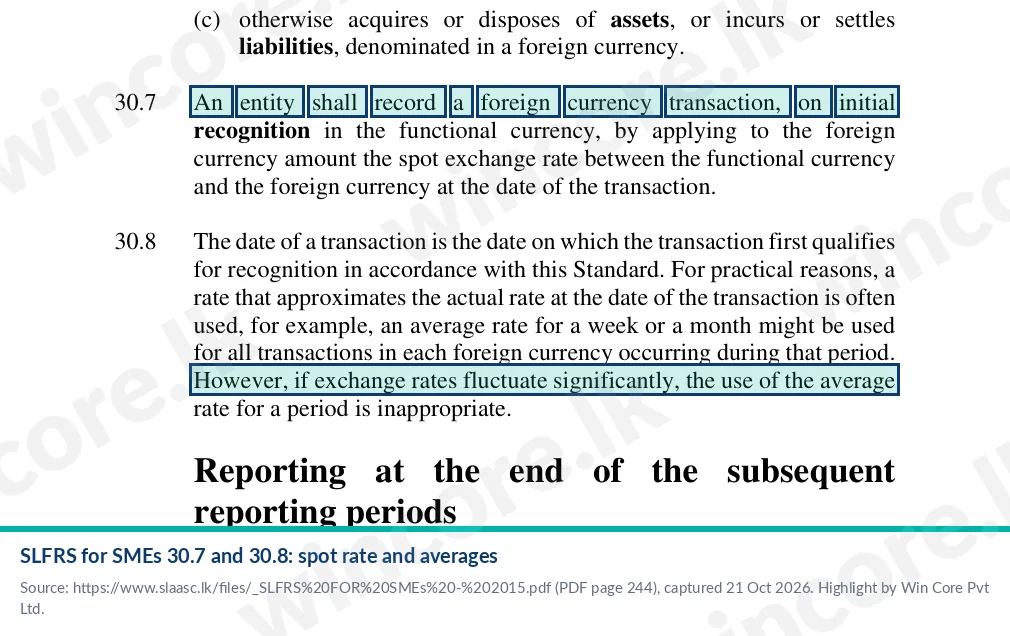
Initial recognition. Paragraph 30.7: "An entity shall record a foreign currency transaction, on initial recognition in the functional currency, by applying to the foreign currency amount the spot exchange rate between the functional currency and the foreign currency at the date of the transaction" [1].
Which date. Paragraph 30.8: "The date of a transaction is the date on which the transaction first qualifies for recognition in accordance with this Standard." For a sale, that is when the revenue rules in Section 23 are met, usually the invoice date for completed work, not the date the money arrives.
Averages, with a limit. Paragraph 30.8 continues: "For practical reasons, a rate that approximates the actual rate at the date of the transaction is often used, for example, an average rate for a week or a month might be used for all transactions in each foreign currency occurring during that period. However, if exchange rates fluctuate significantly, the use of the average rate for a period is inappropriate" [1].
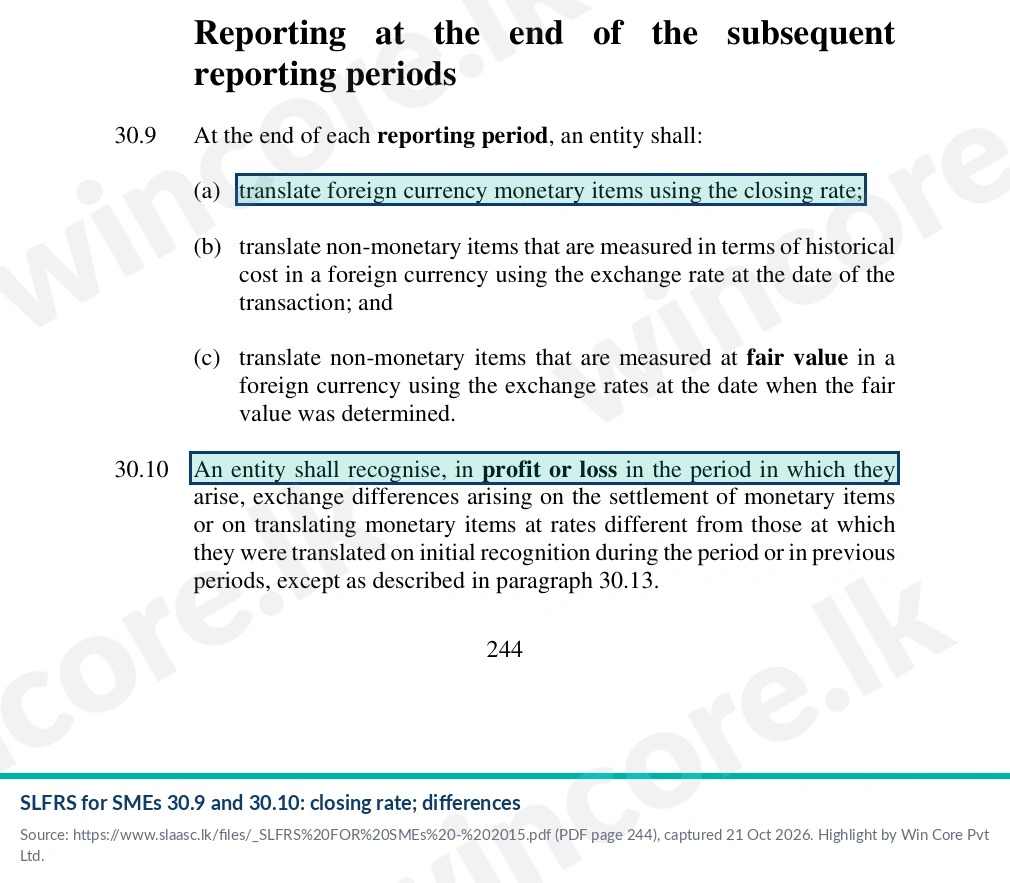
Year end. Paragraph 30.9(a): at the end of each reporting period an entity shall "translate foreign currency monetary items using the closing rate". Monetary items are "Units of currency held and assets and liabilities to be received or paid in a fixed or determinable number of units of currency" (Glossary). On our reading, that covers a USD receivable and a USD balance held in a bank account or on a payment platform [1].
Where the differences go. Paragraph 30.10: "An entity shall recognise, in profit or loss in the period in which they arise, exchange differences arising on the settlement of monetary items or on translating monetary items at rates different from those at which they were translated on initial recognition during the period or in previous periods, except as described in paragraph 30.13." Paragraph 30.13 deals with a monetary item forming part of a net investment in a foreign operation, which rarely applies to a small service company [1].
A fixed booking rate is not what the standard allows
Some businesses book every dollar invoice at one round rate for the year, such as a budget rate. It feels simple. It is not what the standard allows.
A flat rate is not an average of actual rates. It is a fixed number. Paragraph 30.8 allows a rate "that approximates the actual rate at the date of the transaction". On our reading, a budget rate qualifies only if it happens to stay close to actual rates, and the paragraph rules out even a true average "if exchange rates fluctuate significantly".
The damage is in the timing and the label. With a rate above the market, revenue is overstated when booked. The shortfall shows up only when cash arrives, as a difference that has to be explained after the event. Exchange losses then never appear as exchange losses, the year's profit is wrong, and the management accounts overstate the cash the business will actually collect. If you plan cash from those accounts, our virtual CFO service builds the forecast on rupees actually received.
Practice, not a legal requirement: use the actual rate for each invoice from one consistent CBSL series, as our functional currency article suggests. If volumes are high and rates are stable, use a weekly or monthly average of actual rates. Switch back to daily rates when the rupee moves sharply. Write the policy down. Our currency tool does the conversion once the rate is on file.
Revenue takes the transaction-date rate; settlement takes the rate received
Two common questions are "the invoice date or the payment date?" and "the bank's rate or CBSL?"
- The recognition date for revenue and the receivable, usually the invoice date for completed work, because that is when the sale "first qualifies for recognition" (30.8).
- The rate actually received on settlement. The bank or platform rate is the rate at which the receivable was settled. Any difference from the carrying amount is an exchange difference under 30.10. It is not a change to revenue.
- The closing rate at year end for any receivable or foreign currency balance still held (30.9(a)).
Revenue is fixed when booked. Later rate movements go to exchange gains or losses, not to sales. That is what lets you see what currency movements cost you.
Payment platform credits need four separate entries
Payment platform credits are where the three problems meet. A typical flow: the customer pays USD 2,000; the platform deducts a fee; the net USD sits in a USD balance; later it is converted to rupees and sent to a local account, with a conversion fee.
On our reading of the standard, the entries are:
- Revenue at the gross invoice amount, at the invoice-date rate. Paragraph 23.3 measures revenue at "the fair value of the consideration received or receivable", which "takes into account the amount of any trade discounts, prompt settlement discounts and volume rebates allowed by the entity" [1]. A platform's fee is not a discount you give the customer. So, on our reading, it does not reduce revenue.
- The fee as an expense (bank and platform charges) at the rate on the date it is charged.
- The USD balance as foreign currency cash. It is a monetary item, so it is revalued at the closing rate at year end (30.9(a)).
- On conversion to rupees, the difference between the carrying amount and the rupees received is an exchange gain or loss (30.10). Any conversion fee shown separately is an expense.
Practice, not a legal requirement: set the platform up as its own bank account in the books, in USD if your software supports foreign currency accounts. Reconcile it monthly to the platform statement, as with any bank account; our guide to rebuilding accounts from bank statements applies line by line. Whether foreign currency receipts may sit on a platform or must come through a Sri Lankan bank is a foreign exchange question, not an accounting one; our guide to the Business Foreign Currency Account sets out the permitted credits. Our bookkeeping services team runs these reconciliations monthly.
A hypothetical USD 2,000 invoice shows profit moving between years
A Colombo translation bureau with a 31 March year end invoices a customer USD 2,000 on 10 March. All rates below are hypothetical, not CBSL figures, and every rupee amount is our arithmetic.
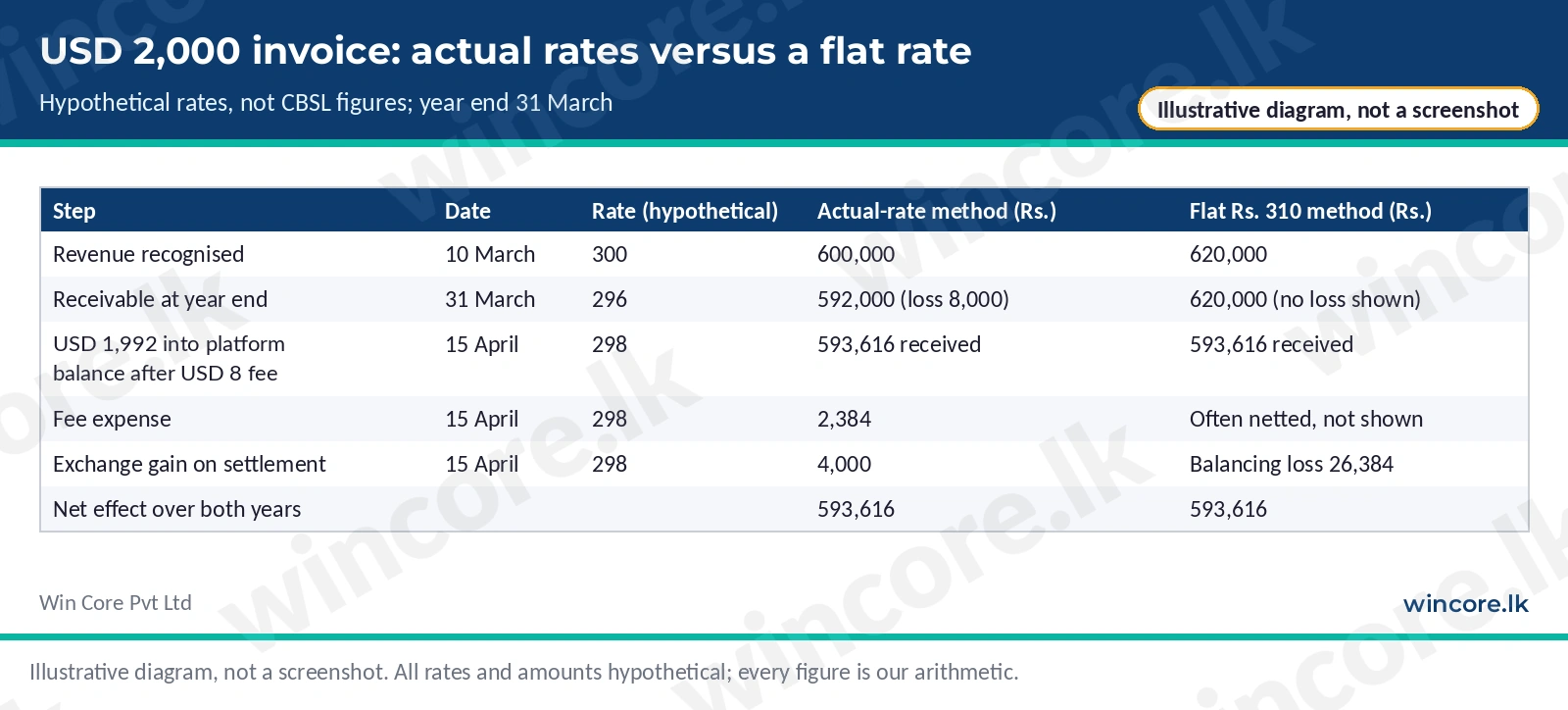
- Actual rates. Revenue is Rs. 600,000 at 300. At year end the receivable is revalued at 296 to Rs. 592,000, an exchange loss of Rs. 8,000 in the year. On 15 April, USD 1,992 arrives in the platform balance after a USD 8 fee, worth Rs. 593,616 at 298. The fee is Rs. 2,384 expense. The exchange gain on the USD 2,000 receivable from 296 to 298 is Rs. 4,000. Rs. 592,000 plus Rs. 4,000 less Rs. 2,384 equals Rs. 593,616.
- Flat Rs. 310. Revenue is Rs. 620,000 and stays there at year end. The same Rs. 593,616 arrives, and a Rs. 26,384 shortfall appears next year with no clear label.
Both methods end with the same cash. But the flat rate shows Rs. 28,000 more profit in the first year (Rs. 620,000 against Rs. 592,000, our arithmetic) and hides the exchange loss and the fee.
For income tax, only realised exchange differences on sales count
The tax computation uses its own translation rule. Section 26(6) of the Inland Revenue Act translates an amount at "the Central Bank of Sri Lanka exchange rate ... on the date the amount is taken into account", unless the Commissioner-General specifies otherwise; our tax rate article sets out the date and the series. A business derives income "when it is receivable" (s.23(1)(a)) [2].
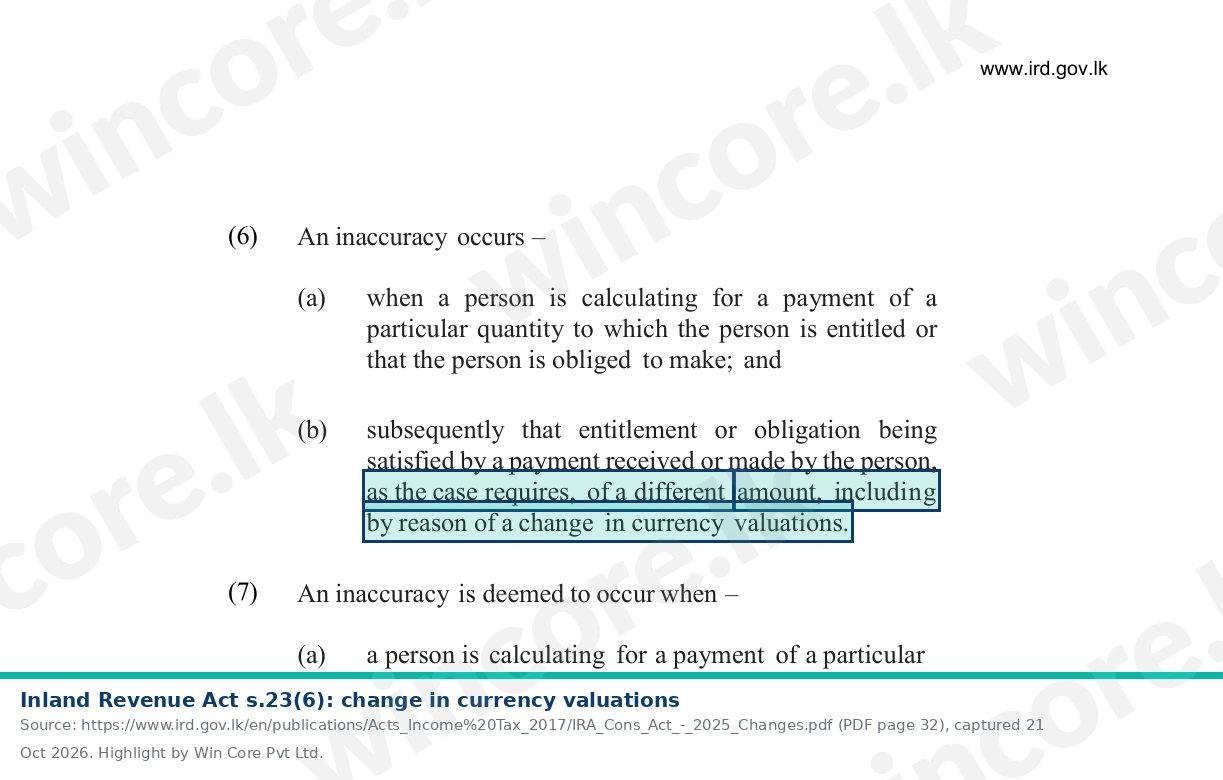
When a receivable is settled at a different rupee amount, s.23(6) treats this as an inaccuracy: the entitlement is satisfied by a payment "of a different amount, including by reason of a change in currency valuations". Section 23(5) then requires "appropriate adjustments" [2].
The IRD has set out how it reads these provisions. Public Ruling PR/IT/2023/01, issued under s.104 on 6 July 2023, says that for persons other than financial institutions, "In the absence of such specifications, section 26(6) is applied for other persons", and that realised gains and losses "could be considered for income tax purposes in the year of assessment where the payment is made or received" [3]. Its summary table, for a business that is not a financial institution:
| Item (PR/IT/2023/01 table) | Unrealised (year-end revaluation) | Realised (on settlement) |
|---|---|---|
| Gain on trade receivables connected to taxable income (row 3) | Not taxable | Taxable |
| Loss on trade receivables connected to taxable income (row 4) | Not allowable | Allowable |
| Loss on foreign currency bank or cash balances of a business (row 7) | Not allowable | Allowable under s.17, subject to s.18(4) |
| Gain on foreign currency bank or cash balances of a business (row 8) | Not taxable | Taxable as a gain on realisation of a capital asset |
The ruling also says "There is no statutory requirement in the IR Act" to consider balance-sheet-date rates for these amounts, so unrealised differences do not arise for tax [3]. In the hypothetical above, the Rs 8,000 year-end loss is in the accounts but, on the ruling, is added back in that year's tax computation; the realised difference is dealt with in the year the money is received. On our reading, a USD balance held on a payment platform falls in rows 7 and 8 as a foreign currency cash balance, but the ruling names only "bank or cash in hand balances", so treat that as our reading. Our income tax services team prepares the add-back schedule with the return.
What this means for you
Stop using a flat rate unless it is a genuine average of actual rates in a calm period. Book each sale at the actual rate on the invoice date, from one CBSL series. Post settlement differences and year-end revaluations to exchange gain or loss, never to sales or bank charges. Record platform fees as expenses and keep revenue gross. Treat each platform balance as a bank account and revalue it at year end. For tax, translate at the CBSL rate under s.26(6), add back unrealised year-end differences and bring realised ones in when the money is received, as PR/IT/2023/01 sets out. Our accounting services team keeps the books and the tax schedule on the same rates.
Checklist: documents needed
- Written exchange rate policy: series, daily or average, when to switch (practice)
- Sales invoices with dates and currency
- CBSL rate file for each invoice date and the year-end date
- Payment platform statements showing gross receipts, fees and conversions
- Bank statements for rupee receipts
- Year-end schedule of foreign currency receivables and balances at the closing rate
- Tax schedule adding back unrealised exchange differences (PR/IT/2023/01)
Frequently asked questions
Can we book revenue at the rate on the day the money arrives?
No, not under paragraphs 30.7 and 30.8 of SLFRS for SMEs. Revenue uses the spot rate on the date the sale first qualifies for recognition, usually the invoice date for completed work. When the money arrives at a different rate, the difference is an exchange gain or loss in profit or loss under paragraph 30.10, not an adjustment to sales.
Is a monthly average exchange rate acceptable in the books?
Yes, as an approximation of the transaction-date rate, unless exchange rates fluctuate significantly in the period. Paragraph 30.8 allows "an average rate for a week or a month" on that condition. A flat budget rate held all year is not an average of actual rates, so it does not qualify unless it happens to stay close to them.
Should payment platform fees reduce revenue?
On our reading, no. Paragraph 23.3 measures revenue at the consideration receivable after trade discounts, prompt settlement discounts and volume rebates you allow the customer. A platform's fee is a cost you pay, not a discount you give. Record revenue at the gross invoice amount and the fee as bank and platform charges.
Is an unrealised exchange gain taxable in Sri Lanka?
No, for a business that is not a financial institution, according to IRD Public Ruling PR/IT/2023/01. Unrealised gains on trade receivables are not taxable and unrealised losses are not deductible. The realised gain or loss is taken into account when the money is received. Financial institutions follow their accounts under s.26 instead.
Do we revalue a USD balance held on a platform at year end?
Yes, in the accounts. A foreign currency balance is a monetary item, translated at the closing rate under paragraph 30.9(a), with the difference in profit or loss. For tax, on our reading, the unrealised part is ignored under PR/IT/2023/01 until the dollars are converted or spent.
Open points we are keeping open
- Platform balances in the ruling. PR/IT/2023/01 names "foreign currency bank or cash in hand balances"; whether a payment platform balance is treated the same way is our reading.
- Standard edition. We read the 2015 SLFRS for SMEs. The IASB issued a third edition of the IFRS for SMEs Accounting Standard in 2025 (Secondary: ifrs.org listing); whether and from when CA Sri Lanka adopts it we did not verify.
- What counts as "fluctuate significantly" under 30.8 has no numeric test.
- Platform fee presentation rests on our reading of 23.3; no Sri Lankan guidance checked.
- Paragraphs 23.3 and the Glossary were not re-read today (our text extraction of the PDF stopped at Section 9); the quotes are as read on 21 October 2026.
This article is general information, not advice for your specific situation.
Talk to us. If your dollar sales, platform balances or year-end revaluation need setting up, or the tax add-back schedule needs preparing, reach us at our contact page.
WinCore Pvt Ltd
References
- Institute of Chartered Accountants of Sri Lanka. Sri Lanka Accounting Standard for Small and Medium-sized Entities (SLFRS for SMEs), 2015, paras 23.3, 30.7 to 30.10, 30.13, Glossary. https://www.slaasc.lk/files/_SLFRS%20FOR%20SMEs%20-%202015.pdf . Primary. Paras 30.7 to 30.10 re-read from the captures on 22 October 2026.
- Inland Revenue Department. Inland Revenue Act, No. 24 of 2017 (consolidated, 2025 changes), ss.23, 26. https://www.ird.gov.lk/en/publications/Acts_Income%20Tax_2017/IRA_Cons_Act_-_2025_Changes.pdf . Primary (IRD consolidation, not a statutory text). Accessed 22 October 2026.
- Inland Revenue Department. Public Ruling No. PR/IT/2023/01: tax treatment of foreign exchange gains and losses, 6 July 2023, sections 5.2 and 5.3 and summary table. https://www.ird.gov.lk/en/publications/Public_Rulings_IT/PR_IT_2023_01_E.pdf . Primary (Commissioner-General's public ruling under s.104). Accessed 22 October 2026.
Put these insights to work
WinCore specialists can review your current workflow, document gaps, and build a practical 90-day action plan.
Book a free consultationContinue reading
Explore more WinCore analysis to keep your finance, tax, and compliance roadmap moving.
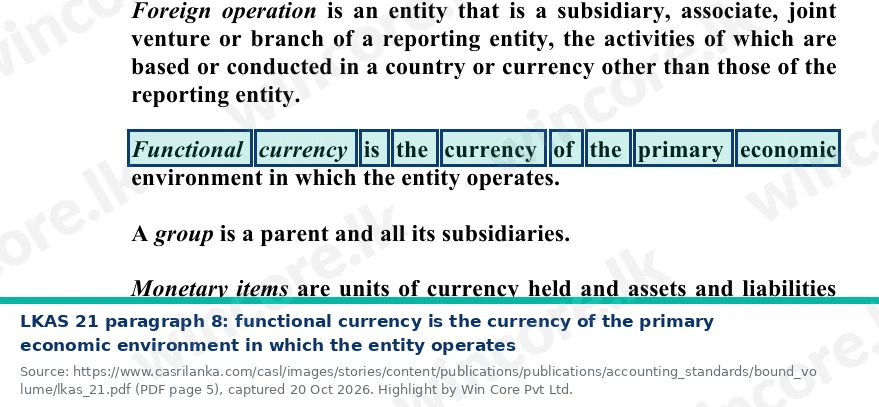
Dollar sales, rupee costs, a dollar loan: which currency are your books really in? The LKAS 21 tests in order, the rates to use, and the tax trail.
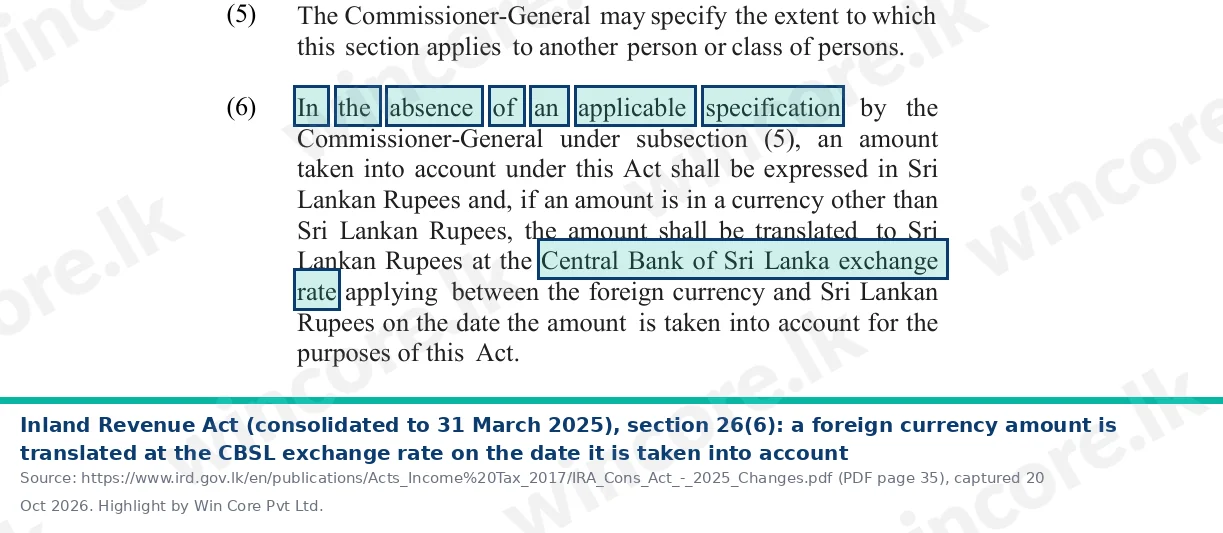
Dollar invoice, dollar dividend, rupee return. The Inland Revenue Act picks the Central Bank rate and the date; you still have to pick the series.
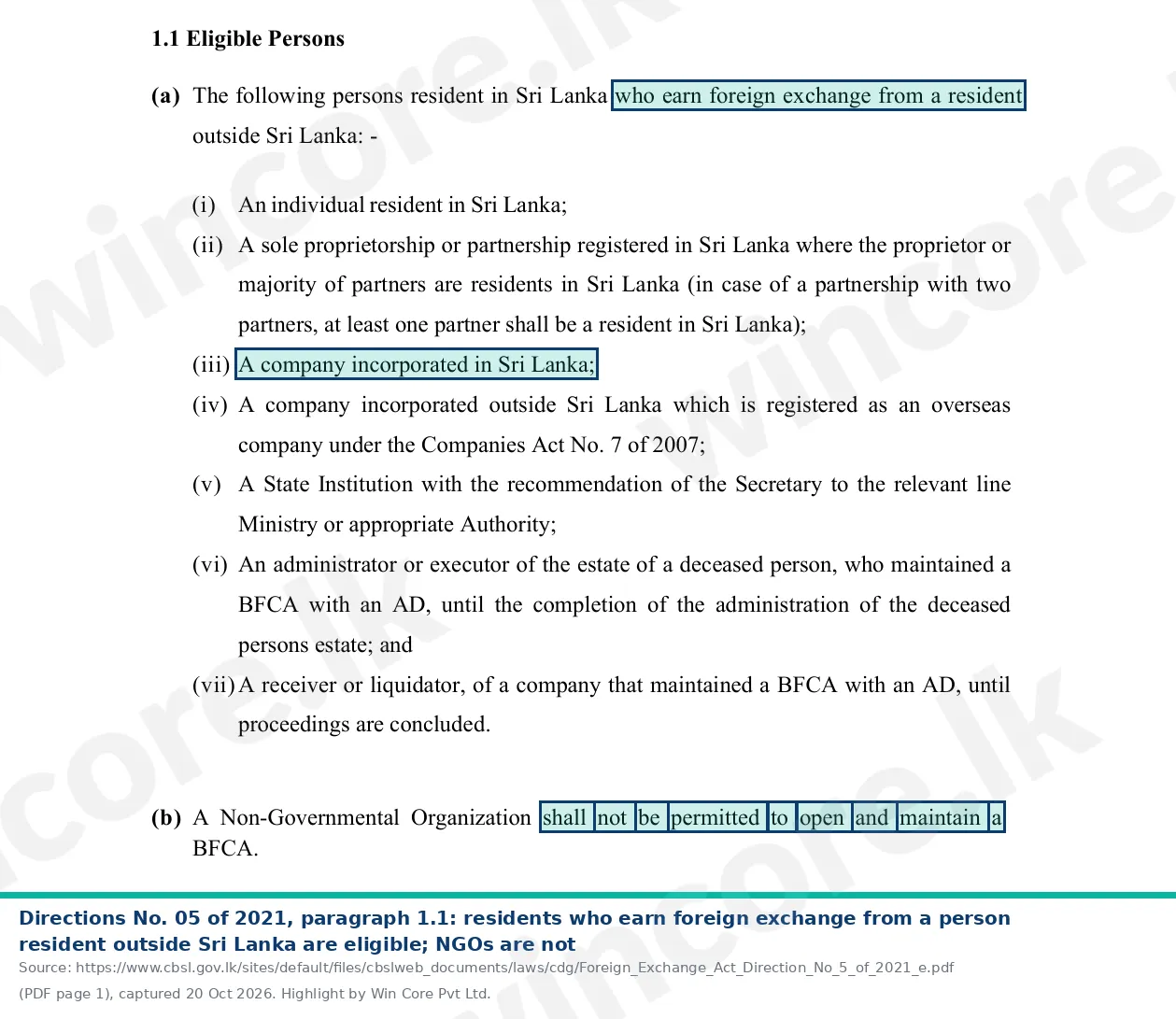
BFCAs are for residents earning foreign exchange from non-residents. The allowed credits and debits, the no-rupee rule and each amending Direction to 2026.