
Rebuild accounts from bank statements in Sri Lanka: prove the chain
Bank statements are source documents, not books. How to prove every month is there, read every line and add what the bank never saw.
On this page
Last verified against the primary sources on 22 October 2026.
You can rebuild accounts from bank statements in Sri Lanka, but the statements alone do not meet the law. Section 148 of the Companies Act, No. 7 of 2007 requires accounting records that "correctly record and explain" every transaction and include a record of assets and liabilities, and section 120(10) of the Inland Revenue Act, No. 24 of 2017 lists bank statements as source documents, and section 120(6) requires records to be kept for at least five years. Both duties apply every day; there is no effective date to wait for.
When books have not been kept, the bank is usually the only complete source left. It is a strong place to start and a weak place to stop. A run of statements works like a chain: each month is a link, joined to the next by its balance, and the closing figure of one statement must be the opening figure of the next. If every link holds, you know you have every month. Only then is it worth reading what each link carries.
This piece separates the law, quoted section by section, from our method, which is practice. For keeping books right from the start, see our guide to bookkeeping basics for Sri Lankan small businesses.
Rebuilding accounts from bank statements starts with what the law requires
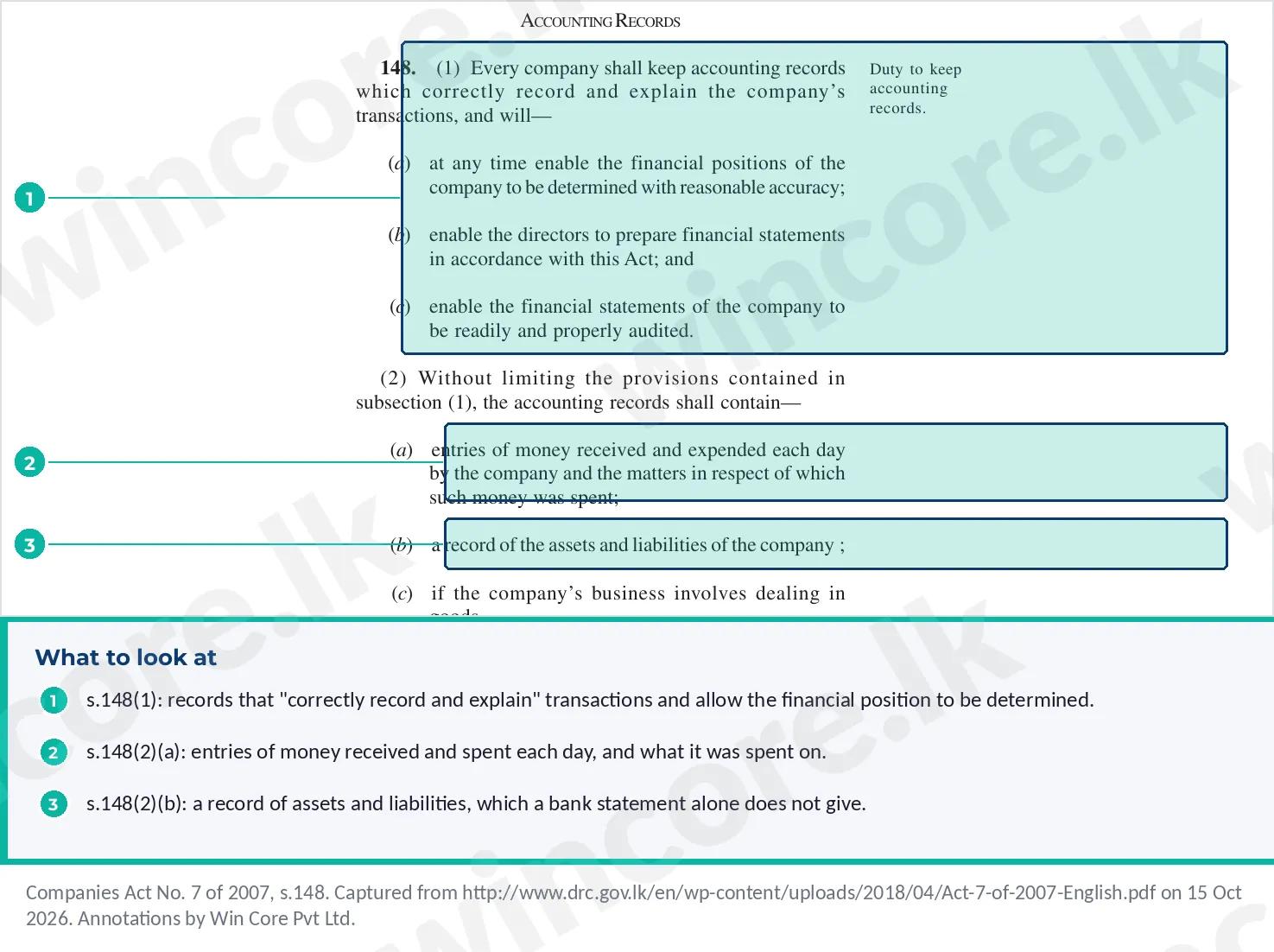
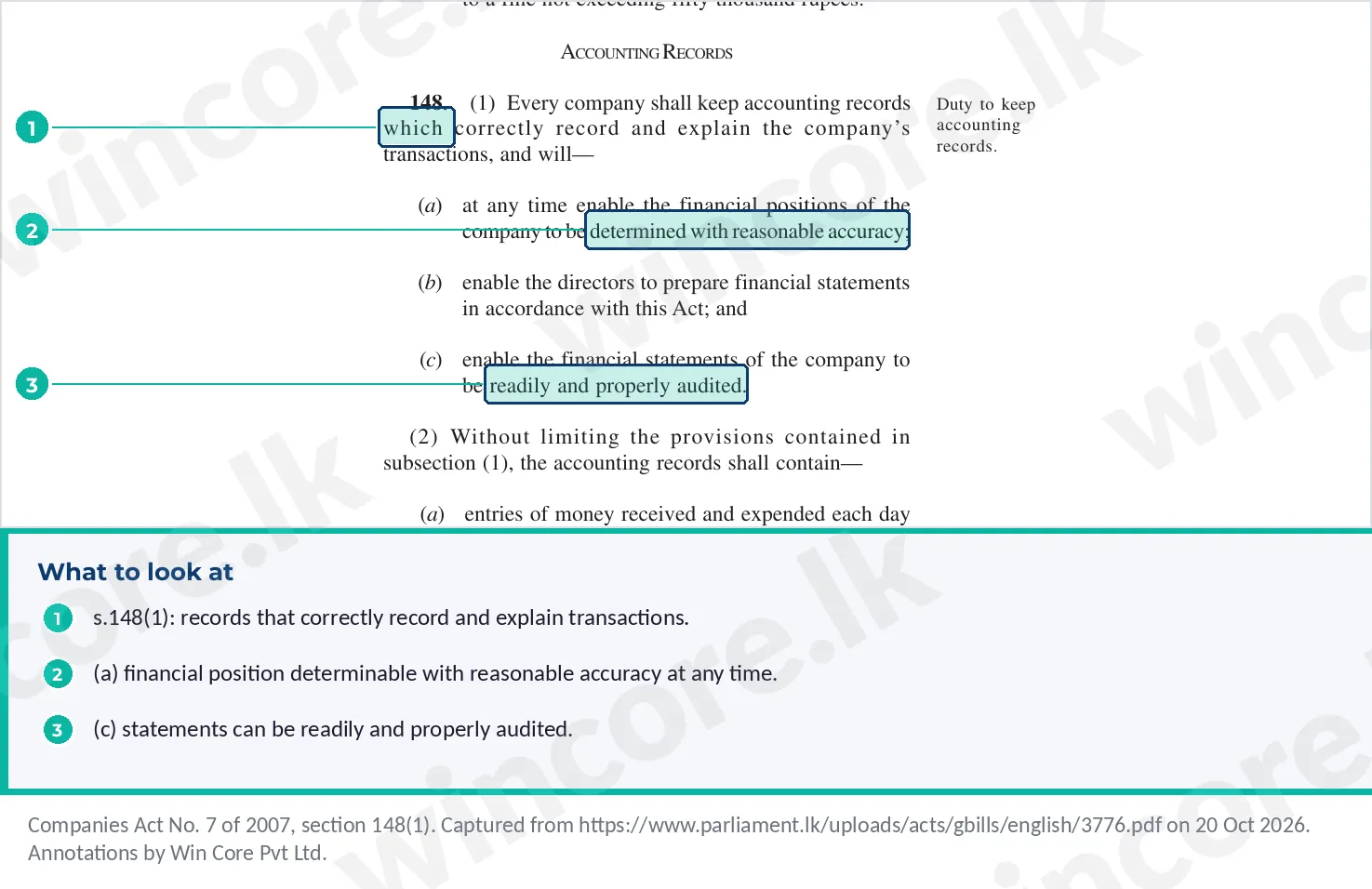
Companies Act s.148(1). Every company "shall keep accounting records which correctly record and explain the company's transactions", and the records must "at any time enable the financial positions of the company to be determined with reasonable accuracy", enable the directors to prepare financial statements under the Act, and "enable the financial statements of the company to be readily and properly audited" [1].
Where and for how long. Section 149(1) requires the records to be kept in Sri Lanka, unless the Registrar, considering it "not prejudicial to the national economy or to the interests of shareholders", permits them to be kept outside. Section 116(1)(k) requires the accounting records "for the current accounting period and for the last ten completed accounting periods" to be kept at the registered office, but section 116(2) lets the Registrar reduce that period and section 116(3)(c) lets the accounting records be kept elsewhere in line with section 149. Section 117(2) requires "adequate measures ... to prevent the records being falsified and detect any falsification of them" [1].
What the records feed. Section 150(1) requires the board to have financial statements completed within six months of the balance sheet date, or a longer period the Registrar determines, and section 151(1) requires them to "give a true and fair view" of the state of affairs and the profit or loss. Section 151(2)(b) adds compliance with "any requirements which apply to the company's financial statements under any other law" [1]. Rebuilt records are what make those statements possible.
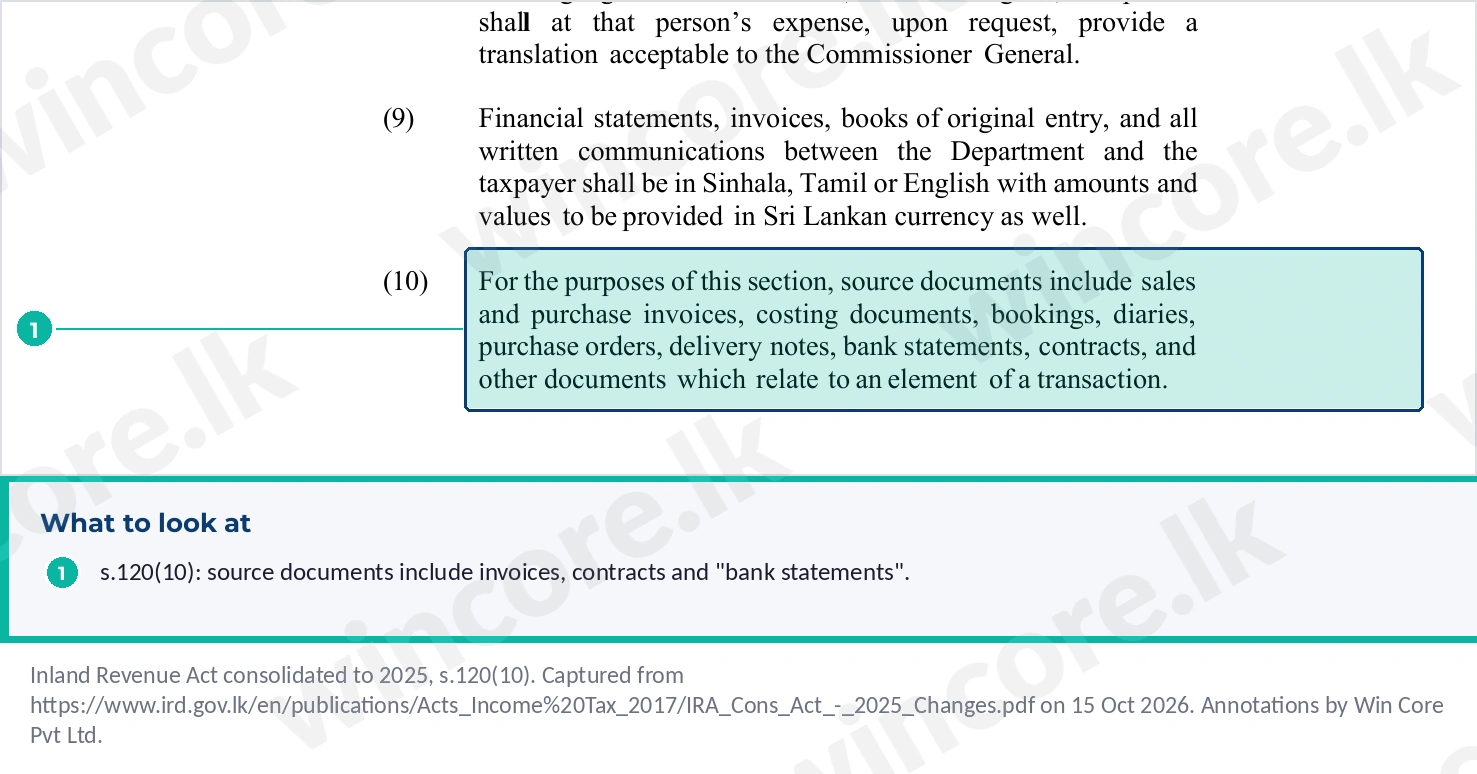
Inland Revenue Act s.120. A taxpayer in business "shall keep and maintain in Sri Lanka records and accounts sufficient to record all transactions and to ascertain the gains and profits made or the loss incurred" (s.120(1)), and "shall also retain source documents and underlying documentation utilized in the creation of the records and accounts" (s.120(5)) [2]. Source documents "include sales and purchase invoices, costing documents, bookings, diaries, purchase orders, delivery notes, bank statements, contracts, and other documents which relate to an element of a transaction" (s.120(10)). Records are kept for five years from the transaction, or longer "until expiration of the time limit for assessment of tax for any tax period to which the records are relevant and until any related proceedings have been completed" (s.120(6)). Section 120(9) requires financial statements, invoices and books of original entry to be in Sinhala, Tamil or English, with amounts also given in Sri Lankan currency [2].
Start the reconstruction with a complete register of bank accounts so an omitted account does not leave a gap in the ledger.
Once the evidence is recovered, sequence the outstanding accounting periods and opening balances before signing the latest set.
A bank statement covers only part of section 148
Section 148(2) says the records "shall contain" at least the following [1]. The right-hand column is our reading.
| Item | Wording | Does a bank statement give it? |
|---|---|---|
| (a) Money in and out | "entries of money received and expended each day by the company and the matters in respect of which such money was spent" | Bank money, yes; the "matters" and any cash, no |
| (b) Assets and liabilities | "a record of the assets and liabilities of the company" | Only the bank balance itself |
| (c) Goods | Goods bought and sold "and the relevant invoices", except goods sold for cash in the ordinary course of a retail business; stock at year end and stock takings | No |
| (d) Services | "a record of services provided and relevant invoices" | No |
Note the retail exception in (c)(i): goods sold for cash in the ordinary course of a retail business are outside the record of goods that identifies the goods, the buyers and the sellers. On our reading, it is an exception to the goods record, not a release from recording the money under (a).
The Inland Revenue Act draws the same line. It names bank statements as source documents, which are inputs to the records, not the records themselves. So a rebuild uses the statements to find every movement of bank money, then has to explain each one from other documents and add everything the bank never saw.
Where the statement shows a payment but the invoice is absent, follow a documented missing-evidence process rather than inventing the transaction details.
Penalties attach to the missing records, not to the rebuild
| Failure | Consequence | Section |
|---|---|---|
| Accounting records not kept as s.148 requires | Company: fine up to Rs 200,000. Every officer in default: fine up to Rs 200,000 | Companies Act s.148(3) [1] |
| Records kept outside Sri Lanka without the accounts and returns and the notice s.149(2) requires | Company up to Rs 200,000; every officer in default up to Rs 200,000 | Companies Act s.149(3) [1] |
| Documents not kept at the registered office as s.116(1) requires, or no notice of another place under s.116(4) | Company up to Rs 200,000; every officer in default up to Rs 100,000 | Companies Act s.116(5) [1] |
| No adequate measures against falsification | Company up to Rs 200,000; every officer in default up to Rs 100,000 | Companies Act s.117(3)(a) and (b) [1] |
| Proper records or books not kept for tax | The Commissioner-General may direct what records to keep, "in addition to prosecution for an offence" | IRA s.120(3) [2] |
| Failure to maintain proper documents, years of assessment ending before 1 April 2023 only | Rs 1,000 for each day the failure continues; no penalty if the taxpayer complies with a prior warning notice in time | IRA s.182(1) to (3), s.182(1) as amended by s.31 of Act No. 45 of 2022 [2] |
Two cautions on the table. First, on our reading, a rebuild fills the records from now on; it does not undo a failure to keep them at the time. Second, s.182(1), as amended by s.31 of Act No. 45 of 2022 from 19 December 2022, applies only "for any year of assessment ending prior to April 1, 2023". On the consolidated text there is no s.182 record-keeping penalty for later years; whether another provision fills that gap is open below.
Prove the balance chain before you read a single line
Everything in this section is our practice. The law sets what the result must show; it does not set the steps.
Step 1. Collect every statement for every account. List every account the company has held in the period: current, savings, overdraft, foreign currency, fixed deposits, loans, company cards and payment wallets. Get statements issued by the bank for every month, not screenshots. Our companion piece on building the bank account list from the statements (publishing alongside this one) covers how to find accounts nobody mentions.
Step 2. Run two tests on every statement. The link test: each statement's opening balance equals the previous statement's closing balance. The arithmetic test: opening balance plus the receipts on the statement less the payments on it equals the closing balance. A break in either means a missing statement, a missing page, a missing account or an error. Do not code a single line until both tests hold for every month.
Step 3. Read every line. Give each transaction a date, counterparty, amount, account code and a document reference. "Sundry" is not a code. Lines you cannot explain go on a query list for the owner, not into a suspense account that never clears.
Step 4. Match to documents. Sales receipts to invoices, payments to bills and contracts, salaries to payroll registers. This is what turns bank lines into s.148(2)(a) entries showing "the matters in respect of which such money was spent".
Step 5. Pair the transfers. A transfer between the company's own accounts appears twice, out of one and into the other, on dates that make sense. An unpaired transfer usually points to an account missing from step 1.
Step 6. Add what the bank never saw. Cash takings, costs a director paid personally, unpaid supplier bills, customer balances, assets bought on credit and loans. These are the s.148(2)(b) assets and liabilities. If the company reports under SLFRS for SMEs, paragraph 7.2 decides whether an overdraft sits in cash: it is "normally considered financing activities similar to borrowings", but part of cash and cash equivalents "if they are repayable on demand and form an integral part of an entity's cash management" [3].
Step 7. Tie to filings. Compare totals with the VAT, APIT, EPF and ETF filings already made. A difference is an error in the books or an error in a filing, and both need an answer. Where a rebuild changes figures already filed, take advice before amending anything; our income tax services cover that work.
Step 8. Date the rebuild honestly. Record when the books were rebuilt and from what. That fits s.117(2): the aim is complete records, not records made to look as if they had always been there.
The order matters. Coding transactions on day one is tempting, but a single missing month or page can hold a large receipt, a loan drawdown or a cheque, and careful coding elsewhere will never reveal it. Our year-end close guide picks up from the point where the rebuilt months are complete, and the annual filing checklist lists what follows.
A worked example: the link holds, the arithmetic does not
Hypothetical. A borehole drilling contractor has a rupee current account and an overdraft account, and no bookkeeping for eighteen months.
For the current account, January closes at Rs 1,250,000. February opens at Rs 1,250,000, so the link holds. February shows receipts of Rs 3,400,000 and payments of Rs 3,150,000 and closes at Rs 1,500,000. The arithmetic holds too: 1,250,000 plus 3,400,000 less 3,150,000 is 1,500,000.
September opens at Rs 2,040,000 and closes at Rs 1,450,000, and October opens at Rs 1,450,000, so the link test passes. But adding the lines on the pages supplied gives receipts of Rs 1,880,000 and payments of Rs 2,310,000, which would close at Rs 1,610,000. The statement is Rs 160,000 short of its own arithmetic. The owner's printout is missing a page, and the bank's copy shows a cheque of Rs 160,000 to a pipe supplier: 2,040,000 plus 1,880,000 less 2,470,000 is 1,450,000.
The link test alone would have missed it. Only once both tests hold for every month on both accounts does the coding begin.
What this means for you
Start with the chain, finish with the documents, and record what you did. The bank tells you most of what happened to the money, but not why, and nothing about what never passed through it. If the backlog is large, our bookkeeping services and accounting services can take the rebuild from statements to signed accounts, and our guide to outsourcing accounting explains how to hand records over. If an investor or buyer will read the result, see what an investor due diligence packet expects of the books. A companion piece on proving that a document is really missing is publishing alongside this one.
Checklist: documents needed
- Bank-issued statements for every account, every month in the gap
- A list of every account held, with its type and currency
- The last signed financial statements or opening balances
- Sales invoices and records of services provided
- Supplier bills, contracts and loan agreements
- Payroll registers and EPF, ETF and APIT records
- VAT and other tax returns already filed
- Records of cash takings and costs paid personally by directors
- A dated note of when and how the books were rebuilt
Frequently asked questions
Can accounts be prepared from bank statements alone in Sri Lanka?
No, not to the standard the Companies Act sets. Section 148(2) requires the records to show what money was spent on and to include a record of assets and liabilities. A bank statement shows neither the purpose of a payment nor cash, unpaid bills, customer balances or loans, so a rebuild has to add those from other documents.
How long must a company keep bank statements in Sri Lanka?
At least five years from the transaction under section 120(6) of the Inland Revenue Act, and longer until the time limit for assessment and any related proceedings have ended. Separately, section 116(1)(k) of the Companies Act requires accounting records for the current and last ten completed accounting periods, unless the Registrar reduces that period.
What if a bank statement is missing?
Ask the bank for a replacement covering the exact dates. In our practice a missing month or page is never estimated, because it may hold a receipt, a loan drawdown or a cheque that nothing else shows. Until the replacement arrives, keep the gap on the query list and do not treat the period as complete.
Does rebuilding the books cure a past breach of section 148?
No. On our reading, rebuilding fills the records from now on; it does not undo a failure to keep them at the time, and the section 148(3) fines attach to that failure. What a rebuild does is give the directors records from which section 150 financial statements can be prepared and audited.
Which accounting standard applies to rebuilt accounts?
It depends on the company. Section 151 requires financial statements to give a true and fair view and to meet any other law that applies to them. Many small companies report under SLFRS for SMEs 2015, whose paragraph 7.2 decides when an overdraft counts as cash. Which framework binds a given company we do not settle here.
Open points we have not closed
- Which framework applies. Whether a given company must use full SLFRS or may use SLFRS for SMEs depends on its status under other law; not covered here.
- IRA s.182 for later years. The s.182 penalty reaches only years of assessment ending before 1 April 2023. We have not established whether any other provision now penalises the same failure for later years.
- Other Inland Revenue offences. The offence provisions behind "prosecution for an offence" in s.120(3) are outside this piece.
- Registrar permissions. Whether the Registrar has permitted records outside Sri Lanka, or reduced the ten-period rule, is company-specific.
Last verified 22 October 2026: Companies Act ss.116, 117, 148, 149, 150 and 151, Inland Revenue Act ss.120 and 182, SLFRS for SMEs paragraph 7.2.
This article is general information, not advice for your specific situation.
Talk to us. If your company has months or years of books to rebuild, we can scope the work with you from the statements first. Contact us at our contact page.
WinCore Pvt Ltd
References
- Parliament of Sri Lanka. Companies Act, No. 7 of 2007, ss.116, 117, 148, 149, 150 and 151. https://www.parliament.lk/uploads/acts/gbills/english/3776.pdf . Primary. Accessed 22 October 2026. Figure 1 is captured from the same Act as published by the Department of the Registrar of Companies, http://www.drc.gov.lk/en/wp-content/uploads/2018/04/Act-7-of-2007-English.pdf .
- Inland Revenue Department. Inland Revenue Act, No. 24 of 2017, consolidated with amendments to 2025, ss.120 and 182. https://www.ird.gov.lk/en/publications/Acts_Income%20Tax_2017/IRA_Cons_Act_-_2025_Changes.pdf . Primary (consolidation). Accessed 22 October 2026.
- CA Sri Lanka (issuer). Sri Lanka Accounting Standard for Small and Medium-sized Entities (SLFRS for SMEs), 2015, para 7.2. Copy hosted at https://www.slaasc.lk/files/_SLFRS%20FOR%20SMEs%20-%202015.pdf . Primary. Accessed 22 October 2026.
Put these insights to work
WinCore specialists can review your current workflow, document gaps, and build a practical 90-day action plan.
Book a free consultationContinue reading
Explore more WinCore analysis to keep your finance, tax, and compliance roadmap moving.

Bookkeeping guide for Sri Lankan small businesses: legal requirements, chart of accounts, source documents, 5-year retention rule, and monthly routines.
Close your books before the March 31 deadline to reduce audit risk and start with clean numbers. A practical 10-step year-end guide for SMEs.
The law sets the books, the six month accounts and the audit. The investor sets the rest. How to keep the two apart and tie one to the other.