
Investor due diligence in Sri Lanka: the financial packet
The law sets the books, the six month accounts and the audit. The investor sets the rest. How to keep the two apart and tie one to the other.
On this page
Last verified against the primary sources on 21 October 2026.
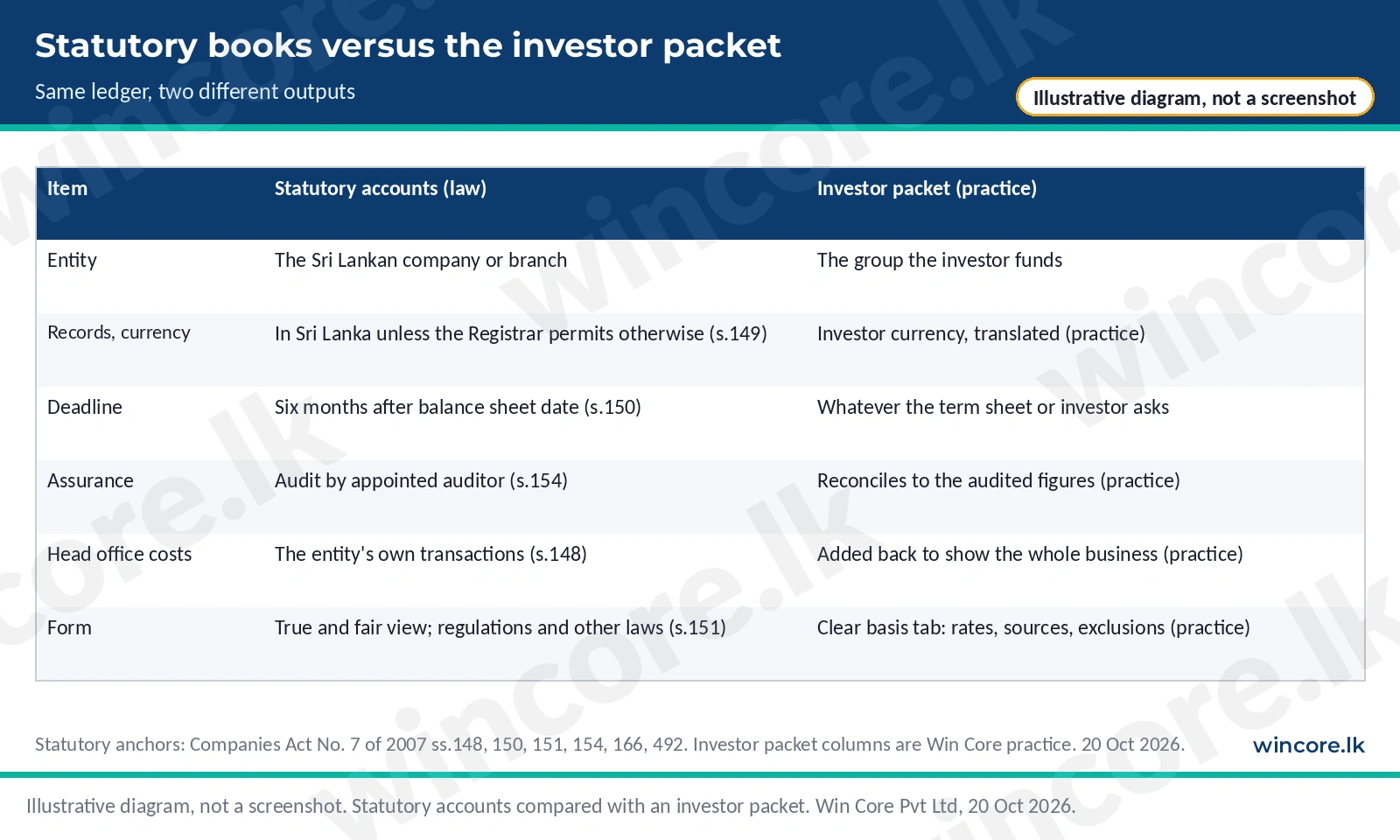
For investor due diligence in Sri Lanka, the Companies Act No. 7 of 2007 sets the floor: accounting records that "correctly record and explain" every transaction (s.148), financial statements completed and signed within six months of the balance sheet date unless the Registrar extends it (s.150), an auditor appointed at each annual general meeting (s.154) and an annual report within six months (s.166). A branch of a foreign company prepares financial statements every calendar year instead (s.492). What a foreign investor asks for on top of that is practice, not law, and it is built from the same books.
This piece keeps the two apart. Part one is what Sri Lankan law requires of the local company or branch, quoted section by section with the penalty for each default. Part two is what investors usually ask for and how we build it, labelled as practice throughout.
Take a hypothetical Singapore-owned coffee roaster with a Sri Lankan subsidiary, raising money from a regional food fund. The lead investor sends a due diligence list. The founder's first instinct is to forward the subsidiary's management accounts. That usually answers the wrong question.
Investor due diligence in Sri Lanka starts with the Companies Act floor
None of the following is optional, and all of it feeds the packet. If the statutory layer is weak, no packet built on top of it will survive a diligence call.
Accounting records that explain every transaction
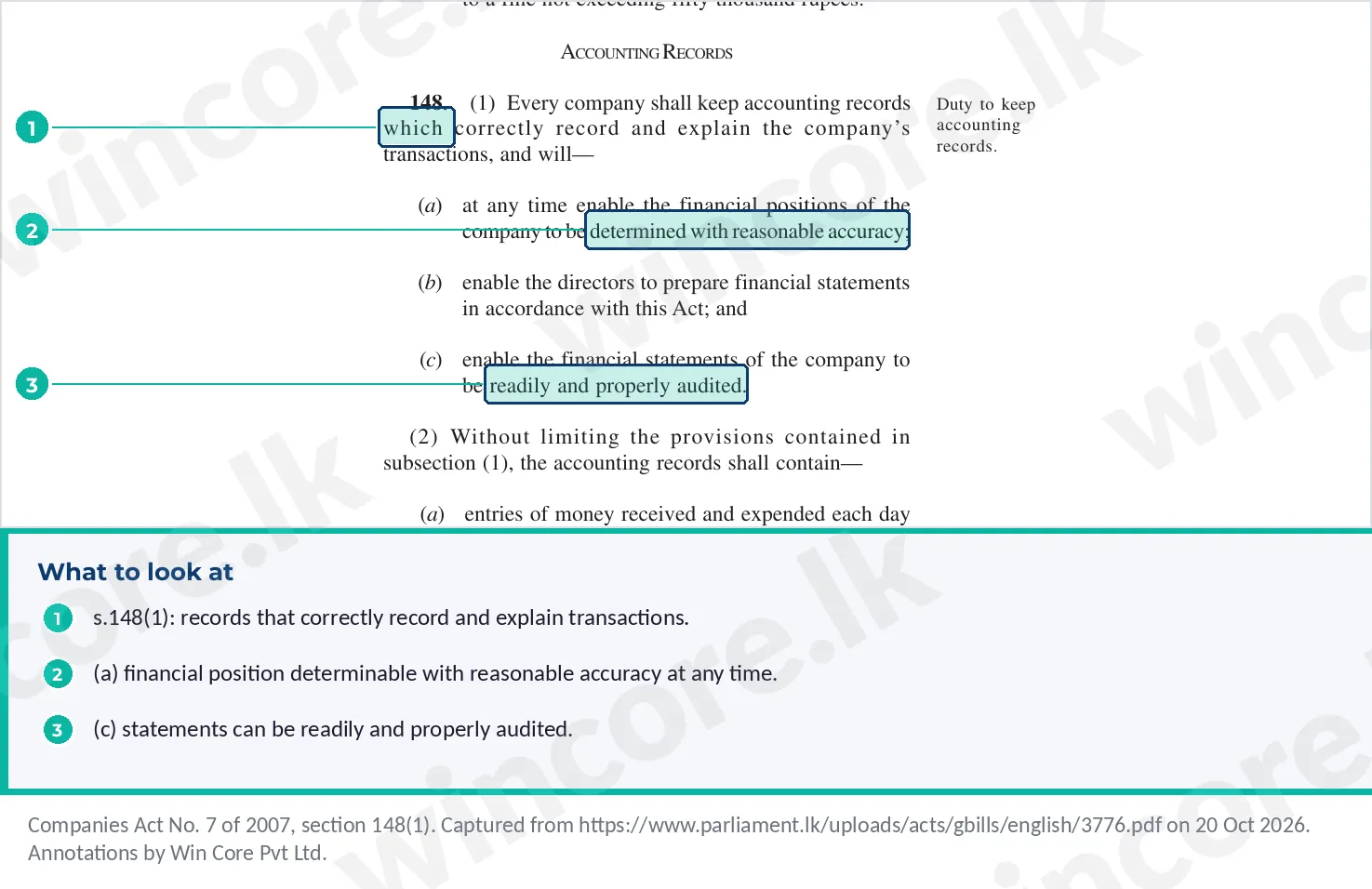
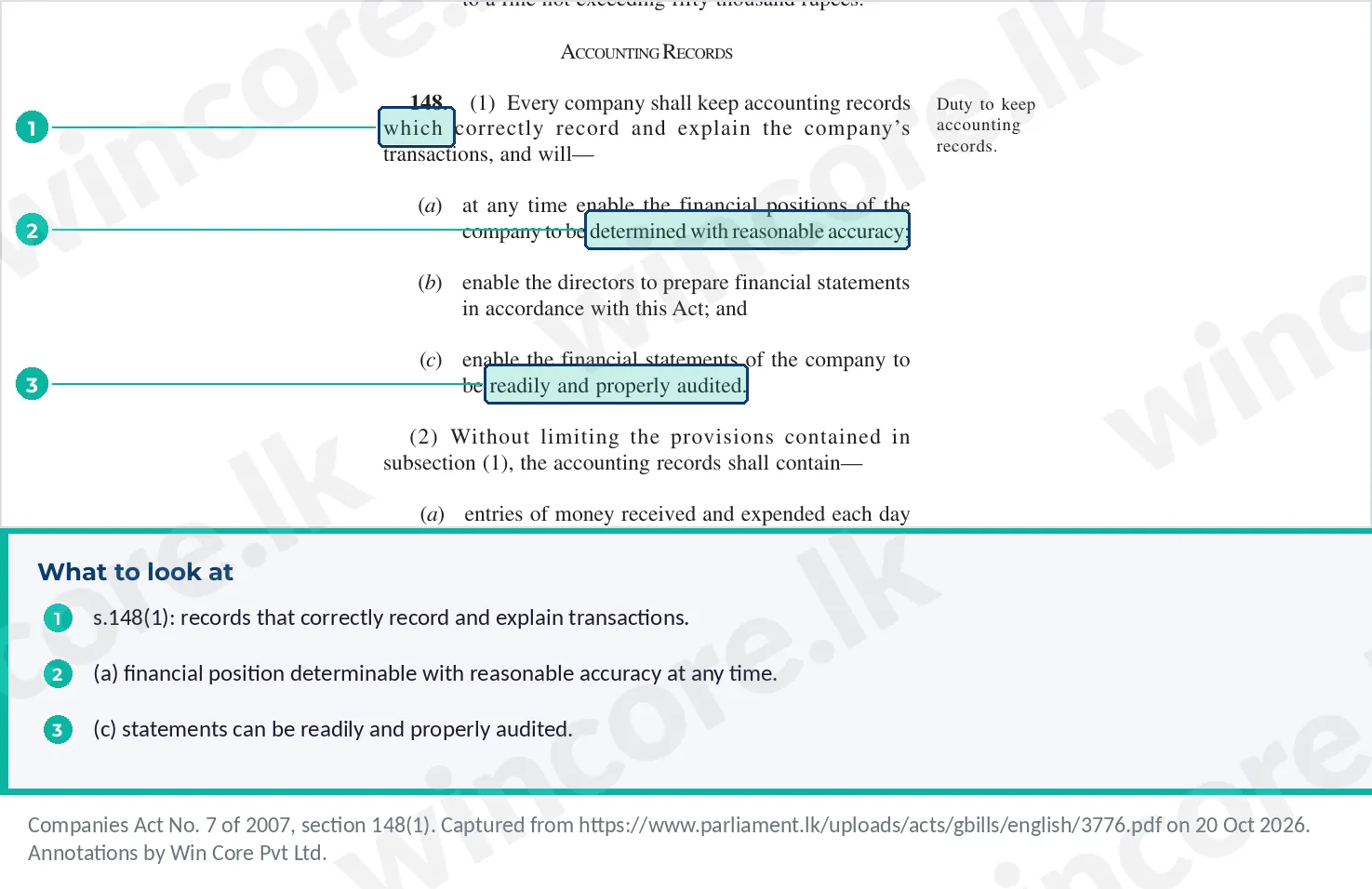
Section 148(1) requires every company to keep accounting records which "correctly record and explain the company's transactions", and which will "(a) at any time enable the financial positions of the company to be determined with reasonable accuracy; (b) enable the directors to prepare financial statements in accordance with this Act; and (c) enable the financial statements of the company to be readily and properly audited" [1].
Section 148(2) lists what the records must contain: entries of money received and spent each day, a record of assets and liabilities, records of goods bought, sold and held for a trading business, and "a record of services provided and relevant invoices" for a service business [1]. Section 149(1) requires the records to be kept in Sri Lanka unless the Registrar permits otherwise [1].
Penalty for this default. Section 148(3): the company commits an offence and is liable on conviction to a fine not exceeding Rs 200,000, and every officer in default faces the same maximum [1].
Financial statements within six months, signed by two directors
Section 150(1) requires the board to ensure that "within six months or within such extended period as may be determined by the Registrar after the balance sheet date", financial statements complying with section 151 are completed, certified by the person who prepared them, and "dated and signed on behalf of the board by two directors of the company or if the company has only one director, by that director" [1].
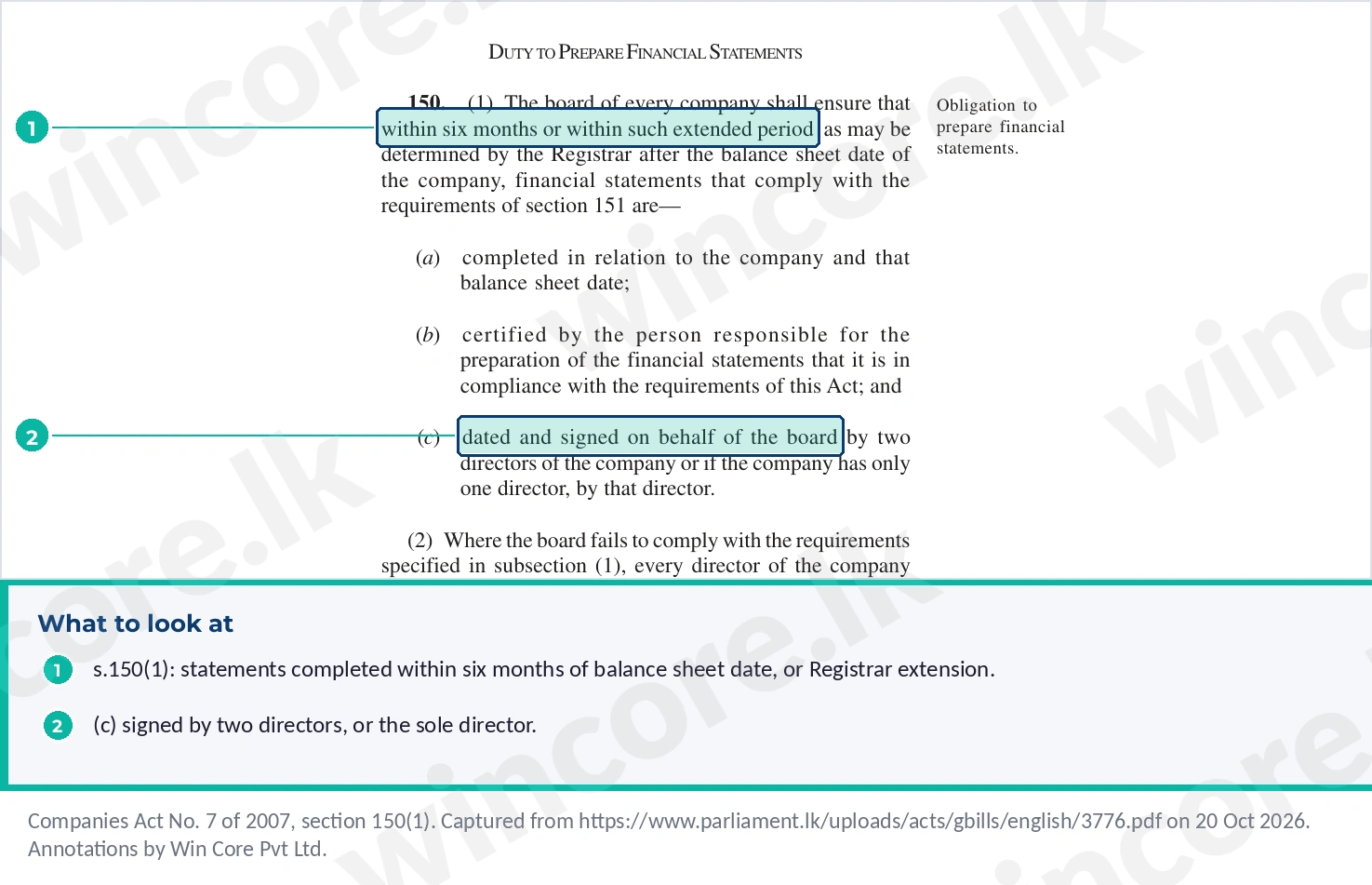
The six months is statutory. A longer period exists only if the Registrar determines one. Section 151 requires the statements to "give a true and fair view" and to comply with any regulations under the Act and "any requirements which apply to the company's financial statements under any other law" [1].
Penalty for this default. Section 150(2): every director in default commits an offence and is liable on conviction to a fine not exceeding Rs 100,000 [1]. Our year-end close guide sets out the steps that get the statements signed in time.
An auditor at each AGM, with a first-period exception
Section 154(1) requires a company to appoint an auditor at each annual general meeting to audit its financial statements [1]. Section 159, headed "Appointment of first auditor", says in subsection (3) that the board and company need not appoint an auditor under that section "if a unanimous resolution is passed by the shareholders that no auditor be appointed", and that "Such a resolution ceases to have effect at the commencement of the first annual general meeting" [1]. On our reading that relief covers the first period only. An investor will usually ask for audited figures anyway, so plan the audit timetable with the round.
An annual report within six months
Section 166(1) requires the board "within six months after the balance sheet date of the company" to prepare an annual report, and section 166(2) makes every director in default liable on conviction to a fine not exceeding Rs 100,000 [1]. Section 168(3) lets a company leave out some contents "if all shareholders agree in writing that it need not do so", noted in the report [1]. Under section 170, a company that is not a private company delivers its financial statements to the Registrar within twenty working days after they must be signed; a private company delivers them only if the Registrar requires it by written notice, again within twenty working days [1]. The Companies (Amendment) Act No. 12 of 2025 corrects cross-references in sections 167 and 168, but on our reading of its Schedule it does not change the duties quoted here [2].
If a concern requires investigation, separate routine due diligence from preserving accounting evidence during a forensic audit.
A branch prepares financial statements every calendar year
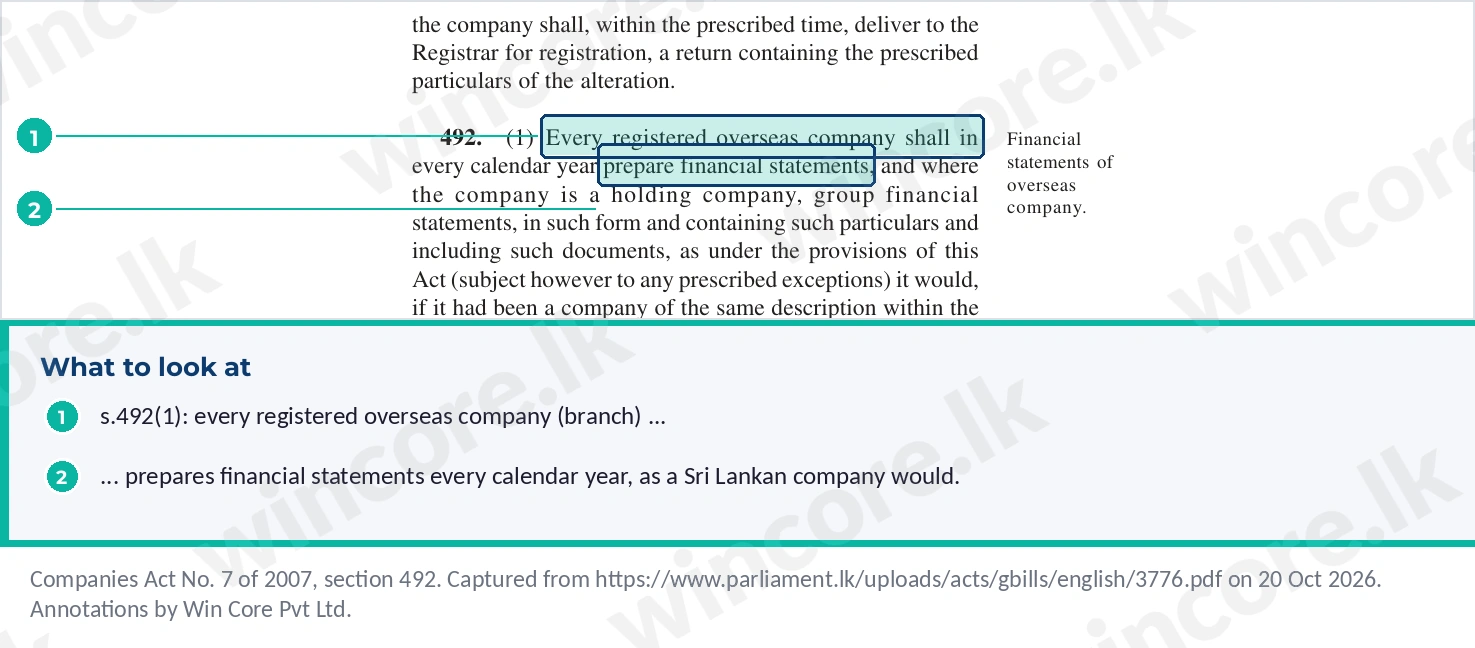
A branch of a foreign company is registered as an overseas company under Part XVIII. Section 492(1) requires "Every registered overseas company" to "in every calendar year prepare financial statements", and group financial statements if it is a holding company, in the form it would have had to "prepare and deliver certified copies of those documents to the Registrar for registration" if it had been a company of the same description under the Act [1]. Section 492(2) requires a translation of any document not in an official language or English [1]. Whether that wording carries a delivery deadline for every branch is a point we keep open below.
Penalty for this default. Section 498: where a company to which Part XVIII applies fails to comply with any provision of that Part other than section 493, the company, and every officer or agent who knowingly and willfully authorises or permits the default, is liable on conviction to a fine not exceeding Rs 50,000 [1]. Our piece on choosing between a subsidiary, a branch and a representative office covers the registration side.
What investors ask for is practice, and it differs by investor
Everything in this part is WinCore practice. It is not a legal requirement in Sri Lanka, and investors and their advisers set their own lists.
Think of the statutory accounts as the foundations and the investor packet as the elevation drawing. The investor wants to see the whole building from outside, but every line must stand on something solid underneath.
Agree the reporting entity before anything else
In practice the investor is usually buying into the parent or holding company, not the Sri Lankan entity. The Sri Lankan accounts show only the Sri Lankan entity's own transactions, as section 148 requires. Costs the parent pays directly, such as its own legal advisers or marketing agencies, sit outside them. A packet for the investor brings those costs in so the investor sees what the whole business costs to run, and keeps intra-group funding as funding rather than income or expense. Agree in writing which entity, which periods and which costs are in.
Present in the investor's currency, and say it is a translation
Investors often expect figures in their own currency. Translate rupee figures at a stated rate for each month and list every rate and its source. Say on the face of the packet that it is a convenience translation for the reader. It does not change the Sri Lankan entity's functional currency or restate its statutory accounts, which stay in their own form under section 151. Our piece on functional currency and which CBSL rate to use covers the accounting side.
Keep the packet short and its basis visible
A packet that works is usually short: an income statement with a bridge from the local result to the group result, a balance sheet, a cash flow, a schedule of every financing instrument and its terms, and a basis page. The basis page records the rates, the source of each figure, what was left out and why, and how the packet ties back to the ledgers. Financing instruments, whether loans, convertible notes or anything else, need a classification decision of their own; our piece on whether SAFE notes are a liability or equity explains why.
Every number should be traceable to a ledger row
A packet that can be tested carries no typed figures. Each translated amount is a formula from the rupee amount and the month's rate, so a reviewer can follow any number back to its source. Noting which version of the ledger the packet was built from lets the investor confirm it matches the books they were given.
Test every "nil" before an investor reads it
A sentence such as "no related-party balances" or "no borrowings" is a claim, not a blank. Test it before it goes out: the relevant accounts read on both sides, every receipt classified, suspense cleared. One unexplained receipt can undermine confidence in everything else. If the figures are unaudited management accounts, the packet says so on its first page.
What this means for you
- Fix the statutory layer first. Records under section 148, statements under section 150, audit under section 154, annual report under section 166, or for a branch the section 492 statements. A packet built on late or unaudited books invites the question you least want.
- Agree the entity and currency with the investor in writing. Group or local entity, which currency, which periods.
- Keep the packet separate from the statutory accounts. Label it as a translation and reconcile it to the audited figures.
- Build by formula, not by typing. It is the difference between a packet that can be checked and one that has to be trusted.
- Disclose your basis. Rates, exclusions and open items belong on the basis page, not in a covering email.
Our accounting services team keeps the statutory books and prepares the accounts, our audit support team prepares the file for your auditor, and our virtual CFO service builds board and investor reporting. Use the currency converter to check a month's rate.
Checklist: documents needed
- General ledgers for each entity, for every period covered
- Bank statements for every account, local and overseas
- Signed and audited Sri Lankan financial statements, or the latest draft with its status noted
- Annual report (company) or section 492 statements (branch)
- Register of financing instruments with their terms
- Monthly exchange rates used, with their source
- Written note of the parent's costs left out locally and brought into the packet
Open points
- Investor-specific formats. There is no Sri Lankan rule on the form of an investor packet. Each investor's list governs.
- Branch delivery under section 492. Section 492(1) measures a branch's statements against what a Sri Lankan company "of the same description" would prepare and deliver, and states no separate time limit. How that maps to a given branch, and when the Registrar expects copies, we treat as open.
- Translation method. The rates and method we use are practice. A group with its own auditors should agree the method with them.
- Tax filings in diligence. Income tax and VAT filings are often requested. Their content and deadlines are outside this piece.
FAQ
Can we send investors our Sri Lankan management accounts?
You can, but they answer a different question. Management accounts show the Sri Lankan entity alone, in rupees, and often unaudited. Investors usually want the whole business in their own currency, tied to audited figures, with the basis stated. Send the management accounts as a supporting schedule, not as the packet itself.
Does a private company in Sri Lanka need an audit?
A company must appoint an auditor at each annual general meeting under section 154(1). Section 159(3) lets shareholders resolve unanimously not to appoint a first auditor, but that resolution ends when the first annual general meeting begins. Investors usually expect audited figures in any case.
When must Sri Lankan financial statements be ready?
Within six months of the balance sheet date, or any longer period the Registrar sets, completed, certified by the preparer and signed by two directors (or the sole director) under section 150(1). Every director in default can be fined up to Rs 100,000 on conviction under section 150(2).
Does a branch of a foreign company prepare financial statements in Sri Lanka?
Yes. Section 492(1) requires every registered overseas company to prepare financial statements in every calendar year, in the form a Sri Lankan company of the same description would prepare. Failing to comply with Part XVIII, other than section 493, can bring a fine of up to Rs 50,000 under section 498.
Is an investor packet a legal document in Sri Lanka?
No. It is a presentation built from the books for one reader, not a statutory filing. That is why the basis page, the stated exchange rates and the tie-back to audited accounts matter: they let the investor's accountant test it rather than take it on trust.
Talk to us. If an investor has sent you a due diligence list and you want the statutory accounts and the packet built from the same books, our contact page.
WinCore Pvt Ltd
This article is general information on the law as at 21 October 2026 and is not advice on your specific situation.
References
- Parliament of Sri Lanka. Companies Act, No. 7 of 2007, ss.148, 149, 150, 151, 154, 159, 166, 168, 170, 492, 498. https://www.parliament.lk/uploads/acts/gbills/english/3776.pdf . Primary. Accessed 20 October 2026; ss.148, 150, 159, 166, 170, 492 and 498 re-read 21 October 2026 on the srilaws.com reproduction of the official English text (Secondary).
- Parliament of Sri Lanka. Companies (Amendment) Act, No. 12 of 2025, s.21 and Schedule, items 30 and 32. Primary. Read for the A9 source set, 15 October 2026; not re-fetched 21 October 2026.
Put these insights to work
WinCore specialists can review your current workflow, document gaps, and build a practical 90-day action plan.
Book a free consultationContinue reading
Explore more WinCore analysis to keep your finance, tax, and compliance roadmap moving.

New companies in Sri Lanka face eight or more compliance registrations in year one. Here is how to set up your books, register for taxes, and stay clean.
Close your books before the March 31 deadline to reduce audit risk and start with clean numbers. A practical 10-step year-end guide for SMEs.
Most Sri Lankan companies can be 100 percent foreign owned. The three restricted lists in Gazette 2213/35, the retail test and the BOI route.