
SAFE note accounting in Sri Lanka: liability or equity?
Money raised on a SAFE feels like equity because it will become shares. LKAS 32 asks a different question, and for most SAFEs the answer is a liability.
On this page
Last verified against the primary sources on 21 October 2026.
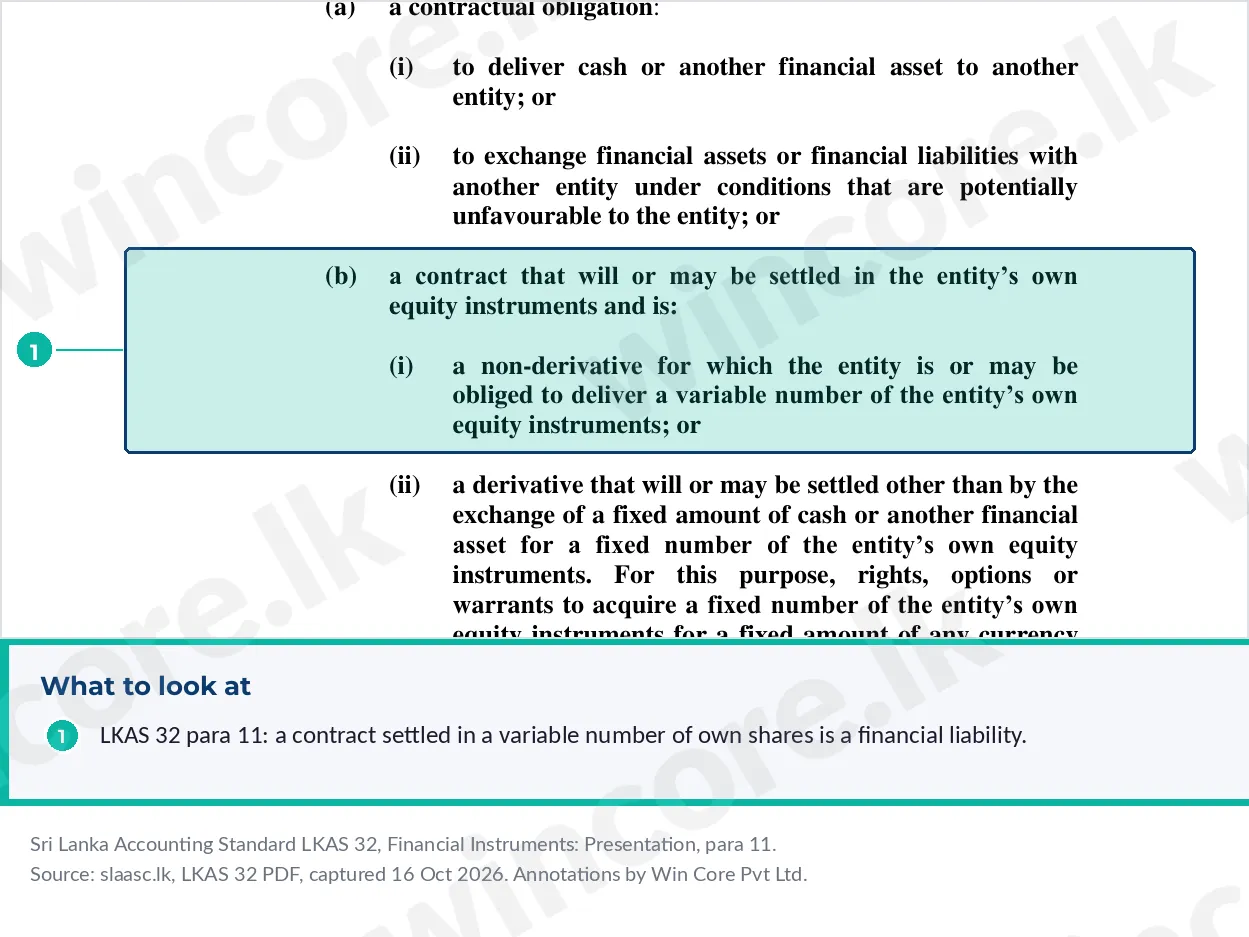
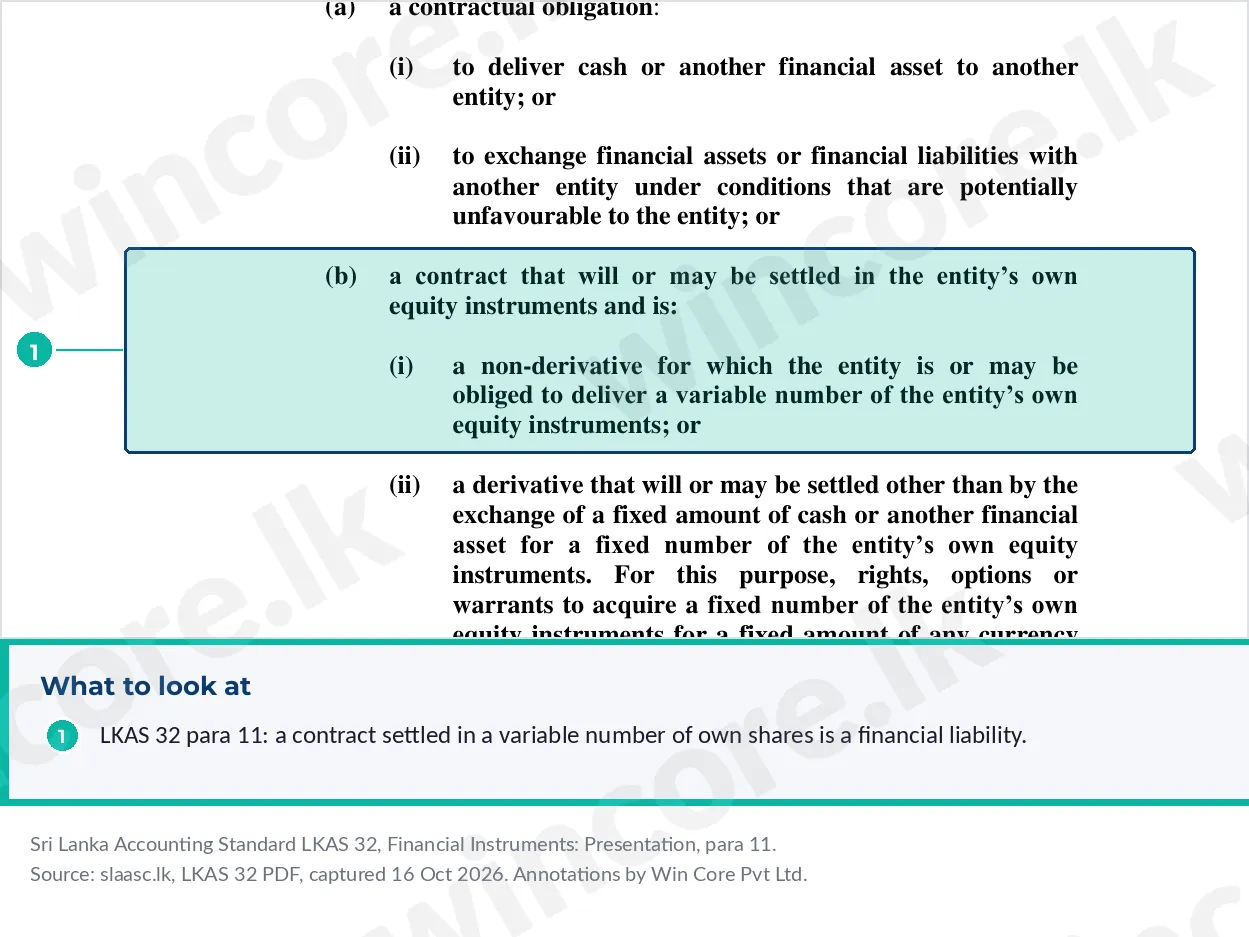
For SAFE note accounting in Sri Lanka, the test is LKAS 32, Financial Instruments: Presentation, which applies to annual periods beginning on or after 1 January 2012. A contract the company will or may settle by delivering a variable number of its own shares is a financial liability (paragraph 11(b)), and paragraph 21 says such a contract is a liability "even though the entity must or can settle it by delivering its own equity instruments". A typical SAFE converts into as many shares as a future price allows, so on our reading it sits in liabilities until it converts, not in stated capital.
A SAFE, a simple agreement for future equity, is a promise about shares that do not exist yet. The investor pays now. The company issues shares later, usually at the next priced funding round, at a price set by a formula. Founders tend to think of the money as equity because it will become equity. The standard asks a different question: what does the company owe today, and how will it settle it?
Think of a SAFE as a voucher with a rupee value printed on it, not a share certificate with a number of shares printed on it. When the voucher is redeemed, the company hands over as many shares as the formula says. That one feature, a number of shares that is not fixed, decides most of the classification.
Take a hypothetical Sri Lankan food technology company that raises Rs 45 million from three angel investors on SAFEs. Does the money go in equity or in liabilities in its statutory accounts?
SAFE note accounting in Sri Lanka is decided by LKAS 32
Section 151(1) of the Companies Act, No. 7 of 2007, requires financial statements to give "a true and fair view" of the state of affairs at the balance sheet date, and section 151(2)(b) requires them to comply with "any requirements which apply to the company's financial statements under any other law" [1]. Sri Lanka Accounting Standards are published by the Sri Lanka Accounting and Auditing Standards Commission. This piece assumes the company applies the full standards, including LKAS 32 [2]. A company that applies the standard for smaller entities should check that standard's own section on liabilities and equity, which we have not reviewed here.
What LKAS 32 says about liability and equity
LKAS 32 sets out "principles for presenting financial instruments as liabilities or equity" [2]. Five paragraphs do the work.
Paragraph 11, the definition. A financial liability includes "a contract that will or may be settled in the entity's own equity instruments and is: (i) a non-derivative for which the entity is or may be obliged to deliver a variable number of the entity's own equity instruments; or (ii) a derivative that will or may be settled other than by the exchange of a fixed amount of cash or another financial asset for a fixed number of the entity's own equity instruments" [2].
Paragraph 15, substance. The issuer classifies the instrument on initial recognition "in accordance with the substance of the contractual arrangement and the definitions" [2]. Paragraph 18 adds that "The substance of a financial instrument, rather than its legal form, governs its classification", and gives the example of a preference share with mandatory redemption, which is a financial liability [2].
Paragraph 16, the equity test. An instrument is equity "if, and only if, both conditions (a) and (b) below are met": (a) it "includes no contractual obligation" to deliver cash or another financial asset, or to exchange financial assets or liabilities on potentially unfavourable terms; and (b) if it will or may be settled in the issuer's own shares, it is "a non-derivative that includes no contractual obligation for the issuer to deliver a variable number of its own equity instruments" or "a derivative that will be settled only by the issuer exchanging a fixed amount of cash or another financial asset for a fixed number of its own equity instruments" [2]. "If, and only if" makes equity the narrow category.
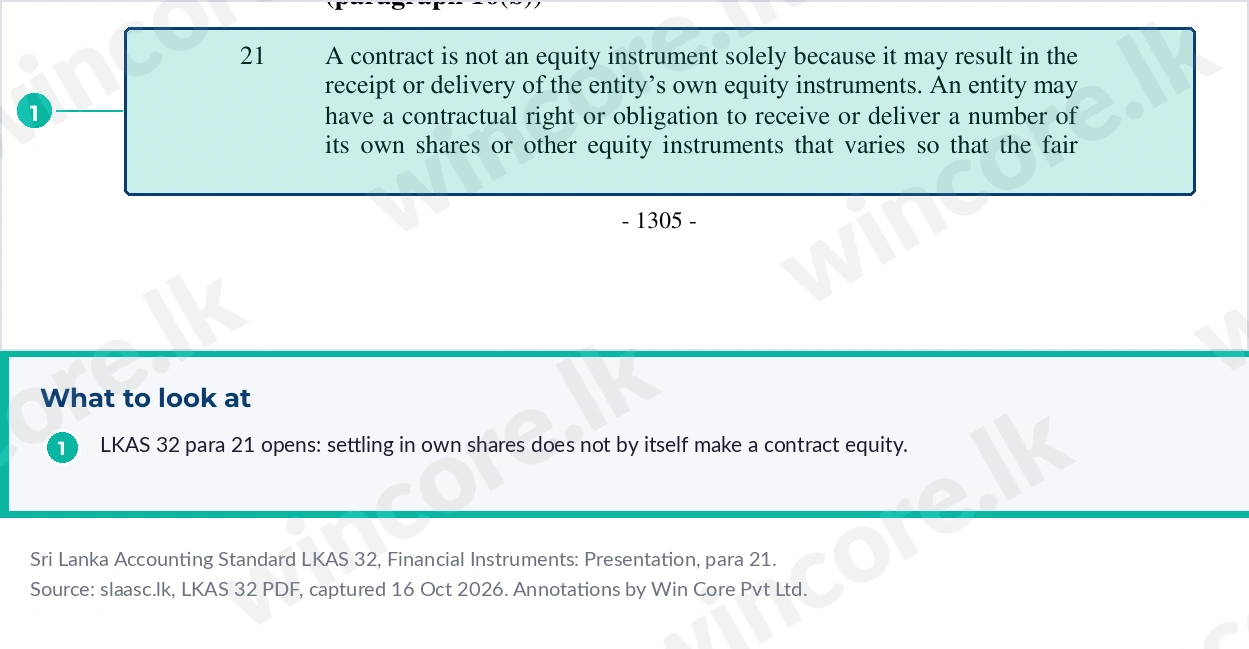
Paragraph 21, the closest match to a SAFE. "A contract is not an equity instrument solely because it may result in the receipt or delivery of the entity's own equity instruments." Its first example is "a contract to deliver as many of the entity's own equity instruments as are equal in value to Rs.100", and it concludes: "Such a contract is a financial liability of the entity even though the entity must or can settle it by delivering its own equity instruments. It is not an equity instrument because the entity uses a variable number of its own equity instruments as a means to settle the contract" [2].
Paragraph 25, contingent settlement. An instrument that requires cash on an uncertain future event "beyond the control of both the issuer and the holder" is a financial liability unless (a) the cash part "is not genuine", (b) the issuer can be required to settle in cash "only in the event of liquidation of the issuer", or (c) it meets the puttable instrument conditions in paragraphs 16A and 16B [2]. The application guidance (AG28) explains "not genuine" as an event that is "extremely rare, highly abnormal and very unlikely to occur" [2].
| Contract | Classification | Paragraph |
|---|---|---|
| Fixed number of shares for a fixed amount of cash | Equity | 16(b)(ii), 22 |
| Shares worth a fixed rupee amount, so a variable number | Financial liability | 11(b)(i), 21 |
| Cash or shares on an event outside both parties' control | Financial liability unless an exception applies | 25 |
| Cash only on the issuer's liquidation | That feature alone does not make it a liability | 25(b) |
| Preference share the issuer must redeem | Financial liability | 18(a) |
A typical SAFE fails the equity test on its conversion formula
SAFE terms vary, and the document in front of you is what counts. The features below are common in the standard SAFE forms used by start-ups; check each against your own agreement.
- Conversion at the next priced round. The purchase amount converts into shares at a price set by a valuation cap, a discount, or both. The number of shares depends on that future price. Whether the SAFE is read as a non-derivative (paragraph 11(b)(i)) or as a derivative (paragraph 11(b)(ii)), the number of shares is not fixed, so on our reading neither limb of paragraph 16(b) is met.
- Cash on a sale of the company. Many SAFEs let the investor choose cash equal to the purchase amount, or shares, on a change of control. A sale is not in the company's control alone. On our reading that is a contingent settlement provision under paragraph 25, and the exceptions in 25(a) to (c) have to be tested. A sale is rarely "extremely rare, highly abnormal and very unlikely" for a funded start-up.
- Repayment on dissolution. A right to be repaid on winding up, on its own, may fall within the paragraph 25(b) exception for settlement "only in the event of liquidation". It does not rescue the instrument if feature 1 or 2 already makes it a liability.
So for a typical SAFE our reading is a financial liability until conversion. That is a reading of the standard against common terms, not a ruling on any particular contract. A SAFE with a truly fixed number of shares and no cash route could come out differently and must be assessed on its own words.
A worked example: why the number of shares moves
Our hypothetical company's SAFEs carry a 20 percent discount and a cap that works out at Rs 120 a share. The conversion price is the lower of the cap price and the round price less the discount.
| Next round price | Discounted price | Conversion price | Shares for Rs 45 million |
|---|---|---|---|
| Rs 100 | Rs 80 | Rs 80 | 562,500 |
| Rs 150 | Rs 120 | Rs 120 | 375,000 |
| Rs 200 | Rs 160 | Rs 120 (cap) | 375,000 |
The same Rs 45 million buys 562,500 shares in one round and 375,000 in another. Until the round happens, the company cannot say how many shares it will issue. That is the variable number paragraphs 11 and 21 describe.
Every side letter is part of the contract for classification
Investors sometimes sign a side letter alongside the SAFE: a most favoured nation clause, information rights, a pro rata right in the next round, or a promise of repayment in some event. Paragraph 15 classifies by "the substance of the contractual arrangement" [2], so on our reading every document that adds a right or obligation forms part of the picture. A side letter that adds a cash repayment trigger can turn a borderline instrument into a clear liability. Read every side letter before you classify.
For another instrument where labels can mislead, compare redeemable preference shares and their accounting classification.
What changes in the accounts if the SAFE is a liability
- The cash received is shown as a liability, not in stated capital or reserves.
- Measurement after initial recognition follows the financial instruments recognition and measurement standard the company applies (SLFRS 9 under the full standards), which this piece does not cover.
- On conversion, the liability comes off and shares are issued, and the Companies Act share issue steps then apply.
Classification also matters for readers. A SAFE liability can turn net assets negative for a young company, and an auditor or investor will ask about going concern. That is a disclosure point to plan for, not a reason to call the SAFE equity. Our piece on the financial packet for investor due diligence covers what investors ask to see. Where the SAFE is in a foreign currency, the rate used for each balance becomes its own question; our piece on functional currency and which CBSL rate to use covers it.
What this means for you
- Do not book SAFE money as share capital. No shares have been issued, and for typical terms LKAS 32 points to a financial liability.
- Read the actual contract and every side letter before classifying. Paragraphs 11, 16 and 25 each turn on specific words.
- Plan the disclosure. If the liability makes net assets negative, explain the instrument and its expected conversion in the notes.
- Revisit at conversion. When shares are issued, the liability comes off and equity goes on.
- Check the money route. If an investor is resident outside Sri Lanka, confirm how the funds may come in before you sign.
Our accounting services team classifies and books financing instruments in the statutory accounts, our audit support team prepares the working paper your auditor will test, and our virtual CFO service models how the round changes the balance sheet. For the first-year books around a raise, see our startup accounting guide.
Checklist: documents needed
- The signed SAFE, with every schedule
- Every side letter or email agreeing extra rights
- The conversion terms: valuation cap, discount and the definition of the triggering round
- The terms for a sale of the company and for dissolution
- Bank evidence of the amount received and the date
- The accounting framework the company applies: full standards or the smaller entity standard
Open points
- Framework. Which Sri Lanka Accounting Standards framework a particular company must apply is not covered here.
- Smaller entity standard. Treatment under the standard for smaller entities has not been reviewed.
- Measurement and currency. Measurement after initial recognition, and the exchange rate for a SAFE in a foreign currency, are not covered.
- Foreign exchange route. Whether a non-resident investor's SAFE payment falls under the share investment permission and its Inward Investment Account route, or is treated another way under the Foreign Exchange Act, we have not settled. Our piece on the Inward Investment Account covers the account for share investment.
- Tax. The tax treatment of SAFE receipts and conversions is not covered.
FAQ
Is a SAFE note share capital in Sri Lanka?
No. No shares are issued until the SAFE converts, so nothing goes into stated capital at the start. For typical terms, LKAS 32 paragraphs 11 and 21 point to a financial liability, because the company must deliver a number of shares that is not fixed when the money comes in. Read your own agreement before booking it.
Can a SAFE be equity if conversion is certain?
Certainty of conversion is not the test. Paragraph 21 says a contract settled in a variable number of shares is a liability "even though the entity must or can settle it by delivering its own equity instruments". What matters is whether the number of shares is fixed, and in a typical SAFE it is not.
Does a repayment right on liquidation make a SAFE a liability?
Not by itself. Paragraph 25(b) excepts an obligation to pay cash "only in the event of liquidation of the issuer". Other features, such as a variable conversion number or a cash choice on a sale of the company, can still make the SAFE a liability, so test each feature separately.
What about a SAFE that converts into a fixed number of shares?
It needs its own assessment. A contract to deliver a fixed number of shares for a fixed amount of cash can be equity under paragraphs 16(b)(ii) and 22, but only if nothing else in the contract or a side letter creates an obligation to pay cash. Read every term before deciding.
Does LKAS 32 apply to every Sri Lankan company?
It applies to companies that use the full Sri Lanka Accounting Standards. A company that uses the standard for smaller entities should check that standard's own section on liabilities and equity. Which framework a company must use is a separate question, so confirm it with your accountant before classifying.
Talk to us. If you have raised money on a SAFE and need it classified, booked and explained in your statutory accounts, our contact page.
WinCore Pvt Ltd
This article is general information on the standards as at 21 October 2026 and is not advice on your specific instrument.
References
- Parliament of Sri Lanka. Companies Act, No. 7 of 2007, s.151. http://www.drc.gov.lk/en/wp-content/uploads/2018/04/Act-7-of-2007-English.pdf . Primary. Accessed 15 October 2026 (Grok's local copy); not re-read 21 October 2026.
- Sri Lanka Accounting and Auditing Standards Commission. Sri Lanka Accounting Standard LKAS 32, Financial Instruments: Presentation, paras 2, 11, 15, 16, 18, 21, 22, 25, 96 and AG28. https://www.slaasc.lk/files/LKAS%2032%20-%20Financial%20Instruments:%20Presentation%20%20%20%20%20%20%20%20%20%20%20%20%20%20%20%20%20%20%20%20%20%20%20%20%20%20%20%20%20%20%20%20%20%20%20%20%20%20%20%20%20%20%20%20%20%20%20%20%20%20%20%20%20%20%20%20%20%20%20%20%20%20%20%20%20%20%20%20%20%20%20%20%20%20%20%20%20%20%20%20%20%20%20%20%20%20%20%20%20%20%20%20%20%20%20%20%20%20%20%20%20%20%20%20%20%20%20%20%20%20_1596192189_35.%20LKAS%2032-Financial%20Instruments%20Presentation.pdf . Primary. Accessed 21 October 2026.
Put these insights to work
WinCore specialists can review your current workflow, document gaps, and build a practical 90-day action plan.
Book a free consultationContinue reading
Explore more WinCore analysis to keep your finance, tax, and compliance roadmap moving.

New companies in Sri Lanka face eight or more compliance registrations in year one. Here is how to set up your books, register for taxes, and stay clean.
Close your books before the March 31 deadline to reduce audit risk and start with clean numbers. A practical 10-step year-end guide for SMEs.
A guide for Sri Lankan SMEs comparing bookkeeping and accounting: what each covers, who is responsible for the accounts, and when to add the accounting layer.