
Redeemable preference shares in Sri Lanka, director fees and tax
How a small company issues and redeems preference shares, why some sit in liabilities, and how director fees meet APIT, EPF and the tax computation.
On this page
Last verified against the primary sources on 22 October 2026.
Redeemable preference shares in Sri Lanka are a share class the articles create: the Companies Act, No. 7 of 2007 lets a company issue shares that "are redeemable" or "confer preferential rights to distributions" (s.49(3)), and s.66 sets three redemption routes, at the company's option, at the holder's option or on a fixed date. In the accounts, SLFRS for SMEs para 22.5(e) makes a preference share with mandatory or holder-option redemption "a financial liability", not equity. Director fees are employment income for income tax because "a position as a corporation or company director" is an "employment" (Inland Revenue Act, No. 24 of 2017, s.195), so APIT applies. This is the position as we read it on 22 October 2026. For how the board approves and records pay, see director remuneration.
In this piece "two accounting bases" means two sets of numbers every company produces: the financial statements under SLFRS for SMEs, and the income tax computation under the Inland Revenue Act. Preference shares and director pay are two of the places where they part company. The legal points are quoted from source; structuring choices are practice.
Redeemable preference shares in Sri Lanka come from the articles and the terms of issue
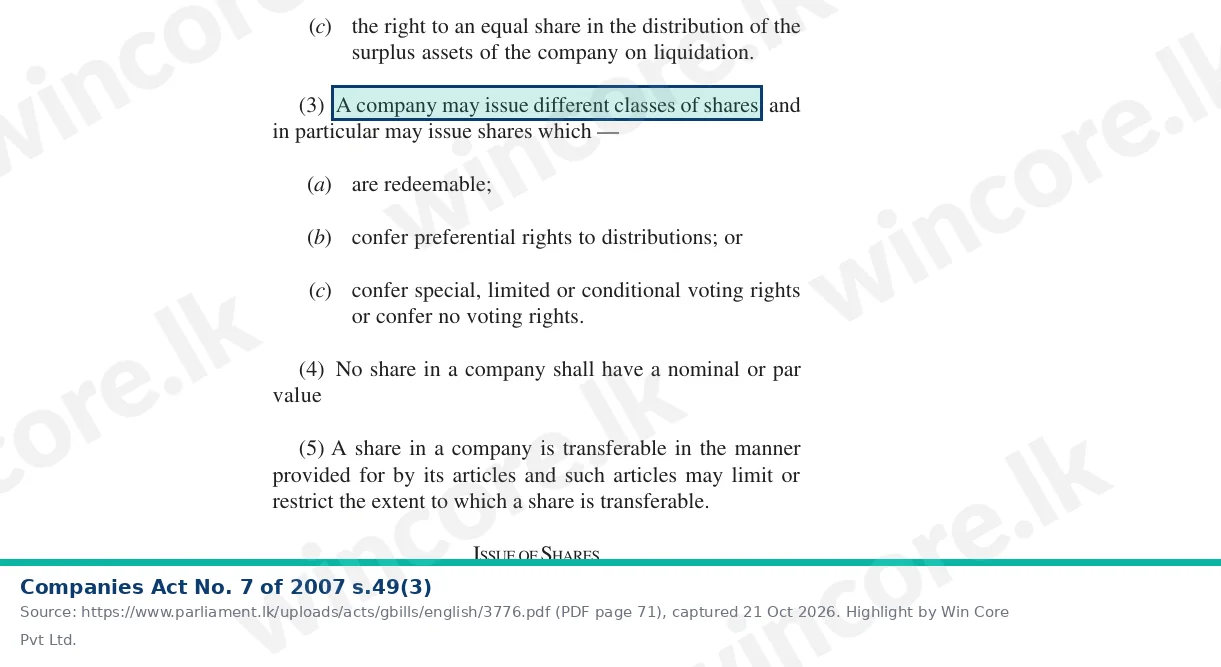
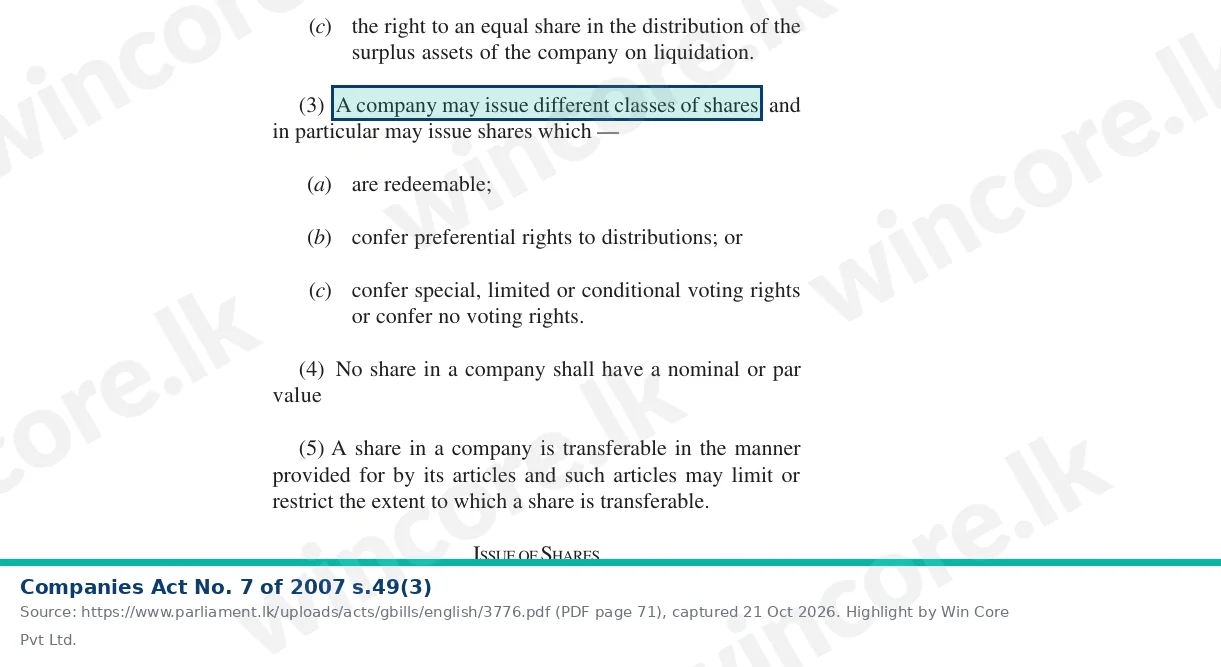
Section 49(2) starts from equal rights: subject to the articles, a share confers "the right to one vote on a poll", "the right to an equal share in dividends paid by the company" and "the right to an equal share in the distribution of the surplus assets of the company on liquidation" [1]. Section 49(3) then says "A company may issue different classes of shares, and in particular may issue shares which (a) are redeemable; (b) confer preferential rights to distributions; or (c) confer special, limited or conditional voting rights or confer no voting rights", and s.49(4) that "No share in a company shall have a nominal or par value" [1].
"Preference share" is not a defined term in the sections we read. On our reading it is a share with preferential rights to distributions under s.49(3)(b), often combined with redemption and limited voting. The holder gets only what the articles and the terms of issue say, so those documents must state the dividend right, whether it is cumulative, the redemption route and price, and voting.
Issuing the shares follows the ordinary rules, as amended from 30 March 2026 by the Companies (Amendment) Act No. 12 of 2025: allotment within twenty working days of receiving the consideration, and a share issue notice that names the allottees. Our article on the Companies (Amendment) Act No. 12 of 2025 sets these out. In a private company, s.31(2)(a) and (c) also let all the shareholders agree in writing to "the issue of shares" and to "the repurchase or redemption of shares", which is then "deemed to be validly authorised" [1]. Our statutory secretarial services team drafts the articles, resolutions and filings.
Three redemption routes, treated differently
Section 66 says a share is redeemable "if the articles of the company make provision for the redemption of that share by the company (a) at the option of the company; (b) at the option of the holder of the share; or (c) on a date specified in the articles", for a consideration "specified or to be calculated by reference to a formula or required to be fixed by a suitably qualified person who is not associated with or interested in the company" [1].
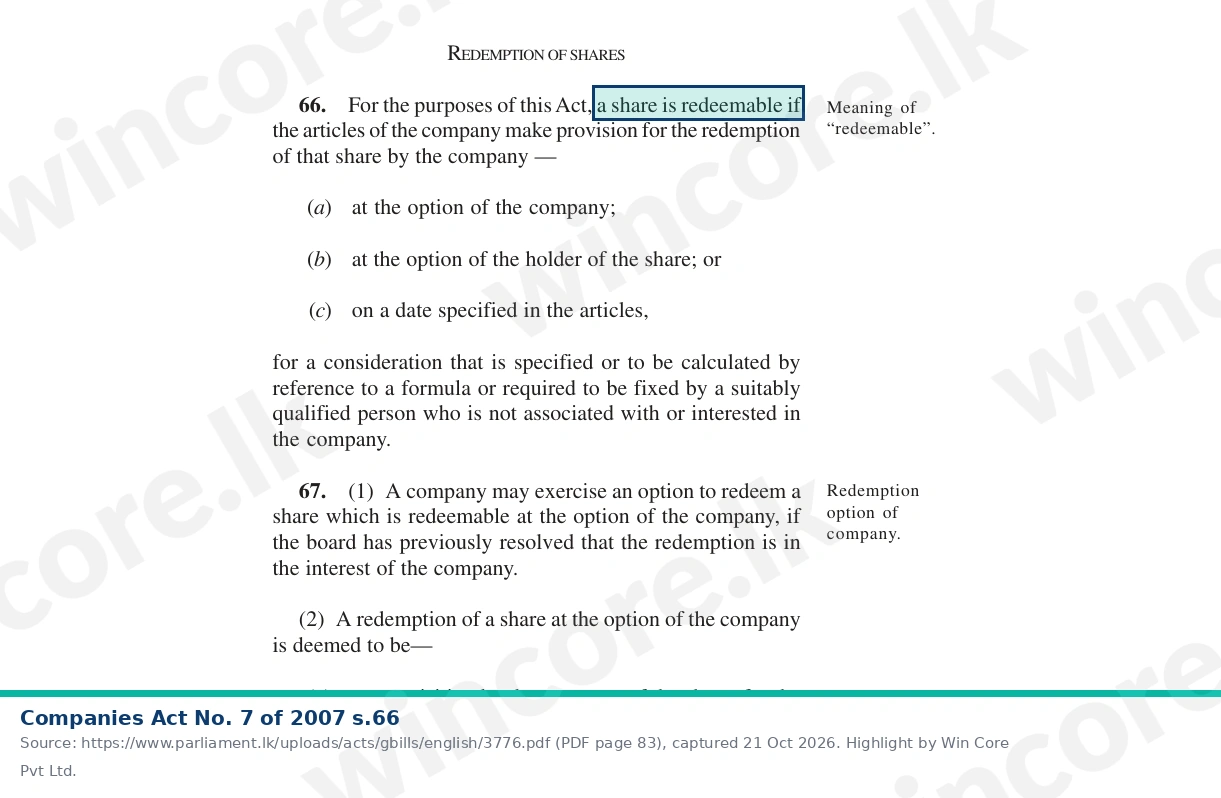
- Company's option (s.67). The board must have "previously resolved that the redemption is in the interest of the company", and the redemption is deemed "a distribution for the pruposes of seciton 56" (spelling as printed) [1]. So the s.56 procedure and solvency test apply in full.
- Holder's option (s.68) or fixed date (s.69). The company "shall redeem the share", the share "is deemed to be cancelled", and the former shareholder "ranks as an unsecured creditor of the company for the sum payable on redemption". The redemption "is not a distribution for the purposes of section 56, but is deemed to be a distribution for the purposes of subsection (1) and subsection (3) of section 61" [1].
The solvency test still reaches mandatory redemptions
Section 56(1) requires a distribution to be authorised by the board and, "unless the company's articles provide otherwise", approved by ordinary resolution. Under s.56(2) the board may authorise it only where "it is satisfied that the company will, immediately after the distribution is made satisfy the solvency test, provided that such board obtains a certificate of solvency from the auditors"; the directors voting for it sign a certificate (s.56(3)); a director who fails to comply with s.56(2) faces a fine on conviction of up to Rs 200,000 (s.56(5)) [1]. Section 57(1) sets the test: the company can pay its debts as they become due, and its assets exceed its liabilities and its stated capital [1].
Two links matter for preference shares. Section 56(4) says that in the solvency test "debts" includes "fixed preferential returns on shares ranking ahead of those in respect of which a distribution is made, except where the fixed preferential return is expressed to be subject to the power of the board to authorise distributions" [1]. And s.61(1) lets the company recover a distribution made when it did not satisfy the solvency test immediately afterwards, unless the shareholder received it in good faith without knowledge, "has altered his position in relying on the validity of the distribution" and "it would be unreasonable in view of the circumstances to require repayment" [1]. Because ss.68(2) and 69(2) deem a mandatory redemption a distribution for s.61(1) and (3), on our reading a holder paid out when the company fails the test can be asked to repay, subject to those conditions. Sections 68(2) and 69(2) do not apply s.61(2), the directors' personal liability limb.
Holder-option or fixed-date redemption makes the share a liability in the accounts
SLFRS for SMEs para 22.3A: "An entity shall classify a financial instrument as a financial liability or as equity in accordance with the substance of the contractual arrangement, not merely its legal form", and "Unless an entity has an unconditional right to avoid delivering cash or another financial asset to settle a contractual obligation, the obligation meets the definition of a financial liability", except for the instruments para 22.4 classifies as equity [2].
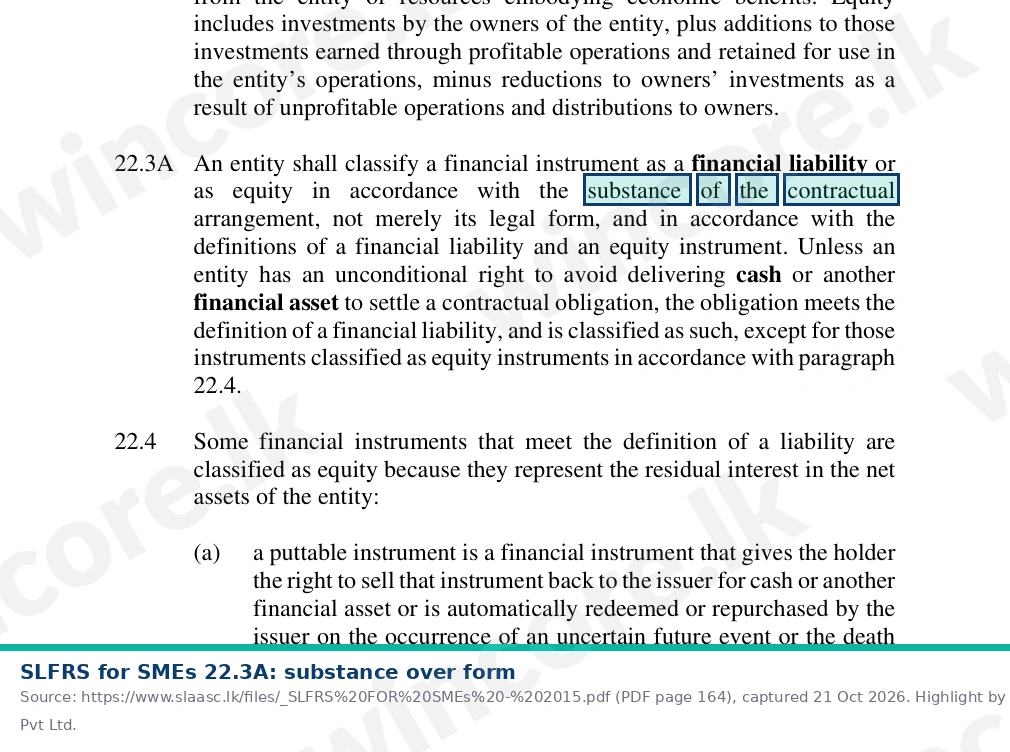
Para 22.5 gives examples of instruments classified as liabilities. Two matter here: "(c) an instrument is classified as a liability if it obliges the entity to make payments to the holder before liquidation, such as a mandatory dividend", and "(e) a preference share that provides for mandatory redemption by the issuer for a fixed or determinable amount at a fixed or determinable future date, or gives the holder the right to require the issuer to redeem the instrument at or after a particular date for a fixed or determinable amount, is a financial liability" [2].
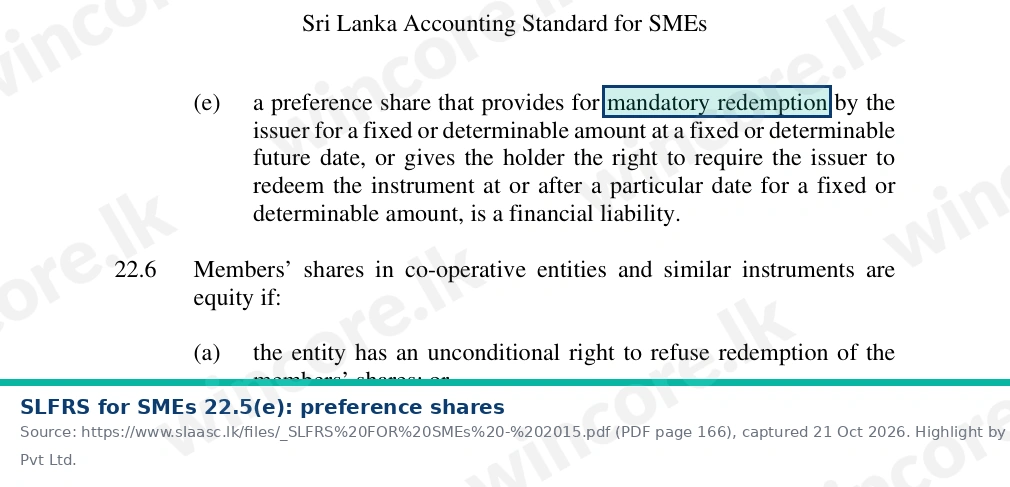
On our reading the Companies Act routes map onto the accounts like this:
| Terms of the preference share | Companies Act | SLFRS for SMEs |
|---|---|---|
| Redeemable on a fixed date | s.69 | Liability, 22.5(e) |
| Redeemable at the holder's option | s.68 | Liability, 22.5(e) |
| Redeemable only at the company's option, dividends at the board's discretion | s.67 | Usually equity, as the company can avoid paying (22.3A) |
| Fixed dividend the company must pay | s.49(3)(b) | Liability, at least in part, 22.5(c) |
Where the share is a liability, its "dividend" is presented as a finance cost, like interest. Companies on full SLFRS reach the same answer under LKAS 32; our article on SAFE notes, liability or equity walks through that standard.
Director fees are employment income, so APIT applies
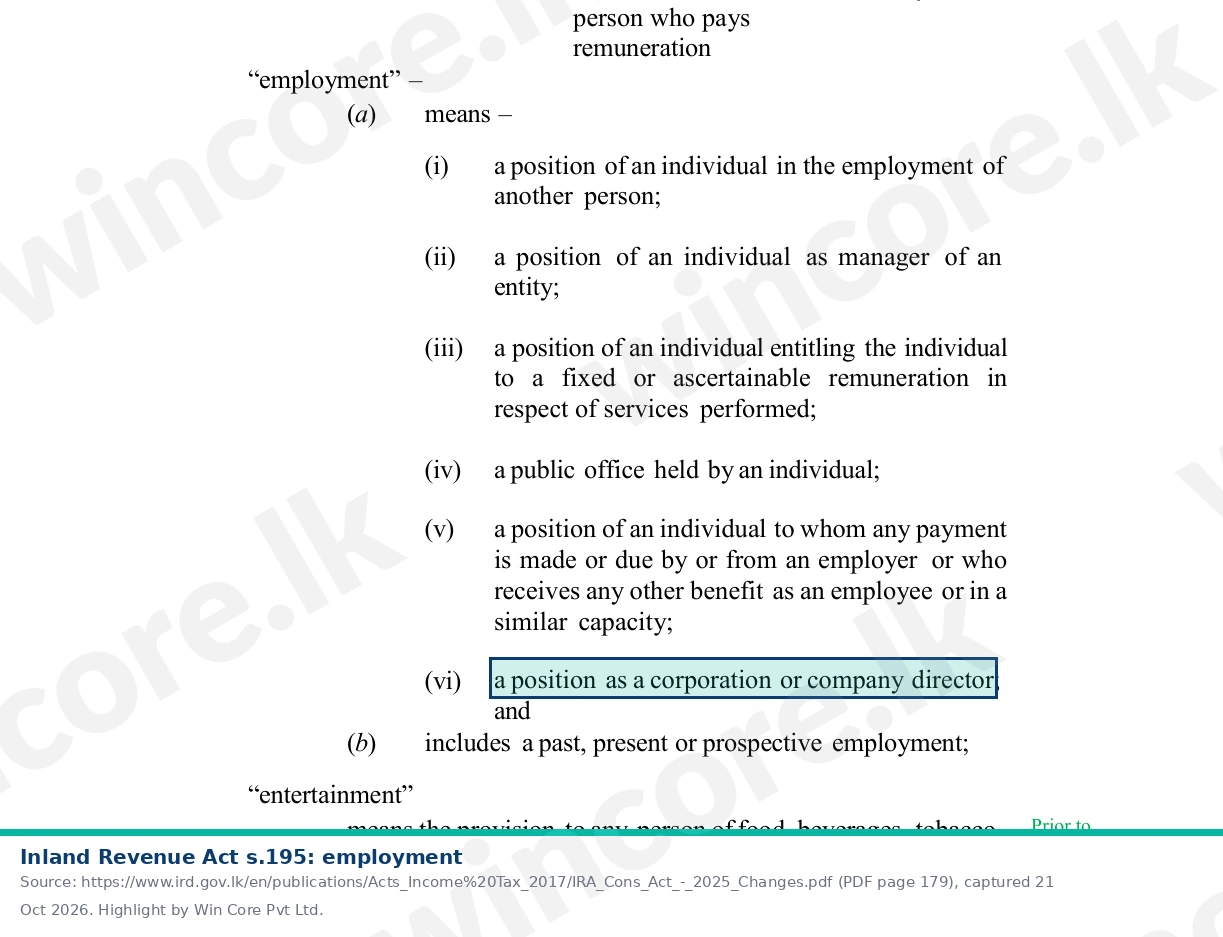
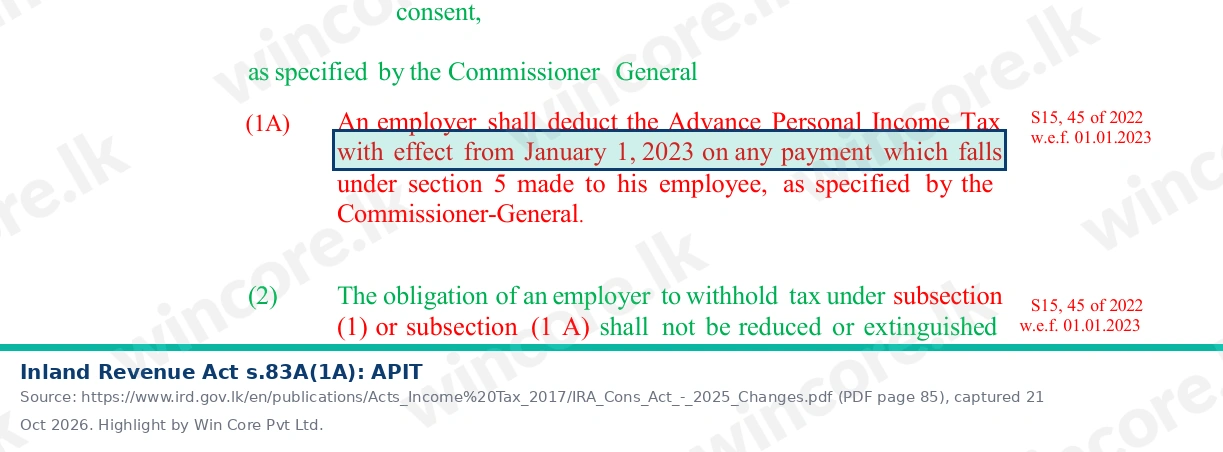
Section 195 defines "employment" to include "(vi) a position as a corporation or company director" [3]. Fees for the directorship are therefore employment income under s.5, whatever the board minute calls them, and s.83A(1A) requires the employer to "deduct the Advance Personal Income Tax with effect from January 1, 2023 on any payment which falls under section 5 made to his employee, as specified by the Commissioner-General" [3]. Our APIT deduction guide covers the tables, the APIT lookup gives the monthly figure, and our piece on consultant or employee misclassification explains why a director's fee does not go through service-fee WHT.
Company law adds the approval. Section 216(1) lets the board, if authorised by the articles or an ordinary resolution, approve "the payment of any remuneration or the provision of other benefits by the company to a director for services as a director or in any other capacity", only "if the board is satisfied that to do so is fair to the company"; approving directors sign a fairness certificate with reasons (s.216(4)) [1]. In a private company, s.31(2)(e) lets all shareholders agree in writing instead [1]. In the accounts, directors are key management personnel and their compensation is disclosed in total (SLFRS for SMEs paras 33.6 and 33.7) [2]. Costs a director pays personally are a separate question; see when a director pays company expenses.
EPF depends on whether the director also has a job
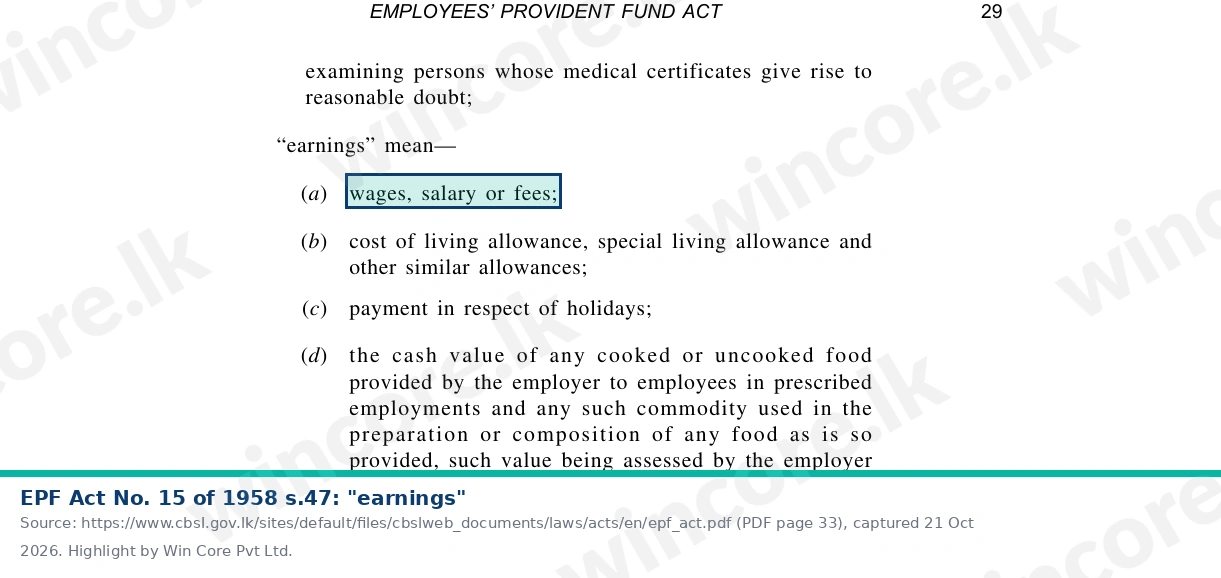
The EPF Act's "earnings" include "(a) wages, salary or fees" (s.47) [4], but regulation 2(2)(a) of the EPF Regulations, 1958 excludes "a person holding the office of director in respect of his employment as such director" [5]. On our reading, fees for the board seat alone are outside EPF, while a director who also works under a separate contract, such as a salaried managing director, is covered for that job. Our sibling article on EPF for foreign nationals and directors sets out the full position. Our payroll services team runs APIT, EPF and ETF for directors and staff.
The accounts and the tax computation are two bases that must be reconciled
The financial statements follow SLFRS for SMEs. The tax computation starts from the accounting profit and adjusts it to the Inland Revenue Act. Differences are normal; each one should be identified, explained and carried in a yearly reconciliation. Typical items in a small company:
- Preference "dividends" shown as finance costs. Section 10(1)(b)(vi) says no deduction shall be made for "dividends of a company", and the Act defines "dividend" as "a payment derived by a member from a company" [3]. On our reading, the return on a preference share is still a dividend for tax although the accounts call it a finance cost, so it is added back. Dividends also carry withholding tax; the dividend tax calculator shows the figure.
- Provisions. Section 10(1)(b)(viii) bars a deduction for an amount transferred "to a reserve or provision for expenditures or losses not yet incurred" [3]. Bad debts are deductible only under s.24(6), after reasonable steps to collect.
- Depreciation. The accounts depreciate over useful life; tax uses capital allowances under the Fourth Schedule.
Our tax return filing services team prepares the computation and reconciliation, and our accounting services team keeps the statements on SLFRS for SMEs.
A worked example: a family boatyard
Hypothetical. A family boatyard company has three directors. A small regional equipment fund subscribes Rs 7,500,000 for preference shares that the articles make redeemable on a fixed date five years after issue, at the issue price, with a fixed dividend of 11 percent a year. The managing director has a service contract and a monthly salary; the two other directors receive a fee for each board meeting.
On our reading:
- The shares are a financial liability under 22.5(e) and 22.5(c). The annual return of Rs 825,000 (our arithmetic) is a finance cost in the accounts.
- In the tax computation the Rs 825,000 is a dividend under s.10(1)(b)(vi) and is added back.
- When the ordinary shareholders want a dividend, the Rs 825,000 a year counts as a "debt" in the s.56 solvency test (s.56(4)), unless the terms make it subject to the board's power to authorise distributions.
- In year five the company "shall redeem" under s.69. The fund becomes an unsecured creditor for Rs 7,500,000 until paid. If the company pays and then fails the solvency test, s.61(1) may let it recover the payment, subject to the good faith conditions.
- All three directors' pay goes through APIT (s.195(vi), s.83A(1A)). The managing director's salary is EPF earnings under the service contract; the meeting fees are outside EPF under regulation 2(2)(a).
What this means for you
If you are raising money through preference shares, write the rights into the articles and the terms of issue, choose the redemption route deliberately, and expect a holder-option or fixed-date share to sit in liabilities. Test solvency before any dividend or redemption, including the fixed returns that count as debts. Put every director's pay through APIT, decide EPF by whether the director has a separate job, and keep a yearly reconciliation from accounting profit to taxable income.
Checklist: documents needed
- Articles showing each share class, its dividend right and redemption terms
- Terms of issue and the share issue notice naming the allottees
- Board resolution or written shareholder agreement for the issue (s.31)
- Board resolution, solvency certificates and auditor's certificate before each dividend or company-option redemption
- Redemption notices and the solvency working for holder-option or fixed-date redemptions
- Board approval and fairness certificate for director pay (s.216), or written shareholder agreement
- Service contracts for executive directors and APIT records for every director
- Reconciliation of accounting profit to taxable income, with each adjustment explained
FAQ
Are redeemable preference shares a liability or equity in Sri Lanka?
It depends on the terms. Under SLFRS for SMEs para 22.5(e), a preference share the company must redeem on a fixed date, or that the holder can require it to redeem, is a financial liability. One redeemable only at the company's option, with dividends at the board's discretion, is usually equity because the company can avoid paying. A mandatory dividend is a liability under 22.5(c). For the tax on the payout, see dividend tax and the 15% final AIT.
Can a company refuse to redeem preference shares when cash is short?
Not if they are redeemable at the holder's option or on a fixed date. Sections 68 and 69 of the Companies Act say the company "shall redeem", and the holder becomes an unsecured creditor for the redemption amount. A redemption at the company's own option is a distribution under s.67, so the board needs the s.56 solvency test and the auditor's certificate first. For the notice when shares are bought back or redeemed, see the Form 9 filing.
Is a director's fee subject to APIT?
Yes. Section 195 of the Inland Revenue Act includes "a position as a corporation or company director" in "employment", so a director's fee is employment income under s.5 whatever it is called. Section 83A(1A) requires the company to deduct APIT on section 5 payments as the Commissioner-General specifies. The fee is not a service fee for withholding tax purposes.
Do we pay EPF on director fees?
Not on fees for the directorship alone. Regulation 2(2)(a) of the EPF Regulations, 1958 excludes a person holding the office of director "in respect of his employment as such director". On our reading, a director who also works under a separate contract, such as a salaried managing director, is covered for that employment, and contributions are due on those earnings.
Is the dividend on a preference share deductible for income tax?
On our reading, no. Section 10(1)(b)(vi) of the Inland Revenue Act bars any deduction for "dividends of a company", and the Act defines a dividend as a payment a member derives from a company. The accounts may show the return as a finance cost when the share is a liability, so it becomes an add-back in the tax computation. We found no IRD ruling on the point.
Open points
- Tax on liability-classified preference returns. Our add-back reading rests on ss.10(1)(b)(vi) and 195; we found no IRD ruling or guidance either way.
- Company-option shares with fixed returns. Whether part of such a share is a liability under 22.5(c) depends on its exact terms.
- EPF Regulations amendments. Later amendments to regulation 2(2) were not traced.
- Standard edition. We read SLFRS for SMEs (2015); adoption of a later revision in Sri Lanka was not checked.
- Companies (Amendment) Act No. 12 of 2025. On our reading it changes share allotment and notices, not ss.49, 56, 57, 61 or 66 to 69.
Last verified 22 October 2026 against the Companies Act ss.31, 49, 56, 57, 61, 66 to 69 and 216 (drc.gov.lk copy), SLFRS for SMEs (2015) paras 22.3A to 22.5 and 33.6 to 33.7, the Inland Revenue Act ss.5, 10(1)(b), 24, 83A and 195 (IRD consolidation to 2025) and EPF Regulations 1958 reg 2(2)(a).
This article is general information, not advice for your specific situation.
Talk to us. If you are planning a preference share issue or want director pay set up properly, contact us at our contact page.
WinCore Pvt Ltd
References
- Parliament of Sri Lanka. Companies Act, No. 7 of 2007, ss.31, 49, 56, 57, 61, 66 to 69 and 216. http://www.drc.gov.lk/en/wp-content/uploads/2018/04/Act-7-of-2007-English.pdf (also https://www.parliament.lk/uploads/acts/gbills/english/3776.pdf for the captures). Primary. Accessed 22 October 2026.
- CA Sri Lanka. Sri Lanka Accounting Standard for Small and Medium-sized Entities (SLFRS for SMEs), 2015, paras 22.3A, 22.4, 22.5, 33.6 and 33.7. https://www.slaasc.lk/files/_SLFRS%20FOR%20SMEs%20-%202015.pdf . Primary. Accessed 22 October 2026.
- Inland Revenue Department. Inland Revenue Act, No. 24 of 2017, consolidated with amendments to 2025, ss.5, 10(1)(b), 24, 83A and 195 ("dividend", "employment"). https://www.ird.gov.lk/en/publications/Acts_Income%20Tax_2017/IRA_Cons_Act_-_2025_Changes.pdf . Primary (IRD consolidation). Accessed 22 October 2026.
- Central Bank of Sri Lanka. Employees' Provident Fund Act, No. 15 of 1958 (reprint, not a statutory reprint), s.47 ("earnings"). https://www.cbsl.gov.lk/sites/default/files/cbslweb_documents/laws/acts/en/epf_act.pdf . Primary. Accessed 21 October 2026 (capture).
- Department of Labour. Employees' Provident Fund Act, No. 15 of 1958, with the Employees' Provident Fund Regulations, 1958, reg 2(2)(a) (Labour Code copy). https://labourdept.gov.lk/downloads/labour_code/48.pdf . Primary. Accessed 22 October 2026.
Put these insights to work
WinCore specialists can review your current workflow, document gaps, and build a practical 90-day action plan.
Book a free consultationContinue reading
Explore more WinCore analysis to keep your finance, tax, and compliance roadmap moving.
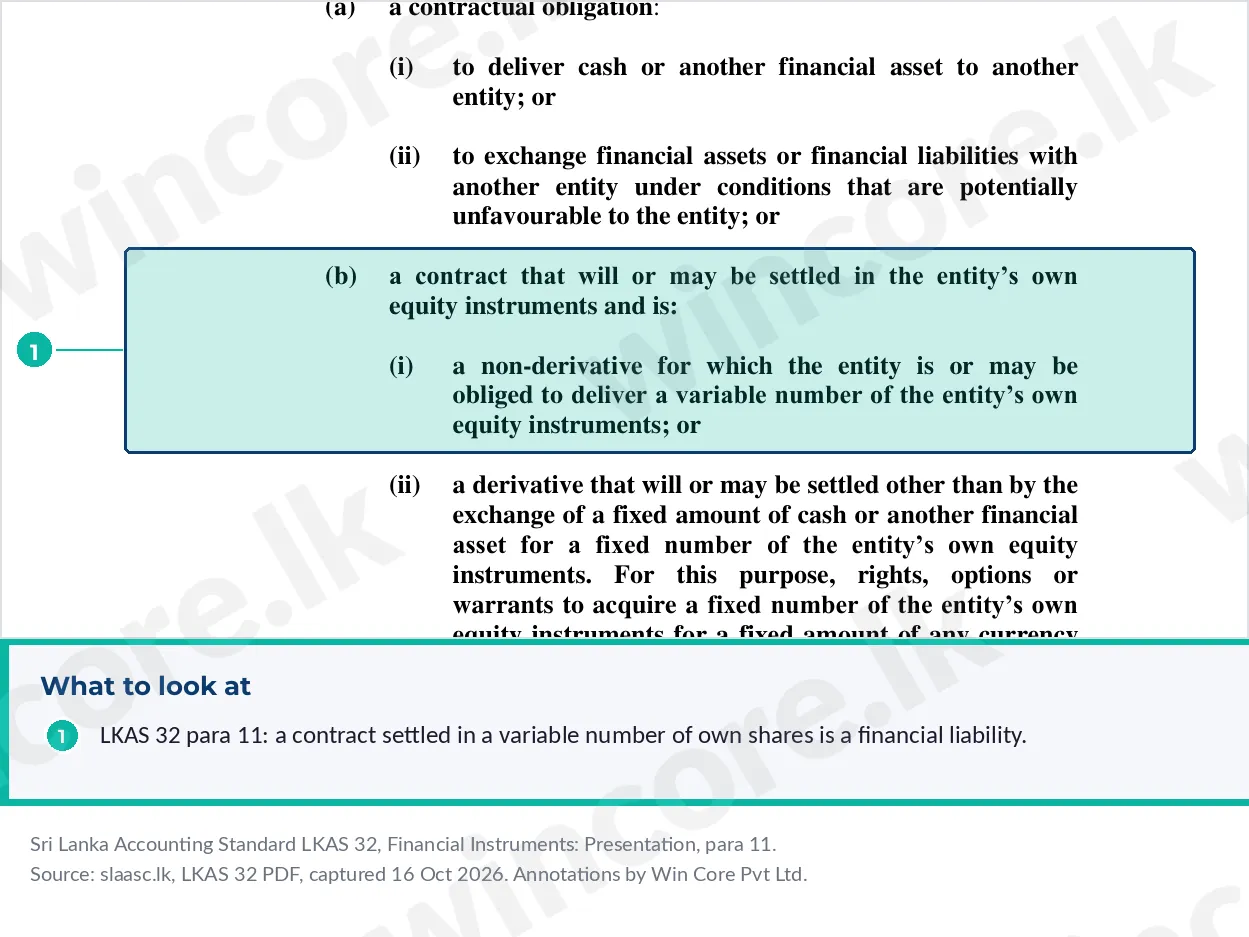
Money raised on a SAFE feels like equity because it will become shares. LKAS 32 asks a different question, and for most SAFEs the answer is a liability.
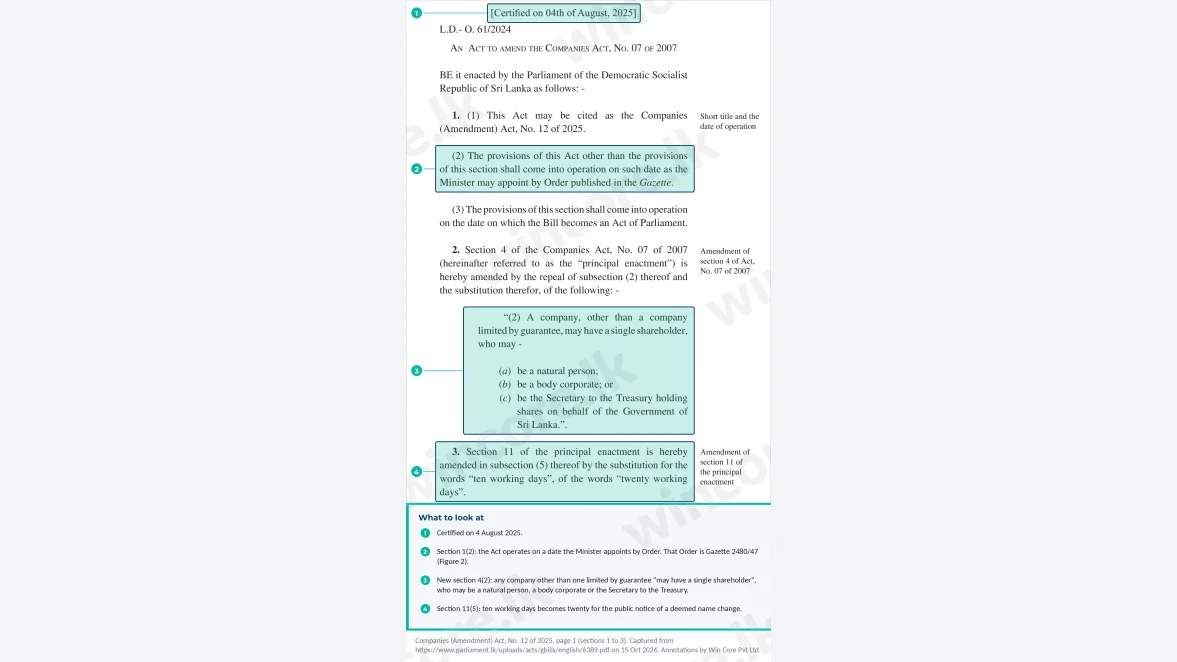
Beyond beneficial ownership, the 2025 amending Act ended bearer shares, moved allotments to working days and added a Rs 1 million general penalty.
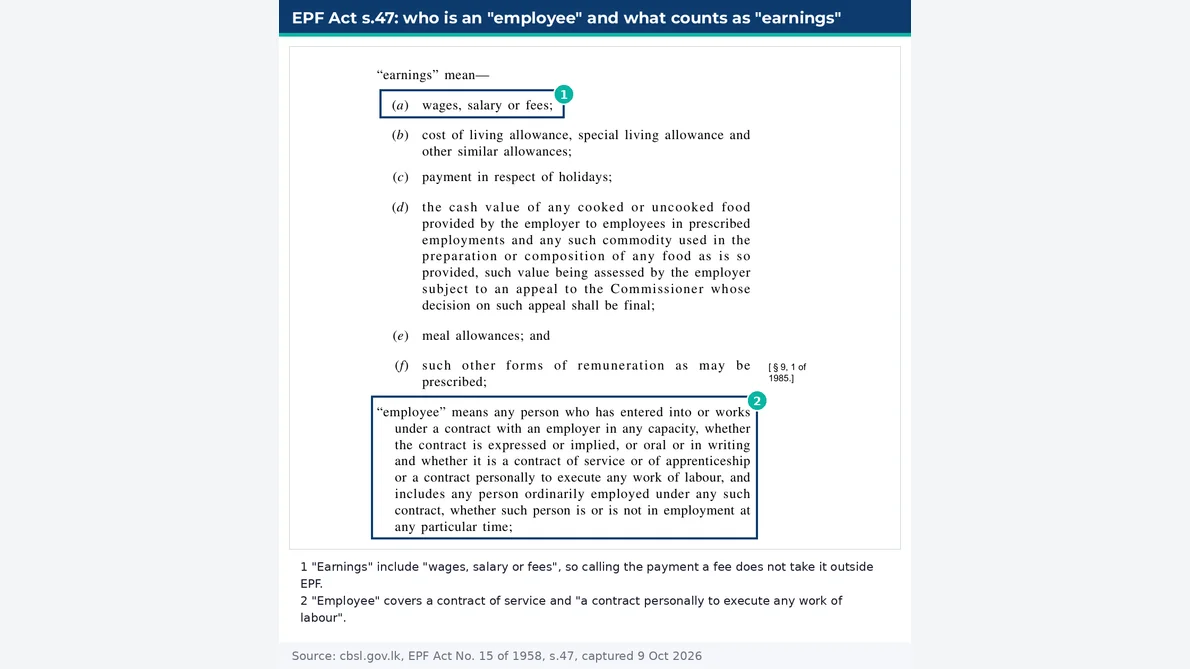
When a consultant is legally an employee in Sri Lanka: the tests under EPF, ETF, gratuity and tax law, and what misclassification costs.