
Director paid company expenses in Sri Lanka: records, approvals, tax
When a director pays a company bill, the company owes the director. How to book it, which Companies Act sections apply and when repayment is taxable.
On this page
Last verified against the primary sources on 22 October 2026.
Director paid company expenses in Sri Lanka are a debt the company owes the director, and the company should book both the expense and that debt on the day the cost was incurred (Companies Act, No. 7 of 2007, s.148). Repaying the director is a transaction in which the director is interested (s.191), which brings in disclosure under s.192. The reverse case, the company paying a director's own costs, is controlled by ss.216 and 217, including a Rs 25,000 limit on loans to directors. For income tax, every company director holds an "employment" (Inland Revenue Act, No. 24 of 2017, s.195), and a reimbursement of costs incurred on behalf of the company is excluded from employment income (s.5(3)(b)). These are the rules as we read them on 22 October 2026. Where we describe practice rather than law, we say so.
Director paid company expenses are a company transaction from day one
Section 148(1) requires every company to keep accounting records that "correctly record and explain the company's transactions" and "at any time enable the financial positions of the company to be determined with reasonable accuracy" [1]. Section 148(2)(a) asks for "entries of money received and expended each day by the company and the matters in respect of which such money was spent", and s.148(2)(b) for "a record of the assets and liabilities of the company" [1]. Breach is an offence for the company and each officer in default, fine up to Rs 200,000 on conviction (s.148(3)) [1].
A cost a director pays for the company is a company transaction although no company money moved. On our reading it is booked when incurred: the expense (or asset) on one side, a liability to the director, usually called a director's current account, on the other. Repayment clears the liability; it is not a second expense.
SLFRS for SMEs treats a director as key management personnel (para 33.6, "including any director (whether executive or otherwise)"), and a member of key management personnel is a related party (para 33.2(a)(i)) [3]. A related party transaction is "a transfer of resources, services or obligations between a reporting entity and a related party, regardless of whether a price is charged" (para 33.8), and one of the examples is a person who controls the entity incurring "expenses directly that otherwise would have been borne by the reporting entity" (para 33.8(c)) [3]. So the director's balance and the amounts through it are disclosed under para 33.9. Balances between sister companies follow the same section; see related party transactions and group recharges.
Where the director operates several ventures, first establish which business belongs in which legal entity before allocating a personal payment.
Whose cost it was decides the entry, not who paid
If the cost was incurred for the company's business, it is the company's expense although the director paid. If it was the director's own cost, it is not, whoever paid.
The Inland Revenue Act draws the same line. Section 11(1) deducts "expenses to the extent they are incurred during the year by the person and in the production of income from the business or investment", s.11(2) bars "an expense of a capital nature", and s.10(1)(b)(i) bars "domestic expenses incurred by the person" [2]. The test is who incurred the expense and for what.
If the invoice is in the director's name, did the company incur it? The Act does not say in terms. On our reading, a cost the director incurred as the company's agent, for its business, can be the company's expense, but an invoice addressed to the company is far stronger evidence (VAT input tax has its own invoice rules, not covered here).
Section 217 stops loans to directors, not money owed to them
Repaying the director
Section 191(1) says a director is interested in a transaction to which the company is a party "if, and only if, the director (a) is a party to or will or may derive a material financial benefit from the transaction", among other limbs [1]. A director who is owed money for a company cost, and is repaid, is a party to that arrangement, so on our reading limb (a) is met without needing to argue about "material financial benefit".
Section 192(1) then requires the director, "forthwith after becoming aware of the fact that he is interested", to "cause to be entered in the interests register and if the company has more than one director, disclosed to the board" the nature and extent of the interest [1]. Failure does not make the transaction invalid (s.192(3)), but it is an offence with a fine on conviction of up to Rs 200,000 (s.192(4)) [1].
One exception is easy to miss. Under s.30(1), "A private company may by unanimous resolution of its shareholders dispense with the keeping of an interests register", and while the resolution is in force no requirement to enter matters in the register applies; any shareholder can end it by written notice (s.30(2)) [1]. On our reading s.30 removes the register entry only. Where there is more than one director, disclosure to the board under s.192(1) still applies. Our company secretarial services team keeps the interests register and board minutes for this.
The company paying a director's own costs
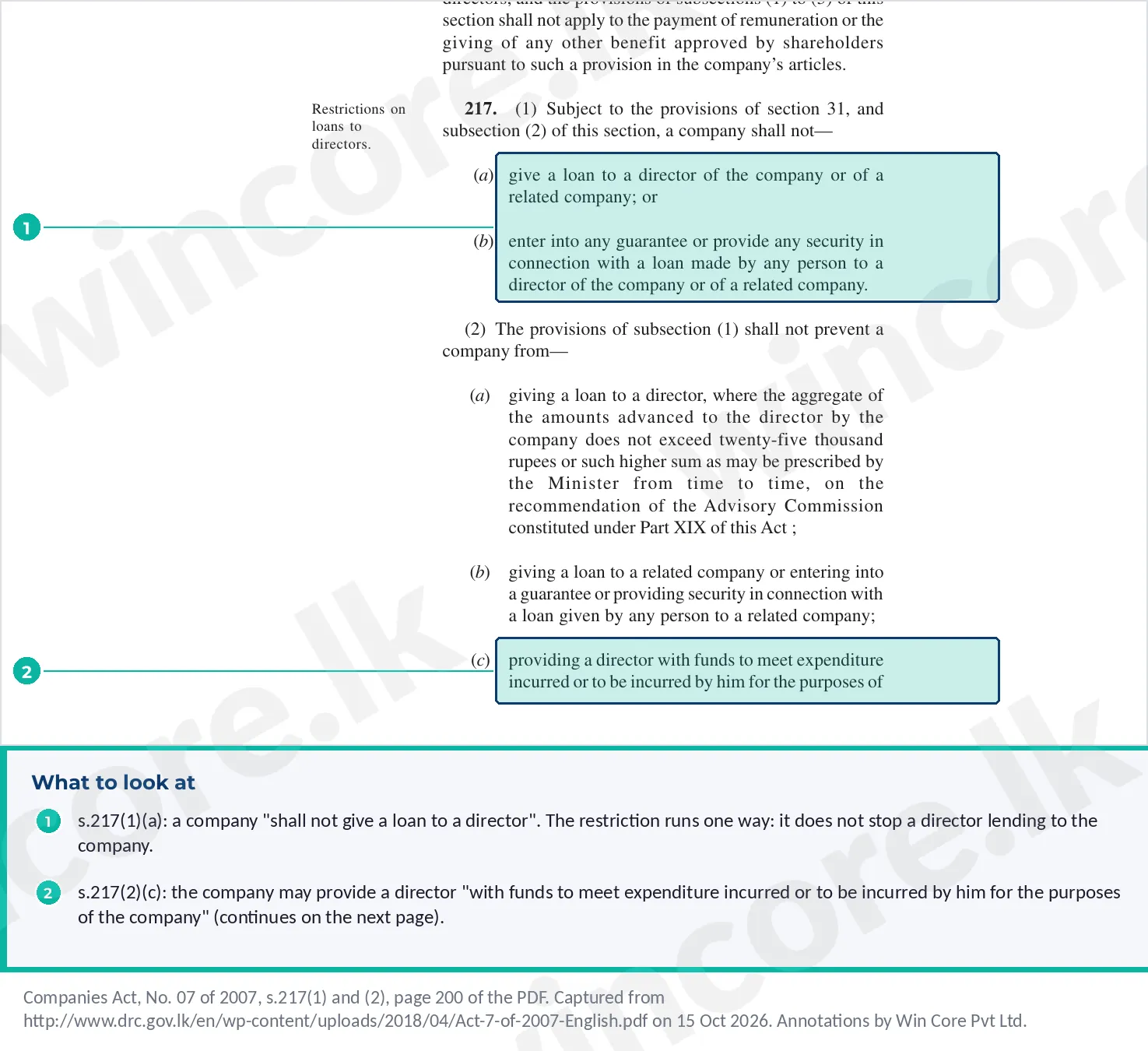
Section 217(1) opens "Subject to the provisions of section 31, and subsection (2) of this section, a company shall not (a) give a loan to a director of the company or of a related company; or (b) enter into any guarantee or provide any security in connection with a loan made by any person to a director" [1]. It restricts money going to the director. A director lending to the company, or paying a company bill and being owed for it, is outside it.
If the company pays a director's personal cost and the director is to repay it, that is a loan. Section 217(2) lists four exceptions: (a) loans where "the aggregate of the amounts advanced to the director by the company does not exceed twenty-five thousand rupees or such higher sum as may be prescribed by the Minister"; (b) loans to a related company; (c) "providing a director with funds to meet expenditure incurred or to be incurred by him for the purposes of the company"; and (d) a lending business's ordinary loans [1]. A loan in breach "shall be voidable at the option of the company" and "immediately repayable upon being avoided" (s.217(3)); the company faces a fine on conviction of up to Rs 200,000 and each director who authorises or permits it up to Rs 100,000 (s.217(5)) [1].
The "Subject to the provisions of section 31" opening matters for private companies. Section 31(1) deems an action validly authorised where "all the shareholders of a private company agree in writing", and s.31(2)(e) expressly covers "the payment of remuneration to a director, or the making of a loan to a director, or the conferment of any other benefit on a director" [1]. So on our reading a private company whose shareholders all agree in writing can authorise a loan above Rs 25,000. Without that agreement, the limit applies. For how the board approves and records pay, see director remuneration.
If the company pays the director's cost with no obligation to repay, it is a benefit. Section 216(1), itself "Subject to the provisions of section 217", lets the board approve "the provision of other benefits by the company to a director", if authorised by the articles or an ordinary resolution, and only "if the board is satisfied that to do so is fair to the company" [1]. Approving directors sign a fairness certificate with reasons (s.216(4)), particulars go in the interests register (s.216(2)), and if the procedure is not followed the director is "personally liable to the company for the amount of the payment" unless he proves it was fair (s.216(5)) [1]. The articles may provide for shareholder approval instead (s.216(6)).
Floats for company spending
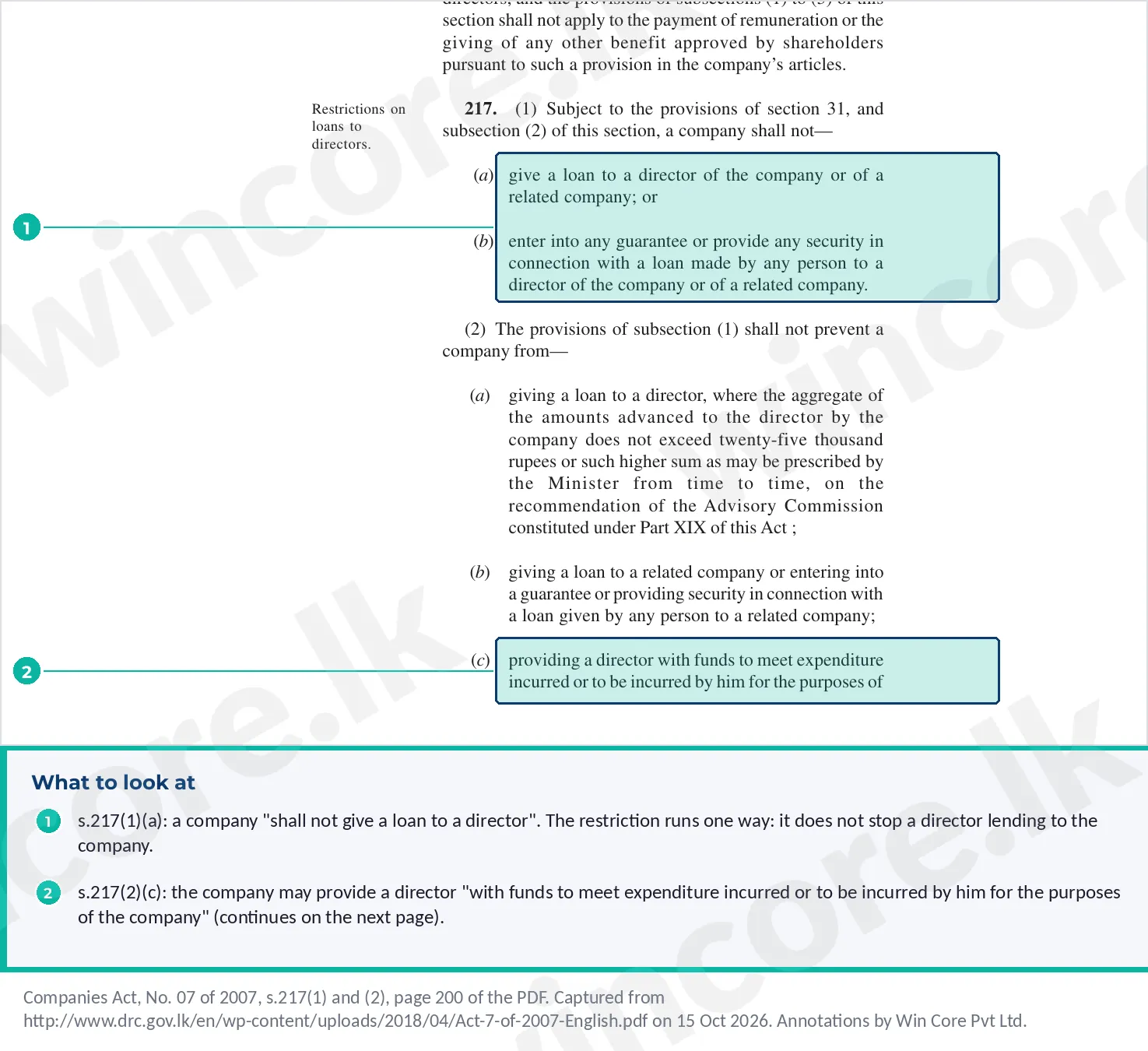
Section 217(2)(c) is the route for a travel float. The funds must be for the company's purposes or the director's duties; a surplus the director keeps is, on our reading, a loan or a benefit. Settle floats promptly against receipts.
Every director holds an employment for income tax, so reimbursements need evidence
Section 195 defines "employment" to include "(vi) a position as a corporation or company director" [2]. So, for income tax, every director has an employment, whether or not the director is on the payroll. Employment income includes "payments providing discharge or reimbursement of expenses incurred by the individual or an associate of the individual" (s.5(2)(c)), but excludes "a discharge or reimbursement of expenses incurred by the individual on behalf of the employer" (s.5(3)(b)) [2].
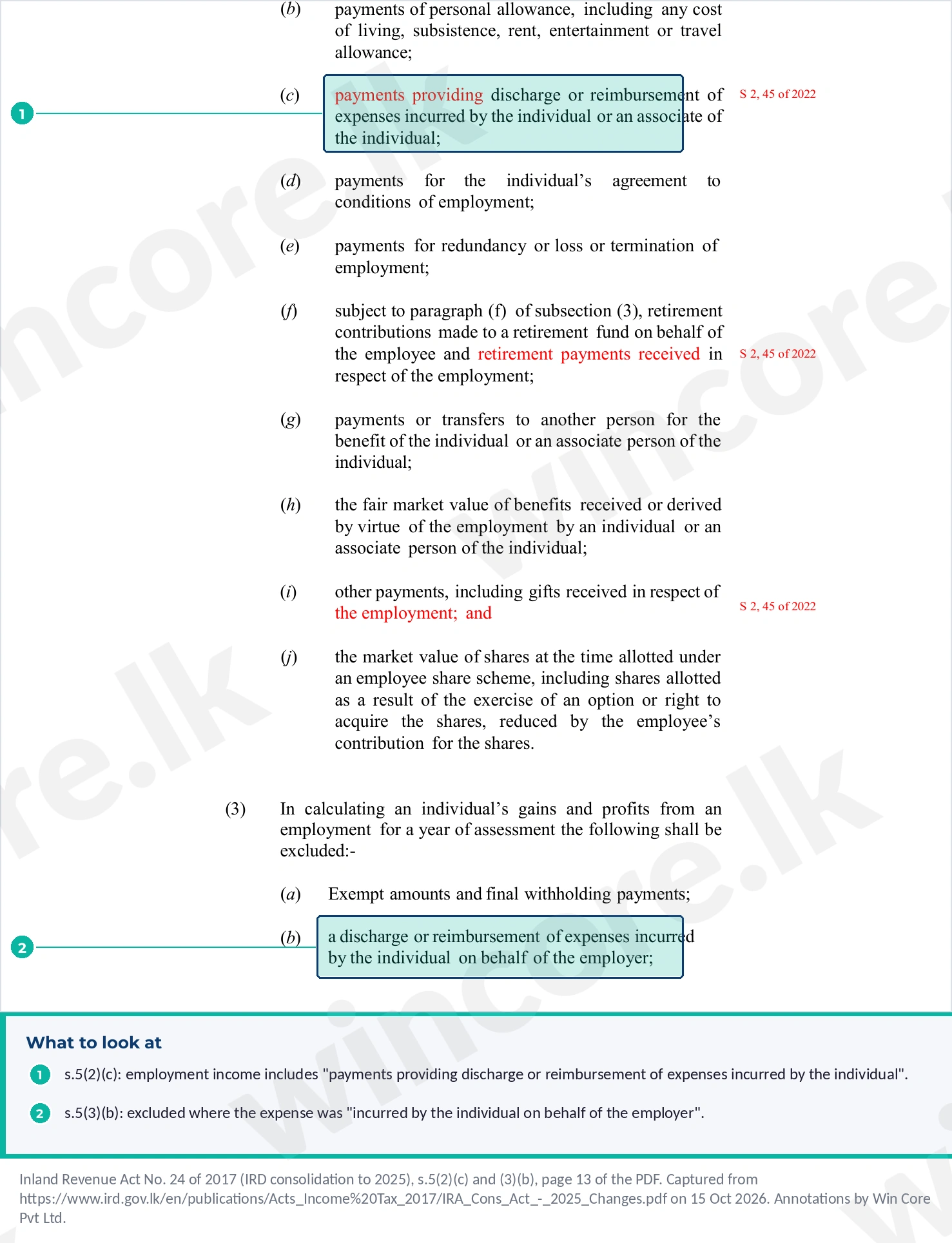
Repaying a genuine company cost is therefore outside employment income. Paying or reimbursing the director's personal cost is employment income, and s.83A(1A) requires the employer to deduct APIT "on any payment which falls under section 5 made to his employee, as specified by the Commissioner-General" [2]. Our APIT deduction guide covers the tables, and the APIT lookup gives the monthly figure. Our article on consultant or employee misclassification covers director fees under the same s.195 limb.
Large cash payments. Section 10(2A) denies a deduction, and treatment as the cost of an asset, where a person pays "Rs. 500,000 or more, in a day, or in respect of a single transaction, or in respect of a series of single transactions relating to one event" otherwise than by account payee cheque or draft, or by "credit card, debit card or electronic payment system through a bank account" [2]. Government and bank payments are excluded (s.10(2A)(b)). The denial falls on "the first mentioned person's income", the payer's. Where a director pays company costs in cash at that level, the company's deduction is at risk, not settled. Our income tax services team can check a specific case.
Keep expense reimbursements distinct from director fees and preference-share funding, which need their own approval and accounting analysis.
A worked example: one claim, two payment methods
Hypothetical. A small engineering contractor has three directors and five shareholders. In March, one director pays Rs 186,400 to a laboratory for soil tests on a new site by online transfer from the director's own bank account, and Rs 640,000 in cash to a crane hire firm for a two-day lift. Both invoices are in the company's name. The company repays Rs 826,400 (our arithmetic) by bank transfer in April.
On our reading:
- Both costs are the company's. In March it records Rs 186,400 of site testing costs, Rs 640,000 of crane hire, and Rs 826,400 owed to the director (s.148).
- The April transfer clears the director's account. It is not an expense, and it is not employment income because the costs were incurred on behalf of the company (s.5(3)(b)).
- The director is a party to the repayment, so the interest is disclosed to the other directors and entered in the interests register, unless the shareholders have passed a s.30 resolution.
- The Rs 640,000 cash payment is a single transaction of Rs 500,000 or more paid otherwise than by card, cheque or bank transfer. Section 10(2A) attaches to the person who pays: here the director paid cash and the company paid the director by bank transfer, so losing the deduction is a risk, not a result. Paying by card or bank transfer avoids it.
- If the company later advances the director Rs 60,000 for a personal purchase, that is a loan above Rs 25,000. It needs the written agreement of all five shareholders under s.31; otherwise it breaches s.217(1).
Our accounting services team sets up the director's account and claim file; the bookkeeping basics guide and startup accounting guide cover the wider ledger.
What this means for you
- Decide whose cost it was before deciding how to record it.
- Book director-paid costs when they happen, with the amount owed to the director (s.148).
- Disclose repayments to the board and, unless a s.30 resolution is in force, in the interests register (s.192).
- Keep the balance one way. If advances to the director add up to more than Rs 25,000, s.217 applies unless all shareholders of a private company agree in writing (s.31).
- Use floats for company spending under s.217(2)(c) and settle the surplus promptly.
- Pay company costs by card or bank transfer, not large cash sums (s.10(2A)), and disclose the director's balance as a related party balance (SLFRS for SMEs 33.9).
The claim file below is practice, not a statutory list.
Checklist: documents needed
- Supplier invoice, ideally addressed to the company
- Proof the director paid: card or bank statement line
- Signed claim stating the business purpose of each cost
- Ledger entry crediting the director's current account on the date incurred
- Board disclosure and interests register entry for each repayment (or the s.30 resolution)
- Bank record of each repayment, referenced to the claim it settles
- Board approval, fairness certificate or written shareholder agreement for any benefit or loan
- Related party note in the year-end accounts showing the director's balance
FAQ
Can a director lend money to their own company in Sri Lanka?
Yes. Section 217 of the Companies Act restricts loans from a company to its directors, not money a director puts in. The director is a party to the arrangement, so on our reading it is an interested transaction under s.191, disclosed to the board and entered in the interests register unless a s.30 resolution is in force.
Can a company pay a director's personal bills?
Only as an approved benefit or a permitted loan. A benefit needs the s.216 procedure, including a board certificate that it is fair to the company. A loan is limited to Rs 25,000 in aggregate under s.217(2)(a) unless all shareholders of a private company agree in writing under s.31. Otherwise the loan is voidable and the company and directors face fines.
Is reimbursing a director taxable in Sri Lanka?
Not when it repays costs incurred on behalf of the company. Every company director holds an "employment" under s.195 of the Inland Revenue Act, and s.5(3)(b) excludes a reimbursement of expenses incurred on behalf of the employer. Paying or reimbursing the director's personal costs is employment income under s.5(2)(c), and APIT applies under s.83A(1A).
Does the invoice have to be in the company's name?
The Inland Revenue Act does not say so for income tax. The deduction turns on whether the company incurred the expense in producing its income (s.11(1)). An invoice addressed to the company is still the strongest evidence of that, and VAT input tax has separate invoice rules, so ask suppliers to bill the company from the start and keep the director's payment record with it.
Open points
- Invoice in the director's name. Whether the company "incurred" the expense under s.11(1) depends on the evidence.
- Higher prescribed loan limit. We found no order raising the Rs 25,000 in s.217(2)(a) in our 22 October 2026 search of drc.gov.lk and documents.gov.lk; we use the figure in the Act.
- Cash paid by a director for the company. Whether s.10(2A) treats a director's cash payment as agent as the company's own payment is not settled.
- Section 10(2A) commencement. The IRD consolidation shows amendments by Acts No. 45 of 2022 and No. 4 of 2023; check the version in force for the year of the payment.
- Interest on director balances. Withholding on interest paid to a director was not reviewed here.
Last verified 22 October 2026 against the Companies Act No. 7 of 2007 (drc.gov.lk copy), the Inland Revenue Act consolidated to 2025 and SLFRS for SMEs (2015).
This article is general information, not advice on your situation.
Talk to us. If you want a simple routine for recording and repaying costs your directors pay, contact us at our contact page.
WinCore Pvt Ltd
References
- Parliament of Sri Lanka. Companies Act, No. 7 of 2007, ss.30, 31, 148, 191, 192, 216 and 217. http://www.drc.gov.lk/en/wp-content/uploads/2018/04/Act-7-of-2007-English.pdf . Primary. Accessed 22 October 2026.
- Inland Revenue Department. Inland Revenue Act, No. 24 of 2017, consolidated with amendments to 2025, ss.5(2), 5(3), 10(1)(b), 10(2A), 11, 83A and 195 ("employment"). https://www.ird.gov.lk/en/publications/Acts_Income%20Tax_2017/IRA_Cons_Act_-_2025_Changes.pdf . Primary (IRD consolidation). Accessed 22 October 2026.
- CA Sri Lanka. Sri Lanka Accounting Standard for Small and Medium-sized Entities (SLFRS for SMEs), 2015, paras 33.2, 33.6, 33.8 and 33.9. https://www.slaasc.lk/files/_SLFRS%20FOR%20SMEs%20-%202015.pdf . Primary. Accessed 22 October 2026.
Put these insights to work
WinCore specialists can review your current workflow, document gaps, and build a practical 90-day action plan.
Book a free consultationContinue reading
Explore more WinCore analysis to keep your finance, tax, and compliance roadmap moving.

Bookkeeping guide for Sri Lankan small businesses: legal requirements, chart of accounts, source documents, 5-year retention rule, and monthly routines.
New companies in Sri Lanka face eight or more compliance registrations in year one. Here is how to set up your books, register for taxes, and stay clean.
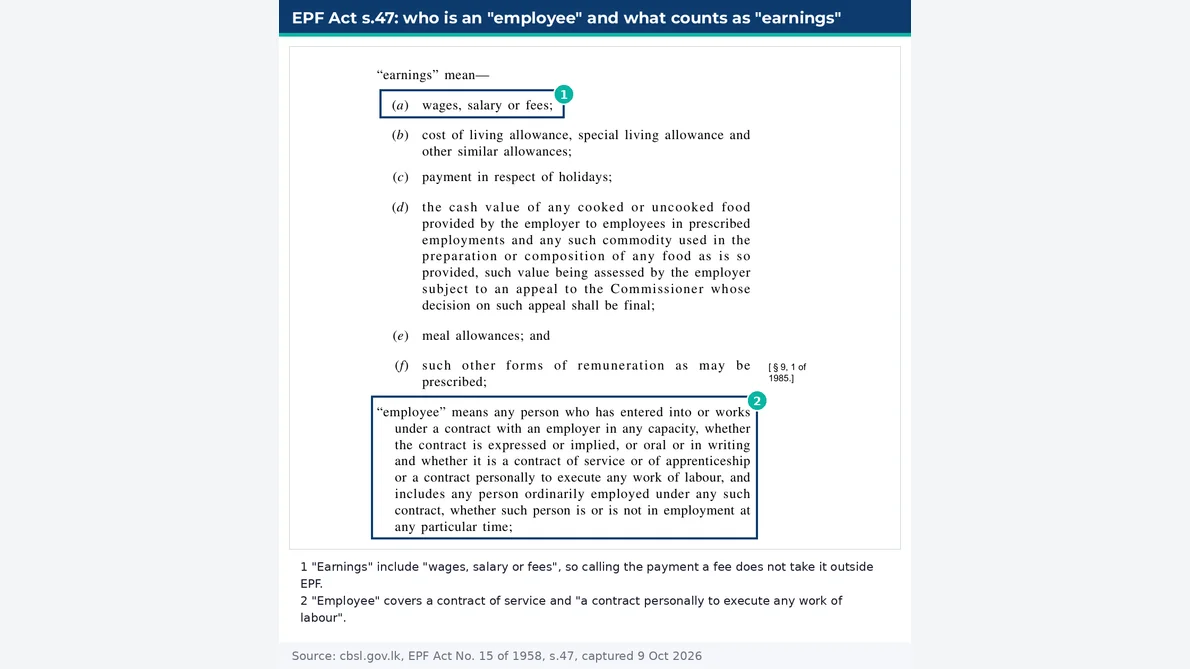
When a consultant is legally an employee in Sri Lanka: the tests under EPF, ETF, gratuity and tax law, and what misclassification costs.