
Separate companies for each business in Sri Lanka: when it pays
One company with departments, or one company per venture? How liability, tax losses, related-company loans, director interests and VAT work in Sri Lanka.
On this page
Last verified against the primary sources on 21 October 2026.
Setting up separate companies for each business in Sri Lanka gives each venture its own legal personality under section 2(1) of the Companies Act, No. 7 of 2007, and its own tax return. The price is that a loss in one company cannot be set against another company's profit: section 19(1) of the Inland Revenue Act, No. 24 of 2017 deducts only "an unrelieved loss of the person", for the year or the previous six years of assessment. Dealings between your companies must be priced at arm's length under section 33, and company-to-company loans are allowed by section 217(2)(b) of the Companies Act [1] [2] [3].
There are two ways to hold several businesses. You can put them all in one company with separate departments, or give each its own company and hold the shares yourself or through a holding company. Neither is always right. The choice turns on four things the law treats differently: liability, tax losses, dealings between the businesses, and the filings each company carries.
Take a hypothetical founder in Galle who runs a translation and subtitling business billing overseas clients, and now wants to open a bakery and a small vehicle rental business. Should all three sit in one company? This piece sets out what the Acts say, so that the decision is made on the text rather than on habit.
Separate companies for each business in Sri Lanka keep liability apart
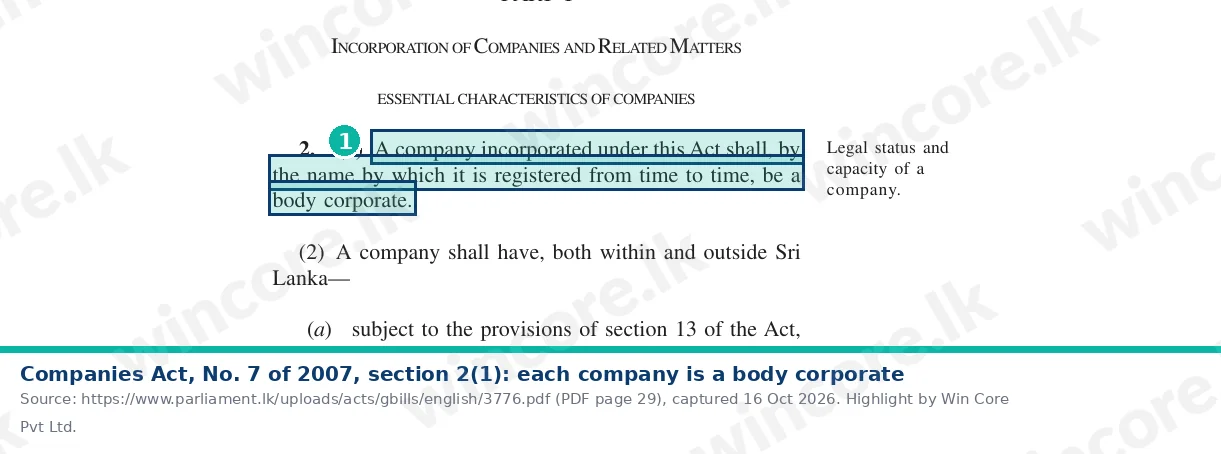
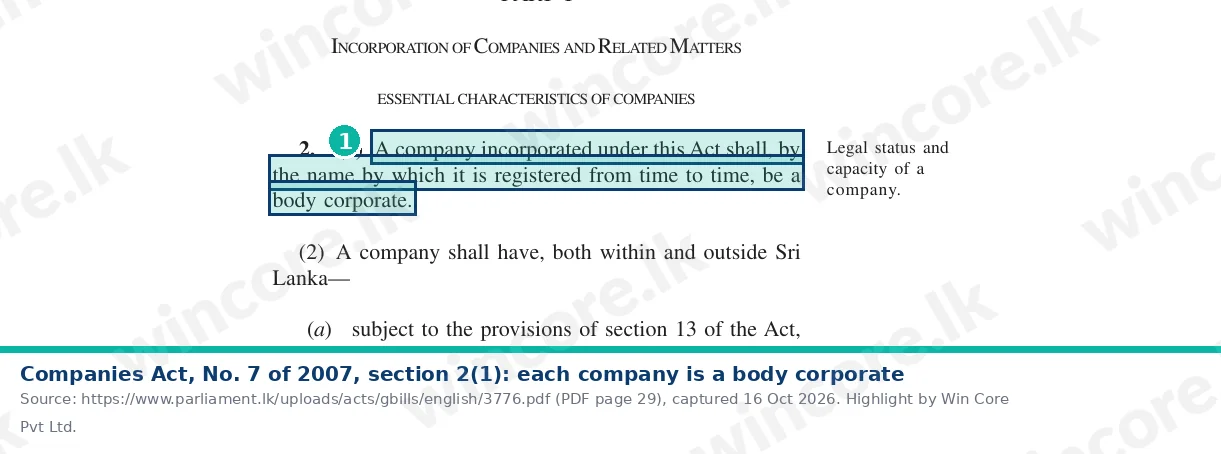
Section 2(1) of the Companies Act says "A company incorporated under this Act shall, by the name by which it is registered from time to time, be a body corporate" [1]. Each company is a separate legal person, with its own contracts, assets and debts.
That separation is the main reason to split. A flour supplier to the bakery contracts with the bakery company. Whether that supplier, or a bank, can reach the translation company depends on what the translation company itself signed, such as a guarantee. Founders often give personal or cross guarantees to banks; that is a commercial choice that can undo the separation, not a rule of law.
Every new company needs its own name, registration and secretary. Our company name check is the first step, and our private limited company registration page sets out the rest.
Separate entities also need documented intercompany recharges and balances, rather than unexplained transfers between their bank accounts.
Each company is a separate taxpayer, and losses stay where they arise
A company incorporated in Sri Lanka is resident under s.69(4)(a) of the Inland Revenue Act and files its own return [2] [4]. Losses belong to the taxpayer that made them. Section 19(1) says that, in calculating a person's income from a business, there shall be deducted "(a) an unrelieved loss of the person for the year from any other business; and (b) an unrelieved loss of the person for any of the previous six years of assessment from the business or any other business" [2] [4].
Read the words "of the person". Inside one company, a loss from the bakery can be set against the vehicle rental profit in the same year. In three companies, the bakery's loss stays in the bakery company and can be used only against that company's own income within the six-year window. We did not find a group relief provision in the Inland Revenue Act that lets one company use another's loss; that is what we found, not a guarantee that nothing exists.
There is a catch inside a single company too. Section 19(3) says that "where a person makes a loss and if the loss were a profit it would be taxed at a reduced rate, the loss shall be deducted only in calculating income taxed at the same reduced rate, a lower reduced rate or exempt amounts" [4]. Act No. 45 of 2022 added a proviso: where the rate on that kind of profit is later increased, the loss is not treated as taxable at a reduced rate [5]. So if the translation business earns export income at the 15 percent rate explained in our guide to non-resident Sri Lankan IT company tax, a loss from that business cannot shelter bakery income taxed at the ordinary rate. Combining the ventures in one company does not always give the loss offset founders expect.
Dealings between your companies must be priced at arm's length
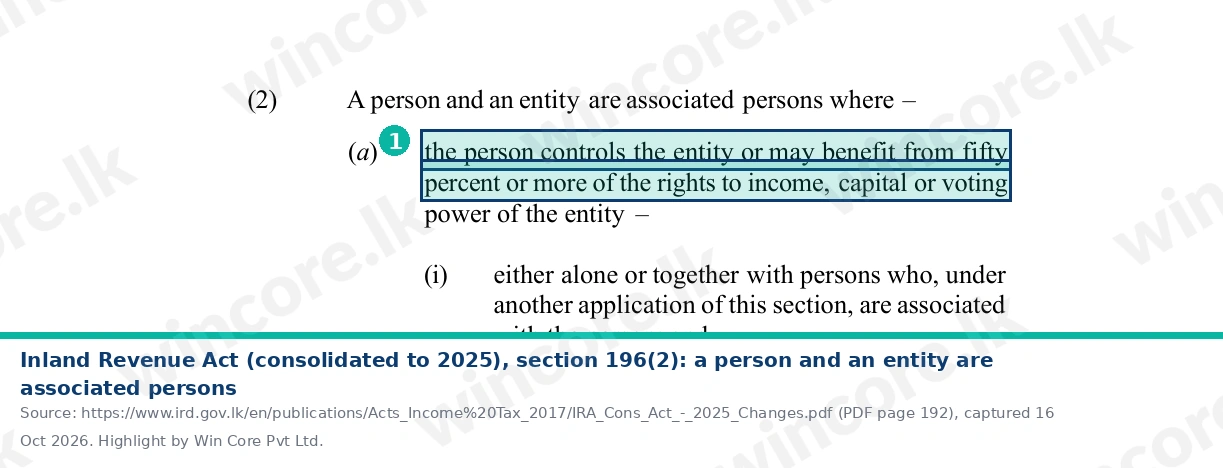
Your companies are associated persons. Section 196(2)(a) says a person and an entity are associated where "the person controls the entity or may benefit from fifty percent or more of the rights to income, capital or voting power of the entity", either alone or with associates, and "whether directly or through one or more interposed entities". Section 196(2)(b) extends this to a person who, under another application of the section, "is an associate of a person referred to in paragraph (a)" [2] [4]. On our reading, if you control two companies, each is your associate, so the two companies are associated through you.
Section 33(1) then says that "Where an arrangement exists between associated persons, the persons shall calculate their income" and tax payable according to the arm's length standard. Under s.33(4), where the Commissioner-General considers that a person has not complied, he may make adjustments, including re-characterising debt financing as equity financing, re-characterising the source and type of income, and apportioning and allocating expenditure based on turnover [4]. Section 34, headed "Income splitting", adds a further rule on transfers between associated persons; we have not quoted it here.
In practice that means a written agreement and a market price when the translation company rents the bakery a room, lends it money or lends it an accounts clerk. Our accounting services keep those intercompany charges and balances agreed between the books each month.
Company-to-company loans are allowed; loans to you as director are restricted
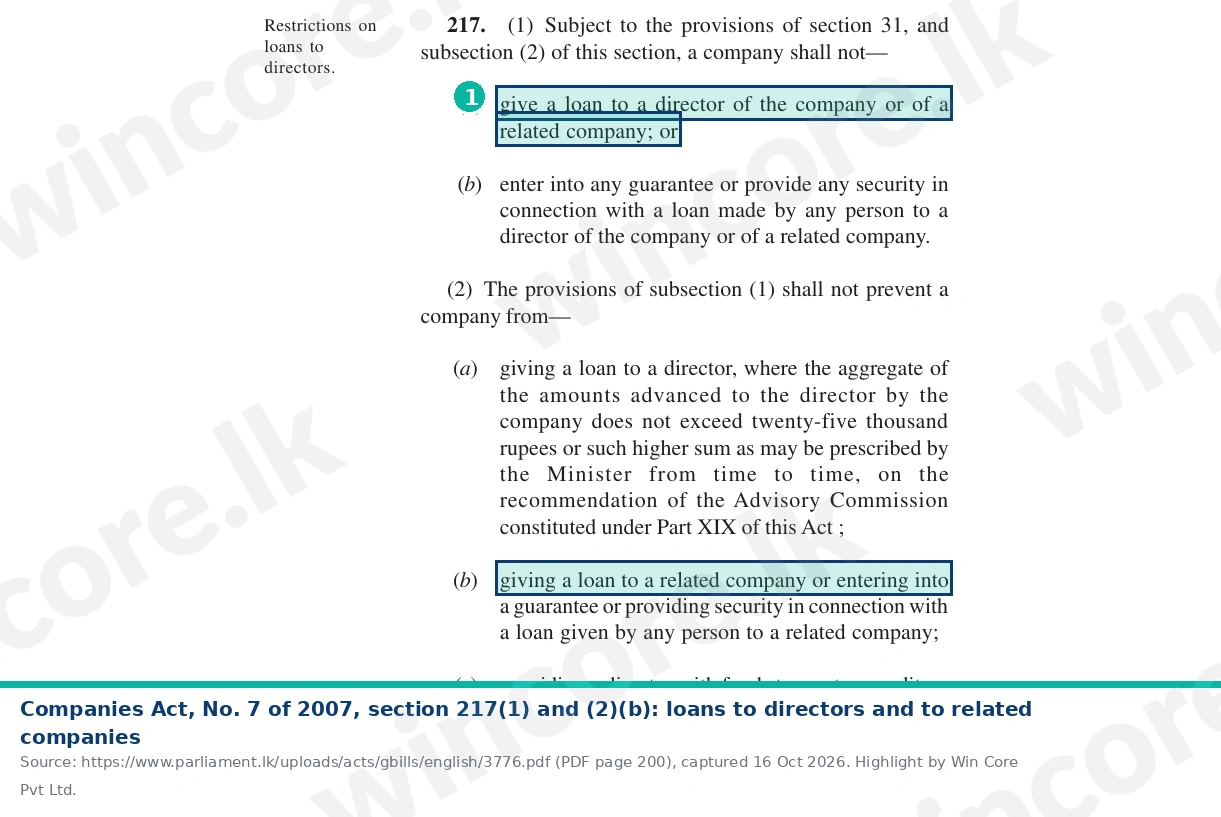
Section 217(1) says that, subject to section 31 and subsection (2), a company shall not "(a) give a loan to a director of the company or of a related company; or (b) enter into any guarantee or provide any security in connection with a loan made by any person to a director of the company or of a related company" [1]. Section 217(2) then says subsection (1) "shall not prevent a company from" giving a loan to a director where the aggregate advanced "does not exceed twenty-five thousand rupees or such higher sum as may be prescribed", or "(b) giving a loan to a related company or entering into a guarantee or providing security in connection with a loan given by any person to a related company", among other listed cases [1].
So company-to-company lending is permitted by s.217, and lending from a company to you as a director is restricted. The tax side still applies: an interest-free loan between associated companies is an arrangement that s.33 expects to be at arm's length.
If you sit on the boards of both companies, the Companies Act requires a director who is interested in a transaction with the company to disclose that interest, to the board where there is more than one director, and to have it entered in the interests register; a general notice that you are a director or shareholder of another named company can serve for later dealings with it (s.192) [1]. A private company may, by unanimous resolution of its shareholders, dispense with keeping an interests register, and while that resolution is in force the provisions requiring entries in the register do not apply (s.30) [6]. Our company secretarial solutions keep the notices and resolutions for each company on file.
VAT registration is tested company by company
Section 10 of the VAT Act, No. 14 of 2002 tests registration on the taxable supplies of "such person", so each company is tested on its own supplies [3]. The VAT Act did once aggregate supplies across a group and across businesses with a common director, but that rule sits in the proviso to s.3(1)(f), part of the wholesale and retail regime that applies only "for any period prior to January 1, 2020" [3]. On our reading it does not aggregate current supplies. Our guide to VAT registration thresholds covers the current figures. Whether the IRD can look through a business split purely to stay below the threshold is a separate question we have not checked, and we keep it open.
| Question | One company | Separate companies |
|---|---|---|
| Liability | Shared across ventures | Separated, unless cross guarantees are given |
| Tax losses | Offset across businesses, subject to s.19(3) | Stay in each company, six years, s.19(1) |
| Dealings between ventures | Internal, no transfer price | Arm's length, s.33 |
| Loans between ventures | Not needed | Allowed company to company, s.217(2)(b) |
| VAT registration | One test on all supplies | One test per company, s.10 |
| Filings | One set of accounts, returns and annual return | One set per company |
Each company also files its own annual return and its own income tax return, with its own late filing exposure. Our guide to Form 15 annual return filing covers the Companies Act side, and the penalty calculator shows what a late tax return costs.
What this means for you
Separate companies suit ventures with different risks, different investors, or a likely sale of one business without the others. One company suits ventures that share staff and customers, where early losses in one would usefully offset profits in another, after checking s.19(3). If you separate, budget for one set of accounts, returns and secretarial filings per company, document every dealing between them at a market price, and file a general notice of interest with each board. Our guide to startup accounting covers setting up each set of books.
Points we keep open:
- Related company. We have not quoted the Companies Act definition of "related company"; check it before relying on s.217(2)(b) for companies without common shareholding.
- Interests register and s.30. How the board disclosure limb of s.192 operates where a private company has dispensed with the register under s.30 is not something we have settled.
- Transfer pricing penalties. We have not mapped which penalty provisions apply to domestic associates. We cite only the s.33(4) adjustment power.
- Holding company. Dividends between your companies, and whether a holding company changes any of this, are outside this piece.
- Artificial splits for VAT. Whether the IRD can treat separately incorporated businesses as one for VAT is not stated in s.10.
Checklist: documents needed
- Certificate of incorporation, Articles and share register for each company
- Group chart showing who holds what in each company
- Written agreements for every service, rent or loan between the companies
- Pricing support showing each intercompany charge is at a market rate
- Loan agreements and board approvals for company-to-company loans
- General notices of interest, or the s.30 resolution, for each company
- Separate bank accounts, books and tax registrations for each company
- Tax loss schedule for each company, by year of assessment
Instruments: Companies Act No. 7 of 2007 ss.2, 30, 192, 217; Inland Revenue Act No. 24 of 2017 ss.19, 33, 34, 69, 196; Inland Revenue (Amendment) Act No. 45 of 2022 s.8; VAT Act No. 14 of 2002 ss.3(1), 10. Official sources: parliament.lk, ird.gov.lk, documents.gov.lk. Last verified: 21 October 2026.
FAQ
Can one of my companies use another company's tax losses in Sri Lanka?
No, not on the text we read. Section 19(1) of the Inland Revenue Act deducts only "an unrelieved loss of the person", from the same year or the previous six years of assessment. A loss stays in the company that made it, and we found no group relief provision that lets a sister company use it [4].
Can one of my companies lend money to another?
Yes, the Companies Act allows it. Section 217(2)(b) says the ban on loans to directors does not prevent a company from giving a loan to a related company or guaranteeing a loan to one. For tax, the loan is an arrangement between associated persons, so s.33 expects arm's length terms, including the interest rate [1] [4].
Can my company lend money to me as a director?
Only within the exceptions in s.217(2). Section 217(1) bars a company from giving a loan to a director of the company or of a related company. Subsection (2) allows, among other cases, loans where the aggregate advanced to the director does not exceed Rs 25,000 or a higher prescribed sum [1].
Do I need to disclose my interest every time my two companies trade?
Usually not each time. Under s.192 of the Companies Act, a general notice that you are a director or shareholder of another named company can serve as disclosure for later transactions with it. A private company can also dispense with the interests register by unanimous shareholder resolution under s.30 [1] [6].
Do separate companies each need their own VAT registration?
Each company is tested on its own supplies. Section 10 of the VAT Act refers to the taxable supplies of "such person". The old rule aggregating group and common-director businesses sat in s.3(1)(f), which applies only to periods before 1 January 2020. Whether the IRD can look through an artificial split is open [3].
This article is general information on the law as at 21 October 2026, not advice for your specific situation.
Talk to us. If you are deciding whether a new venture belongs in its own company, and want the registration, secretarial filings and books set up for each, book a consultation at our contact page.
WinCore Pvt Ltd
References
- Parliament of Sri Lanka. Companies Act, No. 7 of 2007 (certified 20 March 2007), ss.2, 192, 217. https://www.parliament.lk/uploads/acts/gbills/english/3776.pdf . Primary. Accessed 16 October 2026 (s.192 not re-read on 21 October 2026; see VALIDATION).
- Inland Revenue Department. Inland Revenue Act, No. 24 of 2017, consolidated to 2025, ss.19, 33, 34, 69, 196. https://www.ird.gov.lk/en/publications/Acts_Income%20Tax_2017/IRA_Cons_Act_-_2025_Changes.pdf . Primary. Accessed 16 October 2026.
- Inland Revenue Department. Value Added Tax Act, No. 14 of 2002, consolidated to 2025, ss.3(1), 10. https://www.ird.gov.lk/en/publications/Value%20Added%20Tax_Acts/VAT_Act_No_14%5BE%5D_2002_%28Consolidation_2025%29.pdf . Primary. Accessed 21 October 2026.
- SriLaws. Inland Revenue Act No. 24 of 2017, ss.19, 33, 69 and 196 (as enacted). https://srilaws.com/legislation/inland-revenue-act-no-24-of-2017/section-19 . Secondary (corroboration of wording). Accessed 21 October 2026.
- Parliament of Sri Lanka. Inland Revenue (Amendment) Act, No. 45 of 2022, s.8 (amending s.19). https://documents.gov.lk/view/acts/2022/12/45-2022_E.pdf . Primary. Accessed 21 October 2026.
- LankaLaw. Companies Act No. 7 of 2007 (consolidated text), s.30. https://lankalaw.net/wp-content/uploads/2025/02/2007Y0V0C7A.html . Secondary. Accessed 21 October 2026.
Put these insights to work
WinCore specialists can review your current workflow, document gaps, and build a practical 90-day action plan.
Book a free consultationContinue reading
Explore more WinCore analysis to keep your finance, tax, and compliance roadmap moving.
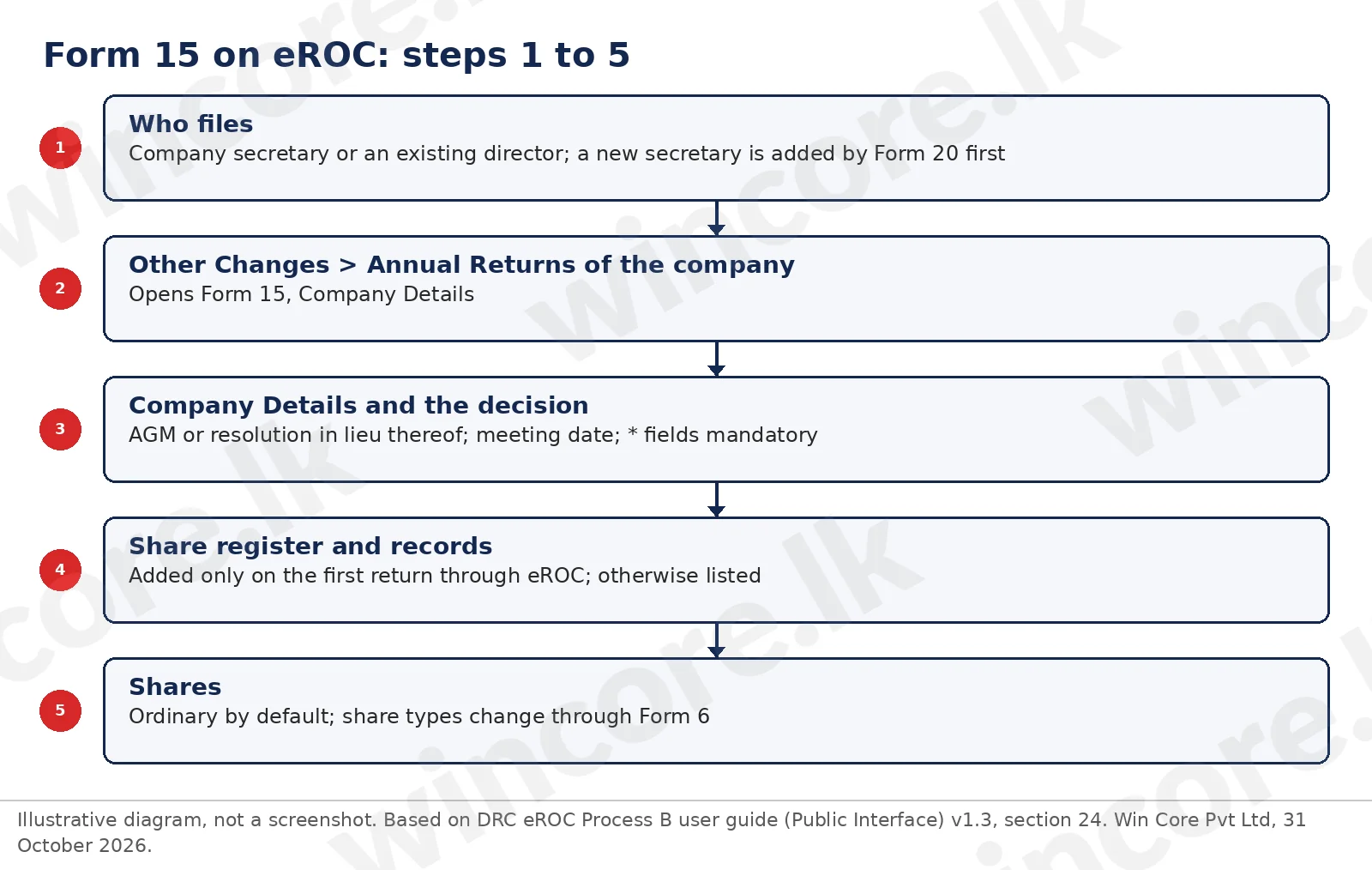
Treat Form 15 as a live governance filing: the 30-working-day clock from the AGM, the BO 4 that goes with it, the fee, and the controls that keep it on time.
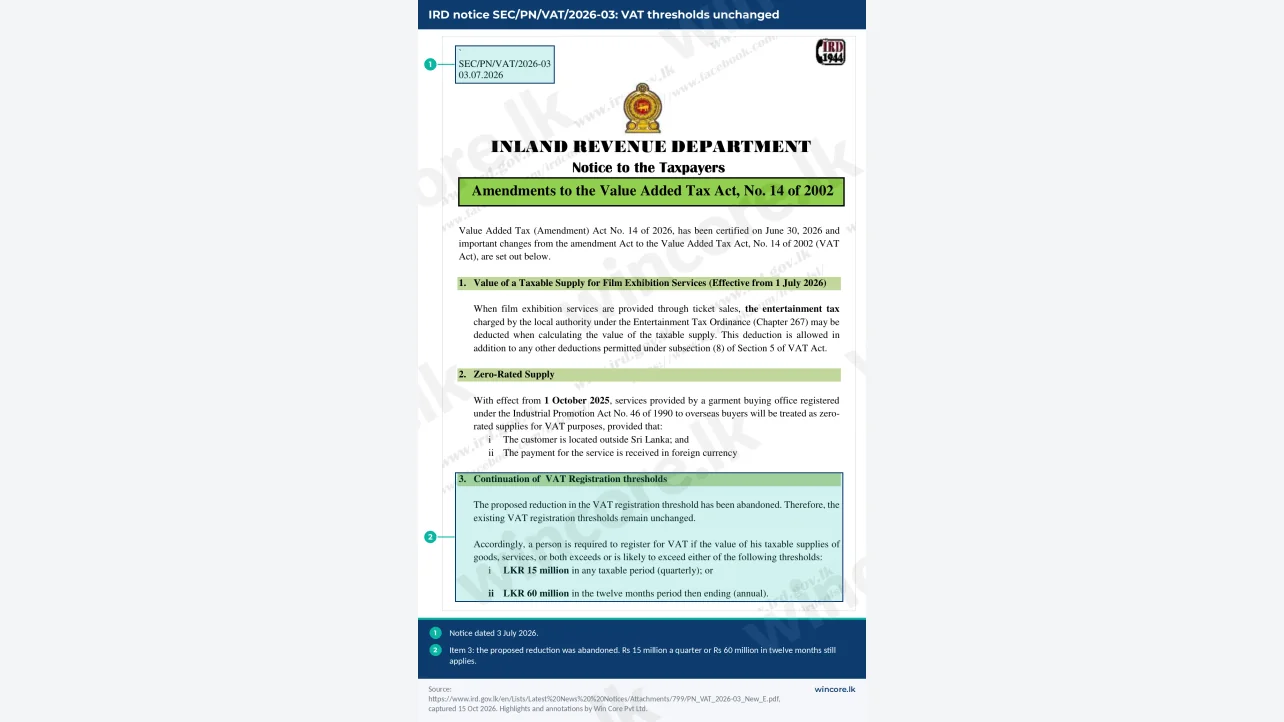
The VAT registration tests are Rs 15 million a quarter or Rs 60 million over 12 months. How the tests run, the 15 day rule and who must register.
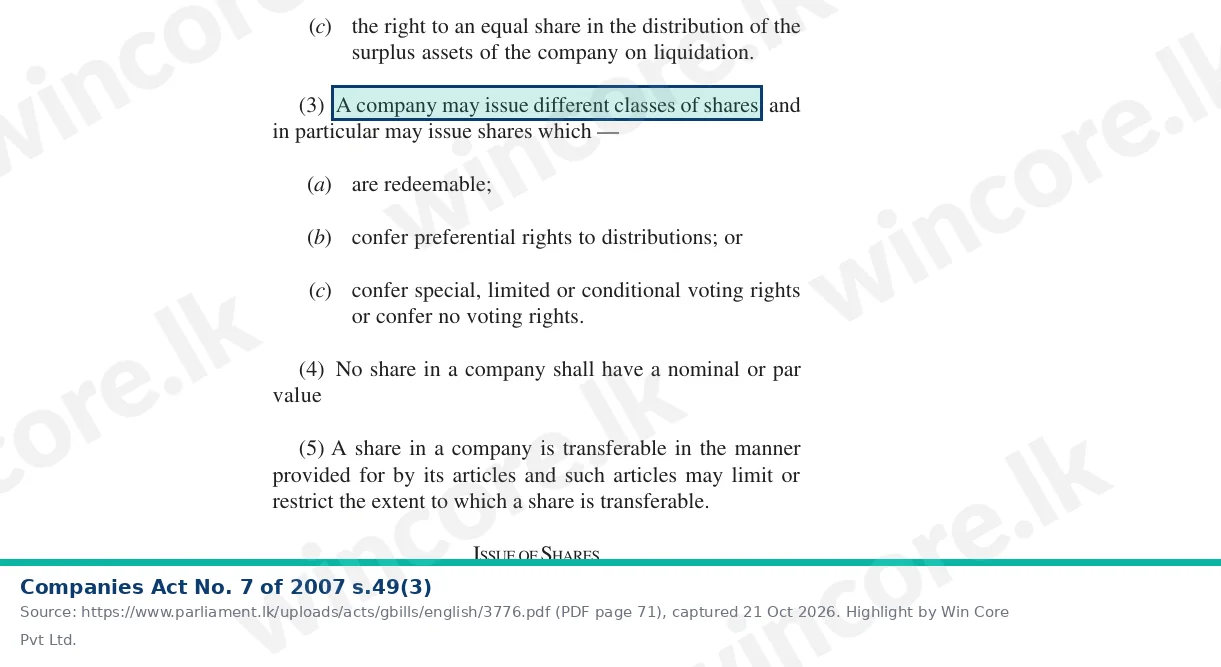
How a small company issues and redeems preference shares, why some sit in liabilities, and how director fees meet APIT, EPF and the tax computation.