
Related party transactions Sri Lanka: recharges and unpaid debts
Sister companies sharing rent and staff are related parties even at no charge. When the arm's length rule bites, what the local file needs and bad debts.
On this page
Last verified against the primary sources on 22 October 2026.
Related party transactions in Sri Lanka are tested twice. For tax, s.77(1) of the Inland Revenue Act, No. 24 of 2017 requires income from transactions with associated enterprises, other than international ones, to be "ascertained having regard to the arm's length price", and the Regulations on Transfer Pricing No. 02 of 2020 (Gazette Extraordinary No. 2217/7 of 2 March 2021, in force from 1 April 2020) apply to those domestic dealings where one company has an exemption, a different tax rate or brought-forward losses. A local file and an annual disclosure form are required only above LKR 200 million of controlled transactions a year, but the arm's length duty itself "remains mandatory for all taxpayers". For the accounts, SLFRS for SMEs Section 33 requires disclosure of related party transactions "regardless of whether a price is charged". This is the position as we read it on 22 October 2026.
Owners with several companies often let whichever company has cash pay, recharge later or not at all, and end up with an intercompany balance nobody agreed. This piece covers when the rules bite, what to do when a related company does not pay, and a set-up routine that is practice, not law.
If one entity is a branch of a foreign company, separate head office rules apply under the Inland Revenue Act. If the payer is a director rather than a sister company, see when a director pays company expenses.
A recharge between sister companies is a related party transaction even at no charge
A recharge passes to one company a cost another paid for it, or a share of a cost that benefits both, such as shared rent or staff, at cost or with a mark-up.
SLFRS for SMEs para 33.2 defines a related party as "a person or entity that is related to the entity that is preparing its financial statements", and lists, among others, a person with control of the reporting entity (33.2(a)(ii)), members of the same group (33.2(b)(i)) and an entity "controlled or jointly controlled by a person identified in (a)" (33.2(b)(vi)) [1]. Two companies controlled by the same individual are related through that last limb. But two entities are not necessarily related "simply because they have a director or other member of key management personnel in common" (33.4(a)) [1].
Para 33.8 then says: "A related party transaction is a transfer of resources, services or obligations between a reporting entity and a related party, regardless of whether a price is charged". Its examples include "transactions between an entity and another entity when both entities are under the common control of a single entity or person" (33.8(b)) [1]. A free recharge, or none at all, is still one. Companies on full SLFRS apply LKAS 24 instead, which we did not re-read here.
Who is an associated enterprise for tax
The Inland Revenue Act uses a different test. For ss.76 and 77, a person is an associated enterprise of another "if one person participates directly or indirectly or through one or more intermediaries in the management, control or capital" of the other, "in such manner or to such extent as may be specified" [2]. Regulation 8 of the Transfer Pricing Regulations specifies it. Two enterprises are associated if, at any time in the year, any one of a list of conditions is met, including where a person holds "shares carrying not less than fifty percent of the voting power in each of such enterprise" (reg 8(b)), loans make up "not less than fifty-one percent of the book value of the total assets of the other enterprise" (reg 8(c)), and where "one enterprise is controlled by an individual or jointly by such individual and his relative, and the other enterprise is controlled by such individual or his relative" (reg 8(j)) [3]. The two tests overlap but differ, so check both.
Section 77 applies the arm's length price to domestic related party transactions
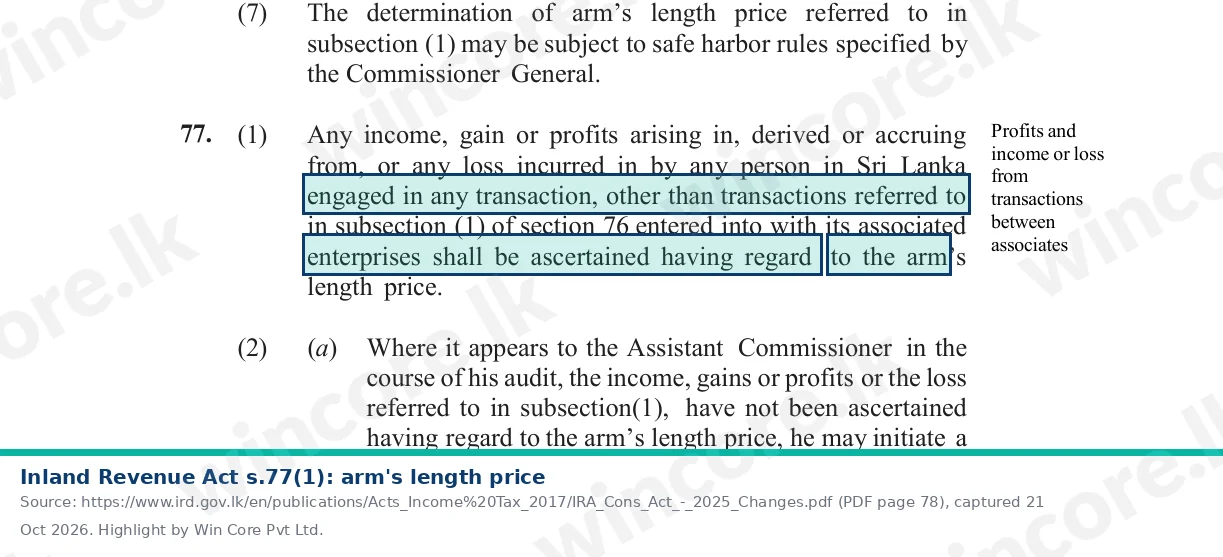
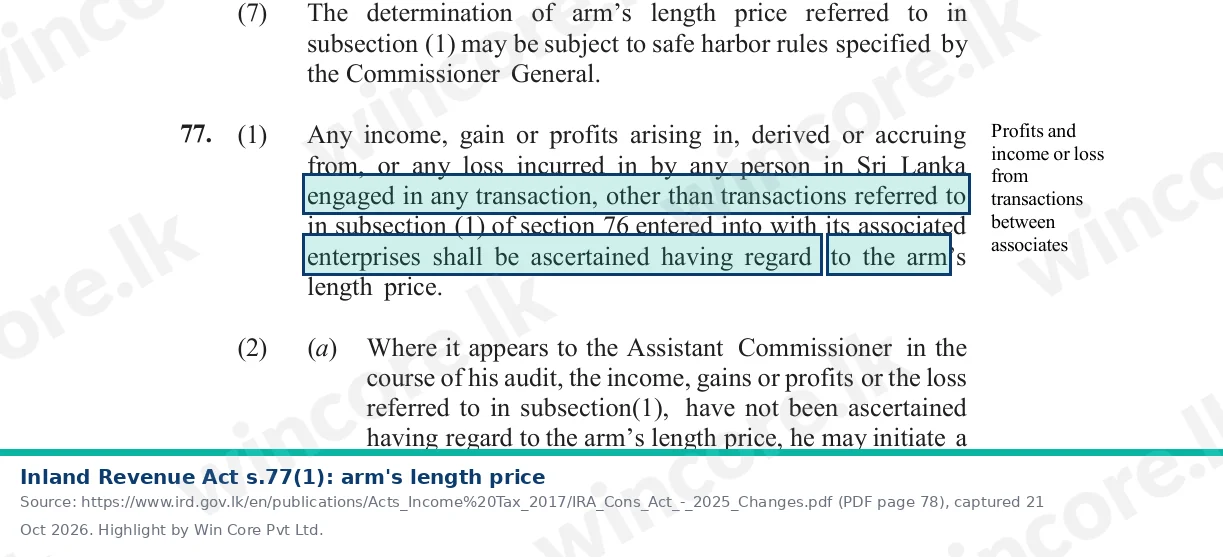
Section 76(1) covers international transactions, defined in s.76(2)(d) as transactions between associated enterprises "either one or both of whom are non-residents" [2]. Section 77(1) covers the rest: income "by any person in Sri Lanka engaged in any transaction, other than transactions referred to in subsection (1) of section 76 entered into with its associated enterprises shall be ascertained having regard to the arm's length price" [2].
The same section limits itself. Section 77(3) says it "shall not apply in a case where the computation" has "the effect of reducing the income, gain or profits chargeable to tax or increasing the loss" computed "on the basis of entries made in the books of account" [2]. Section 77(4) denies any exemption or tax benefit on the amount by which income is increased, and s.77(5) allows safe harbour rules [2]. On our reading the risk runs one way: the IRD can raise a company's profit to an arm's length level, but s.77 cannot be used to lower it.
Regulation 1 names three domestic cases
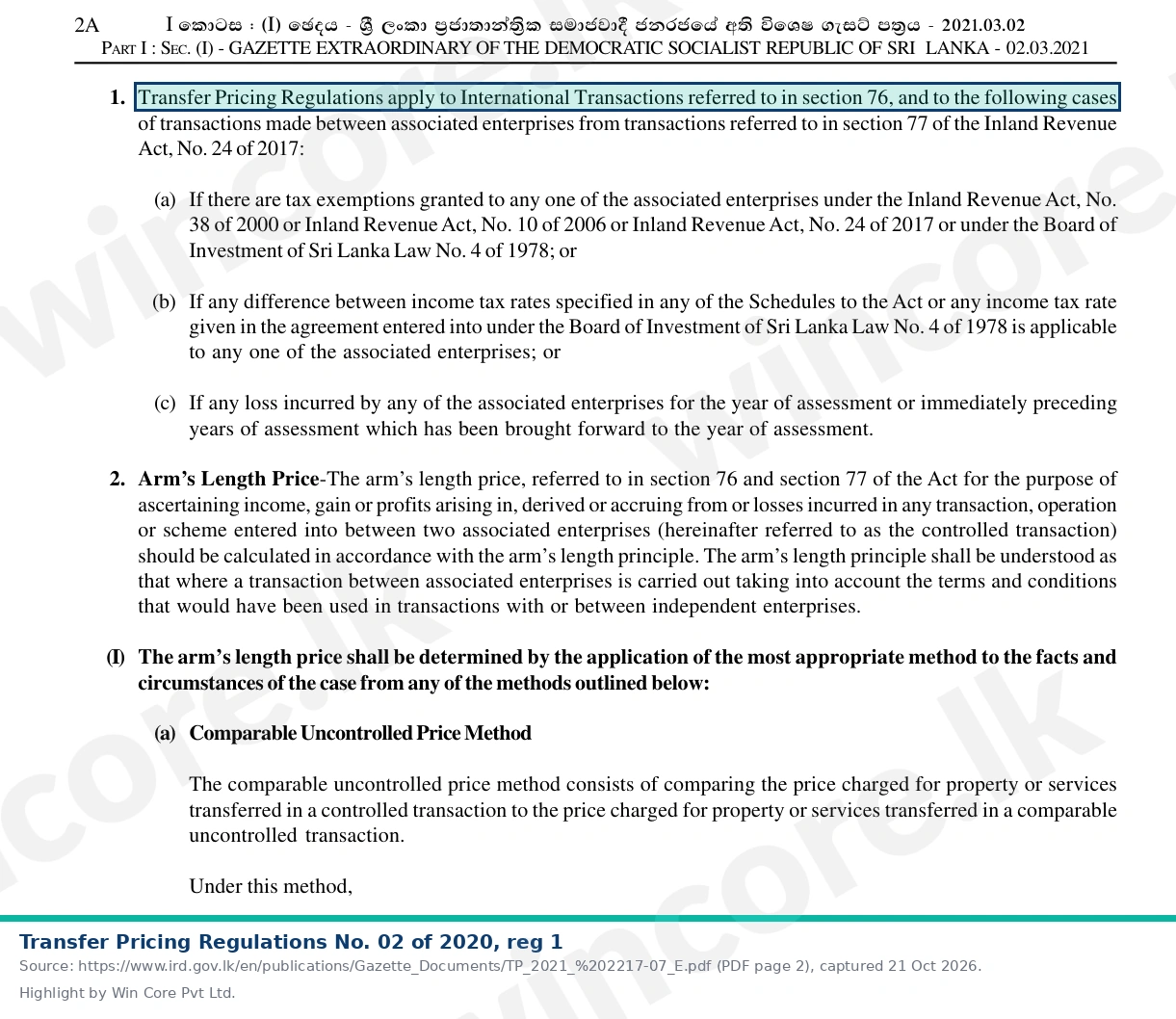
Regulation 1 says the regulations "apply to International Transactions referred to in section 76, and to the following cases of transactions made between associated enterprises from transactions referred to in section 77" [3]:
- "(a) If there are tax exemptions granted to any one of the associated enterprises" under the Inland Revenue Acts of 2000, 2006 or 2017 or the BOI Law;
- "(b) If any difference between income tax rates" in the Schedules or a BOI agreement "is applicable to any one of the associated enterprises"; or
- "(c) If any loss incurred by any of the associated enterprises for the year of assessment or immediately preceding years of assessment which has been brought forward to the year of assessment" [3].
These are common in small groups, and they are where moving profit between companies changes the group's total tax. If the other party is non-resident, the transaction is international under s.76 and these three cases do not narrow it.
Regulation 9 matters for groups: "Where an adjustment is made under section77 of the Act to the taxable income of a taxpayer in relation to a domestic transaction, no tax adjustment would be made to the taxable income of the other party to the transaction" [3]. On our reading, an upward adjustment in one company brings no matching deduction in the sister company.
The Rs 200 million test decides the paperwork, not the arm's length duty
Regulation 6(a) says the local file "is to be prepared and maintained by those enterprises that carry out aggregate controlled transactions with associated enterprises exceed Sri Lankan Rupees (LKR) 200 million for each year of assessment as recorded in the books of account". It "should be kept available for a period of six years from the end of the relevant year of assessment", and "(The transaction here does not include dividend and granting or repayment of loan Capital)" [3]. A master file applies only where declared group revenue exceeds "50 million Euro or its equivalent" [3].
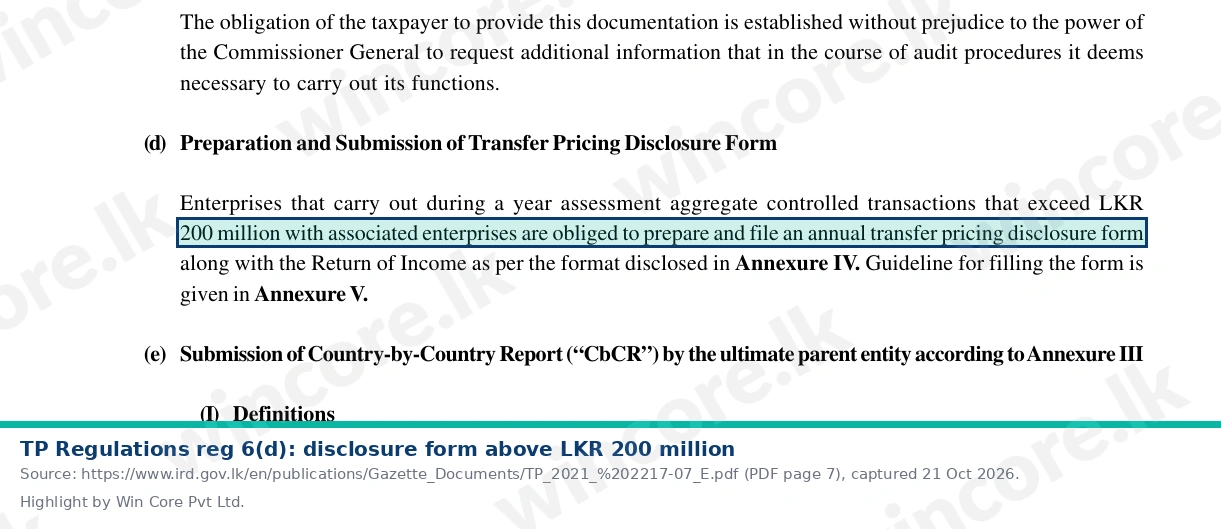
Regulation 6(d): "Enterprises that carry out during a year assessment aggregate controlled transactions that exceed LKR 200 million with associated enterprises are obliged to prepare and file an annual transfer pricing disclosure form along with the Return of Income" [3]. Under regulation 6(c), the documentation must be submitted "within 60 calendar days of the written request" from the Commissioner-General [3].
Below the line, the duty does not go away. Regulation 6(b) says "the substantial obligation of complying with the arm's length principle in controlled transactions with associated enterprises remains mandatory for all taxpayers", who must substantiate their prices "on the basis of documents mentioned in above paragraph (a) or on the basis of any other material available with them when the notice is sent" [3]. The Rs 200 million is the aggregate of controlled transactions, not turnover: a group that recharges Rs 3 million of rent a year but sells Rs 210 million of goods between its companies is over it, while intercompany loan principal is left out.
Penalties under section 184
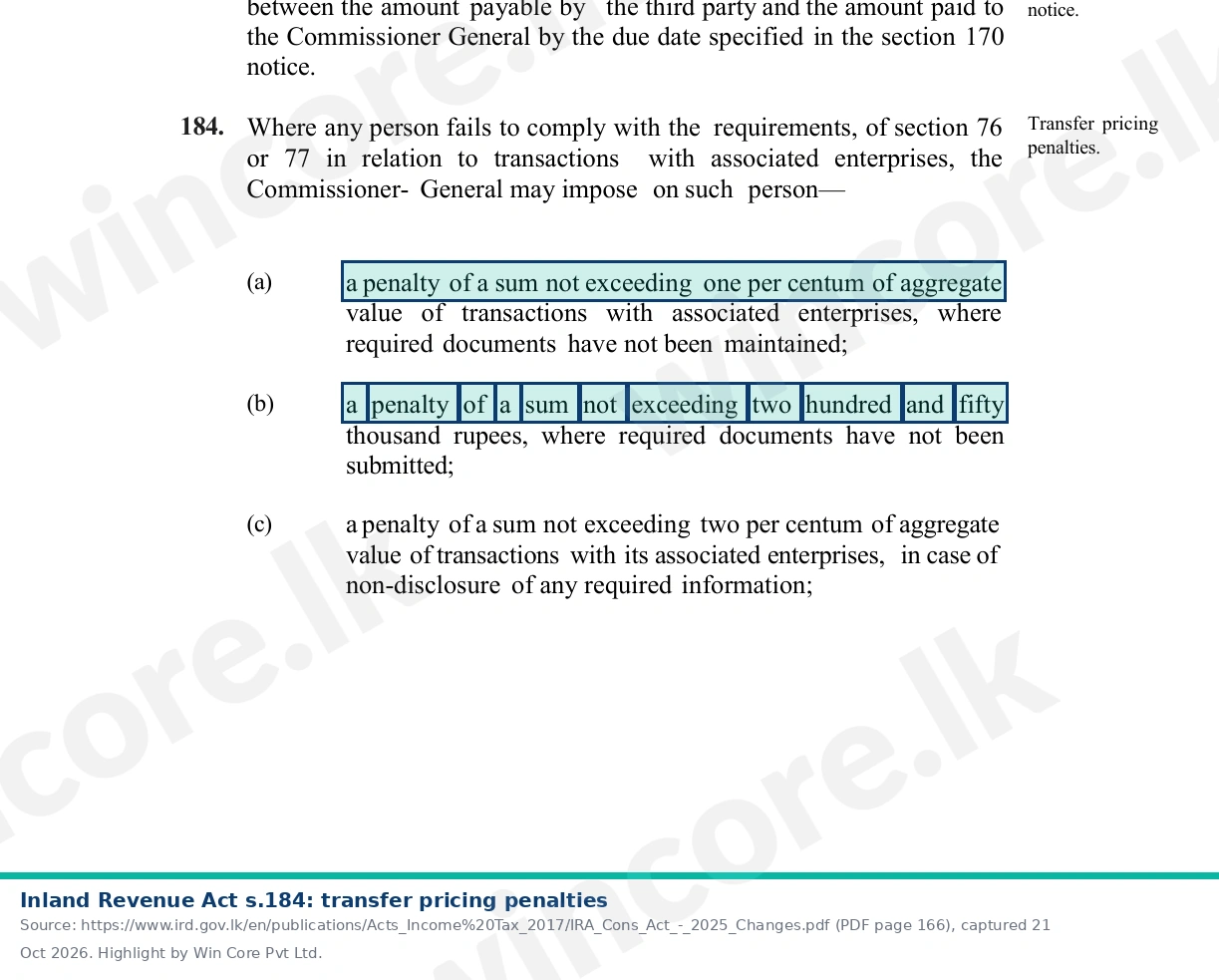
Section 184 applies where a person "fails to comply with the requirements, of section 76 or 77" [2]. The Commissioner-General may impose:
| Default | Section 184 limb | Maximum |
|---|---|---|
| Required documents not maintained | (a) | 1 percent of aggregate value of transactions with associated enterprises |
| Required documents not submitted | (b) | Rs 250,000 |
| Required information not disclosed | (c) | 2 percent of aggregate value of transactions with associated enterprises |
| Documents not submitted on the specified date | (d) | Rs 100,000 |
| Concealed or inaccurate particulars of income, with intent to evade | (e) | 200 percent of the additional tax |
A worked example: shared warehouse, unpaid for eighteen months
Hypothetical. One individual owns all the shares of a tile and sanitaryware retailer and of a lorry hire company. They share a warehouse rented by the retailer at Rs 380,000 a month and an accounts clerk employed by the retailer at a cost of Rs 140,000 a month. They agree that the lorry hire company bears 40 percent of the rent (by floor area) and half of the clerk (by time sheets): Rs 152,000 plus Rs 70,000, so Rs 222,000 a month or Rs 2,664,000 a year (our arithmetic). The retailer also buys Rs 9,600,000 a year of delivery services from the lorry hire company. The lorry hire company has losses brought forward and pays nothing for eighteen months, leaving Rs 3,996,000 owed (our arithmetic).
On our reading:
- The companies are related under SLFRS for SMEs 33.2(b)(vi) and associated under regulation 8(b). The recharges and the delivery purchases are related party transactions, disclosed under 33.9 with the outstanding balance.
- The brought-forward losses bring the dealings within regulation 1(c). Controlled transactions total about Rs 12.3 million a year, far below LKR 200 million, so no local file or disclosure form is needed. The prices must still be arm's length (reg 6(b)).
- If the retailer had charged nothing, the question is whether an arm's length recharge should be imputed to it. If it overcharged, s.77(3) means the IRD would not reduce its income on that ground.
Our income tax services team reviews recharge pricing and the regulation 1 test; the corporate tax calculator shows the effect of an adjustment, and the corporate income tax guide sets out the rates behind regulation 1(b).
An unpaid related party balance needs impairment review, disclosure and real collection steps
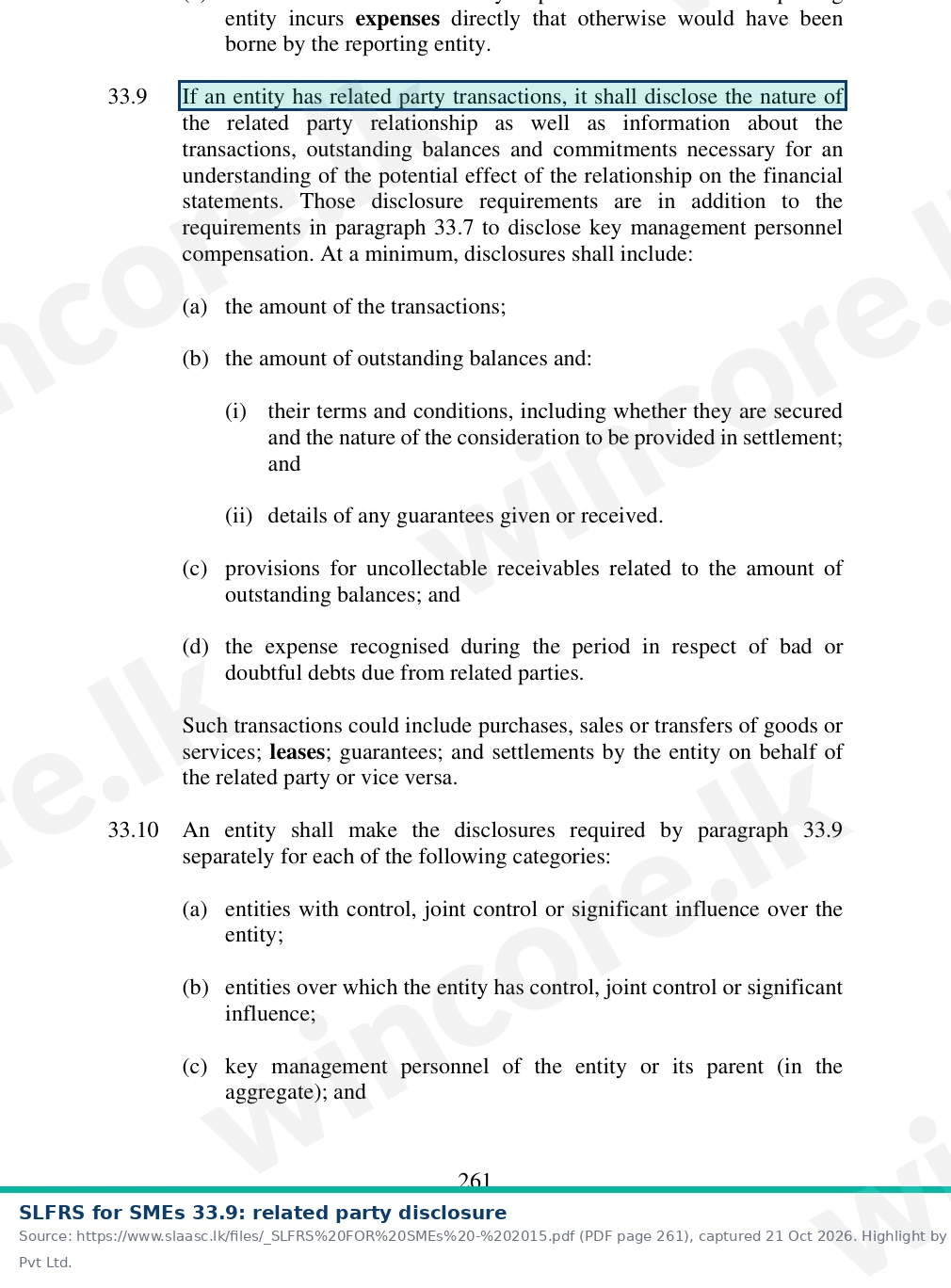
In the accounts. Para 11.21 requires an entity, at the end of each reporting period, to "assess whether there is objective evidence of impairment of any financial assets that are measured at cost or amortised cost" and, if so, to "recognise an impairment loss in profit or loss immediately"; para 11.22 lists evidence including "significant financial difficulty of the issuer or obligor" [1]. Para 33.9 requires, at a minimum, "(c) provisions for uncollectable receivables related to the amount of outstanding balances; and (d) the expense recognised during the period in respect of bad or doubtful debts due from related parties" [1]. Para 33.13 says an entity "shall not state that related party transactions were made on terms equivalent to those that prevail in arm's length transactions unless such terms can be substantiated" [1].
For income tax. Where, "in calculating income on an accrual basis", a person writes off a debt claim as bad, s.24(5) allows the deduction, but s.24(6) says a person "cannot disclaim the entitlement to receive an amount or write off a debt claim as bad unless the person has taken reasonable steps in pursuing payment and the person reasonably believes that the entitlement or debt claim will not be satisfied" [2]. Section 24(1) brings a later recovery back into income. On our reading "reasonable steps" is harder to show against a sister company under the same owner than against an outside customer.
Forgiving the balance is itself a related party transaction under 33.8 and needs disclosing. Its tax effect for each company is an open point below.
Setting up recharges that hold together is practice, not law
- Write a one-page agreement per arrangement: what is shared, the allocation key, any mark-up and payment terms.
- Invoice monthly, post in both companies the same month, and settle on a set day. A balance that only grows is the warning sign.
- Reconcile both sides monthly and keep the allocation evidence; it is what supports an arm's length price under reg 6(b).
Our accounting services team runs intercompany reconciliations, and our virtual CFO service helps owners decide how group costs are shared.
What this means for you
Treat recharges as real transactions: agreed, invoiced, paid and disclosed. Each year, check whether any group company has an exemption, a different rate or losses brought forward, and total all controlled transactions against LKR 200 million to decide the paperwork. Price at arm's length either way, and do not let a sister company's balance sit unpaid for years before trying to write it off.
Checklist: documents needed
- Group chart showing who owns and controls each company
- Written recharge agreement with the allocation key for each arrangement
- Monthly recharge invoices posted in both companies
- Intercompany reconciliation signed off each month
- Allocation evidence: floor plans, time sheets, licence counts
- Yearly total of controlled transactions per company against LKR 200 million
- Note of exemptions, rates and brought-forward losses for each company
- Collection letters and replies for any balance to be impaired or written off
FAQ
Do transfer pricing rules apply to Sri Lankan companies dealing with each other?
Yes, s.77(1) of the Inland Revenue Act applies the arm's length price to transactions with associated enterprises other than international ones. The Transfer Pricing Regulations apply to those domestic dealings where one company has a tax exemption, a different tax rate or brought-forward losses (regulation 1). Whether the IRD applies s.77 outside those three cases is not settled by the text.
We are below LKR 200 million. Are we outside transfer pricing?
No. The LKR 200 million test in regulation 6 decides whether you must keep a local file and file the disclosure form. Regulation 6(b) says the obligation to comply with the arm's length principle "remains mandatory for all taxpayers", who must support their prices with documents or other material when the IRD asks. Keep allocation evidence whatever the size.
Can we recharge at cost with no mark-up?
Often, but it is a judgement, not a rule we can quote. Routine shared costs such as rent or a shared clerk are commonly passed on at cost. A service the provider would sell to outsiders at a profit may need a mark-up to be arm's length. Record the reason for your choice in the recharge agreement and keep the evidence behind the allocation key.
Can we write off a sister company's debt for tax?
Only if s.24(6) of the Inland Revenue Act is met: the company has taken reasonable steps to pursue payment and reasonably believes the debt will not be paid. The deduction is for a person calculating income on an accrual basis. Against a company under the same owner, expect the IRD to test those steps closely, and a later recovery is taxed again under s.24(1).
Open points
- VAT and SSCL on recharges. Whether a recharge is a taxable supply, and counts towards the VAT or SSCL threshold, depends on its nature and each company's registration. We did not review the VAT or SSCL Acts for this piece.
- Section 77 outside regulation 1. The text we read does not settle whether the IRD applies s.77 to domestic transactions outside the three regulation 1 cases.
- Safe harbour. Section 77(5) allows safe harbour rules; we found none published for domestic recharges.
- Debt forgiveness. The tax treatment of forgiving an intercompany balance, for both companies, was not reviewed.
- Later regulations. Our 22 October 2026 search of ird.gov.lk and documents.gov.lk found no regulations replacing No. 02 of 2020; the IRD lists disclosure forms and guides only.
- Standard edition. We read SLFRS for SMEs (2015). A revised IFRS for SMEs has been issued internationally; whether and when CA Sri Lanka adopts it was not checked.
Last verified 22 October 2026 against the Inland Revenue Act ss.24, 76, 77 and 184 (IRD consolidation to 2025), the Regulations on Transfer Pricing No. 02 of 2020 (regulations 1, 6, 8 and 9) and SLFRS for SMEs (2015) paras 11.21, 11.22, 33.2 to 33.4, 33.8, 33.9 and 33.13.
This article is general information, not advice for your specific situation.
Talk to us. If balances between your companies have built up without agreements, contact us at our contact page.
WinCore Pvt Ltd
References
- CA Sri Lanka. Sri Lanka Accounting Standard for Small and Medium-sized Entities (SLFRS for SMEs), 2015, paras 11.21, 11.22, 33.2, 33.3, 33.4, 33.8, 33.9 and 33.13. https://www.slaasc.lk/files/_SLFRS%20FOR%20SMEs%20-%202015.pdf . Primary. Accessed 22 October 2026.
- Inland Revenue Department. Inland Revenue Act, No. 24 of 2017, consolidated with amendments to 2025, ss.24, 76, 77 and 184. https://www.ird.gov.lk/en/publications/Acts_Income%20Tax_2017/IRA_Cons_Act_-_2025_Changes.pdf . Primary (IRD consolidation). Accessed 22 October 2026.
- Minister of Finance. Regulations on Transfer Pricing No. 02 of 2020, Gazette Extraordinary No. 2217/7 of 2 March 2021, regulations 1, 6, 8 and 9. https://www.ird.gov.lk/en/publications/Gazette_Documents/TP_2021_%202217-07_E.pdf . Primary. Accessed 22 October 2026.
Put these insights to work
WinCore specialists can review your current workflow, document gaps, and build a practical 90-day action plan.
Book a free consultationContinue reading
Explore more WinCore analysis to keep your finance, tax, and compliance roadmap moving.

Sri Lanka corporate income tax guide: rates, taxable income, quarterly instalments, deductions, capital allowances, and key compliance penalties.
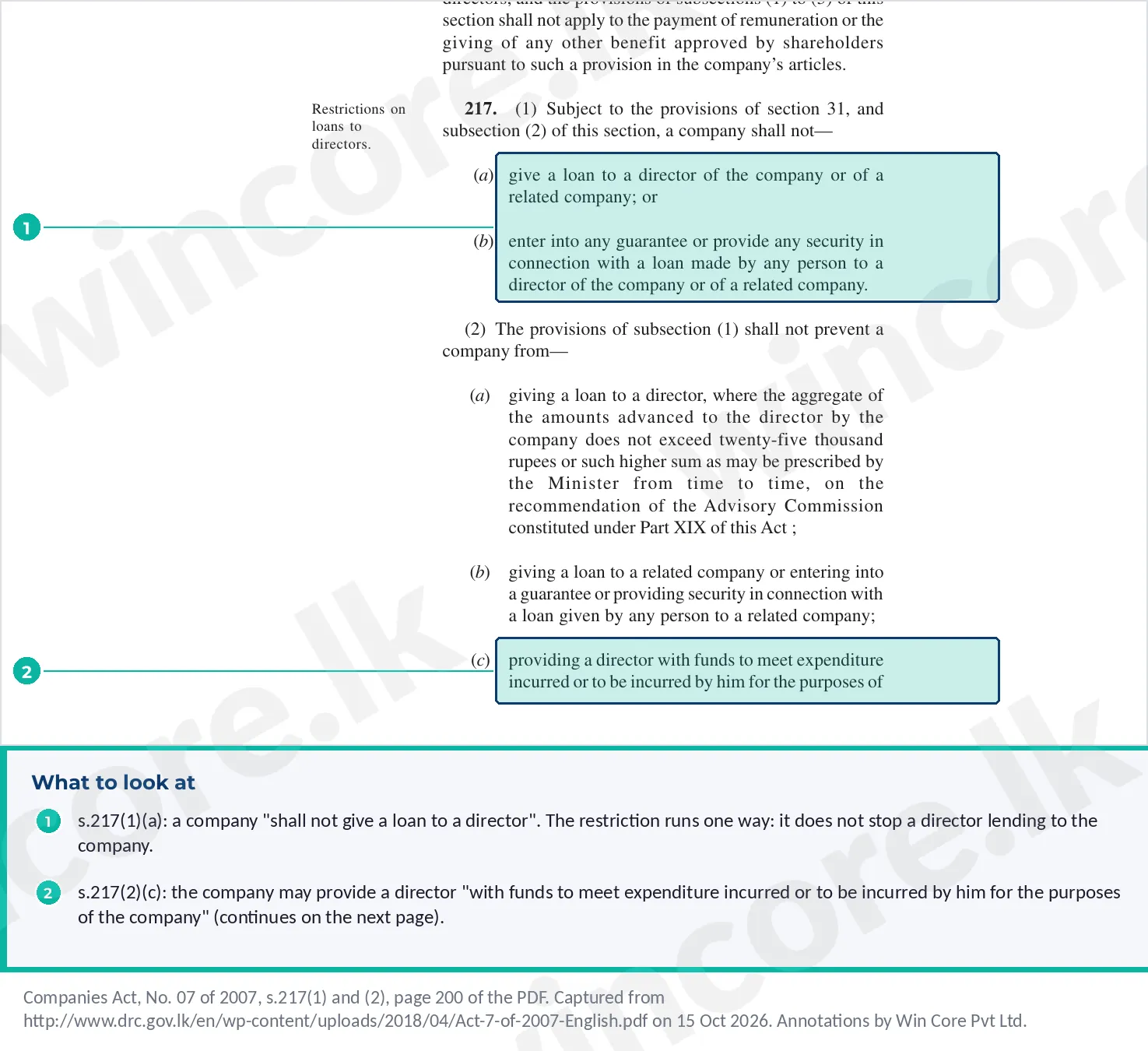
When a director pays a company bill, the company owes the director. How to book it, which Companies Act sections apply and when repayment is taxable.
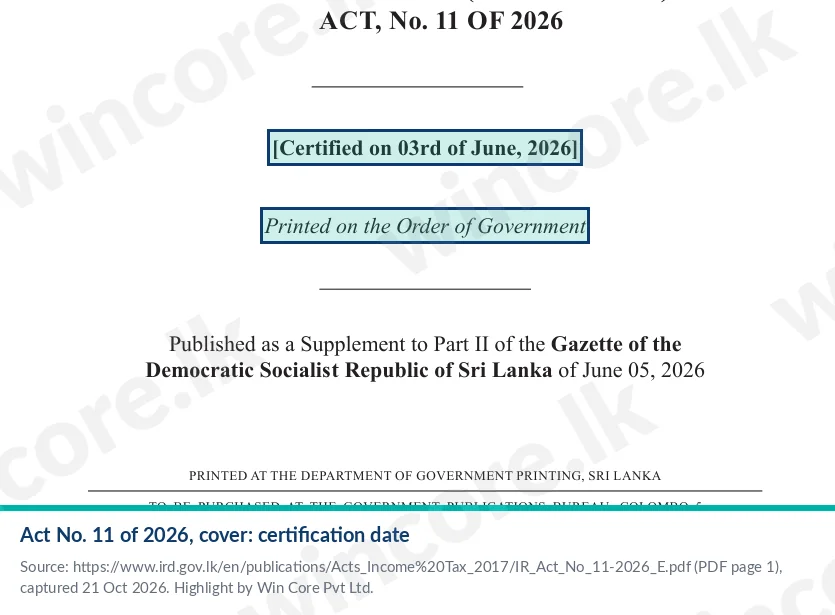
Acts, Gazettes, IRD consolidations and circulars do not carry the same weight. How to tell which text is the law, and which dates to check first.