
Bank account register Sri Lanka: build it from the statements
The accounts nobody mentions are the ones that go unreconciled. Seven sources to test a company's list of bank accounts, and what to record for each.
On this page
Last verified against the primary sources on 22 October 2026.
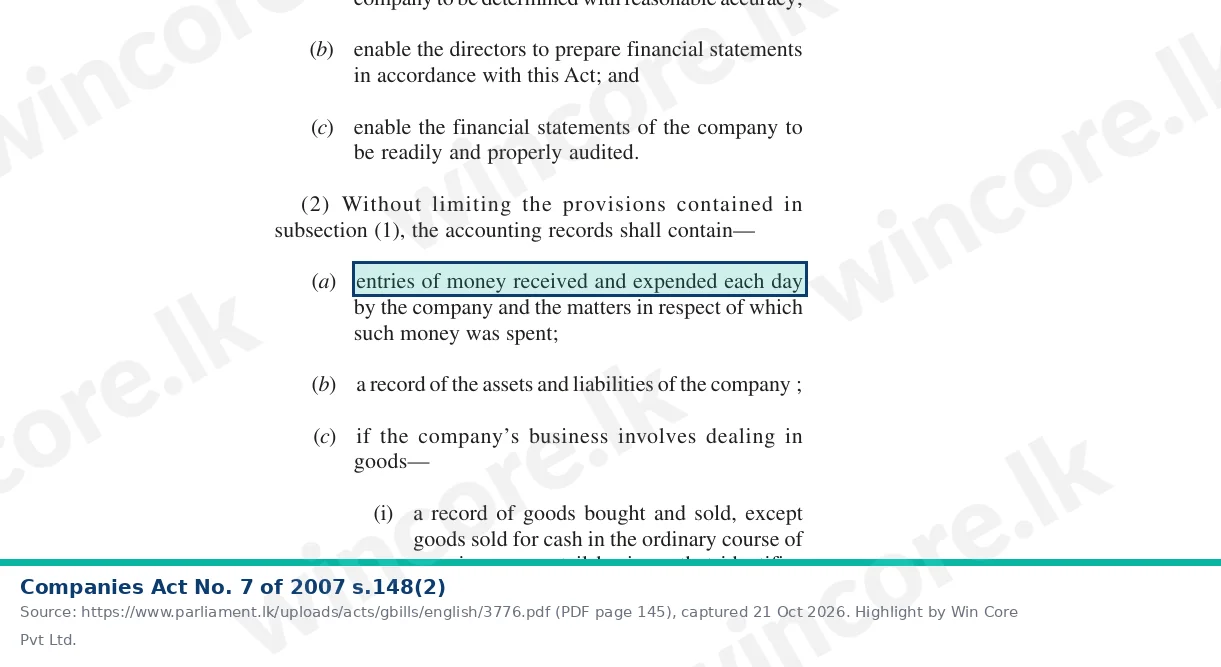
A bank account register in Sri Lanka should be built from the bank statements and other documents, not from what the owner remembers. Section 148(2) of the Companies Act, No. 7 of 2007 requires every company's accounting records to contain entries of money received and spent each day and a record of its assets and liabilities, so an account left off the list leaves both incomplete. The duty is continuous. SLFRS for SMEs 2015 paragraph 7.2 then decides how a found overdraft or deposit is shown.
When an accountant takes on a set of books, one of the first questions is which bank accounts the company has. The answer usually comes from memory: the main current account, perhaps a savings account, maybe a foreign currency account. It is often incomplete. A fixed deposit held as security, an old account with a small balance and monthly charges, a company card, a payment gateway settlement account, an account opened for one project: these are easily forgotten, and an account that is not on the list is not reconciled, not in the accounts and not in front of the auditor.
The procedure below is practice. The duties behind it are quoted from the Companies Act and the Inland Revenue Act, and the treatment of overdrafts and deposits from the accounting standard.
A bank account register in Sri Lanka starts from the duty to keep complete records
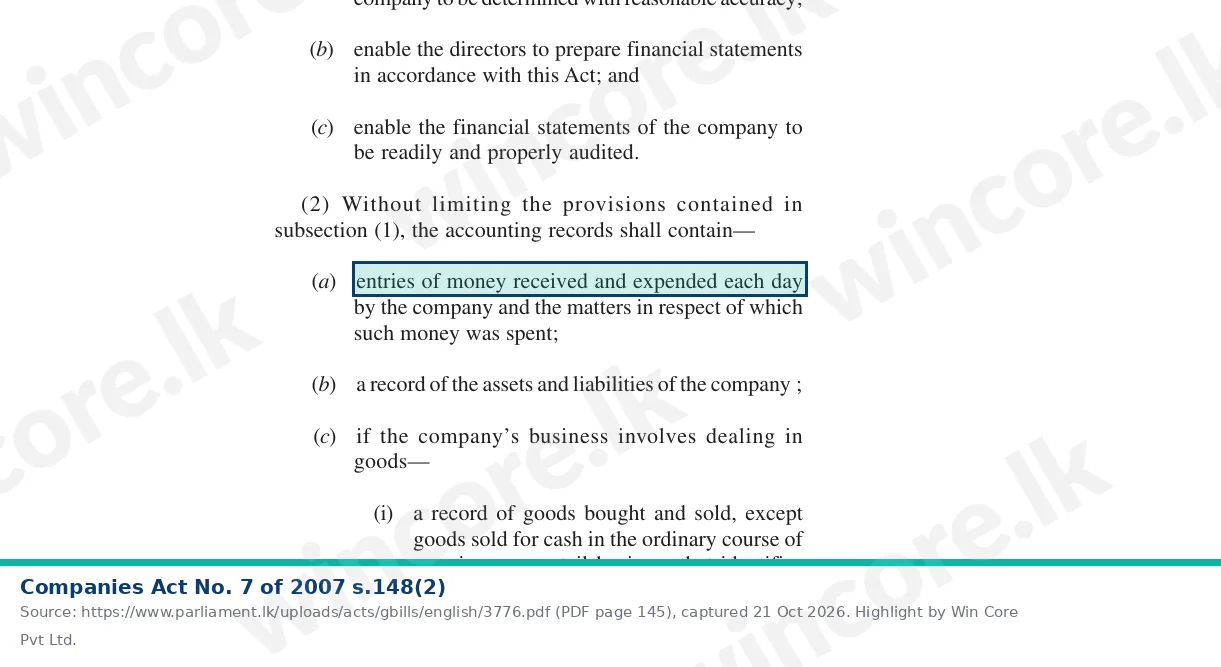
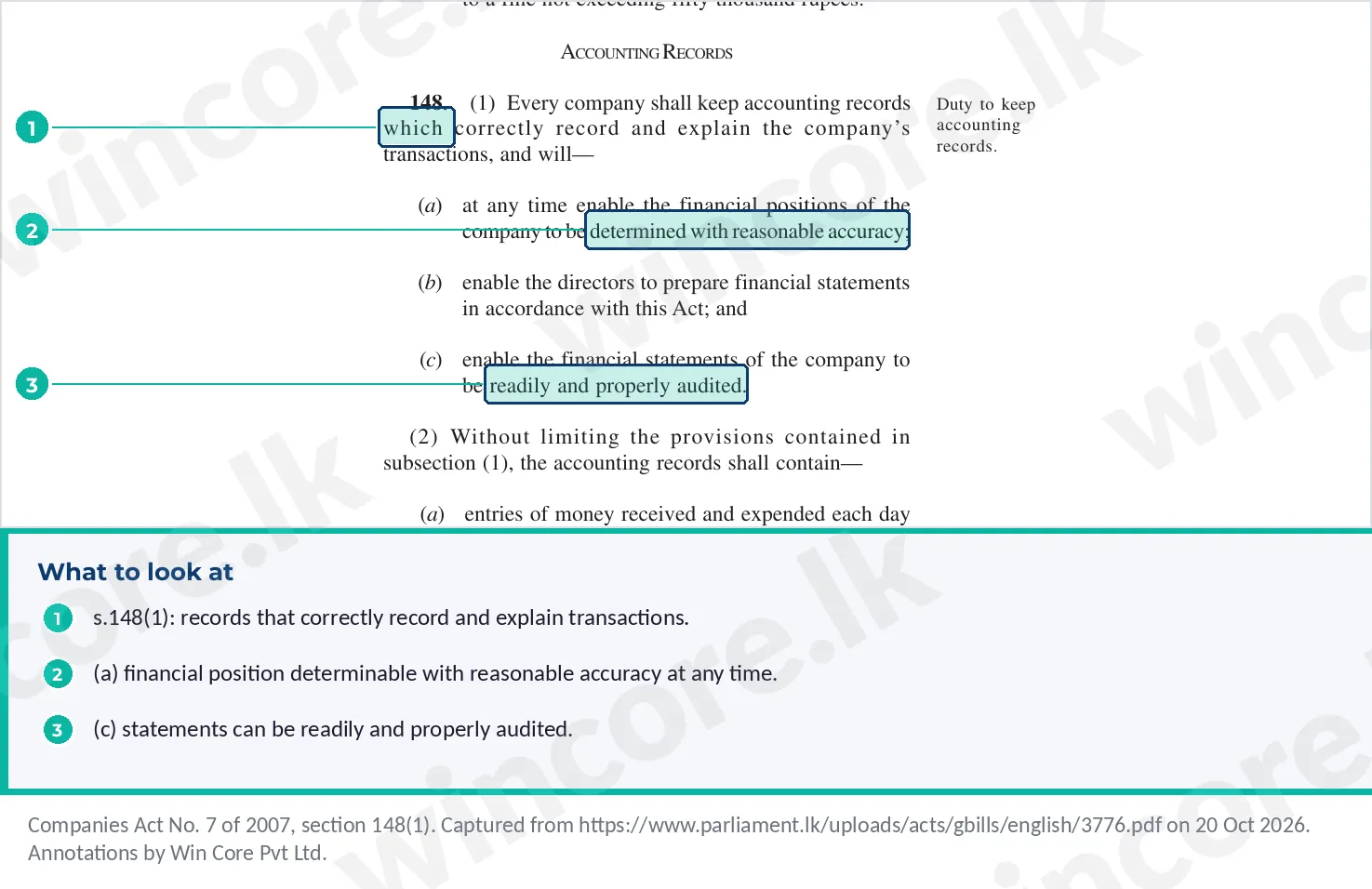
Section 148(1) requires every company to keep accounting records which "correctly record and explain the company's transactions" and will "at any time enable the financial positions of the company to be determined with reasonable accuracy" [1]. Section 148(2) adds that, "Without limiting the provisions contained in subsection (1), the accounting records shall contain (a) entries of money received and expended each day by the company and the matters in respect of which such money was spent; (b) a record of the assets and liabilities of the company" [1].
On our reading, an account that is not in the books means the money moving through it is not recorded "each day", and its balance, whether an asset or an overdraft, is missing from the "record of the assets and liabilities". The legal duty is about the records being complete, not about what anyone remembers. Where a company fails to comply with section 148, section 148(3) makes the company liable on conviction to a fine not exceeding Rs 200,000, and every officer in default to the same maximum [1].
The Inland Revenue Act points the same way. Section 120(1) requires a taxpayer in business to keep records "sufficient to record all transactions", and section 120(10) lists "bank statements" among the source documents that must be retained [2]. Statements for an account nobody listed are source documents nobody kept. Our guide to bookkeeping basics covers the retention period.
The account type decides where a found balance sits
SLFRS for SMEs 2015 paragraph 7.2 says that "Bank overdrafts are normally considered financing activities similar to borrowings. However, if they are repayable on demand and form an integral part of an entity's cash management, bank overdrafts are a component of cash and cash equivalents." The same paragraph says an investment "normally qualifies as a cash equivalent only when it has a short maturity of, say, three months or less from the date of acquisition" [3].
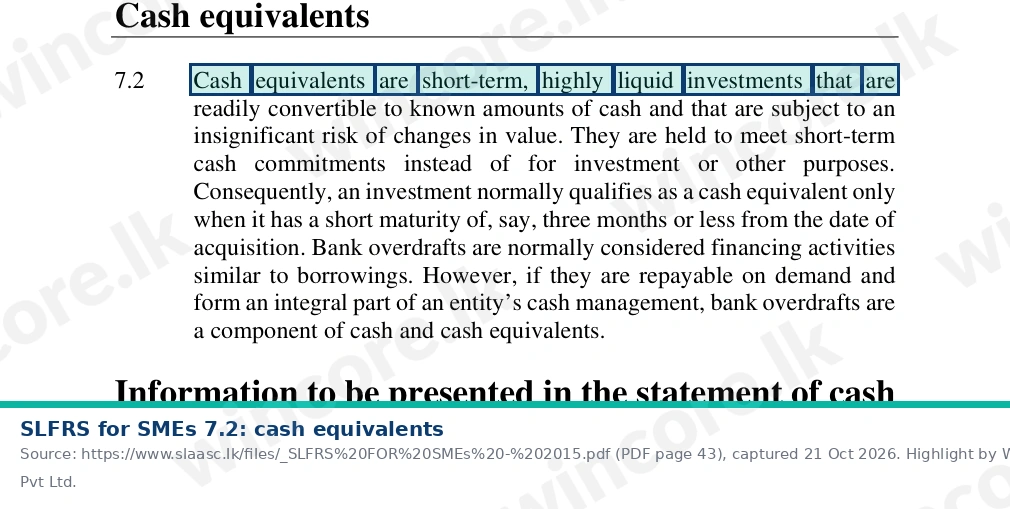
Paragraph 7.21 then requires an entity to disclose, "together with a commentary by management, the amount of significant cash and cash equivalent balances held by the entity that are not available for use by the entity", giving foreign exchange controls and legal restrictions as examples [3]. On our reading, a deposit held under lien as security is a candidate for that disclosure; whether it applies is a judgement for the preparer and the auditor.
So the register should record not only that an account exists, but what kind it is: current account, overdraft, fixed deposit with its term, loan or card. That decides where it sits in the statement of financial position and the statement of cash flows, for companies reporting under SLFRS for SMEs.
Memory misses accounts, so build the list from seven sources
This section is practice. These are the accounts most often left off a list given from memory:
- Security deposits. A fixed deposit placed as security for a facility or guarantee is often thought of as "the bank's", not the company's.
- Dormant accounts. An old account with a small balance still carries charges, and may still receive occasional payments.
- Cards and wallets. Company credit cards, prepaid cards and payment gateway settlement accounts are not thought of as bank accounts.
- Foreign currency accounts. Opened for one contract and then forgotten. Our guide to the business foreign currency account covers the rules for those.
- Change of people. The person who opened the account has left.
None of this suggests bad faith. It is the normal limit of memory, which is why the list is tested against documents.
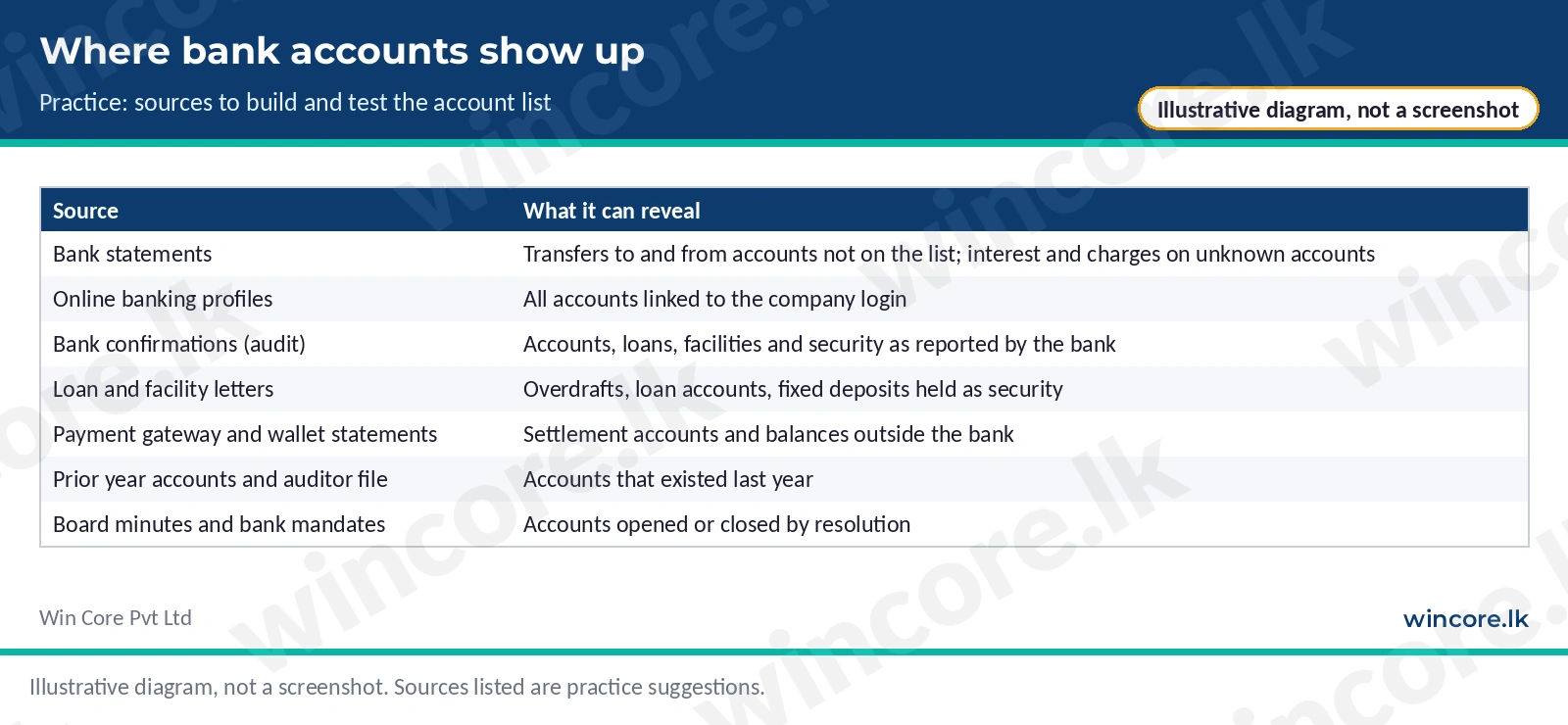
1. Start from what you are told, and mark it unverified. Write down every account the company names, with bank, branch, account number, currency and type. It is a starting list, not a final one.
2. Read the statements for transfers. Go through every known account for the full period. Look for transfers to and from account numbers not on the list, standing orders into deposits, interest credits, charges that refer to other accounts and loan instalments. Each unknown account in the company's name is a lead.
3. Check the online banking profile. The company's internet banking login usually shows every account linked to the customer profile. Keep a dated export or screenshot of the account list.
4. Check facility and loan documents. Facility letters list overdrafts, loans and security, including fixed deposits held under lien.
5. Check prior records. The last audited accounts, the auditor's bank confirmations and the previous accountant's working papers show accounts that existed last year. Any that are not on this year's list need an explanation: closed, with a closing statement, or still open.
6. Check minutes and mandates. Board resolutions and bank mandates record accounts opened and closed.
7. Confirm at year end. The auditor's bank confirmation gives the bank's own view of every account and facility. If the list was built well, it holds no surprises. Our year-end close guide places this in the closing timetable, and our audit support work prepares the confirmation requests.
A worked example: two accounts named, four found
Hypothetical. An engineering contractor tells its new accountant it has two rupee current accounts, one at each of two banks. Reading the first current account's statements, the accountant finds a monthly transfer of Rs 25,000 to an unknown account number at the same bank, and an annual interest credit that refers to a deposit. The online banking export for that bank shows three accounts, not one. A facility letter confirms a Rs 2,000,000 fixed deposit held under lien as security for a performance guarantee.
The unknown account is a dormant savings account that receives the Rs 25,000 transfer as a reserve for equipment replacement. Over twelve months the books expensed Rs 300,000 of transfers as "sundry" (our arithmetic: Rs 25,000 x 12), when the money was still in a company account. The fixed deposit was missing from assets entirely. Both are corrected: the transfers become movements between company accounts, the deposit is recorded as an asset with the lien disclosed, and, on our reading, because its term is twelve months it is not a cash equivalent under paragraph 7.2. The register now holds four accounts, each with a source.
The register needs a source for every account and a monthly review
This section is practice. A bank account register kept with the month-end file records, for each account:
- bank, branch, account number and the name on the account;
- currency and type (current, overdraft, deposit with maturity, loan, card, gateway);
- purpose and date opened;
- signatories and mandate;
- whether it is held as security, and for which facility;
- the document that confirms it exists;
- status: open, dormant, or closed with the date and closing statement;
- the ledger account it maps to, one ledger account per bank account.
At handover. A change of bookkeeper is when accounts are most often lost. The outgoing accountant knows which accounts they reconciled; the incoming one knows only what they are told. The handover pack should hold the register with its sources, the last reconciliation for each account, closing statements of accounts closed in the year and a list of open reconciling items. The incoming accountant repeats sources 2 to 5 for the first period rather than relying on the register alone. Our guide to outsourcing accounting covers the rest of a handover.
Keeping it current. Review the register at every month end alongside the reconciliations. Require a board resolution and a register line for every new account. Close what is not used and file the closing statement. A reviewer who agrees each listed balance to a statement should also ask whether the list is complete.
The same evidence-first approach runs through our companion pieces on rebuilding accounts from bank statements and on proving that a document is really missing, both publishing alongside this one.
What this means for you
Treat the list of bank accounts you are given as a starting point and test it against statements, online banking, facility letters, prior records and minutes. Record each account's type, because overdrafts and deposits are treated differently in the accounts. The Companies Act requires records of money received and spent each day and of assets and liabilities; an account left off the list leaves both incomplete. If an investor will read your accounts, an investor due diligence packet asks for statements for every account. Our bookkeeping services and accounting services build and keep the register as part of the monthly close.
Checklist: documents needed
- Statements for every known account for the full period
- Dated online banking account list for each bank
- Facility letters and loan agreements
- Fixed deposit certificates and lien letters
- Card and payment gateway statements
- Last audited accounts and the auditor's bank confirmations
- Board resolutions and bank mandates
- Closing statements for accounts closed in the period
Frequently asked questions
Why not take the owner's word for which bank accounts exist?
Because memory is incomplete, not because anyone is dishonest. Deposits held as security, dormant accounts, cards and gateway accounts are routinely forgotten, and an account nobody lists is never reconciled. Statements, online banking lists, facility letters and the auditor's bank confirmations are better evidence, so the owner's list becomes the starting point that those documents test.
Is a fixed deposit held as security still the company's asset?
Generally yes, if it is in the company's name: on our reading it is recorded as the company's asset with the security disclosed. Whether it is a cash equivalent depends on its maturity under SLFRS for SMEs paragraph 7.2, and a deposit not available for use may need the paragraph 7.21 disclosure. The auditor will form a view on both.
Is a bank overdraft cash or a loan?
Normally a loan. SLFRS for SMEs paragraph 7.2 treats bank overdrafts as financing activities similar to borrowings, but counts them as part of cash and cash equivalents if they are repayable on demand and form an integral part of the entity's cash management. Record which applies in the register, because it changes the statement of cash flows.
What about accounts in a director's name used for company business?
On our reading they are not company accounts, but company money moving through them still has to be recorded. Note each one in the register as outside the company, list the company transactions that passed through it, and settle the balance through the director's current account. The legal and tax position of such accounts is outside this piece.
How often should the bank account register be checked?
In practice, at every month end alongside the bank reconciliations, and in full at year end against the auditor's bank confirmations. A new account should not open without a board resolution and a register line. This is our practice, not a statutory frequency; the law sets the duty to keep complete records, not a review timetable.
Open points we have not closed
- Accounts in directors' names. Legal ownership and tax consequences of company money held in personal accounts were not reviewed.
- Central account searches. Whether a company can obtain a list of all its accounts across banks from one central source was not checked.
- Standard edition and framework. We read SLFRS for SMEs 2015 and did not check whether a later revision has been adopted, or which companies must use full SLFRS instead.
Last verified 22 October 2026: Companies Act ss.148(1) to (3), Inland Revenue Act s.120(1) and (10), SLFRS for SMEs 2015 paragraphs 7.2 and 7.21.
This article is general information, not advice for your specific situation.
Talk to us. If you are taking over a company's books and want the bank account list proved before the first close, contact us at our contact page.
WinCore Pvt Ltd
References
- Parliament of Sri Lanka. Companies Act, No. 7 of 2007, s.148. https://www.parliament.lk/uploads/acts/gbills/english/3776.pdf . Primary. Accessed 22 October 2026.
- Inland Revenue Department. Inland Revenue Act, No. 24 of 2017, consolidated with amendments to 2025, s.120. https://www.ird.gov.lk/en/publications/Acts_Income%20Tax_2017/IRA_Cons_Act_-_2025_Changes.pdf . Primary (consolidation). Accessed 22 October 2026.
- CA Sri Lanka (issuer). Sri Lanka Accounting Standard for Small and Medium-sized Entities (SLFRS for SMEs), 2015, paras 7.2 and 7.21. Copy hosted at https://www.slaasc.lk/files/_SLFRS%20FOR%20SMEs%20-%202015.pdf . Primary. Accessed 22 October 2026.
Put these insights to work
WinCore specialists can review your current workflow, document gaps, and build a practical 90-day action plan.
Book a free consultationContinue reading
Explore more WinCore analysis to keep your finance, tax, and compliance roadmap moving.

Bookkeeping guide for Sri Lankan small businesses: legal requirements, chart of accounts, source documents, 5-year retention rule, and monthly routines.
Close your books before the March 31 deadline to reduce audit risk and start with clean numbers. A practical 10-step year-end guide for SMEs.
The law sets the books, the six month accounts and the audit. The investor sets the rest. How to keep the two apart and tie one to the other.