
Backlog accounts in Sri Lanka: why the prior year is filed first
Years of missing company accounts? Close them in order from the last signed year. What the Companies Act and the IRA require, and what each delay costs.
On this page
Last verified against the primary sources on 22 October 2026.
Backlog accounts in Sri Lanka have to be closed in order, oldest open year first, because every balance sheet opens on the one before it. The law adds three dates to that arithmetic. Under the Companies Act No. 7 of 2007, s.150(1), the board must complete and sign financial statements within six months after the balance sheet date, or within an extended period the Registrar determines. Under the Inland Revenue Act No. 24 of 2017, s.93(1), the income tax return is due "not later than eight months after the end of each year of assessment", which is 30 November; the return for Y/A 2025/2026 is due on 30 November 2026. The IRD's 2025/2026 guide lists audited financial statements as a required attachment to a company's return. A late return costs at least Rs 50,000 plus Rs 10,000 a month, capped at Rs 400,000 a return (s.178).
This piece works through why the order is fixed, which penalty attaches to which default, and how to run a catch-up. The reasoning on order is ours and is labelled; the dates and penalties are from the Acts, read on 22 October 2026.
Backlog accounts in Sri Lanka start from the last signed balance sheet
The Companies Act puts the duty on the board, not on the accountant.
Records. Section 148(1) requires accounting records which "correctly record and explain the company's transactions" and will "(a) at any time enable the financial positions of the company to be determined with reasonable accuracy; (b) enable the directors to prepare financial statements in accordance with this Act; and (c) enable the financial statements of the company to be readily and properly audited". Section 148(2) says they must contain daily entries of money received and spent, "a record of the assets and liabilities of the company", and records of goods or services and invoices [1].
Statements. Section 151(1) requires a true and fair view of "(a) the state of affairs of the company as at the balance sheet date; and (b) the profit or loss or income and expenditure ... for the accounting period ending on that balance sheet date". Section 151(2) adds compliance with any regulations on form and content and "any requirements which apply to the company's financial statements under any other law" [1].
Why the order is fixed (our reading, not a quoted rule). The state of affairs at a balance sheet date is the previous closing position plus the year's movements. Retained earnings at the end of a year are the opening figure plus the year's profit, less dividends. The same holds for fixed assets and depreciation, loans, tax payable and amounts owed to directors. If the opening figure is unknown, the closing figure is too, so a current-year balance sheet cannot give the view s.151(1)(a) requires until every earlier year is closed. Where a company reports under SLFRS for SMEs, paragraph 3.14 also requires "comparative information in respect of the previous comparable period for all amounts presented in the current period's financial statements" [2], so the prior year has to exist in a form that can be shown beside the current one.
Owners often ask whether the current year can be done first. You can draft its profit and loss on its own. You cannot sign its balance sheet until you know where the year started.
If the cleanup changes account codes, map the old chart to the new one before rebuilding comparatives.
Each year has its own six-month deadline under section 150
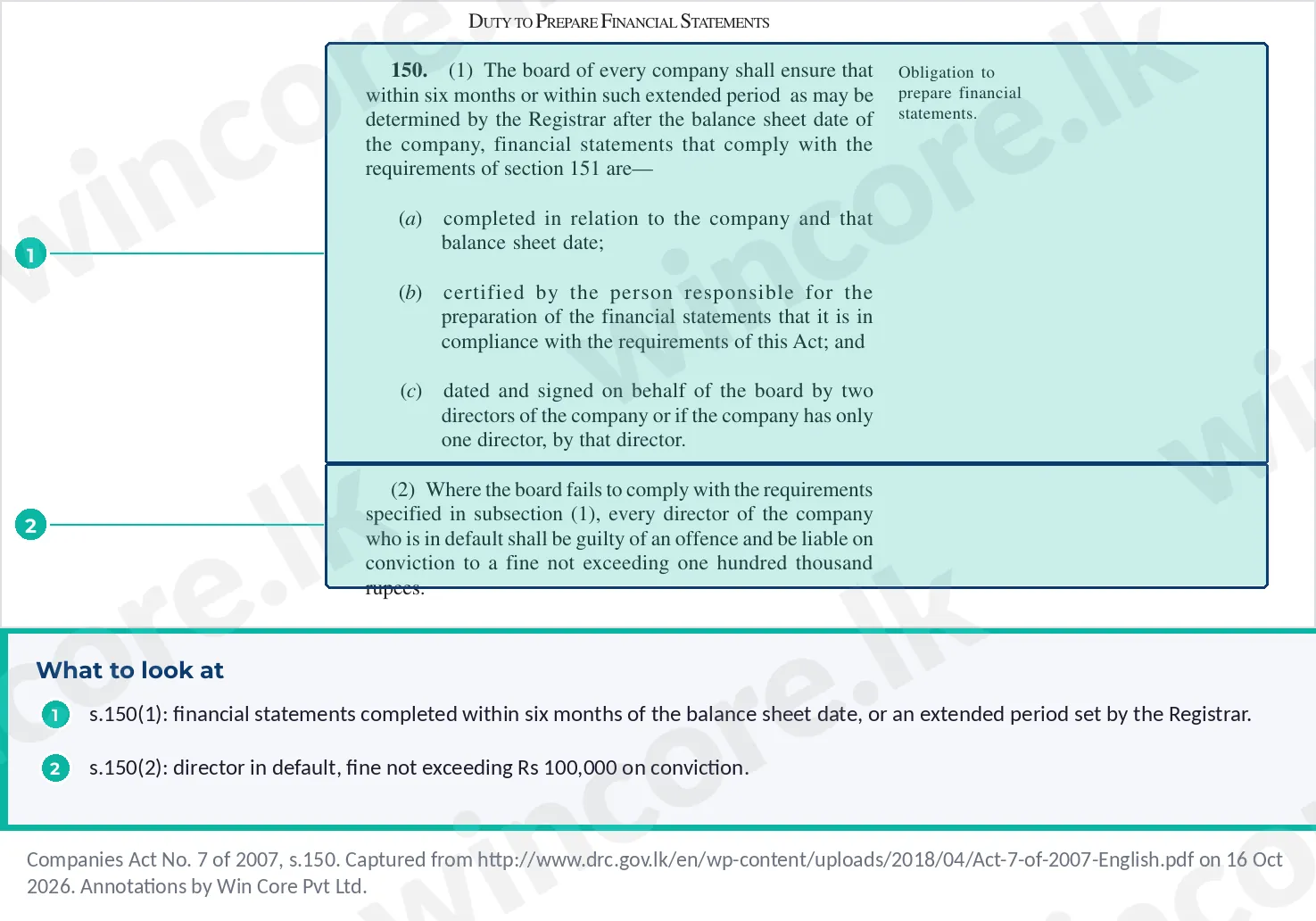
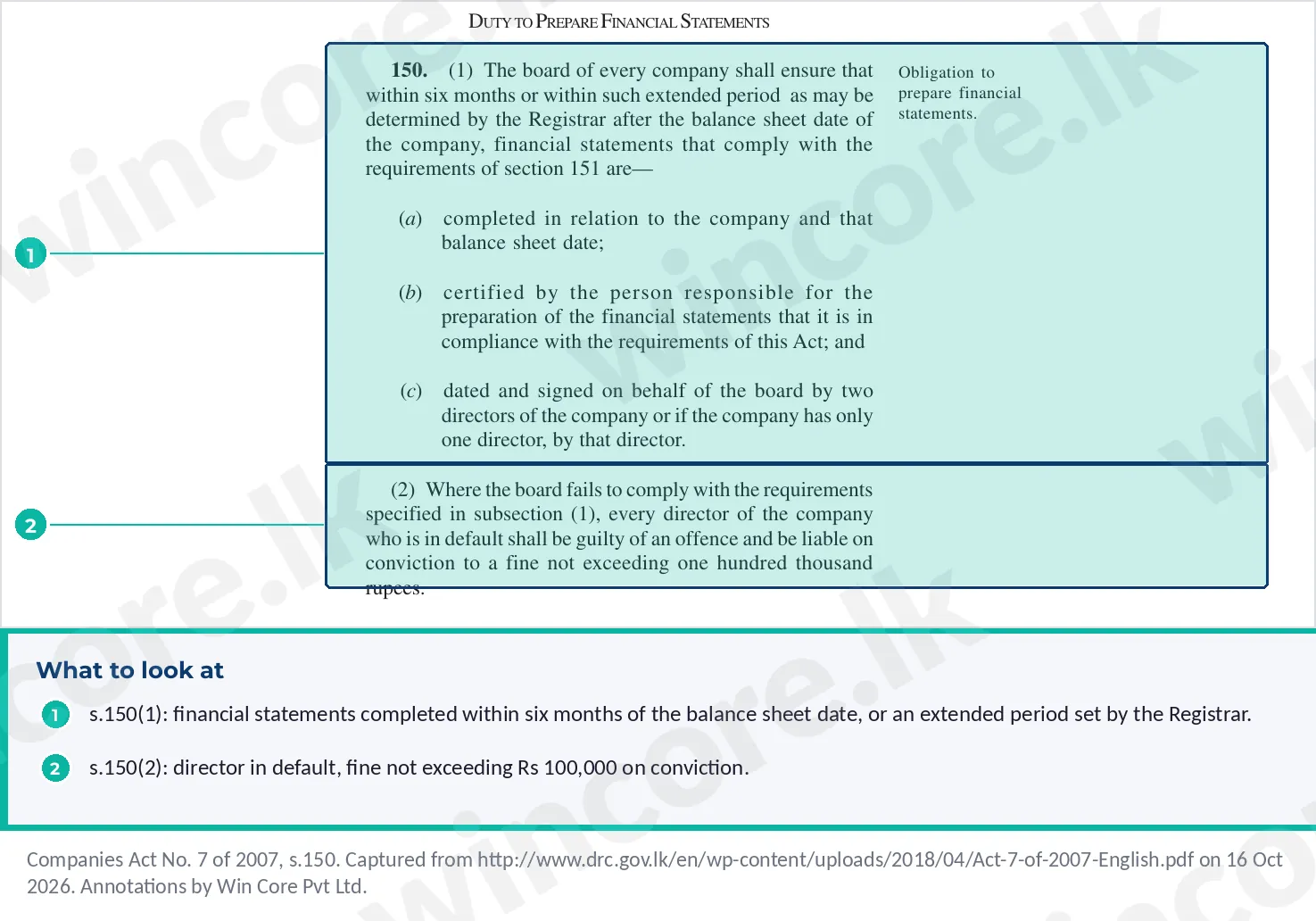
Section 150(1): "The board of every company shall ensure that within six months or within such extended period as may be determined by the Registrar after the balance sheet date of the company, financial statements that comply with the requirements of section 151 are (a) completed in relation to the company and that balance sheet date; (b) certified by the person responsible for the preparation of the financial statements that it is in compliance with the requirements of this Act; and (c) dated and signed on behalf of the board by two directors of the company or if the company has only one director, by that director" [1].
Two dates sit inside that subsection. The statutory date is six months after the balance sheet date: 30 September for a 31 March year end. The second exists only if the Registrar determines "such extended period" for the company. Nothing in s.150 makes an extension automatic, so if you are relying on one, you should be able to point to the Registrar's determination.
The same six-month clock drives two other duties. The annual general meeting must be held "not later than six months after the balance sheet date" and not later than fifteen months after the previous one (s.133(1)), the annual report is due within six months (s.166(1)), and the annual return on Form 15 is due within thirty working days of the AGM (s.131(2)) [1]. Late accounts usually mean a late AGM and a late return to the Registrar as well; our guide to Form 15 annual return filing covers that side, and our company secretarial solutions team handles it. For the order to file overdue returns in, see how to catch up on a late annual return.
Take a hypothetical family aluminium fabrication company with a 31 March year end whose last signed accounts are at 31 March 2022. Nothing has been prepared for the years to 31 March 2023, 2024, 2025 or 2026.
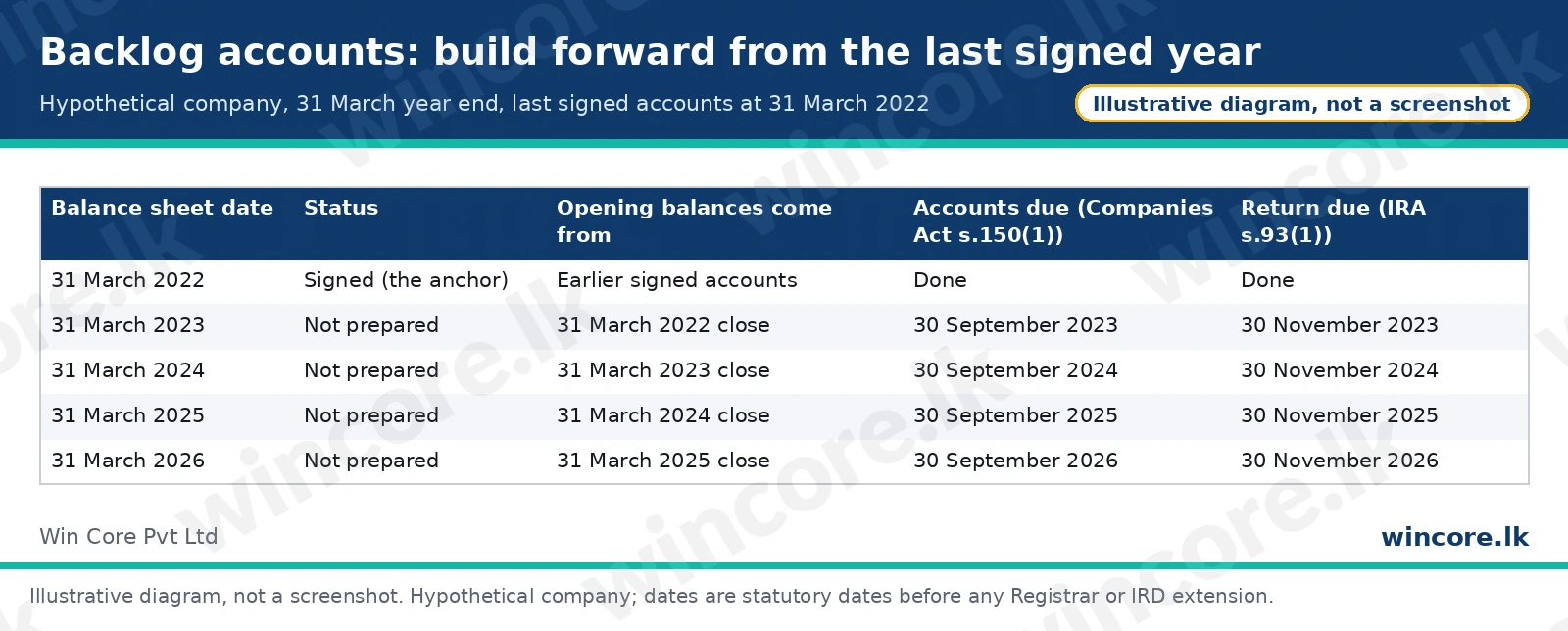
Every year except the last is already past both dates, and the year to 31 March 2026 passed its s.150 date on 30 September 2026. Its return is due on 30 November 2026.
Can the missing years be merged? No. Section 171(1) says "a company shall have a balance sheet date in each calendar year", subject to the first-year rule and to a change of date. A change needs the Registrar to approve it "before it is made", and "the period between any two balance sheet dates shall not exceed fifteen months" (s.171(3) to (5)) [1]. Neither route turns three missed years into one set.
The tax return needs the accounts, so a late set usually means a late return
The date. Section 93(1): "every person shall file with the Commissioner-General not later than eight months after the end of each year of assessment a return of income for the year" [3]. The year of assessment ends on 31 March, so the return is due on 30 November. We read the subsection in the 2017 Act and checked the amending Acts No. 10 of 2021, No. 45 of 2022, No. 4 of 2023, No. 14 of 2023, No. 2 of 2025 and No. 11 of 2026: none changes s.93(1). (The IRD's consolidated text drops the subsection from its text layer, which is why it is easy to miss.) Section 126 is the general provision on tax returns, requiring them "within the stipulated time" [4]. The IRD's guide to the corporate return for Y/A 2025/2026 cites s.93(1) and gives 30 November 2026 [5].
The attachments. The same guide lists "Audited financial statements" first among the required attachments and says a return submitted without them, or "with estimated figures of income", "will be deemed not to have furnished a return of Income for the purpose of the IRA" [5]. That is the IRD's stated position in its guide. In practice it means each year's return waits for that year's accounts, and each year's accounts wait for the year before.
The records. Section 120(1) requires records "sufficient to record all transactions and to ascertain the gains and profits made or the loss incurred", and s.120(6) requires them to be kept "for a period of five years from the date on which the transaction took place", or longer while an assessment time limit or related proceedings run [4]. Our sibling piece on rebuilding accounts from bank statements covers what to do when the records are thin.
Each default carries its own penalty, and none is automatic forgiveness
| Default | Section | What the section says |
|---|---|---|
| Accounting records not kept | Companies Act s.148(3) | Company and every officer in default: fine up to Rs 200,000 each, on conviction |
| Financial statements not completed and signed in time | Companies Act s.150(2) | Every director in default: fine up to Rs 100,000, on conviction |
| AGM not held | Companies Act s.133(6) | Company up to Rs 100,000; every officer in default up to Rs 50,000, on conviction |
| Annual report not prepared | Companies Act s.166(2) | Every director in default: up to Rs 100,000, on conviction |
| Annual return not delivered | Companies Act s.131(4) | Company up to Rs 100,000; every officer in default up to Rs 50,000, on conviction |
| Income tax return late | IRA s.178(1), (2) | Greater of 5 percent of tax owing plus 1 percent a month, or Rs 50,000 plus Rs 10,000 a month; capped at Rs 400,000 a return |
| Return not filed after a 30-day notice | IRA s.185A (Act No. 11 of 2026) | Without reasonable cause: fine up to Rs 400,000, up to six months, or both, on conviction |
The Companies Act fines need a conviction; they are not fees. The s.178 penalty is a tax penalty per return, and s.176(10) makes a part month count in full [4].
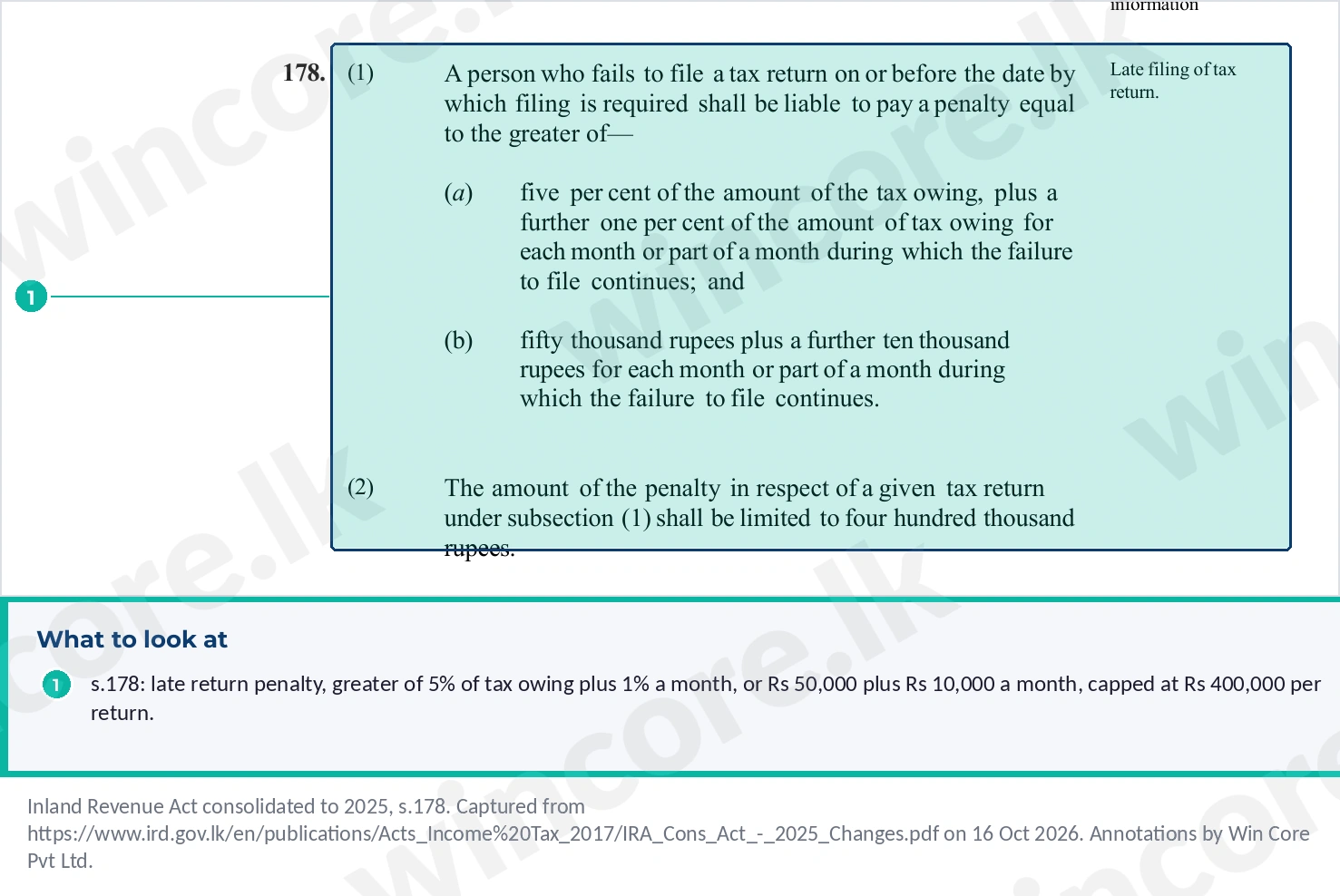
Worked figures (hypothetical, our arithmetic). Assume our fabrication company has no tax owing in any year, so limb (b) of s.178(1) applies. Its Y/A 2022/2023 return was due on 30 November 2023. Filed on 15 January 2027, it is late for 38 months or part months, so Rs 50,000 plus Rs 380,000 is Rs 430,000, cut to the Rs 400,000 cap; the cap is reached after 35 months. Its Y/A 2025/2026 return, if filed by 30 November 2026, carries no s.178 penalty at all. That is the practical case for closing the old years quickly: the newest return can still be on time.
Relief. Section 176(9): "If a person liable for a penalty shows reasonable cause, the Commissioner-General may (a) refrain in whole or in part from assessing the penalty; or (b) remit or waive in whole or in part a penalty that has been assessed" [4]. That is discretion and needs reasonable cause. Separately, s.42 of the Inland Revenue (Amendment) Act No. 11 of 2026 writes off interest under s.157 for years of assessment up to the one ending 31 March 2025, but only if the full tax and any applicable penalties are paid within six months of the Act's operation [6]; our summary of Act No. 11 of 2026 gives the end date, 2 December 2026, and the conditions.
A catch-up runs from the anchor forward, one year end at a time
The useful unit in a backlog is the year end, not the pile of paper, because each year end can be tested: does the closing bank balance in the books agree to the bank statement on that date, and do debtors, creditors and loans at that date stand up to documents? This is practice, not a legal requirement.
- Fix the anchor. Find the last signed balance sheet. Agree its cash, loans and share capital to source documents.
- Close the oldest open year. Rebuild it from bank statements, invoices and contracts, decide cut-off at that balance sheet date, and have it audited where required.
- Roll forward without changing the close. Carry closing figures into the next year as they stand. An error found later in an earlier year is a prior period error: SLFRS for SMEs 10.21 corrects a material one retrospectively by restating comparatives or the opening balances of the earliest period presented [2].
- Sign in order. Directors sign each set under s.150(1)(c), oldest first, and the AGM and annual return follow.
- File the returns in order from the matching audited accounts, and diarise the current year's 30 November date.
Cut-off is where years leak into each other. A bill for March work received in April belongs to the earlier year; if that year has no accounts, there is nowhere to post the correction, and the later year carries a cost that is not its own. Our sibling piece on accrued expenses and cut-off traps shows how to test it.
What this means for you
If your company has more than one year without accounts, start with the oldest and close each year end before the next. Check whether the Registrar has extended your s.150 period before assuming you have one. Expect each tax return to follow its audited accounts: the IRD treats a return without them as not furnished, and the s.178 penalty runs monthly to Rs 400,000 a return. If the newest year can still be filed by 30 November, plan the backlog so that it is. Keep records for at least five years from each transaction (s.120(6)).
Our accounting services and bookkeeping services rebuild and close backlog years in order, and our tax return filing services file the returns behind them. The annual filing checklist lists the Registrar and IRD filings for each year, and the penalty calculator estimates late-filing exposure. For the current return itself, see our income tax return filing guide.
Checklist: documents needed
- The last signed financial statements and the closing trial balance (the anchor)
- Bank statements for every account, every month, for every missing year
- Sales and purchase invoices, contracts and loan agreements for each year
- Payroll records, EPF and ETF returns and tax payment receipts
- Fixed asset invoices and any disposal documents
- Any Registrar determination extending the s.150 period
- Minutes of past AGMs and copies of annual returns filed
FAQ
Can we file this year's accounts and catch up the old years later?
Not in a form you can sign with confidence. You can draft this year's profit and loss, but the balance sheet opens on last year's closing figures, and section 151 asks for a true and fair view of the state of affairs at the balance sheet date. On our reading, unsupported opening balances do not meet that, and the set would need redoing.
Is the six-month deadline for company accounts fixed?
The statutory period is six months after the balance sheet date, so 30 September for a 31 March year end. Section 150(1) lets the Registrar determine an extended period, but that is a decision for the particular company, not an automatic grace period. If you rely on an extension, keep the Registrar's determination on file with the accounts.
What is the penalty for filing a company tax return late?
Under section 178 of the Inland Revenue Act, the greater of 5 percent of the tax owing plus 1 percent a month, or Rs 50,000 plus Rs 10,000 a month, with part months counting in full. The cap is Rs 400,000 a return. If the IRD later serves a notice and you still do not file within 30 days, section 185A makes it an offence.
Does a company with no income in a missing year still need accounts and a return?
Yes, on our reading. The Companies Act requires financial statements for every balance sheet date and a balance sheet date in each calendar year, whatever the trading. A company that must file a return under section 93 and files late still faces the Rs 50,000 plus Rs 10,000 a month limb, because that limb does not depend on tax owing.
Can several missed years be combined into one set of accounts?
No. Section 171 requires a balance sheet date in each calendar year, apart from the first-year rule. A change of balance sheet date needs the Registrar's approval before it is made, and the period between any two balance sheet dates cannot exceed fifteen months. A backlog is therefore closed year by year, each with its own statements.
Open points
- Which accounting standard applies to a given company under s.151(2)(b) (SLFRS for SMEs or full SLFRS), and so whether paragraph 3.14 or its full-standard equivalent governs comparatives: not covered here.
- Audit requirement. The IRD guide expects audited statements; whether and how an audit exemption applies to a particular company was not reviewed.
- IRD extensions of the 30 November date for earlier years were not checked year by year.
- Amendments to the Companies Act by Act No. 12 of 2025 were not re-read today for ss.131, 133, 148, 150, 151, 166 and 171; the validated reading of that Act on this site lists no change to them.
Last verified 22 October 2026 against the sources listed in References.
This article is general information, not advice on your specific position.
Talk to us. If your company has years of accounts to catch up, contact us at our contact page.
WinCore Pvt Ltd
References
- Parliament of Sri Lanka. Companies Act, No. 7 of 2007, ss.131, 133, 148, 150, 151, 166 and 171. http://www.drc.gov.lk/en/wp-content/uploads/2018/04/Act-7-of-2007-English.pdf . Primary. Accessed 22 October 2026.
- Institute of Chartered Accountants of Sri Lanka. Sri Lanka Accounting Standard for Small and Medium-sized Entities (SLFRS for SMEs), 2015, paras 3.14, 10.19 and 10.21. https://www.slaasc.lk/files/_SLFRS%20FOR%20SMEs%20-%202015.pdf . Primary. Accessed 22 October 2026.
- Parliament of Sri Lanka. Inland Revenue Act, No. 24 of 2017, s.93(1). https://www.ird.gov.lk/en/publications/Acts_Income%20Tax_2017/IR_Act_No_24_2017_E.pdf . Primary. Accessed 22 October 2026. Amending Acts checked for s.93: Nos. 10 of 2021, 45 of 2022, 4 of 2023, 14 of 2023, 2 of 2025 and 11 of 2026, https://www.ird.gov.lk/en/publications/sitepages/acts.aspx .
- Inland Revenue Department. Inland Revenue Act, No. 24 of 2017, consolidated with amendments to 2025, ss.120, 126, 176 and 178. https://www.ird.gov.lk/en/publications/Acts_Income%20Tax_2017/IRA_Cons_Act_-_2025_Changes.pdf . Primary (consolidation). Accessed 22 October 2026.
- Inland Revenue Department. Guide to Corporate Return of Income Tax, Year of Assessment 2025/2026 (Asmt_CIT_003), sections 1, 3 and 6.1. https://www.ird.gov.lk/en/Downloads/IT_Corporate_Doc/Asmt_CIT_003_2025_2026_E.pdf . Primary (administrative guide). Accessed 22 October 2026.
- Parliament of Sri Lanka. Inland Revenue (Amendment) Act, No. 11 of 2026, ss.1(2), 31 (new s.185A) and 42. https://www.ird.gov.lk/en/publications/Acts_Income%20Tax_2017/IR_Act_No_11-2026_E.pdf . Primary. Accessed 22 October 2026.
Put these insights to work
WinCore specialists can review your current workflow, document gaps, and build a practical 90-day action plan.
Book a free consultationContinue reading
Explore more WinCore analysis to keep your finance, tax, and compliance roadmap moving.

Step-by-step guide to filing income tax returns in Sri Lanka: deadlines, RAMIS process, relief, bands, WHT credits, and common penalty traps.
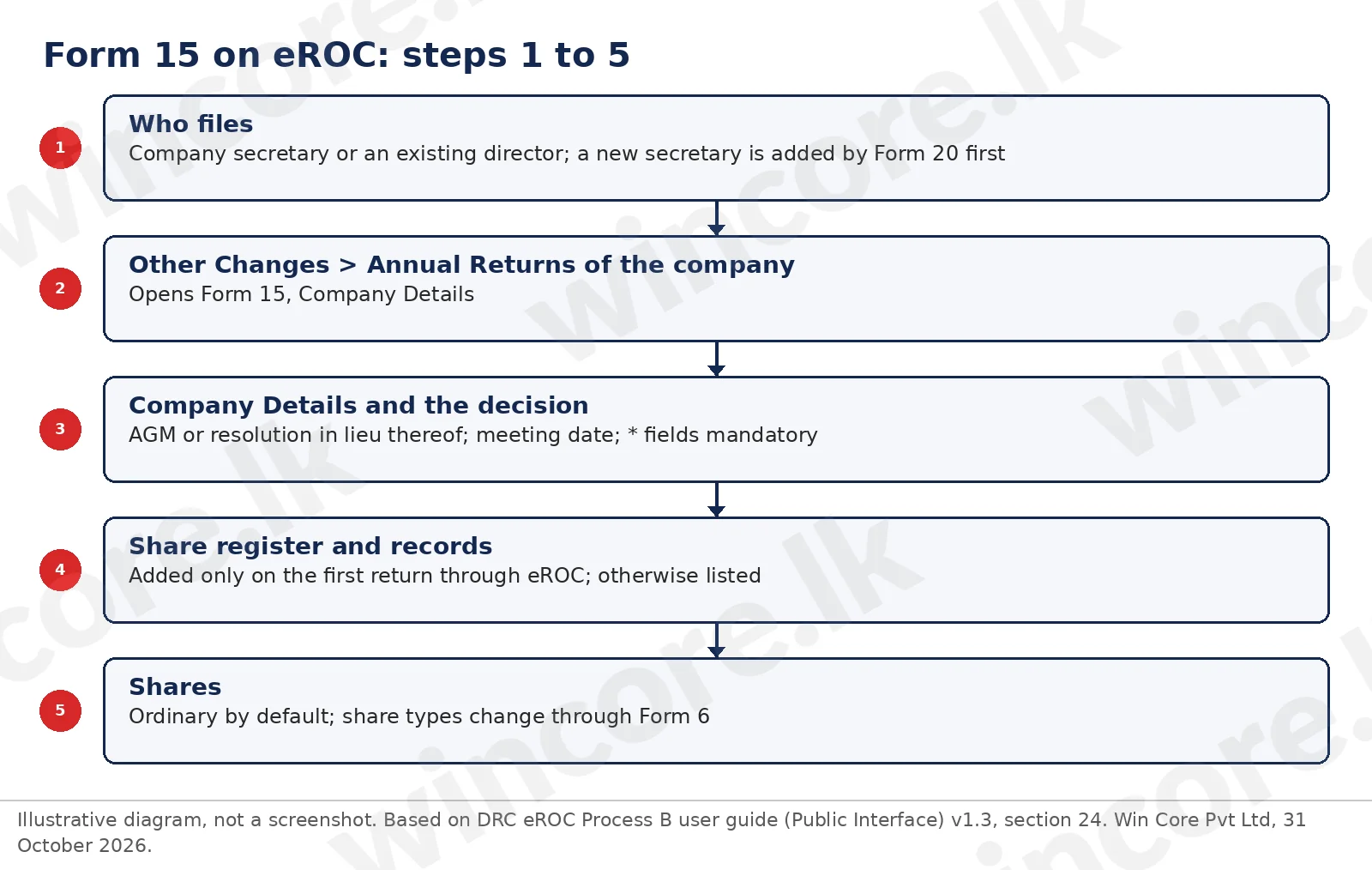
Treat Form 15 as a live governance filing: the 30-working-day clock from the AGM, the BO 4 that goes with it, the fee, and the controls that keep it on time.

Close your books before the March 31 deadline to reduce audit risk and start with clean numbers. A practical 10-step year-end guide for SMEs.