
Changing your chart of accounts in Sri Lanka, keeping comparatives
Restructure your ledger once, at the right time, so this year still compares with last year and the auditor can follow every reclassification.
On this page
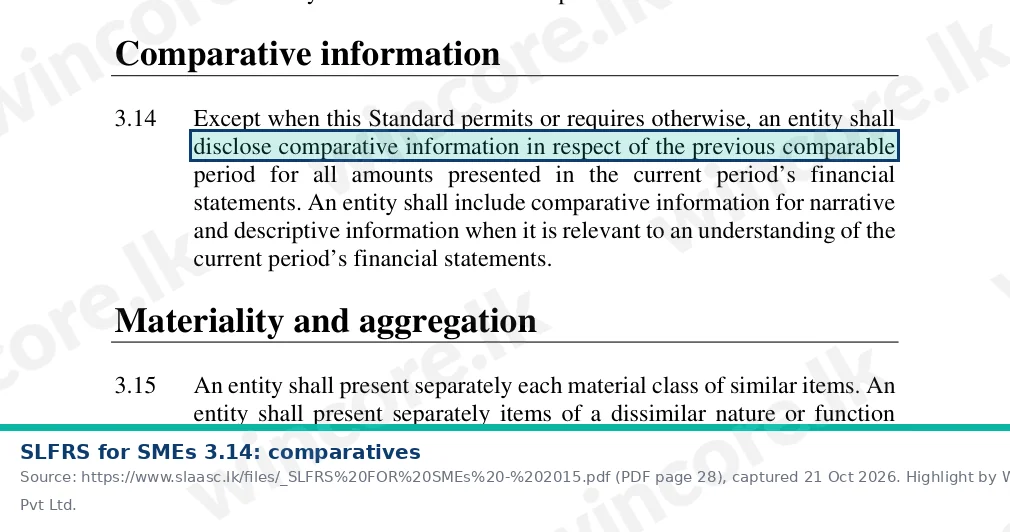
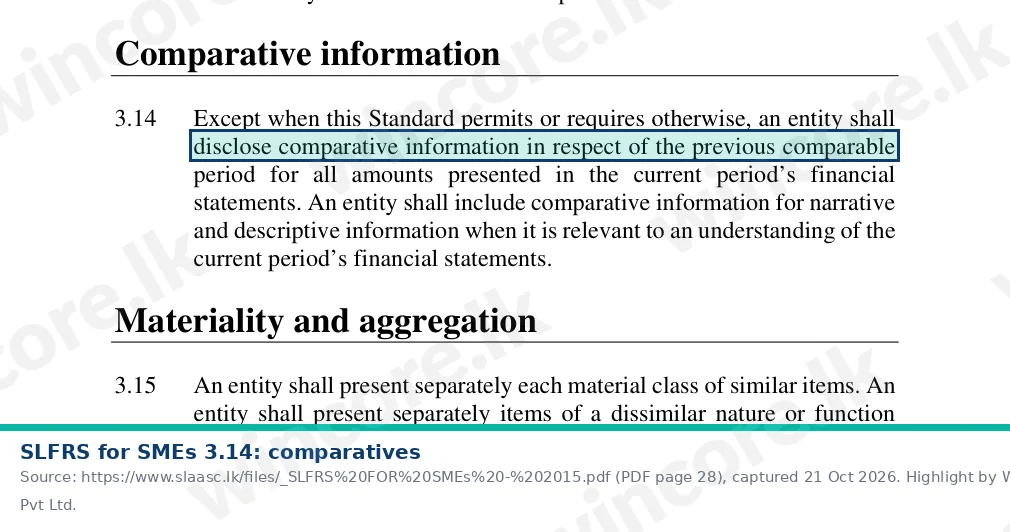
Changing your chart of accounts in Sri Lanka is your decision, but the financial statements built from it are not. Under the Sri Lanka Accounting Standard for Small and Medium-sized Entities (SLFRS for SMEs, 2015), paragraph 3.14 requires comparative figures for the previous period, paragraph 3.11 requires presentation and classification to be kept from one period to the next unless one of two conditions applies, and paragraph 3.12 requires last year's figures to be reclassified, with disclosure, when the presentation changes. A chart that is redesigned once, at a year boundary, with a written mapping, makes those rules easy to meet.
Most small companies inherit a chart from the software's default and add accounts whenever something new comes up. After a few years there are several accounts for "office expenses", one called "misc 2", and no way to tell whether costs rose or were posted somewhere else. This article explains when and how to restructure. The method is practice; the reasons come from the standard and the Inland Revenue Act, which we quote. For the basic account code structure, see our guide to bookkeeping basics.
The standard governs the statements, and the chart decides how hard that is
SLFRS for SMEs paragraph 3.14 says: "Except when this Standard permits or requires otherwise, an entity shall disclose comparative information in respect of the previous comparable period for all amounts presented in the current period's financial statements" [1].
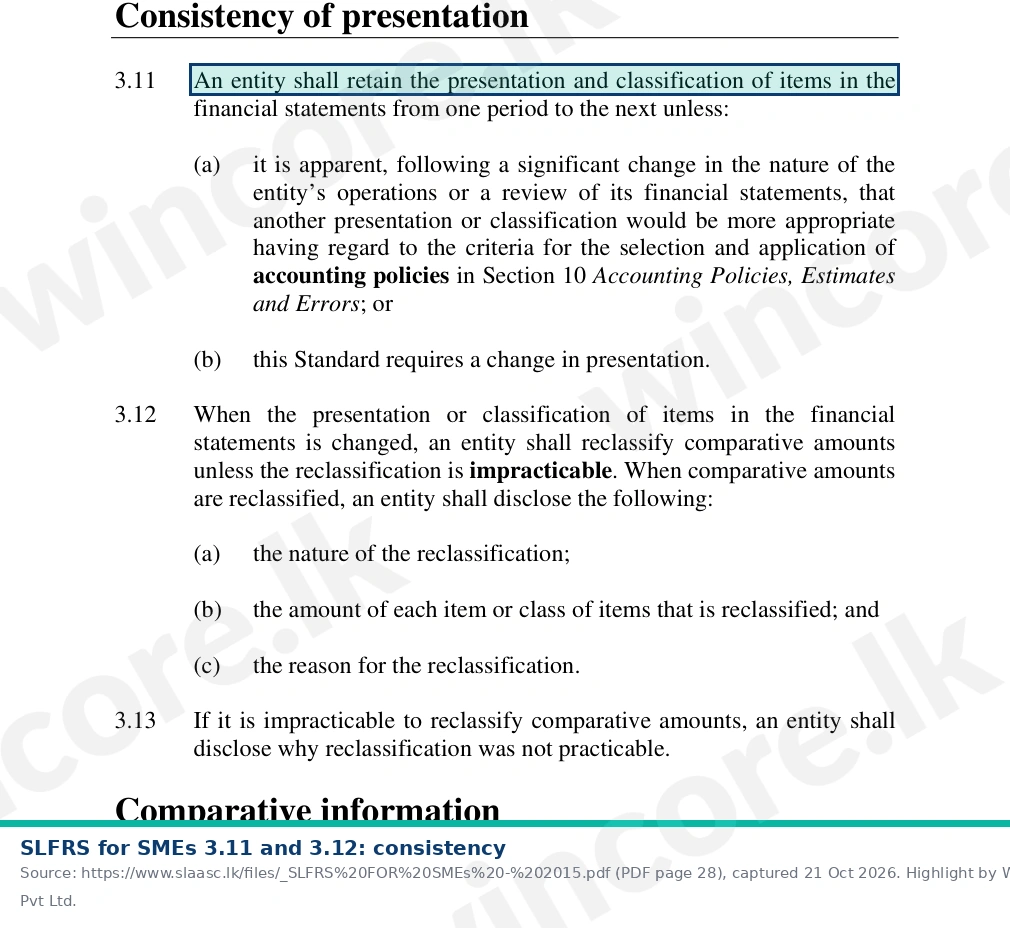
Paragraph 3.11 says: "An entity shall retain the presentation and classification of items in the financial statements from one period to the next unless: (a) it is apparent, following a significant change in the nature of the entity's operations or a review of its financial statements, that another presentation or classification would be more appropriate having regard to the criteria for the selection and application of accounting policies in Section 10 Accounting Policies, Estimates and Errors; or (b) this Standard requires a change in presentation" [1].
When you do change, paragraph 3.12 says "an entity shall reclassify comparative amounts unless the reclassification is impracticable", and requires disclosure of "(a) the nature of the reclassification; (b) the amount of each item or class of items that is reclassified; and (c) the reason for the reclassification." Paragraph 3.13 says that if reclassification is impracticable, "an entity shall disclose why reclassification was not practicable" [1].
Two more paragraphs matter. Paragraph 3.15 says "An entity shall present separately each material class of similar items" and items of a dissimilar nature or function "unless they are immaterial", and paragraph 5.11 requires an analysis of expenses "based on either the nature of expenses or the function of expenses within the entity" [1]. Paragraph 10.7 requires accounting policies to be applied "consistently for similar transactions, other events and conditions" [1].
On our reading, none of these paragraphs governs your internal chart directly; they govern the financial statements. But a chart that changes every year makes 3.11 and 3.12 expensive to comply with, because every change has to be traced back through last year's figures.
The tax law already asks for some separations
Section 120(1A) of the Inland Revenue Act, No. 24 of 2017, with effect from the year of assessment beginning 1 April 2021, says that where income tax is calculated "by applying different tax rates" to parts of taxable income from business or investment, or there are exempt amounts, the person "shall maintain and prepare the financial statements to separately identify such part of taxable income from gains and profits in applying each income tax rate to each part of the taxable income or to identify the exempted gains and profits" [2].
The proviso allows common expenses or assets that "cannot be separately identified" to be divided "on a proportionate basis (according to the proportion of turnover or proportion of asset usage)" [2]. On our reading, the chart is where that separation starts: income taxed at different rates or exempt needs its own accounts from the first day of the year, and the apportionment basis for shared costs should be written down.
Build the chart from the statements and returns, not the software
This section is practice.
- Work backwards. List the lines in your financial statements, your management pack, and your VAT and income tax returns. Each account should roll up to exactly one line in each. If an account would need splitting to fill a return, split it now.
- Name accounts by nature. "Premises: rent" and "Premises: electricity", not "Rent and stuff" or a supplier's name. Supplier and customer detail belongs in the payables and receivables ledgers.
- Keep control accounts separate. VAT output, VAT input, APIT payable, EPF payable, ETF payable and withholding tax each in their own account, each tied to a return or schedule every month.
- Separate what is treated differently. Income streams taxed at different rates or exempt, each director's current account, each related company, and foreign currency bank accounts apart from rupee accounts. Our article on functional currency and which CBSL rate covers the currency side.
- Keep "other" and "suspense" small. Split "other expenses" when it starts to hold items of different nature. Clear suspense to zero at every month-end, as part of a month-end close checklist.
- Use tracking fields for analysis. Departments, projects, branches and locations belong in the software's tracking categories or cost centres, not in new accounts. Our article on cloud accounting in Sri Lanka covers what the common packages offer.
Map every account to its statement line and its tax treatment
This section is practice. Keep three columns beside the chart, outside the software if necessary: the financial statement line, the management pack line, and the tax treatment. The tax column records whether the account is normally allowable, disallowable, or needs review each year, for example entertainment, fines, donations, or depreciation replaced by capital allowances.
That one table does several jobs. It speeds up the yearly reconciliation from accounting profit to taxable income, because the adjusting accounts are already flagged; our corporate tax calculator takes the result from there. It lets a new bookkeeper post correctly without guessing. It shows at a glance when an account has been added with no home in the statements. And when the business changes, it is the first document you update, before touching the software.
Review the mapping once a year, alongside the budget. Archive accounts unused for a year, split any that have grown to hold dissimilar items at the next year boundary, and add an account when a new income stream or tax rule needs one.
Changing the chart of accounts at a year boundary keeps comparatives clean
This section is practice, with the standard's requirements where they apply.
- Change at the start of a year. A mid-year change splits one account's history across two.
- Lock prior periods in the software before you change anything.
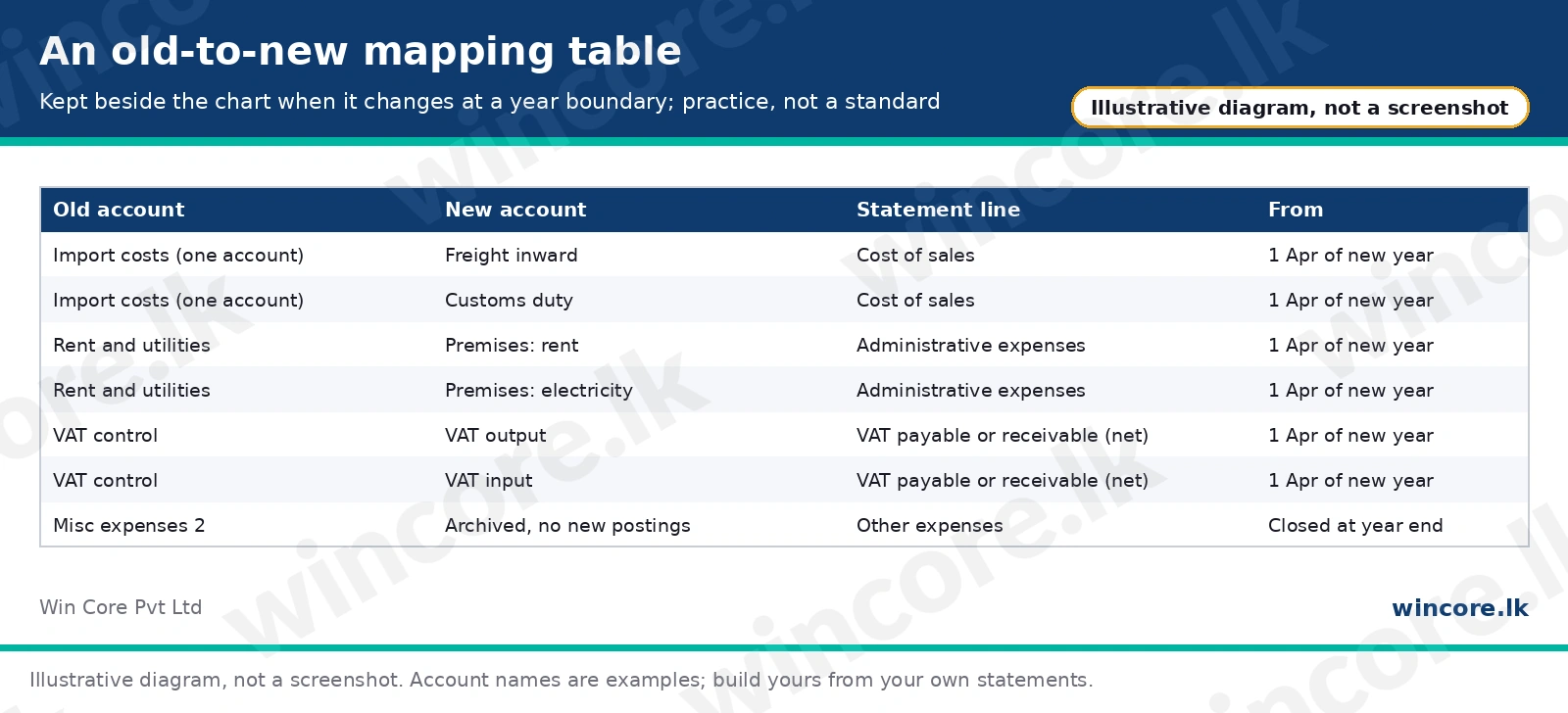
- Write a mapping table: every old account, the new account or accounts it goes to, the statement line and the date.
- Reclassify last year's comparatives in the financial statements to the new presentation where it has changed, as paragraph 3.12 requires, and record the nature, the amounts and the reason.
- Archive, do not delete, old accounts with history so old reports still run.
A worked example
Hypothetical. A tile importer has kept a single "Import costs" account and presented one "Import costs" line in its statements. This year it splits freight and customs duty into separate accounts and, because both are material, presents them as separate lines. For the comparatives it analyses last year's Rs. 24,000,000 of import costs from the supplier and customs documents into Rs. 15,600,000 freight and Rs. 8,400,000 customs duty (our arithmetic; the parts sum to Rs. 24,000,000), and discloses the nature, amounts and reason under paragraph 3.12. If one month's documents cannot be found and the split cannot be made for that part, paragraph 3.13 requires the statements to say why reclassification was not practicable.
If old periods are still unfinished, plan the order for clearing a backlog of accounts before remapping the chart.
Five chart mistakes that cost time at year end
This section is practice.
- Accounts named after people or suppliers. They lose their meaning when the person or supplier changes.
- One account for VAT. Output and input in one account make the monthly tie-out to the return harder.
- Capital items in expense accounts. They have to be found and moved at year end, and the fixed asset register goes out of step; see capitalise or expense.
- Different charts in companies of one group. A shared chart makes group reporting and intercompany matching far easier.
- Restructuring during a backlog. If prior years are not closed, close them on the old chart first; our year-end close guide sets out the steps.
What this means for you
The standard requires comparatives and consistent classification, and requires reclassification with disclosure when presentation changes. The Inland Revenue Act requires income at different rates or exempt to be identifiable in the financial statements. A chart designed once from your statements and returns, with control accounts kept separate and tracking fields used for analysis, makes both easy. Change it only at a year boundary, with a mapping table and locked prior periods. Our bookkeeping services and accounting services can carry out the restructure and the reclassified comparatives.
Checklist: documents needed
- Current chart of accounts exported from your software
- Last year's financial statements and trial balance
- Your VAT and income tax return formats
- Your management pack layout
- A list of income streams, marking any taxed at a different rate or exempt
- A list of directors and related companies needing current accounts
- The old-to-new mapping table and the date prior periods were locked
FAQ
Is there a prescribed chart of accounts for Sri Lankan private companies?
We found none. The Companies Act, the Inland Revenue Act and SLFRS for SMEs (2015), searched on 22 October 2026, do not prescribe one. The financial statements must follow the applicable standard and the tax law's separations, but the chart behind them is your own design. Regulated sectors and government entities may have prescribed formats.
Can we change the chart of accounts in the middle of the year?
You can, but it splits one account's history across two systems of codes and makes the year harder to analyse. Paragraph 3.11 favours keeping presentation and classification stable from one period to the next, so changing at the start of a financial year, with prior periods locked, keeps the comparatives clean and the audit trail short.
What if last year's figures cannot be split into the new accounts?
Paragraph 3.13 requires the financial statements to disclose why reclassification was not practicable. Try the source documents first, because "impracticable" in the standard means the split cannot be made after every reasonable effort, not that it takes time. Record what was tried, keep the working papers, and disclose the part that could not be split.
Should every company in our group use the same chart of accounts?
In practice, yes. A shared chart makes consolidation, intercompany matching and comparison between companies much simpler, and it lets one bookkeeper work across the group without relearning codes. The law does not require it; it is practice. Where one company has a different income stream or tax rate, add accounts within the shared structure.
Open points
- Regulated sectors. Some regulated entities have prescribed reporting formats. Not covered.
- Standard edition. We read the 2015 SLFRS for SMEs; we did not confirm whether CA Sri Lanka has adopted a later edition and from when.
- Full SLFRS entities. Companies applying full SLFRS (LKAS 1) have similar but separately worded requirements. Not reviewed here.
Last verified
We read SLFRS for SMEs (2015) paragraphs 3.11 to 3.16, 5.11 and 10.7, and the Inland Revenue Act, No. 24 of 2017 s.120(1A) (IRD consolidation up to 2025), on 22 October 2026.
The short version
The standard requires comparatives, consistent classification, and reclassification with disclosure when presentation changes. The tax law requires income at different rates or exempt to be identifiable. Design the chart from your statements and returns, keep control accounts separate, use tracking fields for detail, map every account, and change it only at the start of a year with a mapping table and locked prior periods.
Talk to us. If your chart of accounts needs restructuring before the next year begins, our contact page.
WinCore Pvt Ltd
This article is general information, not advice for your specific situation.
References
- Institute of Chartered Accountants of Sri Lanka. Sri Lanka Accounting Standard for Small and Medium-sized Entities (SLFRS for SMEs), 2015, paras 3.11 to 3.16, 5.11, 10.7. https://www.slaasc.lk/files/_SLFRS%20FOR%20SMEs%20-%202015.pdf . Primary. Accessed 22 October 2026.
- Inland Revenue Department. Inland Revenue Act, No. 24 of 2017 (consolidated up to 2025), s.120(1A). https://www.ird.gov.lk/en/publications/Acts_Income%20Tax_2017/IRA_Cons_Act_-_2025_Changes.pdf . Primary (consolidation). Accessed 22 October 2026.
Put these insights to work
WinCore specialists can review your current workflow, document gaps, and build a practical 90-day action plan.
Book a free consultationContinue reading
Explore more WinCore analysis to keep your finance, tax, and compliance roadmap moving.

Bookkeeping guide for Sri Lankan small businesses: legal requirements, chart of accounts, source documents, 5-year retention rule, and monthly routines.
Close your books before the March 31 deadline to reduce audit risk and start with clean numbers. A practical 10-step year-end guide for SMEs.
Xero, QuickBooks, and Zoho Books are all available to Sri Lankan SMEs in 2026. Which platform fits your business, what does RAMIS integration look like, and should you switch from desktop?