
Month-end close checklist Sri Lanka: a 7-day routine and pack
A seven working day close for a small company, the legal floor behind it, and a short monthly pack built around the numbers you actually run on.
On this page
Last verified against the primary sources on 22 October 2026.
A month-end close checklist is practice, not law: no Sri Lankan statute we read requires a monthly close or a management pack. What the law does require, under section 148(1) of the Companies Act, No. 7 of 2007, is accounting records that "at any time" enable the company's financial position to be determined with reasonable accuracy, and under section 120 of the Inland Revenue Act, No. 24 of 2017, records sufficient to work out profit, split by rate where more than one rate applies. A short monthly close, about seven working days in our practice timetable, is the most reliable way we know to meet that standard.
This article sets out that routine and a management pack you design around your own business. Where the law sets a floor, we quote it. Where it does not, we say so.
No law requires a monthly close, but section 148 sets the floor
No statute we read requires a monthly close or a management pack. What the law does require is records good enough that a close is possible at any time.
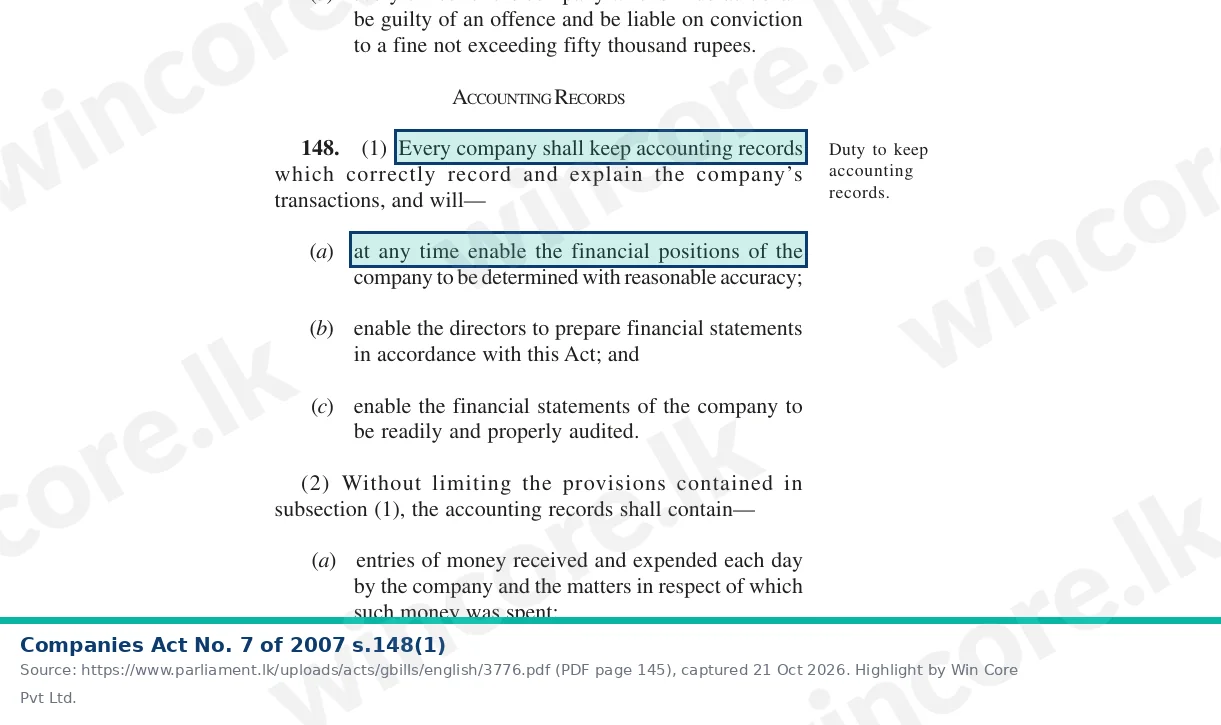
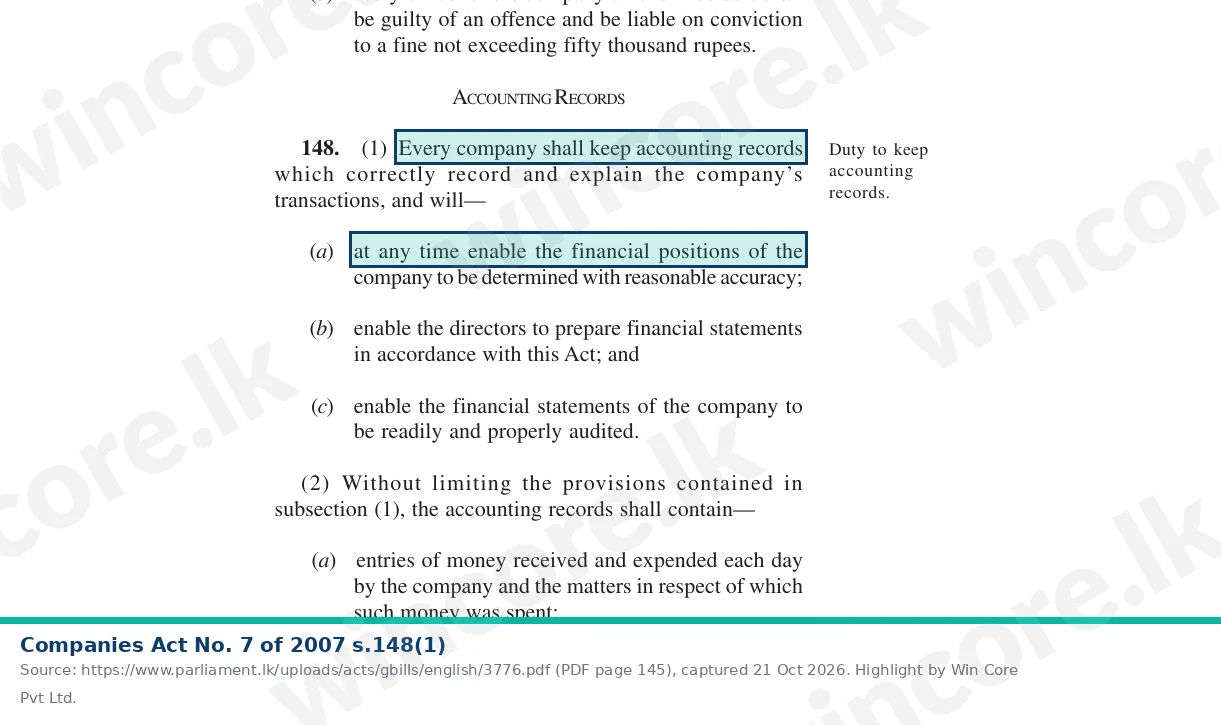
Section 148(1) of the Companies Act, No. 7 of 2007 says: "Every company shall keep accounting records which correctly record and explain the company's transactions, and will (a) at any time enable the financial positions of the company to be determined with reasonable accuracy; (b) enable the directors to prepare financial statements in accordance with this Act; and (c) enable the financial statements of the company to be readily and properly audited" [1].
On our reading, "at any time" is the phrase that matters. If you cannot produce a reasonably accurate balance sheet for last month without weeks of catch-up, the records may fall short of that test. Section 148(2) then lists what the records must contain, starting with entries of money received and spent each day; our guide to bookkeeping basics covers the records themselves.
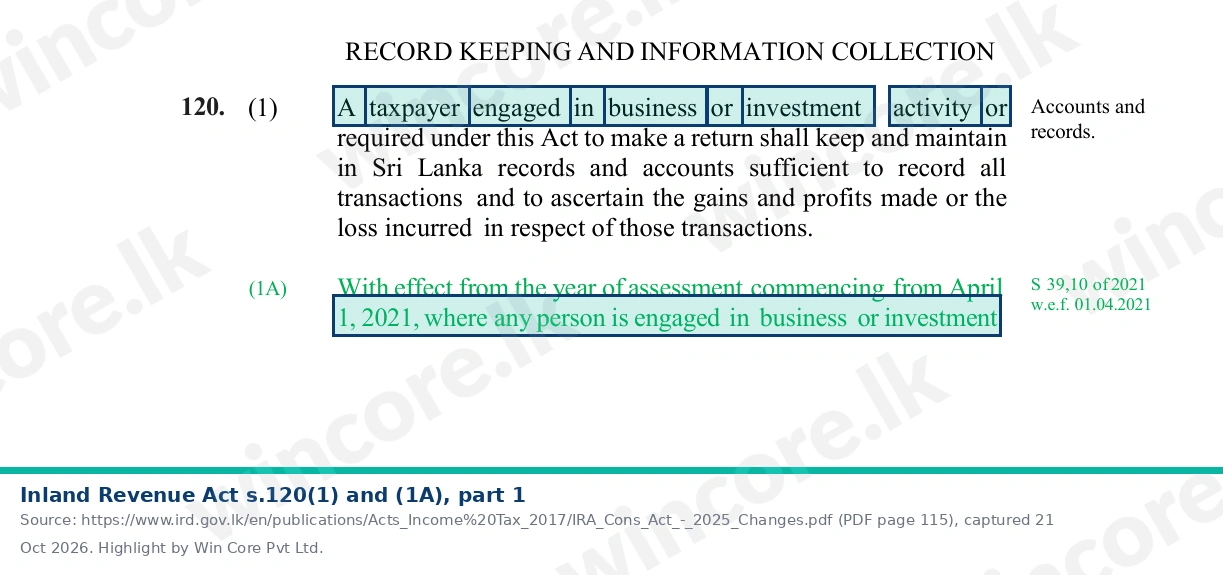
The Inland Revenue Act, No. 24 of 2017 adds a tax-side duty. Section 120(1) requires a taxpayer to "keep and maintain in Sri Lanka records and accounts sufficient to record all transactions and to ascertain the gains and profits made or the loss incurred in respect of those transactions" [2].
Income taxed at more than one rate has to be split in the books
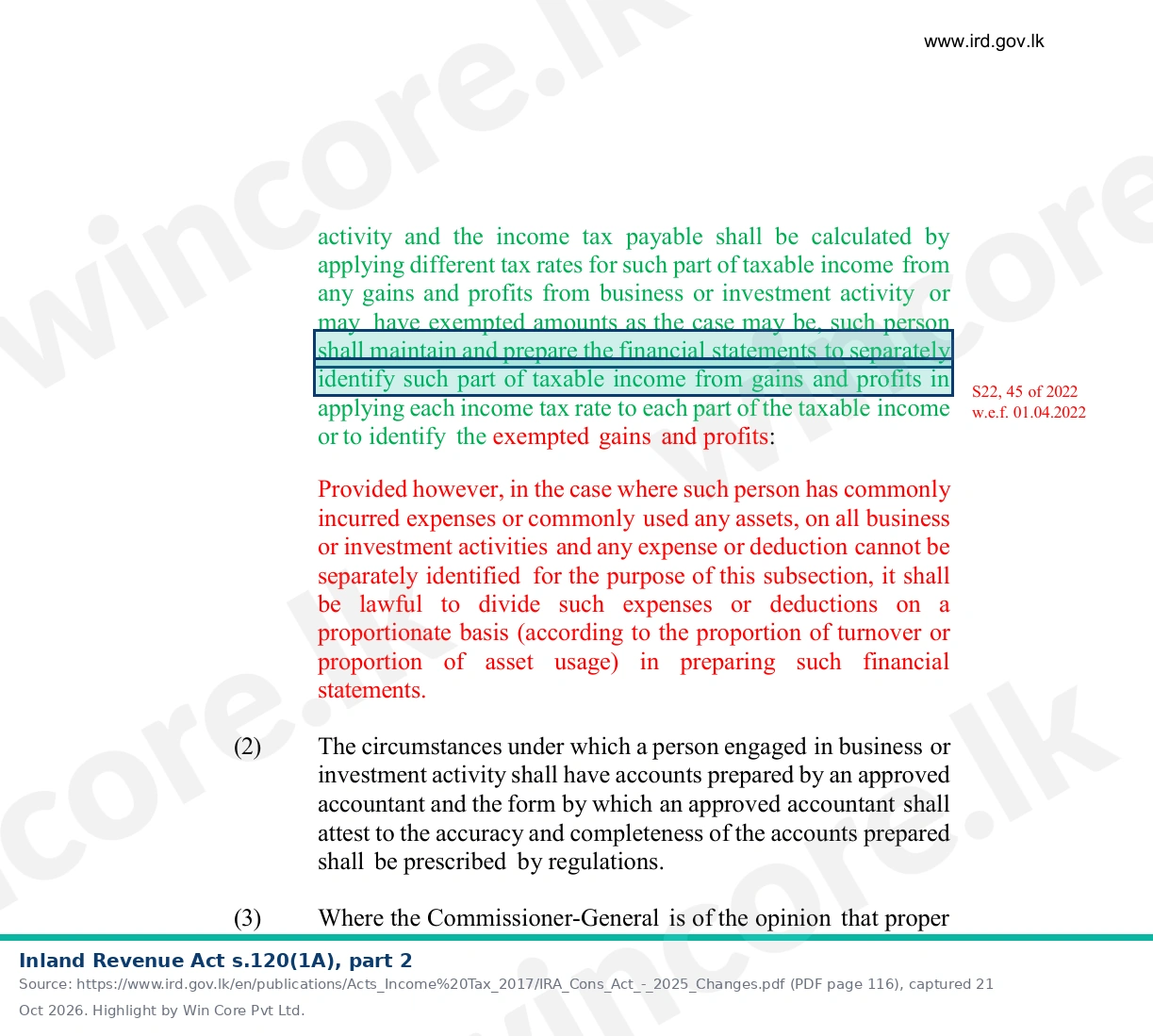
Section 120(1A), with effect from the year of assessment commencing 1 April 2021, matters for businesses with income taxed at more than one rate, or with exempt income. Such a person "shall maintain and prepare the financial statements to separately identify such part of taxable income from gains and profits in applying each income tax rate to each part of the taxable income or to identify the exempted gains and profits". The proviso allows common expenses that cannot be separately identified to be divided "on a proportionate basis (according to the proportion of turnover or proportion of asset usage)" [2].
If that applies to you, build the split into your monthly chart of accounts from the start. Separating streams at year-end from a single sales account is slow and hard to defend.
A month-end close checklist in seven working days (practice)
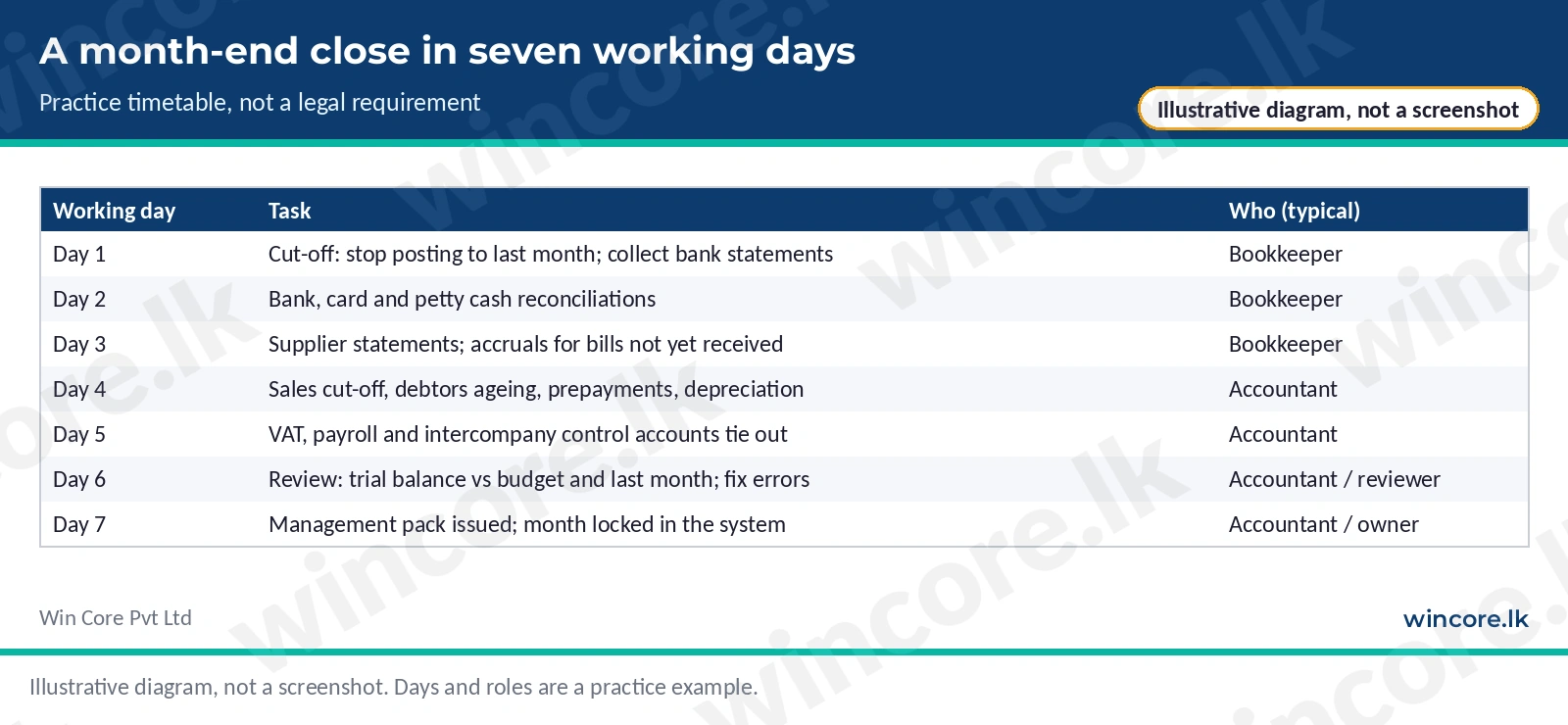
This section is practice, not a legal requirement. The timetable below assumes a small team using cloud accounting software and a bank feed. Change the days to suit your size, but keep the order.
Day 1: cut-off
Stop posting to the month you are closing, except for the closing entries. Download bank and card statements to the last day. Collect till reports, payment gateway settlements and any foreign currency statements. A bill belongs to the month the goods or service were received, not the month it arrives.
Day 2: reconcile cash
Reconcile every bank account, every card and petty cash to the statement balance. A reconciliation is complete only when the closing balance per the books equals the statement, with any differences listed and explained. Unexplained items go on the open issues list, not into a suspense account that nobody reviews.
Day 3: suppliers and accruals
Match supplier statements to the payables ledger for your main suppliers. Accrue for goods and services received but not yet invoiced: utilities, professional fees, rent increases. Record a short note of each estimate and how you reached it.
Day 4: sales, debtors and non-cash items
Check that every delivery or service completed in the month has been invoiced, and nothing from next month has slipped in. Run the debtors ageing. Post prepayments and depreciation. For the start date, method and useful life, see how to set a depreciation policy.
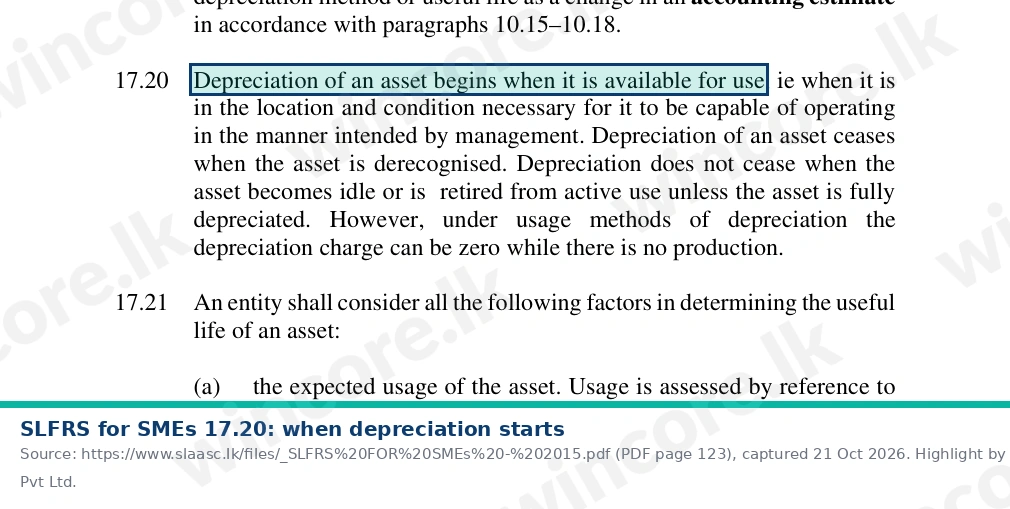
On depreciation, paragraph 17.20 of the Sri Lanka Accounting Standard for Small and Medium-sized Entities (SLFRS for SMEs) says it "begins when it is available for use, ie when it is in the location and condition necessary for it to be capable of operating in the manner intended by management", and "does not cease when the asset becomes idle or is retired from active use unless the asset is fully depreciated" [3]. A monthly charge is a convenient way to follow that.
Day 5: control accounts
Tie each control account to its supporting schedule:
- VAT payable to the return working for the period;
- PAYE/APIT, EPF and ETF payable to the payroll reports;
- loans to lender statements;
- director current accounts to an agreed schedule;
- intercompany balances to the other company's books.
A control account with no schedule behind it is a number nobody can explain.
Day 6: review
Compare the trial balance with last month and with budget. Ask why for every material movement. Look for negative balances where none should exist, such as a negative stock or a debit balance on a supplier. Tie every total back to a statement or a source document, not to another tab of the same workbook.
Day 7: issue and lock
Issue the management pack. Then lock the period in the software so that later entries cannot change a month you have already reported. Corrections go in the current month with a note.
For invoices arriving after the close, review expense cut-off and accrual evidence before carrying the cost into the next month.
A management pack works best in your own format (practice)
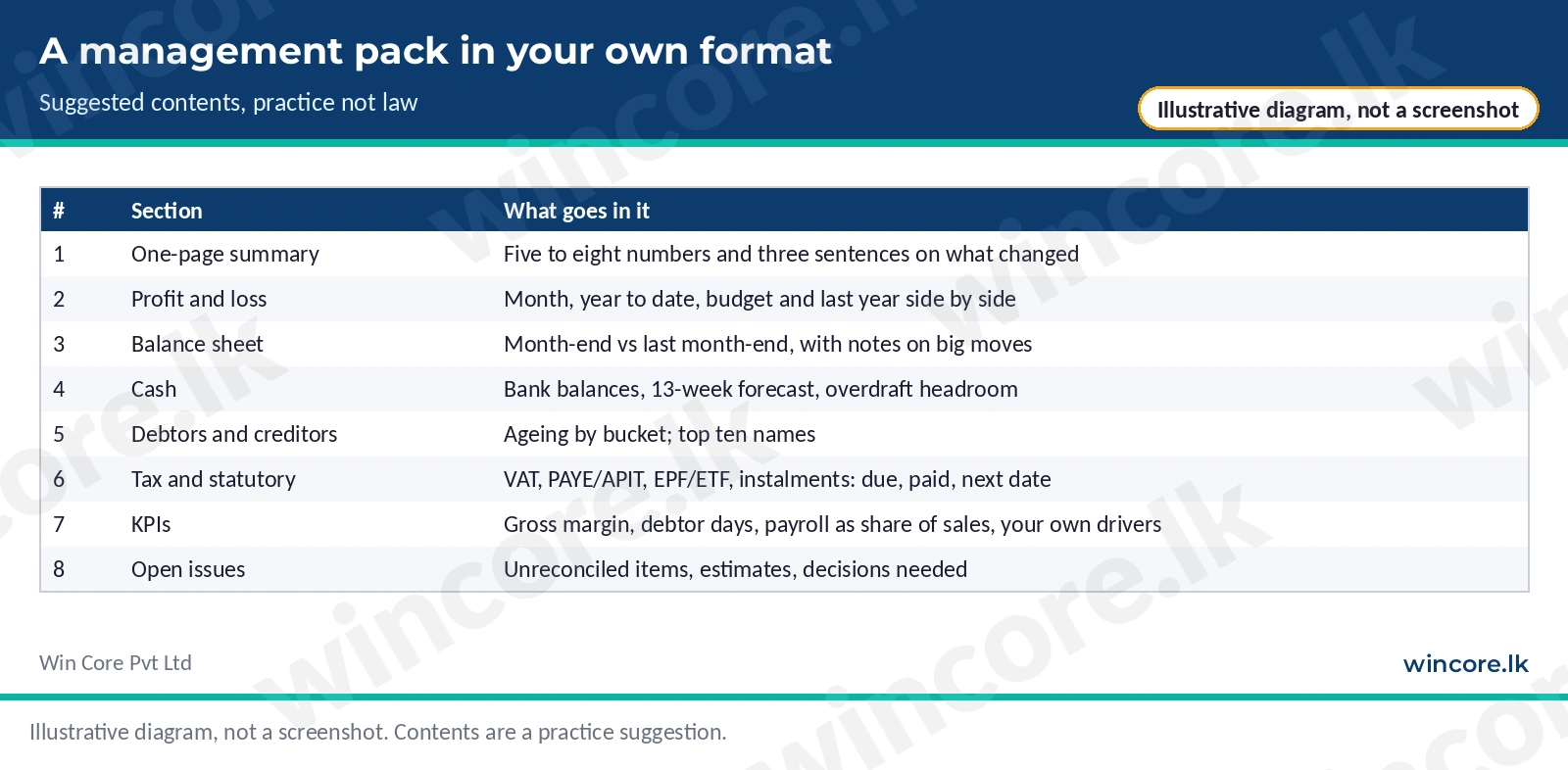
There is no prescribed format for internal management accounts. That is the point: the pack should answer the questions you actually ask about your business. A useful starting structure is below. This is practice, not a legal requirement.
Principles
- One page first. The first page should be readable in two minutes: five to eight numbers, and three sentences on what changed and why.
- Same layout every month. Consistency is what makes trends visible. Change the format at the start of a year, not mid-year.
- Comparatives. Show the month, year to date, budget and the same period last year.
- Cash beside profit. A profit with falling cash needs explaining. Our article on cash flow management covers forecasting the gap.
- Statutory dates. A short table of tax and payroll amounts due, paid and next due. For income tax instalments, see our article on Circular SEC/2026/E/06 and quarterly instalments, and the quarterly income tax instalment calculator for the figure.
- Open issues. List what is estimated, unreconciled or awaiting a decision. A pack that hides its weak points is worse than no pack.
Choosing your own KPIs
Pick three to five drivers that move your profit. A few examples, all practice:
- a services firm: billable hours, utilisation, debtor days;
- a retailer or restaurant: gross margin by category, stock days, average transaction value (see restaurant bookkeeping in Sri Lanka);
- a tea or spice exporter: sales by market, shipments invoiced but unpaid, and the exchange rate used for each.
A worked example
Hypothetical. A design studio closes September. Debtors at month-end are Rs 7,200,000. Sales for July to September were Rs 14,400,000. Debtor days on a 90-day basis are 7,200,000 / 14,400,000 x 90 = 45 days (our arithmetic). In June the same calculation gave 30 days (our arithmetic, hypothetical figures). The front page of the pack then says, in one line, that debtor days rose from 30 to 45, that two customers are on extended terms, and that the cash forecast shows overdraft use in November if they do not pay. That line is the value of the close.
Before circulating the pack, add a clear basis-of-preparation statement so readers know which estimates and accounting policies it uses.
A monthly close fails for five predictable reasons (practice)
This section is practice, not a legal requirement.
- No owner. The close is everyone's job, so it is nobody's. Name one person.
- Waiting for perfect. Close on estimates, and record them. Correct the estimate when the bill arrives.
- Reopening months. Open periods let old entries change reported numbers. Lock and correct forward.
- Backlog. If last year is not closed, start there. Opening balances that are wrong make every later month wrong; our year-end financial close guide sets out the annual steps.
- Too long a pack. Thirty pages nobody reads achieve less than two pages that get discussed.
Open points we keep open
- Approved accountant regulations. Section 120(2) leaves to regulations when accounts must be prepared by an approved accountant. We did not review those regulations here.
- Standard edition. We read the 2015 SLFRS for SMEs and did not verify whether a later revision has been adopted in Sri Lanka.
- Industry rules. Regulated sectors may have their own monthly reporting duties. Not covered.
What this means for you
The law asks for records that can show your financial position at any time, and for tax records good enough to compute your profit, split by rate if needed. A monthly close is the most reliable way we know to meet that standard in practice. Set a short timetable, reconcile cash and control accounts every month, lock the period, and send yourself a pack in a format that answers your own questions. If you would rather hand the close over, our accounting services run it monthly, and our virtual CFO service turns the pack into decisions.
Checklist: documents needed
- Bank, card and petty cash statements to month-end
- Till, POS and payment gateway settlement reports
- Supplier statements for main suppliers
- List of goods and services received but not invoiced
- Payroll reports for PAYE/APIT, EPF and ETF
- VAT working for the period, if registered
- Loan and lease statements
- Fixed asset register with additions and disposals
- Director and intercompany balance schedules
- Budget for the year
FAQ
Is a management pack a legal requirement in Sri Lanka?
No, a management pack is practice, not a legal requirement, in the statutes we read. The legal floor is accounting records under section 148 of the Companies Act and tax records under section 120 of the Inland Revenue Act. A pack is how owners use those records each month, so its contents and format are yours to choose.
How long should a month-end close take?
In practice, a small business with clean records can close in five to seven working days after month end. The first few closes take longer, because opening balances and reconciliations need fixing first. Speed comes from doing the same steps in the same order every month, and from closing on recorded estimates rather than waiting for every bill.
Do we need to close monthly if we only file annually?
Not legally, but section 148(1)(a) asks for records that show your financial position "at any time" with reasonable accuracy. That is hard to meet if the books are only brought up to date once a year. A monthly close also catches errors while they are small and makes the year-end audit and tax return quicker.
Can management accounts use different policies from the annual accounts?
Yes, for internal use, because no format is prescribed for internal management accounts. Differences from the policies in your annual financial statements cause confusion at year-end, though, so keep them few, write them down, and show the adjustment that reconciles the management profit to the statutory profit at the end of the year.
What if we have income taxed at different rates?
Section 120(1A) of the Inland Revenue Act requires financial statements that separately identify each part of taxable income by rate, or the exempt part. Set up separate income and cost accounts for each stream from the first month. Common costs that cannot be identified may be divided by turnover or asset usage under the proviso.
Talk to us. If you want a month-end close set up for your company, or your current routine checked, book a consultation at our contact page.
WinCore Pvt Ltd
References
- Parliament of Sri Lanka. Companies Act, No. 7 of 2007, s.148. https://www.parliament.lk/uploads/acts/gbills/english/3776.pdf . Primary. Accessed 21 October 2026; re-checked 22 October 2026 from the captures.
- Inland Revenue Department. Inland Revenue Act, No. 24 of 2017 (consolidated up to 2025), s.120. https://www.ird.gov.lk/en/publications/Acts_Income%20Tax_2017/IRA_Cons_Act_-_2025_Changes.pdf . Primary (consolidation). Accessed 21 October 2026; re-checked 22 October 2026 from the captures.
- Institute of Chartered Accountants of Sri Lanka. Sri Lanka Accounting Standard for Small and Medium-sized Entities (SLFRS for SMEs), 2015, para 17.20. https://www.slaasc.lk/files/_SLFRS%20FOR%20SMEs%20-%202015.pdf . Primary. Accessed 21 October 2026; re-checked 22 October 2026 from the captures.
Put these insights to work
WinCore specialists can review your current workflow, document gaps, and build a practical 90-day action plan.
Book a free consultationContinue reading
Explore more WinCore analysis to keep your finance, tax, and compliance roadmap moving.

Close your books before the March 31 deadline to reduce audit risk and start with clean numbers. A practical 10-step year-end guide for SMEs.
Bookkeeping guide for Sri Lankan small businesses: legal requirements, chart of accounts, source documents, 5-year retention rule, and monthly routines.
Cash flow management for Sri Lankan SMEs: the cash conversion cycle, 13-week rolling forecasts, receivables and payables, factoring, and planning tax payments.