
Restaurant bookkeeping in Sri Lanka: POS, VAT and SSCL
How a restaurant posts daily POS takings once, clears card and delivery payouts, counts cash and stock, and deals with VAT, SSCL and service charge.
On this page
Last verified against the primary sources on 22 October 2026.
Restaurant bookkeeping in Sri Lanka rests on one rule of practice: post each day's sales once, from the POS end-of-day (Z) report, and let card, delivery app and cash receipts clear against it. On tax, a VAT-registered restaurant charges VAT at 18 percent for any taxable period commencing on or after 1 January 2024 (VAT Act s.2(1)(ix)), and SSCL is 2.5 percent of liable turnover (SSCL Act s.3(1)). Whether a restaurant's liable turnover is 100 percent of turnover, as a service, or 50 percent, as a retail sale, is not settled in the Act; we keep it open below.
The bookkeeping in this article is practice, not law, and we say so section by section. The tax points are checked against the Acts. Service charge has no statute we could find, so we describe practice only. For the general groundwork (chart of accounts, record keeping, payroll journals) see our guide to bookkeeping basics for Sri Lankan small businesses. For what a monthly fee should cover, see the monthly bookkeeping scope.
Restaurant bookkeeping in Sri Lanka starts with the POS settings (practice)
Most bookkeeping problems in restaurants start with how the POS was configured. Before go-live, or at a quiet moment, check these settings:
- Tax settings. If you are VAT-registered, the POS should show VAT correctly on each bill. If you are not registered, it should not show VAT at all.
- Menu categories. Map menu items to a small number of revenue categories (for example food, beverages, takeaway and delivery) that match your chart of accounts.
- Payment methods. Set up a separate tender for each card acquirer and each delivery platform, so the Z-report splits them the way the bank and platform statements do.
- User permissions. Restrict voids, refunds, discounts and price overrides to supervisors, with a reason code.
- Service charge. Configure it as a separate line, not folded into item prices, so it can be tracked to a liability.
- Exports. Confirm the daily and monthly reports can be exported and kept. A POS that cannot produce history is a records problem.
- Tax invoices. If you are VAT-registered, check that the POS, or your invoicing software, can produce a tax invoice in the format the Commissioner-General has specified for every registered person since 1 October 2026. Our article on the tax invoice format in Gazette 2481/22 sets out the fields and when a tax invoice is due.
For small cash purchases outside the POS, maintain a controlled petty-cash float and voucher trail.
Post each day once from the Z-report, and clear every payment channel
The POS end-of-day report (often called the Z-report) is the best single source for sales. It shows gross sales, discounts, voids, tax, and the split by payment method.
Practice:
- Post one daily journal from the Z-report: net sales, output VAT if registered, and the split into cash, card, delivery platforms and any credit accounts.
- Use clearing accounts for each payment channel. When the card acquirer or delivery app pays, the receipt clears the clearing account. It is not posted as sales again; posting both is the commonest double count in restaurant books.
- Review voids, refunds and discounts daily. A high void rate on cash sales is the classic sign of leakage.
- Keep the Z-reports. The Companies Act requires accounting records which "correctly record and explain the company's transactions" (s.148(1)), and the Inland Revenue Act requires a taxpayer to "retain source documents and underlying documentation utilized in the creation of the records and accounts" (s.120(5)) [4] [5].
Cards and delivery apps: keep sales gross
Card acquirers deduct a merchant fee. Delivery platforms deduct commission and sometimes promotions they fund at your expense. If you post only what reaches the bank, sales and costs are both understated, and the VAT and SSCL bases may be wrong.
Practice: record sales at the amount charged to the customer, and fees and commissions as expenses, using each platform's statement. Reconcile each platform monthly: orders per the POS, orders per the platform, gross, commission, adjustments and the bank receipt. On our reading of SLFRS for SMEs Section 23 (Revenue), revenue is measured at the consideration receivable, so a platform's commission is a cost, not a reduction of sales.
Cash and stock need their own counts (practice)
Cash
Practice:
- Count cash at each shift end against the POS cash figure, with a fixed float.
- Post differences to a cash over/short account, never to sales or sundry expenses. Investigate repeated shortages.
- Bank cash daily or as often as practical, and keep deposit slips matched to days.
- Pay suppliers by bank transfer rather than from the till where possible. Till payments make cash counts meaningless unless each one is recorded with a bill.
Stock and food cost
Food cost is the main cost line, and kitchen stock moves fast.
Practice: count key stock weekly or at least monthly, value it at cost, and post the movement so cost of sales reflects consumption, not purchases. Track waste, staff meals and complimentary items separately so the gross margin can be read. A month-end that books all purchases as cost of sales and ignores stock will swing profit from month to month. SLFRS for SMEs Section 13 (Inventories) is the standard that applies to valuing that stock.
Vouchers, deposits and credit accounts are not cash sales (practice)
Not every sale is settled at the table.
Practice:
- Corporate accounts and events. Post these as sales to a named customer account, not as cash. Chase them like any other receivable. Deposits taken for future events are a liability until the event takes place.
- Gift vouchers and prepaid cards. Cash received for a voucher is not yet a sale. Hold it as a liability and release it to sales when the voucher is used. Track expired vouchers under a written policy.
- Staff and owner meals. Ring them through the POS at a zero or staff price so stock usage and margins stay honest. Meals taken by owners are best recorded against the owner's or director's account unless they are part of a documented arrangement; check the tax treatment before you settle on one.
Service charge belongs in a liability, and no statute we found governs it
Many restaurants add a service charge to the bill. On 22 October 2026 we looked for a law in force on collecting or distributing it and found none. The Shop and Office Employees (Regulation of Employment and Remuneration) Act, in a consolidation to 2024, does not mention service charge [3]. The Hotel and Catering Trade Wages Board gazettes we opened on documents.gov.lk (2081/49 of 2018, which sets minimum wages, and 2489/07 of 2026, which appoints board members) do not mention it either [7]. That is a dated search, not proof that no instrument exists, so what the law requires on service charge is an open point, and the rest of this section is practice only.
Practice: if you collect service charge on the understanding that it goes to staff, record it in a separate liability account when collected and clear it when distributed through payroll. That keeps it out of revenue and shows what is owed to staff at month-end. Write down the distribution basis (points, equal shares, by role) and keep each month's working. Whether service charge distributed through payroll counts as earnings for EPF, ETF and APIT is a separate question we have not covered here; so is whether it forms part of the value of a supply for VAT and turnover for SSCL.
A registered restaurant charges VAT at 18 percent on its meals
The VAT Act charges tax "for any taxable period commencing on or after January 1, 2024 at the rate of eighteen per centum (of which the tax fraction is 9/59)" (s.2(1)(ix)) [1].
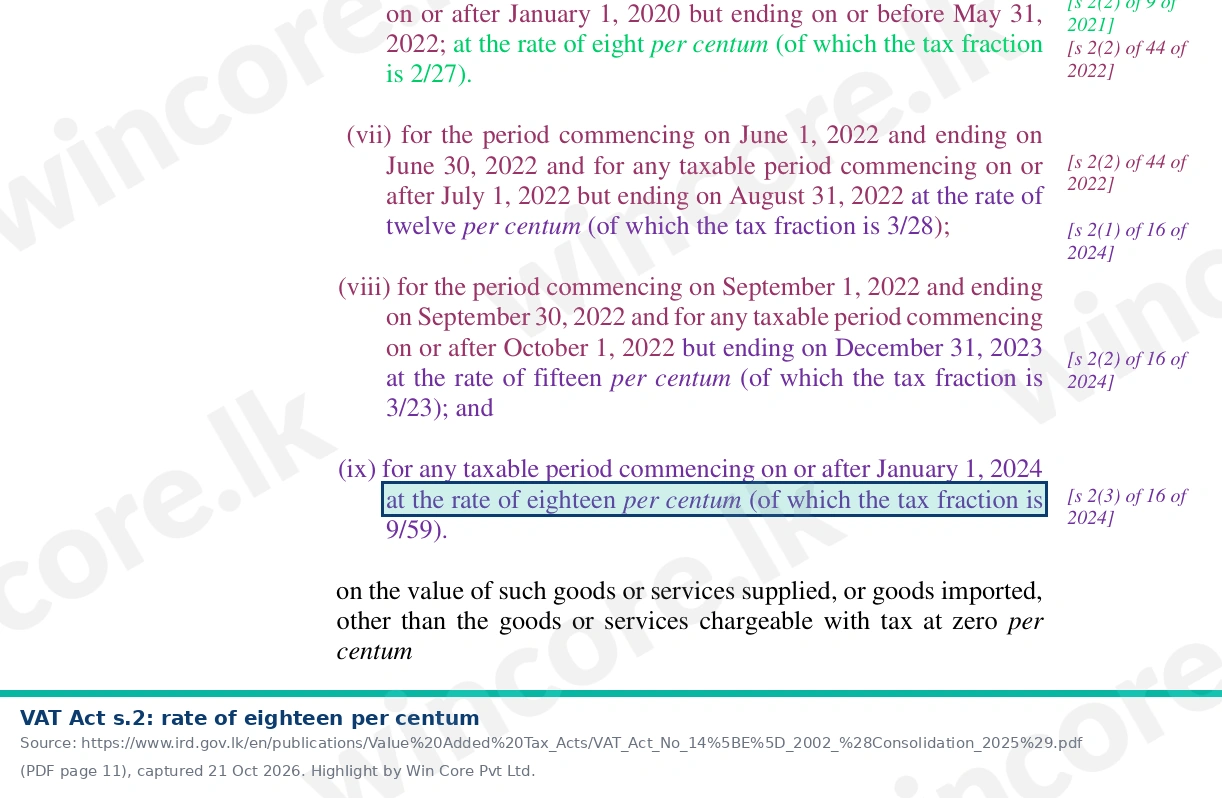
A search of the First Schedule of the IRD's consolidated VAT text on 21 October 2026 found no general exemption for restaurant meals. On our reading, a VAT-registered restaurant therefore charges VAT at 18 percent on its meals and drinks. The tax fraction 9/59 is the same as 18/118, so Rs 236,000 of VAT-inclusive sales contains Rs 36,000 of VAT (our arithmetic; the VAT calculator does the same split).
Registration is a separate test. A restaurant must register when its taxable supplies exceed Rs 15 million in a taxable period or Rs 60 million in twelve months, or are likely to; our guide to VAT registration thresholds runs through both tests and the 15-day rule. Until it is registered, a restaurant does not charge VAT, and its bills should not show any; issuing a tax invoice without being registered is itself an offence under the VAT Act, as our tax invoice article sets out.
Most diners are not registered persons. On the reading in that article, a registered restaurant gives an ordinary diner an invoice showing the total including tax, and issues a tax invoice in the specified format where a registered buyer asks for one, which is common for corporate accounts and events.
The consolidated text also contains narrower items mentioning restaurants, such as services at a restaurant beyond the immigration counter at the international airport. We did not confirm which are current, so we do not rely on them.
SSCL is 2.5 percent, but a restaurant's liable share is an open point
SSCL is charged at "2.5 per centum" on "liable turnover, specified in the Second Schedule" (s.3(1)) [2]. Turnover excludes "any Value Added Tax under the Value Added Tax Act, No. 14 of 2002 paid for that relevant quarter" (s.3(3)(b)).
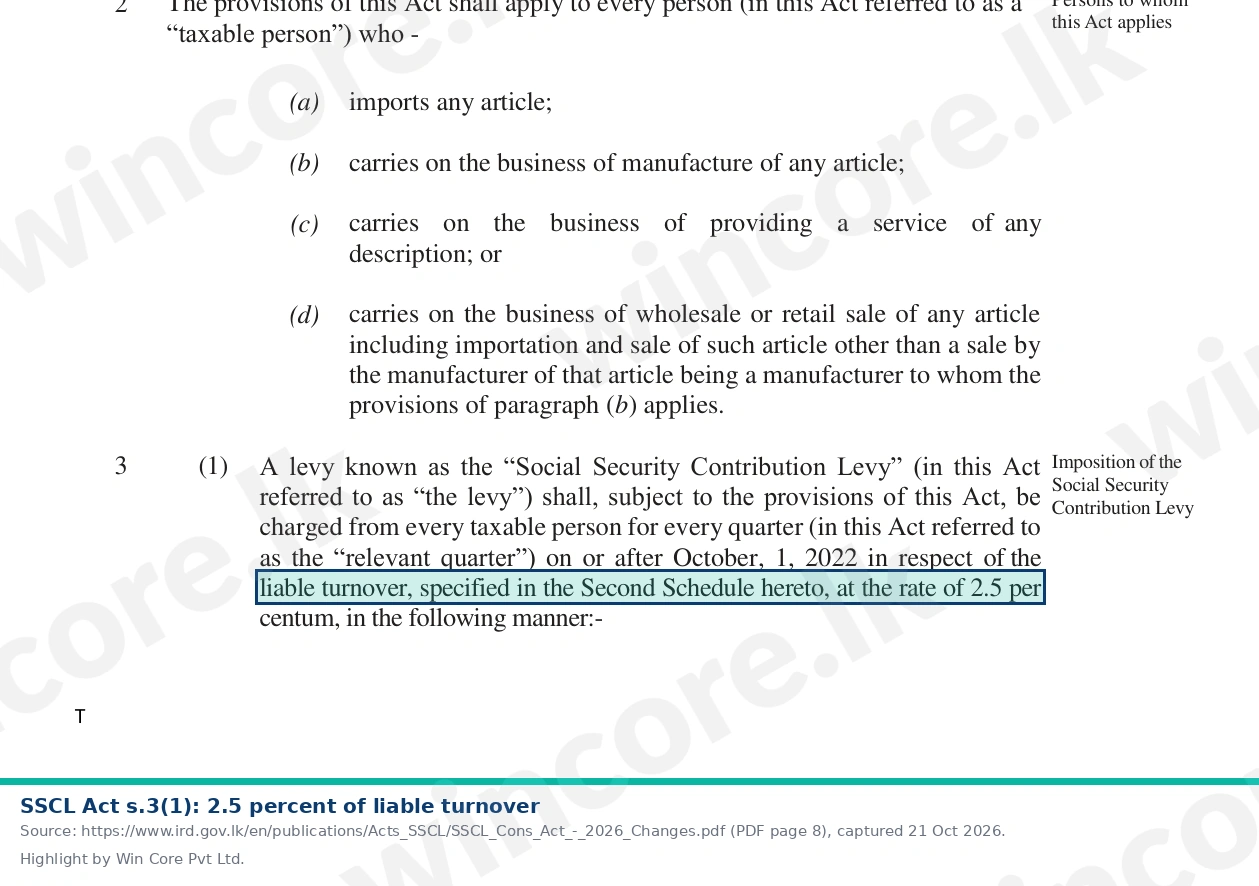
The Second Schedule sets the liable share by activity. Under item 3, "Services other than (a) and (b)" are liable on "100% of the turnover referred to in section 3(2)(c)(iii)". Under item 4(b), "Wholesale or retail sale other than item (a) above including importation and sale" is liable on "50% of the turnover referred to in section 3(2)(d)" [2].
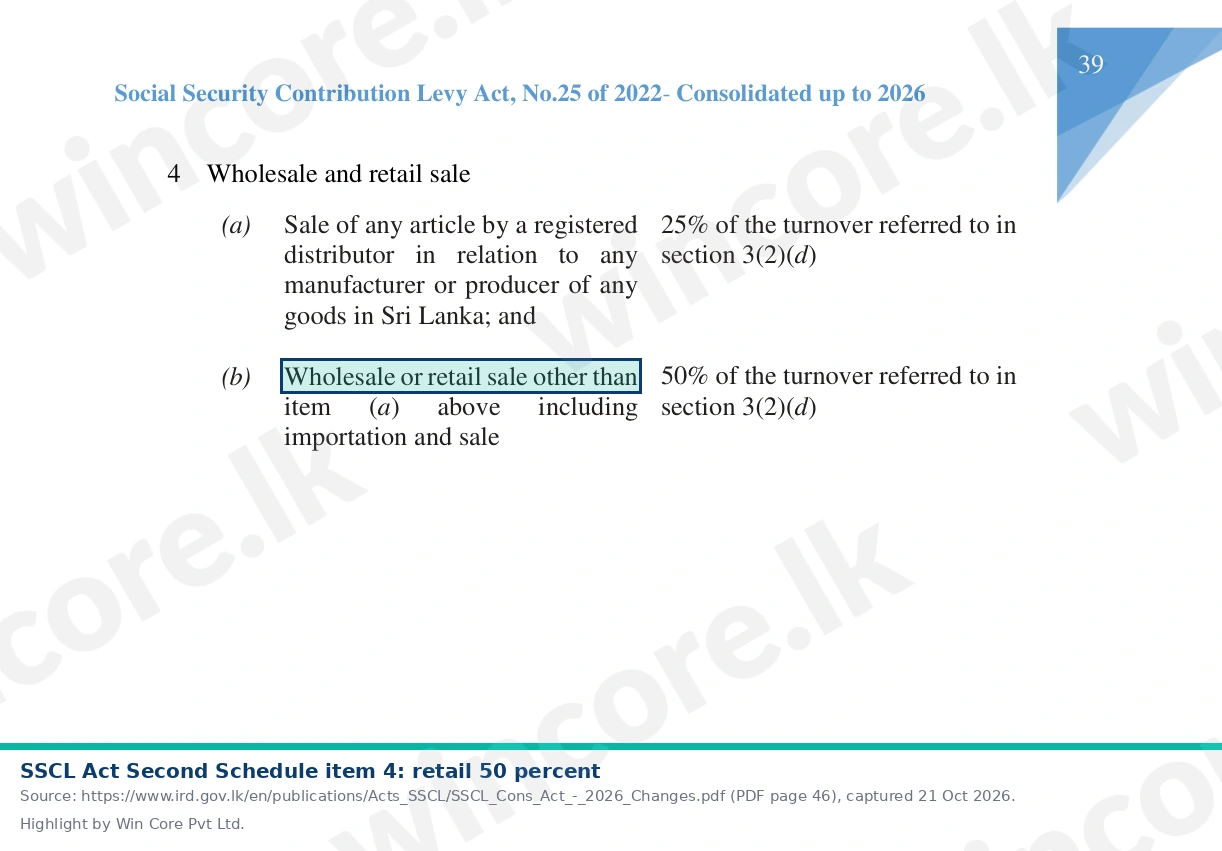
A restaurant sells prepared food and drink and also provides service at the table. Section 2 lists both "the business of providing a service of any description" and "the business of wholesale or retail sale of any article" as taxable activities. The Act does not say which a restaurant is. The IRD's notice to taxpayers PN/SSCL/2021-01 of 21 September 2022 repeats the same categories and percentages and gives no rule for a business that both sells food and serves it (copy read on taxadvisor.lk; Secondary host of an IRD notice) [6]. A search of ird.gov.lk on 22 October 2026 found no SSCL guidance on restaurants. So it is an open point. If part of your sales is plainly a different activity, such as packaged goods sold over the counter, keep a separate working for it, as our SSCL registration guide suggests for any business with two activities. The difference matters: on Rs 200,000 of net sales, 100% liable turnover gives Rs 5,000 of SSCL and 50% gives Rs 2,500 (our arithmetic). Settle the treatment, in writing if you can, before you file.
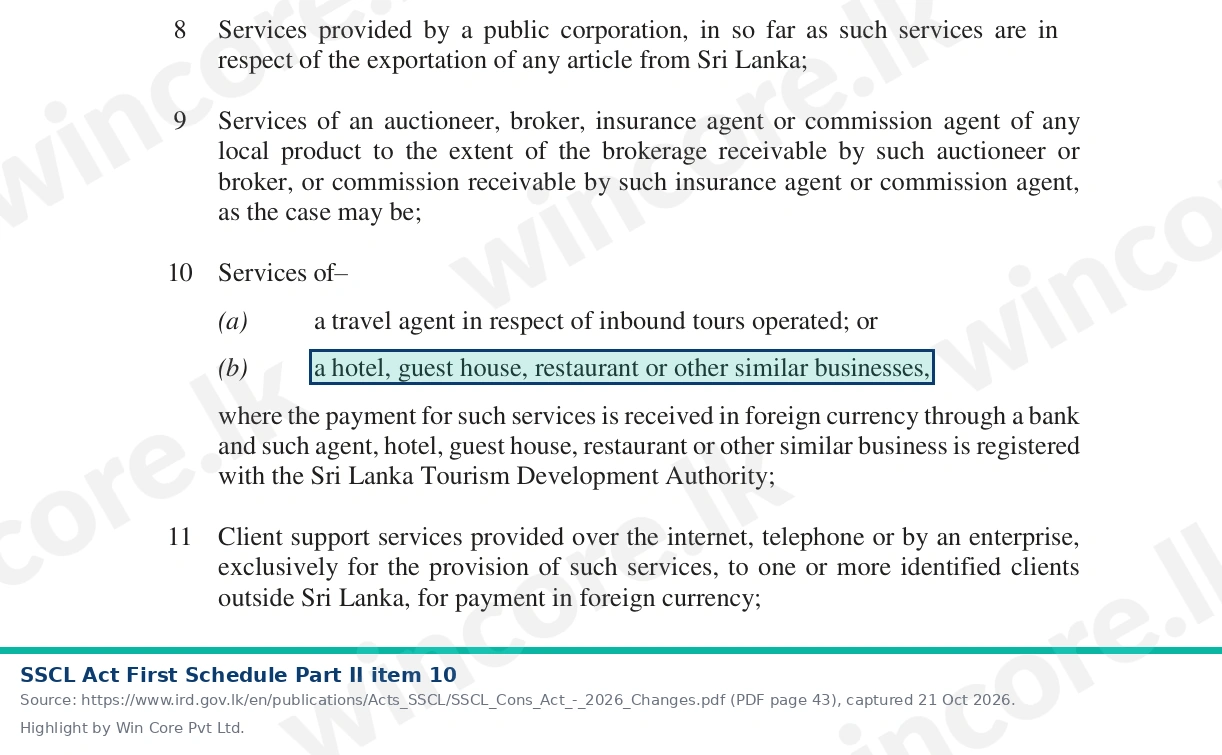
Exemption. First Schedule Part II item 10 exempts services of "a hotel, guest house, restaurant or other similar businesses, where the payment for such services is received in foreign currency through a bank and such agent, hotel, guest house, restaurant or other similar business is registered with the Sri Lanka Tourism Development Authority" [2]. Both conditions must be met, and on our reading the exemption covers only the services paid for that way, not the rest of the turnover.
Registration is tested on turnover, not liable turnover. From 1 July 2026 a business registers within fifteen days once its turnover for a quarter exceeds or is likely to exceed Rs 9 million, or for four consecutive quarters Rs 36 million (s.4(1)(d), inserted by Act No. 10 of 2026) [2].
A restaurant month-end close comes down to eight checks (practice)
A short close, done in the first week of each month, keeps the year-end painless. Our separate piece on a month-end routine and management pack covers the general routine; these are the restaurant-specific checks:
- Check that every day has a posted Z-report and that the month total agrees with the POS monthly report.
- Reconcile each clearing account (cards, each delivery app, credit customers) to nil or to known timing items.
- Reconcile the bank, including cash deposits matched to daily cash counts.
- Count stock and post the movement.
- Accrue unbilled supplier deliveries, utilities and rent.
- Reconcile service charge collected to amounts distributed, and carry any balance as a liability.
- Prepare the VAT and SSCL figures from the posted books, not from a separate POS export, so the returns and the accounts agree.
- Review gross margin and cash over/short against previous months, and explain any large movement.
A hypothetical day, posted
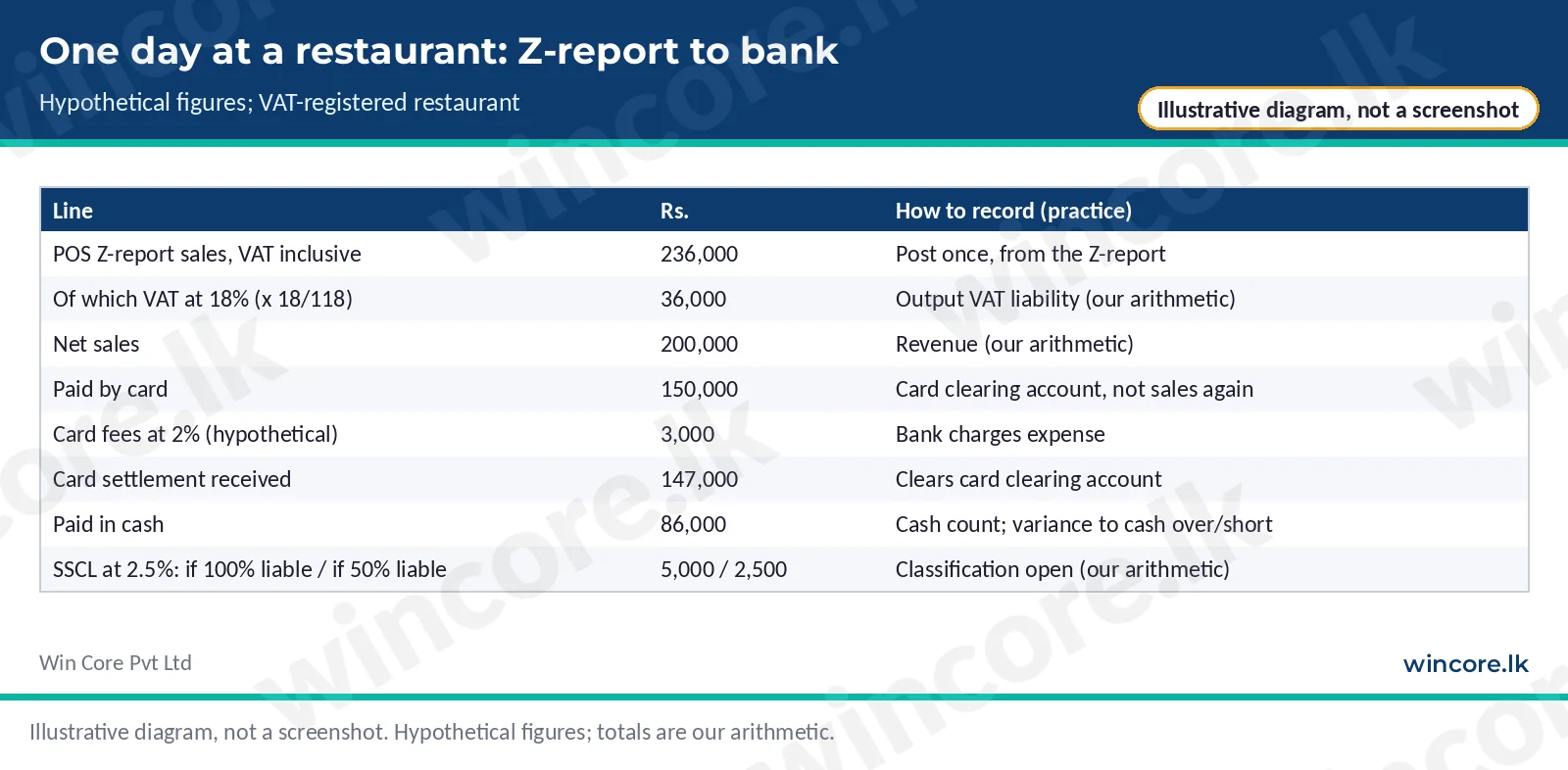
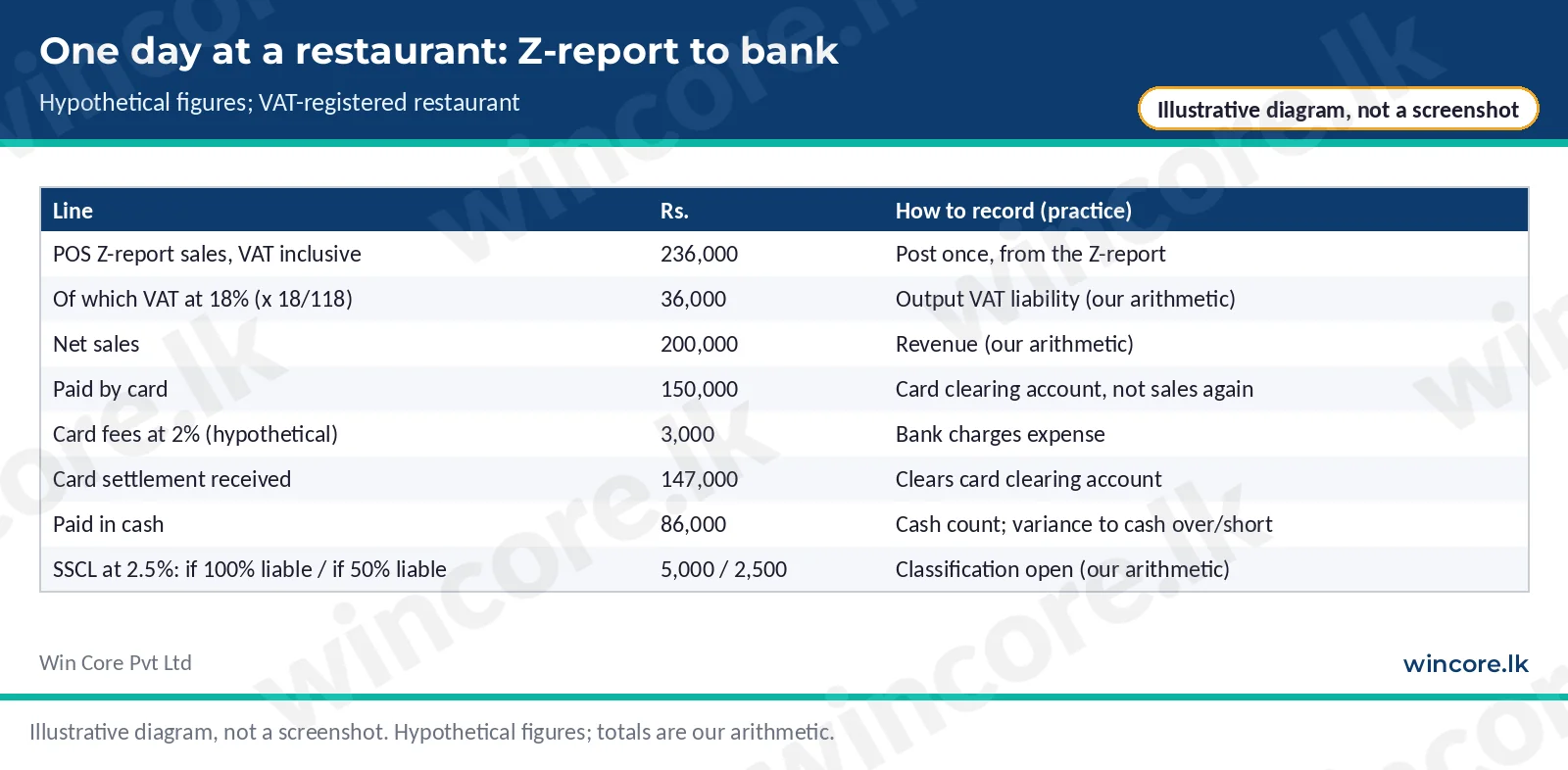
A hypothetical VAT-registered family restaurant takes Rs 236,000 in one day. The Z-report shows Rs 150,000 by card and Rs 86,000 in cash. The bookkeeper posts Rs 200,000 of sales and Rs 36,000 of output VAT once, from the Z-report. When the acquirer pays Rs 147,000, the receipt clears the card clearing account and Rs 3,000 goes to bank charges. The cash count is Rs 85,500, so Rs 500 goes to cash over/short. All figures are hypothetical; the splits are our arithmetic.
Open points we keep open
- SSCL classification of restaurant turnover: service (100 percent) or retail sale (50 percent).
- Service charge law: no statute, regulation or Wages Board decision found in our 22 October 2026 search.
- Service charge for VAT, SSCL, EPF, ETF and APIT: not settled here.
- Narrow VAT items mentioning restaurants in the consolidated text: currency not confirmed.
- Tourism Development Levy and local authority charges: not covered.
What this means for you
Post sales once a day from the Z-report, and use clearing accounts for every payment channel. Keep sales gross and fees as expenses. Count cash every shift and track shortages. Count stock. Hold service charge in a liability until paid out, and settle its payroll treatment before you rely on it. If you are VAT-registered, meals carry VAT at 18 percent on our reading, and tax invoices follow the format in force since 1 October 2026. If you want the daily postings and the VAT and SSCL workings handled for you, our bookkeeping services and tax services cover both. For SSCL, settle whether your turnover is treated as service (100 percent) or retail (50 percent) before you file, and check whether the SLTDA foreign currency exemption applies.
Checklist: documents needed
- Daily POS Z-reports, with voids, refunds and discounts
- Card acquirer and delivery platform statements
- Cash count sheets and bank deposit slips
- Stock counts and waste or staff meal logs
- Service charge collected and distributed, by month (practice)
- VAT and SSCL returns and registration documents
- SLTDA registration and foreign currency receipts, if claiming SSCL item 10
FAQ
Should a restaurant post card settlements as sales?
No, card settlements clear a card clearing account and are not sales again. The sale is posted once, from the Z-report, at the amount the customer paid. When the acquirer pays, the receipt clears the clearing account and the merchant fee goes to bank charges. Posting the settlement as a sale counts the same meal twice and overstates VAT and SSCL turnover.
Do restaurant meals carry VAT in Sri Lanka?
Yes, for a VAT-registered restaurant, at 18 percent on our reading. Section 2(1)(ix) of the VAT Act sets 18 percent for taxable periods from 1 January 2024, and our search of the First Schedule found no general exemption for restaurant meals. A restaurant below the registration thresholds does not charge VAT and should not show it on bills.
Is a restaurant liable to SSCL on 100 or 50 percent of turnover?
That is an open point: the Act does not say whether a restaurant provides a service or makes a retail sale. Services are liable on 100 percent of turnover and retail sale on 50 percent, so the levy differs by half. We found no IRD guidance settling it. Agree the treatment before filing.
Is there a law on restaurant service charge in Sri Lanka?
We found none in force in a search on 22 October 2026. The Shop and Office Employees Act consolidation and the Hotel and Catering Trade Wages Board gazettes we opened do not mention it. That does not prove no instrument exists, so treat it as open, and hold service charge as a liability to staff until it is paid out.
Talk to us. If you run a restaurant and want your POS postings, clearing accounts or VAT and SSCL workings checked, book a consultation at our contact page.
WinCore Pvt Ltd
References
- Inland Revenue Department. Value Added Tax Act, No. 14 of 2002 (consolidated up to 2025), s.2(1)(ix), First Schedule. https://www.ird.gov.lk/en/publications/Value%20Added%20Tax_Acts/VAT_Act_No_14%5BE%5D_2002_%28Consolidation_2025%29.pdf . Primary (consolidation). Accessed 22 October 2026.
- Inland Revenue Department. Social Security Contribution Levy Act, No. 25 of 2022 (consolidated up to 2026), ss.2, 3, 4(1)(d); First Schedule Part II item 10; Second Schedule items 3 and 4. https://www.ird.gov.lk/en/publications/Acts_SSCL/SSCL_Cons_Act_-_2026_Changes.pdf . Primary (consolidation). Accessed 22 October 2026.
- Shop and Office Employees (Regulation of Employment and Remuneration) Act, consolidated to 2024 (Lanka Law). https://lankalaw.net/wp-content/uploads/2025/03/Shop-and-Office-Employees-Consolidated-2024.pdf . Secondary consolidation. Accessed 21 October 2026.
- Parliament of Sri Lanka. Companies Act, No. 7 of 2007, s.148(1). https://www.parliament.lk/uploads/acts/gbills/english/3776.pdf . Primary. Accessed 21 October 2026.
- Inland Revenue Department. Inland Revenue Act, No. 24 of 2017 (consolidated up to 2025), s.120(5). https://www.ird.gov.lk/en/publications/Acts_Income%20Tax_2017/IRA_Cons_Act_-_2025_Changes.pdf . Primary (consolidation). Accessed 21 October 2026.
- Inland Revenue Department. Notice to taxpayers PN/SSCL/2021-01, Social Security Contribution Levy, 21 September 2022. https://www.taxadvisor.lk/data/uploads/_notice_to_taxpayers_22_09_2022_.pdf . Secondary host of an IRD notice. Accessed 22 October 2026.
- Gazette Extraordinary No. 2081/49 of 26 July 2018 (Hotel and Catering Trade Wages Board decisions) https://www.documents.gov.lk/view/extra-gazettes/2018/7/2081-49_E.pdf and No. 2489/07 of 18 May 2026 (Wages Boards appointments) https://documents.gov.lk/view/egz/2026/5/2489-07_E.pdf . Primary. Accessed 22 October 2026.
Put these insights to work
WinCore specialists can review your current workflow, document gaps, and build a practical 90-day action plan.
Book a free consultationContinue reading
Explore more WinCore analysis to keep your finance, tax, and compliance roadmap moving.

Bookkeeping guide for Sri Lankan small businesses: legal requirements, chart of accounts, source documents, 5-year retention rule, and monthly routines.
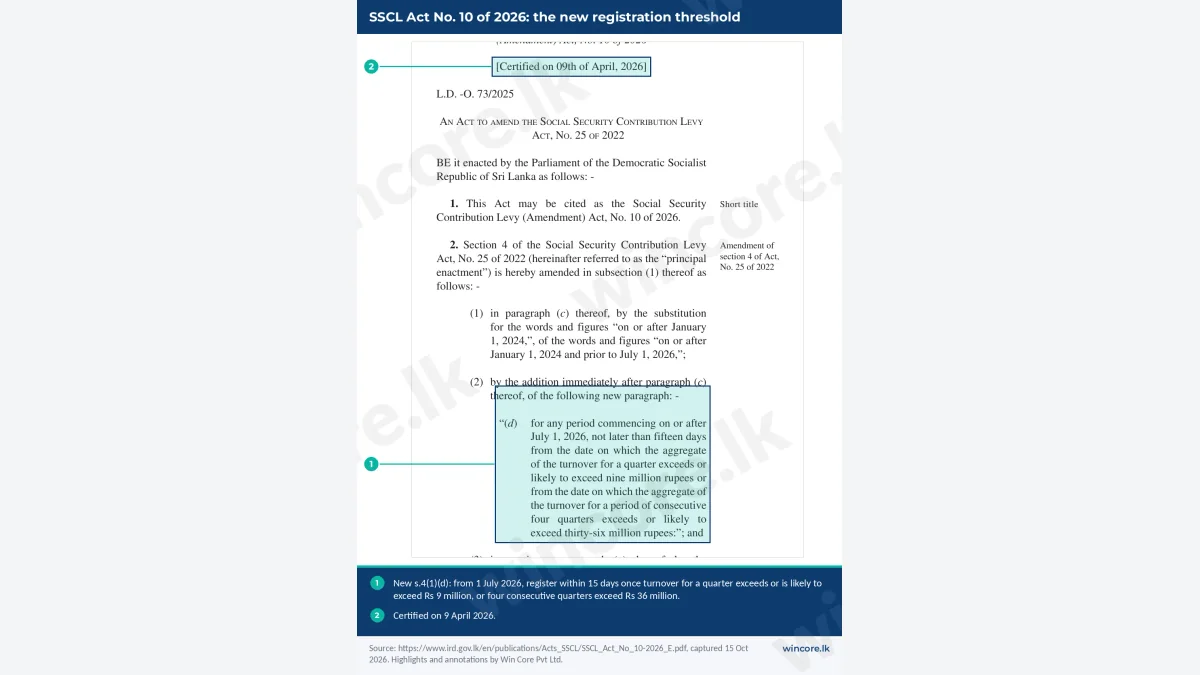
SSCL registration now starts at Rs 9 million a quarter or Rs 36 million a year from 1 July 2026. How to test, register and pay monthly.
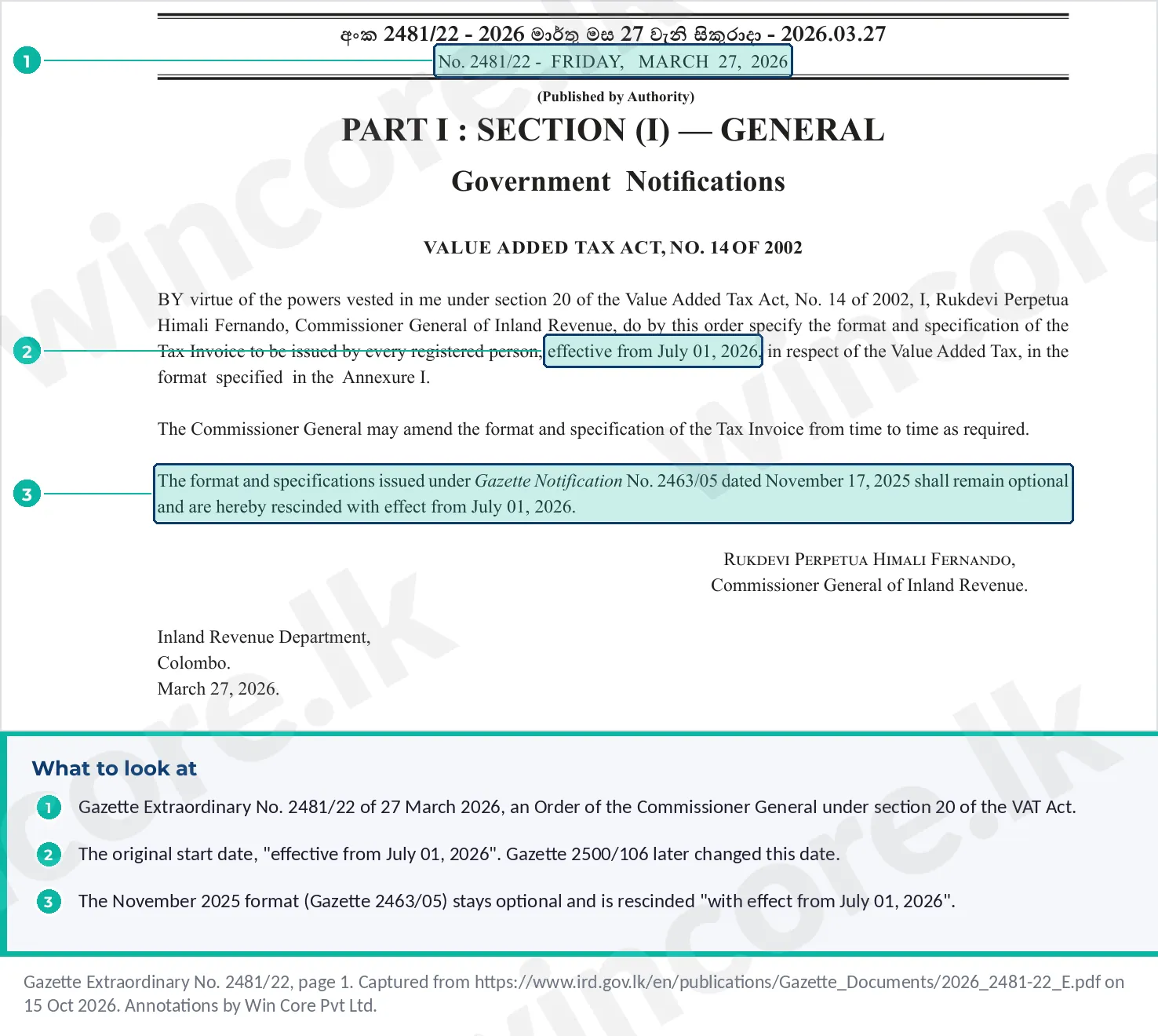
The IRD Order behind the new VAT tax invoice: the 1 October start, the serial number and date rules, and which default carries which penalty.