
Petty cash system in Sri Lanka: approvals and supplier invoices
Set up a fixed cash float, a spending approval matrix and a supplier invoice check that keep daily records clean and your input tax claims safe.
On this page
Last verified against the primary sources on 22 October 2026.
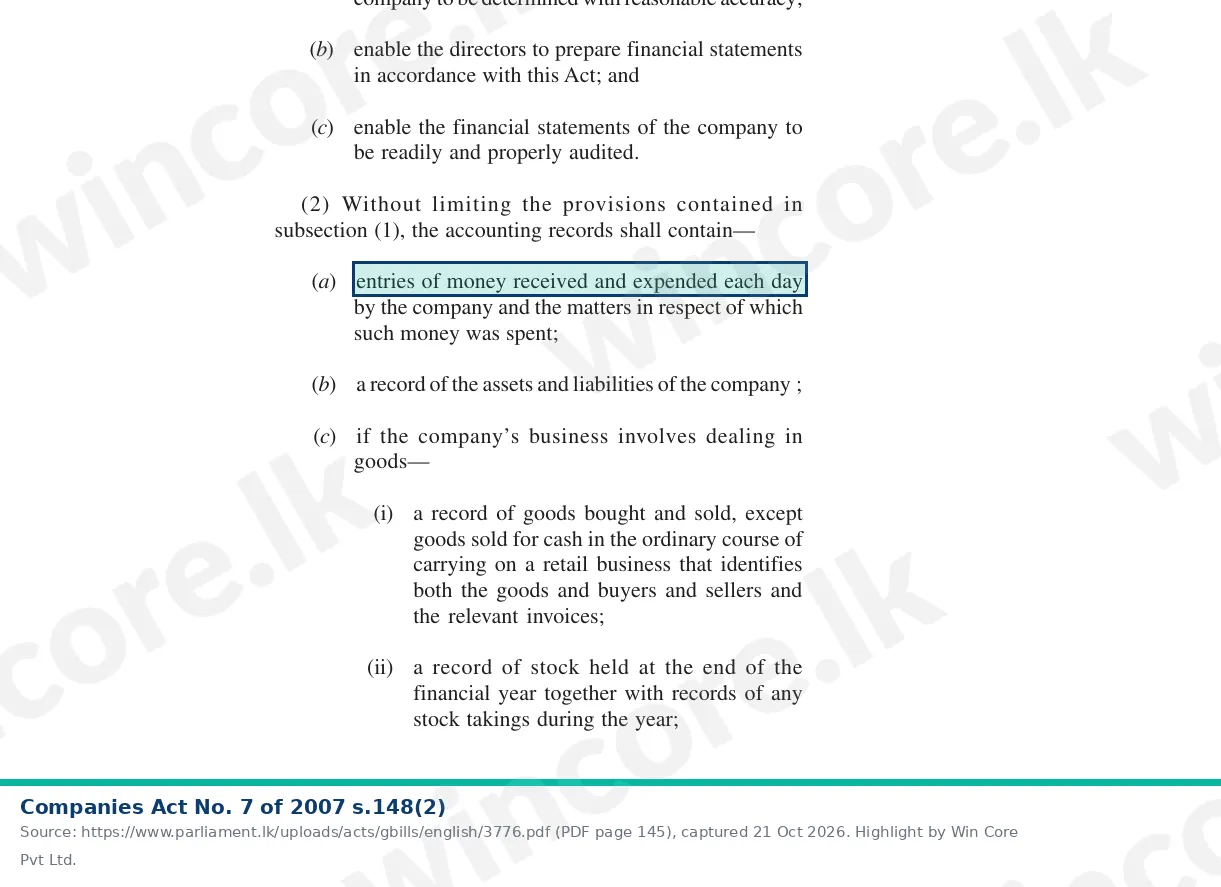
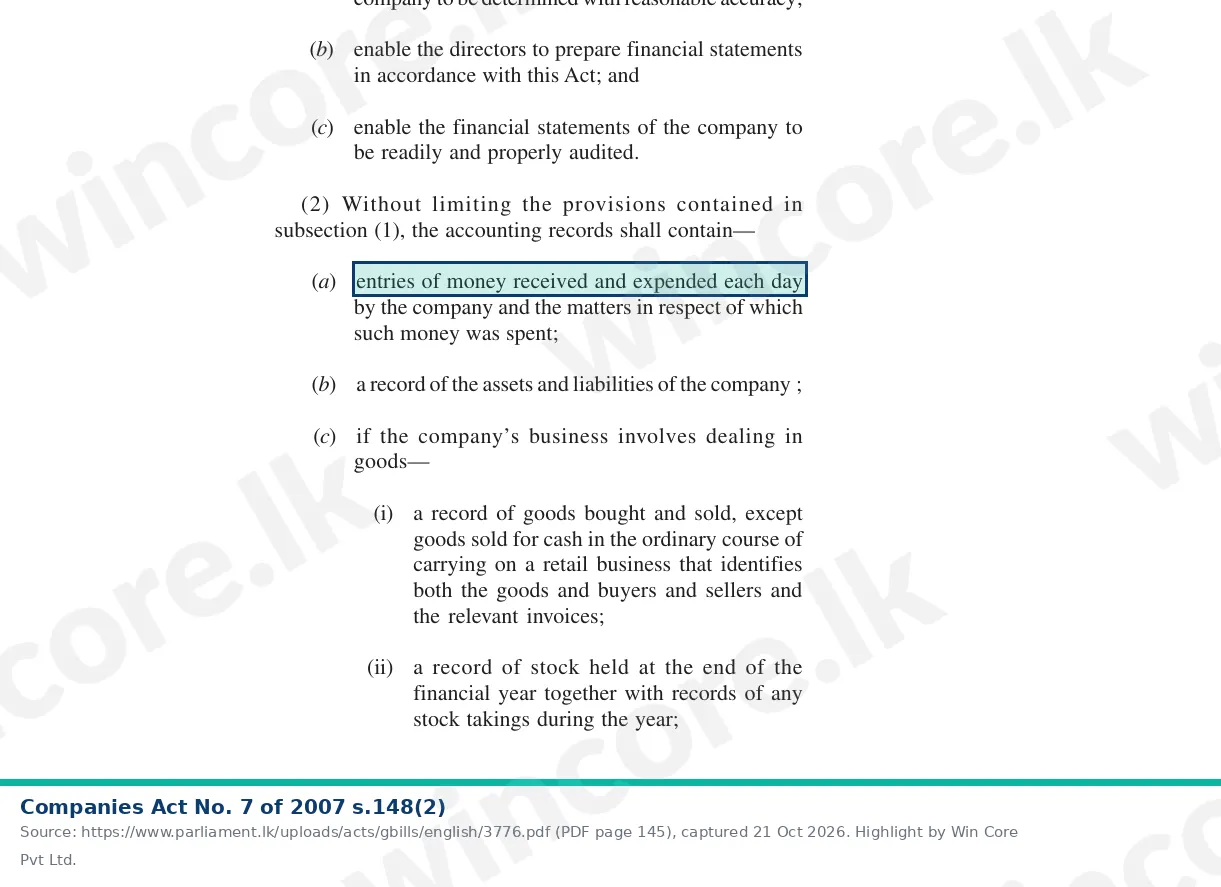
A petty cash system in Sri Lanka has to meet one legal rule before any design choice: section 148(2)(a) of the Companies Act, No. 7 of 2007 requires accounting records to contain entries of money received and spent each day "and the matters in respect of which such money was spent". For a VAT-registered company there is a second rule: under section 22(6)(iii) of the VAT Act, input tax cannot be deducted unless the purchase is supported by a valid tax invoice received within twelve months from the end of the relevant taxable period. Everything else in this article (the imprest float, the approval matrix, the three-way match) is practice, not law, and the limits we use are examples.
In a new company the owner approves everything, often by paying personally. That works until there are a dozen staff, several suppliers a week and a bookkeeper who was not there when the spending happened. Then receipts go missing, invoices get paid twice, and nobody can say who agreed to a purchase.
Sections 148 and 120 set the legal floor for any finance process
Two statutory rules sit underneath any finance process.
First, the Companies Act, No. 7 of 2007. Section 148(2) says the accounting records "shall contain (a) entries of money received and expended each day by the company and the matters in respect of which such money was spent" [1]. On our reading, petty cash spent without a record of what it was for does not meet that wording, however small the amount.
Second, the Inland Revenue Act, No. 24 of 2017 requires a taxpayer to "retain source documents and underlying documentation utilized in the creation of the records and accounts" (section 120(5)) [2]. Our guide to bookkeeping basics covers record keeping in general.
For VAT-registered companies there is a third rule, covered under supplier invoices below.
A petty cash system works best as a fixed imprest float (practice)
Use an imprest system
This section is practice, not a legal requirement. An imprest float is a fixed amount of cash, say Rs 50,000, held by one named custodian. Every payment out is supported by a voucher and a receipt. At any moment, cash on hand plus vouchers paid should equal the float. When the cash runs low, the vouchers are reviewed and the float is topped up by exactly the amount spent.
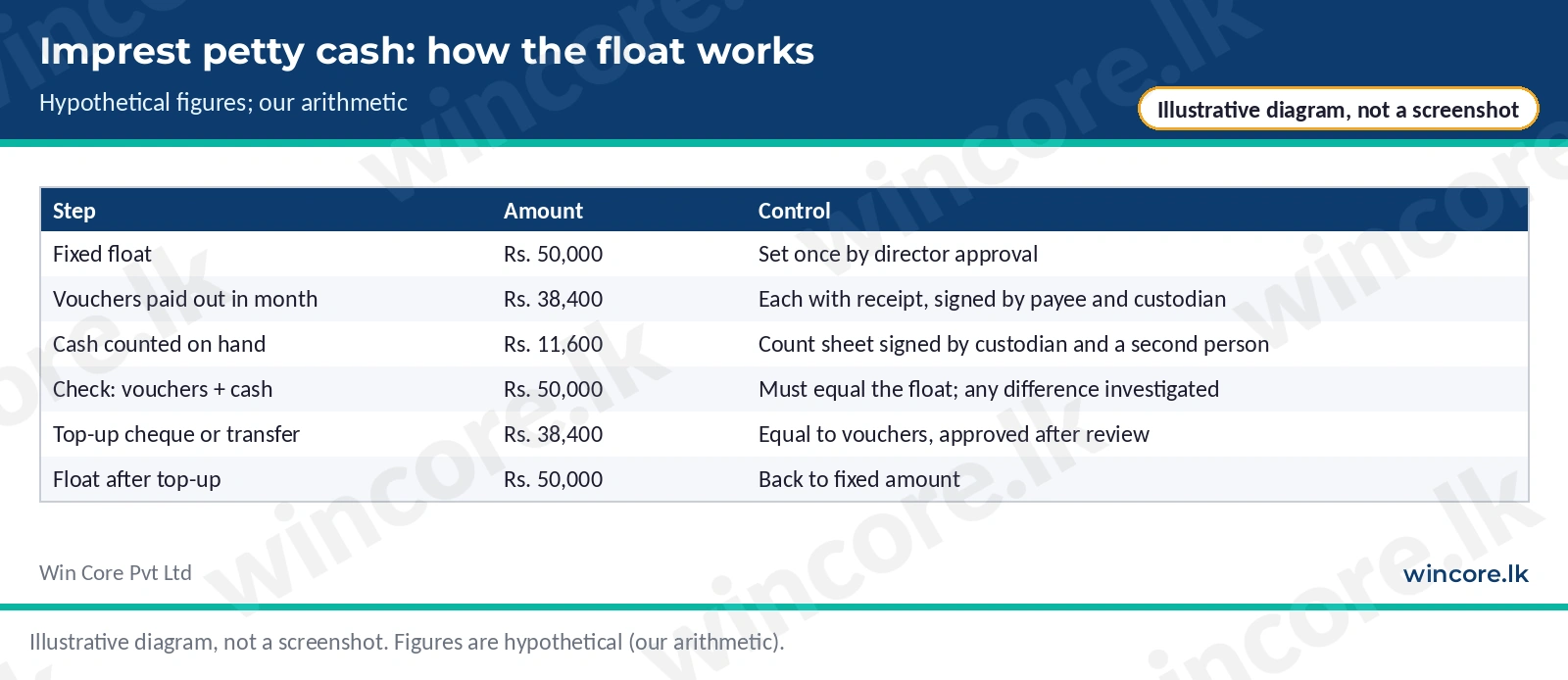
In the hypothetical figures in the diagram, vouchers of Rs 38,400 and cash of Rs 11,600 add back to the Rs 50,000 float, and the top-up is Rs 38,400 (our arithmetic). If the count and vouchers do not add up, the difference is investigated before any top-up.
The advantage over an open-ended cash tin is that the float itself is a control. A shortfall shows up at the next count, not at year-end.
Rules worth writing down
- One custodian. Only one person holds the key and signs for the float. When they go on leave, count and hand over formally.
- A per-item limit. Above it, payment goes through the bank. Pick a limit that suits your business.
- No splitting. Two vouchers for one purchase to stay under the limit is a breach, not a workaround.
- A voucher for every payment, showing date, amount, what it was for, who received the cash and who approved it. Attach the receipt.
- No IOUs or salary advances from petty cash. Those are loans to staff and belong in payroll or a staff loan account.
- A surprise count by someone other than the custodian, at least now and then.
- Monthly reconciliation as part of the close. See our month-end close checklist.
If directors pay company costs from their own pockets instead of petty cash, that creates a director current account. Record each payment against the director, with the bill, and settle the balance on a schedule.
VAT on petty cash spending
Small cash purchases often come with a till slip rather than a tax invoice. For a VAT-registered company, that matters, because input tax needs a valid tax invoice (see below). In practice, decide which recurring cash purchases are large enough to justify asking for a tax invoice, and tell the custodian.
For a restaurant, reconcile petty cash with the POS, delivery-platform and daily-sales records, rather than treating the till as a general cash float.
Approval comes before the commitment, in a one-page matrix (practice)
An approval matrix
This section is practice, not a legal requirement. An approval matrix says who can commit the company to spending, and up to what amount. It should be one page, agreed by the directors and reviewed every year.
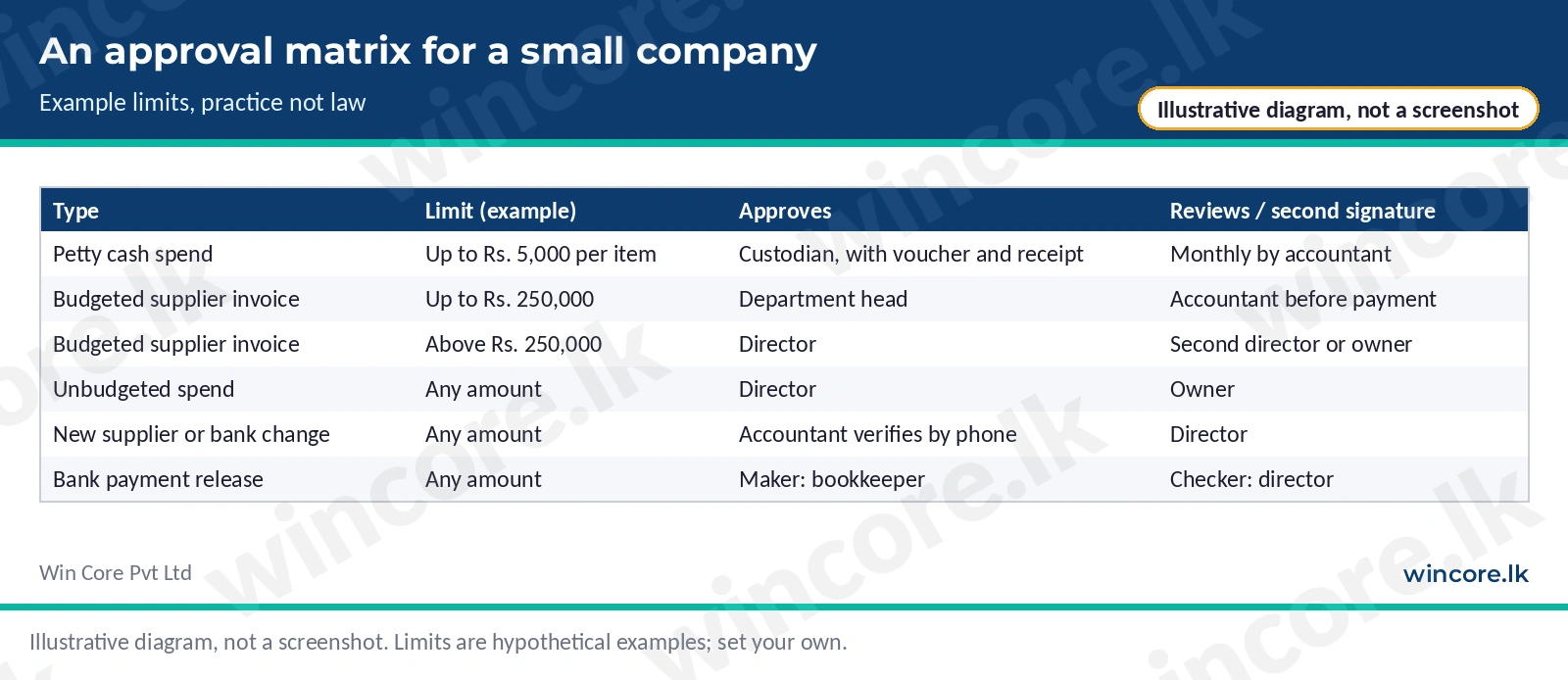
The limits in the diagram are hypothetical. What matters is the structure:
- Approval before commitment. A purchase order or written approval exists before the supplier is engaged, not after the invoice arrives.
- Budget as the first test. Budgeted spending can be approved lower down; unbudgeted spending goes up a level.
- Separation of duties. The person who approves a purchase should not be the only person who releases the payment. In a small team, a common pattern is that the bookkeeper prepares payments in online banking (the maker) and a director releases them (the checker).
- Bank mandate to match. The bank's signing rules should reflect the matrix. A matrix that says two signatures while the bank needs one is not a control.
Changes to supplier bank details
A frequent fraud is an email, apparently from a supplier, saying their bank account has changed. In practice, never change supplier bank details on email alone. Call the supplier on a number already held on file, record who confirmed the change, and have a second person approve the change in the system.
Supplier invoices need a three-way match and a valid tax invoice
The three-way match
This section is practice, not a legal requirement. Before an invoice is approved for payment, match three documents:
- the purchase order or approval (what was agreed);
- the delivery note or confirmation that the service was received (what arrived);
- the supplier's invoice (what is being charged).
Quantities, prices and terms should agree. Differences go back to the approver, not straight to payment.
Valid tax invoices and the twelve-month window
For VAT-registered buyers, the Value Added Tax Act, No. 14 of 2002 sets a hard rule. Section 22(6) lists cases where input tax "shall not be deducted", including "(iii) if the supply of goods or services received is not supported by (a) a valid tax invoice ; or (b) a customs goods declaration or other authenticated document issued by the Director-General of Customs" and "received within twelve months from the end of the relevant taxable period in respect of which such tax invoice was issued or from the date of importation of goods, as the case may be" [3].
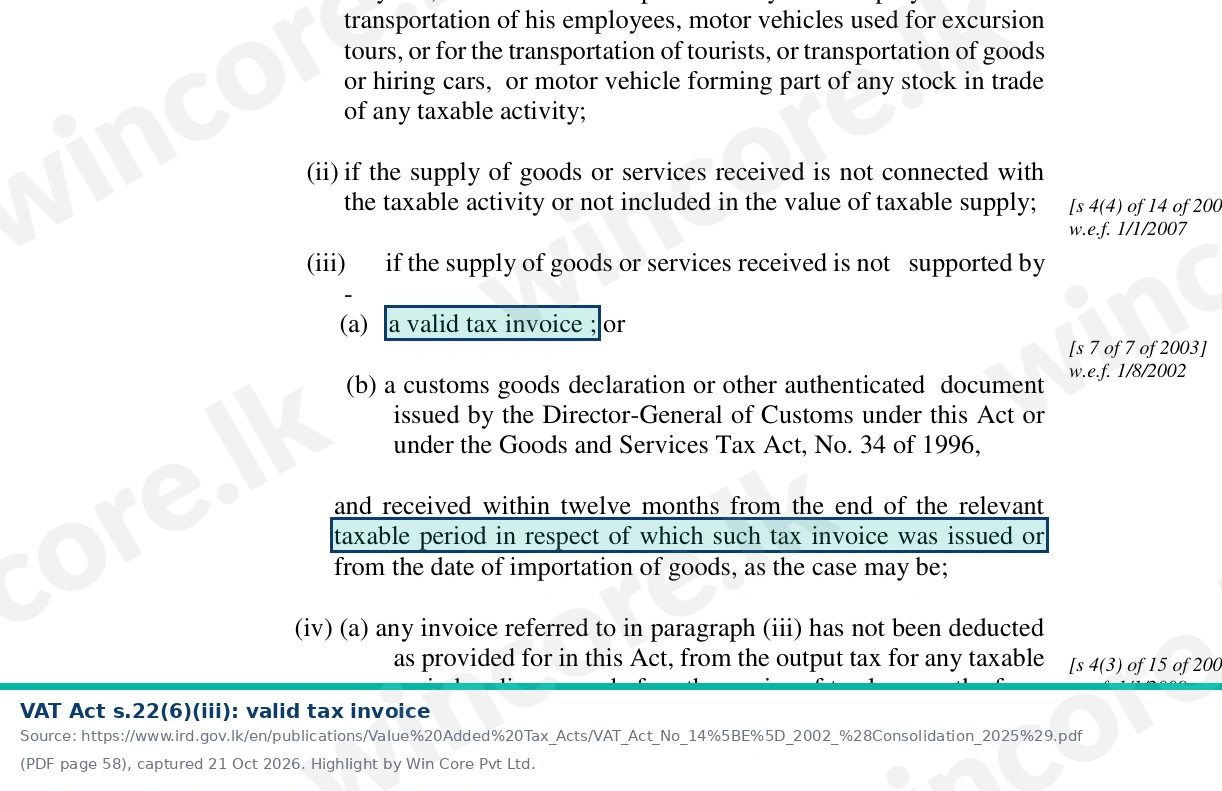
Section 22(6)(iv)(a) adds that input tax is lost where the invoice "has not been deducted as provided for in this Act, from the output tax for any taxable period ending on or before the expiry of twelve months from the date of such tax invoice" by furnishing the return within that period [3].
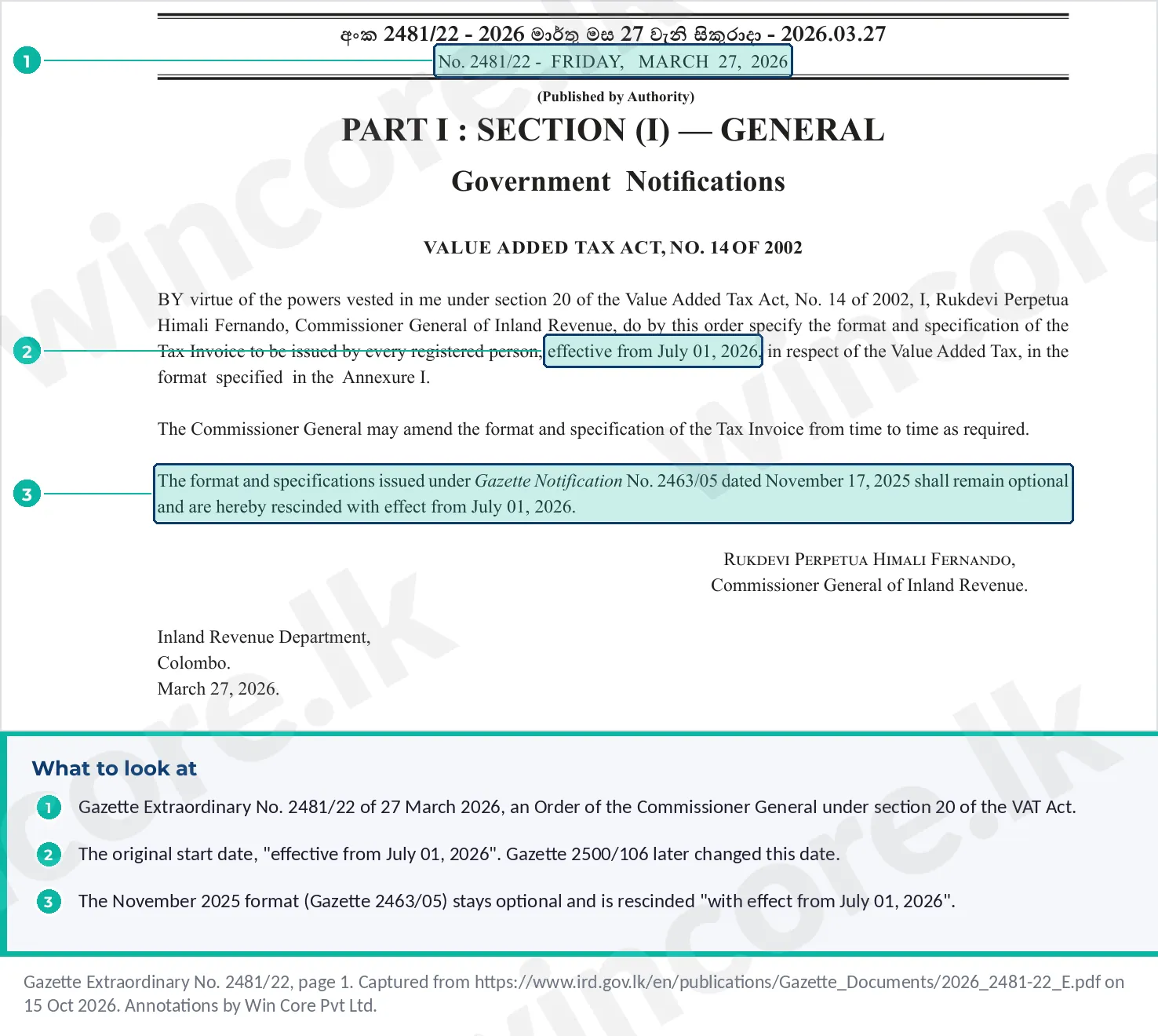
In practice this means three things for your process. Check that each supplier invoice is a valid tax invoice before you approve it; since 1 October 2026 a tax invoice must follow the format in Gazette 2481/22, which our article on the tax invoice format sets out field by field. Chase missing tax invoices promptly rather than at year-end. And post invoices in the period received so the claim is made well within the time limit. Purchases made before your own VAT registration raise a separate question, which we do not cover here.
Duplicates and statements
- One invoice, one entry. Use the supplier's invoice number as a reference field and let the software flag duplicates.
- Stamp or mark paid invoices with the payment date and reference.
- Reconcile supplier statements monthly for main suppliers. A statement that shows an invoice you have never seen is the best way to find a missing bill.
- Do not pay from statements. Pay approved invoices only; statements are for checking.
A payment run
In practice, pay suppliers on a fixed day each week or fortnight. The bookkeeper prepares a list of approved, matched invoices due for payment. A director reviews the list against the cash forecast and releases the payments. Ad hoc payments outside the run need the same approvals and should be rare. Our article on cash flow management covers forecasting.
A worked example
Hypothetical. An engineering contractor receives an invoice for Rs 1,180,000, being Rs 1,000,000 plus VAT of Rs 180,000 at the 18 percent rate in section 2(1)(ix) of the VAT Act (our arithmetic; the VAT calculator gives the same split). The invoice arrives without the buyer's TIN, which the Gazette 2481/22 format requires. Under the approval matrix in our diagram, a director approves it, since it is above Rs 250,000. The bookkeeper's three-way match passes on quantity and price, but the tax invoice check fails. The process sends it back to the supplier for a corrected tax invoice before payment. Paying first and chasing later puts the Rs 180,000 of input tax at risk, because if a valid tax invoice is not received within the twelve-month window in section 22(6)(iii), the deduction is lost.
A five-page finance manual is enough for a small company (practice)
This section is practice, not a legal requirement. A finance manual for a small company can be five pages:
- the approval matrix;
- petty cash rules and the voucher form;
- the supplier invoice steps and payment run day;
- the rule on supplier bank detail changes;
- where documents are filed, and for how long.
Have the directors approve it, give a copy to everyone who spends money, and review it each year.
Open points we keep open
- Stamp duty on receipts. We did not review whether stamp duty applies to receipts issued or received in your process.
- Withholding on supplier payments. Some payments carry withholding tax, for example 5 percent on listed service fees to a resident individual where a month's payments exceed Rs 100,000; see our guide to WHT on service fees. Advance income tax on other supplier payments is not reviewed here.
- VAT amendments. We read the IRD consolidation up to 2025. VAT (Amendment) Act No. 14 of 2026 adds s.22(6)(vii) on deferred project imports; we did not re-check it for any change to paragraphs (iii) and (iv).
- Later limbs of s.22(6). We read paragraphs (iii) and (iv)(a) for this piece, not the rest of the subsection.
What this means for you
The law asks for daily records of money in and out, with what it was spent on, and for source documents behind the records. VAT law makes the tax invoice, and its timing, a condition of input tax. A simple process built on an imprest float, an approval matrix and a three-way match meets those rules in practice and protects you against the most common errors and frauds. If you want the process written and run for you, our bookkeeping services and accounting services cover petty cash, payables and the monthly reconciliations.
Checklist: documents needed
- Approval matrix signed by the directors
- Bank mandate matching the matrix
- Petty cash voucher forms and count sheets
- Purchase orders or written approvals
- Delivery notes or service confirmations
- Valid tax invoices from VAT-registered suppliers
- Supplier statements for main suppliers
- Record of supplier bank detail changes and who confirmed them
- Payment run lists with approver sign-off
FAQ
How big should a petty cash float be?
In practice, big enough for two to three weeks of genuine small cash spending, set from what you actually spend. If you top up more than a couple of times a month, the float or the per-item limit is probably wrong. Anything regular or large should move to bank payment, where the record and the approval are easier to evidence.
Is a receipt enough for petty cash in Sri Lanka?
For your records, a receipt plus a voucher saying what the money was for, because section 148(2)(a) asks for the matters on which money was spent. For a VAT-registered company claiming input tax, a till slip is not enough: section 22(6)(iii) of the VAT Act requires a valid tax invoice received within the time limit.
We only have two directors. How do we separate duties?
Have one director prepare payments and the other release them, and both review the monthly bank reconciliation. A small team cannot separate every duty, so review matters more than structure. Keep the bank mandate in line with what the approval matrix says, so the bank enforces the same rule your matrix does.
What if a supplier will not issue a tax invoice?
Then a VAT-registered buyer cannot deduct the input tax on that purchase. Section 22(6)(iii) blocks the deduction where the supply is not supported by a valid tax invoice received in time. In practice, ask before you order, factor the lost input tax into the price, or choose a supplier who will issue one.
Can we approve supplier invoices by email?
In practice, yes, if the approval is kept with the invoice and the approver is identified, though no statute we read sets the form of an internal approval. Approval inside the accounting software is easier to evidence and harder to lose. Whatever you use, apply it the same way every time and keep it for as long as the invoice.
Talk to us. If you want a petty cash, approval and supplier invoice process set up for your company, book a consultation at our contact page.
WinCore Pvt Ltd
References
- Parliament of Sri Lanka. Companies Act, No. 7 of 2007, s.148. https://www.parliament.lk/uploads/acts/gbills/english/3776.pdf . Primary. Accessed 21 October 2026; re-checked 22 October 2026 from the captures.
- Inland Revenue Department. Inland Revenue Act, No. 24 of 2017 (consolidated up to 2025), s.120. https://www.ird.gov.lk/en/publications/Acts_Income%20Tax_2017/IRA_Cons_Act_-_2025_Changes.pdf . Primary (consolidation). Accessed 21 October 2026; re-checked 22 October 2026 from the captures.
- Inland Revenue Department. Value Added Tax Act, No. 14 of 2002 (consolidated up to 2025), s.22(6). https://www.ird.gov.lk/en/publications/Value%20Added%20Tax_Acts/VAT_Act_No_14%5BE%5D_2002_%28Consolidation_2025%29.pdf . Primary (consolidation). Accessed 21 October 2026; re-checked 22 October 2026 from the captures.
Put these insights to work
WinCore specialists can review your current workflow, document gaps, and build a practical 90-day action plan.
Book a free consultationContinue reading
Explore more WinCore analysis to keep your finance, tax, and compliance roadmap moving.

Bookkeeping guide for Sri Lankan small businesses: legal requirements, chart of accounts, source documents, 5-year retention rule, and monthly routines.
The IRD Order behind the new VAT tax invoice: the 1 October start, the serial number and date rules, and which default carries which penalty.
Cash flow management for Sri Lankan SMEs: the cash conversion cycle, 13-week rolling forecasts, receivables and payables, factoring, and planning tax payments.