
Management accounts basis of preparation: the block every pack needs
A short block at the front of a monthly pack tells directors, banks and investors what the numbers are, what was estimated and what was not checked.
On this page
Last verified against the primary sources on 22 October 2026.
A management accounts basis of preparation is a short statement at the front of a monthly pack that says what the numbers are: unaudited, internal, prepared on the accrual basis, with named estimates and a list of what was not checked. No Sri Lankan law we read requires one, so this is a recommendation, not a rule. The accounting standard that governs annual accounts for most private companies, SLFRS for SMEs (2015), sets the limits: paragraph 3.3 says financial statements "shall not be described as complying with the SLFRS for SMEs unless they comply with all the requirements of this Standard", and paragraphs 8.5 to 8.7 require annual statements to disclose their measurement basis, key judgements and key sources of estimation uncertainty [1]. A monthly pack should borrow that discipline without borrowing the compliance claim.
Management accounts basis of preparation: why every pack should state one
A pack goes to directors, and often further: to a bank, an investor, a buyer or a landlord. Once it leaves the room, the reader cannot tell how it was prepared, what was estimated, what was not reconciled and whether the figures will move. The block answers those questions before they are asked.
On our reading, the standard itself explains why a monthly pack is different. Paragraph 2.2 states the objective of financial statements as information "useful for economic decision-making by a broad range of users of the financial statements who are not in a position to demand reports tailored to meet their particular information needs" [1]. Directors who ask for a monthly pack are exactly the users who can demand a tailored report. Paragraph 2.14 notes that "financial information used internally is often based at least partly on information prepared for general purpose financial reporting purposes" [1]. So a pack draws on the standard's methods but is not a set of general purpose financial statements, and it should say so.
In our view the block does three jobs:
- It tells the reader what the numbers are. Unaudited, internal, prepared on a stated basis.
- It shows where the soft spots are. Estimates, unreconciled items and known issues.
- It limits reliance to the purpose the pack was prepared for.
This is practice. Our accounting services and virtual CFO services prepare monthly packs with this block at the front.
Do not describe a monthly pack as complying with SLFRS for SMEs
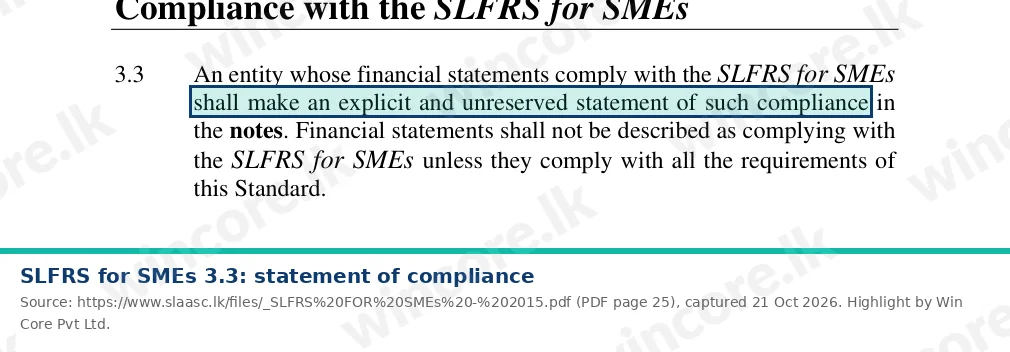
Paragraph 3.3 reads in full: "An entity whose financial statements comply with the SLFRS for SMEs shall make an explicit and unreserved statement of such compliance in the notes. Financial statements shall not be described as complying with the SLFRS for SMEs unless they comply with all the requirements of this Standard" [1].
"All the requirements" is a high bar. Paragraph 3.17 says a complete set of financial statements includes a statement of financial position, a statement of comprehensive income (or an income statement with it), a statement of changes in equity, "a statement of cash flows for the reporting period" and notes with a summary of significant accounting policies; paragraph 3.14 requires comparative information for all amounts presented [1]. On our reading, a monthly pack rarely has all of that. We recommend it does not describe itself as "prepared in accordance with SLFRS for SMEs". Safer wording, our own: prepared on the accrual basis, broadly consistent with the accounting policies in the last annual financial statements, with known departures listed.
Paragraph 2.36 supports naming the basis: an entity "shall prepare its financial statements, except for cash flow information, using the accrual basis of accounting" [1]. If the pack keeps some lines on a cash basis, for example small bills expensed when paid, the block should say which.
Section 8 of the standard shows what to say about estimates
Section 8 governs the notes to annual financial statements, and three paragraphs give a model for the block:
- 8.5: the summary of significant accounting policies discloses "the measurement basis (or bases) used in preparing the financial statements" and "the other accounting policies used that are relevant to an understanding of the financial statements".
- 8.6: disclosure of "the judgements, apart from those involving estimations", that management made in applying the policies and that have "the most significant effect on the amounts recognised".
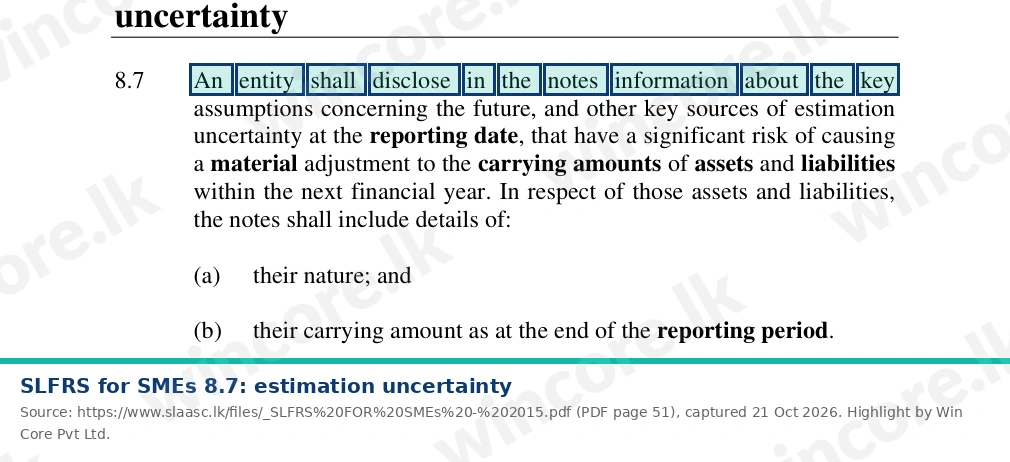
- 8.7: disclosure of "the key assumptions concerning the future, and other key sources of estimation uncertainty at the reporting date, that have a significant risk of causing a material adjustment to the carrying amounts of assets and liabilities within the next financial year", including "(a) their nature; and (b) their carrying amount as at the end of the reporting period" [1].
These paragraphs apply to annual financial statements, not to management packs. The idea transfers well, and it is our recommendation, not a requirement: name each key estimate, give its amount and say how it was reached. Paragraph 2.30 is a useful reminder for directors who distrust estimates: "The use of reasonable estimates is an essential part of the preparation of financial statements and does not undermine their reliability" [1]. Paragraph 2.12 adds the trade-off every monthly pack faces: "Management may need to balance the relative merits of timely reporting and the provision of reliable information" [1]. The block is where that balance is made visible.
Eight headings cover what a reader needs
This section is practice. The headings below are a suggested structure; adapt them to the business.
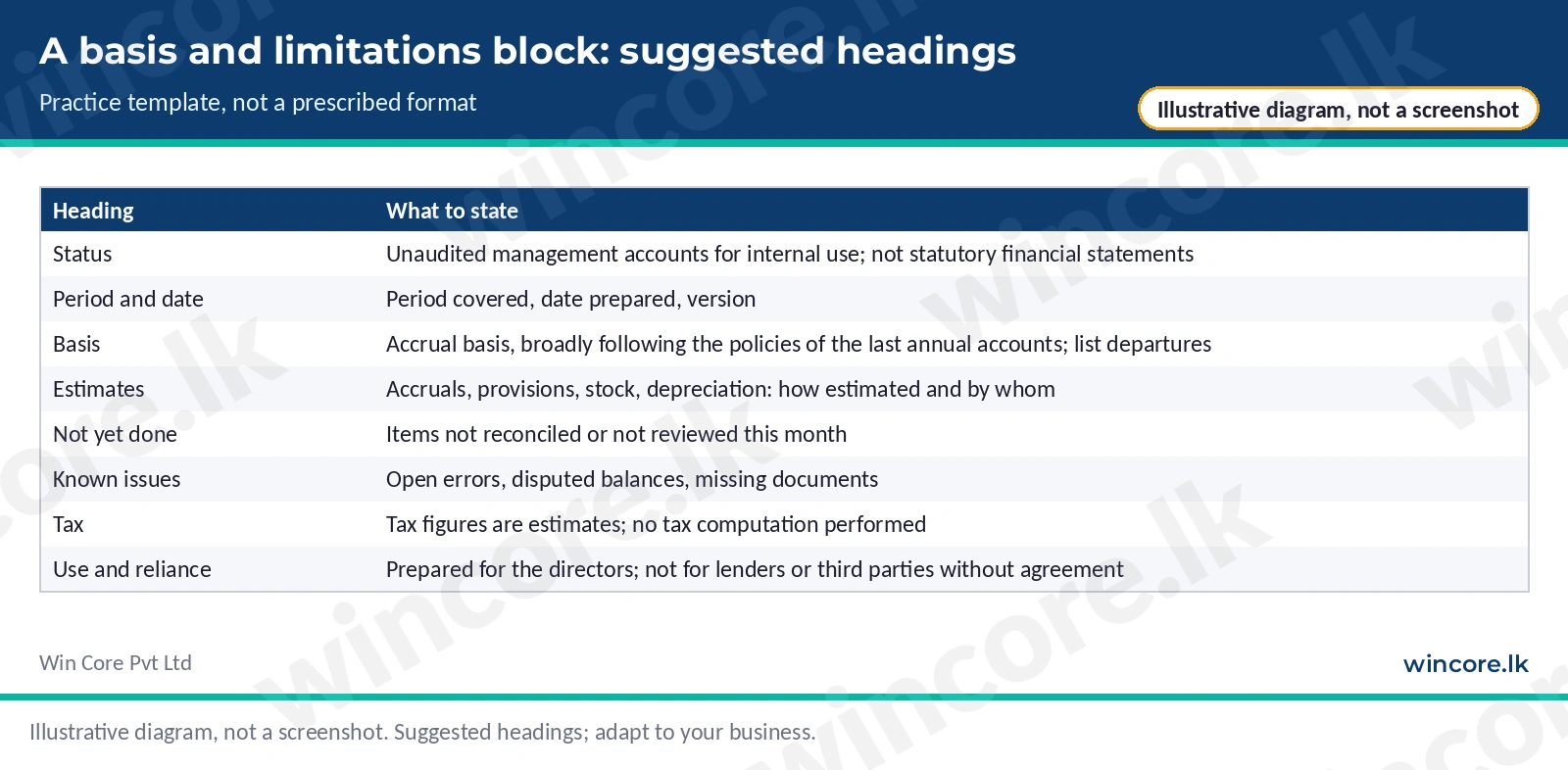
Status. Unaudited management accounts for internal use, not statutory financial statements. If an outside accountant reviewed any part, say what and how far.
Period, date and version. The period covered, the date prepared and a version number. If a revised pack is issued, say what changed.
Basis. The accrual basis and the policies used, by reference to the last annual financial statements, with departures listed: for example depreciation at one twelfth of the annual charge, stock rolled forward from the last count, no impairment review this month, small bills expensed when paid.
Key estimates. The material estimates and their amounts: accruals for bills not yet received, provisions, stock, allowances for doubtful debts and any revenue recognised by stage of completion. Say who made each one and on what basis. A short table works. Shading estimated cells in the figures themselves helps the reader find them.
Not done this month. What was not reconciled or reviewed: an account not reconciled, supplier statements not matched, intercompany balances not agreed. This is the most useful line for any reader and the one most often left out.
Known issues. Open errors, disputed balances, documents not yet traced and any matter the directors know may change the figures.
Tax. If tax is shown, whether it is an estimate and on what basis. A monthly pack rarely includes a full computation; say so. The corporate tax calculator can help check the headline estimate.
Use and reliance. Who the pack is prepared for, and that it should not be given to or relied on by third parties without agreement. If a lender requires monthly accounts, agree the basis with the lender in writing.
Sample wording
Our own example for a small company, about 130 words; change it to fit the facts each month:
These are unaudited management accounts for the month ended 30 September, prepared for the directors on 8 October (version 1). They are not statutory financial statements and have not been audited or reviewed. They are prepared on the accrual basis, broadly consistent with the accounting policies in the annual financial statements for the year ended 31 March, except that depreciation is charged at one twelfth of the annual amount and stock is rolled forward from the June count. Key estimates: freight accrual Rs. 600,000; stock Rs. 18,000,000. Not done this month: reconciliation of the second current account. Known issues: one supplier balance in dispute. Tax is estimated at the expected annual rate; no tax computation has been prepared. These accounts should not be provided to or relied on by third parties without our agreement.
One named estimate turns a surprise into a revision
Hypothetical, rupee figures invented. A wholesaler with a monthly bank covenant sends its September pack to the bank. The pack shows profit of Rs. 2,400,000 for the month. Its block names two key estimates: a freight accrual of Rs. 600,000 for bills not yet received, and stock of Rs. 18,000,000 rolled forward from the June count. It also says one current account has not been reconciled.
In October the September freight bills arrive at Rs. 850,000. September cost was understated by Rs. 250,000, so September profit was Rs. 2,150,000, not Rs. 2,400,000 (our arithmetic: 850,000 less 600,000 is 250,000; 2,400,000 less 250,000 is 2,150,000). Because the pack named the accrual and its amount, the bank sees a refined estimate, not an unexplained fall. Without the block, the same change could read as an error or worse.
The same discipline helps when an investor asks for figures. Our guide to the investor due diligence financial packet recommends that a packet built on unaudited management accounts says so on its first page.
The block only works if it changes every month
This section is practice.
- Update it every month. A block copied unchanged stops being read and soon becomes wrong.
- Keep it short. Half a page is usually enough. A long legal disclaimer hides the useful lines.
- Put it at the front, not on the last page.
- Make the "not done" list real. If everything is always shown as done, the reader learns nothing. Our bookkeeping review checklist covers checks that look complete but test nothing.
- Compare with the year end. When the annual accounts are finished, compare them with the final monthly pack and note the main differences. That shows how reliable the monthly estimates were, and it feeds the year-end financial close.
What this means for you
We recommend that every monthly pack opens with a short block stating its status, period, basis, key estimates with amounts, what was not done, known issues, the tax position and who may rely on it. Do not describe a monthly pack as complying with SLFRS for SMEs: paragraph 3.3 reserves that statement for financial statements that comply with all its requirements, and paragraph 3.17 sets out what a complete set contains. Borrow the idea in paragraphs 8.5 to 8.7 of naming the basis and the key estimates, and keep the block current every month. If the pack will go to a bank or investor, our audit support work can tie its figures to the audited accounts.
Checklist: documents needed
- Last annual financial statements and their accounting policies note
- List of material estimates with amounts, basis and who made each
- Month-end reconciliation status for each bank and control account
- Open issues list and documents not yet traced
- Any lender or investor reporting requirements, agreed in writing
- Version log for the pack
- Last month's block, to update rather than copy
FAQ
Is a basis of preparation for management accounts a legal requirement?
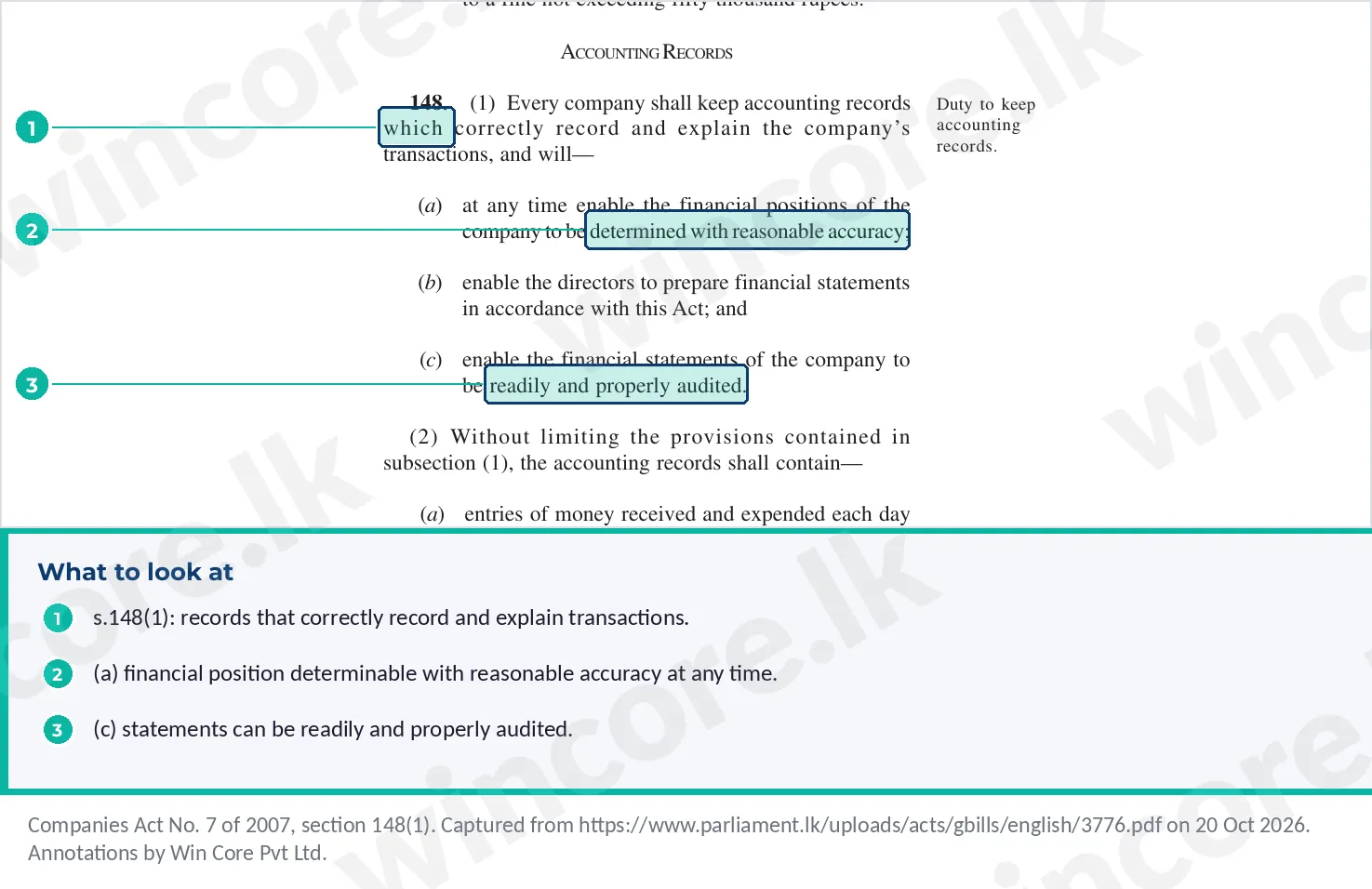
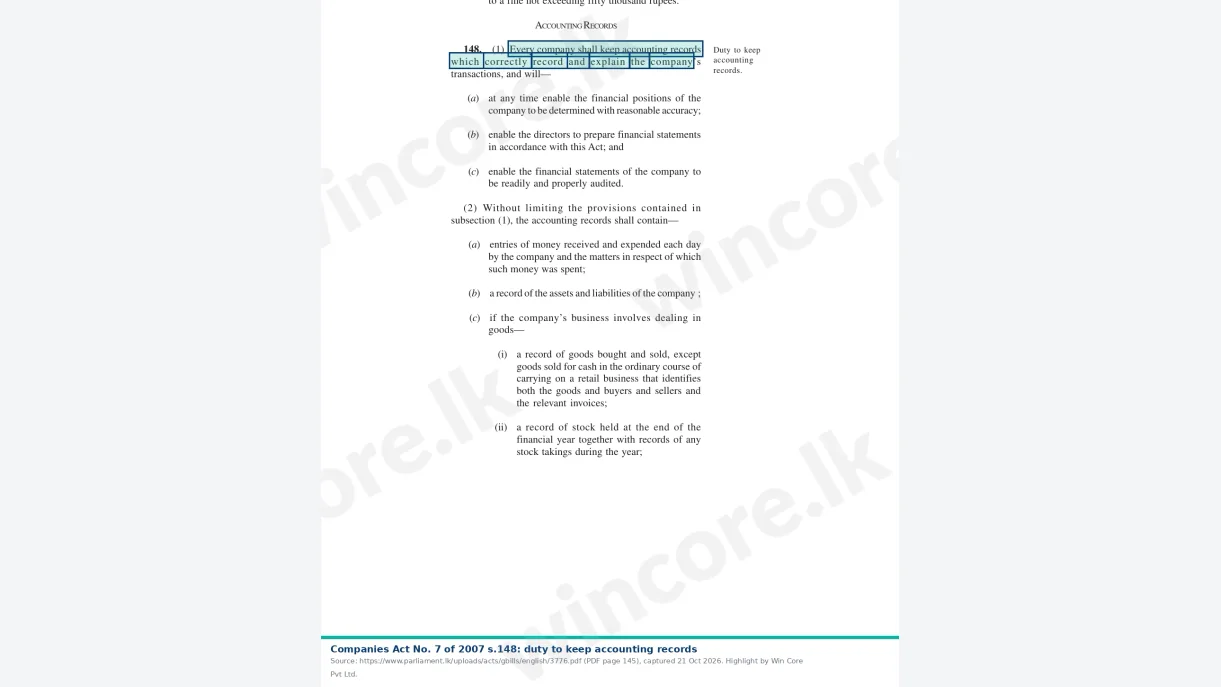
No law we read requires management accounts to carry a basis of preparation, so it is a recommendation, not a rule. The legal floor is the Companies Act duty to keep accounting records that correctly record and explain transactions (s.148). SLFRS for SMEs governs annual financial statements, and its paragraphs on basis and estimates give a good model for the block.
Can we say our management accounts are prepared under SLFRS for SMEs?
We recommend not, because paragraph 3.3 says financial statements shall not be described as complying with SLFRS for SMEs unless they comply with all its requirements. A monthly pack rarely includes a statement of cash flows, full notes and comparatives (paragraph 3.17). Say instead that the pack is prepared on the accrual basis, broadly consistent with the last annual policies.
Does a disclaimer remove our responsibility for errors in the pack?
No, a basis and limitations block tells readers how far to rely on the figures; it does not make careless figures acceptable. Whether a reliance statement limits liability to a lender or buyer is a legal question we have not reviewed. Prepare the pack carefully, name the estimates and keep the "not done" list honest, so the block describes the real position.
What should we do if our bank wants management accounts in its own format?
Agree the format and the basis with the bank in writing, then reflect that agreement in the block. Facility agreements can set their own definitions and reporting deadlines, which we have not reviewed here. State any difference between the bank's format and your usual pack, so a covenant figure and the management figure can be reconciled if they differ.
Open points
- Liability to third parties. Whether a reliance statement limits liability to a lender or buyer is a legal question we did not review.
- Lender requirements. Facility agreements may set their own reporting basis; not covered.
- Standard edition. We read SLFRS for SMEs (2015) on 22 October 2026 and did not verify whether CA Sri Lanka has adopted a later revision.
Talk to us. If you want a monthly pack your directors, bank and investors can rely on for what it is, speak to us at our contact page.
WinCore Pvt Ltd
This article is general information as at 22 October 2026 and is not advice on your specific situation.
References
- CA Sri Lanka, Sri Lanka Accounting Standards Committee. Sri Lanka Accounting Standard for Small and Medium-sized Entities (SLFRS for SMEs), 2015, paras 2.2, 2.12, 2.14, 2.30, 2.36, 3.3, 3.14, 3.17, 8.5, 8.6, 8.7. https://www.slaasc.lk/files/_SLFRS%20FOR%20SMEs%20-%202015.pdf . Primary. Accessed 22 October 2026.
Put these insights to work
WinCore specialists can review your current workflow, document gaps, and build a practical 90-day action plan.
Book a free consultationContinue reading
Explore more WinCore analysis to keep your finance, tax, and compliance roadmap moving.
The law sets the books, the six month accounts and the audit. The investor sets the rest. How to keep the two apart and tie one to the other.

Close your books before the March 31 deadline to reduce audit risk and start with clean numbers. A practical 10-step year-end guide for SMEs.
Three ways a finished-looking set of books can still be wrong, the legal standard they fail, and the review steps that find each one.