
Bookkeeping review checklist Sri Lanka: three traps to catch
Three ways a finished-looking set of books can still be wrong, the legal standard they fail, and the review steps that find each one.
On this page
Last verified against the primary sources on 22 October 2026.
A bookkeeping review checklist in Sri Lanka tests the books against one legal standard: section 148(1) of the Companies Act, No. 07 of 2007 requires every company to keep accounting records that "correctly record and explain the company's transactions", and a failure is an offence with a fine of up to Rs. 200,000 for the company and for every officer in default (s.148(3)). The Inland Revenue Act, No. 24 of 2017 adds that source documents must be retained, for at least five years from the transaction (s.120(5) and (6)), and the Companies Act keeps accounting records at the registered office for the current period and the last ten completed accounting periods (s.116(1)(k)). Three traps defeat that standard while the books still look finished: the same transaction recorded twice, documents that exist but cannot be read or found, and spreadsheet checks that can never fail. The law below is quoted from the Acts. The review methods are practice, not legal requirements, and we label them that way.
The law sets the standard a bookkeeping review checklist tests against
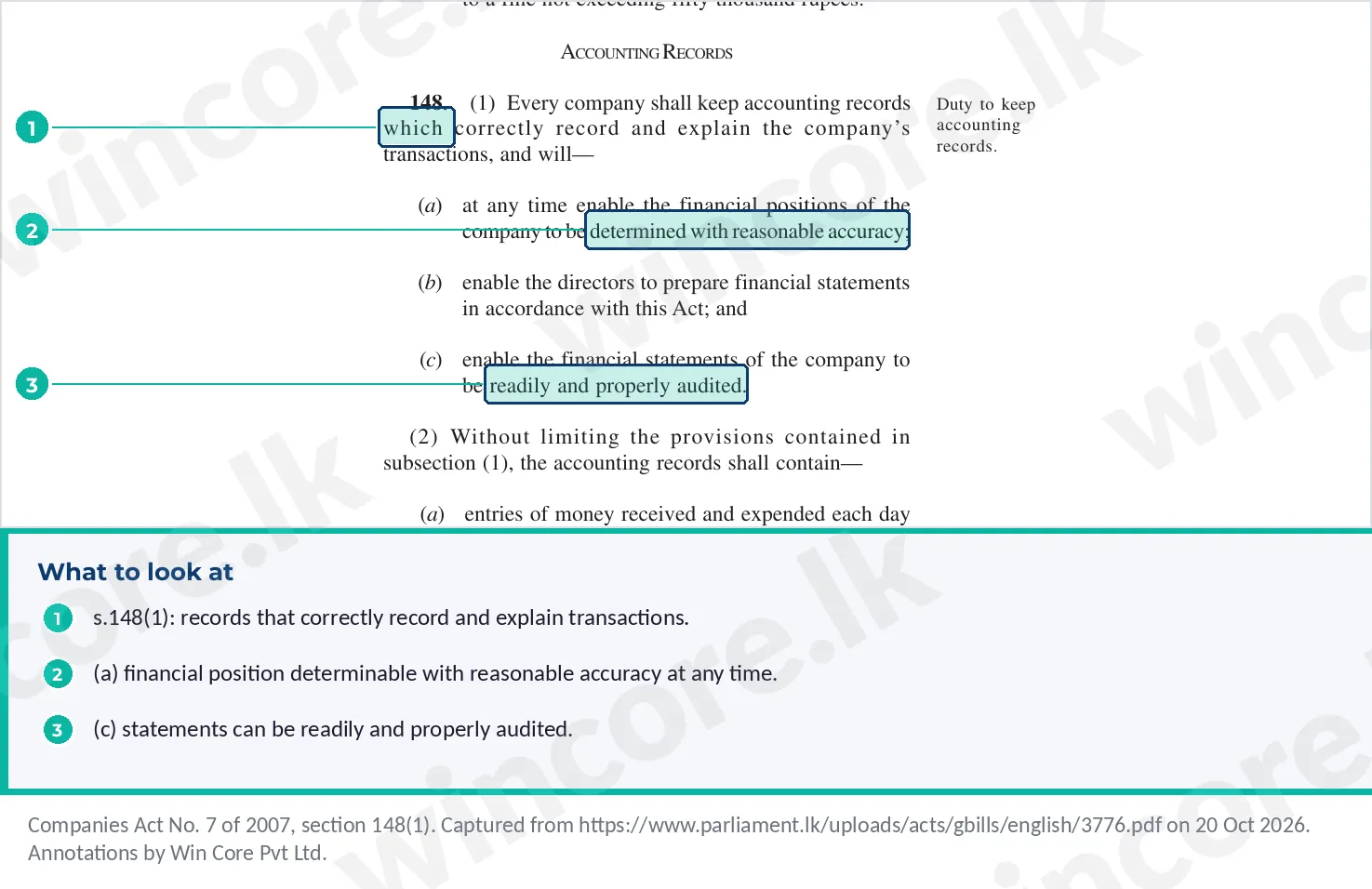
Companies Act: records that correctly record and explain
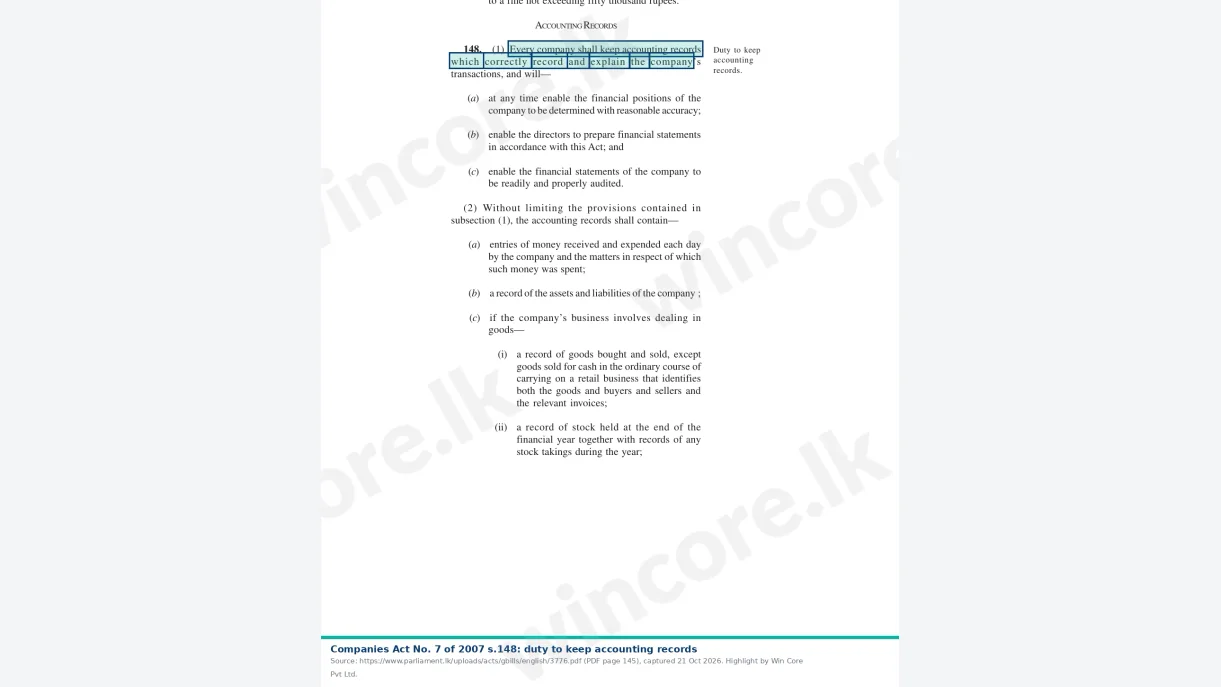
Section 148(1) requires records that "correctly record and explain the company's transactions", and that will "(a) at any time enable the financial positions of the company to be determined with reasonable accuracy; (b) enable the directors to prepare financial statements in accordance with this Act; and (c) enable the financial statements of the company to be readily and properly audited" [1].
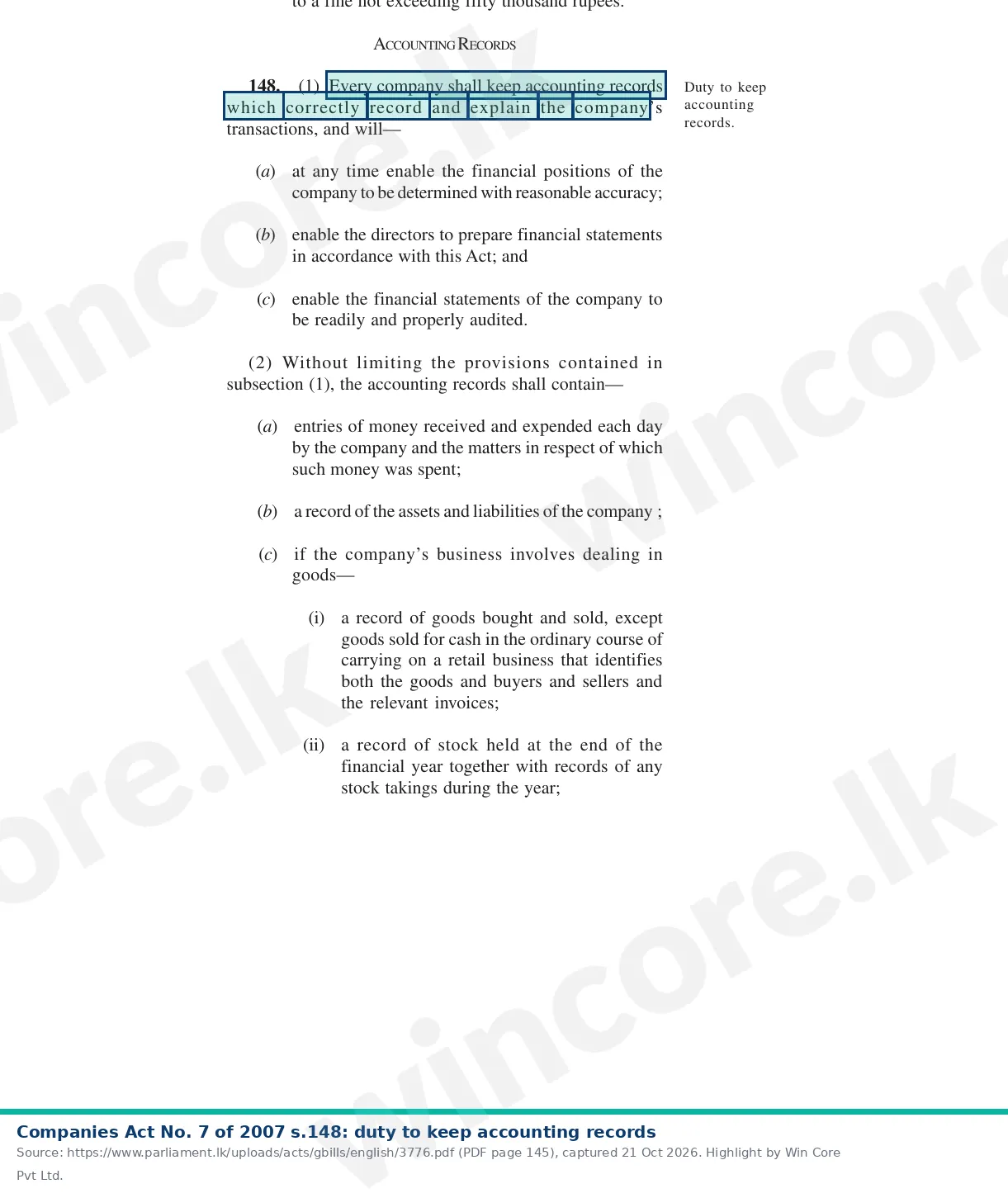
Section 148(2) sets the minimum content: "entries of money received and expended each day by the company and the matters in respect of which such money was spent", "a record of the assets and liabilities of the company", records of goods bought and sold (with an exception for retail cash sales) and of stock at year end for a trading business, and "a record of services provided and relevant invoices" for a service business [1].
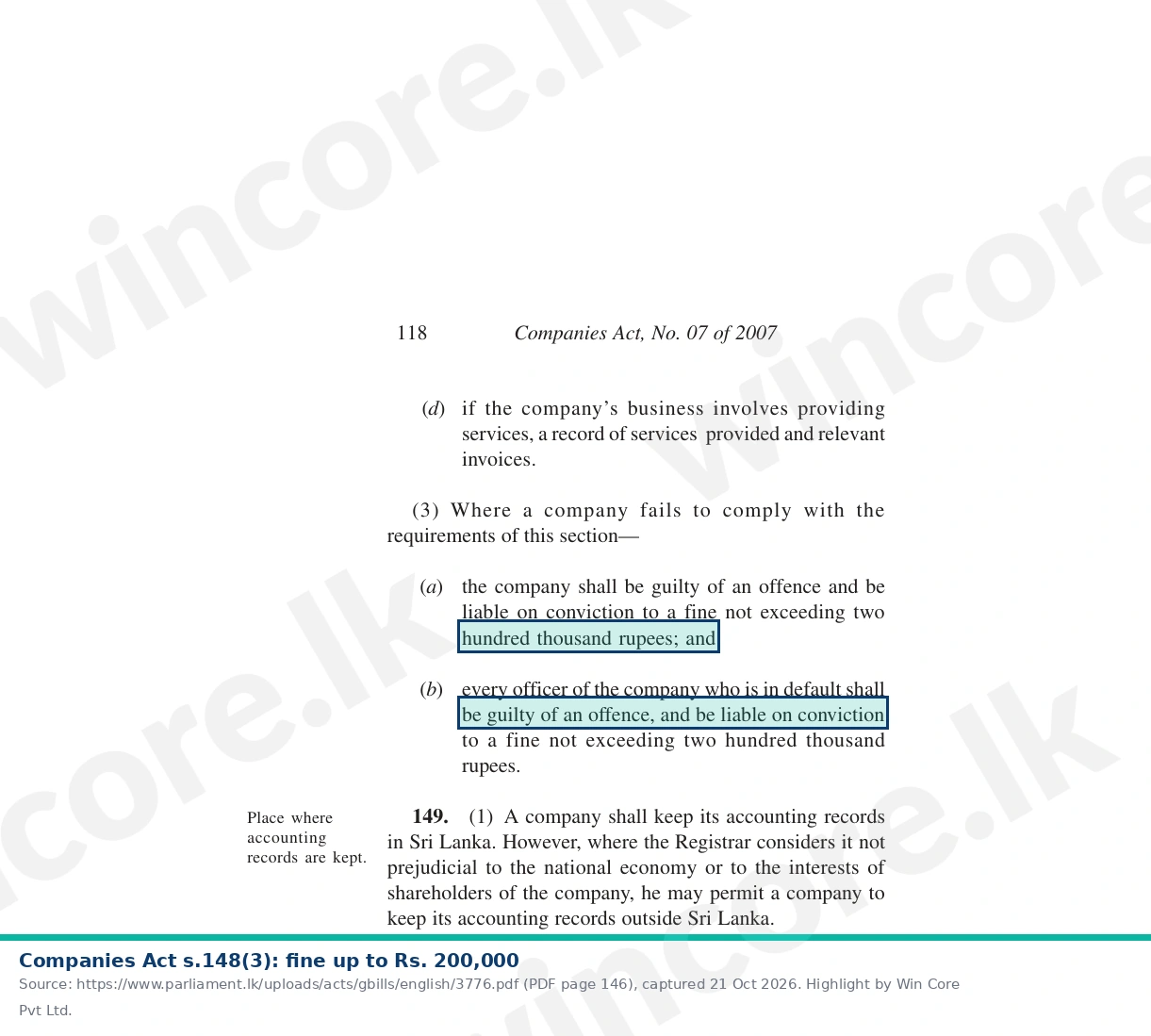
Penalty for this default. Under s.148(3), where a company fails to comply with the section, "the company shall be guilty of an offence and be liable on conviction to a fine not exceeding two hundred thousand rupees", and every officer in default faces the same maximum [1].
Two other sections matter for a review. Section 117(1) allows company records to be kept "in written form or in a form or in a manner that allows the documents and information that comprise the records to be easily accessible and convertible into written form", and s.117(2) requires "adequate measures" to prevent and detect falsification of the records, with a fine of up to Rs. 200,000 for the company and Rs. 100,000 for each officer in default for a breach of s.117(2) (s.117(3)) [1]. Section 116(1)(k) requires the accounting records for the current period and the last ten completed accounting periods to be kept at the registered office, unless the Registrar reduces the period (s.116(2)) or notice of another place in Sri Lanka is given (s.116(3) and (4)) [1]. Keeping those records in order is part of our company secretarial services.
Inland Revenue Act: source documents and five years
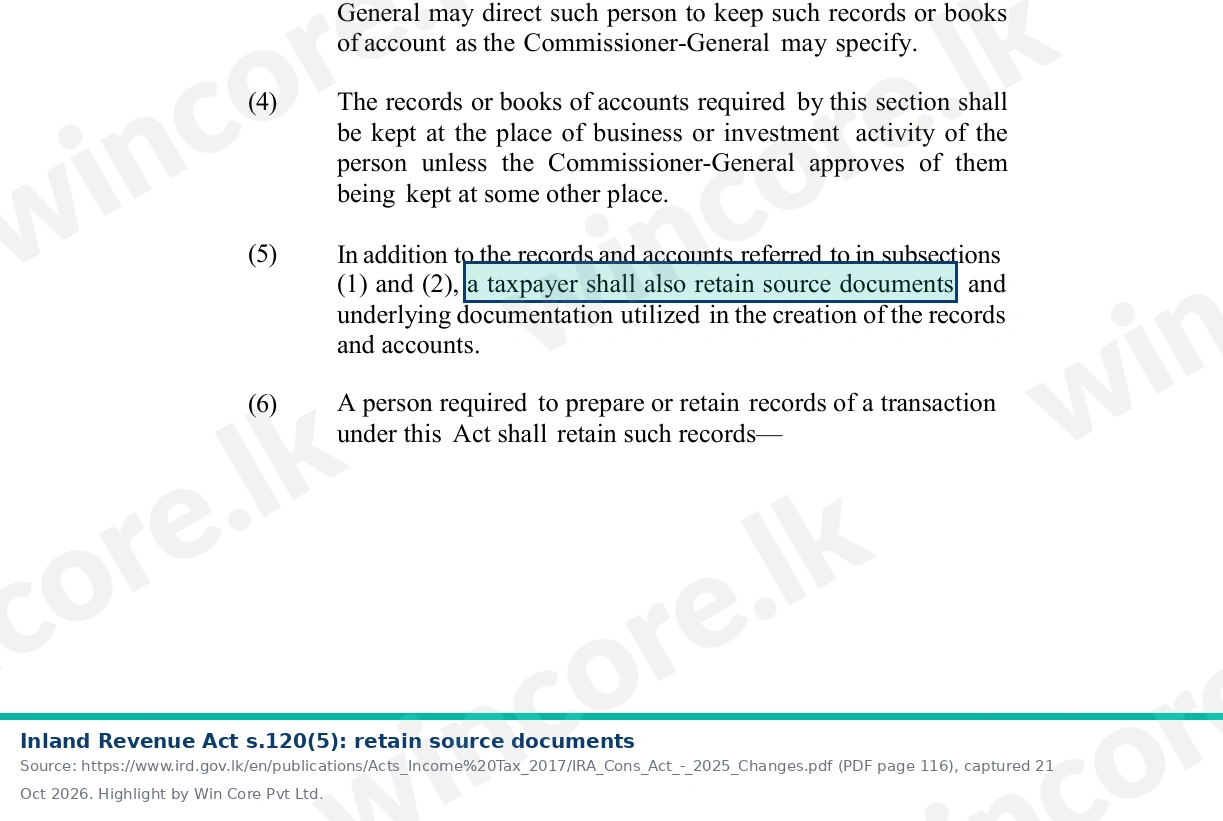
Section 120(1) of the Inland Revenue Act requires a taxpayer in business to "keep and maintain in Sri Lanka records and accounts sufficient to record all transactions and to ascertain the gains and profits made or the loss incurred". Section 120(5) adds that "a taxpayer shall also retain source documents and underlying documentation utilized in the creation of the records and accounts", and s.120(10) lists source documents as including "sales and purchase invoices, costing documents, bookings, diaries, purchase orders, delivery notes, bank statements, contracts". Section 120(6) requires records to be kept "for a period of five years from the date on which the transaction took place", or longer, "until expiration of the time limit for assessment of tax for any tax period to which the records are relevant and until any related proceedings have been completed" [2].
Where proper records are not kept, s.120(3) allows the Commissioner-General, "in addition to prosecution for an offence", to direct the person to keep specified records [2]. The IRA penalty for failing to maintain documents sits in s.182; the consolidation's s.182(1) reads as applying to years of assessment ending before 1 April 2023, so we do not state a current amount here and keep it as an open point.
The live guide to bookkeeping basics in Sri Lanka covers the same retention rules from the set-up side. All three traps below break the "correctly record and explain" test.
Trap 1: the same transaction reaches the ledger by two routes
Double counting happens when one transaction is posted from two documents that describe it. The trial balance still agrees, because each posting is a complete double entry. Common routes:
- Invoice and payment. A bill is posted from the supplier invoice, and the bank payment that settled it is later posted as a new expense instead of clearing the payable.
- Invoices and supplier statements. Bills are posted during the month, then the month-end statement is posted as a new bill.
- Receipts and card statements. Expenses are entered from receipts, then the card statement lines are entered again as new expenses.
- Sales register and bank receipts. Sales are posted from the invoice register, then customer receipts are posted as income again instead of clearing the receivable.
- Director-paid costs. A cost a director paid personally is claimed through the director's account and entered again from the original bill. Our separate article on when a director pays company costs covers that flow.
How to review (practice):
- For each income and cost stream, write down the one document that posts the entry and the one that only clears or matches it.
- Agree income to figures produced outside the ledger: bank receipts net of loans and capital, VAT returns where the business is registered, and the sales system's own reports.
- Agree every main supplier and customer balance to their statement. A payable that is higher than the supplier says, or a customer who appears to have overpaid, often points to a duplicate.
- Sort costs by supplier, amount and date, and look for pairs and for the same reference number appearing twice.
Trap 2: a scan nobody can read or find is not a usable record
A folder of scans is not the same as a set of supporting documents. Scans become invisible in three ways:
- Unreadable. Phone photos that are blurred, cut off or too dark to show the date, party and amount.
- Unsearchable. Files saved without a text layer or a meaningful name, so a search for a supplier or an amount finds nothing.
- Unlinked. Documents stored in one place and ledger entries in another, with no reference between them.
On our reading, a scan that no one can read or locate does little to meet s.117(1)'s test of records that are "easily accessible and convertible into written form", s.148(1)(c)'s records that let the accounts be "readily and properly audited", or s.120(5)'s duty to "retain source documents" [1] [2]. Whether a scan alone satisfies the IRA, or originals must also be kept, is not settled by the text we read; we did not obtain the Electronic Transactions Act, No. 19 of 2006 from an official source today, so that remains open.
How to review (practice):
- Make the folder searchable, for example by running text recognition (OCR), so it can be searched by supplier, amount and date.
- Pick a sample of ledger entries and open the document for each. The test is whether someone who did not post the entry could confirm date, party, amount and purpose quickly.
- Then work the other way: pick documents and find their entries.
- Name files by date, type, party and reference, record the reference in the ledger entry, or attach the file in the accounting software.
- Keep originals of anything a scan may not show well, such as stamps, signatures and thermal-paper receipts, which fade.
Record unresolved evidence gaps in a missing-documents log so the reviewer can distinguish confirmed entries from estimates.
Trap 3: a check that cannot fail tests nothing
Spreadsheets carry checks that look reassuring but would pass however wrong the books are. A check only tests something if it compares the books with a figure produced independently of them.
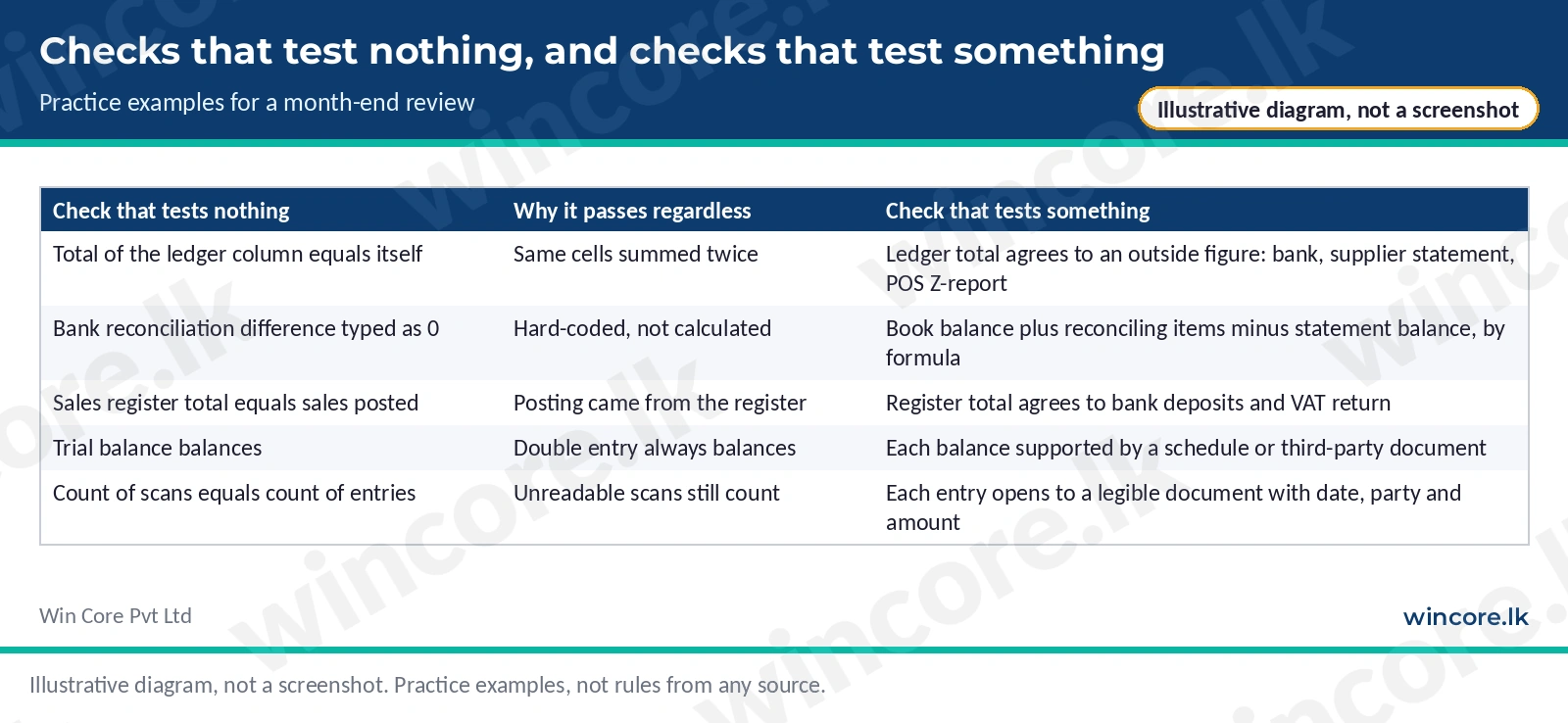
Typical forms:
- Circular comparisons. A figure is compared with itself under another name, or a sales total is compared with the sales posted from that same register.
- Typed results. A reconciliation difference entered by hand as zero rather than calculated.
- Fixed blocks. A total that covers a set block of cells, so lines added later fall outside it.
- Hidden rows. Filtered or hidden rows that a total quietly includes or leaves out.
- Trial balance comfort. Double entry always balances. A balanced trial balance says nothing about whether an entry exists, is in the right account or appears once.
How to review (practice):
- For every check, ask what outside figure it is compared with, and how it could fail.
- Test a check by deliberately changing one input. If it still passes, it tests nothing.
- Replace typed results with formulas, and use tables or named ranges that grow as rows are added.
- When the chart of accounts changes, confirm every account maps to a line in the reports.
- Reconcile each bank account to the statement's closing balance at every month end.
- After any correction, rerun the whole set of checks, not only the one that failed.
The review works best when someone else runs it, monthly
This section is practice. A review works best when the reviewer did not prepare the books: a director, an outside accountant or a second bookkeeper. Monthly reviews catch duplicates while documents are fresh and suppliers still remember the invoices, and a year-end review then confirms balances rather than rebuilding the year; our year-end financial close guide sets out that later step. Keep a short review log of checks run, findings and fixes. On our reading, it also helps show that the records "correctly record and explain" the transactions. Our guide to an independent review of accounts covers the review process itself, including review steps that cannot fail.
Our accounting services include a monthly review of this kind, and our audit support work prepares records so they can be "readily and properly audited".
A hypothetical example shows how the three traps combine
Hypothetical, rupee figures invented. A hardware distributor posts supplier invoices through the month and, at month end, also posts each main supplier's statement as a bill. Its purchases check compares the purchases ledger with the purchases register the ledger was posted from, so it passes. The year-end review agrees each supplier balance to the supplier's statement: one supplier's statement shows Rs. 1,140,000 owed, while the ledger shows Rs. 2,000,000. The difference of Rs. 860,000 is statement totals posted on top of invoices already in the books (our arithmetic: 2,000,000 less 1,140,000).
Reversing the duplicates reduces purchases and the payable by Rs. 860,000. Assuming the closing stock count was right, cost of sales falls and profit rises by the same amount. A check against the supplier's statement, not against the register, is what found it.
What this means for you
We recommend you decide which document posts each transaction and which only matches it, and keep to that. Make every supporting document readable, searchable and linked to its entry, and file them where anyone can search for them. Build checks that compare the books with outside figures, and test them by breaking them. Records that cannot "correctly record and explain" transactions fall short of s.148, with a fine of up to Rs. 200,000 for the company and each officer in default. Keep source documents for at least five years under IRA s.120(6), and accounting records for the current and last ten completed periods under Companies Act s.116(1)(k). If an investor or buyer is about to look at the books, our guide to the investor due diligence financial packet shows what they will test.
Checklist: documents needed
- A map of each income and cost stream: the posting document and the matching document (practice)
- Bank, card and wallet statements for the whole period, as one continuous download per account
- Supplier and customer statements at period end for the main counterparties
- Sales system reports and, if VAT registered, the VAT returns for the period
- Searchable, consistently named scans linked to ledger entries (IRA s.120(5), Companies Act s.117(1))
- Reconciliation workbooks with formulas, inputs marked, and the reviewer's name and date
- The review log of checks run, findings and fixes
Once the ledger review is complete, assemble the schedules and evidence needed for statutory audit.
FAQ
Is a balanced trial balance proof the books are right?
No, a balanced trial balance only shows that total debits equal total credits. A transaction posted twice, posted to the wrong account or left out entirely still balances, because each entry is complete in itself. Test the books against outside figures instead: bank statements, supplier and customer statements, the sales system's reports and, where the business is registered, the VAT returns.
Are scans enough, or must we keep paper originals?
The Inland Revenue Act requires source documents to be retained under s.120(5), but the text we read does not say whether a scan alone is enough. The Companies Act allows records in a form that is easily accessible and convertible into written form (s.117(1)). Until that is settled, keep originals of anything important or fragile and make every scan readable and searchable.
How long must a company keep its accounting records in Sri Lanka?
At least five years from the transaction under Inland Revenue Act s.120(6), or longer until the assessment time limit and any related proceedings end. Separately, Companies Act s.116(1)(k) requires the accounting records for the current period and the last ten completed accounting periods to be kept at the registered office, unless the Registrar reduces that period under s.116(2).
What is the penalty for poor accounting records in Sri Lanka?
Under Companies Act s.148(3), a company that fails to keep proper accounting records commits an offence, with a fine of up to Rs. 200,000 on conviction, and every officer in default faces the same maximum. The Inland Revenue Act has its own penalty provision for failing to maintain documents in s.182, which we have not mapped to current years in this article.
Who should review the books in a small company?
Someone who did not prepare them, such as a director, an outside accountant or a second bookkeeper, working from a written list of checks. This is practice, not a legal requirement. The reviewer should compare the books with documents produced outside them and keep a dated log of what was checked, what was found and how each finding was fixed.
Open points
- Scans and originals. Whether a scan alone satisfies IRA s.120(5) is not settled by the text we read. We did not obtain the Electronic Transactions Act, No. 19 of 2006 from an official source on 22 October 2026, so its retention provisions are not relied on here.
- IRA penalty for record keeping. Section 182(1) in the IRD consolidation reads as limited to years of assessment ending before 1 April 2023. We have not traced the penalty for later years.
- Later amendments. Our article on the Companies (Amendment) Act No. 12 of 2025 lists the sections that Act changes; ss.116, 117 and 148 are not among the substantive changes it describes, but we did not re-read the amending Act's Schedule of corrections for these sections today. The IRD consolidation shows no later change to s.120.
Talk to us. If you want a second pair of eyes on your books before a year end, an audit or an investor review, speak to us at our contact page.
WinCore Pvt Ltd
This article is general information on the law as at 22 October 2026 and is not advice on your specific situation.
References
- Parliament of Sri Lanka. Companies Act, No. 07 of 2007, ss.116, 117 and 148. https://www.parliament.lk/uploads/acts/gbills/english/3776.pdf . Primary. Accessed 22 October 2026.
- Inland Revenue Department. Inland Revenue Act, No. 24 of 2017 (consolidated, 2025 changes), ss.120 and 182. https://www.ird.gov.lk/en/publications/Acts_Income%20Tax_2017/IRA_Cons_Act_-_2025_Changes.pdf . Primary (consolidation). Accessed 22 October 2026.
Put these insights to work
WinCore specialists can review your current workflow, document gaps, and build a practical 90-day action plan.
Book a free consultationContinue reading
Explore more WinCore analysis to keep your finance, tax, and compliance roadmap moving.

Bookkeeping guide for Sri Lankan small businesses: legal requirements, chart of accounts, source documents, 5-year retention rule, and monthly routines.
Close your books before the March 31 deadline to reduce audit risk and start with clean numbers. A practical 10-step year-end guide for SMEs.
The law sets the books, the six month accounts and the audit. The investor sets the rest. How to keep the two apart and tie one to the other.