
Missing documents in bookkeeping, Sri Lanka: prove it first
Many items called missing are misfiled, netted or in another name. A six-step search, three honest conclusions and the law that makes it matter.
On this page
Last verified against the primary sources on 22 October 2026.
Before calling a document missing in Sri Lankan bookkeeping, prove it. Section 120(5) of the Inland Revenue Act, No. 24 of 2017 requires a taxpayer to "retain source documents and underlying documentation", for at least five years from the transaction under section 120(6), and section 148(1) of the Companies Act, No. 7 of 2007 requires records that "correctly record and explain" every transaction. Both duties apply every day, so a genuinely missing document is a compliance gap, and a false "missing" claim sends everyone chasing a gap that does not exist.
"The invoice is missing." "We never received that payment." "There is no receipt for this." In bookkeeping, reviews and audits these statements come up constantly. Many are true. Some are not: the document was filed under another name, posted in another month, settled net of tax, or is sitting in someone's inbox. Calling something missing when it is not wastes time, strains trust, and can lead to wrong adjustments, duplicate payments or unfair suspicion of staff.
The six-step procedure below is practice, not a legal standard. The reason it matters comes from the record-keeping duties, which we quote.
Missing documents matter in bookkeeping because the law requires the evidence
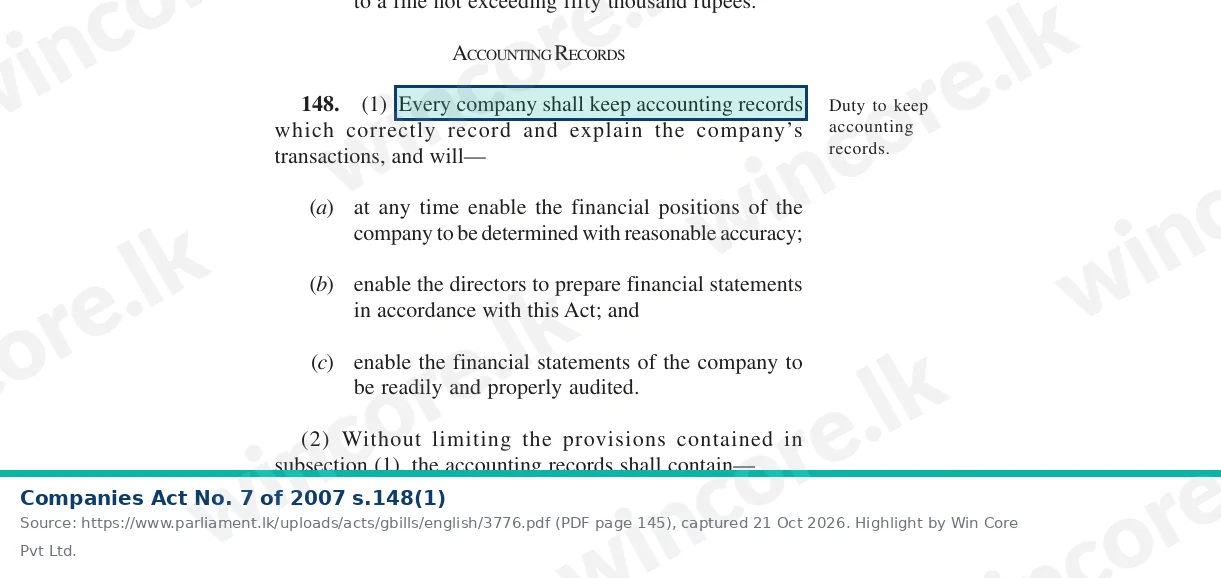
Section 148(1) of the Companies Act requires every company to "keep accounting records which correctly record and explain the company's transactions", records that will "at any time enable the financial positions of the company to be determined with reasonable accuracy" and "enable the financial statements of the company to be readily and properly audited" [1]. Section 148(3) makes a company that fails to comply liable on conviction to a fine not exceeding Rs 200,000, and every officer in default to the same maximum [1].
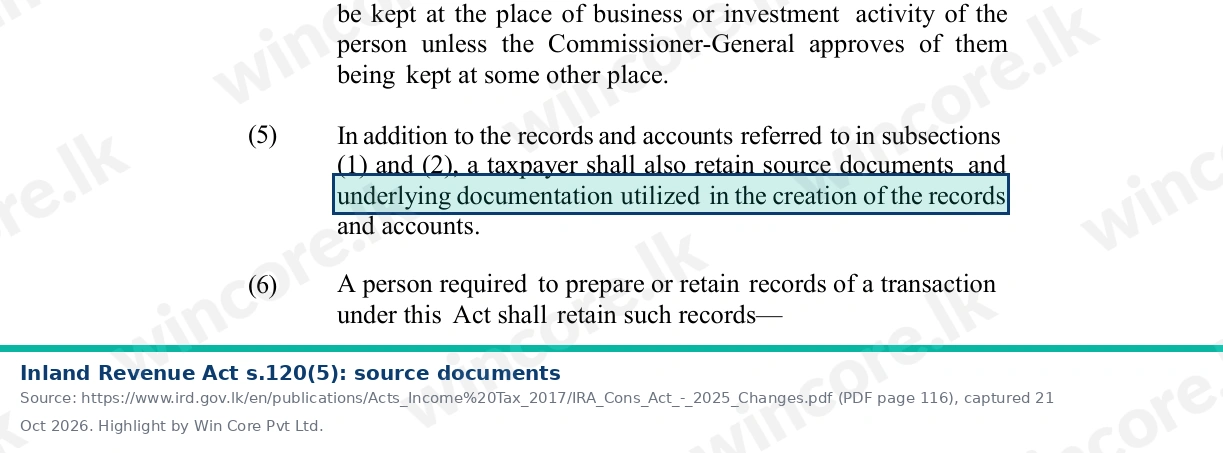
Section 120(5) of the Inland Revenue Act adds: "In addition to the records and accounts referred to in subsections (1) and (2), a taxpayer shall also retain source documents and underlying documentation utilized in the creation of the records and accounts" [2]. Section 120(10) says source documents "include sales and purchase invoices, costing documents, bookings, diaries, purchase orders, delivery notes, bank statements, contracts, and other documents which relate to an element of a transaction", and section 120(6) requires them to be kept for five years from the transaction, or longer until the time limit for assessment and any related proceedings have ended [2].
The tax penalty is separate. Section 182(2) sets a penalty of Rs 1,000 for each day a failure to maintain proper documents continues, and section 182(3) says no penalty is due if the taxpayer complies with the Commissioner-General's warning notice within the time it specifies [2]. In the consolidation, section 182(1) is worded for years of assessment ending before 1 April 2023; we keep its reach for later years open below.
On our reading, both Acts are about keeping the evidence. That is a reason to search properly before concluding something is gone, and to record the search if it really is.
Most "missing" items are misfiled, netted or in another name
This section is practice. Common reasons something looks missing when it is not:
- Another name. A supplier trading under a name different from its legal name, or a customer paying through a related company.
- Another period. Posted in the month before or after, or dated by invoice date rather than delivery date.
- Another entity. Recorded in a sister company's books.
- Netted or combined. One payment covering several invoices, or a receipt net of bank charges or tax withheld by the customer, so no single amount matches. A withholding certificate usually explains the gap; see our guide to the withholding tax certificate.
- Not yet posted. Sitting in an unposted batch, an approval queue or someone's inbox.
- Not searchable. Scanned as an image with no text layer, so a keyword search cannot find it.
- Paid by someone else. A director or employee paid personally and has not yet claimed.
Six steps prove a document is really missing
This section is practice.
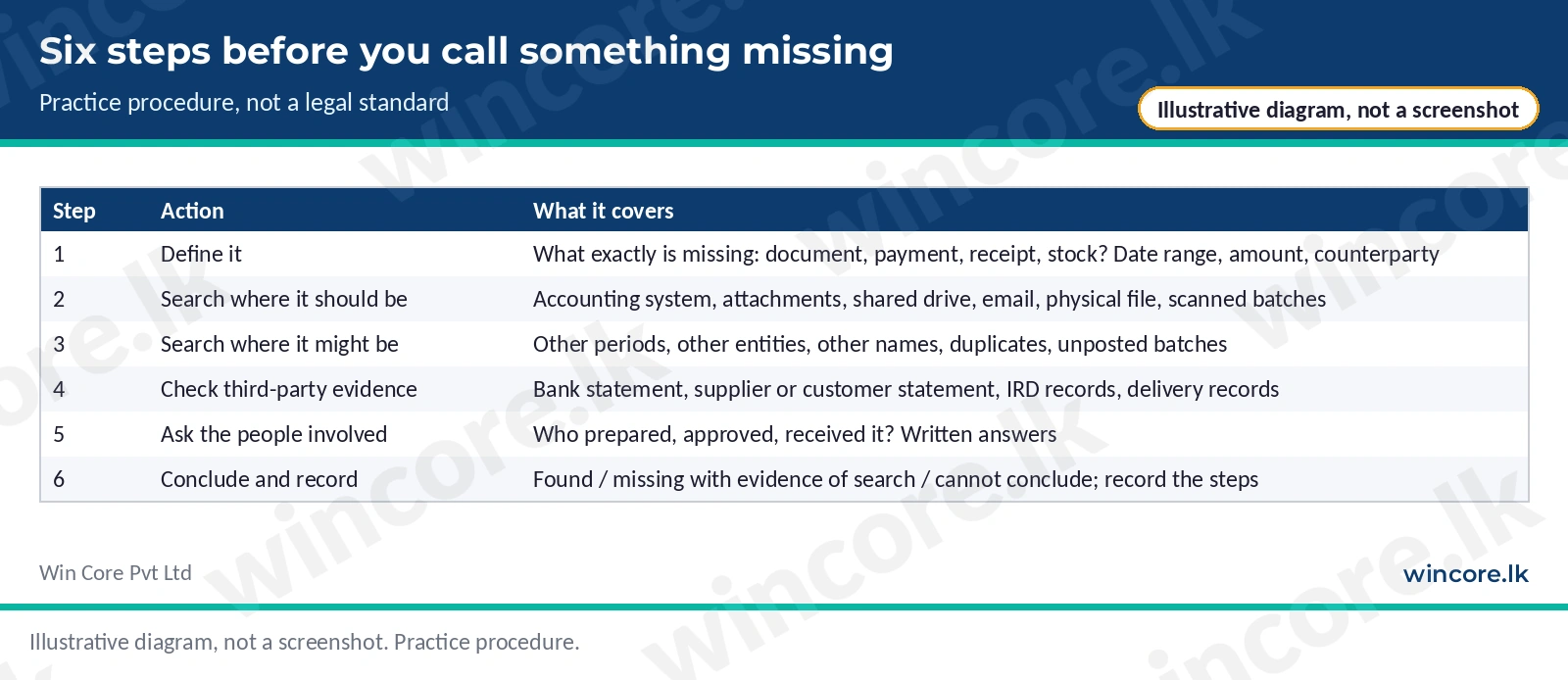
1. Define exactly what is missing
Write down the item: a supplier invoice, a customer receipt, a payment, a delivery, a contract. Give the date range, the amount or approximate amount, and the counterparty. "Some March invoices" cannot be searched; "the Rs 85,000 invoice from supplier X for a March delivery" can.
2. Search where it should be
Look in the accounting system including attachments, the shared drive, the physical file and the email address invoices are sent to. Search by amount as well as name, because names vary and amounts usually do not.
3. Search where it might be
Widen the search: the months either side, other companies in the group, alternative names, unposted and draft entries, the suspense account and the duplicate checks. Search for the amount with and without VAT, and net of tax withheld or bank charges.
4. Check third-party evidence
The counterparty and the bank keep their own records. A bank statement shows whether money moved; section 121 of the Inland Revenue Act requires a bank to "keep records of all transactions with a client" [2], which on our reading is one reason a replacement statement can usually be had. A supplier or customer statement shows what they think happened. Delivery notes and courier receipts confirm other events.
5. Ask the people involved
Ask who prepared, approved, received or paid it, and ask in writing so the answer is on file. A question about a document is not an accusation, and the wording should say so.
6. Conclude and record
There are three honest conclusions:
- Found, with where it was and how the filing will be fixed.
- Missing, with a record of every step taken and the third-party evidence that confirms the transaction, or that it did not happen.
- Cannot conclude yet, with what is outstanding and who is following up.
The record of the search is itself evidence. If a tax officer or auditor later asks for the document, a written search record with a supplier statement or bank entry confirming the transaction is far better than "it is missing".
When the document really is missing, replace the evidence, not the facts
This section is practice.
- Ask for a copy. Most suppliers can reissue a copy of an invoice. For VAT, check what a tax invoice must show; see our guides to VAT tax invoice requirements and the VAT tax invoice format under Gazette 2481/22.
- Use other evidence. Bank records, contracts, delivery notes and correspondence can support the entry where the original is lost. Whether that is enough for a particular tax claim depends on the rule involved, which we do not review here.
- Fix the process. Find out why it went missing and change the filing step so it does not recur.
- Do not reconstruct by guessing. Rebuilding records from bank statements is a structured process, covered in our companion piece on rebuilding accounts from bank statements, publishing alongside this one.
A worked example: twelve receipts called missing, two left open
Hypothetical. At a year-end review of a building maintenance contractor, the auditor lists 12 customer invoices with no matching receipt in the books. The bookkeeper works through the six steps:
- 5 were received net of tax the customer withheld, so no bank credit matched the invoice amount; the customers' withholding certificates explain each gap;
- 3 were paid by a customer's parent company under its own name, and had been posted to a suspense account;
- 2 were in a batch of bank lines imported but never posted;
- 1 is confirmed by the bank statement and the customer's statement, but its remittance advice cannot be found, so it is recorded as missing with that evidence on file and a copy requested;
- 1 has no bank credit and no answer yet, so it is cannot conclude yet, and the customer has been asked in writing.
Ten of the twelve were never missing (our count on hypothetical figures). A real review could come out very differently; the point is the procedure, not the ratio.
What this means for you
Before you report something as missing, define it precisely, search where it should be and where it might be, check bank and counterparty records, and ask in writing. Record what you did. Most false claims come from filing habits, so fix those upstream: attach the document when the entry is posted, send all bills to one finance address, scan to searchable PDF with date, supplier and amount in the file name, reconcile supplier statements monthly, and keep legal names in the ledger with trading names in a notes field. These habits also shorten the year-end close; our guide to bookkeeping basics sets out the document flow. Our bookkeeping services and accounting services run this search as part of every review, and a companion piece on building the bank account list from the statements publishes alongside this one.
Checklist: documents needed
- A precise description of each item claimed as missing
- Access to the accounting system, attachments and shared drive
- Bank statements for the relevant period
- Supplier or customer statements
- Withholding tax certificates received from customers
- Email archives of the people involved
- A search log recording each step and its result
Frequently asked questions
How long should we search before calling a document missing?
Until all six steps are done. The time depends on the volume of records, but the steps are what matter: define the item, search where it should be and where it might be, check bank and counterparty records, ask in writing, then record the conclusion. This is our practice; the law sets the duty to keep documents, not a search procedure.
Is a bank statement enough evidence on its own?
No. A bank statement shows that money moved, not what it was for. The Inland Revenue Act lists it as one source document among many. Combine it with a supplier or customer statement, a contract, a delivery note or correspondence, so the entry shows both the payment and the matter it was for, as section 148(2)(a) of the Companies Act expects.
What if a staff member says a document never existed?
Check third-party records first. If the bank and the counterparty's statement show a transaction, a document probably existed and should be requested from the counterparty. If neither shows anything, the transaction may not have happened, which is a different finding. Ask in writing, keep the answer on file, and treat the question as a records check, not an accusation.
How long must source documents be kept in Sri Lanka?
At least five years from the date of the transaction under section 120(6) of the Inland Revenue Act, and longer until the time limit for assessing the relevant tax period has expired and any related proceedings have been completed. Companies Act section 116(1)(k) separately keeps accounting records for the current and last ten completed accounting periods, unless the Registrar reduces that.
Open points we have not closed
- Evidence for tax claims. Whether other evidence is accepted for a particular deduction or input tax claim depends on the rule; not reviewed here.
- IRA s.182 for later years. The consolidation words s.182(1) for years of assessment ending before 1 April 2023; how the daily penalty applies after that needs the amending Act No. 45 of 2022, which we have not read.
- Proceedings. Evidence rules for court or disciplinary proceedings were not reviewed.
Last verified 22 October 2026: Companies Act ss.116(1)(k) and 148, Inland Revenue Act ss.120, 121 and 182.
This article is general information, not advice for your specific situation.
Talk to us. If a review has left you with a list of "missing" items, we can run the search with you before anything is adjusted. Contact us at our contact page.
WinCore Pvt Ltd
References
- Parliament of Sri Lanka. Companies Act, No. 7 of 2007, ss.116 and 148. https://www.parliament.lk/uploads/acts/gbills/english/3776.pdf . Primary. Accessed 22 October 2026.
- Inland Revenue Department. Inland Revenue Act, No. 24 of 2017, consolidated with amendments to 2025, ss.120, 121 and 182. https://www.ird.gov.lk/en/publications/Acts_Income%20Tax_2017/IRA_Cons_Act_-_2025_Changes.pdf . Primary (consolidation). Accessed 22 October 2026.
Put these insights to work
WinCore specialists can review your current workflow, document gaps, and build a practical 90-day action plan.
Book a free consultationContinue reading
Explore more WinCore analysis to keep your finance, tax, and compliance roadmap moving.

Bookkeeping guide for Sri Lankan small businesses: legal requirements, chart of accounts, source documents, 5-year retention rule, and monthly routines.
Close your books before the March 31 deadline to reduce audit risk and start with clean numbers. A practical 10-step year-end guide for SMEs.

WHT reporting breaks when certificates and annual statements are treated as year-end admin. Build a monthly evidence workflow that files cleanly.