
Independent review of accounts: checks that can never fail
A second look at the books only helps if it could find something. Who should do it, what to test, how to record it and the steps that prove nothing.
On this page
Last verified against the primary sources on 22 October 2026.
An independent review of accounts in Sri Lanka, in the sense used here, is a second review by someone who did not prepare the books, against a written scope and evidence from outside them. No law requires a small company to have one; it is practice. The law sets the stakes: under section 150(1) of the Companies Act, No. 07 of 2007 the person who prepares the financial statements certifies their compliance with the Act and two directors sign them, within six months of the balance sheet date unless the Registrar extends it, and a director in default faces a fine of up to Rs. 100,000 (s.150(2)) [1]. Under SLFRS for SMEs paragraph 10.21, a material error found later must, to the extent practicable, be corrected by restating the comparatives [2]. A review that cannot fail protects no one from either.
This is an internal review, not an audit and not a review engagement under the assurance standards, which we have not covered.
Errors a reasonable review would have caught are the ones restated later
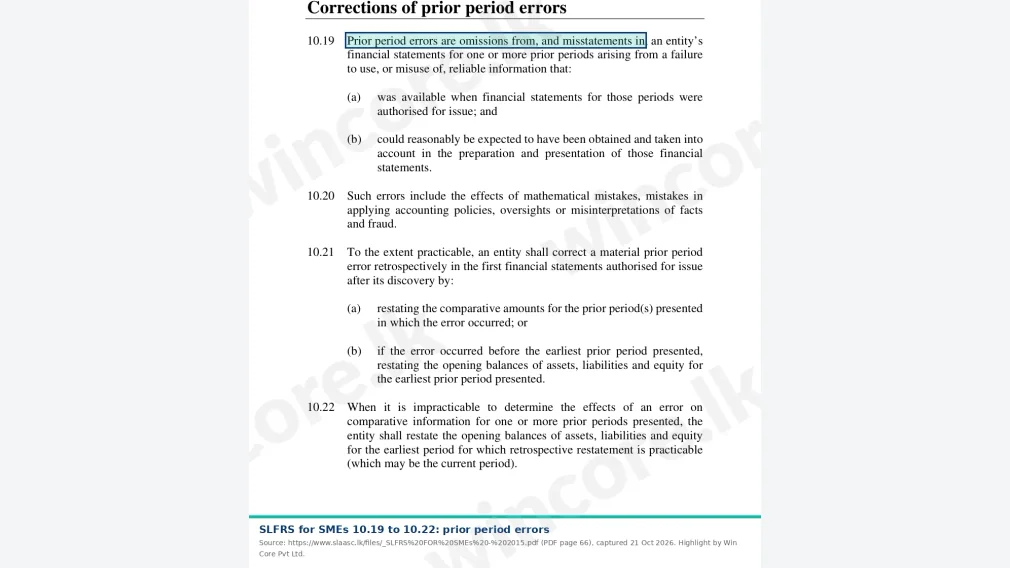
SLFRS for SMEs paragraph 10.19 defines prior period errors as "omissions from, and misstatements in, an entity's financial statements for one or more prior periods arising from a failure to use, or misuse of, reliable information that: (a) was available when financial statements for those periods were authorised for issue; and (b) could reasonably be expected to have been obtained and taken into account in the preparation and presentation of those financial statements" [2].
Paragraph 10.20 adds: "Such errors include the effects of mathematical mistakes, mistakes in applying accounting policies, oversights or misinterpretations of facts and fraud." Paragraph 10.21 requires that, "To the extent practicable, an entity shall correct a material prior period error retrospectively in the first financial statements authorised for issue after its discovery", by restating the comparative amounts for the prior period in which it occurred or, if it occurred earlier, the opening balances for the earliest prior period presented. Paragraph 10.22 covers the case where that is impracticable: the opening balances are restated "for the earliest period for which retrospective restatement is practicable (which may be the current period)". Paragraph 10.23 then requires disclosure of the nature of the error and the amount of the correction for each line item affected [2].
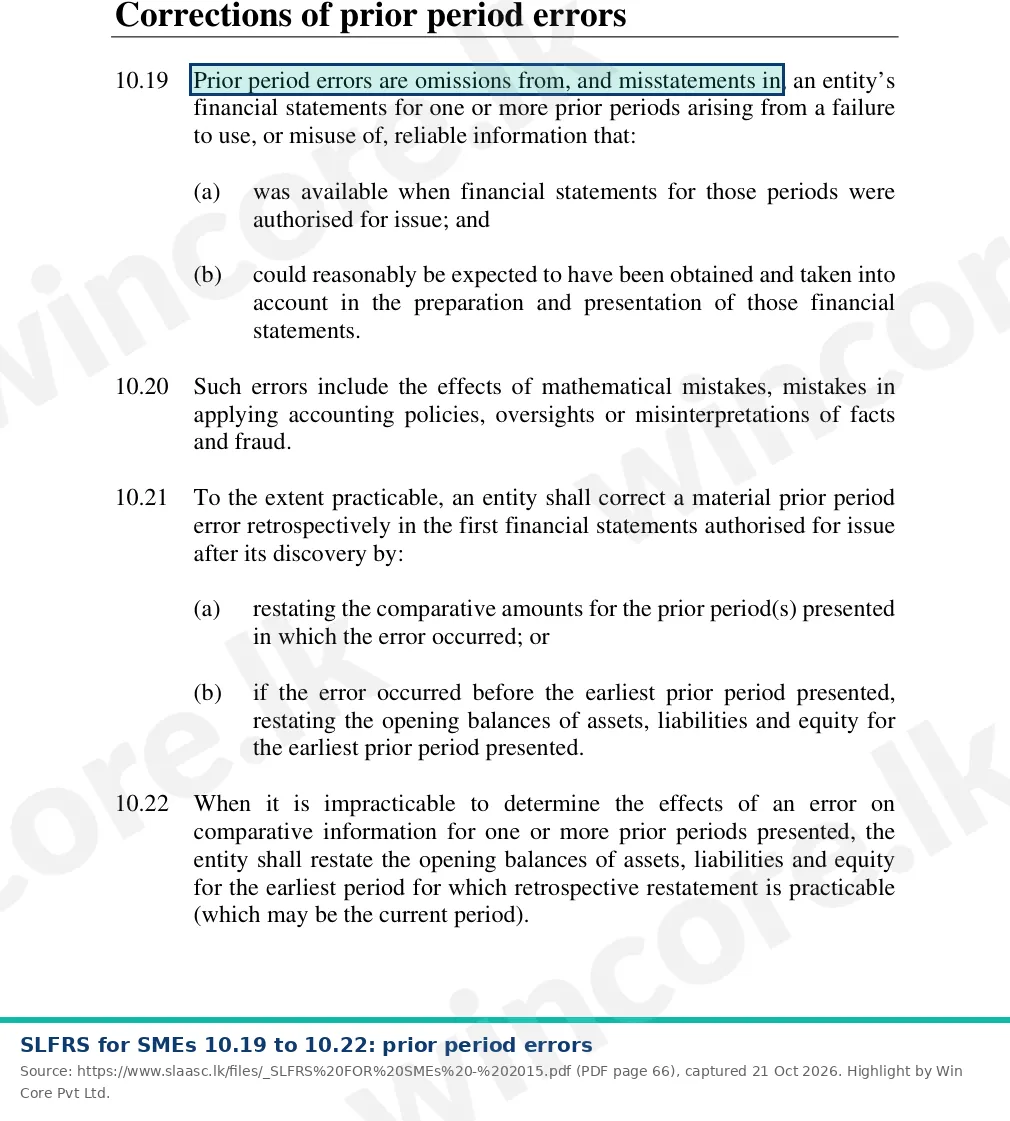
On our reading, the words "could reasonably be expected to have been obtained" are the point for a reviewer. An error that a reasonable review would have caught, using information already in the files, is exactly the kind that ends in a restatement and a disclosure note. The review is the cheapest point at which to find it. Restatement applies only to material errors; paragraph 3.16 says omissions or misstatements are material "if they could, individually or collectively, influence the economic decisions of users", depending on "the size and nature" of the item [2].
An independent review of accounts has five features
This section is practice. In our view a second review is real when it has all five.
1. A different person. The reviewer did not prepare the work. A preparer re-reading their own schedules tends to see what they expect. In a very small team the reviewer may be a director, an outside accountant or a colleague from another area.
2. A written scope. The reviewer knows which accounts, which period, which risks and to what depth. "Review the accounts" is not a scope. "Agree every bank and loan balance to statements, review all manual journals above Rs. 100,000 and explain every movement above 10% against budget" is one.
3. Evidence from outside the books. Bank statements, supplier and customer statements, contracts, payroll reports, tax returns, physical counts. Re-adding the preparer's schedule is not independent.
4. A record of what was done. Notes list the items tested, the evidence seen and the findings. Without them, nobody can later tell whether the review happened or what it covered.
5. Follow-up. Findings go into a log with an owner, a fix and a re-check date. A review that finds the same error every month with nothing changing has stopped working.
If an audit is also required, use an audit-preparation checklist; an independent review is not a replacement for that engagement.
Recompute from source before opening the preparer's workings
This section is practice. The strongest review method we know is also the simplest to describe. For the figures that matter, the reviewer builds their own answer from the source documents first, and only opens the preparer's schedule once their own numbers are fixed. Then they compare line by line and put every difference into one of three groups: the preparer's error, the reviewer's error, or a defensible difference of judgement.
Two habits make this work:
- Compare with last period. Explaining each line's movement against the prior period, in rupees, finds more than most other tests, because a duplicate, an omission or a misposting usually shows up as a movement nobody can explain.
- Start the report with what was right. A review that lists only faults reads as an attack and gets resisted. Saying which areas agreed, and how they were tested, also shows the reviewer's coverage.
What an independent review of accounts should look at
This section is practice. A risk-based review of a small company usually covers:
- Cash. Every bank, card and wallet balance agreed to the external statement, reconciling items listed, old items explained, and each account's running balance proved from the opening figure.
- Journals. Manual journals above a set amount, and every journal posted by a senior person or after the period was closed.
- Control accounts. VAT, payroll liabilities, loans, director and intercompany accounts agreed to independent schedules.
- Cut-off. A sample of sales and purchases either side of the period end, checked to the service or delivery date on the document.
- Analytical review. Movements against budget and last period, with each movement above a threshold explained in writing.
- Estimates. Accruals, provisions and stock: the basis, and whether last period's estimates turned out right. Our guide to the management accounts basis of preparation shows how to name them in the pack.
- Unusual items. Round amounts, weekend postings, new suppliers, payments to staff or directors, and anything the reviewer does not understand.
At year end the same areas feed the year-end financial close, and our audit support work prepares the evidence the auditor will ask for.
Review steps that cannot fail give false comfort
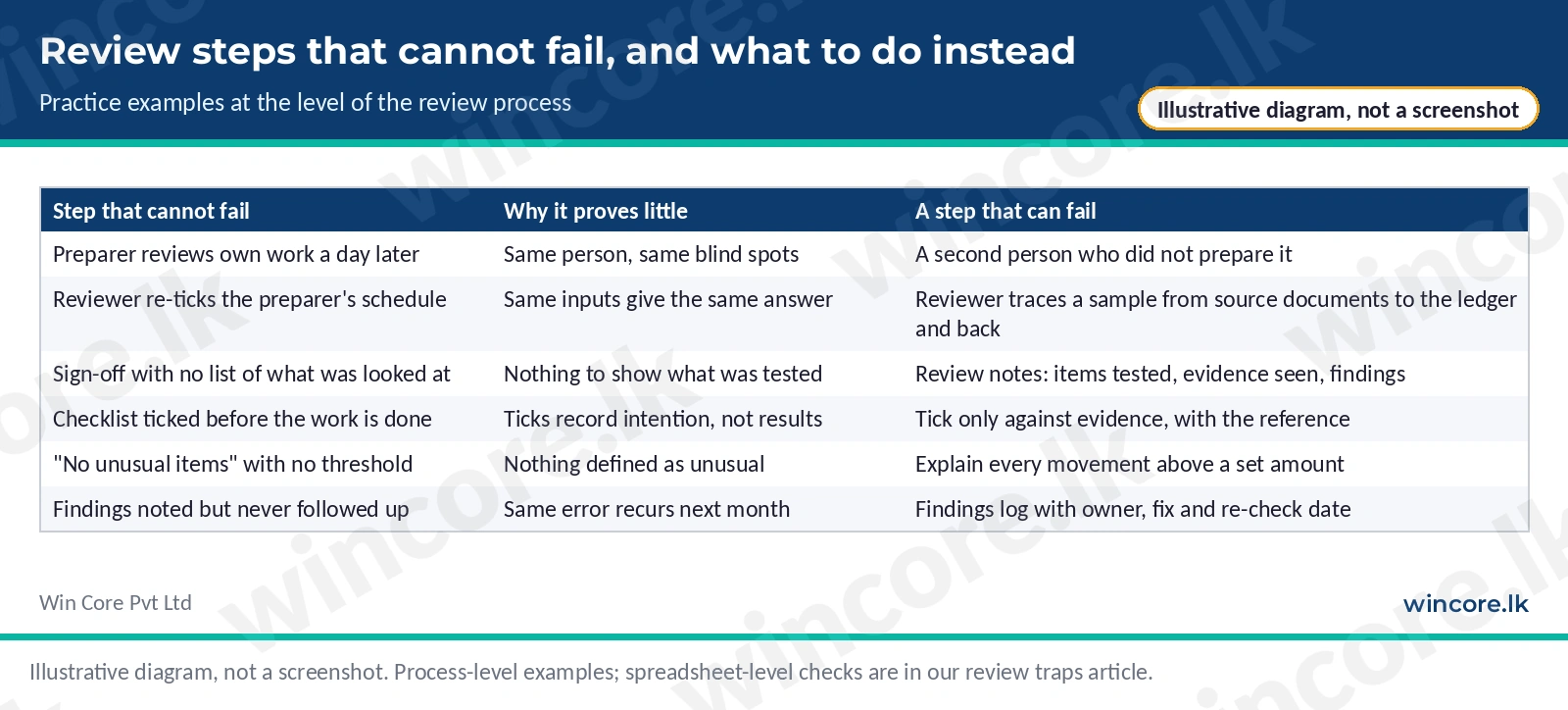
This section is practice. A step "cannot fail" if it would pass however wrong the books are. Our bookkeeping review checklist covers the spreadsheet-level versions (circular checks, typed results, short ranges). At the level of the review process, common examples are:
- The preparer reviews their own work a day later. Same person, same blind spots.
- The reviewer re-ticks the preparer's schedule. Same inputs give the same answer.
- Sign-off with no list of what was looked at. Nothing shows what was tested.
- A checklist ticked before the work is done. Ticks record intention, not results.
- "No unusual items" with no threshold. Nothing was defined as unusual.
- Findings noted but never followed up. The same error recurs next month.
- A fix that is not re-checked from source. A correction can introduce a new error, and only a fresh derivation from the documents shows it.
A useful test for any step: describe an error it would catch. If you cannot, it is not a check. Replace it with one that compares the books with something outside them, or remove it so it stops creating comfort.
The review is only as good as its evidence trail
This section is practice.
- Review notes, dated and signed by the reviewer, listing what was looked at and what was found.
- References. For each item tested, the document or statement it was agreed to.
- A findings log, carried forward month to month.
- Sign-off only after findings are resolved or accepted, with the reason for any accepted item.
- No quiet edits. The reviewer does not change the books directly. Findings go back to the preparer, who posts the correction, so the trail shows who did what.
- Judgements to a named person. Where the question is an estimate or a policy choice, a director or the outside accountant decides, and the decision is recorded with its reason.
Keep the notes with the period's records. They help the directors who sign under s.150(1)(c), and they help the external auditor.
A hypothetical example: two errors the old review could not find
Hypothetical, rupee figures invented. A tyre retreading company's bookkeeper prepares the September accounts. The previous "review" was the owner reading the profit figure. A second review by an outside accountant agrees both bank accounts to statements, reviews all manual journals above Rs. 100,000 and explains every movement above 10% against August.
It finds a Rs. 375,000 sales invoice for a fleet job finished on 28 September left out of September because it was typed up in October, and a Rs. 92,000 machine repair posted to the fixed asset account instead of repairs. Revenue was understated by Rs. 375,000 and costs by Rs. 92,000, so profit was understated by Rs. 283,000 (our arithmetic: 375,000 less 92,000). Both errors used information already in the files: the signed job card dated 28 September, and the supplier's invoice describing the work as a repair. On our reading of paragraph 10.19, had they reached issued annual accounts and been material, they would have needed restating later under paragraph 10.21.
What this means for you
We recommend that your second review is done by someone who did not prepare the work, against a written scope, using evidence from outside the books, with notes and a findings log. Recompute key figures from source before reading the preparer's workings, and test every review step by asking what error it would catch. Errors a reasonable review would have found, using information that was available, are the kind SLFRS for SMEs requires to be restated if material, so finding them now costs less. If your bookkeeping is outsourced, the provider's own internal review is not a second review from your side; our guide to outsourcing accounting for SMEs covers who keeps which tasks. Our accounting services and virtual CFO services can act as that second reviewer.
Checklist: documents needed
- Written review scope: accounts, period, thresholds and sample sizes
- Trial balance and management pack for the period
- Bank, card and wallet statements for every account
- Supplier and customer statements for the main counterparties
- Journal listing showing who posted each journal and when
- Control account schedules (VAT, payroll, loans, directors, intercompany)
- Budget and prior period figures
- Last period's findings log and this period's signed review notes
FAQ
Can the owner be the second reviewer of the accounts?
Yes, if the owner did not prepare the work and follows a written scope with evidence from outside the books. Reading the profit figure alone is not a review in our sense, because it could not find a duplicate or a misposting. An owner who agrees bank balances to statements, reviews large journals and explains movements is doing a real review.
Is an independent review of accounts the same as an audit?
No, the review described here is internal practice, done by a director, colleague or outside accountant who did not prepare the books. A statutory audit is a separate engagement by a qualified auditor under the auditing standards, and a formal review engagement has its own assurance standard, which we have not covered. An internal review helps the books reach the audit in better shape. For whether the audit is required at all, see does a private company need an audit.
How many items should the reviewer test?
There is no fixed rule in the law or the accounting standard, so set amounts and samples by risk. Write them into the scope, for example every journal above a set amount and every movement above a set percentage, and keep them consistent from month to month. Increase the depth after a finding, a staff change, a new system or rapid growth.
What if the second review finds nothing?
Record what was tested, the evidence seen and that nothing was found, then sign it off. A clean result is only meaningful if the steps could have failed, so check that each step compared the books with something produced outside them. Keep the notes with the period's records, so a later reader can see the coverage, not just the conclusion.
What happens if an error is found after the annual accounts are issued?
If it is material, SLFRS for SMEs paragraph 10.21 requires it to be corrected retrospectively, to the extent practicable, in the first financial statements authorised for issue after its discovery. That means restating the comparative figures, or the opening balances if the error is older, and paragraph 10.23 requires the nature and amount of the correction to be disclosed.
Open points
- Assurance standards. Standards for review engagements and for audits were not read for this article; it describes internal review practice only.
- Materiality. Whether a particular error is material is a judgement under paragraph 3.16; we give no threshold.
- Standard edition. We read SLFRS for SMEs (2015) on 22 October 2026 and did not verify whether CA Sri Lanka has adopted a later revision.
Talk to us. If you want someone who did not prepare your books to review them before the directors sign, speak to us at our contact page.
WinCore Pvt Ltd
This article is general information as at 22 October 2026 and is not advice on your specific situation.
References
- Parliament of Sri Lanka. Companies Act, No. 07 of 2007, ss.150 and 151. https://www.parliament.lk/uploads/acts/gbills/english/3776.pdf . Primary. Accessed 22 October 2026.
- CA Sri Lanka, Sri Lanka Accounting Standards Committee. Sri Lanka Accounting Standard for Small and Medium-sized Entities (SLFRS for SMEs), 2015, paras 3.16, 10.19 to 10.23. https://www.slaasc.lk/files/_SLFRS%20FOR%20SMEs%20-%202015.pdf . Primary. Accessed 22 October 2026.
Put these insights to work
WinCore specialists can review your current workflow, document gaps, and build a practical 90-day action plan.
Book a free consultationContinue reading
Explore more WinCore analysis to keep your finance, tax, and compliance roadmap moving.
Three ways a finished-looking set of books can still be wrong, the legal standard they fail, and the review steps that find each one.
A short block at the front of a monthly pack tells directors, banks and investors what the numbers are, what was estimated and what was not checked.

Close your books before the March 31 deadline to reduce audit risk and start with clean numbers. A practical 10-step year-end guide for SMEs.