
Does a private company need an audit in Sri Lanka? Yes, in practice
Every company must appoint an auditor at each AGM. What the one-off first-auditor resolution allows, and what the IRD expects with the return.
On this page
Last verified against the primary sources on 26 October 2026.
Short answer: in practice, yes. Does a private company need an audit in Sri Lanka? The Companies Act requires every company to appoint an auditor at each annual general meeting. The only release we found is a one-off: shareholders can unanimously resolve not to appoint a first auditor, and that resolution ends at the first AGM. Separately, the IRD's corporate return guide lists audited financial statements as a required attachment to the income tax return. We found no general small or private company exemption in the Companies Act No. 7 of 2007 or in the Companies (Amendment) Act No. 12 of 2025. This guide quotes each rule and works through a small construction company in its second year.
The Companies Act requires every company to appoint an auditor at each AGM
Financial statements, every year
Section 150(1) requires the board of every company to ensure that, "within six months or within such extended period as may be determined by the Registrar after the balance sheet date", financial statements complying with section 151 are completed, certified and "dated and signed on behalf of the board by two directors of the company or if the company has only one director, by that director" [1]. Section 151(1) requires them to "give a true and fair view". A director in default faces a fine of up to Rs 100,000 (s.150(2)).
An auditor, appointed at each AGM
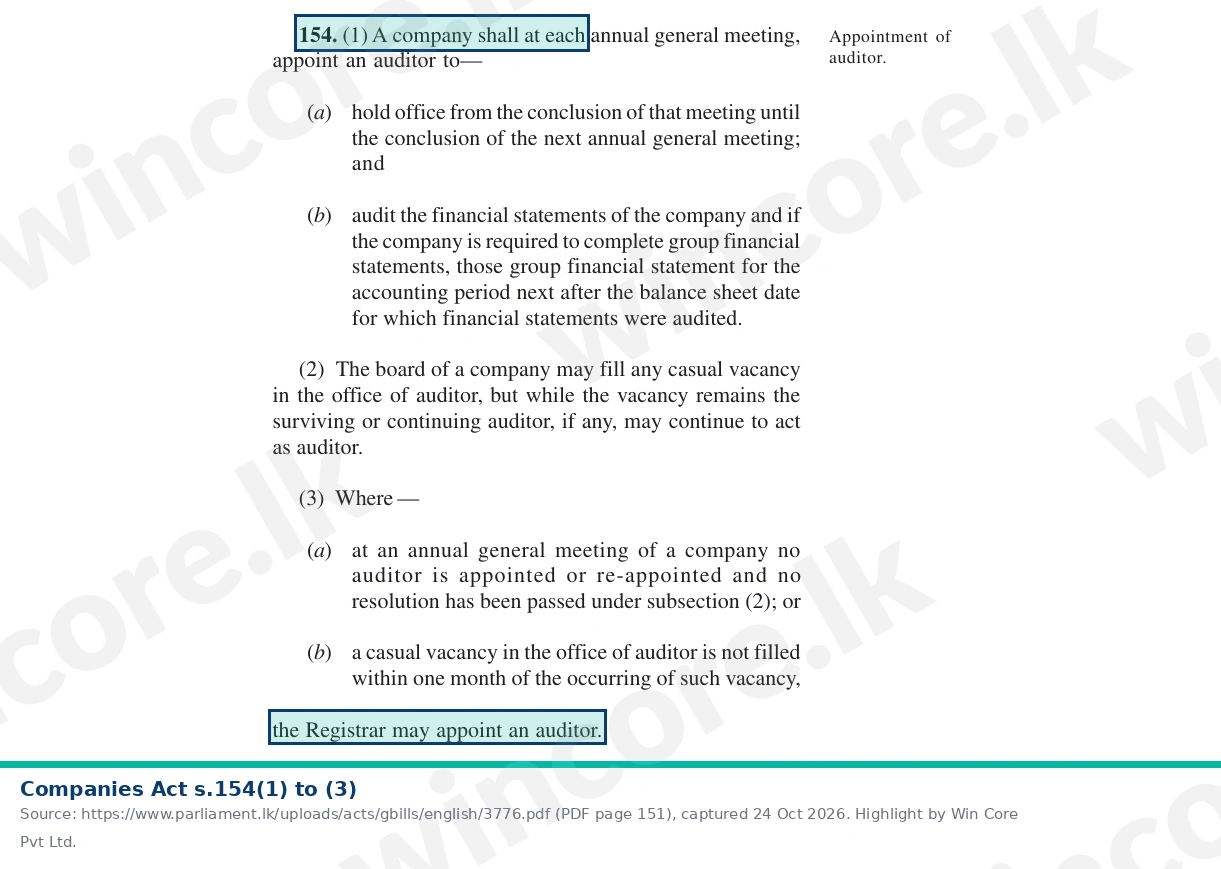
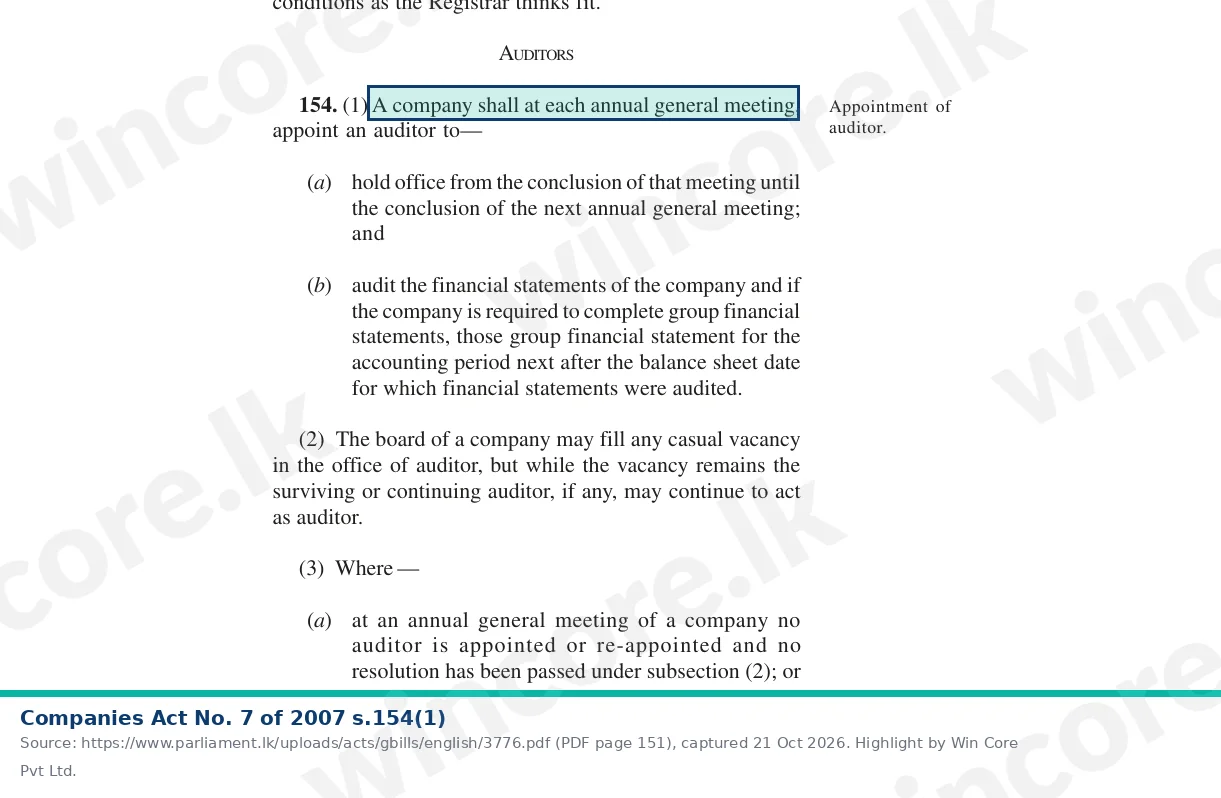
Section 154(1) is the core rule: "A company shall at each annual general meeting, appoint an auditor to" hold office until the next AGM and "audit the financial statements of the company" for the accounting period next after the balance sheet date for which financial statements were audited [1]. For who must file accounts and how, see filing financial statements with the Registrar.
The section says "a company". It does not distinguish private from public companies.
Section 158(1) makes this easier in later years. An auditor, "other than an auditor appointed under subsection (1) of section 159", "shall be deemed to be re-appointed at an annual general meeting of the company", unless they are not qualified, the meeting appoints someone else, or the auditor has said they do not wish to be re-appointed. To replace the auditor, see how to change auditor.
When the AGM must be held
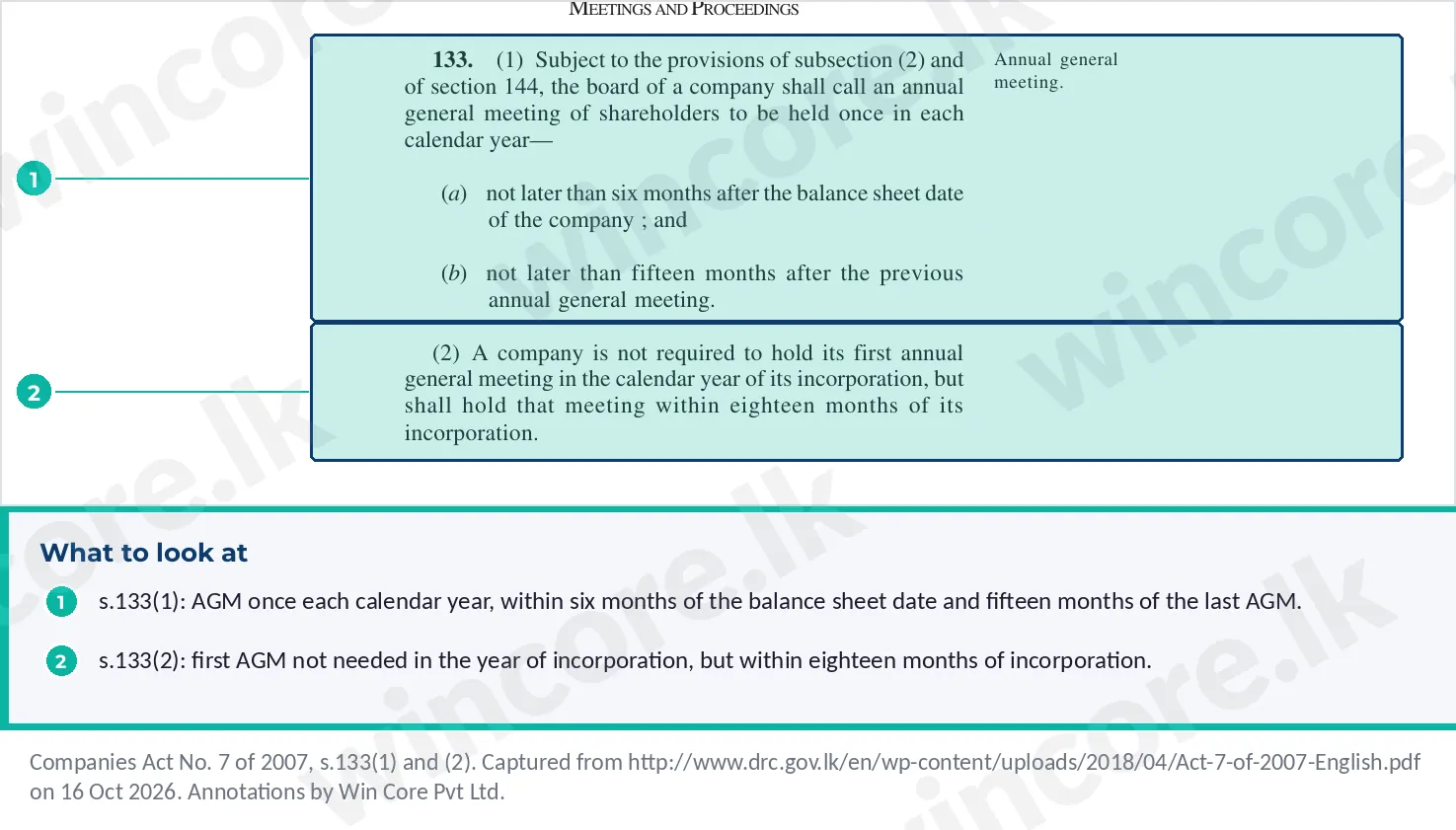
Section 133(1) requires an AGM "once in each calendar year", "not later than six months after the balance sheet date" and "not later than fifteen months after the previous annual general meeting" [1]. The rule is "subject to the provisions of subsection (2) and of section 144", which is the resolution in lieu of a meeting. Section 133(2) allows the first AGM to be held "within eighteen months of its incorporation". See our guide on a late first AGM and annual return.
What happens if no auditor is appointed
Section 154(3) gives the Registrar the power: where "at an annual general meeting of a company no auditor is appointed or re-appointed and no resolution has been passed under subsection (2)" (subsection (2) is the board's power to fill a casual vacancy), or a casual vacancy is not filled within one month, "the Registrar may appoint an auditor" [1].
Section 154(4) puts the duty on the company to report this. It must, "within five working days of the power becoming exercisable, give written notice to the Registrar". Failing to do so is an offence under section 154(5), with a fine of up to Rs 200,000 for the company and a separate fine for each officer in default.
Under section 155(c), an auditor appointed by the Registrar has fees "fixed ... by the Registrar".
The unanimous-shareholder option: first auditor only
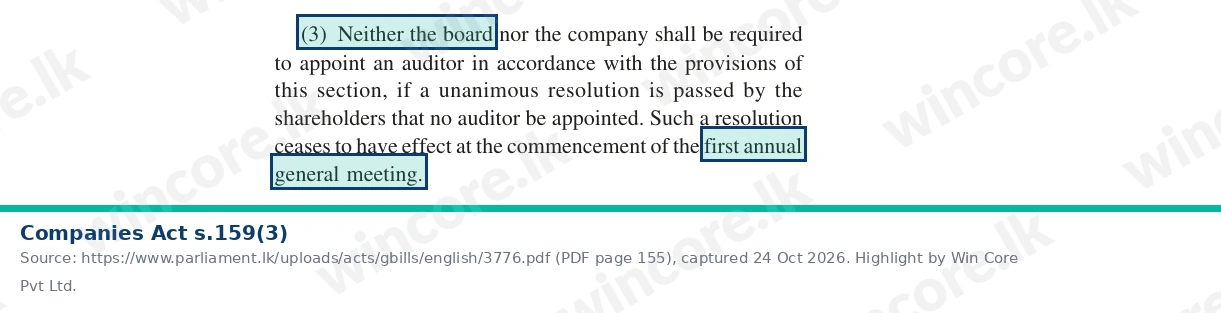
The only option we found to skip an auditor is in section 159, on the first auditor. Section 159(1) lets the board appoint the first auditor before the first AGM. Section 159(2) says that otherwise "the company shall appoint the first auditor at a meeting of the company". Section 159(3) then provides:
"Neither the board nor the company shall be required to appoint an auditor in accordance with the provisions of this section, if a unanimous resolution is passed by the shareholders that no auditor be appointed. Such a resolution ceases to have effect at the commencement of the first annual general meeting." [1]
It has three conditions:
- Unanimity: every shareholder must agree.
- Limited scope: it releases only the first-auditor appointment under section 159.
- Limited time: it ends when the first AGM starts, and from then on section 154(1) applies.
What the Act does not provide. We checked the Second Schedule, which lists provisions that do not apply to a private company acting with unanimous shareholder approval under section 31. It covers matters such as distributions, share issues and major transactions. Sections 154 to 159 are not on that list. Section 168(3) lets all shareholders agree in writing to drop parts of the annual report, but not paragraph (b), the financial statements, or paragraph (c), the auditor's report "where an auditor has been appointed by the company".
The Amendment Act. We read the Companies (Amendment) Act No. 12 of 2025 section by section. It amends sections 4, 11, 51, 52, 206, 211, 270, 272, 341, 424, 471, 472, 487, 508 and 529, and inserts new provisions after sections 51, 130, 484 and 513. Its section 21 Schedule also corrects wording in many sections, including sections 152(1)(c), 167(1), 168(1)(j) and 168(2). None of these changes touch the auditor rules in sections 154 to 159 or the section 150 duty [2]. The only other amending Act we know of, Act No. 13 of 2019, amends sections 5, 9 and 10 according to a secondary listing; we could not open its certified text on 26 October 2026.
Only a qualified person who is not a director or employee can audit; a separate Act covers larger companies
Who can be the auditor
Section 157(1) requires the auditor to be a member of the Institute of Chartered Accountants of Sri Lanka or "a registered auditor". Under section 157(2), a company "other than a private company or a company limited by guarantee" must use an Institute member.
Section 157(3) bars "a director or employee of the company" from being the auditor, along with anyone in a firm with, or employed by, such a person. Section 157(4) adds a two-year cooling-off period after leaving such an office. Your own bookkeeper, if employed by the company, cannot audit your accounts [1].
The Sri Lanka Accounting and Auditing Standards Act: which companies it reaches
The Sri Lanka Accounting and Auditing Standards Act No. 15 of 1995 applies to "specified business enterprises" listed in its Schedule (s.5) [3]. Section 6(1) makes it "the duty of every specified business enterprise to prepare its accounts in compliance with the Sri Lanka Accounting Standards and take all necessary measures to ensure that its accounts are audited in accordance with the Sri Lanka Auditing Standards". Section 7(1) requires the audit to be done by "members of the Institute holding a certificate to practise".
The Schedule names banks, insurers, leasing, factoring and finance companies, fund managers, stock brokers, and listed companies. It also covers unlisted companies "which have a turnover in excess of the prescribed limit", or which exceed prescribed limits for shareholders' equity, gross assets, liabilities to banks and financial institutions, or staff. Groups are covered where any one company qualifies.
The Act leaves the limits to regulations. The Sri Lanka Accounting and Auditing Standards Monitoring Board's own page gives them as:
- turnover "in excess of Rupees 500 Million";
- shareholders' equity in excess of Rupees 100 Million;
- gross assets in excess of Rupees 300 Million;
- liabilities to banks and other financial institutions in excess of Rupees 100 Million;
- a staff "in excess of 1000 employees" [4].
We could not find or read the regulation that prescribes these limits: a web search on 26 October 2026 did not turn it up, and the Board's page did not load for us that day. Treat the figures as the Board's summary and an open point.
Most small private companies are not specified business enterprises. Even so, the Companies Act audit duty in section 154 still applies to them.
The IRD expects audited statements, and we found no dormant or review exemption
What the IRD expects with the income tax return
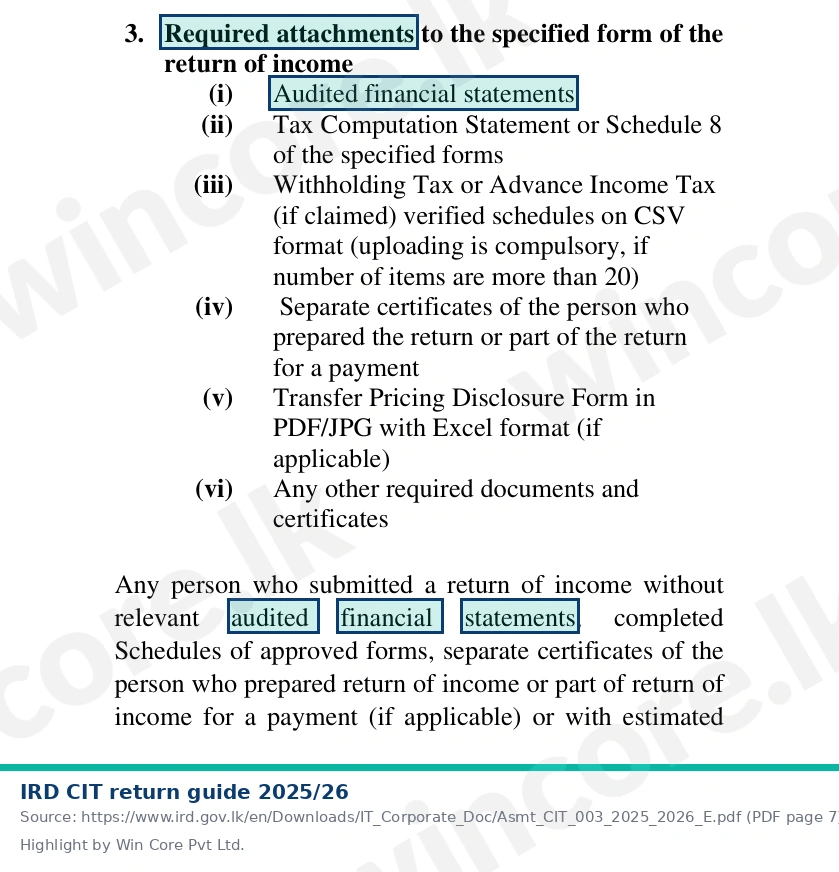
The Inland Revenue Act lets the Commissioner-General specify attachments to returns (s.126(2)). The IRD's Guide to Corporate Return of Income Tax, Year of Assessment 2025/2026 lists the "Required attachments to the specified form of the return of income", and the first is "(i) Audited financial statements" [5].
It then warns: "Any person who submitted a return of income without relevant audited financial statements ... or with estimated figures of income etc., will be deemed not to have furnished a return of Income for the purpose of the IRA."
Threshold. The guide sets no turnover threshold for this attachment, and we found none in the Inland Revenue Act. The return for 2025/26 is due on or before 30 November 2026, according to the guide. See our income tax return filing guide.
Dormant and newly incorporated companies
Newly incorporated. A new company can rely on section 159(3) until its first AGM, if every shareholder agrees. That releases the auditor appointment only. It does not change the IRD guide's list of attachments for any return the company files in that period. Plan the first year with that in mind, and take advice.
Dormant. We found no dormant company exemption in the Companies Act, in Act No. 12 of 2025, or in the IRD guide; on 26 October 2026 a search for "dormant" in all three, and a search of drc.gov.lk, returned nothing. A company that is not trading still has the section 150 and section 154 duties, and still files its annual return. If you believe a dormant company is treated differently, ask for the written source.
Audit versus independent review
An audit under section 163 ends in an auditor's report to shareholders. The report states the basis of opinion, the scope and limitations of the audit, and whether proper accounting records have been kept [1].
An independent review is a separate engagement giving a lower, limited level of assurance. We found no provision in the Companies Act, and nothing in the IRD guide, that accepts a review in place of an audit. A review can be useful for a lender, a buyer or the board, but treat it as an addition to the audit, not a replacement. See our independent review guide.
Does a private company need an audit in Sri Lanka? The table by company type
| Company type | Audit required? | Source |
|---|---|---|
| Private company, from its first AGM | Yes: auditor appointed at each AGM | Companies Act s.154(1), s.158 |
| Private company before its first AGM, all shareholders resolve no auditor | No first auditor needed until the first AGM | Companies Act s.159(3) |
| Private company before its first AGM, no such resolution | Yes: board or company appoints first auditor | Companies Act s.159(1), (2) |
| Specified business enterprise (listed, financial sector, or over a prescribed limit) | Yes, to Sri Lanka Auditing Standards, by an Institute member with a practising certificate | SLAASA ss.5 to 7 and Schedule |
| Public company | Yes; auditor must be an Institute member | Companies Act s.154(1), s.157(2) |
| Dormant company | No exemption found | Companies Act; Act No. 12 of 2025 |
| Any company filing a CIT return | Audited FS listed as a required attachment | IRD CIT guide 2025/2026, section 3 |
The example: a small construction company in its second year
This is an invented example. A small construction company was incorporated on 1 June 2024, with two shareholder-directors and a balance sheet date of 31 March. Turnover for the year to 31 March 2026 is Rs 48 million, it has 14 staff, and it has no bank loans over Rs 100 million.
First period. Both shareholders signed a unanimous resolution under section 159(3) that no auditor be appointed. The resolution ceased at the start of the first AGM. Section 133(2) required that AGM within eighteen months of incorporation (by 1 December 2025, our count), and section 133(1)(a) points to six months after the 31 March 2025 balance sheet date (30 September 2025). The Act does not say which governs a first AGM; on our reading, hold it by the earlier date.
Second year. At the first AGM, section 154(1) required the company to appoint an auditor to audit the financial statements for the year to 31 March 2026. The directors must have those statements completed and signed within six months of 31 March 2026 (s.150(1)). The IRD guide lists audited financial statements as an attachment to the 2025/26 return, due on or before 30 November 2026. The auditor must meet section 157 and must not be a director or employee.
SLAASA. At Rs 48 million of turnover and 14 staff, the company is below the limits on the Board's page, so it is not a specified business enterprise. That does not remove the Companies Act audit.
If the AGM appointed no one. Section 154(3) lets the Registrar appoint an auditor, and the company had five working days to notify the Registrar (s.154(4)).
Getting ready for the audit
An audit goes faster when the year-end close is done first. That means reconciled bank accounts, a fixed asset register, confirmed receivables and payables, payroll and statutory payments agreed, and signed board minutes. See our statutory audit preparation guide.
What this means for you
- Assume your private company needs an auditor every year from its first AGM.
- Use section 159(3) only with every shareholder's signed agreement, and remember it ends at the first AGM.
- Appoint the auditor at the AGM. If you don't, notify the Registrar within five working days.
- Attach audited financial statements to the company income tax return, as the IRD guide lists.
- Check the SLAASA limits each year once turnover, assets or borrowing grow.
- Do not treat an independent review as a substitute for the audit.
Checklist: documents needed
- Certificate of incorporation and articles
- Any section 159(3) unanimous resolution, with its date
- AGM minutes showing the auditor appointment (s.154(1))
- Auditor's letter confirming Institute membership or registration (s.157)
- Financial statements signed by the directors (s.150(1))
- Trial balance, bank reconciliations and fixed asset register
- Prior-year audited financial statements and tax return
FAQ
Does a small private company need an audit in Sri Lanka?
Yes, in practice. Section 154(1) of the Companies Act requires every company to appoint an auditor at each AGM to audit its financial statements. The only release we found is section 159(3), a unanimous shareholder resolution not to appoint a first auditor, which ends at the first AGM. The IRD guide also lists audited statements with the return.
Can all the shareholders agree to skip the audit?
Only for the first auditor. Section 159(3) lets shareholders resolve unanimously that no auditor be appointed, but the resolution "ceases to have effect at the commencement of the first annual general meeting". Sections 154 to 159 are not in the Second Schedule of provisions that unanimous shareholders can switch off, so the yearly appointment continues after that.
Is there a turnover threshold below which no audit is needed?
Not that we found. The Rs 500 million turnover figure is the monitoring board's summary of one limit for specified business enterprises under the 1995 Act; we have not read the regulation that sets it. It does not remove the Companies Act audit. The IRD guide for 2025/2026 lists audited financial statements as an attachment without any threshold.
What if we forget to appoint an auditor at the AGM?
Section 154(3) gives the Registrar the power to appoint an auditor, and section 154(4) requires the company to notify the Registrar within five working days of that power arising. Failing to notify is an offence, with a fine of up to Rs 200,000 for the company and a separate fine for each officer in default.
The short version
Every company appoints an auditor at each AGM. A unanimous resolution can delay only the first auditor, and only until the first AGM. Specified business enterprises also follow the 1995 Act. The IRD expects audited statements with the return. We found no dormant or small company exemption.
Talk to us. If you need an auditor, or want to know what yours will ask for, see our auditing services, which list "Annual Statutory Audits" and "Internal Audits", or book a consultation at our contact page.
WinCore Pvt Ltd
This article is general information on the law as at 26 October 2026 and is not advice on your specific position.
Cover image: Image by 8photo on Freepik.
References
- Parliament of Sri Lanka. Companies Act, No. 07 of 2007, ss.133, 150, 151, 154, 155, 157, 158, 159, 163, 168 and Second Schedule. https://www.parliament.lk/uploads/acts/gbills/english/3776.pdf . Primary. Accessed 24 October 2026.
- Parliament of Sri Lanka. Companies (Amendment) Act, No. 12 of 2025. https://www.parliament.lk/uploads/acts/gbills/english/6389.pdf . Primary. Accessed 24 October 2026.
- Sri Lanka Accounting and Auditing Standards Act, No. 15 of 1995, ss.5 to 7 and Schedule. https://slaasc.lk/pdf/01.pdf . Copy of the Act hosted by the standards body. Accessed 24 October 2026.
- Sri Lanka Accounting and Auditing Standards Monitoring Board. "Specified Business Enterprises". https://slaasmb.gov.lk/specified-business-enterprises/ . Official summary; regulation not read. Accessed 24 October 2026.
- Inland Revenue Department. Guide to Corporate Return of Income Tax, Year of Assessment 2025/2026 (Asmt_CIT_003). https://www.ird.gov.lk/en/Downloads/IT_Corporate_Doc/Asmt_CIT_003_2025_2026_E.pdf . Primary (administrative guidance). Accessed 24 October 2026.
Put these insights to work
WinCore specialists can review your current workflow, document gaps, and build a practical 90-day action plan.
Book a free consultationContinue reading
Explore more WinCore analysis to keep your finance, tax, and compliance roadmap moving.
A new company's first AGM, worked from the incorporation date: the eighteen month limit, the six month question, and what a late annual return costs.
Who must be audited, what the auditor can demand, and how to have confirmations, schedules and fixes ready before fieldwork starts.
A second look at the books only helps if it could find something. Who should do it, what to test, how to record it and the steps that prove nothing.