
Accrued expenses Sri Lanka: four cut-off traps and the fix
Bills arrive late, landlords recharge in bundles and one month goes missing. Four cut-off traps, the rule behind each and a six-step monthly routine.
On this page
Last verified against the primary sources on 22 October 2026.
Accrued expenses in Sri Lanka are costs you have received the service for but have not yet been billed for, and they belong in the month or year the service happened, not the month the bill arrives. Paragraph 2.36 of SLFRS for SMEs (2015) requires the accrual basis, and section 21(3) of the Inland Revenue Act, No. 24 of 2017 requires it for business income, with s.23(3) fixing an expense once "economic performance" occurs. Small businesses get cut-off wrong in four predictable places: work billed in arrears, utilities recharged by a landlord, bills that span two months, and a bill that never turns up. This article sets out the rule, then the fix for each trap. The fixes are bookkeeping practice, not legal requirements, and we label them that way.
Accrued expenses in Sri Lanka follow the service period under the standard and the Act
The accounting standard
Many smaller Sri Lankan private companies report under the Sri Lanka Accounting Standard for Small and Medium-sized Entities (SLFRS for SMEs). Companies on full SLFRS follow the same accrual principle. The standard is issued by the Institute of Chartered Accountants of Sri Lanka (CA Sri Lanka). We read the 2015 edition, using the copy on the Sri Lanka Accounting and Auditing Standards Monitoring Board's website [1].
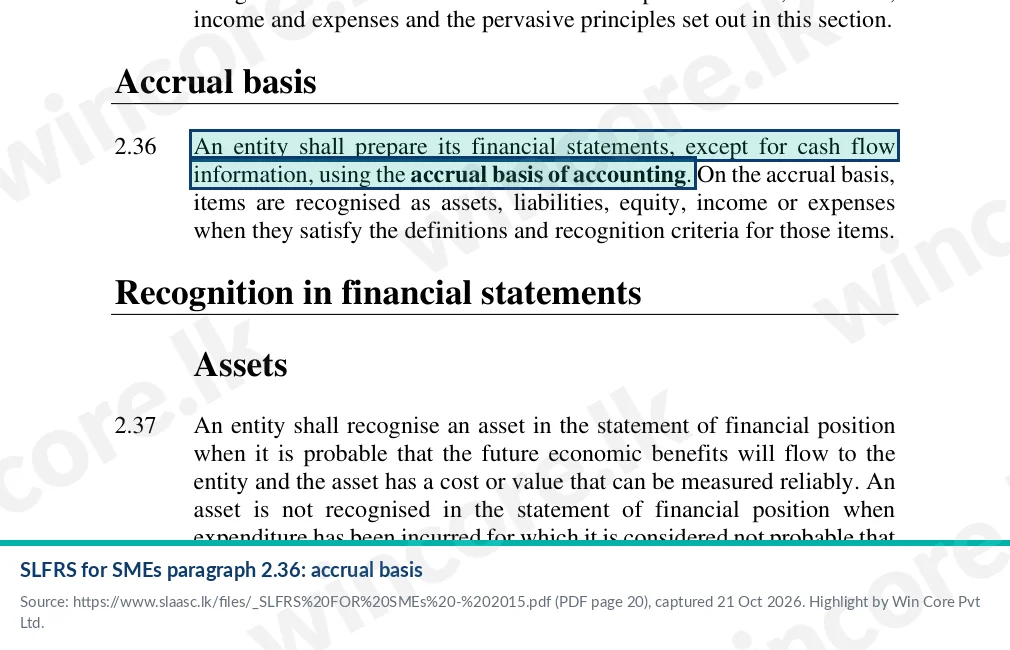
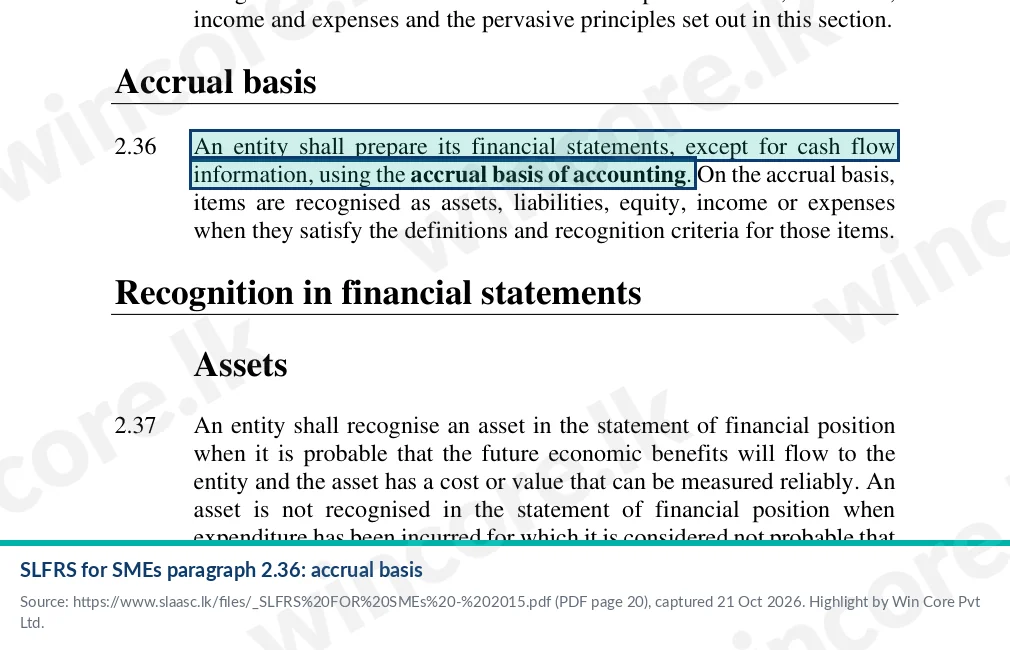
Paragraph 2.36 sets the basis: "An entity shall prepare its financial statements, except for cash flow information, using the accrual basis of accounting. On the accrual basis, items are recognised as assets, liabilities, equity, income or expenses when they satisfy the definitions and recognition criteria for those items" [1].
Three other paragraphs do the work at month-end [1]:
- 2.39 recognises a liability when "the entity has an obligation at the end of the reporting period as a result of a past event", settlement is probable, and "the settlement amount can be measured reliably".
- 2.42 recognises an expense when "a decrease in future economic benefits related to a decrease in an asset or an increase of a liability has arisen that can be measured reliably".
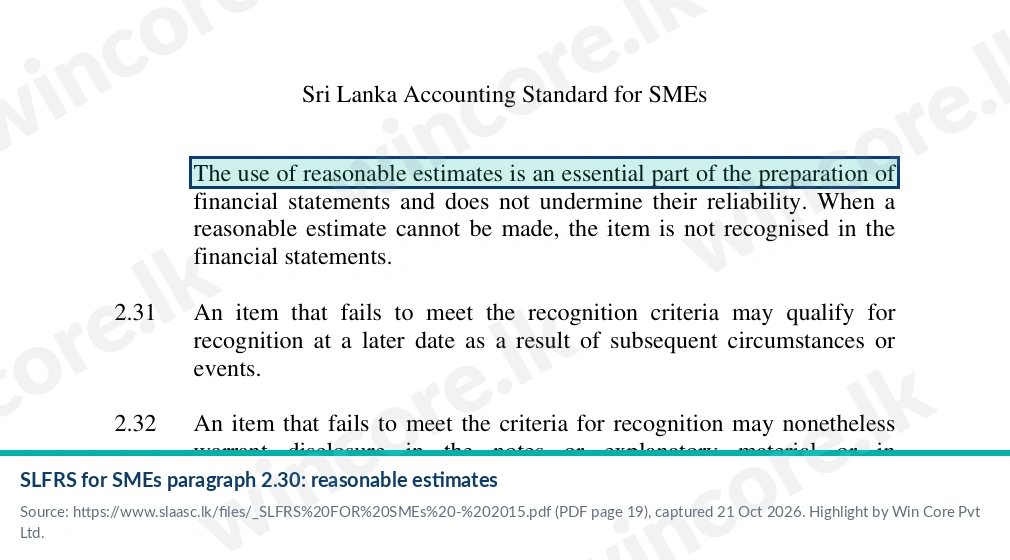
- 2.30 allows estimates: "The use of reasonable estimates is an essential part of the preparation of financial statements and does not undermine their reliability. When a reasonable estimate cannot be made, the item is not recognised in the financial statements."
Paragraph 2.6 adds materiality: information is material "if its omission or misstatement could influence the economic decisions of users", but "it is inappropriate to make, or leave uncorrected, immaterial departures" to achieve a particular presentation [1].
The tax law
The Inland Revenue Act, No. 24 of 2017 (IRA) follows the accounts on timing. Section 21(1): "Unless otherwise provided by this Act, the timing of inclusions and deductions in calculating a person's income shall be made according to generally accepted accounting principles." Section 21(3): "An individual or entity conducting business shall account for income tax purposes on an accrual basis" [2].
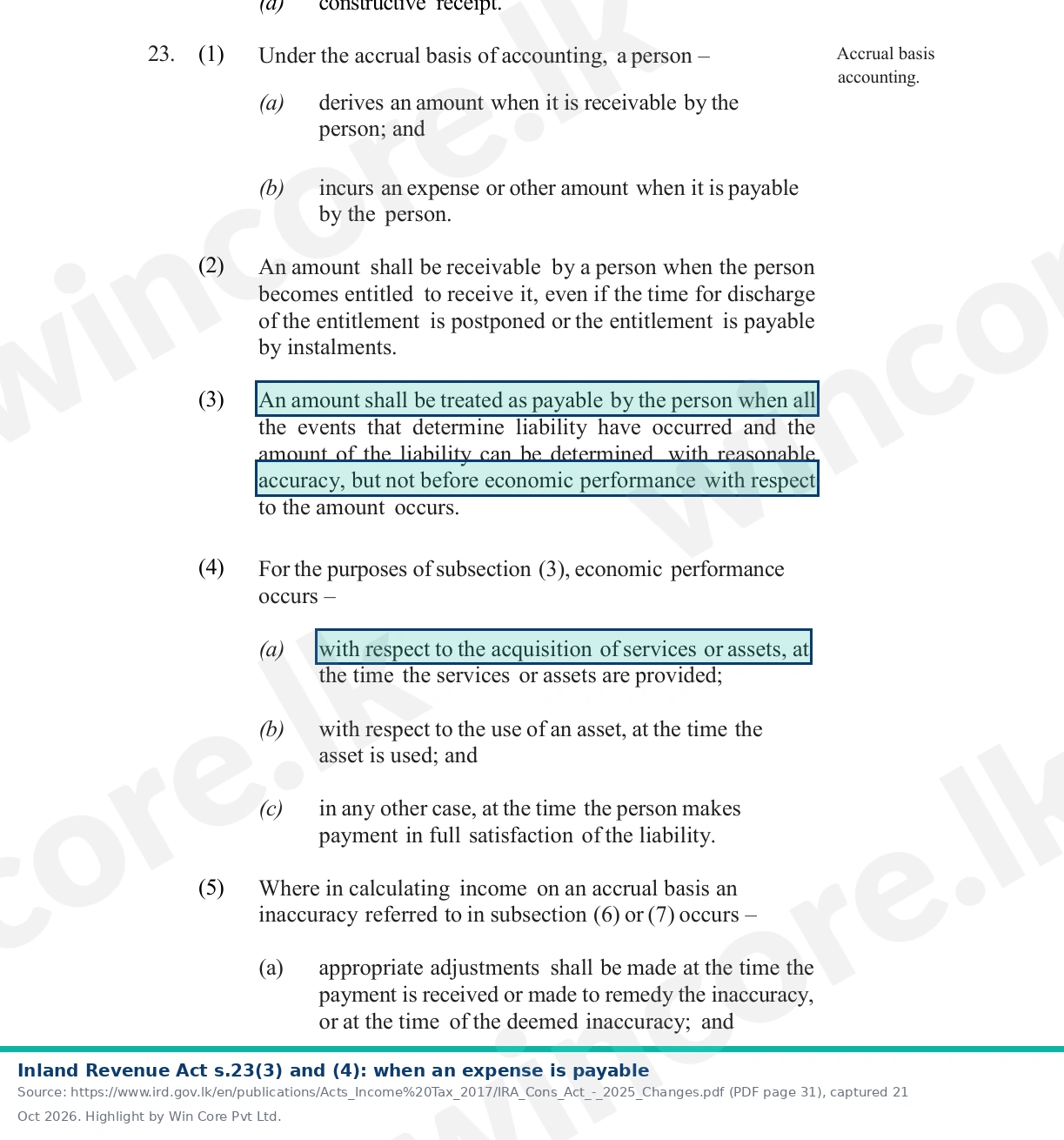
Section 23 defines the accrual basis. A person "derives an amount when it is receivable" and "incurs an expense or other amount when it is payable". Under s.23(3), an amount is payable "when all the events that determine liability have occurred and the amount of the liability can be determined with reasonable accuracy, but not before economic performance with respect to the amount occurs". Under s.23(4)(a), for services or assets, economic performance occurs "at the time the services or assets are provided" [2].
Two provisos matter for estimates. Section 23(5) and (6) require "appropriate adjustments" when an amount is later settled at a different figure, made "at the time the payment is received or made"; s.23(5) also lets the Commissioner-General require the adjustment in the year the inaccuracy arose instead. Section 23(7) deems an inaccuracy where an obligation "is not satisfied by a payment being made by the person within three years of the obligation arising" [2]. On our reading, a deduction claimed for an accrual still unpaid three years later has to be adjusted for tax under s.23(5).
So the standard and the tax law point the same way: the cost belongs to the period in which the service was received, whatever the bill date.
Trap 1: a bill that arrives after the month still belongs to that month
Rent, security, cleaning, professional fees and many contractors bill after the month. The March invoice arrives in April. If the books close on 31 March using only invoices on file, March is understated.
Practice: keep a list of every supplier that bills in arrears. At each month-end, accrue the expected charge for each one not yet billed. Reverse the accrual on the first day of the next month, so the real invoice posts against it without doubling.
The same trap runs the other way for income. If you finish work in March and invoice in April, the income is still March income. Section 23(2) makes an amount receivable "when the person becomes entitled to receive it, even if the time for discharge of the entitlement is postponed" [2]. Record accrued income at month-end. Our guide to bookkeeping basics shows where accrued expenses and accrued income sit in a small company chart of accounts.
Trap 2: landlord utility recharges need an estimate every month
Many tenants pay electricity and water through the landlord. The landlord reads sub-meters irregularly, bundles several months, and sometimes recharges common-area costs a quarter late.
Practice:
- Ask for the meter-reading dates on every recharge, as well as the amount.
- Accrue each month on the last known daily cost, adjusted for any known change in use.
- When the bundled recharge arrives, compare it with the accruals and post only the difference to the current month, unless the difference is material to an earlier closed period.
- Check the lease for the recharge basis. A fixed share of the building bill and a sub-meter reading give different numbers.
The estimate is permitted by 2.30. The later true-up is the s.23(5) adjustment for tax.
Trap 3: a bill that crosses the year end is split by days of service
A service or maintenance contract bill often covers, say, 15 March to 14 April. If the year ends on 31 March, part of it belongs to each year.
Practice: split by days of service where the amount is material. In a hypothetical case, a Rs. 46,500 bill covering 31 days has 17 days in March, so Rs. 25,500 is accrued in March and Rs. 21,000 falls in April. That split is our arithmetic, not a figure from any source. For small monthly bills that recur at the same level, some businesses book each bill in the month received. On our reading, that is defensible only while the effect is immaterial under paragraph 2.6, and paragraph 2.6 does not allow an immaterial departure made to achieve a particular presentation. At year end, check it.
Prepaid items are the mirror image. An annual software licence paid in March for April to March next year is a prepayment, not a March expense. Spread it over the months it covers.
Trap 4: a missing bill is still a cost you accrue
A bill can go missing: lost in email, sent to a former director, or never issued. The cost was still incurred.
Practice:
- Estimate from the prior months and any known change, and accrue it. Paragraph 2.30 allows this; if no reasonable estimate can be made, the item is not recognised, so keep the basis for your estimate on file.
- Ask the supplier for a duplicate or a statement of account. For utilities, the account number usually gets a copy.
- When the real bill arrives, post the difference.
- Do not leave a gap in a recurring series. A missing month is a common sign of an unrecorded liability, and reviewers look for it.
If you are rebuilding a year from bank statements, our guide to rebuilding accounts from bank statements covers the method. A payment in May may settle a February bill.
A six-step month-end routine catches most cut-off errors
This is practice, not a rule from either source. A short routine run on the same working day each month catches most errors; our month-end close checklist sets out the full close around it:
- Pull the arrears supplier list and accrue any bill not yet received.
- Check each recurring bill against last month. A gap or a large jump needs a reason.
- Split any material bill that crosses the month-end by days of service.
- Move any payment made ahead for a future period to prepayments.
- Review completed but uninvoiced work and accrue the income.
- Reverse last month's accruals and confirm the real bills cleared them.
If the books are already months behind, fix the prior year first; our companion article on backlog accounts (publishing in this series) explains why. At the year end, the same checks sit inside our year-end financial close guide. If you would rather hand the routine over, our bookkeeping services team runs it each month.
A hypothetical year end shows all four traps together
A small bakery trading from a shopping arcade closes its year on 31 December. In January it receives: the December invoice from its contract cleaners, the arcade management's recharge of common-area power and water for October to December, a cold-room maintenance bill for 10 December to 9 January, and nothing for November's pest-control visit, which has always cost about Rs. 4,500.
At year end it accrues the December cleaning charge in full; an estimate of three months' common-area charges based on the last recharge; Rs. 22,000 of a Rs. 31,000 maintenance bill (our arithmetic: 22 of 31 days fall in December); and Rs. 4,500 for the missing November pest-control bill (our estimate on prior visits). It reverses these on 1 January and posts the real bills against them.
What this means for you
Close each month on the service period, not the bill date. Keep a short list of arrears suppliers and recurring bills, and tick it off at every month-end. Accrue what is missing on a written basis. Spread prepayments. True up when bills arrive, and keep the working papers. Tax follows the accounts on timing under s.21(1), so good cut-off protects both the financial statements and the return. Our accounting services team prepares accrual accounts on this basis, and our income tax services team carries the same timing into the return; the corporate tax calculator gives a first estimate of the tax on the corrected profit.
Checklist: documents needed
- List of suppliers billing in arrears, with usual monthly amounts (practice)
- Lease clauses on utility recharges and meter readings
- Last 12 months of utility and telecom bills, with service periods
- Accruals schedule with the basis for each estimate (SLFRS for SMEs 2.30)
- Prepayments schedule for annual licences, insurance and rent paid ahead
- Supplier statements of account at year end
Frequently asked questions
Can we just record bills when they arrive?
Only where the effect is immaterial. Paragraph 2.36 of SLFRS for SMEs requires the accrual basis, and s.21(3) of the Inland Revenue Act requires it for business income. A small bill that recurs at the same level each month may make little difference, but paragraph 2.6 still bars an immaterial departure made to achieve a particular presentation, so check the effect at every year end.
What if our accrual estimate turns out wrong?
Post the difference when the real bill arrives. Paragraph 2.30 accepts reasonable estimates as part of preparing accounts, and for tax s.23(5) and (6) of the Inland Revenue Act provide for an adjustment when an amount is settled at a different figure. Keep the basis of each estimate on file so the adjustment can be explained.
Is an unpaid accrual ever reversed for tax?
Yes, on our reading, once three years pass without payment. Section 23(7) deems an inaccuracy where an obligation is not satisfied by a payment within three years of arising, and s.23(5) then requires an adjustment. How the IRD applies this to old accruals in practice is an open point we have not checked, so review long-unpaid accruals each year.
Does cut-off apply to income as well as costs?
Yes. Work completed in March is March income even if you invoice in April. Section 23(2) makes an amount receivable when the person "becomes entitled to receive it", even if payment is postponed. Record accrued income at month end for completed but unbilled work, and reverse it when the invoice is raised the following month.
Who decides what is material for accruals?
The board, on our reading, because the directors are responsible for the financial statements; the auditor then forms its own view. Neither SLFRS for SMEs nor the Inland Revenue Act sets a rupee threshold. Paragraph 2.6 judges materiality by "size and nature" in the circumstances, so a small but unusual item can still matter.
Open points we are keeping open
- Standard edition. We read the 2015 SLFRS for SMEs. The IASB issued a third edition of the IFRS for SMEs Accounting Standard in 2025 (Secondary: ifrs.org listing); whether and from when CA Sri Lanka adopts it we did not verify.
- Materiality threshold. Neither source sets a number; it is judgement.
- Section 23(7) reversal. How the IRD applies it in practice to old accruals was not checked.
This article is general information, not advice for your specific situation.
Talk to us. If your month-end accruals need setting up, or a year end needs its cut-off checked before the audit, reach us at our contact page.
WinCore Pvt Ltd
References
- Institute of Chartered Accountants of Sri Lanka. Sri Lanka Accounting Standard for Small and Medium-sized Entities (SLFRS for SMEs), 2015, paras 2.6, 2.30, 2.36, 2.39, 2.42. https://www.slaasc.lk/files/_SLFRS%20FOR%20SMEs%20-%202015.pdf . Primary. Accessed 22 October 2026.
- Inland Revenue Department. Inland Revenue Act, No. 24 of 2017 (consolidated, 2025 changes), ss.21, 23. https://www.ird.gov.lk/en/publications/Acts_Income%20Tax_2017/IRA_Cons_Act_-_2025_Changes.pdf . Primary (IRD consolidation, not a statutory text). Accessed 22 October 2026.
Put these insights to work
WinCore specialists can review your current workflow, document gaps, and build a practical 90-day action plan.
Book a free consultationContinue reading
Explore more WinCore analysis to keep your finance, tax, and compliance roadmap moving.

Bookkeeping guide for Sri Lankan small businesses: legal requirements, chart of accounts, source documents, 5-year retention rule, and monthly routines.
Close your books before the March 31 deadline to reduce audit risk and start with clean numbers. A practical 10-step year-end guide for SMEs.
New companies in Sri Lanka face eight or more compliance registrations in year one. Here is how to set up your books, register for taxes, and stay clean.