
Capitalise or expense in Sri Lanka: threshold, fit-out, subscriptions
No rupee threshold is set by the standard or the tax law. How to treat chairs, office fit-out, landscaping and software subscriptions in books and tax.
On this page
Last verified against the primary sources on 22 October 2026.
Whether you capitalise or expense in Sri Lanka is decided by two separate rules. In the books, SLFRS for SMEs (2015) Section 17 treats an item as property, plant and equipment if it is held for use and expected to be used during more than one period, its benefits are probable and its cost can be measured reliably. For tax, Inland Revenue Act No. 24 of 2017 section 11(3) treats an expense that "secures a benefit capable of lasting longer than twelve months" as capital, recovered through Fourth Schedule capital allowances: five years for Classes 1 to 3 and twenty years for Class 4. Neither the standard nor the Act sets a rupee threshold. This is the position in the IRD consolidation to 2025, and the Inland Revenue (Amendment) Act No. 11 of 2026 did not change the class table.
Below we apply both to small purchases, leased-office fit-out, landscaping and subscriptions, and mark practice as practice.
Capitalise or expense in Sri Lanka: SLFRS for SMEs Section 17 decides the books
We read Section 17 (property, plant and equipment) and Section 18 (intangible assets) of the Sri Lanka Accounting Standard for Small and Medium-sized Entities, 2015 edition [1].
What counts. Paragraph 17.2: property, plant and equipment are tangible assets that "(a) are held for use in the production or supply of goods or services, for rental to others, or for administrative purposes; and (b) are expected to be used during more than one period."
When to recognise. Paragraph 17.4 applies the general recognition criteria in 2.27: the entity "shall recognise the cost of an item of property, plant and equipment as an asset if, and only if: (a) it is probable that future economic benefits associated with the item will flow to the entity; and (b) the cost of the item can be measured reliably" [1].
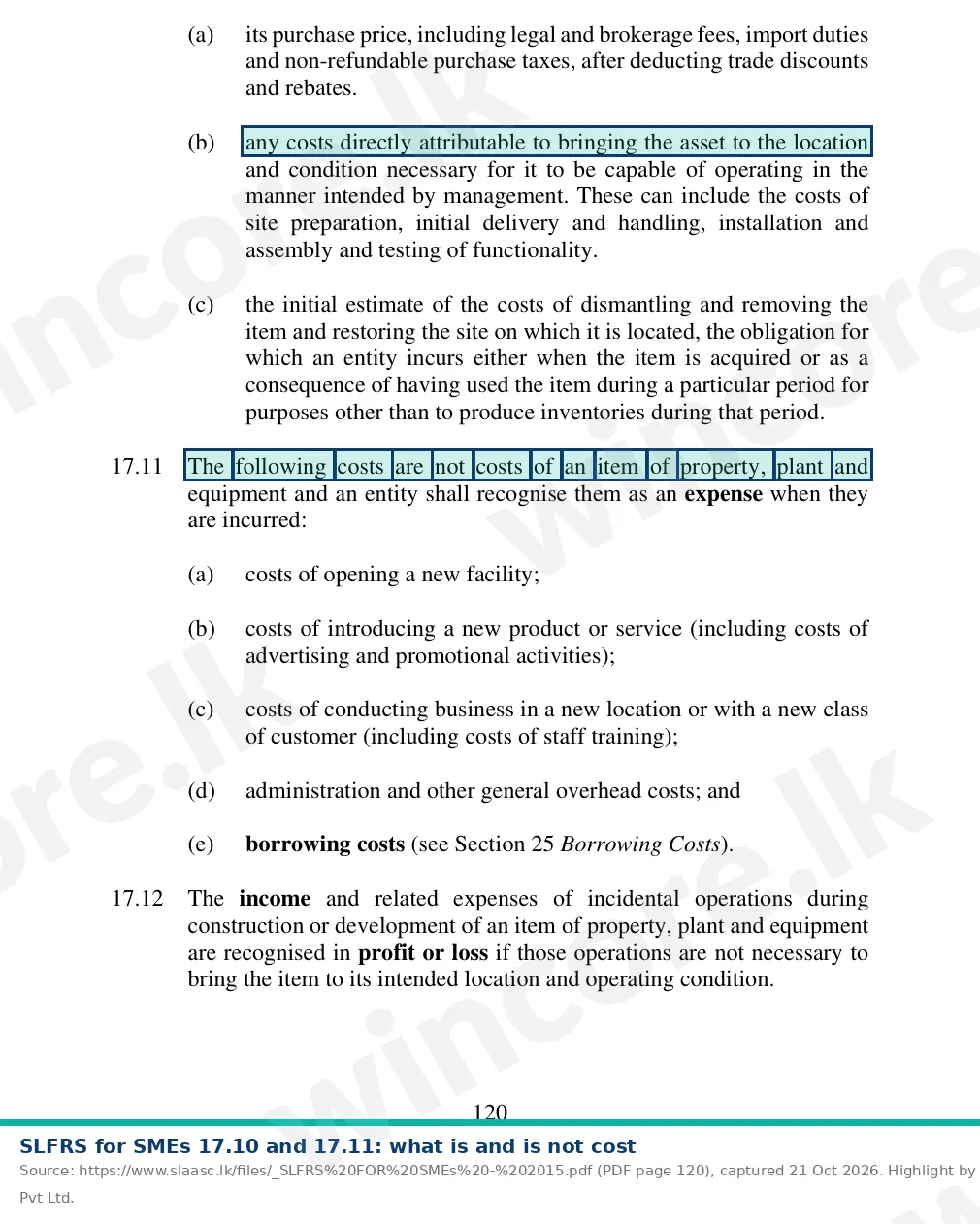
What goes into cost. Paragraph 17.10(b) includes "any costs directly attributable to bringing the asset to the location and condition necessary for it to be capable of operating in the manner intended by management", such as "site preparation, initial delivery and handling, installation and assembly and testing of functionality". Paragraph 17.11 requires other costs to be expensed, including "costs of opening a new facility", staff training for a new location and "administration and other general overhead costs" [1].
Running costs. Day-to-day servicing goes to profit or loss when incurred (17.15). A replacement part is added to cost only "if the replacement part is expected to provide incremental future benefits" (17.6) [1].
For an overseas software subscription, consider the withholding analysis for SaaS payments separately from whether the cost is capitalised or expensed.
No rupee threshold exists in the standard or the Act; any threshold is a policy you choose
The standard sets none. SLFRS for SMEs contains no rupee figure for capitalisation. What it offers is materiality and consistency. Paragraph 2.6 says materiality "depends on the size and nature of the omission or misstatement judged in the surrounding circumstances", and adds that it is "inappropriate to make, or leave uncorrected, immaterial departures" from the standard "to achieve a particular presentation". Paragraph 10.7: "An entity shall select and apply its accounting policies consistently for similar transactions, other events and conditions" [1].
Practice, not a rule. Many small companies adopt a written capitalisation threshold and expense items below it, on the basis that the effect is immaterial. The figure is the directors' choice. Write it down, approve it, apply it every year, and size it to the business: what is immaterial for a large company may be material for a small one. Watch bulk purchases. Twelve chairs at Rs. 45,000 each are Rs. 540,000 together (our arithmetic). Some policies capitalise a group of similar items bought together even when each item falls below the threshold. That is also practice.
The tax gap. The Inland Revenue Act has no threshold either, and its test is different. Section 11(2): "No deduction shall be allowed under subsection (1) for an expense of a capital nature." Section 11(3): "In this section, 'expense of a capital nature' includes an expense that secures a benefit capable of lasting longer than twelve months" [2].
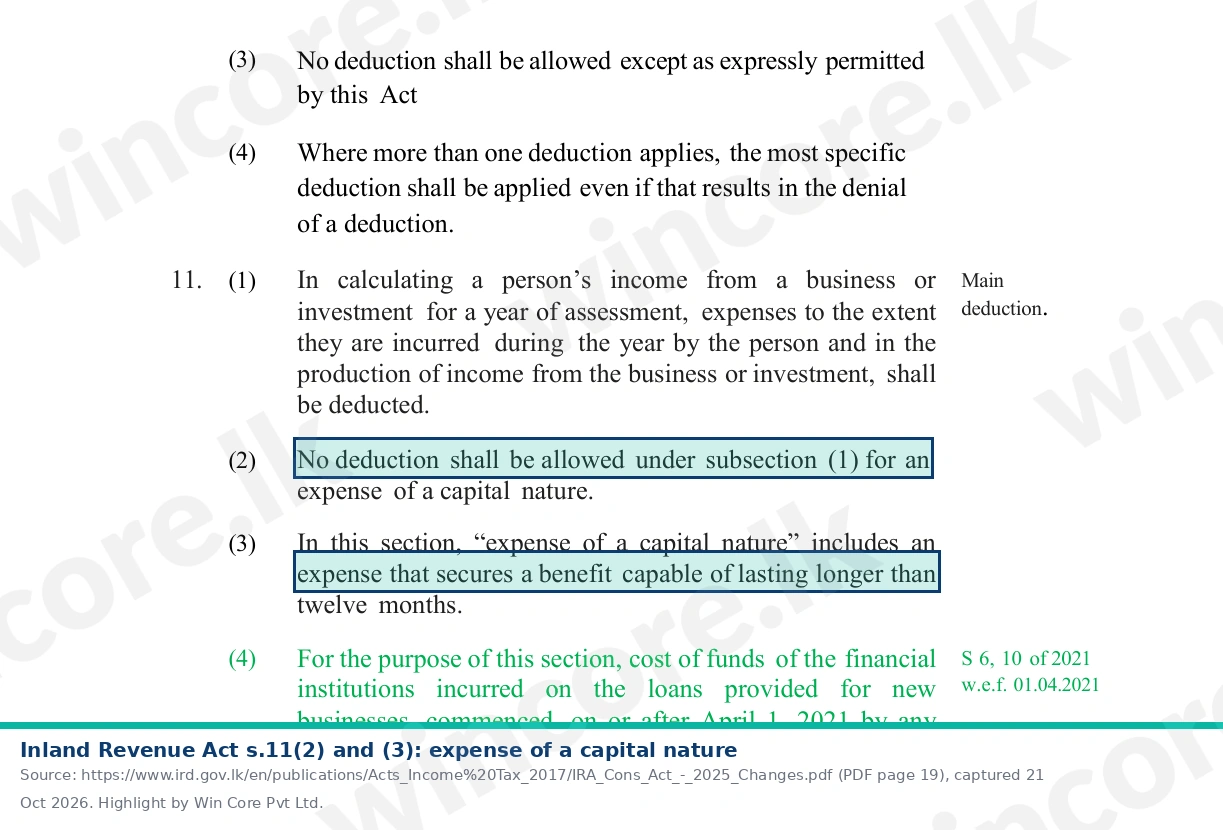
On our reading, a chair you expense in the books under your threshold is still capital for tax if it will last more than a year. You add it back in the tax computation and claim capital allowances on it instead. A book threshold does not change the tax answer.
Tax follows the twelve-month test and the Fourth Schedule classes
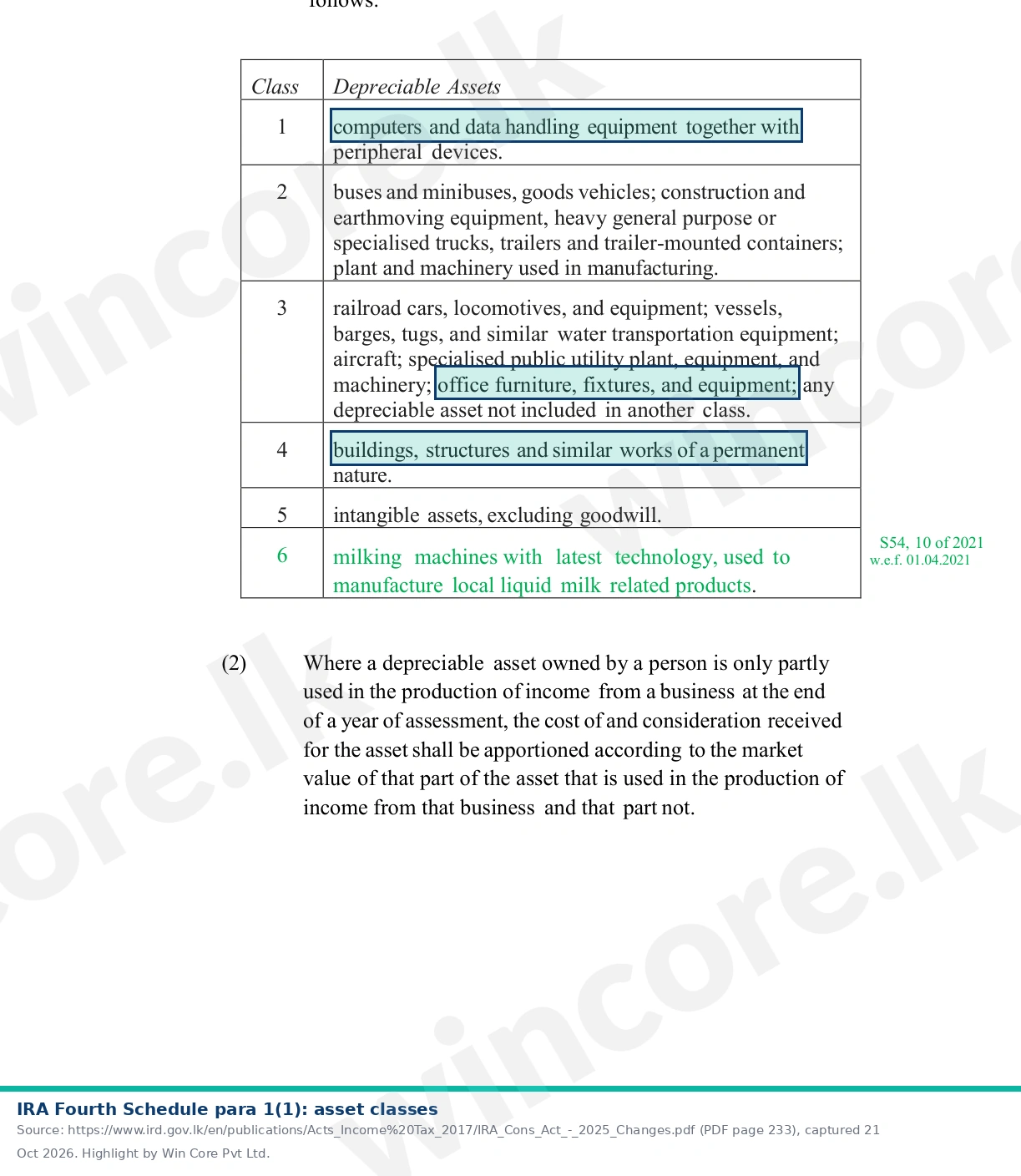
Section 16(2) grants capital allowances on depreciable assets "owned and used by a person at the end of a year of assessment" in a business, and s.16(3A) caps the total at cost [2]. The classes are in the Fourth Schedule ("Capital Allowances, Balancing Allowances and Assessable Charges"; the Fifth Schedule is qualifying payments and reliefs), paragraph 1(1):
| Class | Assets (quoted in part) | Years (para 2(3)) |
|---|---|---|
| 1 | "computers and data handling equipment together with peripheral devices" | 5 |
| 2 | buses, goods vehicles, construction equipment; "plant and machinery used in manufacturing" | 5 |
| 3 | includes "office furniture, fixtures, and equipment; any depreciable asset not included in another class" | 5 |
| 4 | "buildings, structures and similar works of a permanent nature" | 20 |
| 5 | "intangible assets, excluding goodwill" | Actual useful life, or 20 if indefinite |
| 6 | milking machines used to manufacture local liquid milk products | 2 |
The allowance is straight line: the depreciation basis divided by the years for the class (para 2(2)). A "depreciable asset" is one employed in a business "which is likely to lose value because of wear and tear, obsolescence or the passing of time", but the definition "excludes goodwill, an interest in land, a membership interest in an entity and trading stock" (s.195) [2]. You can model the effect on tax payable with our corporate tax calculator. For the start date, method and useful life, see how to set a depreciation policy.
Repairs and improvements. Section 14(1) allows repairs and improvements to your own depreciable assets "irrespective of whether they are of a capital nature or not". From 1 April 2021 the s.14(2) cap applies to improvements: five percent of written down value for Class 4, twenty percent otherwise, with the excess added to the depreciation basis (s.14(3)); where that value is zero, s.14(4) (Act No. 45 of 2022) spreads it over twelve years for Class 4 and three for other classes [2] [3].
Cash payments. Under s.10(2A), a payment of Rs. 500,000 or more in a day or for a single transaction, made other than by account payee cheque or draft, cash deposited into the payee's bank account (added by Act No. 11 of 2026 with effect from 8 May 2023), or card or electronic payment through a bank account, is not deductible and is not "considered as cost of an asset". Government, bank and prescribed payments are excluded [2] [4]. A contractor paid in cash can cost you the allowance.
Larger new projects may instead qualify for the Second Schedule allowance in our enhanced capital allowance guide; the Inland Revenue Amendment Act No. 11 of 2026 summary lists the other 2026 changes.
Fit-out and landscaping split into parts, and the tax class stays open
Fit-out in the books. Partitions, ceilings, wiring, air conditioning, flooring and built-in furniture in a rented office are usually capitalised: they meet 17.2 and 17.4, and 17.10(b) brings installation into cost. Pre-opening costs are not fit-out and are expensed (17.11(a), 18.15(b)). Where the lease obliges you to remove the fit-out and restore the premises, 17.10(c) adds "the initial estimate of the costs of dismantling and removing the item and restoring the site" to cost. Paragraph 17.21(d) requires you to consider "legal or similar limits on the use of the asset, such as the expiry dates of related leases" [1]. On our reading, fit-out that stays with the landlord should not be depreciated beyond the period you expect to occupy, including renewals you expect to take.
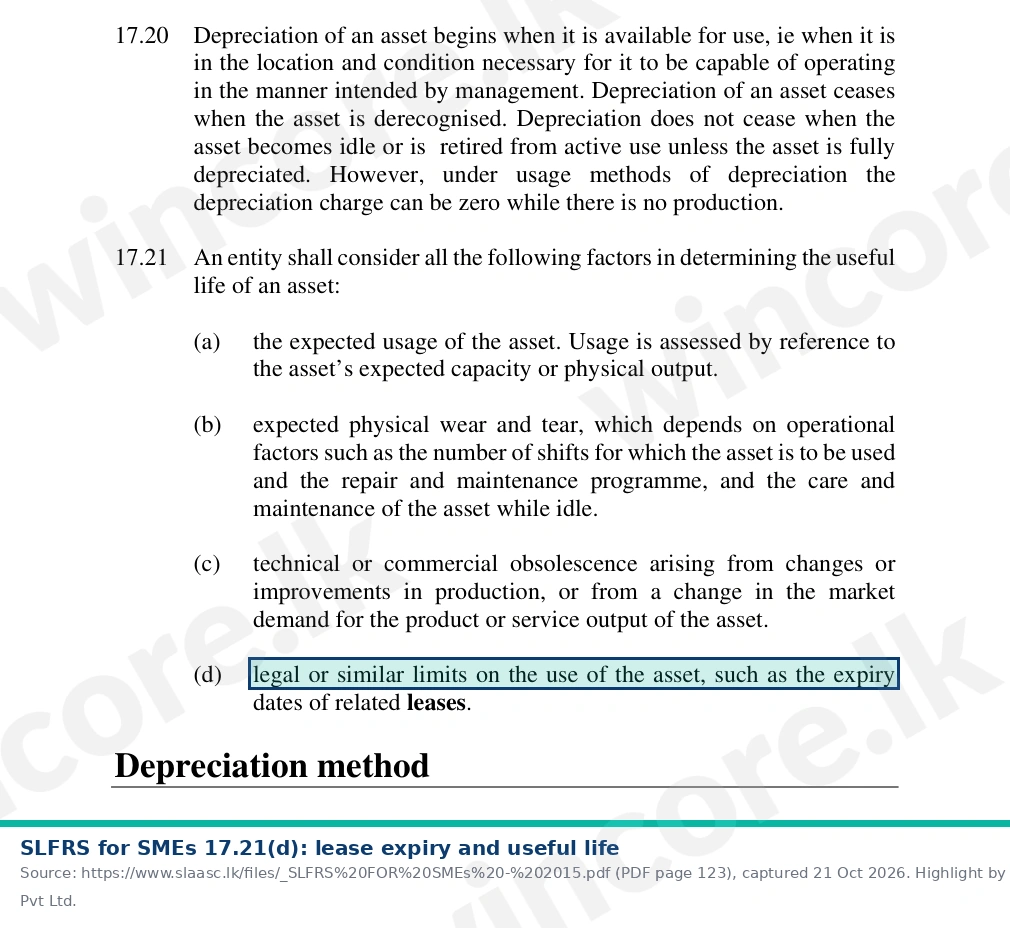
Fit-out for tax. Movable furniture and equipment the tenant owns read naturally as Class 3, over five years. Works fixed to the landlord's building are harder: s.16(2)(a) needs assets "owned and used" by the person, and the Act does not say who owns a tenant's improvement. The IRD's Manual of Inland Revenue Act, still marked Draft, takes a view: improvements by a lessee are capital, "not deductible under section 11", but "the expense will constitute an intangible asset of the lessee for which capital allowances may be claimed over the term of the lease" (section 5.8, example 5.8.3) [5]. That points to Class 5, over the lease term, rather than Class 4 over twenty years. Second Schedule paragraph 1(9) is consistent with it: "for the purpose of this Schedule", meaning the enhanced allowances, a permanent structure "constructed or made in a leasehold land" by the investor "shall not be deemed as an intangible asset but deemed as a depreciable asset" [2]. On our reading the Draft manual is an administrative view, not the Act, so the class stays open. The manual also says a tenant's ordinary repairs are deductible in full under s.11 because s.14 covers only the person's own assets (example 5.8.2), and that the landlord may be taxed on a tenant's improvement as rent (example 5.8.4). Get the contractor's bill split by item.
Landscaping in the books. Paragraph 17.16: with exceptions such as quarries, "land has an unlimited useful life and therefore is not depreciated", and major components with significantly different patterns of consumption are depreciated separately [1]. As practice, split hard landscaping (paving, drains, retaining walls, lighting), usually capitalised as a component with a finite life, from soft landscaping (lawn, plants), often expensed, with replanting treated as day-to-day servicing under 17.15.
Landscaping for tax. "An interest in land" is not a depreciable asset (s.195). On our reading, hard landscaping on owned land may be Class 4 works of a permanent nature, on leased land it joins the lessee improvement question, and lawns and plants fit no class easily. We searched ird.gov.lk on 22 October 2026: the Draft manual covers lessee improvements but we found no IRD guidance on landscaping, so it stays open.
Subscriptions are prepayments, not assets
- Annual subscriptions (software as a service, cloud storage, memberships of twelve months or less) are service costs. Paid ahead, they are a prepayment expensed over the months covered. For tax, s.11(3) does not catch a benefit of twelve months or less, so on our reading it is a revenue expense.
- Multi-year subscriptions paid up front are still prepayments in the books, spread over the term. For tax, a benefit "capable of lasting longer than twelve months" is capital. The Draft IRD manual treats a lease premium as a Class 5 asset written off over the lease period (section 5.8) [5]; by analogy, on our reading, a multi-year subscription may be Class 5 over its term, but no text says so and it is open.
- Perpetual software licences are intangible assets if they meet 18.2 and 18.4. Paragraph 18.2 defines an intangible asset as "an identifiable non-monetary asset without physical substance" that is separable or "arises from contractual or other legal rights" [1]. On our reading, for tax they fall in Class 5, over their actual useful life.
- Internally built software or websites are expensed under 18.14, which requires internal expenditure on an intangible item to be expensed "unless it forms part of the cost of another asset that meets the recognition criteria" [1].
On our reading of 18.2, not a stated rule, a plain subscription is a right to receive a service rather than a software asset you control, so it is a prepayment, not an intangible. Withholding tax on payments to a foreign provider is a separate question.
What this means for you
Write a capitalisation policy with a threshold and a bulk-purchase rule, and apply it every year. Keep a book fixed asset register and a separate capital allowance schedule by class, because they will differ. Add back items expensed under your threshold that last over twelve months, and claim allowances. Pay large suppliers through the bank, split fit-out and landscaping invoices by item, and treat subscriptions as prepayments. Our bookkeeping basics guide shows where the register sits, and the year-end close guide places the fixed asset review in the close.
A worked example (hypothetical)
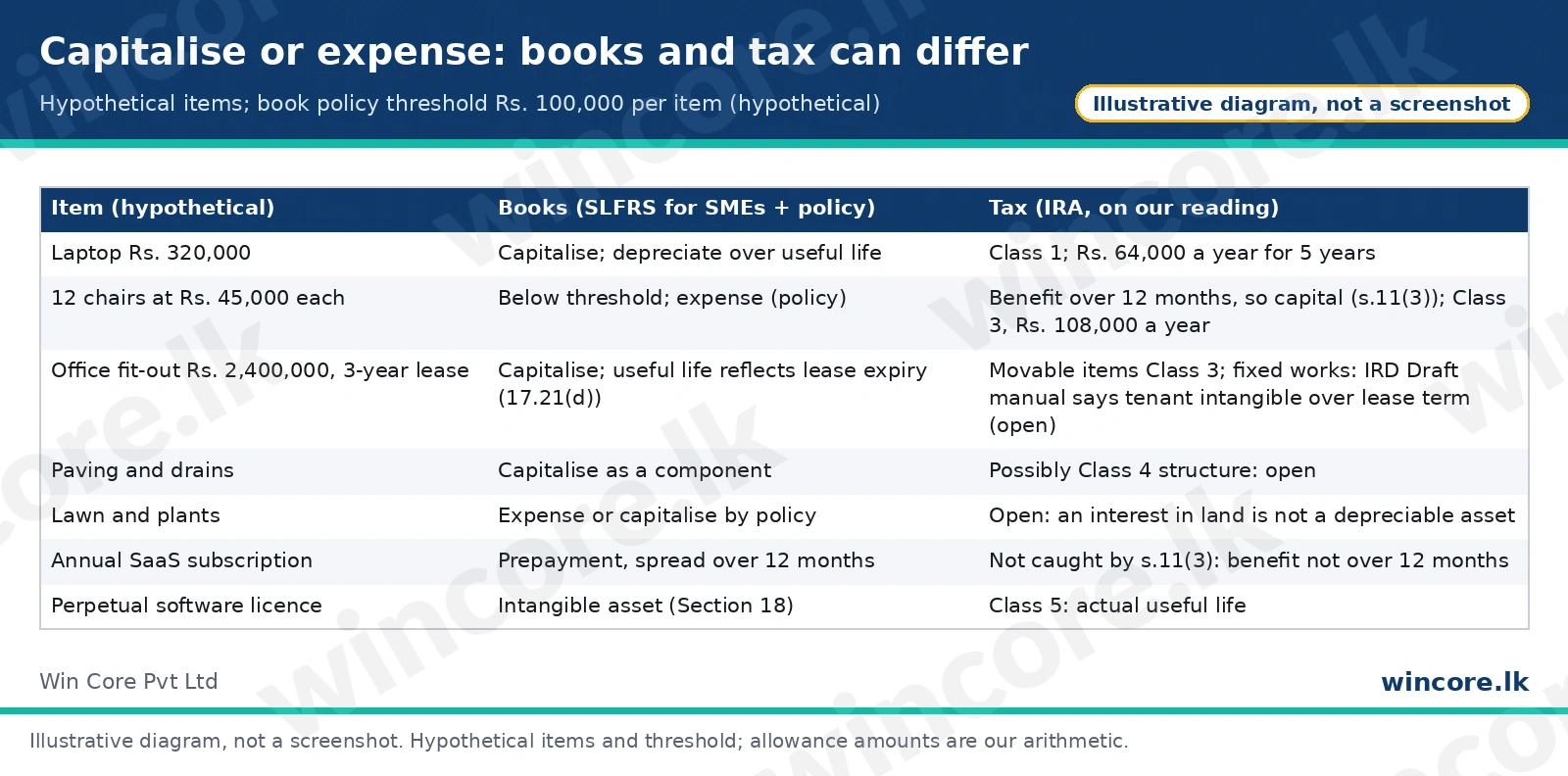
A printing and packaging business in its eighth year has a board-approved book threshold of Rs. 100,000 per item (a hypothetical figure, not a recommendation). In one year it buys a laptop for Rs. 320,000, twelve chairs at Rs. 45,000 each, and a Rs. 2,400,000 fit-out for an office on a three-year lease, all paid by bank transfer. It also pays an annual cloud subscription.
- Laptop: capitalised in the books. For tax, Class 1: Rs. 64,000 a year for five years (our arithmetic).
- Chairs: expensed in the books under the threshold, Rs. 540,000 in total. For tax, on our reading, capital under s.11(3). The company adds the Rs. 540,000 back and claims Class 3 allowances of Rs. 108,000 a year for five years (our arithmetic).
- Fit-out: capitalised and depreciated over the three years it expects to stay: Rs. 800,000 a year (our arithmetic). For tax, Rs. 400,000 of movable furniture is Class 3, Rs. 80,000 a year. The Rs. 2,000,000 of fixed works is, on the Draft IRD manual's view, a tenant intangible over the three-year lease, about Rs. 666,667 a year (our arithmetic); the Act does not settle this, so it is flagged in the tax file.
- Subscription: prepayment, expensed over twelve months; on our reading deductible for tax.
Checklist: documents needed
- Board-approved capitalisation policy and threshold (practice; SLFRS for SMEs 10.7)
- Fixed asset register for the books and a capital allowance schedule by class (IRA Fourth Schedule)
- Supplier invoices split by item for fit-out and landscaping
- Bank evidence for any payment of Rs. 500,000 or more (IRA s.10(2A))
- Lease agreement showing the term, renewal options and any restoration clause (17.10(c), 17.21(d))
- Subscription invoices showing the service period
- Software licence terms (perpetual or term)
Our accounting services and bookkeeping services cover the policy and registers, and our income tax services carry the add-backs and allowances into the return.
FAQ
What capitalisation threshold should a small company use in Sri Lanka?
Neither SLFRS for SMEs nor the Inland Revenue Act sets one. The directors choose a figure based on materiality (paragraph 2.6), write it into the accounting policies and apply it consistently (paragraph 10.7). It should suit the size of the business, and it governs the books only. For tax, the twelve-month test in section 11(3) still applies.
If we expense a small item in the books, can we deduct it for tax?
Not if it secures a benefit capable of lasting longer than twelve months, because section 11(3) makes that an expense of a capital nature and section 11(2) denies the deduction. On our reading, you add the item back in the tax computation and claim capital allowances on it under the Fourth Schedule instead, usually Class 3 for furniture and equipment.
Can office fit-out be depreciated over the lease term?
Yes in the books, where the lease limits use. Paragraph 17.21(d) requires lease expiry dates to be considered in setting useful life, so on our reading a life matching expected occupation is appropriate. For tax, movable items are Class 3 over five years; the Draft IRD manual treats fixed improvements as a tenant intangible over the lease term, which the Act does not settle. For how an office lease goes into the accounts, see lease accounting under SLFRS for SMEs.
Is a SaaS subscription an intangible asset?
On our reading, no. A subscription is a right to receive a service for a period, so a payment in advance is a prepayment expensed over the months covered. A perpetual licence you control can be an intangible asset under paragraph 18.2. For tax, an annual subscription is not caught by section 11(3); a multi-year one paid up front is an open point.
Open points
- Class for fixed fit-out and hard landscaping on leased premises. The Act does not settle Class 3, 4 or 5, or whether a tenant owns fixed works for s.16(2)(a). The IRD's Draft manual says Class 5 intangible over the lease term; it is not law and was still marked Draft on 22 October 2026.
- Hard landscaping on owned land (Class 4 or another class).
- Soft landscaping for tax, given the exclusion of "an interest in land".
- Multi-year subscriptions for tax: Class 5 over the term, or non-deductible.
- Standard edition. We read the 2015 SLFRS for SMEs; adoption of a later edition in Sri Lanka was not verified.
Last verified 22 October 2026 against the sources listed in References.
This article is general information, not advice on your specific position.
Talk to us. If you want a capitalisation policy for your company and your book and tax asset registers reconciled, contact us at our contact page.
WinCore Pvt Ltd
References
- Institute of Chartered Accountants of Sri Lanka. Sri Lanka Accounting Standard for Small and Medium-sized Entities (SLFRS for SMEs), 2015, paras 2.6, 10.7, 17.2, 17.4, 17.6, 17.8, 17.10, 17.11, 17.15, 17.16, 17.21, 18.2, 18.4, 18.14, 18.15. https://www.slaasc.lk/files/_SLFRS%20FOR%20SMEs%20-%202015.pdf . Primary. Accessed 22 October 2026.
- Inland Revenue Department. Inland Revenue Act, No. 24 of 2017 (consolidated, 2025 changes), ss.10(2A), 11, 14, 16, 195; Second Schedule para 1(9); Fourth Schedule paras 1, 2. https://www.ird.gov.lk/en/publications/Acts_Income%20Tax_2017/IRA_Cons_Act_-_2025_Changes.pdf . Primary (consolidation). Accessed 22 October 2026.
- Parliament of Sri Lanka. Inland Revenue (Amendment) Act, No. 45 of 2022, ss.5 and 6 (new s.14(4) and s.16(3A)). https://www.ird.gov.lk/en/publications/Acts_Income%20Tax_2017/IR_Act_No._45_2022_E.pdf . Primary. Accessed 22 October 2026.
- Parliament of Sri Lanka. Inland Revenue (Amendment) Act, No. 11 of 2026, ss.1(3), 3 (s.10(2A)), 37 and 39 (Second and Fourth Schedules). https://www.ird.gov.lk/en/publications/Acts_Income%20Tax_2017/IR_Act_No_11-2026_E.pdf . Primary. Accessed 22 October 2026.
- Inland Revenue Department. Manual of Inland Revenue Act (Inland Revenue Act No 24 of 2017), Draft, section 5.8 and examples 5.8.2 to 5.8.4. https://www.ird.gov.lk/en/publications/Acts_Income%20Tax_2017/Guide%20to%20Inland%20Revenue%20Act.pdf . Primary (administrative guidance, marked Draft). Accessed 22 October 2026.
Put these insights to work
WinCore specialists can review your current workflow, document gaps, and build a practical 90-day action plan.
Book a free consultationContinue reading
Explore more WinCore analysis to keep your finance, tax, and compliance roadmap moving.

From 1 April 2026, Sri Lanka's Enhanced Capital Allowance also applies to new undertakings whose depreciable assets exceed USD 250,000 but not USD 3 million, opening a 100% allowance to mid-market investors.

Close your books before the March 31 deadline to reduce audit risk and start with clean numbers. A practical 10-step year-end guide for SMEs.
Bookkeeping guide for Sri Lankan small businesses: legal requirements, chart of accounts, source documents, 5-year retention rule, and monthly routines.