
Exchange rate for income tax Sri Lanka: which CBSL rate, which date
Dollar invoice, dollar dividend, rupee return. The Inland Revenue Act picks the Central Bank rate and the date; you still have to pick the series.
On this page
Last verified against the primary sources on 21 October 2026.
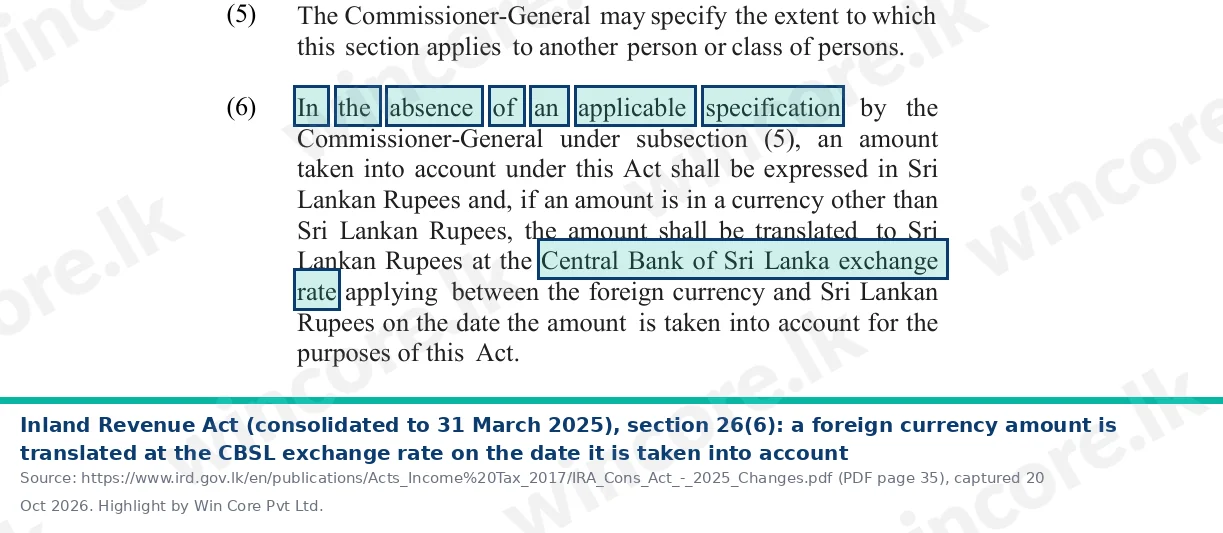
The exchange rate for income tax in Sri Lanka is set by section 26(6) of the Inland Revenue Act, No. 24 of 2017: unless the Commissioner-General specifies otherwise, every foreign currency amount is translated into rupees "at the Central Bank of Sri Lanka exchange rate ... on the date the amount is taken into account". The date comes from your accounting basis: entitlement for a business on the accrual basis, receipt for an individual's salary or investment income. The Act does not name which Central Bank of Sri Lanka (CBSL) series to use, so you have to choose one and keep it.
This piece covers the tax return. For the financial statements, see functional currency and which CBSL rate the books use. The two rules differ, and a business with dollar income usually needs both.
The exchange rate for income tax in Sri Lanka is the CBSL rate on the date in section 26(6)
Section 26(6) reads [1]:
"In the absence of an applicable specification by the Commissioner-General under subsection (5), an amount taken into account under this Act shall be expressed in Sri Lankan Rupees and, if an amount is in a currency other than Sri Lankan Rupees, the amount shall be translated to Sri Lankan Rupees at the Central Bank of Sri Lanka exchange rate applying between the foreign currency and Sri Lankan Rupees on the date the amount is taken into account for the purposes of this Act."
Three elements follow from the wording:
- Rupees. Every amount taken into account "shall be expressed in Sri Lankan Rupees".
- The Central Bank rate. Foreign currency is translated "at the Central Bank of Sri Lanka exchange rate", not at a commercial bank's rate.
- The date. The rate is the one applying "on the date the amount is taken into account for the purposes of this Act". On our reading, that means one rate per amount on its own date, not a year-end rate and not an annual average.
The scope question we are keeping open
Section 26 is headed "Foreign currency and financial instruments", and s.26(1) applies the section, "subject to subsections (4) and (5)", to "a person who is a financial institution" for amounts on a financial instrument [1]. Subsection (6), though, speaks of "an amount taken into account under this Act", with no such limit. On our reading, (6) is the general translation rule for every taxpayer, and the IRD agrees: its Public Ruling PR/IT/2023/01 of 6 July 2023 says that, in the absence of a Commissioner-General specification, "section 26(6) is applied for other persons", meaning persons other than financial institutions (section 5.2) [6]. A public ruling sets out the Commissioner-General's interpretation under s.104; it is not the Act and can be withdrawn.
When the Commissioner-General can change the default
Section 26(5) lets the Commissioner-General "specify the extent to which this section applies to another person or class of persons", and s.26(4)(c) allows, "with the prior written approval of the Commissioner-General", a "specified translation method" for amounts within the section [1]. We found no published specification under s.26(5) in the material we read. If you hold one, it overrides the default.
Your accounting basis fixes the date, under sections 21 to 23
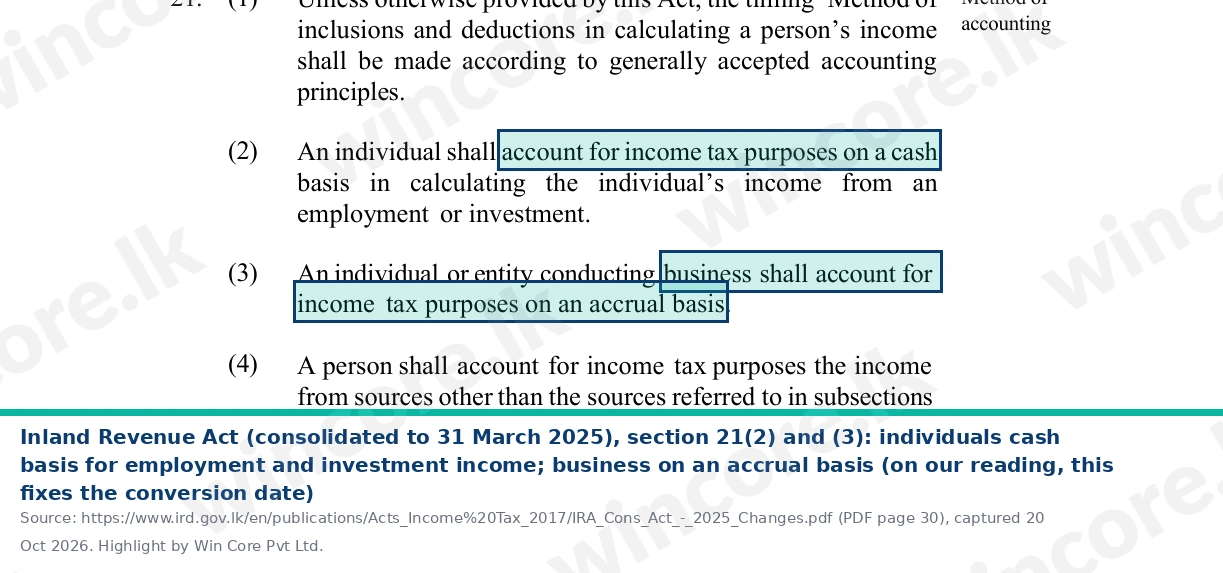
"The date the amount is taken into account" depends on how you account for tax. Section 21 sets the basis [1]:
- s.21(2): "An individual shall account for income tax purposes on a cash basis in calculating the individual's income from an employment or investment."
- s.21(3): "An individual or entity conducting business shall account for income tax purposes on an accrual basis."
Sections 22 and 23 then fix the moment [1]:
| Basis | Income is derived | Expense is incurred |
|---|---|---|
| Cash (s.22(1)) | "when payment is received by or made available to the person" | "when it is paid by the person" |
| Accrual (s.23) | "when it is receivable", that is, when "the person becomes entitled to receive it" (s.23(2)) | "when it is payable", once "all the events that determine liability have occurred", the amount "can be determined with reasonable accuracy", and not "before economic performance" (s.23(3)) |
So, on our reading:
| Situation | Date for the CBSL rate |
|---|---|
| A business invoices a foreign client in USD | The date it becomes entitled to the fee, usually the invoice date for completed work |
| A business owes a USD supplier | The date the liability is fixed and the goods or services have been delivered |
| An employee is paid in USD | The date the salary is received or made available |
| An individual receives USD interest or dividends | The date received or made available |
A business receivable translated on the invoice date is often collected later at a different rate. The difference is an exchange gain or loss. Its income tax treatment follows s.21(1), which times inclusions and deductions "according to generally accepted accounting principles" unless the Act says otherwise, and the wider income rules. That treatment is outside this article.
The Act does not name a CBSL series, so name one and keep it
Section 26(6) says "the Central Bank of Sri Lanka exchange rate" but CBSL publishes several. Its Exchange Rates page describes them [2]:
- the USD/LKR spot indicative rate, "the weighted average rate of all actual USD/LKR Spot transactions executed in the domestic inter-bank foreign exchange market ... throughout the previous/latest available business day";
- indicative rates for other currencies, "derived based on world currency rates against the US dollar at the beginning of the business day and the indicative rate of the USD/LKR Spot exchange rate";
- average TT buying and selling rates, calculated from bank quotes at 9.30 AM.
The page also records that the "Middle Rate" announcement "was discontinued effective from 07.03.2023" [2]. Any tax working paper that still says "CBSL middle rate" needs a new reference.
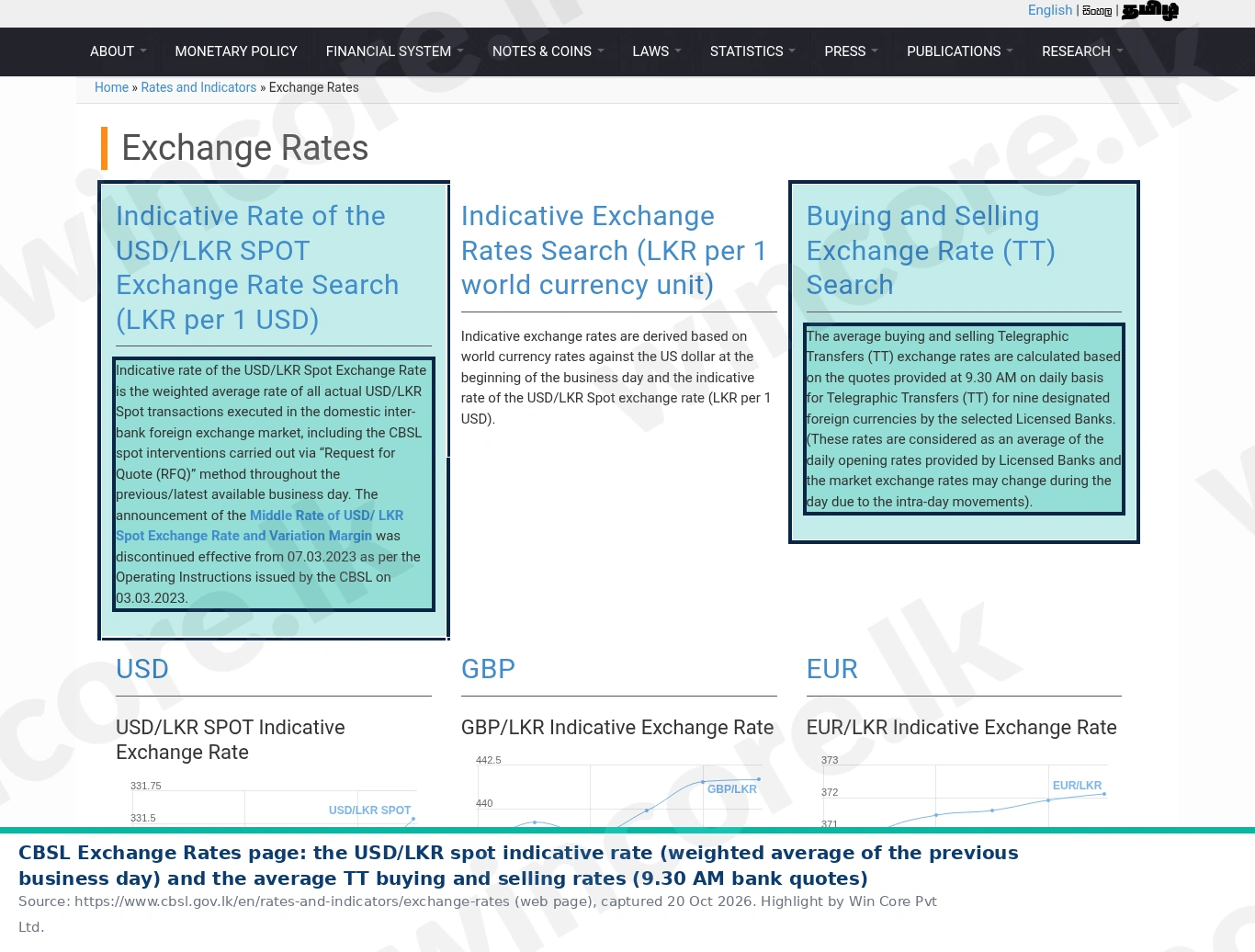
Where to find each figure on cbsl.gov.lk: the daily USD/LKR spot indicative rate and the daily indicative rates for other currencies each have their own search page under Rates and Indicators, Exchange Rates. The same page links spreadsheets of monthly average spot rates and end-of-month spot rates, updated each month [2] [3]. Our currency tool does the conversion once you have the rate.
Our practice suggestion, not a rule: use the USD/LKR spot indicative rate for US dollars and the CBSL indicative rate for other currencies, for the date s.21 to s.23 give you. For a weekend or holiday, pick a fallback, such as the rate for the nearest earlier business day, and write it down. Use the same choice in every return and every year, and save the page or download with the document. One open question: the spot indicative rate reflects the previous business day's trades, and whether that is the rate "applying ... on the date" is untested.
The return guide gives no rate, so section 26(6) does the work
The IRD's guide to the 2025/2026 individual return asks for "Remitted amounts in Foreign Currency" in Cage 210A and says qualifying foreign-source income remitted through a licensed commercial bank is "subject to a maximum rate of 15%" [4]. We searched it for "exchange rate", "rate of exchange" and "rupee equivalent" and found none. Its Example 06 mentions converting "USD to LKR" without naming a rate or source [4]. So the rule to apply is s.26(6).
For businesses, the same applies to the company return. Service exporters taxed at 15 per cent need both the rupee figure and the foreign currency banking trail; our guide to foreign service export tax and the foreign service export tax calculator cover that test. The filing steps are in our income tax return filing guide.
A wrong rate is not an offence by itself, but it can trigger section 180
Using the wrong rate matters because it changes the tax. The penalty then depends on fault:
| Default | Section | Consequence |
|---|---|---|
| Tax underpaid because of an incorrect statement or material omission in a return that results from intentional conduct or negligence | IRA s.180 | 25% of the underpayment; 75% where the underpayment is higher than Rs 10 million or higher than 25% of the tax liability for the period [1] [5] |
| A false or misleading statement in a material particular to a tax official that changes the tax payable or refundable, where s.180 does not apply | IRA s.181(1), (2), (6) | The greater of Rs 50,000 and the shortfall or excess refund; no penalty if the person "did not know" and could not reasonably be expected to know (s.181(3)) [5] |
Both sections turn on fault. A CBSL rate for the right date, saved with the document, is evidence of care. A wrong series applied consistently is still, on our reading, exposed under the negligence limb of s.180. That is our reading, not an IRD statement.
A hypothetical invoice shows the two dates and the exchange difference
Take a hypothetical Colombo architecture practice on the accrual basis. It completes a USD 10,000 design job for an overseas client on 14 May and invoices that day. It translates at the CBSL USD/LKR spot indicative rate published for 14 May, say Rs 300.00, and records Rs 3,000,000 of income. The client pays on 20 June, when the rate is, say, Rs 304.00. The dollars received are worth Rs 3,040,000 at that day's rate. The Rs 40,000 difference is an exchange difference on the receivable, dealt with separately from the fee. Both rates are invented for the example.
| Step | Date | USD | CBSL rate (hypothetical) | Rupees |
|---|---|---|---|---|
| Fee becomes receivable (s.23(2)) | 14 May | 10,000 | 300.00 | 3,000,000 |
| Cash received | 20 June | 10,000 | 304.00 | 3,040,000 |
| Exchange difference | 40,000 |
The practice keeps the CBSL rate for 14 May with the invoice and the rate for 20 June with the bank advice.
What this means for you
Treat each foreign currency amount as having its own date and its own CBSL rate. Take the date from your accounting basis: entitlement for a business, receipt for an individual's salary or investment income. Name one CBSL series and use it every time, with a written weekend and holiday rule. Keep the published rate with the document. The default in the Act is the rate on the date. The one average the IRD itself recommends is the CBSL average rate for the year, where financial accounts prepared in a foreign currency are translated into rupees and the spot rate of each transaction is difficult to trace (PR/IT/2023/01 section 5.4) [6]. For any other average, get the Commissioner-General's written position first. Our income tax advisory services team prepares returns on this basis, and our accounting services team can keep the rate table in your books.
Checklist: documents needed
- Invoices, contracts or payslips showing the foreign currency amount and its date
- Bank statements showing receipt or payment dates
- The CBSL rate page or download for each date used
- A one-page policy naming the CBSL series and the weekend or holiday rule
- Any Commissioner-General specification or approval under s.26(4) or (5)
- Exchange difference workings for receivables and payables settled later
Frequently asked questions
Can I use one average exchange rate for the whole year on my tax return?
Not as the default. Section 26(6) uses the CBSL rate "on the date the amount is taken into account", so each amount takes its own date's rate. The IRD's Public Ruling PR/IT/2023/01 section 5.4 makes one exception: where accounts kept in a foreign currency are translated and each spot rate is difficult to trace, it recommends the CBSL average rate for the year. Otherwise use the date rate.
Can I use the rate my bank gave me?
Not as the default. Section 26(6) names "the Central Bank of Sri Lanka exchange rate", and a commercial bank's buying or selling rate is a different figure, even when it is close. Keep the bank advice as evidence of the amount and date received, but translate the amount for tax at the CBSL rate for the date your accounting basis gives you.
Which exchange rate applies to foreign dividends or interest I receive?
On our reading, the CBSL rate for the date the amount is received or made available to you. Section 21(2) puts an individual's investment income on a cash basis, and s.26(6) then applies the Central Bank rate for that date. Keep the bank credit advice showing the date, and save the CBSL rate page for the same day.
Which rate should I use for euros or pounds?
CBSL publishes daily indicative rates for other currencies, derived from world rates against the US dollar and the USD/LKR spot indicative rate. On our practice suggestion, use that indicative rate for the date the amount is taken into account, with the same weekend and holiday rule you use for dollars, and save the page with the document.
Does section 26(6) also apply to VAT and SSCL?
Not on its wording. Section 26(6) applies "for the purposes of this Act", meaning the Inland Revenue Act. We have not found an equivalent translation rule in the VAT Act or the SSCL Act, so the basis for translating foreign currency consideration for those taxes remains an open point. Until it is settled, use and document the same CBSL date basis.
Open points we are keeping open
- Status of the IRD ruling. PR/IT/2023/01 confirms s.26(6) reaches persons other than financial institutions and recommends the CBSL annual average only for foreign-currency accounts where spot rates are hard to trace. It is guidance under s.104 and can be withdrawn; check for a later ruling.
- Which series. The Act does not name the spot indicative, other indicative or TT rate.
- Previous-day rate. The spot indicative rate reflects the previous business day; whether that is the rate "applying ... on the date" is untested.
- s.26(5) specifications. We found none published; one may exist for a class of persons.
- VAT and SSCL. No translation rule found; how IRD expects foreign currency consideration to be translated for those taxes is open.
- Exchange differences. Their income tax treatment is outside this article.
This article is general information, not advice for your specific situation.
Talk to us. If your return includes dollar income or costs and you want the rates and dates set out before you file, reach us at our contact page.
WinCore Pvt Ltd
References
- Inland Revenue Department. Consolidated Text of the Inland Revenue Act No. 24 of 2017 (amendments up to 31 March 2025), ss.21, 22, 23, 26 and 180. https://www.ird.gov.lk/en/publications/Acts_Income%20Tax_2017/IRA_Cons_Act_-_2025_Changes.pdf . Primary (IRD consolidation, not a statutory text). Accessed 21 October 2026.
- Central Bank of Sri Lanka. Exchange Rates (web page). https://www.cbsl.gov.lk/en/rates-and-indicators/exchange-rates . Primary. Accessed 21 October 2026.
- Central Bank of Sri Lanka. Monthly Average Exchange Rates (spreadsheet, to September 2026). https://www.cbsl.gov.lk/sites/default/files/cbslweb_documents/statistics/sheets/IF_Monthly_Average_Exchange_Rates_September%202026.xlsx . Primary. Accessed 21 October 2026.
- Inland Revenue Department. Guide to fill the Return of Income, Schedules and Statement of Assets and Liabilities for Individual, Year of Assessment 2025/2026. https://www.ird.gov.lk/en/Downloads/IT_Individuals_Doc/Asmt_IIT_004_2025_2026_E.pdf . Administrative guidance. Accessed 21 October 2026.
- srilaws.com. Inland Revenue Act No. 24 of 2017, sections 180 and 181 (as enacted). https://srilaws.com/legislation/inland-revenue-act-no-24-of-2017/section-180 . Secondary (third-party copy of the Act). Accessed 21 October 2026.
- Inland Revenue Department. Public Ruling No. PR/IT/2023/01: tax treatment of foreign exchange gains and losses (6 July 2023), sections 5.2 and 5.4. https://www.ird.gov.lk/en/publications/Public_Rulings_IT/PR_IT_2023_01_E.pdf . Administrative guidance (Commissioner-General's public ruling under s.104). Accessed 22 October 2026.
Put these insights to work
WinCore specialists can review your current workflow, document gaps, and build a practical 90-day action plan.
Book a free consultationContinue reading
Explore more WinCore analysis to keep your finance, tax, and compliance roadmap moving.

Since 1 April 2025, profits from services used outside Sri Lanka and paid in foreign currency through a bank are taxed at 15%. The conditions and the records to keep.
Step-by-step guide to filing income tax returns in Sri Lanka: deadlines, RAMIS process, relief, bands, WHT credits, and common penalty traps.
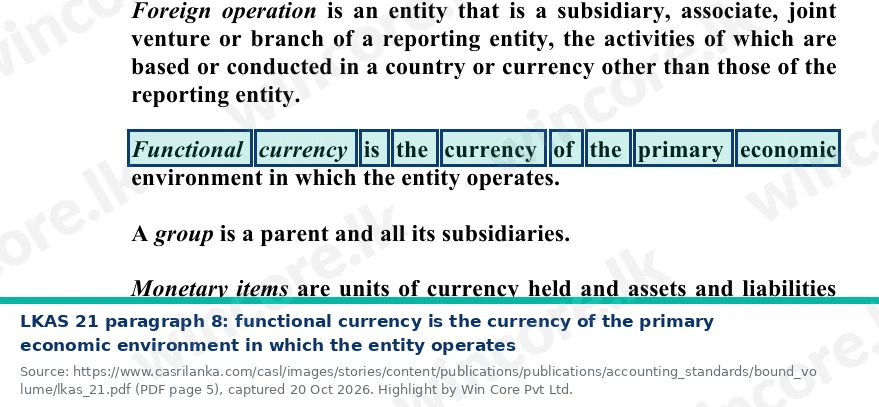
Dollar sales, rupee costs, a dollar loan: which currency are your books really in? The LKAS 21 tests in order, the rates to use, and the tax trail.