
Gazette 2213/35: foreign ownership bands, as amended to 2026
What Regulations No. 2 of 2021 actually say about non-resident shares, the four amending gazettes, the IIA and three-month rules, and the penalties.
On this page
Last verified against the primary sources on 21 October 2026.
Gazette 2213/35 of 3 February 2021, in operation since 22 March 2021, is the instrument that decides how much of a Sri Lankan company a non-resident may own. It lets non-residents hold shares in most companies with no percentage limit, closes three businesses, caps ten at 40 percent unless the Board of Investment approves more, and leaves five to the relevant authority. Four amending gazettes since 2021 dealt with listed securities, loans and conversions; none changed those bands, and as at 21 October 2026 we found no later amendment.
For the plain guide to whether a foreigner can own 100 percent of a company, read our foreign ownership guide. This page is the Regulation Desk view of the instrument itself: which band the business is in, then how the money comes in.
Think of the regulations as a zoning map. Most land is open, a few plots are closed, some have a 40 percent height limit a special permit can raise, and on the rest the height is whatever the authority approves.
Take a hypothetical investor based in Singapore who wants 60 percent of a Sri Lankan deep sea fishing company. Under the map, deep sea fishing is in the 40 percent band. Sixty percent is possible, but only with a special approval from the Board of Investment. The same investor buying 60 percent of a solar panel installer needs no such approval under these regulations.
Gazette 2213/35 is Regulations No. 2 of 2021, amended four times but never on the bands
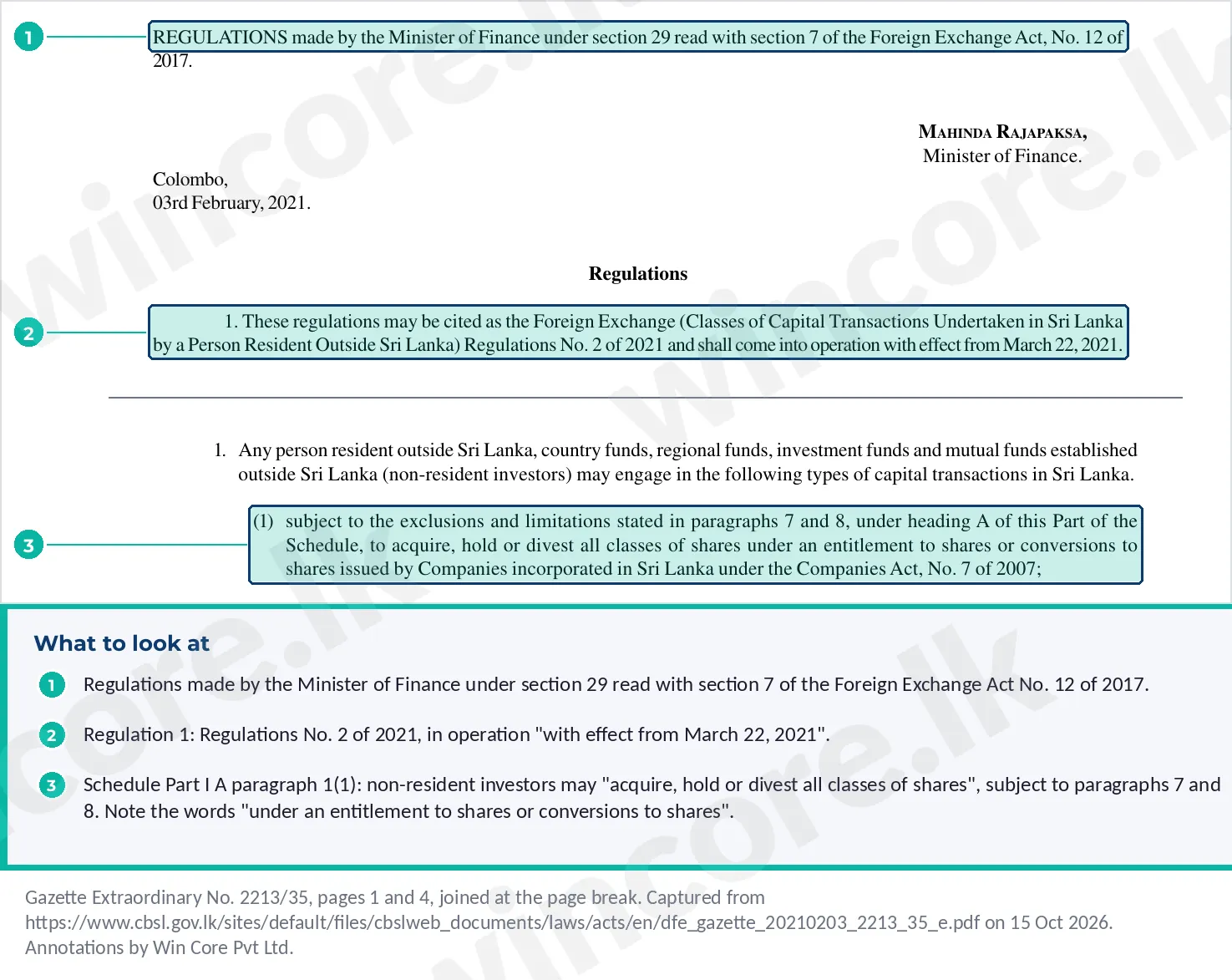
The Foreign Exchange (Classes of Capital Transactions Undertaken in Sri Lanka by a Person Resident Outside Sri Lanka) Regulations No. 2 of 2021, published in Gazette Extraordinary No. 2213/35 of 3 February 2021. They were made by the Minister of Finance "under section 29 read with section 7 of the Foreign Exchange Act, No. 12 of 2017", and "shall come into operation with effect from March 22, 2021" [1].
Section 7(1) of the Act requires the Minister to "authorize by regulations, the class or classes of capital transactions in foreign exchange" [7]. The word "classes" in the title refers to that power: these are the classes of capital transaction a non-resident may carry out through an authorised dealer, "subject to such limits, terms and conditions specified in these regulations and the Schedule" [1].
The amendments, to 21 October 2026
| Gazette | Date | What it changes |
|---|---|---|
| 2235/22 | 6 July 2021 | Listed debt securities in rupees and in foreign currency; new para 1(11) on listed shares in a designated foreign currency, with conditions in para 4(9) and 4(10) [2] |
| 2371/33 | 15 February 2024 | New para 1(12): listed securities under "Securities Borrowing and Lending"; new para 4(1)(f) routing those payments through the Inward Investment Account [3] |
| 2371/48 | 16 February 2024 | Repeals para 1(9) (short term working capital loans) "without prejudice to anything done thereunder"; replaces para 4(1)(e) on repaying such loans in rupees [4] |
| 2371/49 | 16 February 2024 | Adds a proviso to para 4(10)(g) allowing rupee conversion where the investee lacks foreign exchange [5] |
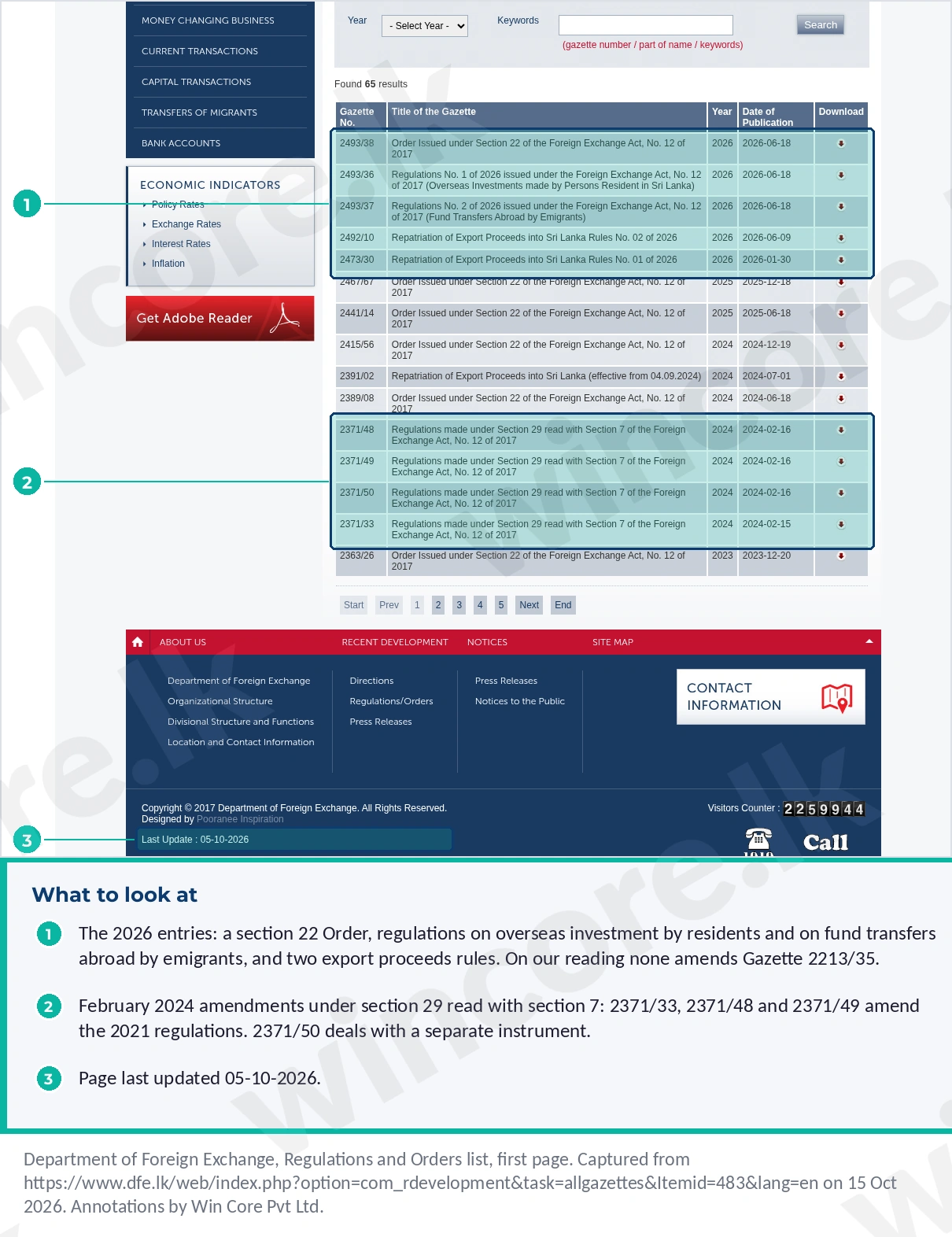
None of these touches the four bands. Paragraphs 7 and 8 read today as they did in 2021. Gazette 2371/50 of the same week repeals and replaces a different instrument, the sovereign bonds Regulations No. 6 of 2021 [6]. The Department of Foreign Exchange (DFE) list showed five 2026 instruments on 15 October 2026, none titled as an amendment to 2213/35. When we checked it again on 21 October 2026 the newest entries were still those five, dated January to June 2026 [8]. We found no later amendment.
Who it affects
"Any person resident outside Sri Lanka, country funds, regional funds, investment funds and mutual funds established outside Sri Lanka (non-resident investors)" [1]. It also binds the other side. Part III paragraph 3 requires companies incorporated under the Companies Act to "issue, transfer and register shares in the name of a non-resident investor subject to these regulations, irrespective of the means of acquisition or devolvement of such shares" [1].
When it took effect
It has applied since 22 March 2021 [1]. The amendments in the table took effect on publication, as section 29(2) of the Act provides where no later date is specified [7].
Four bands: open, closed, 40 percent and approved percentage
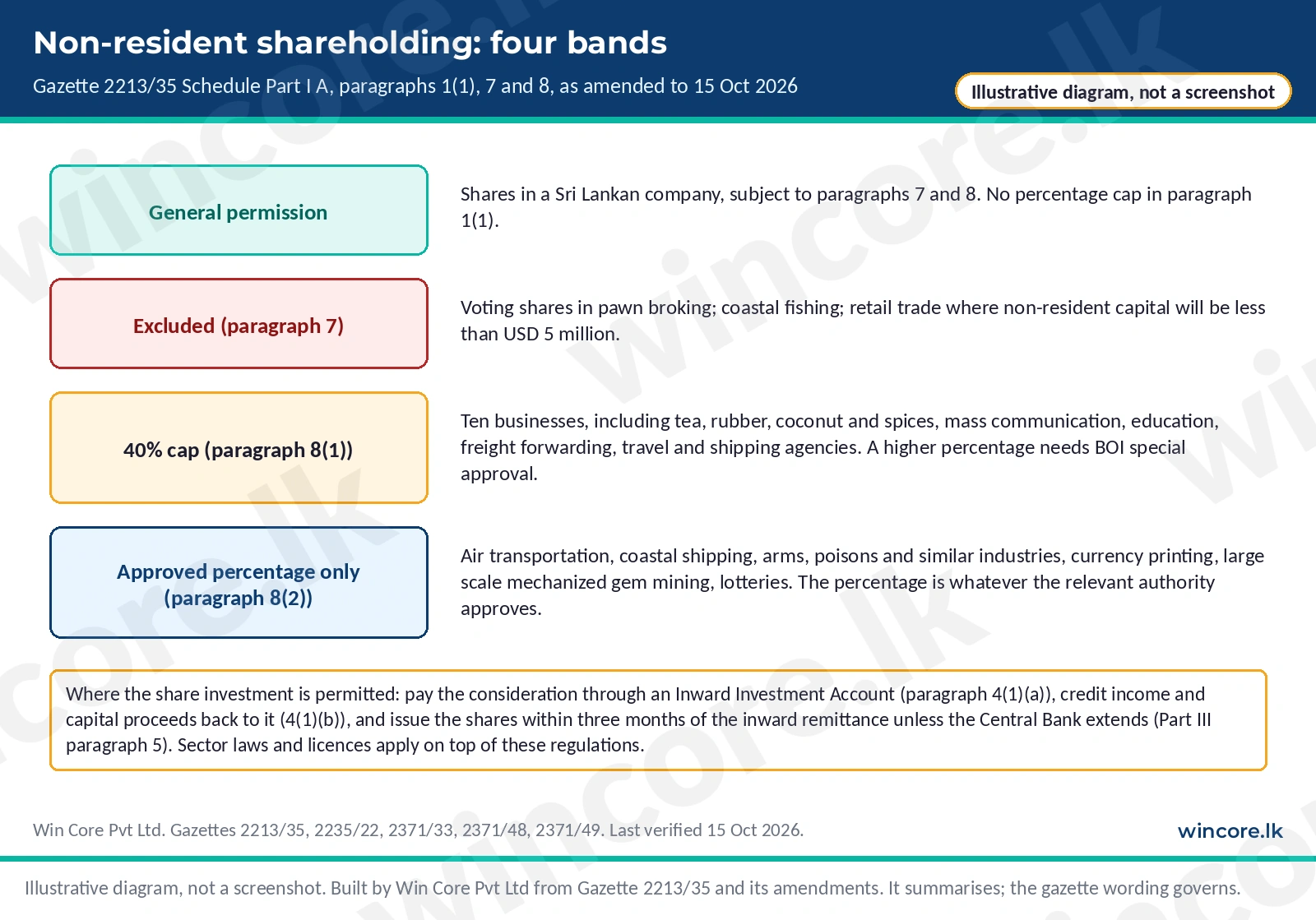
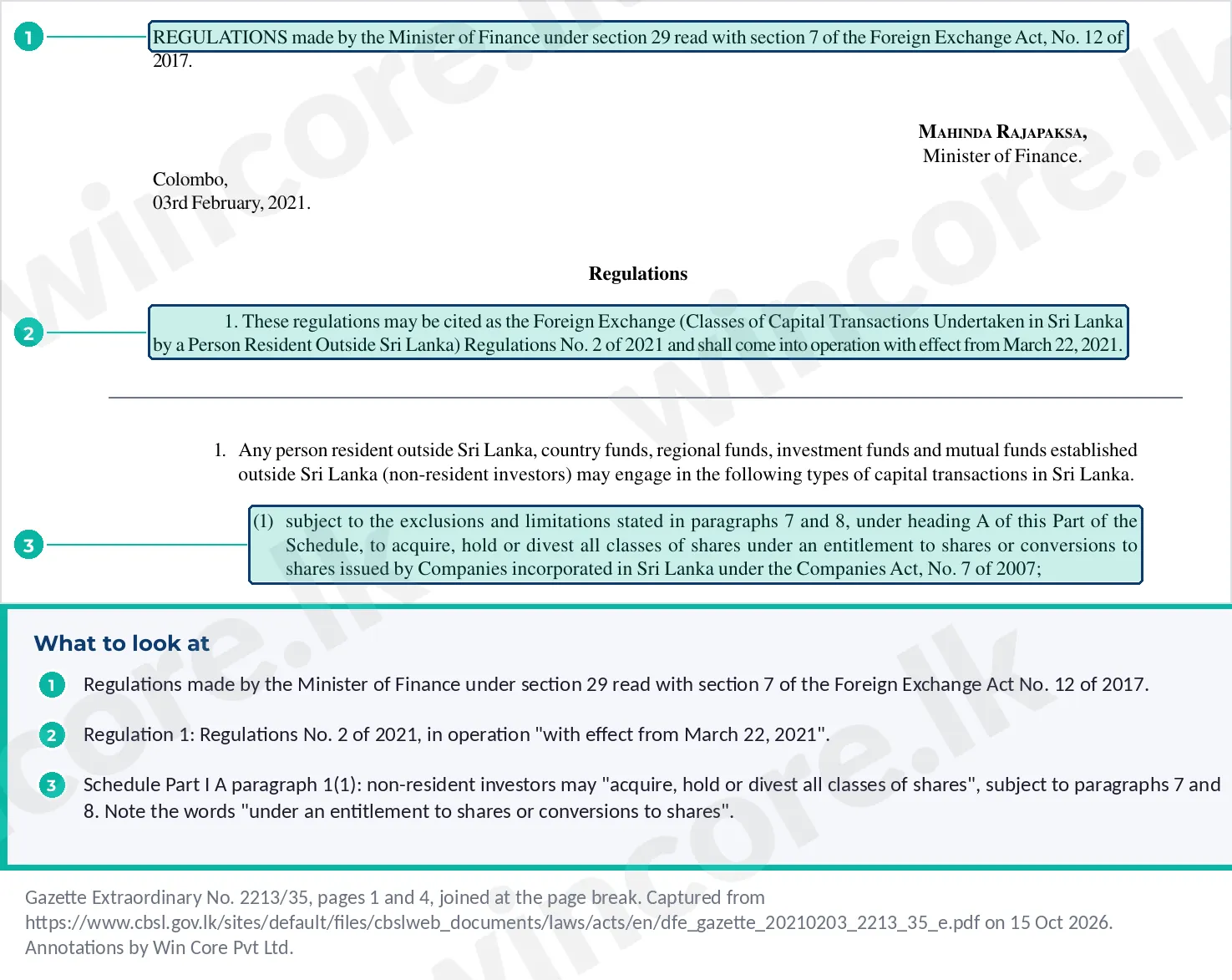
Band 1: open. Paragraph 1(1) permits non-resident investors "subject to the exclusions and limitations stated in paragraphs 7 and 8 ... to acquire, hold or divest all classes of shares" in companies incorporated under the Companies Act [1]. It sets no percentage. If the business is not in paragraph 7 or 8, these regulations allow up to 100 percent, subject to the drafting point discussed below.
Band 2: closed (paragraph 7). The permission "shall not apply in respect of voting shares of a company proposing to carry on or carrying on any of the following businesses": "(1) pawn broking; (2) coastal fishing ... (3) retail trade where capital contributed by persons resident outside Sri Lanka will be less than USD 5 Million" [1]. The exclusion covers voting shares only, and retail trade is closed only below the USD 5 million line.
Band 3: 40 percent (paragraph 8(1)). The permission applies "only up to 40 per cent of the number of fully paid voting shares of such company or if a special approval has been granted by the Board of Investment of Sri Lanka for a higher percentage of foreign investment in any company, only up to such higher percentage" [1]. The ten businesses are:
- production of goods where Sri Lanka's exports are subject to internationally determined quota restrictions
- growing and primary processing of tea, rubber, coconut, cocoa, rice, sugar and spices
- mining and primary processing of non-renewable national resources
- timber based industries using local timber
- deep sea fishing
- mass communication
- education
- freight forwarding
- travel agencies
- shipping agencies
Band 4: approved percentage (paragraph 8(2)). The permission applies "only up to the percentage of the number of fully paid voting shares of such company for which percentage either general or special approval has been granted by the relevant legal or administrative authority" [1]. The list: air transportation; coastal shipping; industries in the Second Schedule to the Industrial Promotion Act (arms and military hardware; poisons, narcotics, alcohol, dangerous drugs and hazardous materials; currency, coins and security documents); large scale mechanized mining of gems; and lotteries.
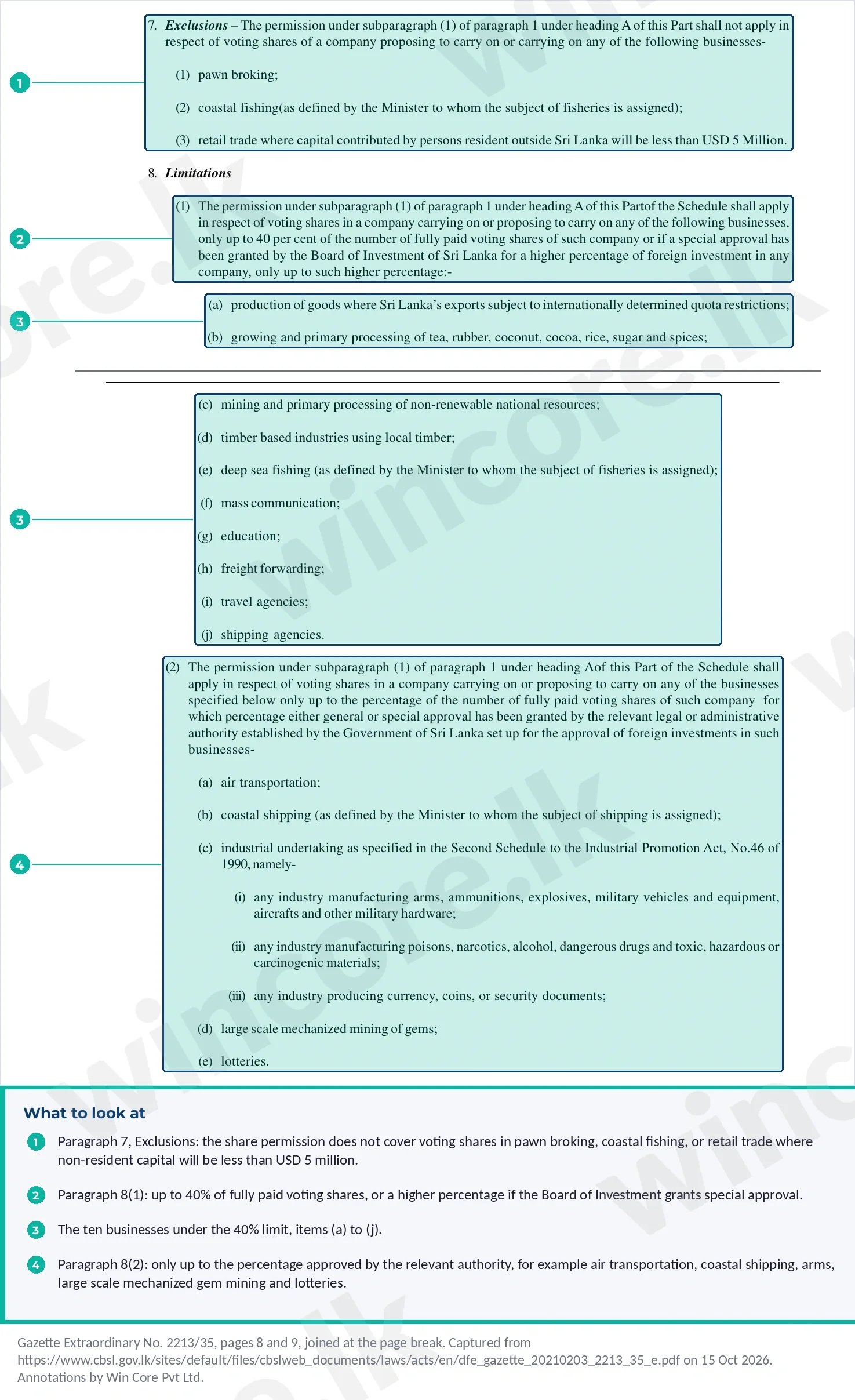
Is there a general foreign ownership cap in Sri Lanka, then? Not in these regulations. The cap applies only to the ten Band 3 businesses, and Band 4 depends on approval. Sector laws and licensing conditions sit on top of the map and can add their own limits. This article does not cover them.
The money comes through an IIA, and the shares issue within three months
Zoning tells you the height. The conditions in paragraph 4 tell you how to build.
- Route the money through an Inward Investment Account (IIA). "The consideration payable for permitted investments referred to above shall be routed through an Inward Investment Account opened and maintained in any designated foreign currency or Sri Lanka Rupees" (para 4(1)(a)), and "all income and any capital proceeds derived from such investments shall be credited to the Inward Investment Account through which the investment was made" (para 4(1)(b)) [1]. The exception in para 4(1)(c) lifts the IIA routing for some other categories of investment, not for paragraph 1(1) shares.
- Issue the shares within three months. Under Part III paragraph 5, companies "shall issue, transfer or register shares (where applicable) and debt securities ... within three (3) months from the date of receipt of inward remittances for the investment, unless otherwise granted an extension of time by the Central Bank" [1].
- Check the band before signing. For Band 3 above 40 percent, obtain the BOI special approval first. For Band 4, obtain the relevant authority's approval.
- Keep the evidence. Before dealing in foreign exchange on a capital transaction, the bank must ask for the information, documents or declaration it reasonably needs (section 7(6) of the Act), and must refuse if they are not given (section 7(7)) [7]. Regulation 4 of the 2021 regulations puts the same duty on the dealer and requires the investor to supply the evidence [1].
Read literally, paragraph 1(1) covers only entitlement and conversion shares
Read paragraph 1(1) slowly: "to acquire, hold or divest all classes of shares under an entitlement to shares or conversions to shares issued by Companies incorporated in Sri Lanka" [1]. Regulation 10 defines "entitlement to shares" as shares issued or transferred "by virtue of a corporate action by the issuer or mergers or amalgamations", inheritance, gifts from family or a court settlement. "Conversions to shares" covers conversions of preference shares, loans or debt securities, and imported machinery [1].
On a literal reading, paragraph 1(1) permits only shares received through an entitlement or a conversion, not shares bought for cash. That cannot be the intended scope. Paragraph 4(1)(a) speaks of "the consideration payable for permitted investments", which assumes purchases, and Part III paragraph 5 ties share issues to "inward remittances for the investment" [1]. Compare the later para 1(11), added by 2235/22, which says "all classes of shares ... (including the shares under an entitlement to shares or conversions to shares)" [2]. The word "including" is what paragraph 1(1) seems to be missing.
We read paragraph 1(1) as covering cash purchases and subscriptions; paragraph 4 and Part III only make sense on that reading. It remains a drafting point that no amendment has fixed, and we keep it open: an authorised dealer, not the investor, decides whether to execute a share purchase, so ask the bank early.
Penalties come from the Foreign Exchange Act, and can reach the transaction value
The regulations contain no penalties of their own. The Act supplies them.
| Who | Default | Section | Consequence |
|---|---|---|---|
| Investor, company or other person who is not a dealer | Acts in violation of section 11(1)(a) to (d), including violating "any regulation or Order made thereunder" | s.11(5) | After a hearing, "a sum not exceeding rupees one million or ... a penalty of an amount not exceeding the amount or value of such current transaction or capital transaction", plus the Central Bank's detection and investigation expenses [7] |
| Authorised or restricted dealer | Same failures | s.11(1) to (4) | Notice to comply; temporary suspension; revocation; or payment up to the value of the asset, or a limitation for up to twelve months [7] |
| Anyone | A contravention "for which no penalty is prescribed" | s.26(1) | A penalty the Central Bank may require in writing, "not exceeding one million rupees", with appeal to the Board of Inquiry within thirty days under s.26(2) [7] |
The penalty under s.11(5) can reach the full value of the transaction, and an appeal lies to the Board of Inquiry within thirty days (s.11(7)(b)) [7]. For a share purchase, that may be far larger than Rs 1 million. Whether a company's late share issue under Part III paragraph 5 falls under s.11(5) or the residual s.26(1) is not settled in the text. We treat it as open.
Overseas company branches follow a separate, longer list
Part I B covers an overseas company registered under the Companies Act that opens a place of business here. A branch or project office must "receive a minimum investment of USD 200,000 or equivalent amount in any other designated foreign currencies, channeled through an Inward Investment Account opened by the parent company", and "provide evidence for the proof of said investment, to the Department of Registrar of Companies, within ninety (90) days of the registration" [1]. A liaison or representative office must not generate income, and its funds also come through an IIA.
The branch list is different from the company list. Paragraph 3 of Part I B bars ten activities, including money lending (other than foreign bank branches), pawn broking, retail trade under USD 5 million "after such investment", freight forwarding, shipping agency business and lotteries. Paragraph 4 permits nine others only with prior approval [1]. Do not read the company bands across to a branch. Our foreign branch registration team handles the Registrar side of a branch; for the government fees involved, see our ROC fees guide. For a foreign company with a place of business here, see overseas company filings on eROC.
Common misreadings
"Foreigners can own only 40 percent of a Sri Lankan company." Only in the ten Band 3 businesses, and BOI special approval can raise it [1].
"Retail trade is closed to foreigners." Only where non-resident capital "will be less than USD 5 Million" [1].
"The 2024 amendments changed the caps." They did not. They dealt with listed securities lending, short term loans and rupee conversion [3] [4] [5].
"The money can come in through any account." For paragraph 1(1) shares, para 4(1)(a) requires an IIA [1].
What this means for you
- If you are a foreign investor: identify the band first, then open the IIA before you remit. Our registration team can incorporate the company and coordinate the share issue; see our guide on how to register a company in Sri Lanka.
- If you are a Sri Lankan company taking foreign capital: issue the shares within three months of the remittance and keep the IIA details on the share register file. Our company secretarial services team handles allotments and filings, and the new shareholder's beneficial ownership details must reach the Registrar within twenty working days of the issue.
- If you are setting up a branch of a foreign company: the USD 200,000 investment and the 90 day evidence rule apply; our currency converter gives a working equivalent in other designated currencies, but the bank's rate on the day governs.
- If you were offered a local nominee to stay under a cap: a holding through a nominee is still disclosed under the beneficial ownership rules, and as our practice WinCore does not supply nominee shareholders or directors. See beneficial ownership for foreign-owned companies and, for the director side, resident directors.
- If your business is near a band line, for example retail close to USD 5 million, take advice before structuring the investment.
Checklist: documents needed
- A short description of the business activity, to place it in a band
- BOI special approval, or the relevant authority's approval, where the business is in paragraph 8
- Inward Investment Account details in the investor's name
- Bank advice of the inward remittance, with its date
- Board resolution and share issue record, dated within three months of the remittance
- For a branch: IIA credit evidence of USD 200,000 for the Registrar within 90 days
FAQ
Is there a maximum foreign shareholding in a Sri Lankan private company?
Not under Gazette 2213/35, unless the business is listed in paragraph 7 or 8. Paragraph 1(1) sets no percentage. Paragraph 7 closes pawn broking, coastal fishing and retail trade under USD 5 million, paragraph 8(1) caps ten businesses at 40 percent, and paragraph 8(2) leaves five to the relevant authority. Sector laws can add limits [1].
Can the 40 percent foreign ownership cap be exceeded?
Yes, with a special approval from the Board of Investment. Paragraph 8(1) allows a non-resident to go above 40 percent of the fully paid voting shares "if a special approval has been granted by the Board of Investment of Sri Lanka for a higher percentage", and then only up to that approved percentage. Without the approval, 40 percent is the limit [1].
Did any amendment to Gazette 2213/35 change the 40 percent list?
No. Gazettes 2235/22, 2371/33, 2371/48 and 2371/49 dealt with listed securities, securities lending, short term loans and rupee conversion. Paragraphs 7 and 8 read as they did in 2021. The DFE list checked on 21 October 2026 shows no later amending instrument [2] [3] [4] [5] [8].
How long does a company have to issue shares to a foreign investor?
Three months from receiving the inward remittance. Part III paragraph 5 requires the company to issue, transfer or register the shares within three months of the date the money arrives, "unless otherwise granted an extension of time by the Central Bank". The consideration must come through an Inward Investment Account under paragraph 4(1)(a) [1].
What is the penalty for a share investment outside the regulations?
Up to Rs 1 million, or up to the value of the transaction, plus investigation costs. Section 11(5) of the Foreign Exchange Act lets the Central Bank impose this on a non-dealer after a hearing, with an appeal within thirty days. Section 26(1) covers breaches with no other penalty, up to Rs 1 million [7].
Talk to us. If you would like us to check which band your business falls in and plan the share issue through an Inward Investment Account, book a consultation at our contact page.
WinCore Pvt Ltd
This article is general information on the law as at 21 October 2026 and is not advice on your specific transaction.
References
- Minister of Finance. Foreign Exchange (Classes of Capital Transactions Undertaken in Sri Lanka by a Person Resident Outside Sri Lanka) Regulations No. 2 of 2021, Gazette Extraordinary No. 2213/35 (3 February 2021), regs 1 and 2; Schedule Part I A paras 1, 4, 7 and 8; Part I B paras 1, 3 and 4; Part II; Part III paras 3 and 5. https://www.cbsl.gov.lk/sites/default/files/cbslweb_documents/laws/acts/en/dfe_gazette_20210203_2213_35_e.pdf . Primary. Accessed 21 October 2026.
- Minister of Finance. Amendment to Regulations No. 2 of 2021, Gazette Extraordinary No. 2235/22 (6 July 2021), paras (1) to (5). https://documents.gov.lk/api/content-file-proxy?file=/extra-gazette-content/2235-22_E_1784562944.pdf . Primary. Accessed 15 October 2026.
- Minister of Finance, Economic Stabilization and National Policies. Amendment to Regulations No. 2 of 2021, Gazette Extraordinary No. 2371/33 (15 February 2024), paras i and ii. https://www.dfe.lk/web/images/rdevelopment/dbeb6c2d1b041cdae4e5fd85df11f8fa-2371-33-E.pdf . Primary. Accessed 15 October 2026.
- Minister of Finance, Economic Stabilization and National Policies. Further amendment to Regulations No. 2 of 2021, Gazette Extraordinary No. 2371/48 (16 February 2024), paras (i) and (ii). https://www.dfe.lk/web/images/rdevelopment/1b43dfa6c379e4c69177be57cae3c185-2371-48-E.pdf . Primary. Accessed 15 October 2026.
- Minister of Finance, Economic Stabilization and National Policies. Further amendment to Regulations No. 2 of 2021, Gazette Extraordinary No. 2371/49 (16 February 2024). https://www.dfe.lk/web/images/rdevelopment/f9ffdebeb8ff88c02f22749873d0e4c2-2371-49-E.pdf . Primary. Accessed 15 October 2026.
- Minister of Finance, Economic Stabilization and National Policies. Repeal and replacement of Regulations No. 6 of 2021 (International Sovereign Bonds), Gazette Extraordinary No. 2371/50 (16 February 2024). https://www.dfe.lk/web/images/rdevelopment/2edb19be87094e145fc91f3664281b06-2371-50-E.pdf . Primary. Accessed 15 October 2026.
- Parliament of Sri Lanka. Foreign Exchange Act, No. 12 of 2017, ss.7, 11, 26 and 29. https://www.cbsl.gov.lk/sites/default/files/cbslweb_documents/laws/acts/en/FOREIGN%20EXCHANGE%20ACT%2C%20No.%2012%20OF%202017%20-%20E.pdf . Primary. Accessed 21 October 2026.
- Department of Foreign Exchange, Central Bank of Sri Lanka. Regulations and Orders list ("Last Update : 05-10-2026"). https://www.dfe.lk/web/index.php?option=com_rdevelopment&task=allgazettes&Itemid=483&lang=en . Primary. Accessed 21 October 2026.
Put these insights to work
WinCore specialists can review your current workflow, document gaps, and build a practical 90-day action plan.
Book a free consultationContinue reading
Explore more WinCore analysis to keep your finance, tax, and compliance roadmap moving.
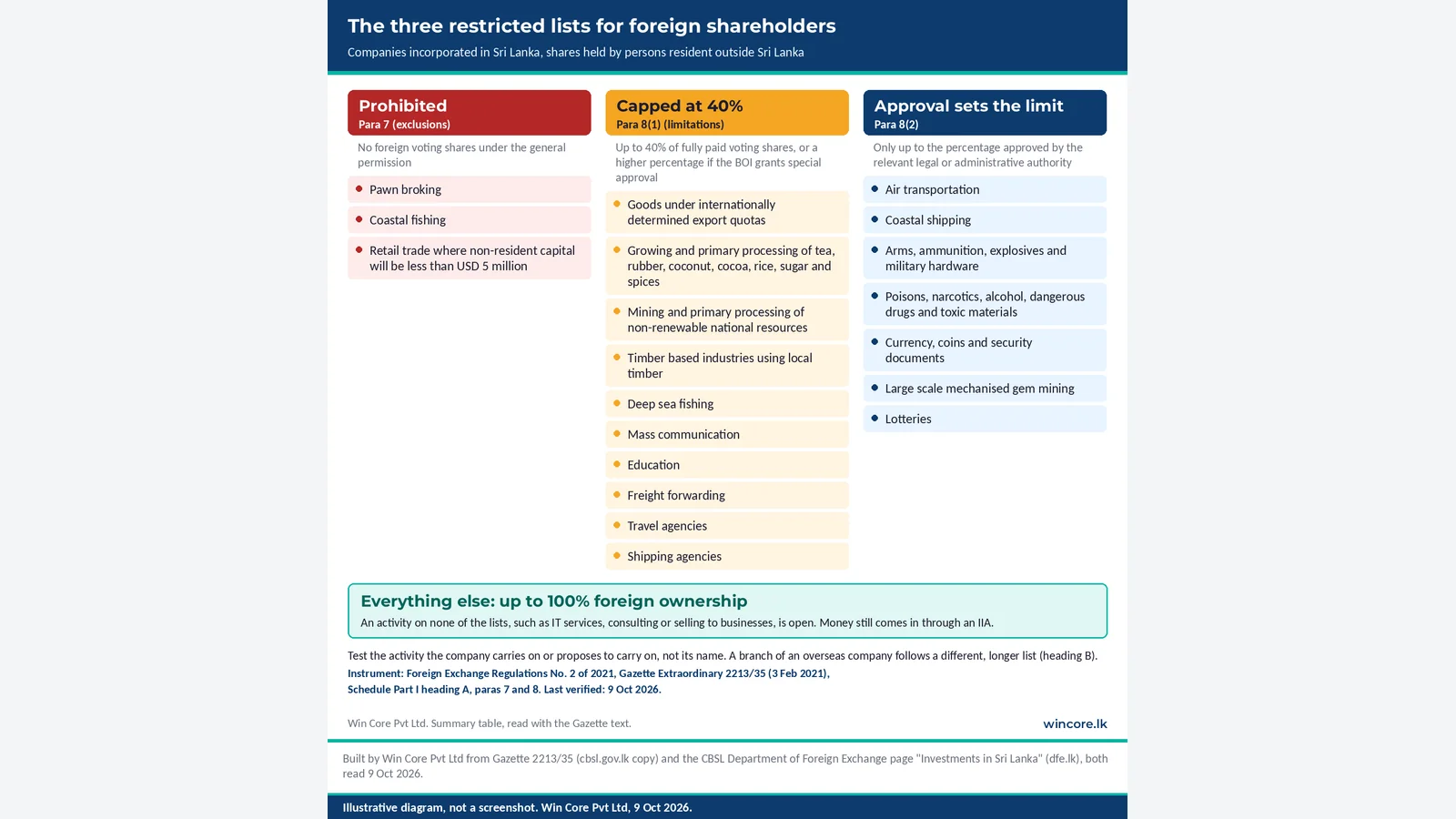
Most Sri Lankan companies can be 100 percent foreign owned. The three restricted lists in Gazette 2213/35, the retail test and the BOI route.
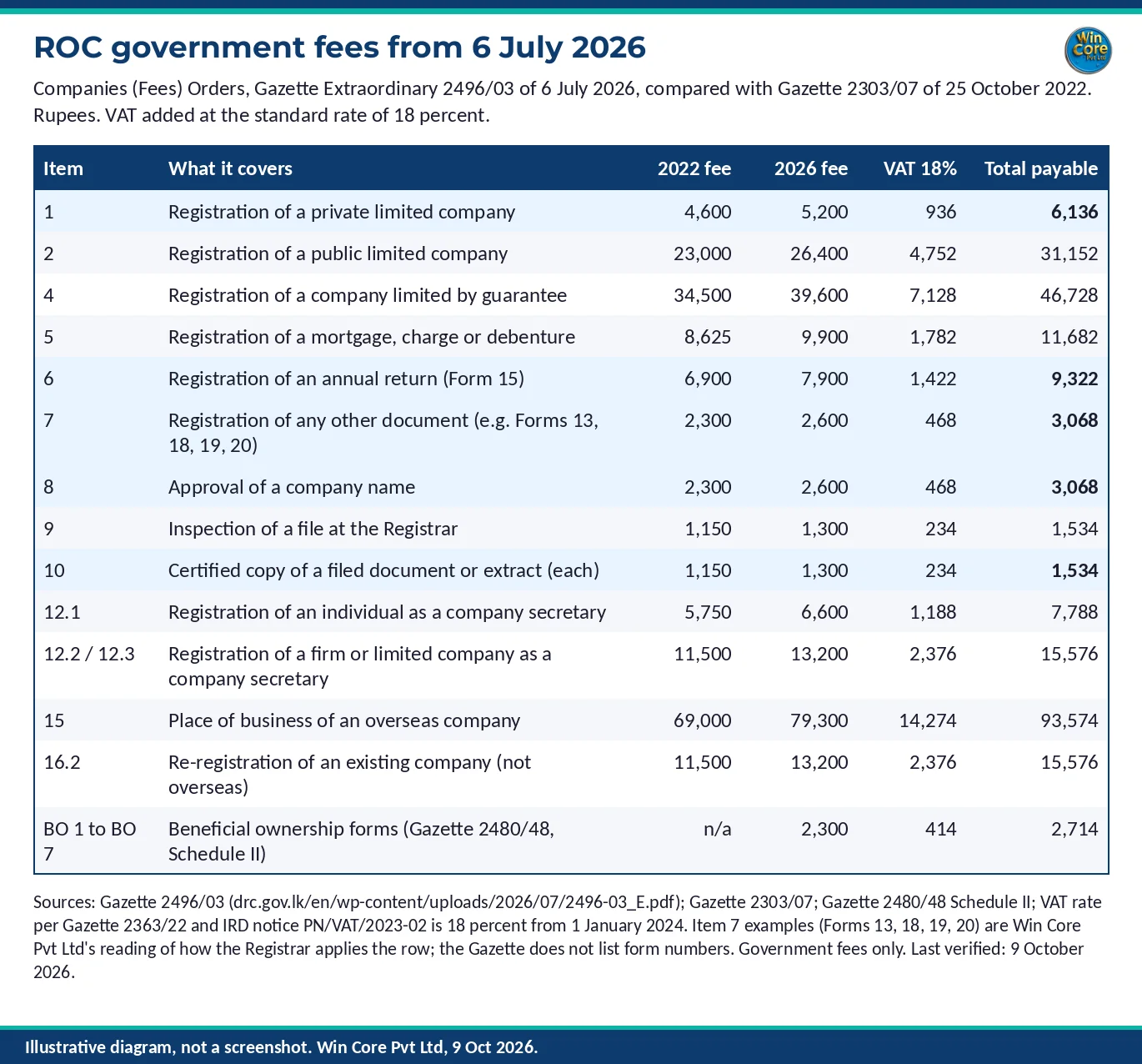
Every Registrar of Companies fee from 6 July 2026 with VAT added, and worked costs for an incorporation, a late Form 15 and a secretary change.
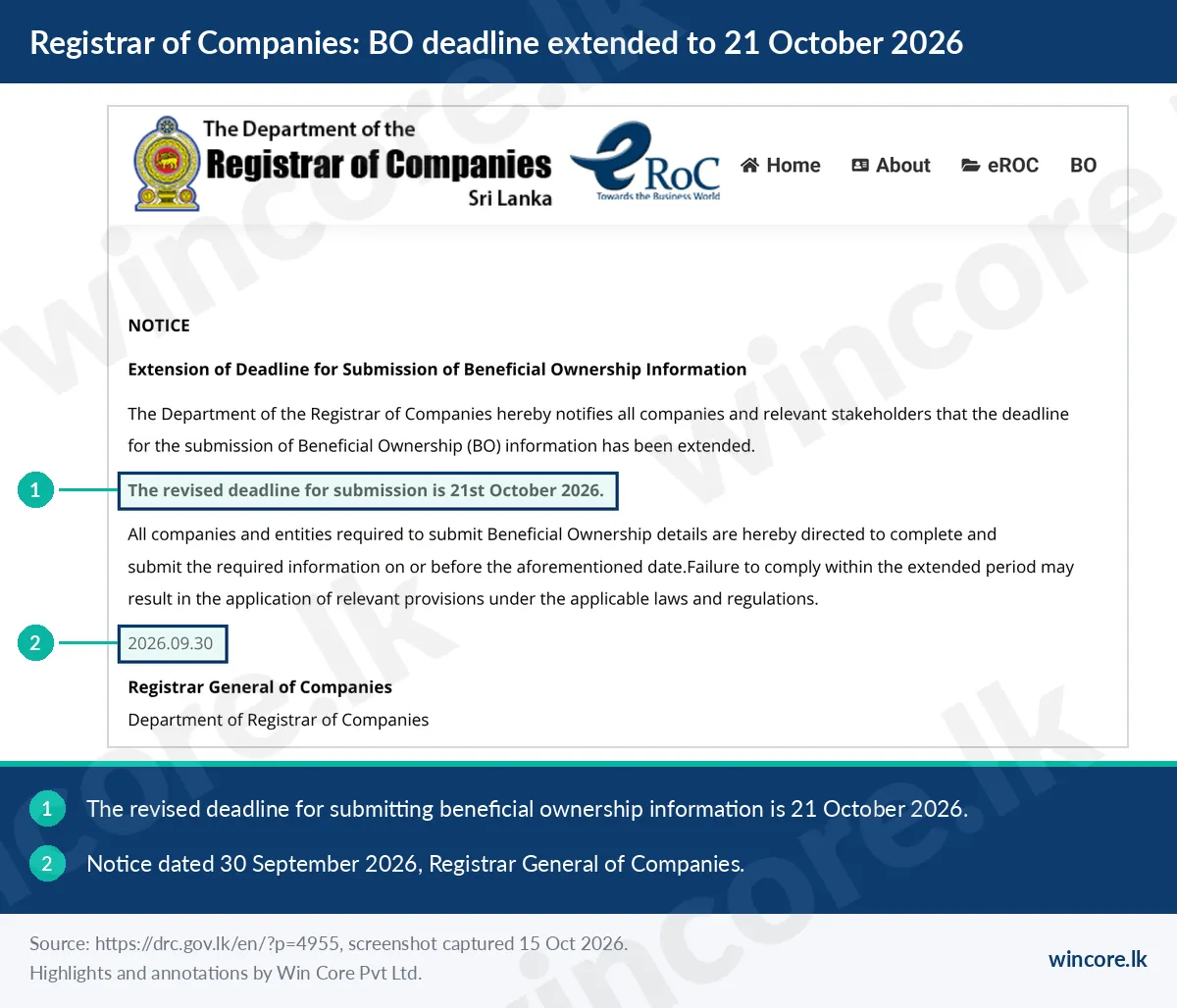
Who counts as a beneficial owner at 10 percent, the forms in the October 2026 regulations, and what existing companies face after the 21 October deadline.